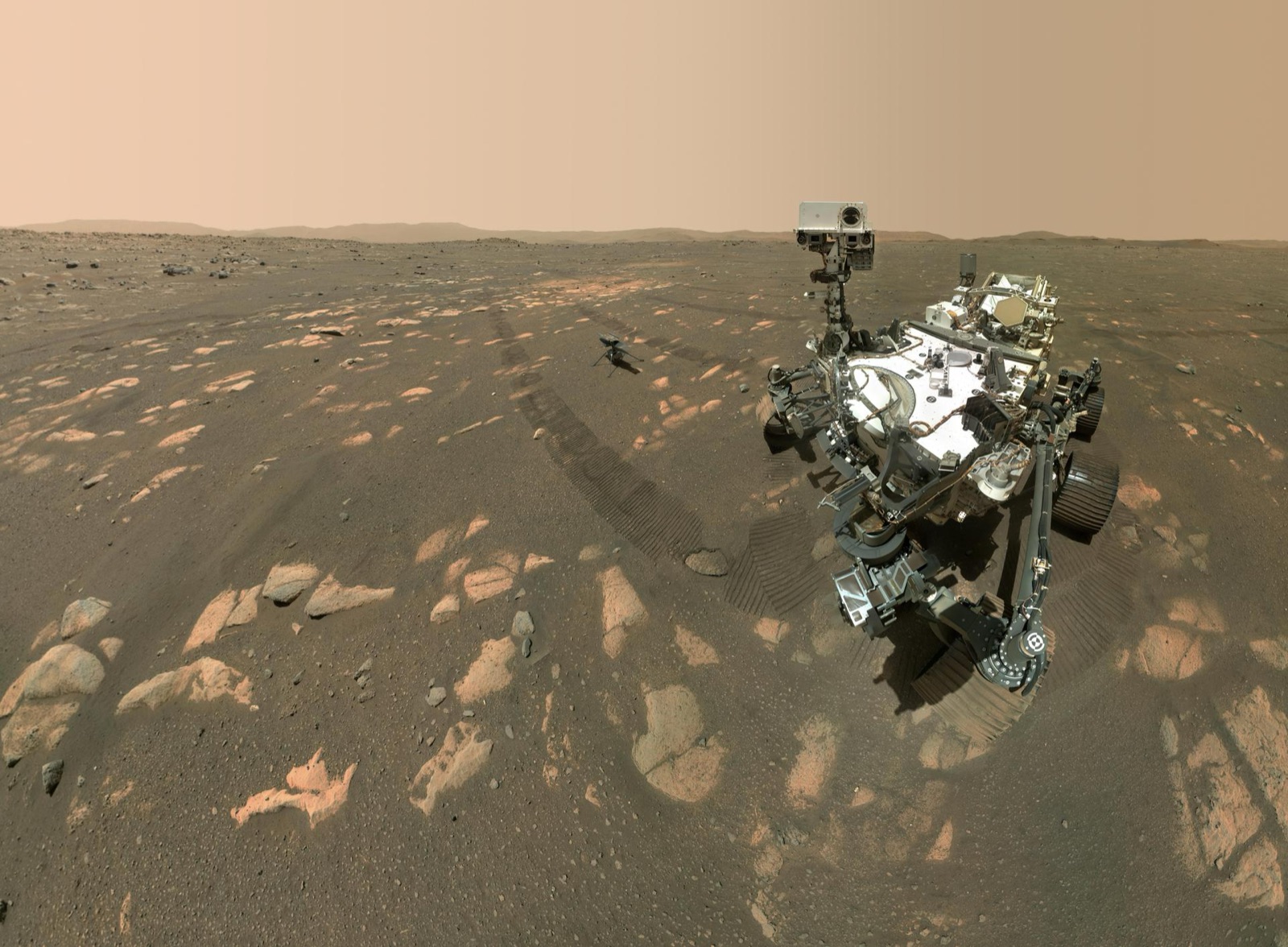
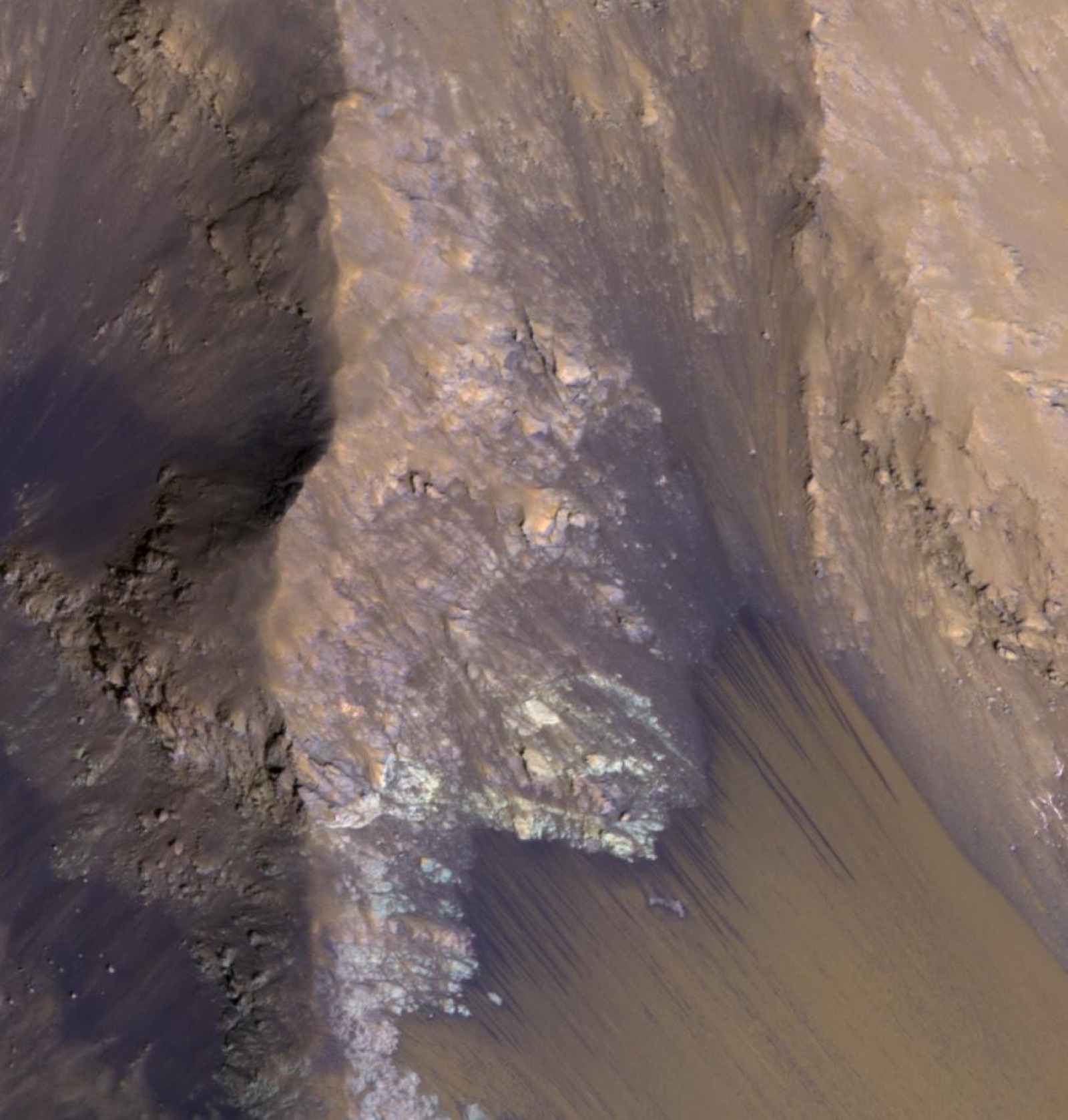
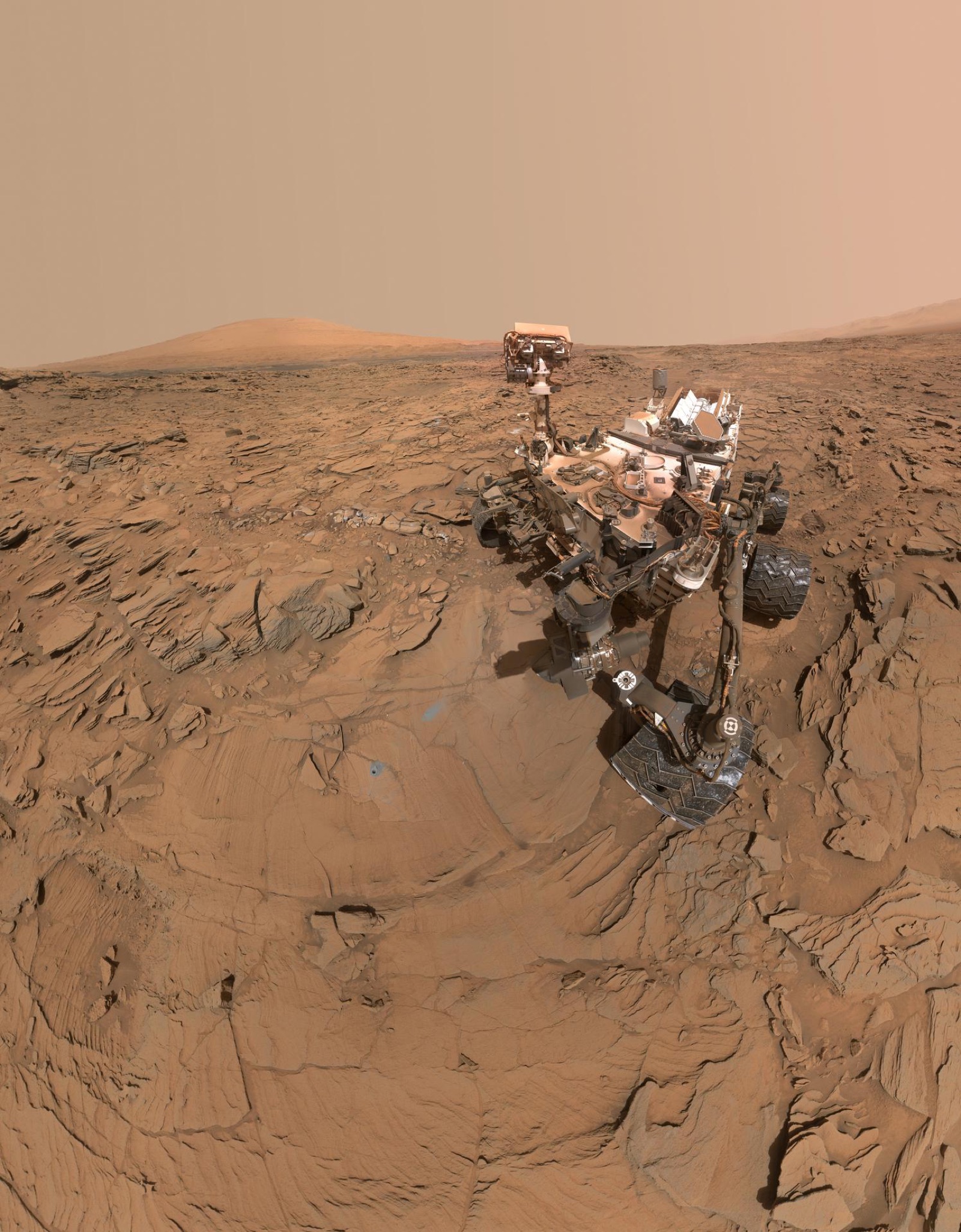
 Photograph · NASA/JPL-Caltech/MSSS
Spacecraft · Deep guide
Curiosity
The rover that proved Mars was habitable. After a decade+, it is still climbing its mountain.
What is it?
Curiosity landed in Gale Crater in August 2012 and settled the biggest question of its era within months: ancient Mars was habitable. It found an old lakebed with neutral water, all of life's key elements, and chemical energy — a place where microbes, had they existed, could have lived. Thirteen years on, it is still climbing Mount Sharp, reading the layers where Mars's climate dried out.
Go deeper
Curiosity's Sample Analysis at Mars lab detected complex organics in 3.5-billion-year-old mudstones and a seasonal methane cycle (background ppb levels with spikes) that remains genuinely unexplained — geological serpentinization and biological sources both fit; ESA's Trace Gas Orbiter's failure to see methane from orbit deepens the puzzle. Its RTG power declines gracefully; wheel damage from early sharp-rock terrain is managed by routing. Gale's strata record the global wet-to-dry transition — Curiosity is driving up through the chapters of Mars losing its water.
01 Habitable vs inhabited
Curiosity was built to ask 'COULD Mars have supported life?' — and answered yes, definitively. 'DID it?' is a different, harder question needing better instruments or returned samples. The distinction sounds pedantic and is everything: habitability is chemistry; inhabitation is history.
The deep dive
Researched for the Atlas from Wikipedia — Curiosity (rover) (37,612 characters read) · updated Sep 20, 2026
02 A name chosen by a 12-year-old from Kansas
The rover did not arrive at its name through a committee of scientists or a NASA branding exercise. A nationwide contest drew more than 9,000 proposals submitted by students across the United States, and the winner was Clara Ma, a twelve-year-old at Sunflower Elementary School in Lenexa, Kansas. Her prize was a trip to NASA's Jet Propulsion Laboratory in Pasadena, California, where she did something no other contest winner had done before: she signed her name directly onto the rover while it was still being assembled on the workshop floor. Her winning essay described curiosity as "an everlasting flame that burns in everyone's mind" and "the passion that drives us through our everyday lives." That signature now sits on the surface of Mars, permanently bonded to the vehicle. More than 1.2 million additional names from the international public were etched onto a silicon chip using an electron-beam machine and mounted on Curiosity's deck, traveling with it on the 560-million-km journey to Gale crater.
03 The sky crane: landing on a 20-metre leash
Every previous NASA Mars rover was encased in airbags that bounced across the surface until it rolled to a stop. Curiosity was far too heavy for that approach, tipping the scales at 899 kg (1,982 lb), roughly the weight of a small car. Engineers devised a system called the sky crane, in which a rocket-powered descent stage lowered the rover on a 20 m (66 ft) tether while hovering above the surface. Curiosity was actively switched on and operational as it descended, unlike its predecessors. When its wheels touched down, the rover waited two seconds to confirm it had reached solid ground, then fired pyrotechnic fasteners to cut the bridle cables. The descent stage immediately flew away and crashed at a safe distance. The entire spacecraft at launch weighed 3,893 kg (8,583 lb), and Curiosity itself made up only 23 percent of that mass — the rest was the hardware needed to get it safely to the surface and then discard itself.
 ⤢
⤢
04 Nuclear power in a plutonium-fuelled generator Deeper
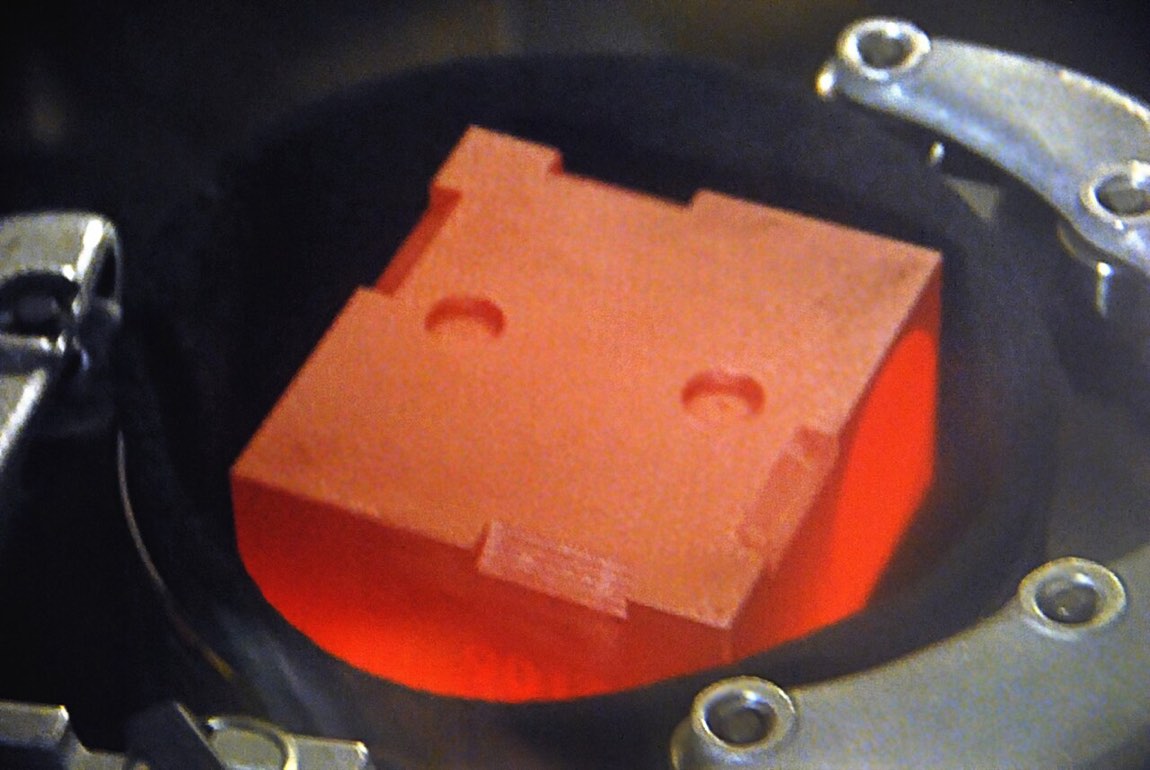
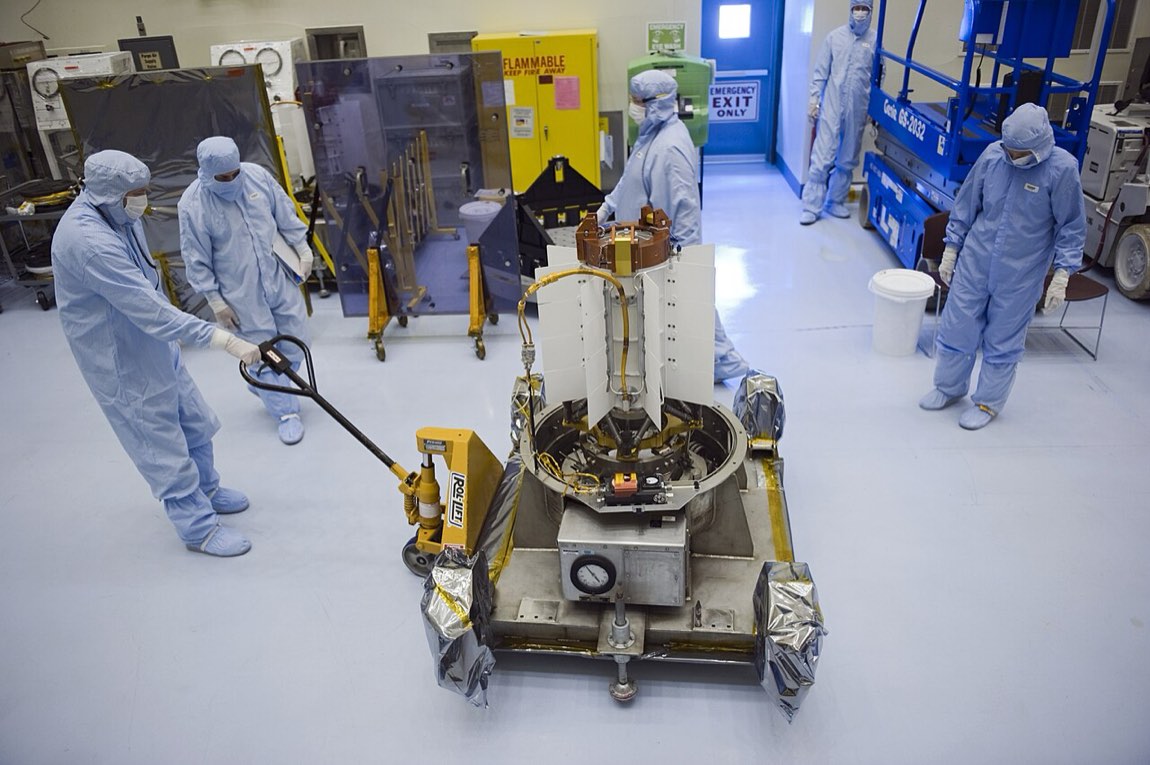
Curiosity does not rely on sunlight. Its Multi-Mission Radioisotope Thermoelectric Generator (MMRTG), designed and built by Rocketdyne and Teledyne Energy Systems and fuelled at the Idaho National Laboratory, contains 4.8 kg (11 lb) of plutonium-238 dioxide supplied by the U.S. Department of Energy. Plutonium-238 is not fissile — it does not explode — but its steady radioactive decay releases heat, which thermocouples convert directly into electricity. At the start of the mission the MMRTG produced 110 watts of electrical power and about 2,000 watts of thermal power, generating 9 MJ (2.5 kWh) of electrical energy each day. For comparison, the solar-powered Mars Exploration Rovers managed only about 2.1 MJ (0.58 kWh) per day. Because plutonium-238 decays continuously, output drops over time: at the generator's minimum rated lifetime of 14 years, electrical output falls to 100 watts. Waste heat from the generator is not wasted — fluid pumped through 60 m (200 ft) of tubing inside the rover body carries thermal energy to keep sensitive electronics warm during the brutal Martian nights, reducing the electrical load needed for heaters.
05 Seventeen cameras and a laser that reads rocks
Curiosity carries 17 cameras in total: eight hazard-avoidance cameras (Hazcams), four navigation cameras (Navcams), two MastCam imagers, one Mars Hand Lens Imager (MAHLI), one Mars Descent Imager (MARDI), and one ChemCam imager. The most dramatic instrument may be ChemCam, developed jointly by the French CESR laboratory and Los Alamos National Laboratory. It fires between 50 and 75 pulses of a 1067 nm infrared laser at a rock target up to 7 m (23 ft) away, each pulse lasting just 5 nanoseconds, vaporizing a pinprick of material. The resulting flash of plasma glows with wavelengths characteristic of the elements present, and ChemCam records up to 6,144 different wavelengths between 240 nm and 800 nm to identify what the rock is made of — all without touching it. The first target on Mars was a rock called N165, nicknamed "Coronation," tested on August 19, 2012, just days after landing. On a typical day the ChemCam team aims to take approximately one dozen compositional measurements.
06 Wheels that write Morse code in the dust
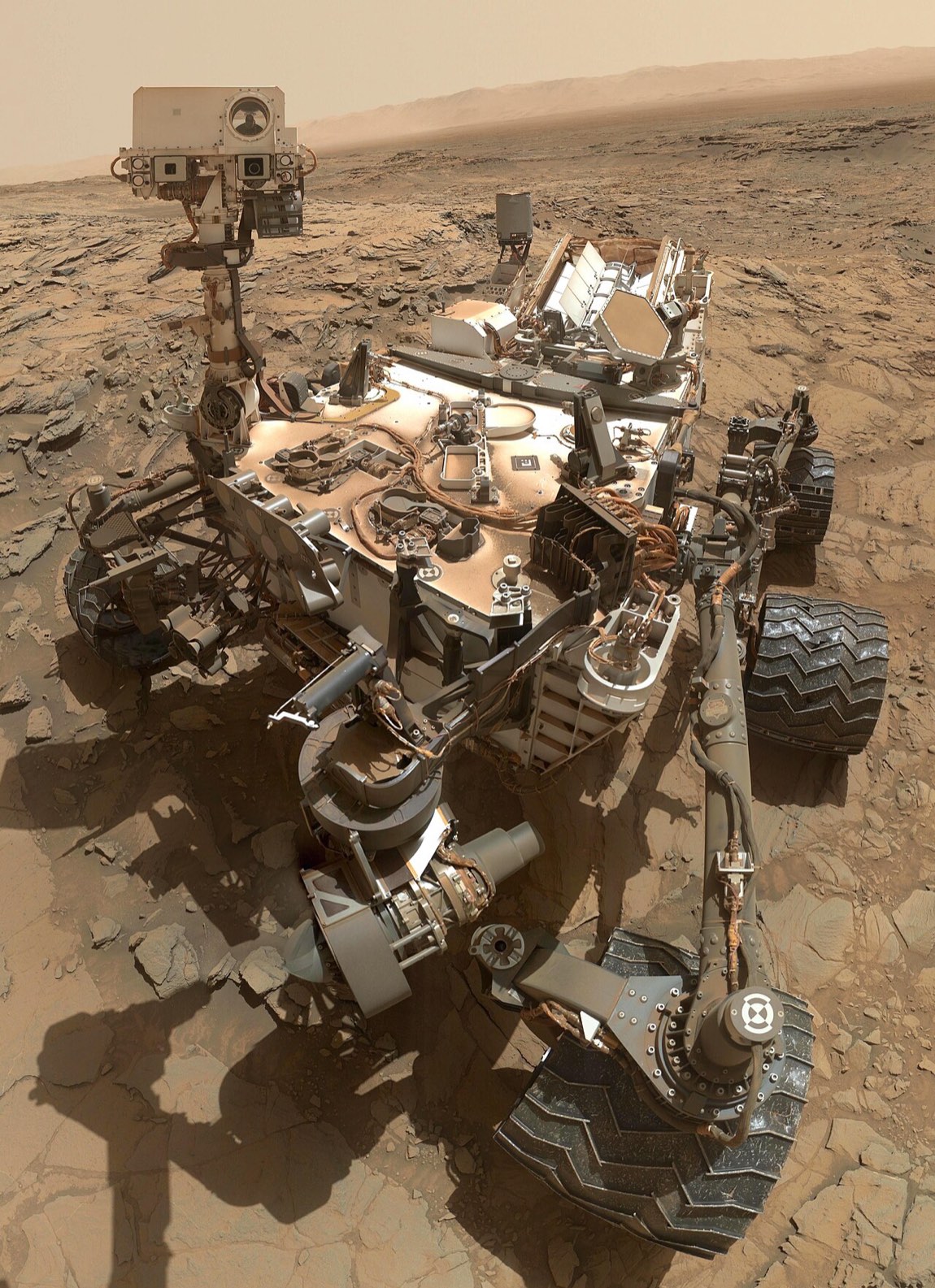
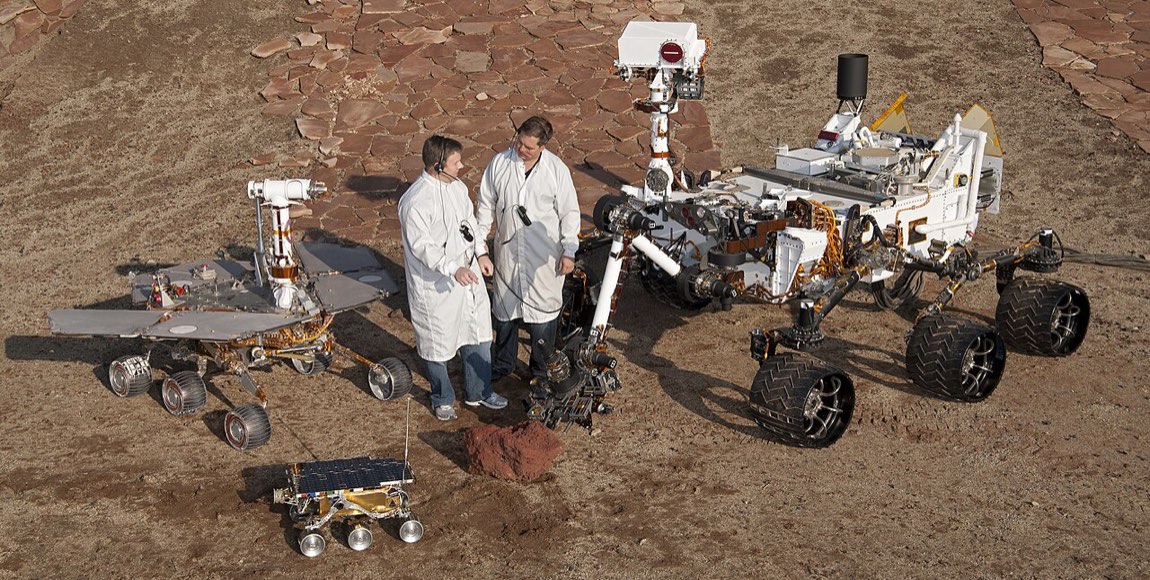
Curiosity rolls on six aluminium wheels, each 50 cm (20 in) in diameter, mounted in a rocker-bogie suspension that also served as the landing gear when the sky crane set the rover down. Each wheel is independently motorised and steered, so the rover can spin in place or carve wide arcing turns. The front and rear wheels steer independently, giving the vehicle remarkable flexibility on broken terrain. The rover can climb obstacles up to 65 cm (26 in) high and handle slopes up to 12.5° on sand dunes, while automatic tilt sensors prevent it from exceeding a 30° lean even though its centre of mass could tolerate at least 50°. The wheel treads leave a distinctive pattern in Martian soil that on-board cameras use to estimate distance travelled. That pattern is Morse code for "JPL" — dots and dashes for ·--- ·--· ·-·· — chosen after NASA declined to permit the letters "JPL" to appear as plain text on the wheels. After six years of use, the wheels showed visible punctures and tears from the sharp Martian rocks.
 ⤢
⤢
07 Gale crater: a 3.5-billion-year geological archive Deeper
Curiosity did not land just anywhere. Gale crater is estimated to be between 3.5 and 3.8 billion years old, formed by a massive impact into ancient Martian crust. Scientists believe the crater was gradually filled with sediment — first deposited by water, then by wind — possibly until it was entirely buried. Subsequent wind erosion then stripped much of that infill away, leaving behind an isolated mountain 5.5 km (3.4 mi) tall at the crater's centre: Aeolis Mons, informally called Mount Sharp. Because those layered sediments represent roughly two billion years of Martian history stacked on top of one another, the rover has the opportunity to drive uphill through time, reading older chapters at the base and younger ones higher up. The crater itself is 154 km (96 mi) wide. Curiosity landed about 10 km (6.2 mi) from the mountain's base and its primary mission called for traversing a minimum of 19 km (12 mi). By January 2025, the rover had climbed more than 740 m (2,430 ft) in elevation from its landing site.
08 Organic molecules locked in billion-year-old rock Deeper
One of the most significant scientific returns from Curiosity has been the detection of organic molecules — carbon-bearing compounds that are the chemical building blocks associated with life — preserved in ancient Martian rock. Drill samples taken in 2015 and analysed in 2018 revealed benzene and propane in rock approximately 3 billion years old. In March 2024, researchers published the discovery of long-chain alkanes containing up to 12 consecutive carbon atoms in mudstone within Gale crater. In April 2026, scientists announced the detection of benzothiophene and benzene rings with amine groups, along with other DNA precursors, in a sample collected in 2020, likely sourced from meteorites. The Sample Analysis at Mars (SAM) instrument suite has identified over 20 organic molecules from clay-bearing sandstones in the roughly 3.5-billion-year-old Knockfarrill Hill member of the Glen Torridon region. In every case, the origin of these molecules remains genuinely open: they could be exogenous, arriving via meteorites or interplanetary dust, or they could be endogenous products of abiotic chemistry or, speculatively, biological processes.
09 Reading the weather on another world
Curiosity carries the Rover Environmental Monitoring Station (REMS), a meteorological package that measures humidity, pressure, air and ground temperature, wind speed, and ultraviolet radiation at the Martian surface. The investigation team is led by Javier Gómez-Elvira of the Spanish Astrobiology Center, with a UV sensor provided by the Spanish Ministry of Education and Science and the Finnish Meteorological Institute as a partner. Sensors are distributed across two booms on the rover's mast and a UV assembly on the top deck, with control electronics inside the warm body of the rover. REMS data feeds into scientists' understanding of Martian general circulation patterns, micro-scale weather systems, the local water cycle, and the destructive potential of ultraviolet radiation at the surface — radiation levels that bear directly on whether anything could survive in the shallow subsurface. Because Curiosity has been collecting these measurements for over a decade, it provides one of the longest continuous surface weather records ever assembled for another planet.
 ⤢
⤢
10 How Curiosity talks to Earth from 14 minutes away
Radio signals between Earth and Mars take an average of 14 minutes and 6 seconds each way, which means every command and every reply crosses a gap that makes real-time control impossible. Curiosity carries two types of communication hardware: an X-band transmitter for direct links to Earth, and a UHF Electra-Lite software-defined radio for relaying through Mars orbiters. Direct transmission to Earth tops out at 32 kbit/s, but the bulk of science data travels through the Mars Reconnaissance Orbiter at up to 2,000 kbit/s and through the Odyssey orbiter at up to 256 kbit/s — though each orbiter can only communicate with Curiosity for roughly eight minutes per day, just 0.56 percent of the time. NASA's Jet Propulsion Laboratory serves as the central hub for both receiving data and sending commands upward, with scientists distributed at their home institutions around the world. As of February 2019, the MAVEN orbiter was also being positioned to serve as an additional relay while continuing its own science mission.
11 The radiation environment no instrument had measured before Deeper
Before Curiosity launched, no spacecraft had ever measured the radiation environment from inside a spacecraft travelling through interplanetary space. The Radiation Assessment Detector (RAD), developed by Southwest Research Institute and the extraterrestrial physics group at Christian-Albrechts-Universität zu Kiel in Germany, and funded jointly by NASA and Germany's space agency DLR, was built specifically to fill that gap. During the cruise phase and after landing in August 2012, RAD characterised the broad spectrum of radiation that any future human traveller or Martian surface organism would face. Its primary practical purpose is to determine how much shielding human explorers would need, both during the journey to Mars and while living and working on the surface. The DAN instrument complements this picture from a different angle: using a 14.1 MeV pulsing neutron generator, it measures the quantity and depth of hydrogen, water ice, and liquid water at or just below the Martian surface, data directly relevant to both habitability and resource planning for future crews.
12 A $3.2 billion mission that keeps running
Curiosity's original mission was two Earth years. In December 2012, before that period was even complete, NASA extended the mission indefinitely — a recognition that the rover and its instruments remained healthy and the scientific return was too valuable to switch off. Adjusted for inflation, the rover's life-cycle cost stands at US$3.2 billion in 2020 dollars, slightly higher than the US$2.9 billion life-cycle cost of its successor Perseverance, which launched in 2021. The design proved so successful that Perseverance was built on the same rover chassis, though it carries an entirely different instrument payload. Some spare parts fabricated during Curiosity's construction and ground testing were reused in the new vehicle. The NASA/JPL Mars Science Laboratory team was awarded the 2012 Robert J. Collier Trophy by the National Aeronautic Association for "significantly improving humanity's understanding of ancient Martian habitable environments." As of September 20, 2026, Curiosity had been active on Mars for 5,020 sols — the equivalent of 14 years and 45 days.
 ⤢
⤢
13 Twin rovers that stay home to solve problems
When something goes wrong on Mars, engineers cannot simply walk over and take a look. To simulate fixes before sending commands across 14 light-minutes of space, JPL maintains two full-sized copies of Curiosity at its Mars Yard test facility in California. One twin, called MAGGIE (Mars Automated Giant Gizmo for Integrated Engineering), has a full computer brain and can be driven and operated just as the real rover is. The other, called Scarecrow, has no computer and is used for purely mechanical testing of mobility and hardware. Both were built to the same specifications as the flight vehicle and are driven over simulated Martian terrain to rehearse manoeuvres and diagnose faults. This approach proved its value when the drill mechanism suffered an intermittent electrical short beginning in early 2015, a full malfunction in December 2016, and eventually a complete suspension of drilling for over a year, before operations resumed on May 22, 2018. The test beds allowed engineers to work through solutions on Earth before committing any change to the real rover on Mars.
14 First X-ray mineralogy of Martian soil Deeper
On October 17, 2012, at a sandy patch named Rocknest, Curiosity performed the first X-ray diffraction analysis ever conducted on Martian regolith. The instrument responsible, CheMin (Chemistry and Mineralogy), was developed by David Blake at NASA Ames Research Center and won the 2013 NASA Government Invention of the Year award. CheMin directs a beam of X-rays at powdered samples delivered by the rover's drill or scoop; the crystal structure of each mineral deflects the beam at characteristic angles, producing a pattern that uniquely identifies what is present. The Rocknest results revealed feldspar, pyroxenes, and olivine, and suggested the soil resembled the weathered basaltic soils found near Hawaiian volcanoes. Subsequent analyses found carbonates in the form of crystalline siderite (FeCO3), with one rock containing more than 10 percent of that mineral. Other rocks contained plagioclase with sodium, calcium, and aluminium; calcium- and magnesium-bearing pyroxene; calcium sulfates; magnesium sulfates; and varying amounts of iron oxyhydroxides. The mineralogical picture that has emerged shows a surface that was once chemically active in the presence of water.
Weird & wonderful
- Curiosity sang 'Happy Birthday' to itself on its first landing anniversary — by vibrating a sample tray.
- It vaporizes rocks with a laser and reads the flash — a million zaps and counting.
- Its landing was so wild NASA's own engineers nicknamed the video 'Seven Minutes of Terror.'