- Surface temperature
- 5,500 K
- Radius
- 10 × the Sun
- Luminosity
- 89.8 × the Sun
- Spectral type
- B0Ib
Cataloged star · Database record + computed analysis
Cygnus X-1
HIP 98298 · HD 226868
A real star from the HYG catalog in the constellation Cygnus.
B-type: blue-white powerhouse
Its spectral type is B0Ib: hot (10,000–30,000 °C), luminous and fast-burning: the searchlights of young star regions. From its measured color, its surface temperature is roughly 5,501 K (5,228 °C), an estimate computed from the catalog's color index.
How far away is it?
It lies about 1,941 light-years away (595.2 parsecs, from its measured parallax). The light reaching Earth tonight left it around the year 84.
How powerful is it?
Its computed luminosity is about 89.8 times the Sun's output (derived from its brightness and distance).
Can you see it?
At apparent magnitude 8.84, it is invisible to the naked eye, though binoculars will show it. It favors northern observers.
It varies
This is a catalogued variable star (V1357): its brightness measurably changes over time, whether by pulsation, eclipses in a double system, or surface activity.
Everything above is computed from the catalog’s measured values for this star. Where a value is missing, the statement is omitted rather than guessed.
The deep dive
Researched for the Atlas from Wikipedia — Cygnus X-1 (22,543 characters read) · updated Sep 20, 2026
01 Two rockets that changed astronomy
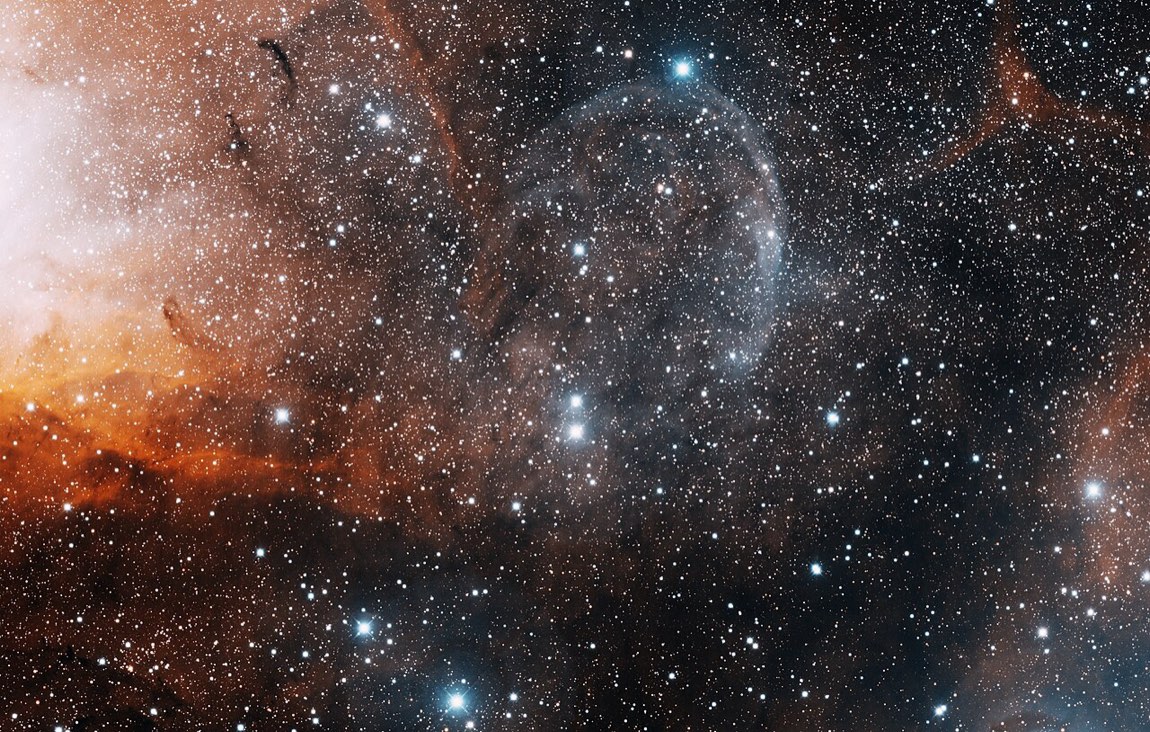
The discovery of Cygnus X-1 came not from a grand observatory but from a pair of small sounding rockets launched from White Sands Missile Range in New Mexico. In 1964, two Aerobee suborbital rockets carried Geiger counters aloft to measure X-ray emission in the wavelength range of 1 to 15 ångströms across an 8.4-degree section of sky. As the rockets rotated, their instruments swept across the heavens producing overlapping scans — a crude but effective mapping technique. From that survey, eight new cosmic X-ray sources were identified, one of them catalogued as Cyg XR-1, later renamed Cygnus X-1. At the time, nobody flagged anything especially remarkable at its estimated position of right ascension 19h53m and declination 34.6°. No prominent radio or optical source was obvious there. The discovery only became scientifically electric years later, once longer follow-up observations revealed the violent, rapid flickering that pointed toward something extraordinarily compact lurking in that patch of Cygnus. The rockets themselves were a stopgap — the atmosphere blocks X-rays entirely, so any observation at all required getting instruments above most of the air, even briefly.
02 Uhuru and the flickering source
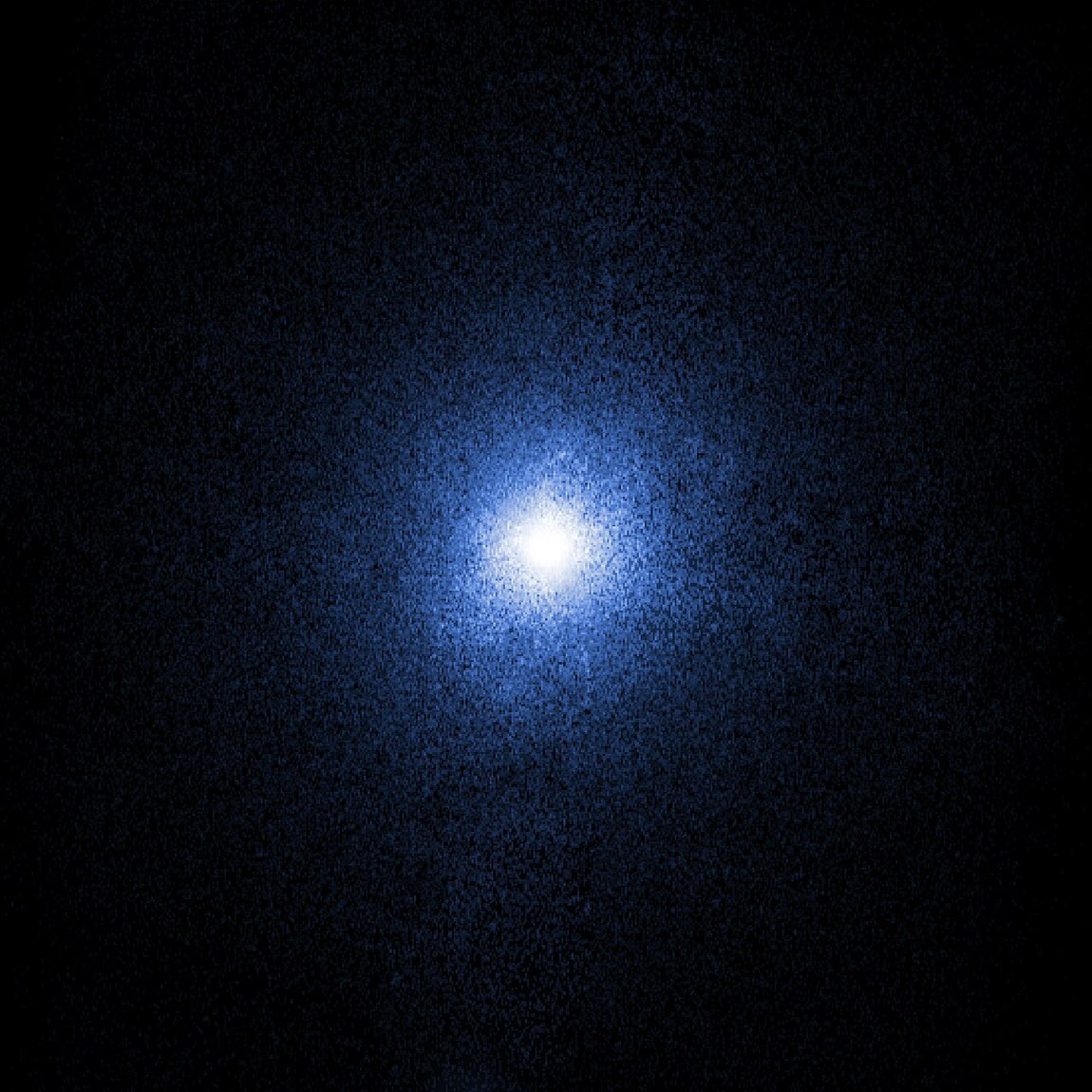
The sounding-rocket detection was a beginning, not an answer. Riccardo Giacconi and Herb Gursky recognised as early as 1963 that genuine X-ray astronomy needed an orbiting satellite capable of watching sources for hours at a time rather than minutes. NASA's Uhuru satellite, launched in 1970, delivered exactly that. Among its broader haul of 300 newly detected X-ray sources, Uhuru gave astronomers their first extended look at Cygnus X-1, and what it showed was startling: the X-ray intensity flickered several times per second. That rapid variation imposed a hard physical limit on the size of the emitting region. Because no signal can travel faster than light, a source that changes coherently in a fraction of a second can be no larger than the distance light covers in that time — working out to roughly 100,000 km, approximately the size of Jupiter. Something of planetary dimensions was pouring out X-rays bright enough to be measured across 7,000 light-years of space. Later measurements pushed the variability down to a single millisecond, shrinking the implied source region even further and making the black-hole interpretation essentially unavoidable.
 ⤢
⤢
03 The radio signal that named the culprit
For years after the initial discovery, nobody knew precisely which object in Cygnus was responsible. The breakthrough came in April and May of 1971, when two independent teams detected radio emission from the source. Luc Braes and George K. Miley at Leiden Observatory made the detection, as did Robert M. Hjellming and Campbell Wade at the National Radio Astronomy Observatory — each group working without knowledge of the other's efforts. Radio waves can be pinpointed far more precisely than the crude Geiger-counter X-ray maps allowed, and the accurate radio position pointed directly at a catalogued star: AGK2 +35 1910, also known as HDE 226868. On the celestial sphere it sits about half a degree from the fourth-magnitude star Eta Cygni. Within a year, Louise Webster, Paul Murdin, and independently Charles Thomas Bolton had measured the Doppler shift of HDE 226868's spectral lines, proving that the star was orbiting an unseen, massive companion — one too heavy to be a neutron star. By the end of 1973, the astronomical community had broadly accepted Cygnus X-1 as the most credible black-hole candidate known.
04 Inside the accretion disk: fire and friction Deeper
The black hole itself emits nothing, but the disk of gas spiralling into it is among the most energetic environments in the galaxy. Ionised gas in faster inner orbits grinds against slower outer orbits, generating intense frictional heating that turns the inner disk into a plasma. Cygnus X-1 is typically the brightest persistent source of hard X-rays — those with energies from roughly 30 up to several hundred kiloelectronvolts — in the entire sky. Lower-energy photons born in the thin inner disk gain additional energy through Compton scattering off extremely hot electrons in a geometrically thicker, nearly transparent corona that envelops the inner disk; some X-rays are also reflected back from the disk's own surface. The corona is not a permanent fixture: in the less common soft state, the disk may draw as close as 150 km to the compact object, cooling or ejecting the corona entirely, before a new one regenerates and the system transitions back to the hard state. An alternative model holds that Compton scattering occurs at the base of a jet rather than in a corona — a debate not yet settled. The outer disk extends to an estimated 500 times the Schwarzschild radius, or about 15,000 km, cooling and becoming less ionised with distance.
 ⤢
⤢
05 Jets darker than anything nearby Deeper
Cygnus X-1 launches a pair of relativistic jets — streams of particles fired roughly perpendicular to the accretion disk at a significant fraction of the speed of light. Unusually, these jets are described as inefficient radiators: they release only a small proportion of their energy as electromagnetic radiation, making them appear effectively dark. The estimated angle of the jets to our line of sight is 30°, and they may be precessing. One jet is ploughing into a relatively dense patch of the interstellar medium, carving out an energised ring detectable by its radio emission and apparently forming an optical nebula in the process. Powering that nebula requires the jet to sustain an estimated average output of 4 to 14 ×10³⁶ erg/s, which the article also expresses as (9±5)×10²⁹ watts — more than 1,000 times the total power radiated by the Sun. No corresponding ring appears on the other side because that counter-jet propagates into a lower-density region and encounters less resistance. In 2006, Cygnus X-1 became the first stellar-mass black hole found to produce gamma-ray emission above 100 GeV, observed simultaneously with a hard X-ray flare, suggesting the flare originated at the jet's base while the gamma rays were generated where the jet met HDE 226868's stellar wind.
06 HDE 226868: a star living dangerously
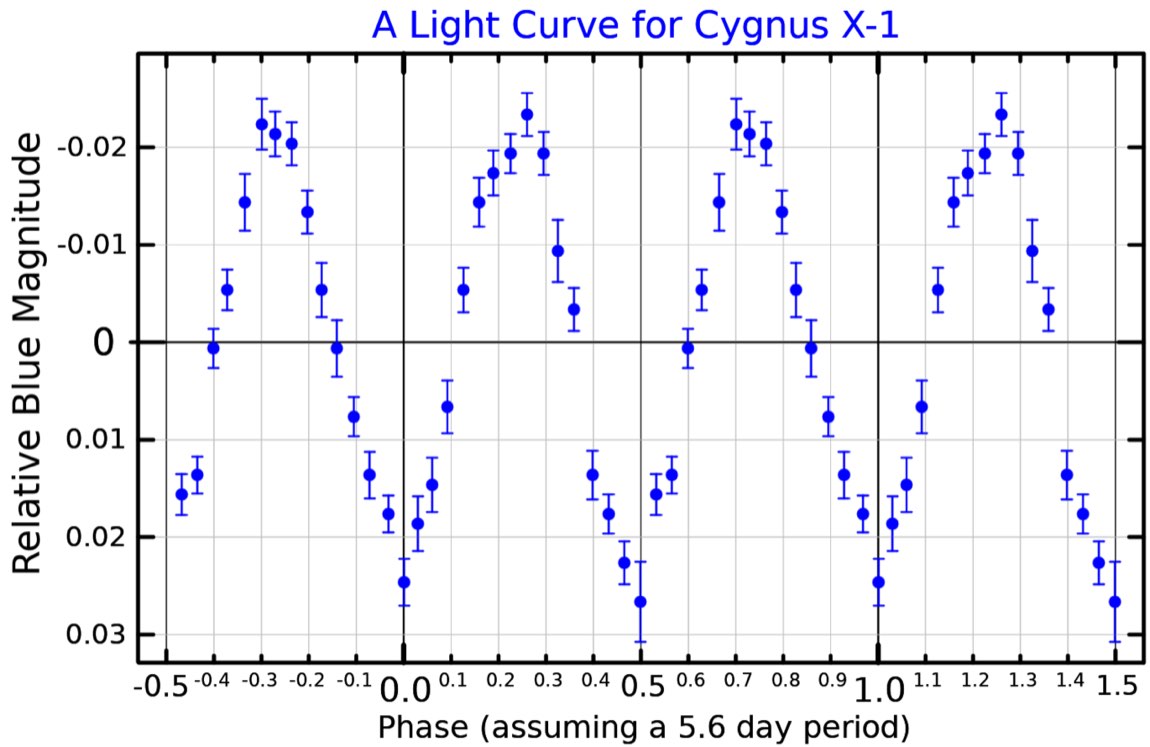
The visible half of the Cygnus X-1 system is a blue supergiant classified O9.7 Iab — right on the boundary between O-type and B-type stars — with a surface temperature of 31,000 K and a mass estimated between 20 and 40 times that of the Sun. At the estimated distance of 2,000 parsecs, its radius works out to about 15 to 17 times the solar radius, and it shines with 300,000 to 400,000 times the Sun's luminosity. That luminosity is partly responsible for the star's invisibility to casual observers: intervening gas and dust between Earth and HDE 226868 impose an interstellar extinction of 3.3 magnitudes. Without that obscuring material, HDE 226868 would be a fifth-magnitude star visible to the naked eye. Its companion black hole orbits at roughly 40 solar radii — only twice the star's own radius. That proximity distorts the stellar surface into a teardrop shape through tidal gravity and rotation, causing the star's optical brightness to vary by 0.06 magnitudes across the 5.6-day orbital period in what astronomers call an ellipsoidal light variation, driven by limb darkening and gravity darkening across the star's stretched surface.
 ⤢
⤢
07 A wind that feeds a monster Deeper
HDE 226868 continuously bleeds mass into space at an estimated rate of 2.5×10⁻⁶ solar masses per year — equivalently, one full solar mass lost every 400,000 years. Its ultraviolet and hydrogen-alpha spectral lines resemble those of the luminous variable star P Cygni, indicating that a gaseous envelope is being accelerated away from the stellar surface at speeds of about 1,500 km/s. Under ordinary circumstances this wind would expand spherically into space, but the gravitational pull of the black hole reshapes it into a focused, asymmetric geometry. X-rays from the inner accretion region heat and ionise the wind, altering its properties as the black hole moves through different wind densities during each 5.6-day orbit — a variation tracked in UV lines, radio emission, and X-ray flux simultaneously. The Roche lobe — the gravitational boundary within which material stays bound to the star — is believed to sit close to HDE 226868's surface without quite overflowing, so the stellar wind, rather than direct surface stripping, is the dominant mass-transfer mechanism. Comparing the star's spectrum to the similar star Alnilam reveals an overabundance of helium and a deficiency of carbon in HDE 226868's atmosphere, which may be a chemical signature of mass exchanged earlier in the system's history.
08 How a black hole might be born quietly
Reconstructing the origin of Cygnus X-1 requires working backwards from what exists today. The most massive main-sequence star currently in the Cygnus OB3 association weighs about 40 solar masses, and because more massive stars evolve faster, the progenitor of Cygnus X-1 must have been heavier still — more than 40 solar masses. Given that the black hole now sits at roughly 21 solar masses, the progenitor shed over 30 solar masses during its lifetime, most likely through a powerful stellar wind. It may have passed through a Wolf-Rayet phase, a class of star notorious for driving away enormous fractions of its own atmosphere. The key question is how the collapse ended. If the progenitor had exploded as a supernova, the asymmetric kick from the explosion would almost certainly have flung the remnant out of the binary system entirely, as seen in comparable objects. Because the black hole is still in orbit, the evidence points instead to a direct collapse — the stellar core falling inward without a dramatic explosion, or at most a modest one. This quiet death leaves no supernova remnant, no pulsar, and almost no record except the black hole itself now silently consuming its companion's wind.
 ⤢
⤢
09 Spin: from near-zero to 790 times a second Deeper
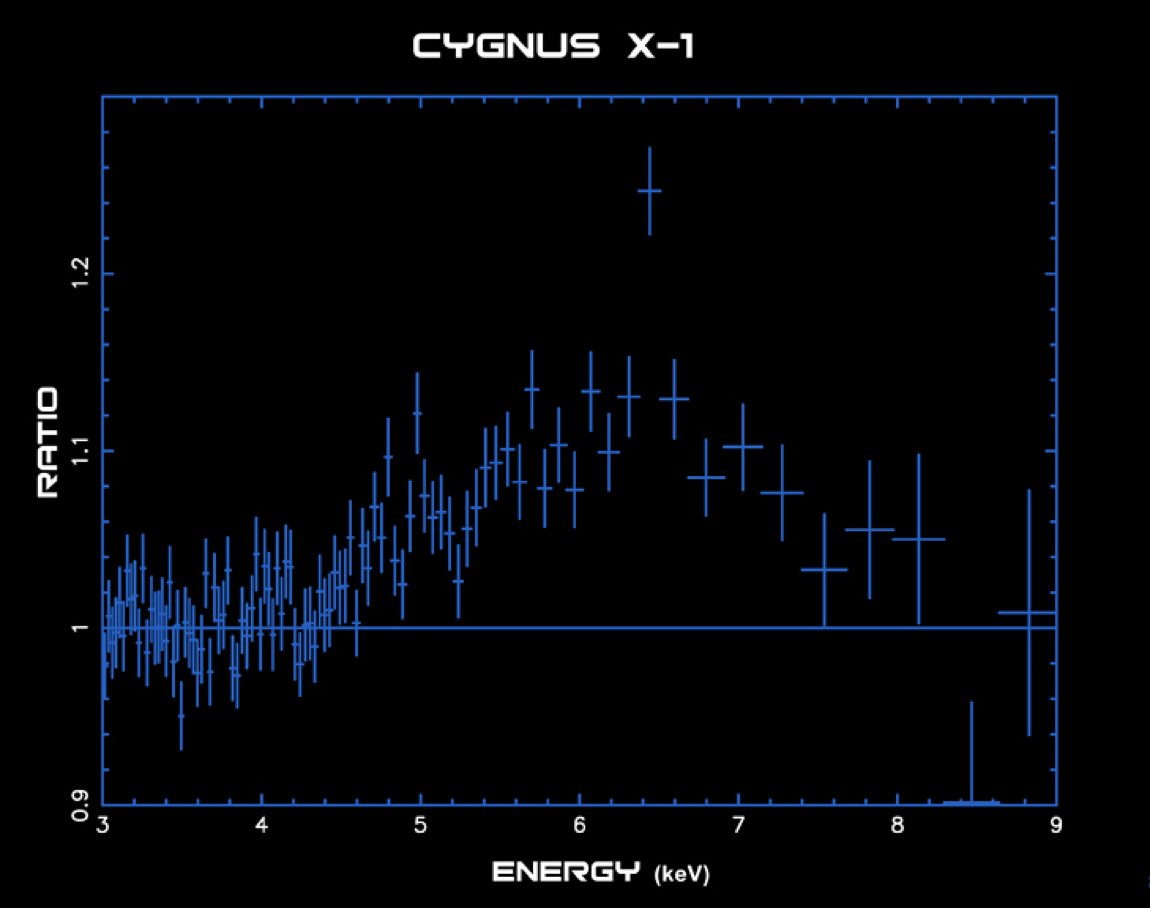
One of the most fundamental properties of a black hole — alongside its mass and electric charge — is its spin, and for Cygnus X-1 the story has changed dramatically over time. Early analysis of data from the Chandra X-ray Observatory suggested the object was not rotating to any significant degree. Then in 2011 new evidence was announced claiming the opposite: that Cygnus X-1 is rotating extremely rapidly, approximately 790 times per second. The article notes bluntly that the spin is "not yet well determined," which is a frank admission of how difficult it is to measure rotation in an object you cannot see directly. Measuring black-hole spin typically relies on fitting the X-ray spectrum of the inner accretion disk — where relativistic effects distort the emission profile — but the technique depends on other quantities, such as distance and inclination, that carry their own uncertainties. The no-hair theorem offers a useful contrast: it guarantees that a black hole's magnetic field is exactly aligned with its rotation axis and therefore static, which is why Cygnus X-1 has never shown the stable pulsations characteristic of a rotating neutron star's offset magnetic field.
10 Dying pulses and the event horizon Deeper
One of the most direct pieces of evidence for a genuine event horizon in Cygnus X-1 emerged from an elegant observation. As self-luminous clumps of matter spiral toward a black hole, general relativity predicts that the radiation they emit will be progressively redshifted — its wavelengths stretched longer and longer as the emitting material approaches the horizon. If the compact object had a solid surface instead, infalling matter would produce a final burst of radiation on impact. If there is a true event horizon, the signal should simply fade away, producing what observers call a dying pulse train. In 1992, ultraviolet observations with the High Speed Photometer on the Hubble Space Telescope captured exactly two such dying pulse trains. The results were announced in 2001. This behaviour is consistent with matter crossing an event horizon and being lost from the observable universe rather than striking a surface. It does not prove the event horizon exists — proving an absence is notoriously difficult — but it is the kind of evidence that the black-hole model uniquely predicts and that no alternative compact-object model straightforwardly explains.
11 Mass: a number that keeps being revised Deeper
Pinning down the mass of the Cygnus X-1 black hole has proved unexpectedly difficult, with different techniques producing results that don't always agree. Stellar evolutionary models have suggested roughly 20±5 solar masses, while other approaches returned about 10 solar masses. Measuring periodicities in the X-ray emission — quasi-periodic oscillations — yielded 14.8±1 solar masses. Measurements published in 2021 settled on 21.2±2.2 solar masses, a value that became the most widely cited estimate. Then a 2025 study introduced further revision, estimating 17.5 solar masses as a possible upper limit, with a second method from the same work yielding 13.8 solar masses. The spread across these figures — from roughly 10 to 21 solar masses — illustrates how each technique depends on different assumptions: orbital inclination, distance, the companion star's mass, and the geometry of the accretion disk all feed into the calculation. What none of the estimates dispute is that the object is far above the maximum mass for a neutron star, which cannot exceed three solar masses, making the black-hole identification secure even as the precise number remains in negotiation.
12 A system heading for merger in five billion years
Cygnus X-1 is not a static system frozen in its current configuration. The orbital eccentricity is only 0.018±0.002, making the black hole and its companion star's orbit nearly circular — a sign that any kick delivered at the black hole's formation was relatively gentle. The two objects complete one orbit every 5.599829 days, separated by a semi-major axis of about 0.2 AU, roughly the same as 20% of the Earth-Sun distance. Over time, as energy and angular momentum are radiated away, the system is expected to spiral inward and ultimately merge into a single black hole in approximately five billion years. The article notes that this merger may generate gravitational waves during the process — making Cygnus X-1 a potential, though distant, source of the same kind of ripples in spacetime detected from merging black-hole pairs by LIGO. The system's orbital plane is inclined to our line of sight at somewhere between 27° and 65°, with a 2007 study estimating 48.0±6.8°, and the inclination is significant enough that the black hole never passes behind HDE 226868 from Earth's perspective — the system does not eclipse.
13 Rock music and a spaceship named Rocinante
Cygnus X-1 has escaped the astronomy journals and entered popular culture in a handful of memorable ways. The Canadian progressive rock band Rush dedicated a two-part song series to the object. The first part, titled "Book I: The Voyage," closes their 1977 album A Farewell to Kings; the second, "Book II: Hemispheres," opens the 1978 album Hemispheres. The lyrics follow an explorer aboard a spaceship called Rocinante who travels toward the black hole believing something lies beyond it, finds the ship increasingly difficult to control as gravity tightens its grip, and is eventually pulled in. The 1979 Disney science-fiction film The Black Hole features a scientific survey ship named the Cygnus — captained by Dr. Hans Reinhardt — which the article notes is presumably named for Cygnus X-1, though the film never states this explicitly. And in a briefer nod, Season 7, Episode 10 of the animated series Futurama opens with the tagline "What Happens in Cygnus X-1 Stays In Cygnus X-1." Together these references reflect the object's unusual cultural weight: few individual astronomical sources outside the solar system have earned a named spacecraft, a concept album, and a punchline.
About this record
Data: the HYG stellar database v4.1 (Hipparcos + Yale + Gliese, CC BY-SA, © David Nash / astronexus). Want the full stories? Our deep star guides cover Sirius, Betelgeuse, Proxima Centauri, Vega and three dozen more. You can also browse the catalog or learn how stars live and die.