Astrophysics
The Lives of Stars
ConfirmedThe idea
A star's life is a long argument between gravity squeezing in and fusion pushing out. Its mass decides everything. Small red dwarfs sip fuel for trillions of years. Sun-like stars live ten billion, swell into red giants, and retire as white dwarfs. The heaviest stars burn savagely for mere millions of years and exit as supernovae, leaving neutron stars or black holes.
Go deeper Advanced
Stars assemble along the main sequence, where they spend ~90% of life; the H-R diagram of luminosity vs temperature is the field's master map. Core hydrogen exhaustion triggers shell burning and expansion; degenerate cores set the white-dwarf (1.4 M☉ Chandrasekhar) and neutron-star (~2–3 M☉) limits. Every element in your body heavier than helium came from these lives and deaths.
The deep dive
Researched for the Atlas from Wikipedia — Stellar evolution (30,826 characters read) · updated Sep 20, 2026
01 How astronomers study stars across time
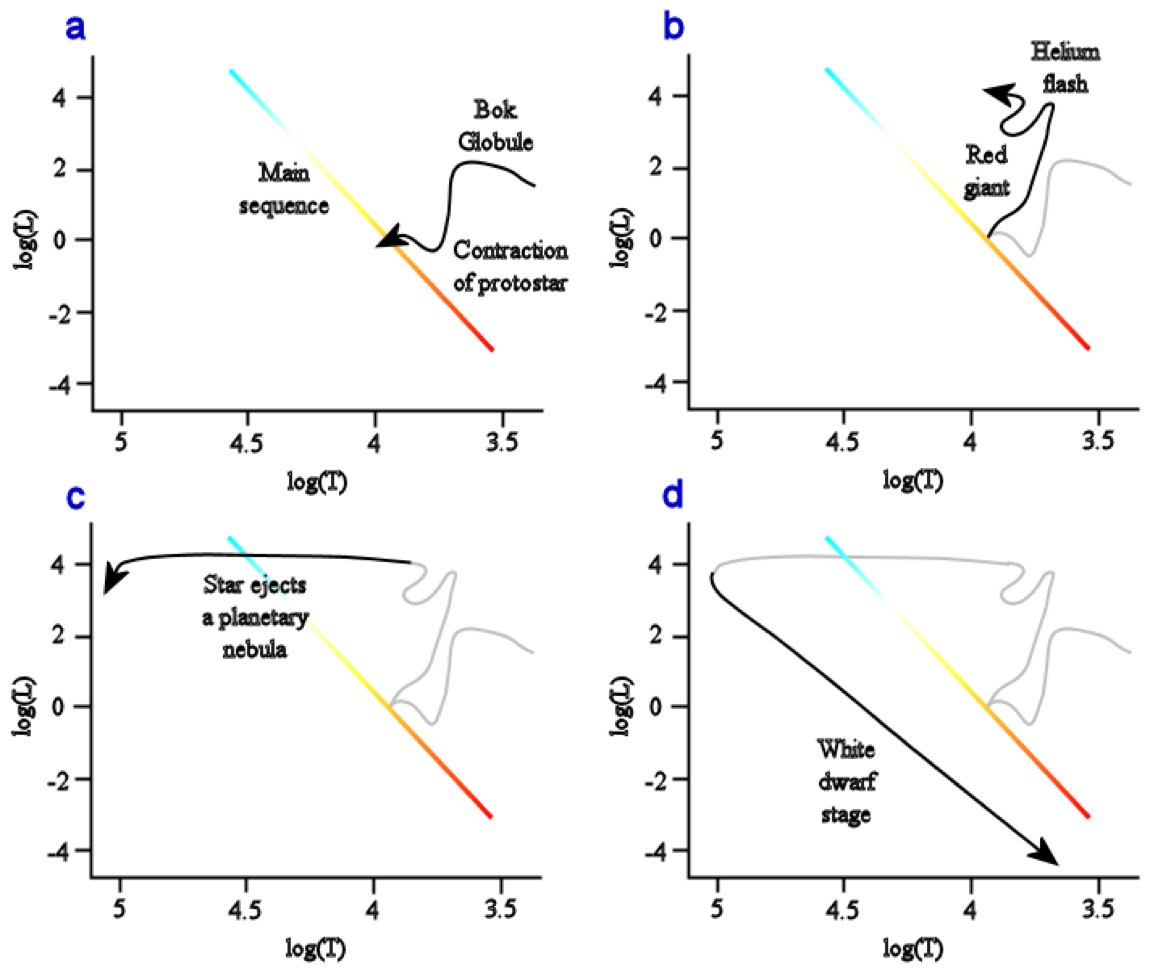
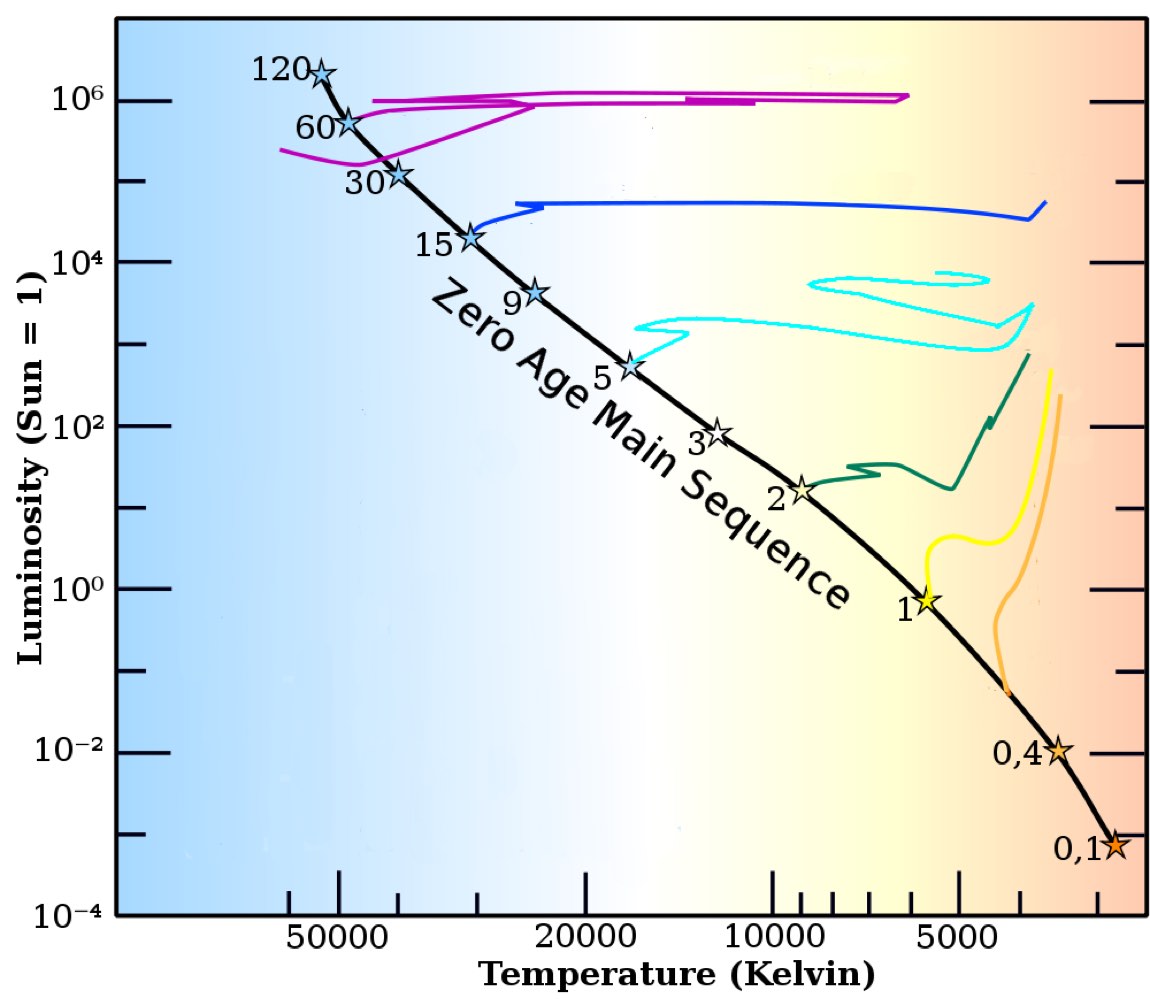
Stellar evolution cannot be watched the way you might watch a seed become a tree. Most changes in a star happen far too slowly to detect even over many centuries of careful observation. Instead, astrophysicists take a snapshot approach: they observe enormous numbers of stars at different points in their lifetimes simultaneously, then piece together a coherent life story the way a detective reconstructs events from clues scattered across a crime scene. Computer models are essential partners in this work. A stellar evolutionary model takes just two inputs — the mass and chemical composition of a star — and uses the physics of hydrostatic equilibrium to calculate how luminosity and surface temperature change over time. The result is a predicted track across the Hertzsprung–Russell diagram that can be compared directly against observations. These models are precise enough that matching a star's physical properties to a computed evolutionary track gives a reliable estimate of its current age, making them one of astronomy's most powerful dating tools.
02 The molecular cloud: a star's raw material
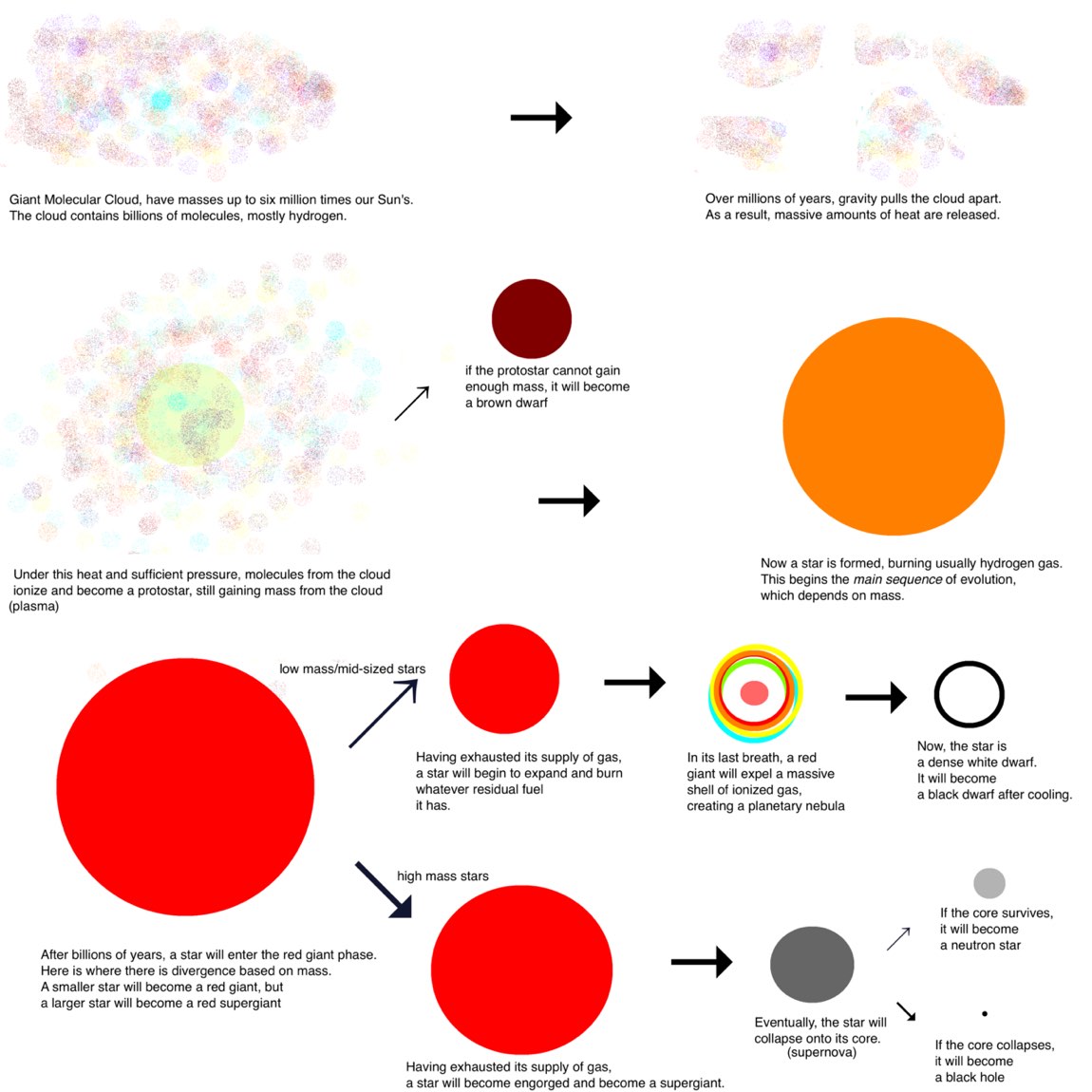
Every star begins inside a giant molecular cloud — an enormous, cold reservoir of gas and dust. Typical giant molecular clouds span roughly 100 light-years across, which is about 9.5×10¹⁴ km, and can contain up to 6,000,000 solar masses of material. When gravity causes such a cloud to collapse, it does not fall as a single blob. Instead it fragments into smaller and smaller pieces, each piece releasing gravitational potential energy as heat as it shrinks. Individual fragments condense into rotating balls of superhot gas called protostars. Crucially, the cloud is threaded with filamentary structures that are almost universal in molecular clouds. These dense filaments fragment further into gravitationally bound cores — the direct precursors to individual stars. Observations have revealed quasi-periodic chains of dense cores spaced at intervals comparable to the filament's inner width, with embedded protostars already driving gas outflows. Magnetic fields, continuous gas accretion, and the geometrical bending of filaments all help control exactly how and where these cores form.
03 Objects too small to truly ignite: brown dwarfs
Not every collapsing fragment becomes a true star. If a protostar accumulates less than roughly 0.08 solar masses — about 1.6×10²⁹ kg — its core never grows hot enough to fuse hydrogen, and it stalls before reaching the main sequence. The International Astronomical Union draws a more precise line: objects massive enough to fuse deuterium at some point in their lives qualify as brown dwarfs, and this threshold sits at 13 Jupiter masses, or about 0.0125 solar masses. Objects smaller than 13 Jupiter masses are classified as sub-brown dwarfs, though if they orbit another stellar object they are instead called planets. Both brown dwarfs and sub-brown dwarfs shine dimly — not from nuclear fusion of hydrogen but from residual heat — and they fade slowly, cooling over hundreds of millions of years with no dramatic endpoint. Their existence highlights that star formation produces a continuous spectrum of objects rather than a clean divide between stars and planets.
 ⤢
⤢
04 Why low-mass stars will outlive the universe
The smallest red dwarfs burn hydrogen so frugally that their lifetimes dwarf the current age of the universe. Recent astrophysical models suggest that a red dwarf of just 0.1 solar masses may remain on the main sequence for somewhere between six and twelve trillion years, gradually increasing in both temperature and luminosity the whole time. After leaving the main sequence, such a star would then take several hundred billion additional years to collapse slowly into a white dwarf. The reason these stars behave so differently from the Sun is structural: the entire star is a convection zone, meaning hydrogen fuel is continuously stirred throughout the whole body rather than being confined to a shrinking core. As a result, hydrogen fusion continues until nearly the entire star has been converted to helium. Because no such star has yet had time to die in a universe only 13.8 billion years old, this evolutionary path has never been directly observed — it rests entirely on the predictive power of stellar models.
05 The helium flash: a hidden explosion Deeper
When a mid-sized star between roughly 0.6 and 2.0 solar masses exhausts the hydrogen in its core, the inert helium core is supported largely by electron degeneracy pressure. As it heats up, helium fusion eventually ignites not gradually but in a sudden runaway event called the helium flash. The nuclear power released during this flash is staggering: it peaks at roughly 10⁸ times the Sun's luminosity for a period of days and reaches approximately 10¹¹ times the Sun's luminosity — comparable to the entire luminosity of the Milky Way Galaxy — for a matter of seconds. Yet no observer outside the star would notice anything at all. The energy is entirely consumed by thermally expanding the degenerate core, which lifts the degeneracy. As the core expands, hydrogen fusion in the surrounding shell slows, total energy output drops, and the star actually contracts and heats its surface before settling onto the horizontal branch. The helium flash is one of stellar physics' most dramatic events, hidden completely from view.
06 Dredge-ups: bringing the deep interior to light Deeper
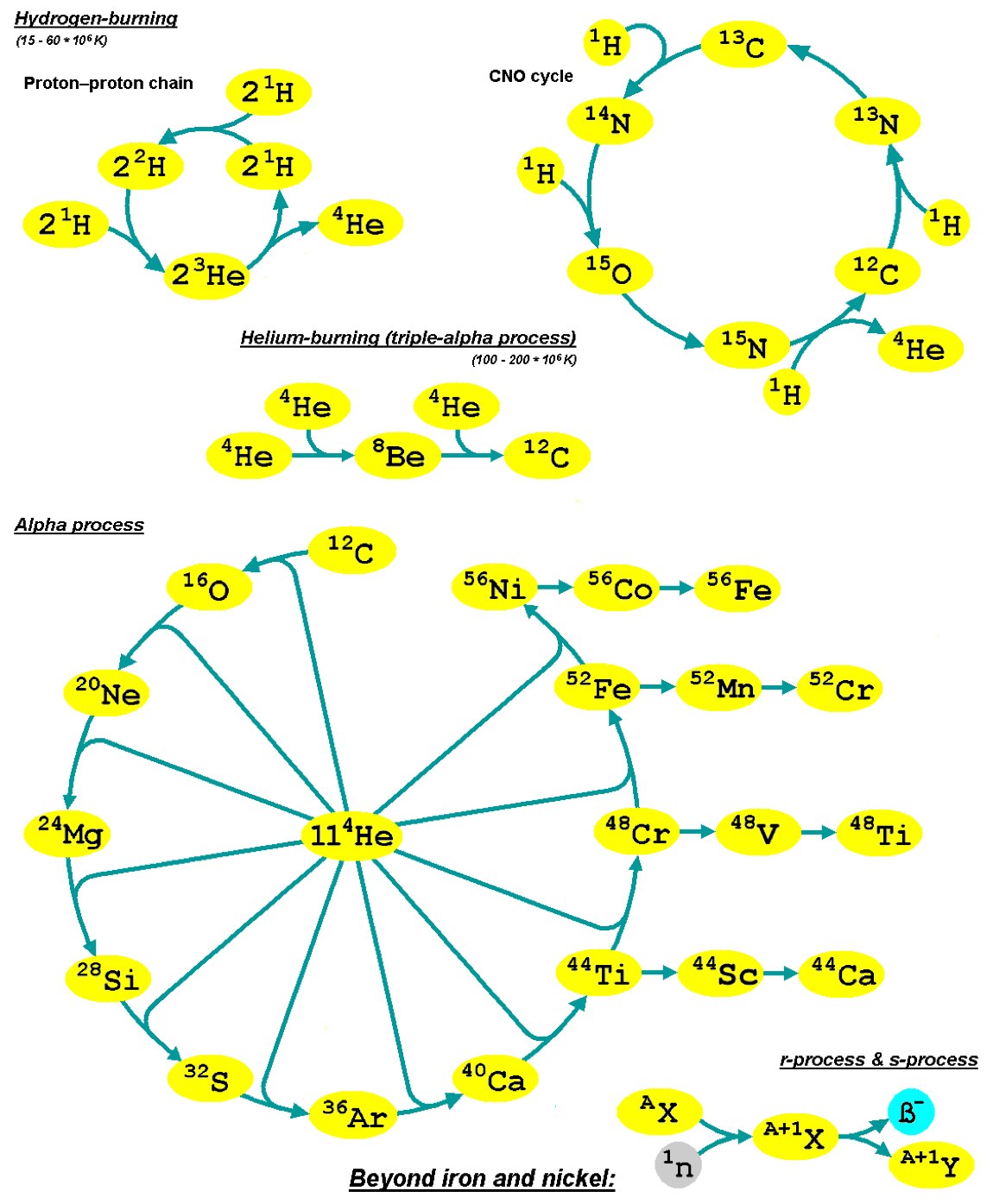
As a mid-sized star climbs the red-giant branch, its expanding outer layers become convective, churning material from near the nuclear burning regions up to the surface. This mixing — called the first dredge-up — exposes the products of interior nuclear reactions for the first time in the star's life. The changes are detectable with spectroscopy: the ratio of carbon-12 to carbon-13 decreases, and the proportions of carbon and nitrogen shift due to the CNO cycle having operated in the interior. Later, on the asymptotic giant branch, a second dredge-up event can carry carbon produced in the helium-burning core all the way to the stellar surface. In some stars a third dredge-up also occurs. Through these repeated episodes, a star can become a carbon star — an extremely cool, strongly reddened object whose spectrum is dominated by carbon absorption lines. A competing process called hot bottom burning can convert some of that dredged-up carbon into oxygen and nitrogen before it ever reaches the surface, and the interplay between dredge-ups and hot bottom burning determines the observed brightness and spectra of carbon stars in stellar clusters.
 ⤢
⤢
07 Thermal pulses and the AGB star's final gasps Deeper
Toward the end of the asymptotic-giant-branch phase, a star with a carbon-oxygen core is fusing helium and hydrogen in concentric shells. The arrangement is unstable. Helium produced by the hydrogen-burning outer shell periodically rains inward, causing the helium shell's energy output to spike dramatically in events called thermal pulses. Depending on the star's mass and composition, there may be anywhere from several to hundreds of these pulses during the final stages of the AGB phase. The star also pulsates on longer timescales: the Mira variables, a well-known class of AGB stars, pulsate with well-defined periods ranging from tens to hundreds of days and amplitude changes of up to about 10 magnitudes in visible light, though the total luminosity varies by a much smaller amount. In more massive AGB stars, these pulsations drive enhanced mass loss until the star becomes so deeply shrouded in expelled dust that it is undetectable at visible wavelengths. These objects are observed instead as OH/IR stars, pulsating in the infrared and displaying OH maser emission — a sign of molecules forming in the cool circumstellar envelope.
08 Iron cores and why massive stars must die violently Deeper
A star heavier than about 8 solar masses climbs an inexorable ladder of fusion stages: hydrogen, helium, carbon, neon, oxygen, and finally silicon, each stage producing ash that becomes the fuel for the next. The entire sequence from a fully formed carbon core to an iron core takes only a few hundred years — so brief that the star's outer appearance barely changes. Iron represents a dead end because fusing it absorbs energy rather than releasing it. As the iron core grows toward what is called the effective Chandrasekhar mass — ranging from about 1.34 solar masses in the least massive red supergiants to more than 1.8 solar masses in more massive stars — electrons begin to be captured into iron-peak nuclei. With electron degeneracy pressure removed, the core collapses catastrophically. The collapse generates a massive surge of neutrinos, as was directly observed from supernova SN 1987A. These neutrinos fragment nuclei, release neutrons, and drive a shock wave outward, scattering heavy elements — including radioactive isotopes up to uranium and likely beyond — throughout the surrounding galaxy.
09 What white dwarfs are made of, and their limits
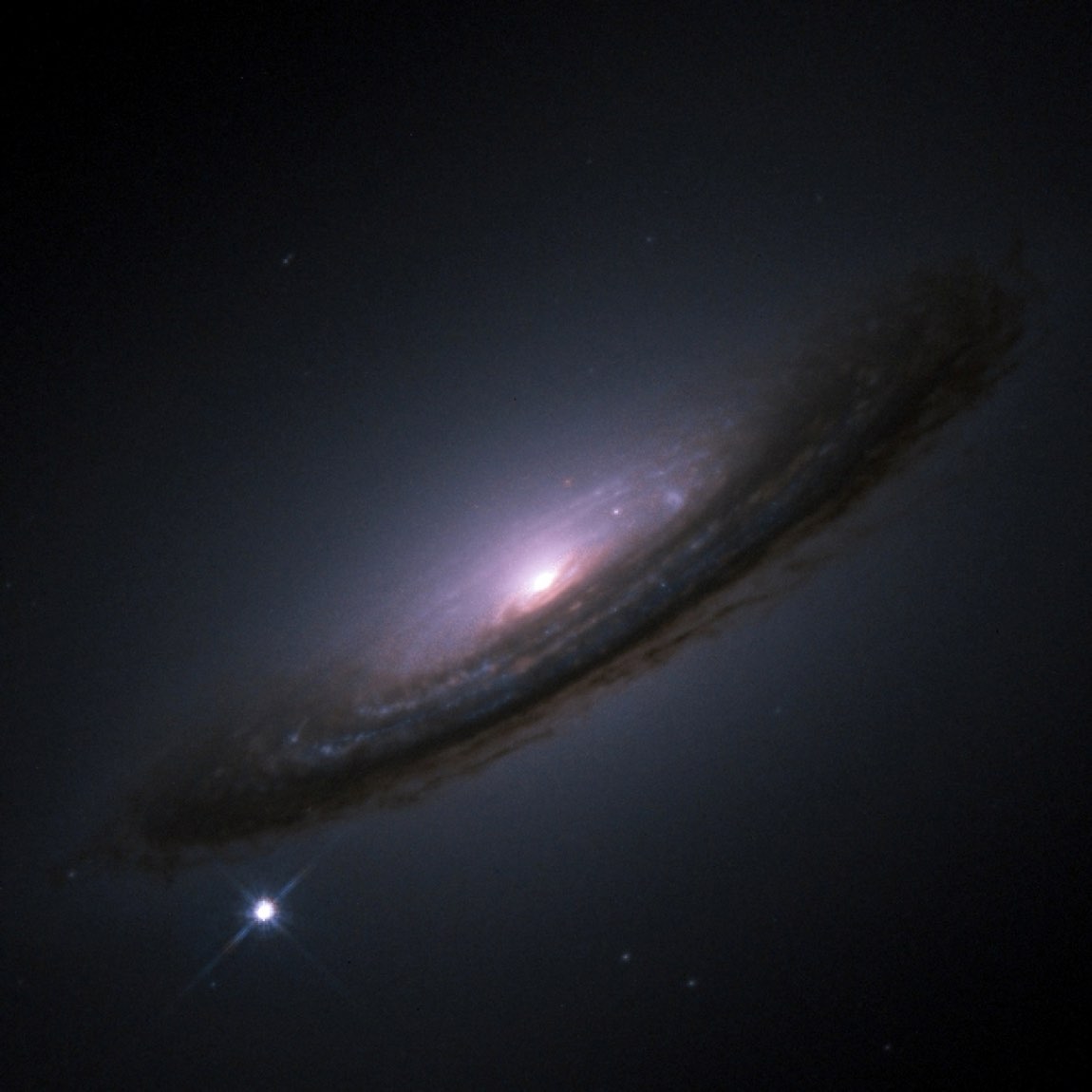
Not all white dwarfs are alike in composition. A star similar in mass to the Sun, which cannot ignite carbon fusion, leaves behind a white dwarf made chiefly of carbon and oxygen. A star in the range of 8 to 12 solar masses can ignite carbon fusion to form magnesium, neon, and smaller amounts of other elements, producing a white dwarf composed mainly of oxygen, neon, and magnesium — provided it sheds enough mass to fall below the Chandrasekhar limit. A star of less than about half a solar mass, unable to ignite helium fusion at all, would leave a helium white dwarf. A newly formed white dwarf is intensely hot, exceeding 100,000 K at its surface and even hotter inside, and it radiates so energetically in its first 10 million years that it loses a significant fraction of its energy as neutrinos. After about a billion years it has radiated away most of its energy. The Chandrasekhar limit for a white dwarf composed chiefly of carbon, oxygen, neon, or magnesium is 1.4 solar masses; exceeding this threshold through mass transfer in a binary system triggers either collapse to a neutron star or a runaway thermonuclear explosion — a Type Ia supernova.
 ⤢
⤢
10 Neutron stars: cities of nuclear density
When a massive star's core collapses past the point where electron degeneracy can halt it, electrons and protons are forced together by the immense pressure to form neutrons via electron capture. The result is a neutron star — an object with a radius on the order of just 10 km, no larger than a major city, yet containing more than roughly 1 to a few solar masses of material. The analogy offered by physics is vivid: if an ordinary atom were scaled up to the size of a football stadium, its nucleus would be about the size of a dust mite. A neutron star is essentially all nucleus. As the core collapses, conservation of angular momentum spins the remnant up to astonishing rotation rates; observed rotational periods of neutron stars range from about 1.5 milliseconds — more than 600 revolutions per second — to several seconds. When a spinning neutron star's magnetic poles sweep past the Earth, it produces a detectable pulse of radiation with each rotation. These objects are called pulsars, and they were the first neutron stars to be discovered. Pulsars have been detected not only in radio waves but also at visible, X-ray, and gamma-ray wavelengths.
11 Pair-instability and stars that leave nothing behind Deeper
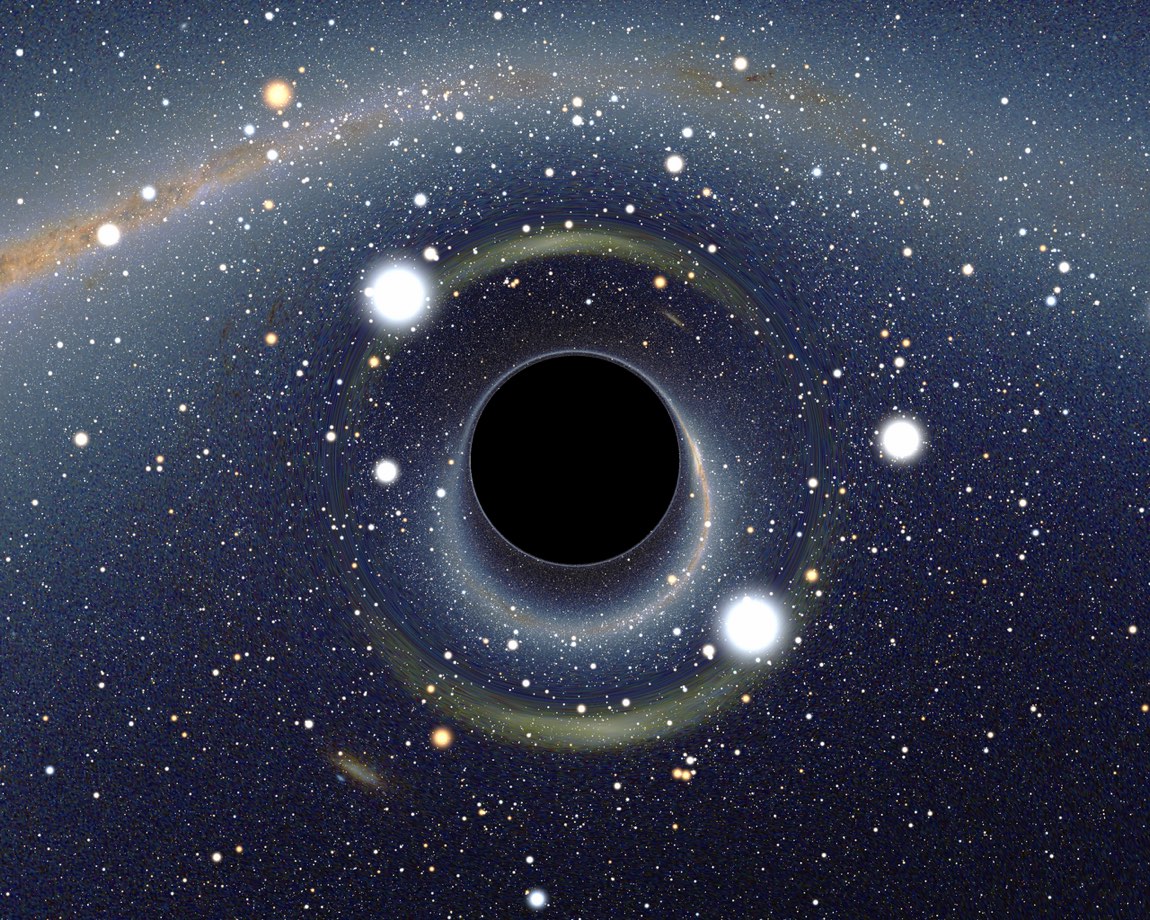
The most massive stars alive today, estimated at around 100 to 150 solar masses, are already near the upper boundary at which radiation pressure would expel their outer layers entirely. But in the earlier universe, even larger stars existed, and their deaths were different in kind from ordinary supernovae. Stars of extreme mass can be destroyed by a mechanism called pair-instability, in which gamma rays in the core spontaneously produce electron-positron pairs, reducing the radiation pressure supporting the star. The collapse triggers such a violent thermonuclear explosion that the energy released greatly exceeds the star's own gravitational binding energy, completely disintegrating the star. Crucially, pair-instability supernovae leave behind no remnant at all — no neutron star, no black hole. At the very top of the mass range, stars can instead lose so much energy to photodisintegration — gamma rays breaking apart nuclei — that the explosion cannot overcome gravity, and the star collapses directly into a black hole at the end of its life. These extreme pathways are rare today but were more common in the young universe when stars were even more massive.
12 The unresolved puzzle of supernova energy transfer Deeper
Despite decades of work, astrophysicists cannot yet fully explain how a collapsing stellar core produces the spectacular explosion we call a core-collapse supernova. The basic sequence is understood: the core bounces, sending a shock wave outward through the infalling material. But current computer models of Type Ib, Type Ic, and Type II supernovae can account for only part of the energy transfer needed to actually eject the star's outer layers at observed velocities. Something is missing. One candidate for the missing energy is neutrino oscillations, which could affect both the total energy carried by neutrinos of different flavors and their interaction with surrounding matter through general-relativistic effects. It is also still not certain whether some massive stars can collapse directly to a black hole with no visible supernova at all, or whether some supernovae produce a neutron star that subsequently collapses into a black hole. The exact relationship between a star's initial mass and the nature of its final remnant remains incompletely mapped. Resolving all of this requires analyzing more supernovae and their remnants, making each new detected explosion a genuinely valuable scientific event.
13 Heavy elements: supernovae share the credit
The origin of elements heavier than iron is one of nuclear astrophysics' central questions, and the answer turns out to require more than one type of event. Non-exploding red giants can produce significant quantities of heavy elements through neutron capture reactions running alongside their normal nuclear burning. Core-collapse supernovae produce a different spectrum of heavy elements: neutrons released during the collapse bombard surrounding nuclei, triggering rapid neutron capture and building radioactive isotopes all the way up to uranium and likely beyond. However, the relative abundances of heavy elements and their isotopes found in the Solar System cannot be matched by either red giant production or supernovae alone. Neutron star mergers are also required to account for the observed pattern. This multi-source picture means that the iron in Earth's core, the gold in jewelry, and the uranium in nuclear reactors each carry the imprint of several different kinds of stellar violence spread across billions of years of cosmic history — a direct chemical legacy written into every atom of the world around us.
✦ Keep exploring