Cygnus
“The Swan” · Northern · best around September evenings
Real star positions and magnitudes (HYG database via D3-Celestial, BSD-3). Lines are the conventional stick figure; north is up.
The story
A swan flying south along the Milky Way — or, by its other name, the Northern Cross. Deneb, its tail, is one of the most luminous stars we can see: roughly 2,600 light-years away yet still first-magnitude. Albireo, the beak, is the sky's favorite double star — gold and sapphire in any small telescope. Cygnus X-1, the first confirmed black hole, lurks along the swan's neck.
How to find it
Summer/autumn evenings: Deneb is the faintest corner of the Summer Triangle (with Vega and Altair). The cross flies straight down the Milky Way's band.
✦ What lives inside it
- North America Nebula
The deep dive
Researched for the Atlas from Wikipedia — Cygnus (constellation) (22,028 characters read) · updated Sep 20, 2026
01 A Swan, a Hen, and a Grieving Friend
Western sky-watchers see a swan, but Arabic astronomers saw something altogether different: ad-Dajājah, meaning simply "the hen." The constellation's brightest star, Deneb, takes its very name from this tradition — it derives from the Arabic dhaneb, meaning "tail," completing the phrase Dhanab ad-Dajājah, "the tail of the hen." Across the Pacific, Polynesian cultures carved up the same stars into their own patterns. Tongan navigators called the figure Tuula-lupe, while the Tuamotu Islanders used at least two different names for parts of it: Fanui-tai and Fanui-raro. In New Zealand the whole figure was Mara-tea, and a single star — Beta Cygni — was probably called Whetu-kaupo. Meanwhile in the Society Islands it bore the elaborate name Taurua-i-te-haapa-raa-manu. These parallel naming traditions, stretching from the Mediterranean to Polynesia, remind us that the same pattern of stars inspired very different stories depending on which ocean a culture sailed.
02 Three Swans Named Cygnus in Ovid
Most people know one myth behind the swan constellation, but the Roman poet Ovid packed his Metamorphoses with three entirely separate characters all named Cygnus, every one of them transformed into a swan. The first is Cygnus of Liguria, the devoted companion of Phaethon, who grieved so bitterly after Zeus destroyed Phaethon's runaway sun-chariot that he spent days diving into the river Eridanus to collect Phaethon's bones for a proper burial. The gods, moved by this loyalty, turned him into a swan and set him in the sky. Ovid's second Cygnus is a boy from Aetolia who hurls himself off a cliff after his companion Phyllius refuses him a tamed bull — yet instead of dying, he is transformed mid-fall into a swan and flies away. The third is a son of the sea god Poseidon, an invulnerable warrior in the Trojan War whom Achilles eventually kills; Poseidon saves him at the moment of death by changing him into a swan. The sheer repetition suggests how naturally the ancient imagination linked this cluster of stars with transformation and grief.
03 The Northern Cross and Its Body of Christ
Long before anyone called it the Northern Cross, the German celestial cartographer Johann Bayer gave the asterism a striking religious layer in his 1603 star atlas the Uranometria. In Bayer's scheme, Alpha, Beta, and Gamma Cygni form the upright pole of a cross, while Delta and Epsilon Cygni form the cross-beam — a geometry any modern observer can verify by eye on a clear summer night. What makes this more than a geometric curiosity is what Bayer placed at the center: the nova P Cygni, which had blazed to 3rd magnitude in 1600 AD, just three years before the atlas appeared. Bayer identified this temporary new star as the body of Christ on that cross. P Cygni has since settled to a steady 5th magnitude, despite lying more than 5,000 light-years away, and its spectrum remains scientifically unusual — it shows very strong emission lines produced by surrounding nebulosity. Its name is now attached to an entire class of spectral line profiles seen in outflowing stellar winds.
04 Deneb: Brightness at an Extreme Distance Deeper
Deneb's reputation rests on a remarkable combination: it is simultaneously one of the brightest stars visible in the night sky and the most distant first-magnitude star known. Its spectral classification is A2Iae — a white supergiant — and it varies only slightly, between magnitudes 1.21 and 1.29, so the change is invisible to the naked eye. Its distance of about 2,600 light-years makes the casual brightness all the more astonishing; virtually every other star you can easily see without a telescope lies within a few hundred light-years. Sitting at the tail of the swan and at one corner of the Summer Triangle, Deneb is described as one of the largest and most luminous A-class stars known. By contrast, the star at the opposite tip of the constellation, Albireo (Beta Cygni), lies only 430 light-years away — roughly six times closer — yet glows at a much dimmer magnitude 3.1. The gulf between these two stars illustrates how deceptive apparent brightness can be as a guide to a star's true nature.
05 Albireo and the Art of the Color Contrast Double
Among the pleasures accessible to anyone with a small telescope, few match the view of Albireo, Beta Cygni. The system sits 430 light-years from Earth and is visible in large binoculars, but a modest amateur telescope separates it into two stars whose colors make the pair one of the most celebrated sights in the sky: the primary is an orange-hued giant of magnitude 3.1, the secondary a blue-green star of magnitude 5.1. The constellation offers a second, dimmer version of this experience in the stars 30 and 31 Cygni, also visible in binoculars. There, 31 Cygni is an orange star of magnitude 3.8 lying 1,400 light-years away, while 30 Cygni appears blue-green, of spectral type A5IIIn and magnitude 4.83, at a closer distance of about 610 light-years — meaning the two are not physically associated, just a line-of-sight pairing. The contrast doubles of Cygnus offer an immediate, visceral demonstration that stars come in a real range of temperatures and colors, with bluer stars being hotter and orange ones considerably cooler.
06 61 Cygni and the First Measured Star Distance Deeper
Hidden among the brighter spectacles of Cygnus is one of the most historically significant stars in astronomy: 61 Cygni, a binary pair of orange dwarf stars only 11.4 light-years from Earth. The primary shines at magnitude 5.2, the secondary at magnitude 6.1, and both are visible in large binoculars or a small amateur telescope. Their orbital period is a leisurely 750 years. What makes 61 Cygni extraordinary is not its appearance but what Friedrich Wilhelm Bessel did with it in 1838: he measured its parallax, making it the first star other than the Sun to have a known distance determined by direct geometric means. Before that measurement, the scale of the universe beyond the solar system was entirely a matter of inference and argument. Bessel's success with 61 Cygni cracked open the cosmic distance ladder and gave humanity its first hard number for how far away a star actually is. The pair remains one of the nearest stellar systems to the Sun, and its proximity is precisely why its parallax — the tiny annual shift in position against the background of more distant stars — was large enough for 19th-century instruments to detect.
07 Cygnus X-1 and the Black Hole Debate Deeper
The X-ray source Cygnus X-1 sits approximately 2.2 kiloparsecs from the Sun, near the star Eta Cygni, and holds a landmark place in the history of astrophysics: it was the first object widely believed to be a black hole. The system is a binary in which a blue supergiant known as HDE 226868 orbits an unseen massive companion that is accreting material from it, producing copious X-rays. A separate but related feature, the Cygnus X-1 nebula, is formed by jets ejected from this binary system. The constellation also hosts Cygnus X-3, a microquasar pairing a Wolf–Rayet star with a very compact object in an orbital period of only 4.8 hours — one of the shortest known for such systems. Cygnus X-3 emits cosmic rays and gamma rays, has experienced outbursts during which it was found to emit muons likely caused by neutrinos, and has been speculated to harbor a quark star rather than a conventional neutron star or black hole. Cygnus X-2 rounds out the trio: an X-ray binary in which an A-type giant circles a neutron star every 9.8 days, notable because the companion star is unusually low in mass compared to most millisecond pulsars.
08 Variable Stars Across Every Type Deeper
Cygnus hosts an unusually varied collection of variable stars. Chi Cygni is a red giant and the second-brightest Mira variable at maximum, swinging between magnitudes 3.3 and 14.2 — a factor of roughly 4,000 in brightness — over a period of 408 days. Its spectral type ranges from S6,2e to S10,4e across that cycle, and its diameter reaches 300 solar diameters while lying just 350 light-years away. NML Cygni is far more extreme: an OH/IR red hypergiant located 5,300 light-years from Earth, with a radius exceeding at least that of the orbit of Jupiter, a magnitude of around 16.6, and a pulsation period of about 940 days — one of the largest stars currently known in the galaxy. SS Cygni operates on a very different schedule as a dwarf nova, flaring from 12th to 8th magnitude roughly every 7 to 8 weeks, driven by an orbital period of less than 0.28 days between two extraordinarily close objects. W Cygni is a semi-regular red giant cycling between magnitudes 5.10 and 6.83 over about 131 days. The variety on offer — from a nova visible to the naked eye in 1600, to a hypergiant rivaling Jupiter's orbit, to a cataclysmic binary that resets itself every two months — makes Cygnus a one-stop showcase for stellar physics.
09 The Kepler Mission's Window on Cygnus
When mission planners chose a target field for NASA's Kepler space telescope, they pointed it at a patch of sky centered on Cygnus and kept it there. The result is that Cygnus now contains about a hundred stars with known planets, more than any other constellation. Among them, the Kepler-11 system stands out: it holds six transiting planets, all confined within a plane of approximately one degree, making it the first system with six confirmed exoplanets. All six are more massive than Earth, all have low densities, and all but one orbit closer to their star than Mercury orbits the Sun. Kepler-11 itself has a spectral type of G6V, making it slightly cooler than the Sun. The Kepler-22 system earned attention in 2011 for hosting what was then the most Earth-like exoplanet known. Even with the naked eye, the triple star 16 Cygni — about 70 light-years away and composed of two Sun-like stars and a red dwarf — reveals its planetary nature through radial-velocity variations, with a planet orbiting one of the Sun-like components.
10 Nebulae Hidden and Famous
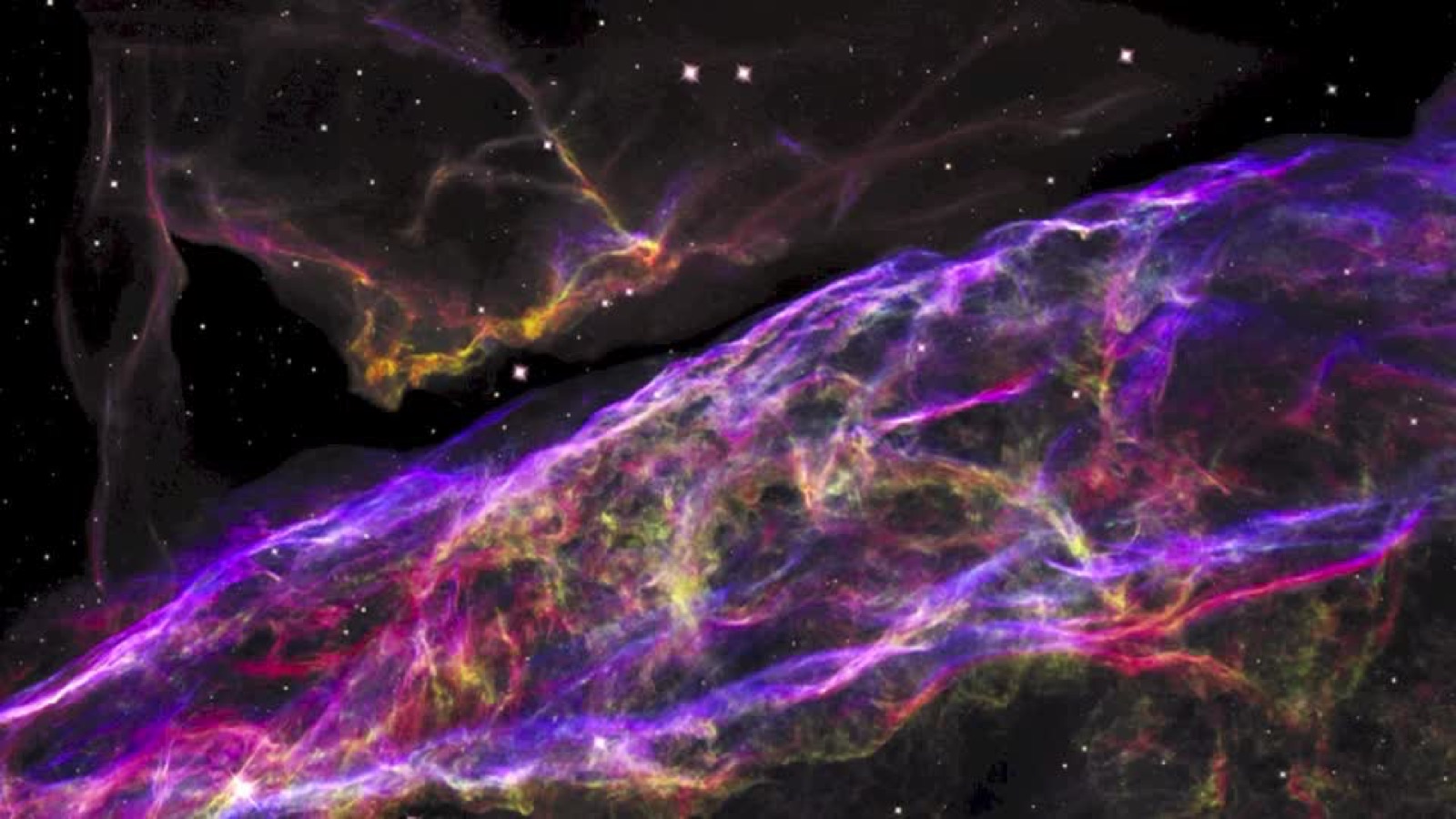
The North America Nebula, NGC 7000, is large enough to see without a telescope under dark skies — it appears as a bright patch in the Milky Way — yet paradoxically it is difficult to observe in a telescope, precisely because it spans up to 2 degrees across, diluting its light over a huge area of sky. It lies 1,500 light-years away and is illuminated by an embedded star of magnitude 6. South of Epsilon Cygni, the Veil Nebula is the tattered remains of a supernova explosion roughly 5,000 years ago; it covers about 3 degrees of sky and stretches more than 50 light-years end to end. Its brightest portion, NGC 6992, is faintly detectable in binoculars. The Crescent Nebula, NGC 6888, lies between Gamma and Eta Cygni and was sculpted by the stellar wind of the Wolf–Rayet star WR 136 at a distance of about 5,650 light-years. Two planetary nebulae add to the inventory: the Blinking Planetary, NGC 6826, which appears to wink in and out as the eye shifts between its bright central star of 10th magnitude and the surrounding 8.5-magnitude glow; and Kronberger 61, nicknamed "The Soccer Ball," discovered by Austrian amateur Matthias Kronberger on archival survey photographs in 2011 and confirmed by the Gemini Observatory.
11 Cygnus A and Radio Galaxy Firsts Deeper
Far beyond the stars and nebulae of Cygnus lies an object in an entirely different category: Cygnus A, the first radio galaxy ever discovered. At a distance of 730 million light-years from Earth, it is also the closest powerful radio galaxy, giving radio astronomers their sharpest look at this class of object. In visible light it appears as an elliptical galaxy embedded in a small cluster, unremarkable at a glance. But Cygnus A harbors an active nucleus where a supermassive black hole is accreting matter, and that process launches two opposed jets of material from the galactic poles. Where those jets plow into the surrounding intergalactic medium, they inflate enormous radio-emitting lobes, which are responsible for the galaxy's extraordinary radio luminosity. The contrast between its modest visible appearance and its dominance at radio wavelengths made Cygnus A a foundational puzzle that helped establish the field of radio astronomy and ultimately the understanding that many apparently quiet elliptical galaxies conceal enormously energetic engines at their cores.
12 Amateur Discoveries in Modern Times
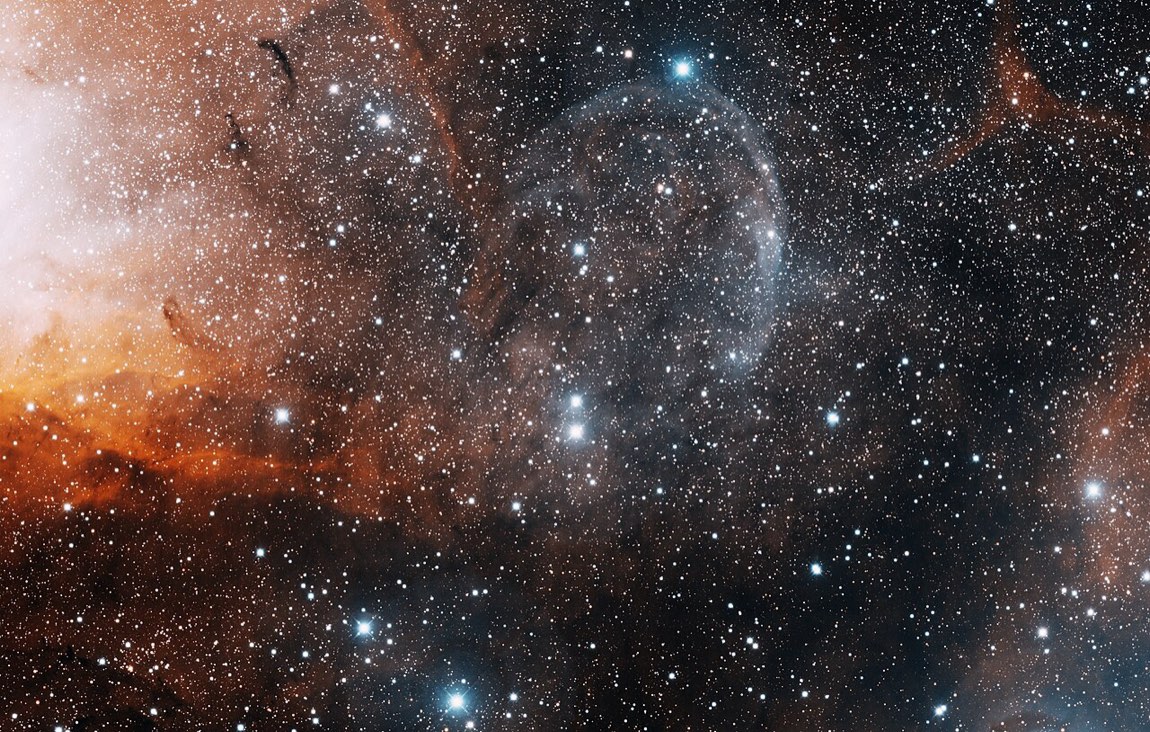
Cygnus remains a constellation where dedicated amateurs can still make genuine discoveries. Dave Jurasevich found the "Soap Bubble Nebula" (formally PN G75.5+1.7), a nearly perfect circular planetary nebula near the Crescent Nebula, on a digital image in 2007. In that same year, amateur astronomer Stephen Waldee first reported visually detecting a fan-shaped reflection nebula associated with the fifth-magnitude star 4 Cygni (HD 183056) from near San Jose, California; the discovery was confirmed photographically by Al Howard in 2010, and California amateur Dana Patchick later noted he had noticed it on Palomar Observatory survey photographs as early as 2005 but had not published the finding. Kronberger 61, discovered in 2011 on old survey photos by Austrian amateur Matthias Kronberger, was subsequently confirmed by the Gemini Observatory. These are not trivial finds: planetary nebulae are scientifically important objects, and each represents a late stage in the life of a star like the Sun. The richness of the Cygnus field — dense with emission, reflection, and planetary nebulae — means that careful observers with modern digital tools continue to turn up objects that professional surveys had catalogued but not fully characterized.
13 The Cygnus Rift and Its Molecular Clouds Deeper
Running along the bright band of the Milky Way in Cygnus is a river of darkness called the Cygnus Rift, which forms one end of the Great Rift — the broad dark lane that splits the Milky Way along its galactic plane for much of the sky. The Rift begins around the Northern Coalsack and is not empty space but rather a dense molecular cloud complex sitting between us and the more distant regions of the galaxy. This complex partially obscures the larger Cygnus molecular cloud behind it, which in turn is the parent structure that the North America Nebula belongs to. Within and around these clouds lies Cygnus X, described as the largest star-forming region in the solar neighborhood, home to some of the brightest and most massive stars known, including Cygnus OB2-12. The stellar association Cygnus OB2 is so richly populated that some researchers classify it as a young globular cluster rather than a conventional OB association. What had previously been interpreted as a single enormous structure — the Cygnus Superbubble, inferred from X-ray observations — has been recast by detailed studies as a superposition of multiple unrelated objects at different distances, likely an illusion created by our line of sight through this extraordinarily active region of the galactic plane.