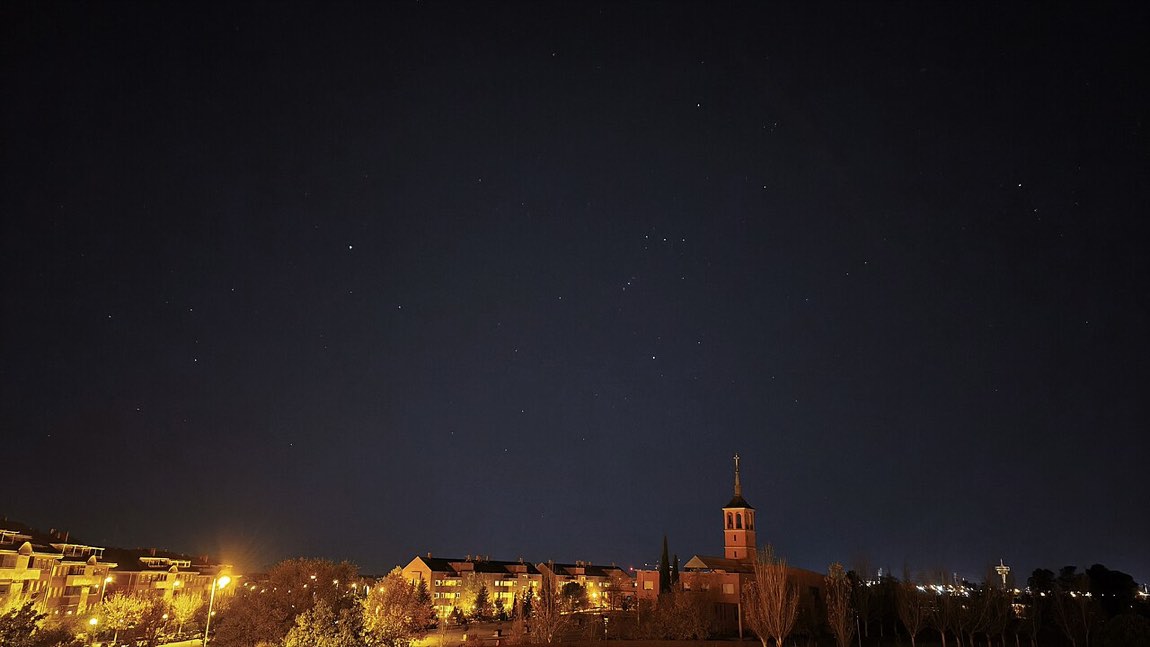
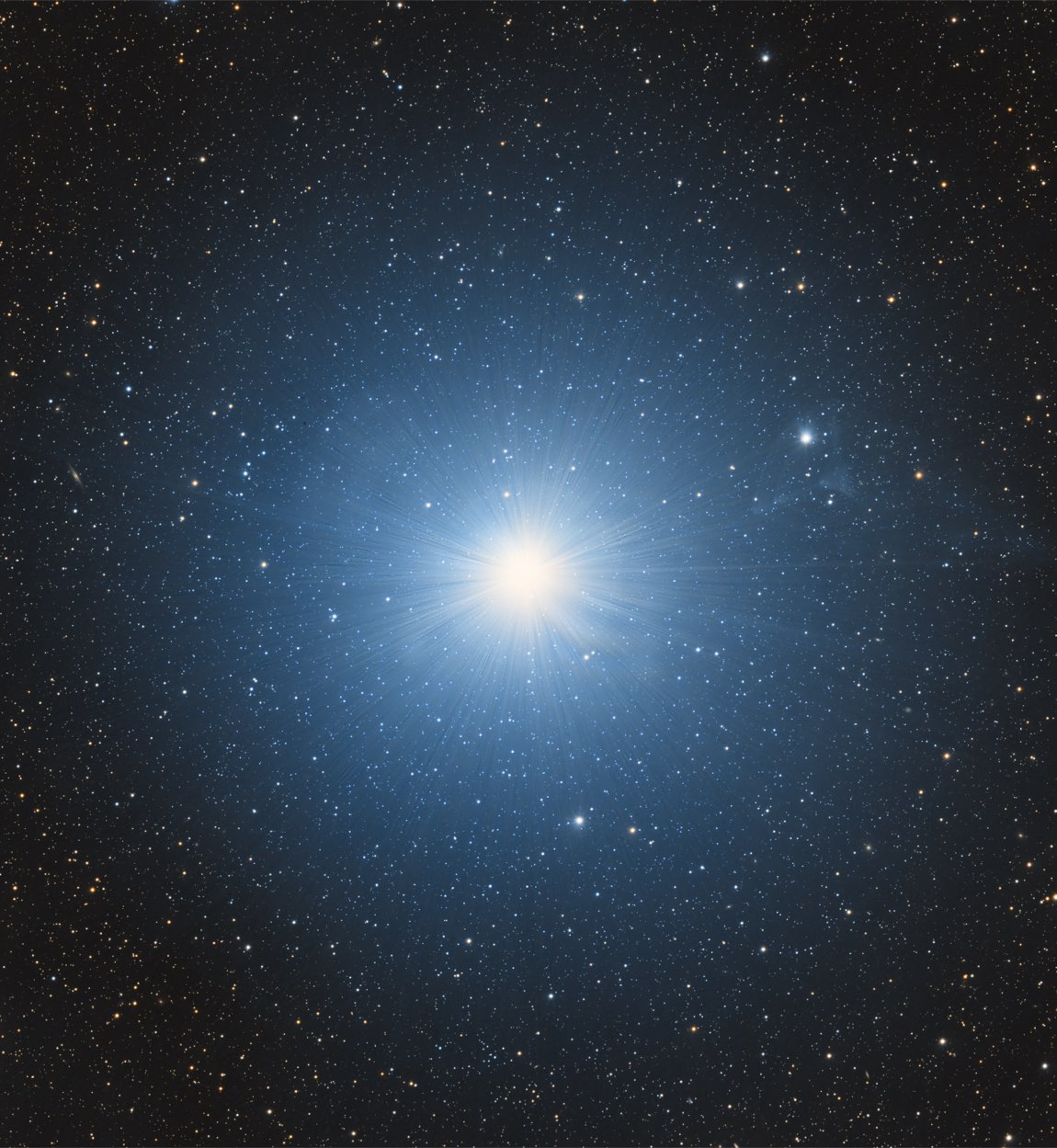
 Photograph · Chuck Ayoub · CC0
Star · Deep guide
Vega
Also called: Alpha Lyrae
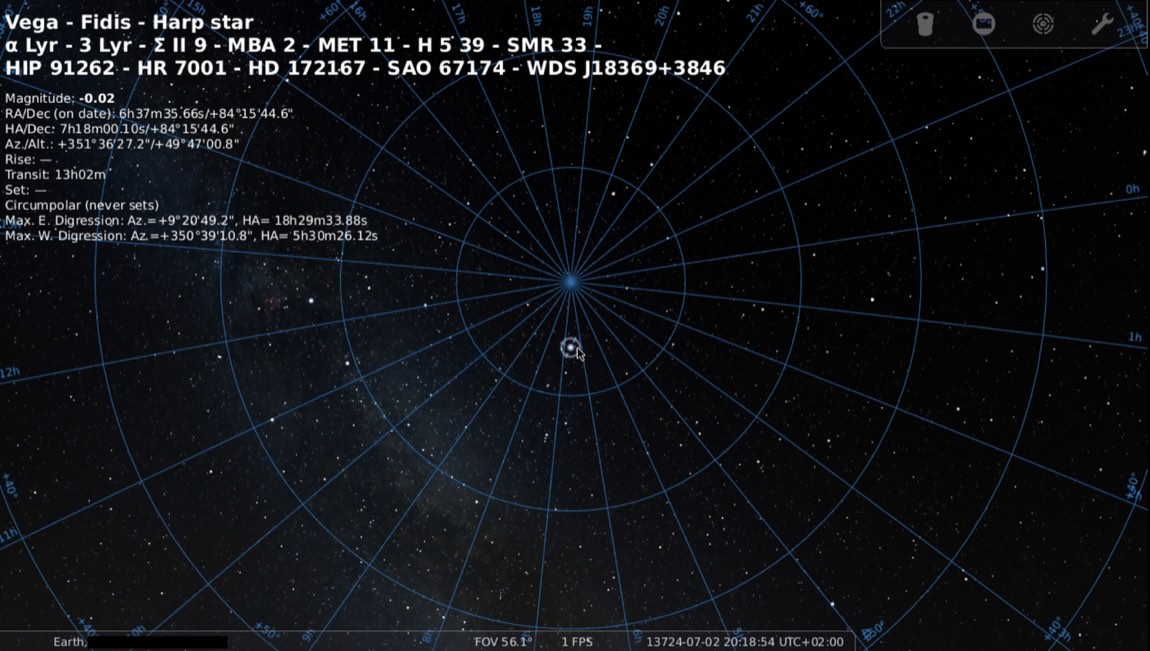
A fast-spinning star ringed by planet-making dust, Vega is the sapphire beacon of summer skies.
What is it?
Vega is the fifth-brightest star in the night sky and the brilliant blue-white anchor of the Summer Triangle. Just 25 light-years away and twice the Sun's mass, it spins so fast — a full rotation every 12.5 hours — that it bulges visibly at its equator. Around it lies a huge disk of dust: the debris of comet collisions, the raw material and wreckage of planet formation.
Go deeper
Vega was the first star ever photographed (1850), the northern pole star of 12,000 BC and 14,000 AD, astronomy's historical brightness zero-point (magnitude ≈ 0 by definition), and the star whose infrared excess — discovered by IRAS in 1983 — revealed debris disks and launched modern planet-formation science. We view it nearly pole-on, staring down its spin axis. Despite exquisite searches, no planet has been confirmed; a hot candidate from radial velocity remains just that.
01 The Summer Triangle
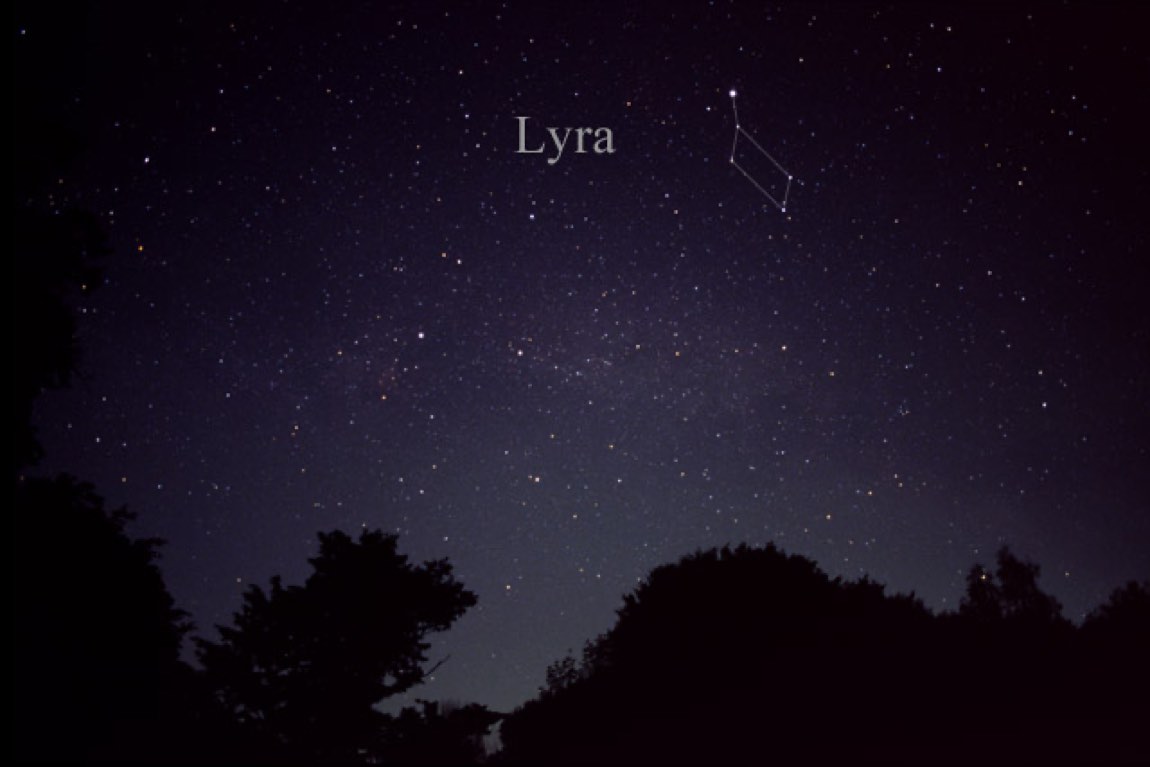
On northern summer evenings, three bright stars form a huge triangle overhead: Vega (the brightest), Deneb, and Altair. It is the easiest star pattern in the summer sky and the gateway to finding the constellations around it. In Chinese folklore Vega is the Weaver Girl, separated from the Cowherd (Altair) by the river of the Milky Way — reunited once a year by a bridge of magpies.
02 Contact's star
Carl Sagan chose Vega as the source of the signal in *Contact* — close, bright, and real. When the film's characters 'travel' there, the star they arrive at is the genuine article of the northern summer sky.
The deep dive
Researched for the Atlas from Wikipedia — Vega (33,386 characters read) · updated Sep 20, 2026
03 The star that taught us how bright stars are
For much of the twentieth century, every brightness measurement in astronomy was quietly anchored to Vega. When astronomers introduced the UBV photometric system in the 1950s, they chose Vega and five other A0V stars and defined the zero point of the entire scale so that all six had identical magnitudes in ultraviolet, blue, and yellow light — meaning U − B = B − V = 0. In practical terms, every observatory wanting to know how bright a galaxy or nebula was would first point its telescope at Vega and use it as a reference candle. The star's flux density at 5,480 Å was pinned at 3,650 Jy, with an error margin of just 2%. The arrangement worked well until astronomers discovered that Vega itself varies in brightness — likely by 1–2%, with occasional swings to 4% — and is not always conveniently above the horizon. The zero point is now defined numerically rather than by the star, but Vega's fingerprints remain embedded in decades of calibrated data across the entire observable universe.
04 First photograph, first spectrum, first X-rays
Vega has accumulated a remarkable string of astronomical firsts. On 17 July 1850, William Bond and John Adams Whipple pointed a daguerreotype camera at Vega from the Harvard College Observatory, producing the first photograph ever taken of a star other than the Sun. Just twenty-two years later, in August 1872, Henry Draper photographed Vega's spectrum and captured the first stellar spectrum showing absorption lines. In 1879, William Huggins used that spectrum — and similar ones from comparable stars — to identify twelve "very strong lines" common to the group, which were later recognized as the hydrogen Balmer series; those same lines now anchor the classification of thousands of stars. Then in 1979, Vega claimed another record: it became the first solitary main-sequence star beyond the Sun confirmed as an X-ray source, detected by an imaging telescope launched on an Aerobee 350 rocket from the White Sands Missile Range. Each of these firsts made Vega a proving ground for entirely new branches of astronomy, from astrophotography to spectroscopy to high-energy stellar physics.
05 A star spinning close to its own destruction Deeper
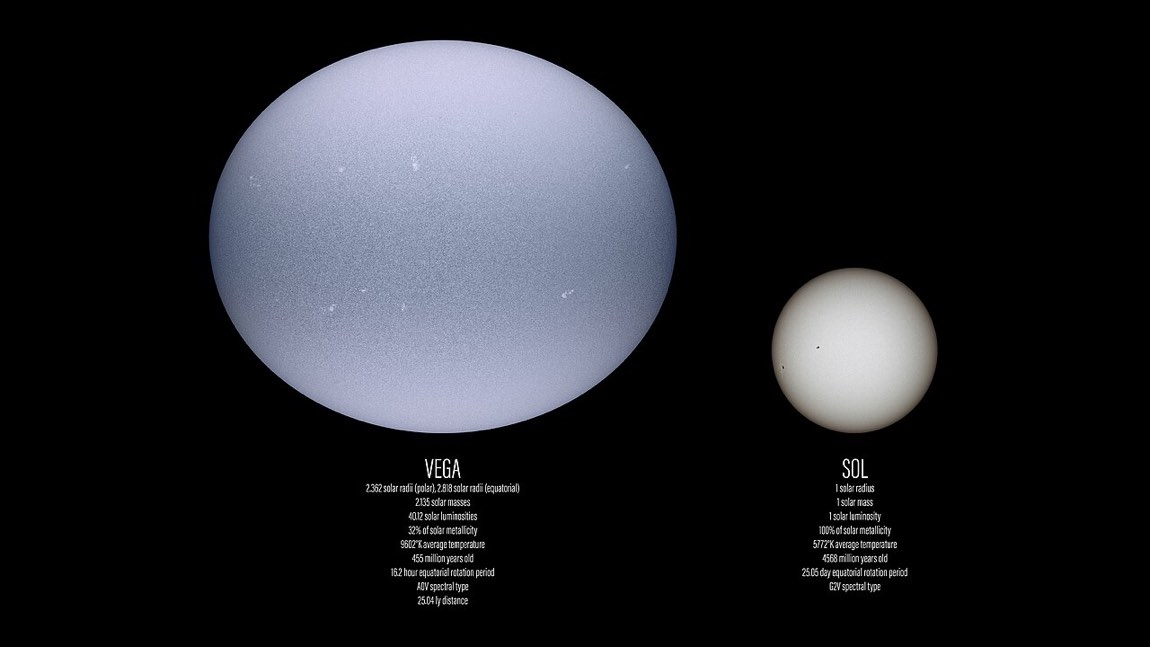
Vega spins at up to 236.2 ± 3.7 km/s along its equator — a velocity that is 88% of the speed at which centrifugal force would begin to tear the star apart. One full rotation takes only about 16.3 hours, compared to roughly 25 days for the Sun. That furious spin has profoundly deformed the star: its equatorial radius of 2.726 solar radii is 19% larger than its polar radius of 2.418 solar radii, making Vega more oblate than Saturn, which holds the record among Solar System planets at just under 11%. The distortion drives a steep temperature gradient across the photosphere. At the poles, where gravity is strongest, the surface reaches nearly 10,000 K; at the bloated equator the temperature drops to about 8,152 K — a difference of roughly 1,850 K between top and bottom of the same star. By the Von Zeipel theorem, luminosity tracks local surface gravity, so the poles blaze more intensely than the equator. This effect, called gravity darkening, means that if we could view Vega edge-on rather than nearly pole-on, the star would appear noticeably dimmer overall.
 ⤢
⤢
06 Why Vega's poles face us — and why that matters
Earth lies almost directly in line with Vega's north pole: the star's rotation axis tilts no more than five degrees away from our line of sight. This near-perfect pole-on orientation has fooled astronomers more than once. When the star's radius was measured with an interferometer, it came out at 2.73 ± 0.01 solar radii — 60% larger than the radius of Sirius, even though stellar models predicted Vega should be only about 12% larger. The puzzle dissolved once astronomers realized they were staring straight down at the equatorial bulge as if looking into a slightly flattened bowl. Observations by the CHARA array in 2005–06 confirmed this explanation. The pole-on geometry also complicates X-ray studies: a polar coronal hole may be present, and because most coronal X-rays would not be emitted directly along our line of sight, it is genuinely difficult to confirm whether Vega has any corona at all. And because Vega served for decades as a photometric standard, astronomers must now revisit calibrations that assumed the star was a perfect, spherically symmetric light source.
07 A magnetic field where none should exist Deeper
Ordinary A-type stars are not supposed to have detectable surface magnetic fields unless they belong to a rare, chemically peculiar subclass called Ap stars. Vega is not an Ap star, so when a team at the Observatoire du Pic du Midi used spectropolarimetry to measure its field, the detection was a genuine surprise — the first of its kind for a normal spectral class A star. The average line-of-sight component of the field measured −0.6 ± 0.3 gauss, a sign convention indicating the field points toward Earth. For comparison, the mean magnetic field across the Sun's surface is roughly 1 gauss, while stronger reports for Vega reach about 30 gauss. Then in 2015, bright starspots were detected on Vega's surface — the first such discovery on any normal A-type star. Those spots show clear rotational modulation with a period of 0.68 day, distinct from the star's overall 16.3-hour spin period measured at the equator. The origin of both the field and the spots remains an open question, since the standard dynamo mechanisms that generate magnetic activity in cooler stars should not operate efficiently in Vega's predominantly radiative atmosphere.
08 An unusually metal-poor stellar chemistry Deeper
Compared with the Sun, Vega is strikingly short on heavy elements. The metallicity of its photosphere is only about 32% of the solar value, meaning that elements heavier than helium make up just roughly 0.54% of Vega's composition by abundance. Most major elements — iron, calcium, silicon — fall to between 10% and 30% of solar levels, and barium and scandium drop below 10%. The contrast with Sirius is especially sharp: that star has roughly three times the Sun's heavy-element abundance, while Vega sits at a third of it. Nitrogen is slightly more abundant than solar, oxygen only marginally less, and sulfur sits at about half the solar level. The helium-to-hydrogen ratio is 0.030 ± 0.005, about 40% lower than in the Sun, possibly because radiative diffusion near the surface has allowed helium to sink rather than being churned upward by convection. This chemical profile makes Vega a weak Lambda Boötis star. Whether the deficiency traces back to a metal-poor birth cloud or arose later through diffusion and mass loss is still debated, and stellar models suggest that diffusion-driven depletion would ordinarily not become significant until near the end of hydrogen burning.
09 The debris disk that named a whole class of stars
In 1983 the Infrared Astronomical Satellite revealed more heat coming from Vega than the star alone could produce, and that excess was interpreted as thermal emission from orbiting dust — making Vega the first star ever found to host a dust disk. The discovery was so influential that any star showing unexplained infrared radiation from dust is now formally called a "Vega-like" or "Vega-excess" star; as of 2002 roughly 400 such stars had been catalogued. Later observations fleshed out the disk's true scale: the Spitzer Space Telescope found it extends to 543 AU at 70 μm and 815 AU at 160 μm — more than twenty times the diameter of Neptune's orbit. The estimated total dust mass is 3 × 10⁻³ Earth masses, about 7.5 times the mass of the asteroid belt. That dust cannot be a relic of planet formation; it must be continuously replenished by collisions between larger bodies in a structure analogous to the Solar System's Kuiper Belt. The disk viewed from above is nearly circular and remarkably smooth, with dust particle sizes ranging from 1 to 50 μm.
10 What JWST revealed about the disk's hidden structure Deeper
The most detailed portrait of Vega's disk came in 2024, when combined observations from Hubble STIS and JWST MIRI were published. Hubble captured the first-ever image of the disk in scattered visible light and revealed an outer halo composed of small dust grains. JWST detected that halo, the outer disk, and for the first time the inner disk as well, and the infrared images exposed a gap in the disk at around 60 AU. The disk interior to the outer ring is consistent with dust being slowly dragged inward by Poynting–Robertson drag. A second gap exists between the inner disk and a zone of hot infrared excess located within about 0.2 AU of the star — a region populated by small grains of graphite and iron and manganese oxides. The inner edge of the inner disk is hidden behind JWST's coronagraph, but photometry places it at 3–5 AU from Vega. The overall morphology of the disk shows no sign of shaping by a planet more massive than Saturn beyond 10 AU, and simulations indicate that even a planet smaller than 6 Earth masses at 65 AU would produce interior asymmetric structures that are simply not observed.
 ⤢
⤢
11 The long hunt for planets around Vega
Astronomers have been searching for planets around Vega since the 1990s, with results that have shifted back and forth. In 1997, observations from the James Clerk Maxwell Telescope revealed a bright elongated region offset 70 AU to the northeast of the star, suggesting either a planet perturbing the disk or a dust-shrouded companion. A 2002 paper proposed a Jupiter-mass planet in an eccentric orbit collecting dust in resonant clumps. A 2003 hypothesis instead favored a Neptune-mass planet that had migrated outward from 40 to 65 AU over 56 million years. By 2007, however, more sensitive instruments on the Plateau de Bure Interferometer found the disk smooth and symmetric, with no sign of the earlier-reported blobs. The most concrete candidate arrived in 2021, when ten years of spectroscopic data revealed a 2.43-day radial-velocity signal carrying only a 1% chance of being a false positive. At a face-on inclination of 6.2°, the implied planet mass jumps from a minimum of 21.9 ± 5.1 Earth masses to roughly 203 ± 47 Earth masses — closer to Neptune or a super-Neptune than a rocky world. A second, 196.4-day signal was also detected but remains too faint to confirm.
12 Energy generation deep inside Vega Deeper
Unlike the Sun, which produces most of its energy through the proton–proton chain, Vega relies primarily on the carbon–nitrogen–oxygen cycle, or CNO cycle. In this process, protons are fused into helium nuclei using carbon, nitrogen, and oxygen as intermediaries rather than as fuel; those atoms are regenerated at the end of each cycle. The CNO cycle becomes dominant above roughly 17 million K, slightly above the Sun's core temperature, but it is actually less efficient per unit mass than the proton–proton chain. Its defining feature for stellar structure is extreme temperature sensitivity: reaction rates change dramatically with small temperature shifts. That sensitivity forces the core to transport energy through convection rather than radiation, stirring the fusion ash evenly through the core region. Above that convective core, however, Vega's outer layers sit in nearly pure radiative equilibrium — the opposite layering from the Sun, which has a radiative interior and a convective outer envelope. This internal architecture, combined with Vega's rapid rotation, produces a complex temperature landscape from core to surface that makes the star a genuinely unusual laboratory for stellar physics.
13 Vega's place among the moving stars
Vega is not stationary in space. It is currently approaching the Sun at 13.9 ± 0.9 km/s — the negative sign on its radial velocity means it is moving toward us — while its sideways motion across the sky amounts to 327.78 milliarcseconds per year, enough to shift by a full degree every 11,000 years. The star's overall space velocity in the galaxy is 19 km/s. That approach will continue for a long time: Vega will make its closest pass to the Sun in an estimated 264,000 years, reaching a perihelion distance of 13.2 light-years. As it draws nearer it will grow brighter, and in 210,000 years it will become the single brightest star in Earth's night sky, peaking at an apparent magnitude of −0.81 around 290,000 years from now. Vega also appears to share its trajectory with a loose association of about 16 stars called the Castor Moving Group, which includes Fomalhaut and Castor and has an estimated age of 200 ± 100 million years. Vega may be considerably older than the group's average, however, so whether it truly formed from the same dispersed cluster remains uncertain.
14 Vega across world cultures and history
Few stars have gathered as many names and stories as Vega. Its current name traces to the Arabic phrase an-nasr al-wāqi', "the falling eagle," a description echoed in the Latin translation Vultur Cadens used in the Alfonsine tables compiled between 1215 and 1270. Ancient Egypt depicted the constellation as a vulture; ancient India saw an eagle. The Assyrians called the pole star Dayan-same, "Judge of Heaven," while in Akkadian it was Tir-anna, "Life of Heaven." Among northern Polynesian peoples it was whetu o te tau, the year star, marking the season for planting until the Pleiades took over that role. In Chinese tradition, Vega is Zhī Nǚ yī, the First Star of the Weaving Girl, central to the Qixi legend in which the weaver and her cowherd husband are separated by the Milky Way and reunited just once a year — a story also celebrated in Japan's Tanabata festival, where Vega is called Orihime. In Zoroastrianism the star was linked to Vanant, "the conqueror." The indigenous Boorong people of north-western Victoria, Australia, named it Neilloan, "the flying loan," and in Hindu astronomy it represents the nakshatra Abhijit, described in the Srimad Bhagavatam as one of Krishna's celestial identities.
15 Vega's future: red giant, then white dwarf
Vega is only about 700 million years old — roughly one tenth the age of the Sun — but because it is 2.1 times as massive, it burns through its hydrogen fuel far more quickly. Its total main-sequence lifetime is only about one billion years, meaning it has already consumed the better part of its nuclear fuel supply and is approaching the midpoint of its hydrogen-burning life. When the hydrogen in its core is exhausted, Vega will swell into a class-M red giant and shed a large fraction of its mass through stellar winds. What remains will contract into a white dwarf. The bolometric luminosity today is already about 40 times the Sun's, and because of its pole-on orientation and rapid spin the apparent luminosity calculated by assuming uniform brightness across the disk reaches about 57 times solar. The star's interior, dominated by CNO-cycle fusion in a convective core surrounded by a radiative envelope, will gradually shift as the core hydrogen runs out, triggering the structural changes that mark the end of the main-sequence phase and the beginning of the star's long, luminous decline.
 ⤢
⤢
Could life exist here?
A young star with grinding comet belts and no confirmed planets; its short A-star lifetime (~1 billion years total) leaves little time for biology regardless.
Our labels: Confirmed · Strong Evidence · Estimated · Hypothesis · Theoretical · Speculative (see Methodology).
How would we get there?
25 light-years — six times the Proxima crossing. Strictly telescope territory.
Weird & wonderful
- Vega will be the North Star again around the year 14,000.
- It was the first star photographed and the original definition of 'magnitude zero.'
- Seen pole-on, its fast spin hides in plain sight — the star is actually lozenge-shaped.