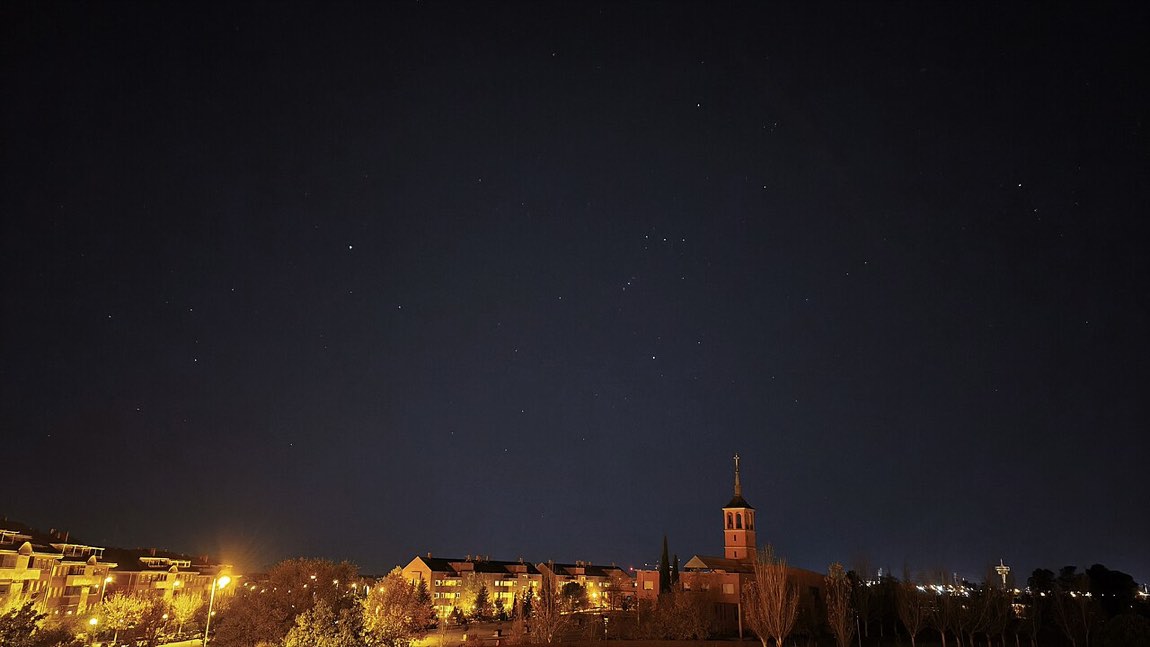
 Photograph · Jorge Simonet · CC BY-SA 4.0
Star · Deep guide
Sirius
Also called: The Dog Star · Alpha Canis Majoris
The brightest star in Earth's night sky is a blazing white sun with a dead star for a companion.
What is it?
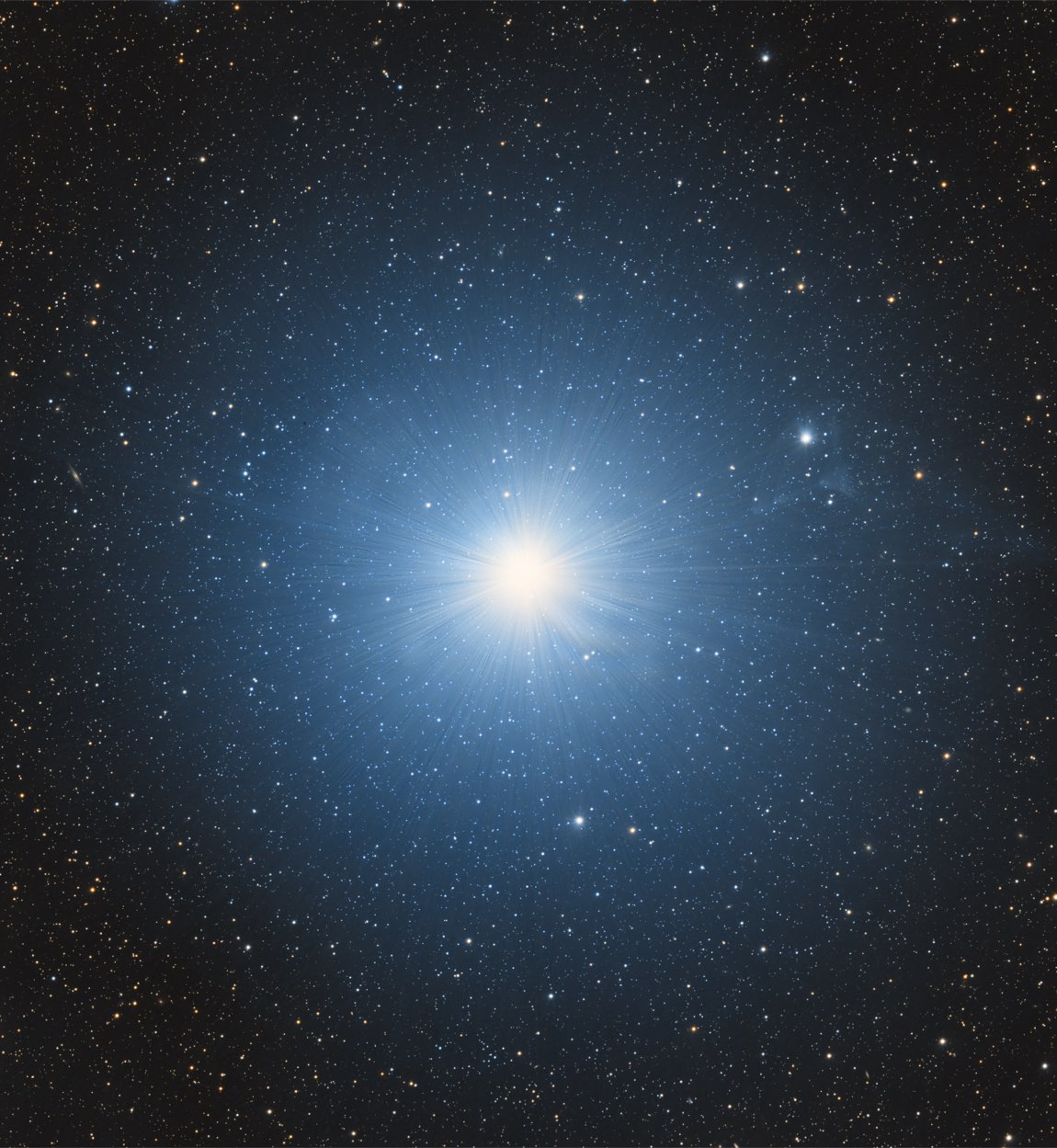
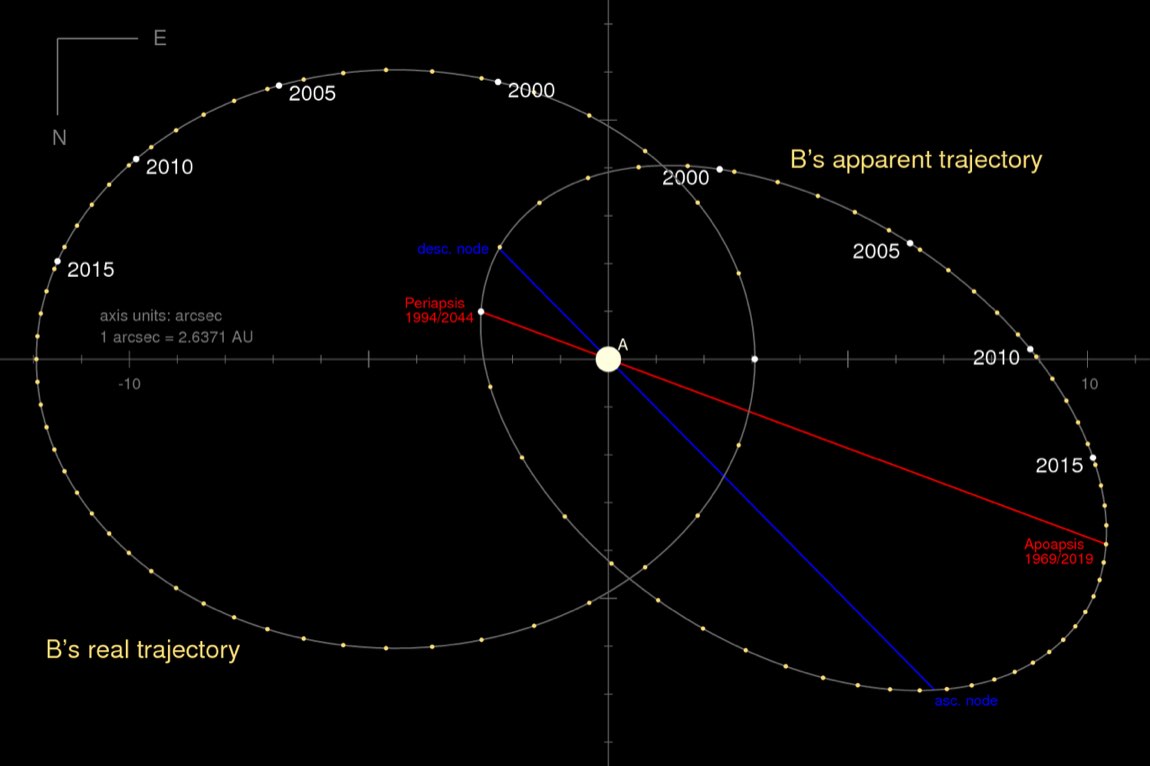
Sirius is the brightest star in our night sky, unmistakable on winter evenings (northern hemisphere) below Orion. It is a hot white star twice the Sun's mass, 25 times its luminosity — and genuinely close, just 8.6 light-years away. Circling it every 50 years is Sirius B, a white dwarf: the burned-out core of a star that died 120 million years ago, now the size of Earth but the mass of the Sun.
Go deeper
Sirius B was the first white dwarf discovered (1862) and remains the nearest — matter so compressed that a teaspoon weighs tonnes, held up not by fusion but by electron degeneracy pressure. Its existence was deduced before it was seen, from Sirius A's wobble. Sirius A itself is young (~240 Myr) and metal-rich; ancient Egypt timed its calendar to Sirius's dawn rising, which heralded the Nile flood.
01 Why does Sirius twinkle in colors?
Low on the horizon, Sirius famously flashes red, blue and white. That's not the star — it's Earth's atmosphere acting as a shifting prism, splitting its intense white light. The steadier a star sits overhead, the less it twinkles. Sirius gets reported as a UFO more than any other star.
02 The Pup Deeper
Sirius B ('the Pup') packs a full solar mass into an Earth-sized ball: surface gravity ~400,000 × Earth's. When astronomers measured its light's gravitational redshift in 1925, it was one of the first confirmations of general relativity's predictions in a stellar setting. In a few hundred million years it will cool into a black dwarf-in-waiting — the same fate our Sun faces, on a slower clock.
The deep dive
Researched for the Atlas from Wikipedia — Sirius (37,735 characters read) · updated Sep 20, 2026
03 A name older than the alphabet
The word "Sirius" reaches back at least to the 7th century BC, when the poet Hesiod used it in Works and Days — one of the earliest recorded uses of any star's name. It comes from the Ancient Greek Σείριος, meaning "glowing" or "scorcher," though scholars suspect the Greeks borrowed the word from somewhere older still; one authority proposes a connection to the Egyptian god Osiris. Across the centuries the star accumulated more than 50 other designations. Medieval European astrolabes called it Alhabor, from the Arabic al-'abūr, "the one who crossed over." In Sanskrit literature it appears as Mŕgavyādh, "deer hunter," and represents the god Rudra. Scandinavians called it Lokabrenna — "Loki's torch." The name Sirius was formally standardized for the star Alpha Canis Majoris A by the International Astronomical Union's Working Group on Star Names in its first bulletin of July 2016, cementing a word that had already been in daily use for nearly three thousand years.
04 How the Dog Star shapes its own calendar
Sirius has an unusual geometric advantage over most stars: its position far from the ecliptic means its heliacal rising — the first dawn appearance after weeks of invisibility — repeats with a period of almost exactly 365.25 days, matching the solar year with extraordinary precision. At Cairo this rising falls on 19 July in the Julian calendar, arriving just before the annual Nile flood. Ancient Egyptians worshipped Sirius as the goddess Sopdet, guarantor of their land's fertility, and treated the star's return as the anchor of their year. The 70-day disappearance of Sirius from the night sky was understood as Sopdet's journey through the underworld. Sopdet was later merged with Isis, linking Sirius symbolically to the most important goddess in the Egyptian pantheon. Meanwhile Greek observers dreaded the star's summer reappearance, believing its "emanations" wilted crops and weakened men — the original "dog days." On the Aegean island of Ceos, priests watched whether Sirius rose clear or hazy to forecast the season's fortune, a practice memorialized on 3rd-century BC coins showing dogs and rayed stars.
05 Measuring Sirius: a very long struggle Deeper
Getting an accurate distance to Sirius took two and a half centuries of effort. In 1698 Christiaan Huygens estimated its distance at 27,664 times the Earth–Sun separation — about 0.437 light-years — implying a parallax near 7.5 arcseconds, far too large. A string of observers including Jacques Cassini, Nevil Maskelyne, and Giuseppe Piazzi all tried and got values between 4 and 6 arcseconds, still wrong. Friedrich Wilhelm Bessel himself found no sensible parallax at all. Scottish astronomer Thomas Henderson, using observations from 1832 to 1837 combined with data from South African astronomer Thomas Maclear, finally converged on 0.23 arcseconds, writing cautiously in 1839 that the parallax was "probably much less" than half an arcsecond. Astronomers then used 0.25 arcseconds as the accepted figure for most of the 19th century. The true value is nearly 0.4 arcseconds. Today the Hipparcos satellite places Sirius at 8.60 light-years with a statistical uncertainty of plus or minus 0.04 light-years, while a Gaia Data Release 3 measurement of Sirius B gives 8.709 ± 0.005 light-years — though that figure is flagged for astrometric excess noise and may be unreliable.
06 The hidden companion nobody could see
Long before anyone glimpsed Sirius B through a telescope, mathematics betrayed its existence. In a letter dated 10 August 1844, German astronomer Friedrich Wilhelm Bessel reported that the proper motion of Sirius was not perfectly straight but showed a gentle wobble, which he interpreted as the gravitational tug of an unseen companion. It took nearly 18 more years for technology to catch up with the prediction. On 31 January 1862, American telescope-maker Alvan Graham Clark spotted the faint companion while testing an 18.5-inch (470 mm) aperture great refractor — at the time the largest refracting telescope lens in the United States — intended for Dearborn Observatory. The sighting was confirmed on 8 March 1862 with smaller instruments. More than five decades later, in 1915, Walter Sydney Adams used the 60-inch (1.5 m) reflector at Mount Wilson Observatory to record the spectrum of Sirius B and established it as a faint whitish star, leading astronomers to classify it as only the second white dwarf ever discovered. The diameter of Sirius A itself was not measured until 1959, when Robert Hanbury Brown and Richard Q. Twiss used their stellar intensity interferometer at Jodrell Bank.
07 Why ancient writers called Sirius red Deeper
Around 150 AD, Claudius Ptolemy listed Sirius among six "reddish" stars — company that also included Betelgeuse, Antares, and Arcturus, which genuinely are orange or red today. Sirius is now a brilliant blue-white. The puzzle was first formally aired at the Royal Society in 1760 by amateur astronomer Thomas Barker, and the debate was periodically revived, most notably when Thomas J. J. See compiled ancient citations in 1892 and 1926, including the claim of the philosopher Seneca that Sirius was redder than Mars. A particularly striking piece of evidence surfaced in 1985, when German astronomers Wolfhard Schlosser and Werner Bergmann identified an 8th-century Lombardic manuscript describing a bright star as rubeola — reddish — which they argued referred to Sirius B during a red-giant phase. Modern physics rejects all intrinsic explanations: stellar evolution simply cannot change a star's colour on a timescale of thousands of years, and there is no trace of the nebulosity such a transformation would leave behind. Reddening by interstellar dust thick enough to turn Sirius red would also dim it by several magnitudes — far beyond what any ancient source records. The most plausible surviving explanation is atmospheric: Sirius was systematically observed near the horizon during heliacal risings across the Mediterranean, precisely when atmospheric scattering reddens starlight, just as it reddens sunrises. Chinese observers, lacking that tradition, consistently recorded Sirius as white from the 2nd century BC through the 7th century AD.
08 Sirius A from the inside out Deeper
Sirius A carries a mass of 2.063 times the Sun's and a surface temperature of 9,940 K, hot enough to glow a strong blue-white. Stellar models indicate that after roughly 10 million years the star's internal energy became entirely nuclear, with its core becoming convective and running on the CNO cycle rather than the proton-proton chain that powers the Sun. One striking quirk is visible in its spectrum: Sirius A is classified as an Am star, meaning it shows abnormally deep absorption lines from heavy elements. Iron in its atmosphere is 316 percent as abundant as in the Sun's atmosphere — but this richness is almost certainly superficial. The star's relatively gentle surface gravity allows heavier elements to be radiatively levitated upward from the interior, concentrating them in the outermost layers rather than reflecting a globally metal-rich composition. The star's projected rotational velocity is only 16 km/s, slow enough that its disk shows no measurable flattening — a striking contrast to the similarly sized Vega, which spins at 274 km/s and bulges visibly at its equator. A weak magnetic field has also been detected at the surface. Sirius A is expected to exhaust its core hydrogen within a billion years of its formation, after which it will swell into a red giant and eventually become a white dwarf.
09 What Sirius B is made of Deeper
Sirius B began its life as a star of roughly 5 solar masses — probably a type B5V main-sequence star burning somewhere between 600 and 1,200 times more luminously than the Sun. It consumed its hydrogen, swelled into a red giant about 120 million years ago, shed its outer layers, and collapsed into a white dwarf with a mass of 1.02 solar masses — nearly double the typical white dwarf average of 0.5 to 0.6 solar masses — all packed into a volume roughly equal to Earth's. At its core lies a carbon-oxygen mixture produced by helium fusion in the progenitor star. Surrounding that is an envelope of lighter elements, with materials sorted by mass under the crushing surface gravity: the outermost atmosphere is now almost pure hydrogen, because it is the least massive element and floats to the top while everything heavier sinks below the detection threshold of spectroscopy. The current surface temperature is 25,200 K. With no ongoing nuclear reactions to replenish the heat, Sirius B will simply radiate away its remaining warmth over the next roughly two billion years. The Chandra X-ray Observatory has observed Sirius B actually outshining Sirius A as an X-ray source — a dramatic reversal of their optical hierarchy.
10 The question of a third body Deeper
Irregularities in the orbital motion of Sirius A and B have been tentatively noted since 1894, hinting at a possible third companion with an apparent periodicity of 6 to 6.4 years. A 1995 study concluded that such a body likely exists, estimating its mass at roughly 0.05 solar masses — placing it at the boundary between a small red dwarf and a large brown dwarf — with an apparent magnitude fainter than 15 and located within 3 arcseconds of Sirius A. However, in 2017 the Hubble Space Telescope provided astrometric measurements precise enough to rule out any object orbiting Sirius A with more than 0.033 solar masses (35 Jupiter masses) on a 0.5-year orbit, and more than 0.014 solar masses (15 Jupiter masses) on a 2-year orbit. No candidate was detected even to an accuracy of 5 milliarcseconds. An apparent "third star" observed in the 1920s is now believed to be a background object. The current consensus is that the Sirius system almost certainly contains no additional bodies larger than a small brown dwarf or large exoplanet — a conclusion further supported by a 2008 observational study that found no evidence of any third star or planet.
11 Sirius in motion: proper motion and its future
Sirius is not standing still. In 1717, Edmond Halley compared contemporary star positions with those recorded in Ptolemy's Almagest from the second century AD and found that Sirius had shifted about 30 arcminutes — roughly the apparent diameter of the full Moon — toward the southwest since Ptolemy's time, helping demolish the old idea that stars were fixed. Today the star is slowly drifting in the south-southwest direction and is gradually drawing closer to the Solar System. Over the next 60,000 years its brightness is expected to increase to a peak apparent magnitude of −1.68. Around the year 66,270 AD, Sirius will pass within 1.6 degrees of the south celestial pole, briefly serving as a southern Pole Star — a result of both axial precession and the star's own proper motion. After that the distance will grow again and Sirius will fade, but it will remain the brightest star in Earth's night sky for approximately 210,000 years into the future. Only then will Vega, an intrinsically more luminous A-type star, claim the title of brightest star. In 1868, Sirius also became the first star ever to have its radial velocity measured, when William Huggins studied its spectrum and detected a Doppler shift — though he concluded incorrectly that the star was receding at about 40 km/s; the modern value is −5.5 km/s, meaning it is approaching us.
12 Polynesian skies and the Bird of Sirius
While Mediterranean cultures feared Sirius as a summer harbinger of drought and disease, Polynesian navigators across the Pacific built an entire cosmological framework around it. Sirius served as the body of a great constellation called Manu — the Great Bird — with Canopus marking the southern wingtip and Procyon the northern, dividing the whole night sky into two hemispheres. Crucially, the star's declination of roughly −17 degrees matches the latitude of Fiji almost exactly, meaning Sirius passes directly overhead there every sidereal day and could serve as a precise latitude marker for navigators on open water. For the Māori it marked winter and was called Takurua, a word used for both the star and the season. In Hawaii its culmination at the winter solstice was celebrated and it was known as Ka'ulua, "Queen of Heaven." The Marquesas Islands knew it as Tau-ua; New Zealand as Rehua; Tahiti by two long ceremonial names, including Ta'urua-fau-papa, "Festivity of original high chiefs." Far from being a harbinger of ill fortune, for these cultures Sirius was a reliable calendar keeper and an essential guide across the largest ocean on Earth.
13 How to actually see both stars
Sirius is visible from virtually every inhabited place on Earth — only observers north of latitude 73° N are permanently denied the view, and from Saint Petersburg it climbs just 13° above the horizon. At magnitude −1.46 it is dimmer than Jupiter and Venus, and sometimes dimmer than Mercury and Mars, but it outshines every other star by nearly a factor of two. On exceptional days, with very clear skies, a high-altitude observing site, the star near the zenith, and the Sun low on the horizon, Sirius can even be glimpsed in daylight — conditions most easily met at sunset in March and April or sunrise in September and October. Separating Sirius A from Sirius B is a genuine challenge: the two range from 3 arcseconds to 11 arcseconds apart across their 50-year orbit, and at minimum separation a telescope of at least 300 mm (12 inches) aperture with excellent seeing conditions is required. Periastron last occurred in 1994, after which the pair moved apart. Apoastron came in 2019, and the greatest observational separation from Earth — 11.333 arcseconds — occurred in 2023, making that year the friendliest window in a generation for amateur observers wanting to glimpse the Pup.
14 Star cluster hidden behind Sirius
Even at 8.6 light-years away, Sirius manages to have a cosmic coincidence lurking just behind it. In 2017, astronomers conducting a statistical analysis of data from the Gaia space observatory discovered a massive star cluster located only 10 arcminutes away from Sirius on the sky — close enough that the two appear almost neighbours when viewed from Earth. In reality the cluster is more than a thousand times farther away than the Sirius system, yet it is large enough to shine at an apparent magnitude of 8.3, just beyond the naked-eye limit. The discovery illustrates how Gaia's precision astrometry can peel apart objects that appear spatially related but have no physical connection whatsoever. Separately, Sirius has long been associated with the Ursa Major Moving Group, a set of 220 stars sharing a common motion through space. The astronomer Ejnar Hertzsprung first proposed this membership in 1909, but analyses in 2003 and 2005 cast doubt on it: the Ursa Major Group is about 500 ± 100 million years old, while Sirius is estimated at only 230 million years — too young to belong. Sirius may instead be part of a looser proposed grouping called the Sirius Supercluster, one of three large clusters within 500 light-years of the Sun, alongside the Hyades and the Pleiades.
 ⤢
⤢
Could life exist here?
No planets are known; A's brilliance plus B's history of red-giant mass loss make stable habitability unlikely — searches continue.
Our labels: Confirmed · Strong Evidence · Estimated · Hypothesis · Theoretical · Speculative (see Methodology).
How would we get there?
8.6 light-years: double the Proxima problem. At Voyager speed, ~150,000 years.
Weird & wonderful
- Sirius outshines every star we see — yet 25-times-Sun is ordinary; it just lives next door.
- Its companion held the record as the most massive white dwarf known near Earth.
- Ancient Egyptians started their year on Sirius's first dawn appearance.
- In ~60,000 years Sirius will drift close enough to become even brighter.