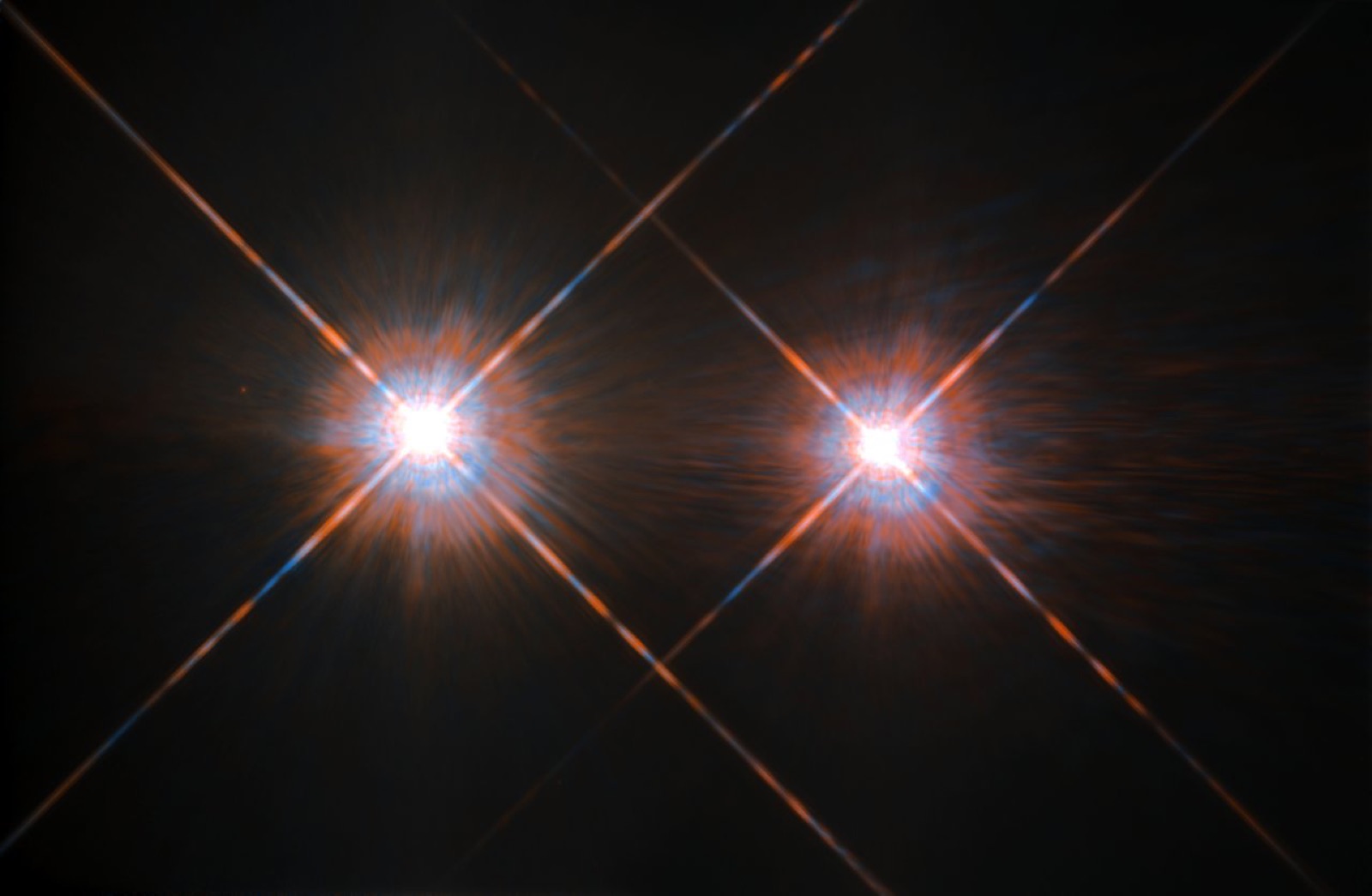
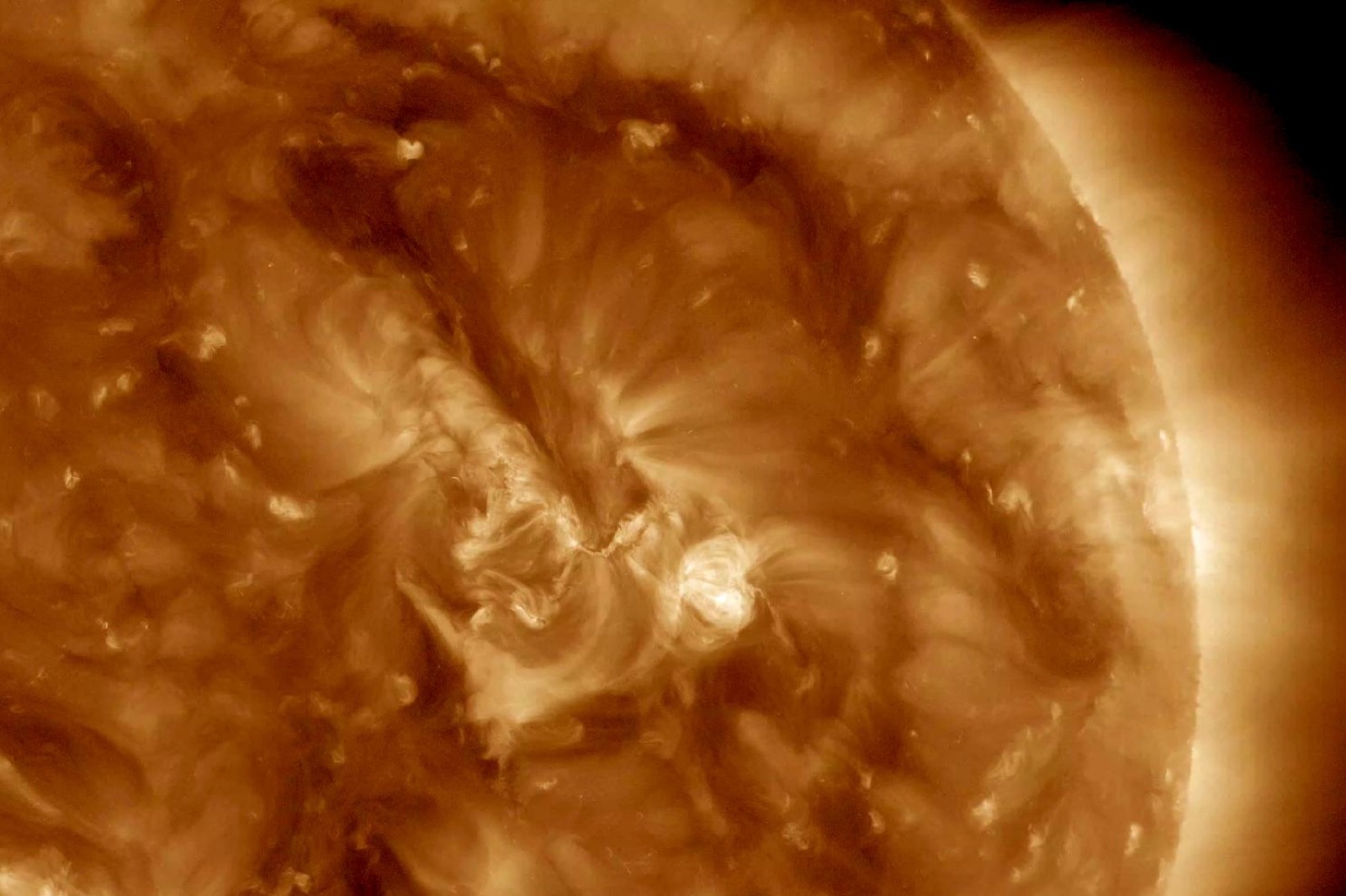
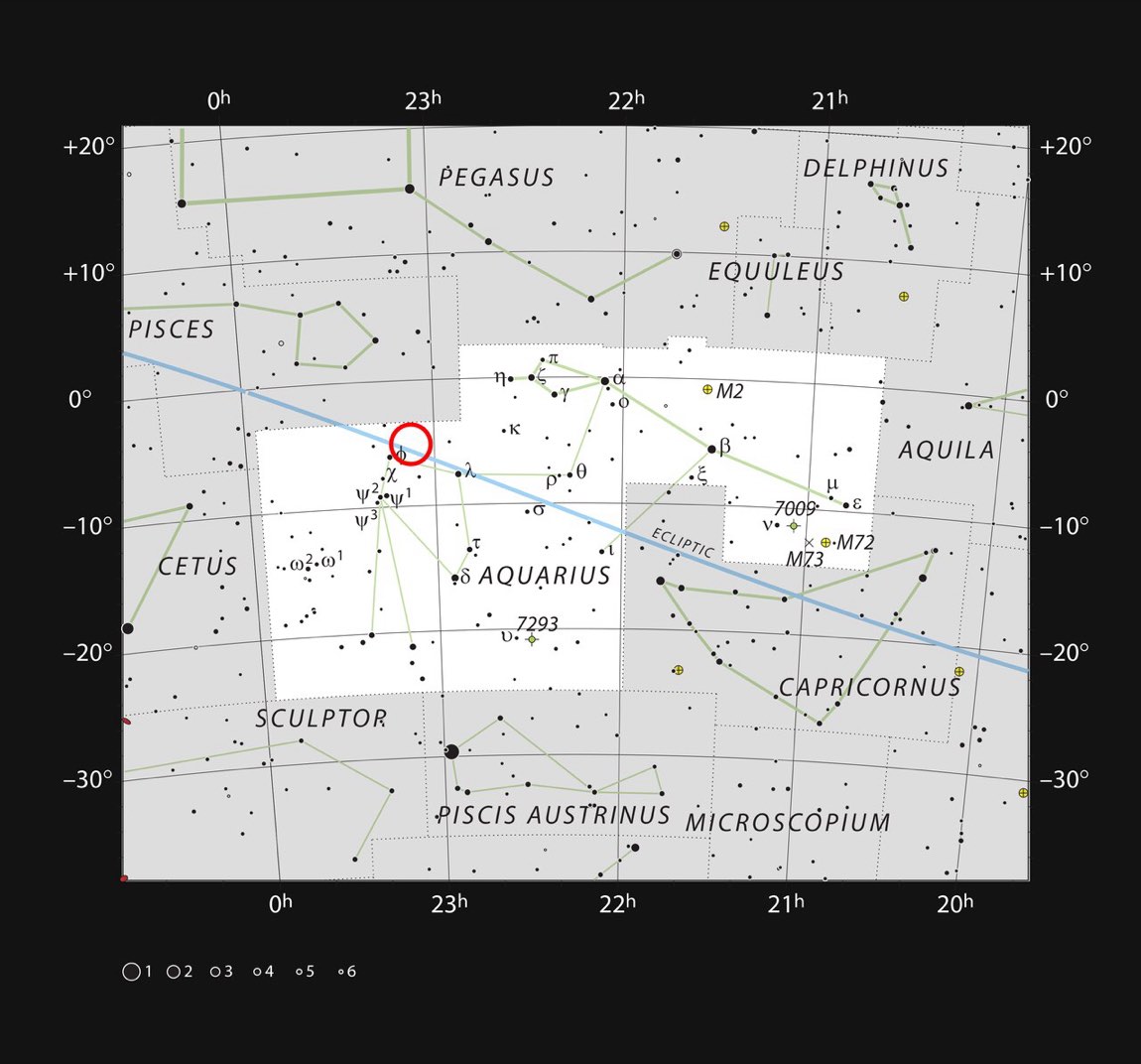
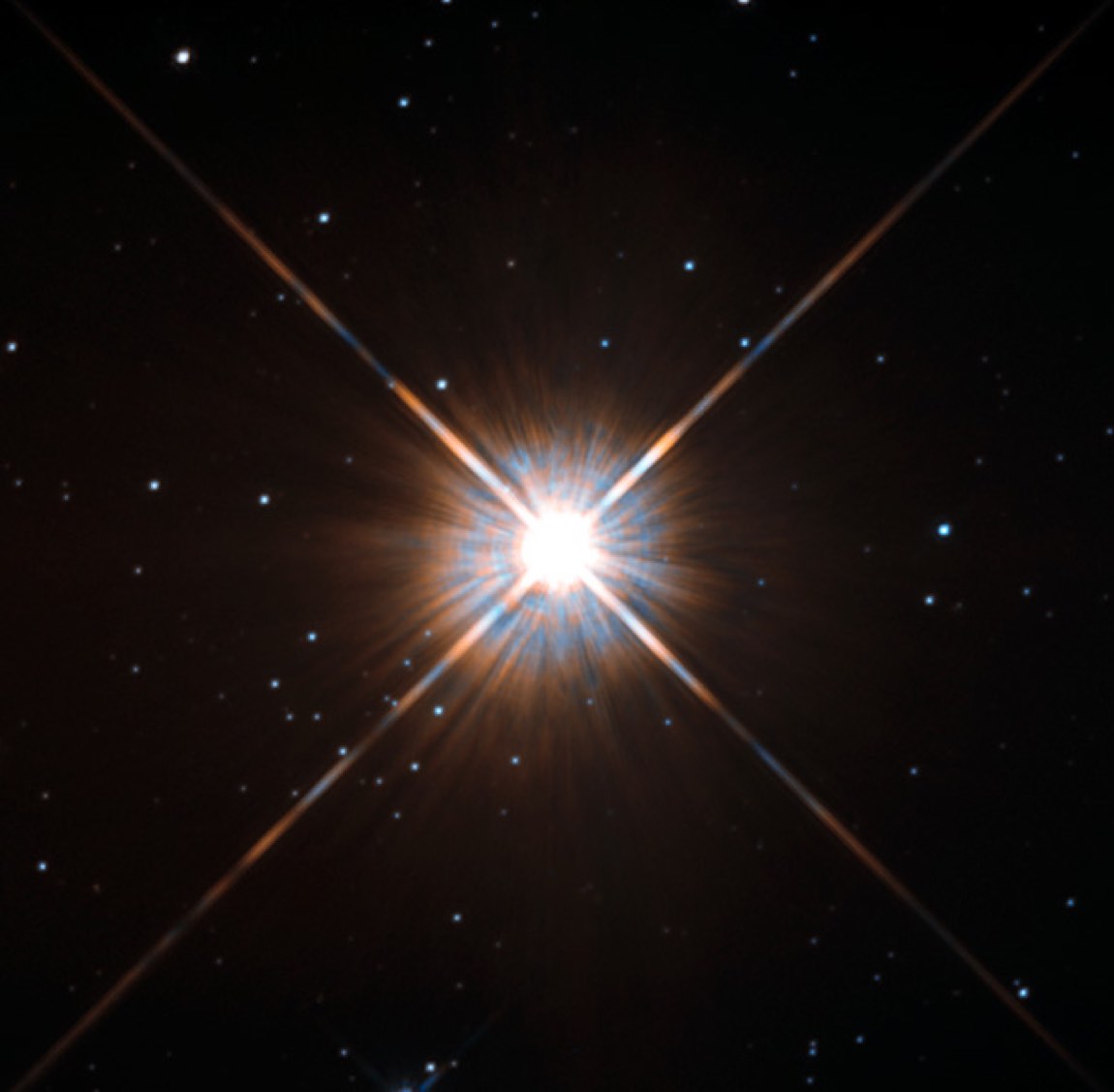
 Photograph · ESA/Hubble & NASA · CC BY 4.0
Star · Deep guide
Proxima Centauri
Also called: Alpha Centauri C
A tiny red dwarf with a planet in its habitable zone, and the nearest star to the Sun.
What is it?
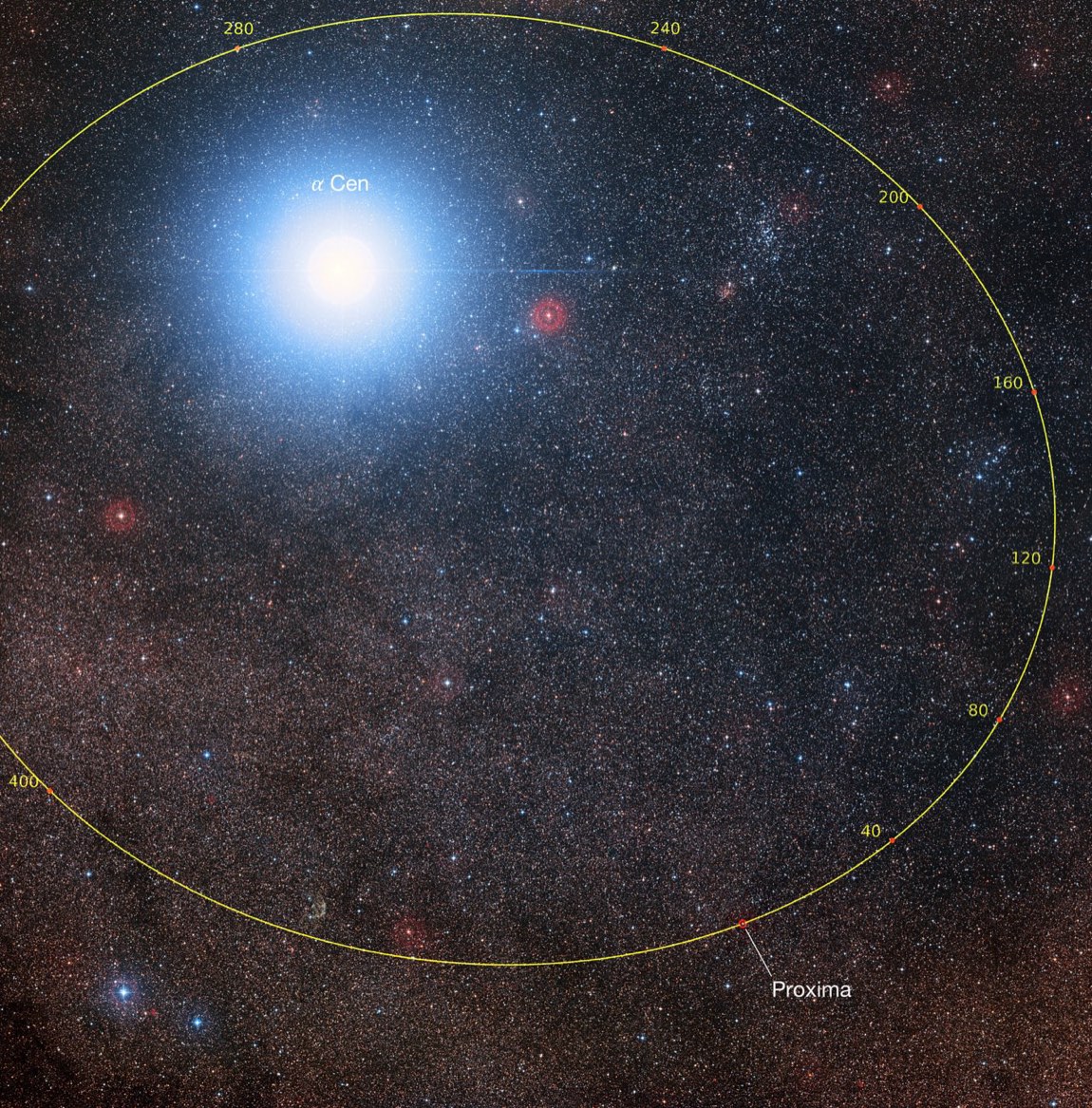
Proxima Centauri is our Sun's closest stellar neighbor, 4.246 light-years away. It is a red dwarf — a star so small and dim that, despite being the closest star there is, you cannot see it without a telescope. It orbits the bright pair Alpha Centauri A and B, and it hosts at least two confirmed planets, one of which — Proxima b — sits in the zone where liquid water is possible.
Go deeper
Proxima is an M5.5Ve flare star: convective throughout, it stores magnetic energy and releases it in violent flares that can briefly double its brightness — a serious problem for the habitability of Proxima b, which orbits 20 times closer than Earth does to the Sun. Red dwarfs like Proxima make up ~75% of all stars and burn so frugally that Proxima will still be shining in several trillion years — hundreds of times the current age of the universe. It takes ~550,000 years to orbit the Alpha Centauri pair.
01 Why can't we see the closest star?
Proxima gives off less than two-hundredths of one percent of the Sun's light. Even from next door (in cosmic terms), that is far too faint for human eyes — you would need a decent telescope and a good star chart. The bright 'closest star' you can actually see is its big sibling Alpha Centauri, visible from the southern hemisphere.
02 A dangerous neighborhood for planets Deeper
Proxima b receives about 65% of Earth's sunlight — promising on paper. But it likely keeps one face to the star (tidal locking), and Proxima's flares hit it with bursts of X-rays and charged particles that may have stripped its atmosphere long ago. Whether red-dwarf planets can keep atmospheres is one of the biggest open questions in exoplanet science — JWST is testing it on nearby systems right now.
03 The first interstellar target Deeper
Every serious interstellar-travel concept starts with Proxima. Breakthrough Starshot's proposal — gram-scale probes on laser-driven light sails at 20% of light speed — would make the crossing in about 21 years. Status: early-stage research; the lasers, sails, and electronics all remain to be invented at scale.
The deep dive
Researched for the Atlas from Wikipedia — Proxima Centauri (25,426 characters read) · updated Sep 20, 2026
04 Discovered by chasing a moving star
The story of Proxima Centauri's discovery is a detective tale built on patience. In 1915, Scottish astronomer Robert Innes, then director of the Union Observatory in Johannesburg, South Africa, noticed that a dim star shared the exact same proper motion across the sky as the bright Alpha Centauri pair. Proper motion — the slow drift of a star against the background — is a telltale sign of a near neighbor, and matching motions strongly suggested a physical connection. Innes proposed the name Proxima Centauri, from the Latin for 'nearest of Centaurus.' Two years later, Dutch astronomer Joan Voûte at the Royal Observatory at the Cape of Good Hope measured its trigonometric parallax at 0.755 ± 0.028 arcseconds, confirming it sat at roughly the same distance from the Sun as Alpha Centauri — and noting it was the lowest-luminosity star known at the time. American astronomer Harold L. Alden sharpened that figure in 1928, measuring a parallax of 0.783 ± 0.005 arcseconds and confirming Innes's suspicion that this faint smudge was in fact the closer of the two. It took three nations and thirteen years to nail down the identity of our nearest stellar neighbor.
05 A star so dense it staggers the imagination Deeper
Despite being only about one-seventh the diameter of the Sun — roughly 1.5 times the diameter of Jupiter — Proxima Centauri packs in about 12.2% of the Sun's entire mass. That compression produces an extraordinary mean density of 47,100 kg/m³, compared with just 1,411 kg/m³ for the Sun — making Proxima Centauri about 33 times denser than our star on average. The surface gravity is even more startling. Measured as log g = 5.20 in standard astronomical units, that translates to a surface gravitational pull 162 times stronger than Earth's. A person weighing 70 kg on Earth would effectively weigh more than 11,000 kg standing on Proxima Centauri's surface. These extreme properties arise directly from the physics of low-mass stellar interiors: the less massive the red dwarf, the more tightly gravity squeezes its material. Optical interferometry with the Very Large Telescope confirmed its angular diameter at 1.02 ± 0.08 milliarcseconds in 2002, allowing its true physical size to be calculated directly from its known distance — a rare opportunity that Proxima's cosmic closeness uniquely affords.
06 Fully stirred: a star with no quiet center Deeper
Inside the Sun, energy works its way outward in two distinct layers: a radiative zone where photons bounce for hundreds of thousands of years, and a convective zone near the surface where hot plasma physically rises. Proxima Centauri has no such division. Its low mass means the entire interior is convective, with plasma circulating from core to surface in a continuous churn. The practical consequence is profound: the helium 'ash' produced by hydrogen fusion does not pile up at the center, as it does in the Sun. Instead, it gets mixed throughout the whole star. Where the Sun will only burn through roughly 10% of its hydrogen before abandoning the main sequence, Proxima Centauri will consume nearly all of its fuel. That makes Proxima an extraordinarily efficient stellar furnace — and is precisely why it will remain on the main sequence for roughly four trillion years, about 300 times longer than the Sun's total lifespan. This complete convection also continuously regenerates the magnetic field, linking the star's quiet interior directly to the violent flaring seen at its surface.
07 The slow spin of a very old star
Proxima Centauri is a slow rotator by stellar standards, and pinning down exactly how slow has required decades of observation. A 1998 photometric study suggested it completes one full rotation every 83.5 days. A 2002 analysis of chromospheric activity hinted at a longer period of 116.6 ± 0.7 days. Later magnetic field observations found 89.8 ± 4 days, consistent with a radial velocity measurement of 92.1 days. The most recent estimate, as of 2026, settles on 84.9 ± 0.6 days. For comparison, the Sun rotates in about 25 days at its equator. This sluggish spin matters enormously because rotation drives magnetic activity: as red dwarfs age and their rotation slows, their flaring and overall activity level winds down. Proxima's relatively low overall activity, despite having an active chromosphere, is consistent with an estimated age of 4.85 billion years — about the same age as our Solar System. The star is thought to be tilted at 47° ± 7° relative to our line of sight, which complicates efforts to determine its exact spin rate from Doppler measurements alone.
08 Flares that dwarf the entire star
Proxima Centauri's convective churning continuously regenerates a magnetic field, and that field releases energy explosively at the surface. Flares can last as briefly as ten seconds, yet the largest can grow as big as the star itself and reach temperatures of up to 27 million K — hot enough to radiate X-rays. In 2016, a superflare boosted the star's optical brightness by a factor of 68 times, briefly pushing it to approximately magnitude 6.8 and making it nearly visible to the naked eye. Such extreme events are estimated to occur around five times every year, yet each lasts only a few minutes, which is why none had been caught before. On 6 May 2019, another record-setting flare produced a far ultraviolet emission of 2 × 10³⁰ erg, briefly becoming the brightest flare ever detected. Despite all this violence, Proxima Centauri's quiescent X-ray luminosity — approximately 4 to 16 × 10²⁶ erg/s — is roughly equal to that of the much larger Sun. About 88% of the star's surface is considered active, far higher than the Sun even at solar maximum, and its coronal temperature sits at 3.5 million K even during quiet periods.
09 The star's own 442-day weather cycle Deeper
The Sun's activity waxes and wanes over a well-known 11-year solar cycle, driven by the rise and fall of its magnetic field. Proxima Centauri has its own analogous cycle, but it runs much faster: observations show the overall activity level varying with a period of roughly 442 days, less than a year and a half. The underlying mechanism is similar — changing magnetic field geometry modulating how much flare activity and chromospheric emission the star produces — but the compressed timescale reflects the different interior physics of a fully convective star. The chromosphere itself is conspicuously active; Proxima's spectrum displays a strong emission line of singly ionized magnesium at a wavelength of 280 nm, a reliable indicator of chromospheric heating. Despite all this activity, Proxima Centauri is actually considered a relatively calm red dwarf compared to younger members of its class. Its stellar wind, for instance, carries no more than 20% of the mass-loss rate of the solar wind — though because the star is so much smaller, the mass loss per unit of surface area may still be eight times higher than the Sun's.
10 Proxima's eventual fate: blue, then white
Proxima Centauri's multi-trillion-year future holds a fate strikingly different from the Sun's. Because it will fuse nearly all of its hydrogen, it will not swell into a red giant. Instead, as hydrogen depletes over the next four trillion years, the star will actually shrink and heat up, gradually transforming into what astronomers call a 'blue dwarf' — a phase that is purely theoretical since the universe is not yet old enough for any star to have reached it. Near the end of this long arc, Proxima Centauri will become significantly more luminous, reaching about 2.5% of the Sun's current luminosity, and it will briefly warm any remaining orbiting bodies for several billion years. After that comes the final act: without enough mass to ignite helium fusion, it will quietly collapse into a helium white dwarf, bypassing the dramatic planetary nebula stage entirely, and then spend unimaginable eons slowly cooling into darkness. There will be no explosive finale — just a slow, dignified fading.
11 A gravitational companion with a very long orbit
For most of the twentieth century it was suspected but not proven that Proxima Centauri is a true gravitational companion of the Alpha Centauri binary — not merely a line-of-sight neighbor. High-precision radial velocity measurements by Kervella and colleagues in 2017 finally confirmed with high confidence that all three stars are gravitationally bound. Proxima orbits the Alpha Centauri AB barycenter with a period of 547,000 years — give or take a few thousand — along a noticeably elongated path with an eccentricity of 0.5 ± 0.08. At its closest (periastron) it approaches to 4,300 AU, and at its farthest (apastron) it retreats to about 13,000 AU. Right now, Proxima sits at about 12,947 AU from the AB pair — close to the far end of its orbit. From Earth, that separation appears as just 2.18 degrees: four times the apparent diameter of the full Moon. But this partnership has an expiration date. As the Alpha Centauri stars age and gradually shed mass, their gravitational grip will weaken, and Proxima is predicted to drift free of the system in about 3.5 billion years.
12 The tiny planet that tugs its star with magnetism Deeper
Proxima Centauri d is one of the lightest planets ever detected by the radial velocity method, with a minimum mass of just 0.29 times that of Earth. It orbits extremely close to its star — only 0.028 AU, or about 4.2 million km — completing one circuit every 5.15 days. First spotted in 2019 as a puzzling spike in ESPRESSO instrument data and formally announced in February 2022, it was independently confirmed by the NIRPS spectrograph in work published in July 2025. What makes Proxima d especially remarkable is new evidence of a strong planetary magnetic field estimated at roughly 16 gauss — far stronger than Earth's surface field of about 0.5 gauss. According to an analysis of 2026 ESPRESSO data, this magnetic field is powerful enough that Proxima d appears to be inducing phase-locked stellar flares on Proxima Centauri itself: the planet's proximity and magnetic strength trigger bursts of activity on the star in step with the planet's orbit. If confirmed, this would be one of the most direct examples ever seen of a planet actively influencing the magnetic behavior of its host star.
13 The parallax proof from New Horizons
On 22 and 23 April 2020, NASA's New Horizons spacecraft — then outbound beyond Neptune on its post-Pluto journey — turned its camera toward Proxima Centauri and Wolf 359. Because New Horizons was roughly 42 AU from Earth at the time, the parallax shift it observed was far larger than anything measurable from a single Earth-based telescope: Proxima appeared at a noticeably different position against the background stars compared with simultaneous images taken from Earth. The result is a visually striking demonstration of cosmic geometry — the closest thing to a direct depth-perception view of our stellar neighborhood. The exercise was primarily illustrative and did not improve on the precision of existing parallax measurements. The best current figure for Proxima's distance, from the Gaia spacecraft's 2020 Data Release 3, is a parallax of 768.0665 ± 0.0499 milliarcseconds, placing Proxima at exactly 4.2465 light-years — 268,550 AU — from the Sun. That precision represents a measurement uncertainty of less than one part in fifteen thousand.
14 How Proxima Centauri's distance has been measured Deeper
Measuring the distance to Proxima Centauri has been a century-long exercise in increasing precision. Joan Voûte's 1917 ground-based measurement of 0.755 ± 0.028 arcseconds gave a reasonable first estimate. Harold Alden refined it to 0.783 ± 0.005 arcseconds in 1928. The Hipparcos satellite published 772.33 ± 2.42 milliarcseconds in its original 1997 catalogue, revised to 771.64 ± 2.60 milliarcseconds in the 2007 New Reduction. The Hubble Space Telescope's fine guidance sensors achieved 768.77 ± 0.37 milliarcseconds in 1999. The first Gaia data release in 2018 delivered 768.5 ± 0.2 milliarcseconds, and the 2020 Gaia Data Release 3 sharpened this to 768.0665 ± 0.0499 milliarcseconds — an uncertainty of just 65 microarcseconds, roughly the apparent size of a coin at a distance of 65,000 km. This century of effort has shrunk the measurement uncertainty by a factor of more than 500. The Research Consortium On Nearby Stars contributed an independent value of 768.13 ± 1.04 milliarcseconds in 2014, providing a useful cross-check on the space-based missions.
15 Reading Proxima Centauri's light: mostly invisible
Almost everything Proxima Centauri radiates, it radiates where human eyes cannot see. The star's total luminosity across all wavelengths is just 0.16% of the Sun's, already astonishingly faint. But in the visible wavelengths that our eyes are most sensitive to, Proxima shines at only 0.0056% of the Sun's visible output — roughly 1,800 times dimmer than its already dim total luminosity figure suggests. The reason is that more than 85% of the star's radiated power pours out in the infrared. Its effective temperature of around 3,000 K — compared with the Sun's 5,778 K — means the peak of its emission spectrum is pushed well into infrared wavelengths, with comparatively little energy left over for the visible range. The star's spectral class is M5.5, placing it firmly at the low-mass, cool end of the M dwarf sequence. Its apparent visual magnitude is 11.13, requiring at minimum an 8 cm telescope under ideal dark-sky conditions to detect. Even from the surface of Alpha Centauri A or B, Proxima would appear as only a fifth-magnitude star — faintly visible but unremarkable to the naked eye.
16 Proxima d's magnetic storm connection Deeper
The confirmation of Proxima Centauri d opened an unexpected window into star-planet magnetic interactions. When astronomers analyzed ESPRESSO data from 2026, they found evidence that Proxima d carries a magnetic field of approximately 16 gauss at its surface. For context, Earth's surface magnetic field averages about 0.5 gauss, making Proxima d's field roughly 32 times stronger. The planet is so close to its star — just 0.028 AU, completing an orbit every 5.15 days — that this strong magnetic field appears to reach across the gap and directly trigger flare activity on Proxima Centauri. The stellar flares appear phase-locked to the planet's orbital period, meaning the eruptions follow the same rhythm as the planet's journey around the star. This phenomenon, sometimes called star-planet magnetic interaction, had been theorized for close-in planets around magnetically active stars, but catching it in action at Proxima Centauri provides one of the clearest observational cases yet. It also complicates the search for any additional planets in the system, since planetary-induced flares add noise to the very radial velocity signals astronomers use to detect planets.
 ⤢
⤢
Could life exist here?
Proxima b orbits in the habitable zone, but flare bombardment and tidal locking are serious obstacles. No evidence either way yet — a prime JWST-era target.
Our labels: Confirmed · Strong Evidence · Estimated · Hypothesis · Theoretical · Speculative (see Methodology).
Could humans live here?
The nearest possible destination for any future interstellar mission — and still 280,000 times farther than Mars at its closest.
How would we get there?
With chemical rockets: ~75,000 years. With proposed laser sails: ~21 years for gram-scale robots, one-way, no stopping. Crewed travel to any star remains firmly theoretical.
Weird & wonderful
- Proxima will outlive the Sun by trillions of years.
- Its habitable-zone planet has a year of just 11.2 Earth days.
- A flare in 2017 briefly made Proxima 68 times brighter in some wavelengths.
- Light you see from Proxima tonight left it more than four years ago.