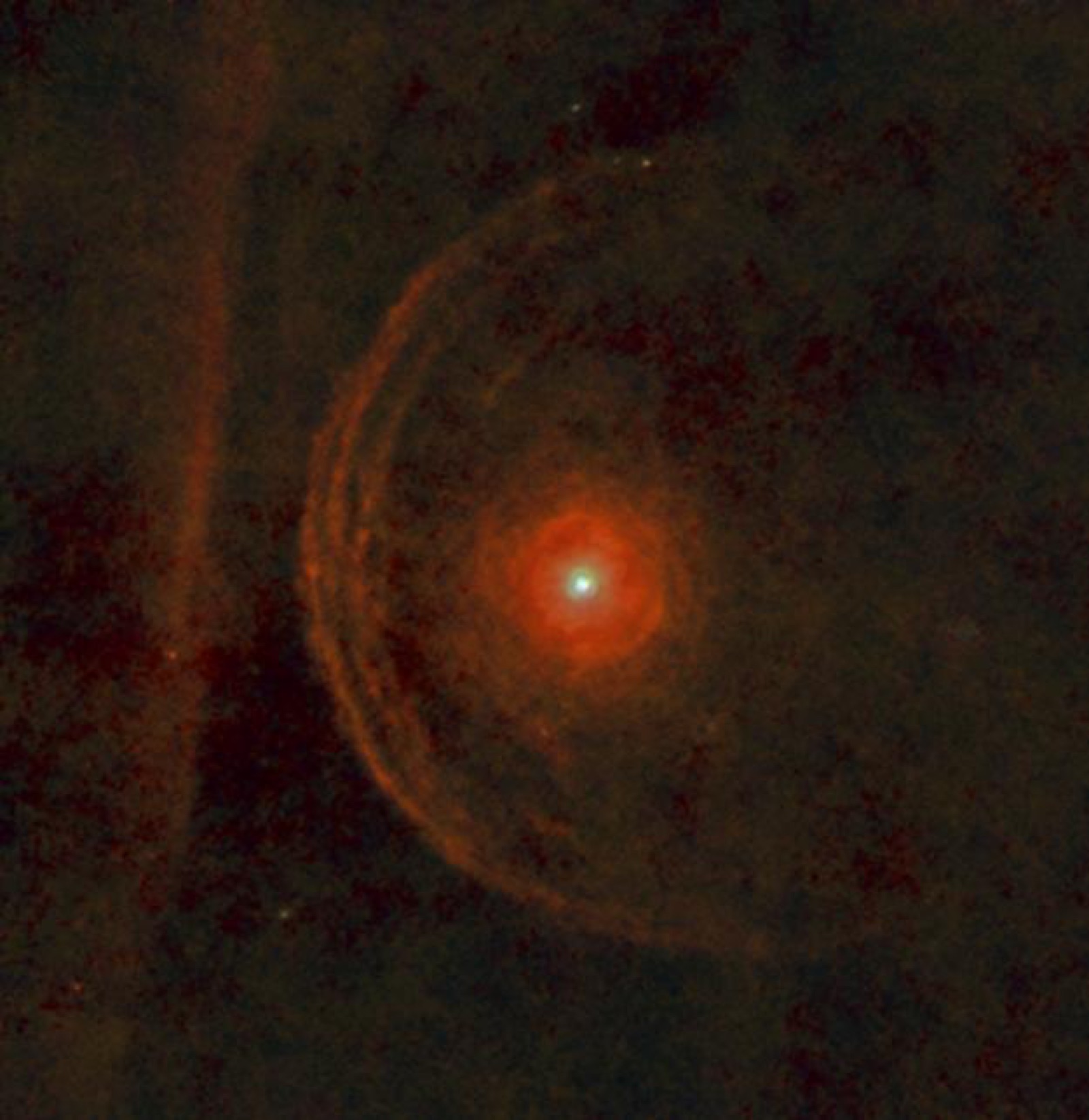
 Photograph · ESA/Herschel/PACS/L. Decin et al. / NASA Image Library
Star · Deep guide
Betelgeuse
Also called: Alpha Orionis
One day this dying supergiant, Orion's red shoulder, will explode as a supernova.
What is it?
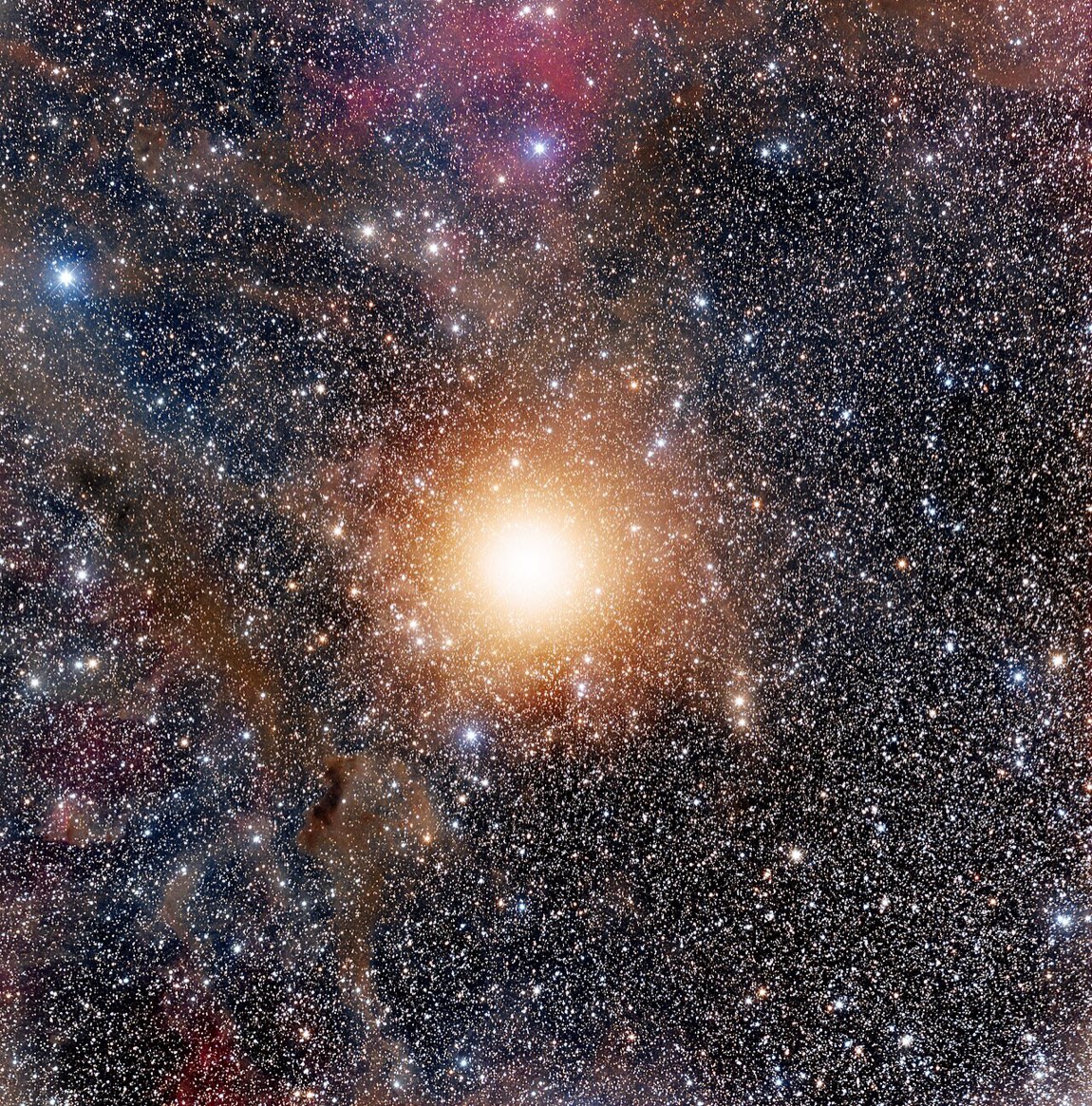
Betelgeuse is the bright orange-red star marking Orion's shoulder — one of the largest stars visible to the naked eye. It is a red supergiant near the end of its life: if it sat where the Sun is, its surface would swallow Mercury, Venus, Earth, Mars, and reach toward Jupiter. Sometime in the next ~100,000 years it will collapse and explode as a supernova bright enough to see in daytime.
Go deeper
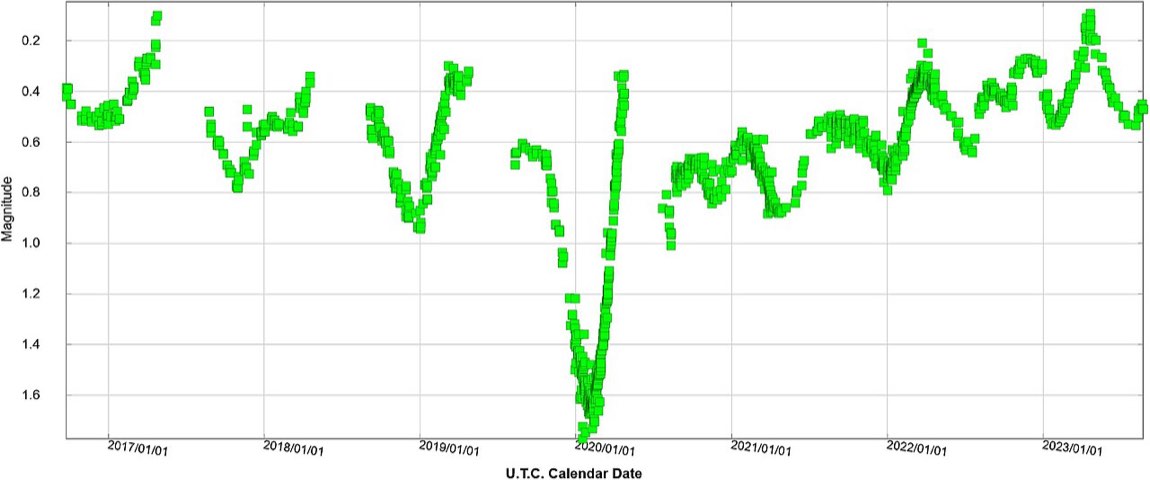
Betelgeuse burns heavy elements in shells around a growing iron core — the endgame of a ~15–20 solar-mass star. Its distance is genuinely uncertain (roughly 500–650 ly; the star's boiling surface defeats clean parallax), which propagates into every other parameter. The 2019–20 'Great Dimming' — when it faded by two-thirds — was traced by Hubble and ESO imaging to a surface mass ejection whose dust briefly veiled the star, a direct look at how supergiants shed mass. When it blows, the neutrino burst arrives hours before the light; the explosion will rival the full Moon, cast shadows, and pose zero danger at this distance.
01 How big is it, really?
Numbers fail here, so try this: if Earth were a marble, the Sun would be a beach ball a hundred meters away — and Betelgeuse would be a sphere the size of a sports stadium. Around 700 million Suns would fit inside it. Yet its outer layers are thinner than Earth's air: a 'red-hot vacuum' glowing across half a solar system.
02 When it explodes Deeper
The core will fuse its way to iron — the element that absorbs rather than releases energy — then collapse in under a second. The rebound shock, powered by an unimaginable neutrino flood, blows the star apart. From Earth: a new 'star' rivaling the full Moon for weeks, visible in daylight, then a slow fade — and Orion loses a shoulder. Neutrino observatories would give the world a few hours' warning.
03 The Great Dimming Deeper
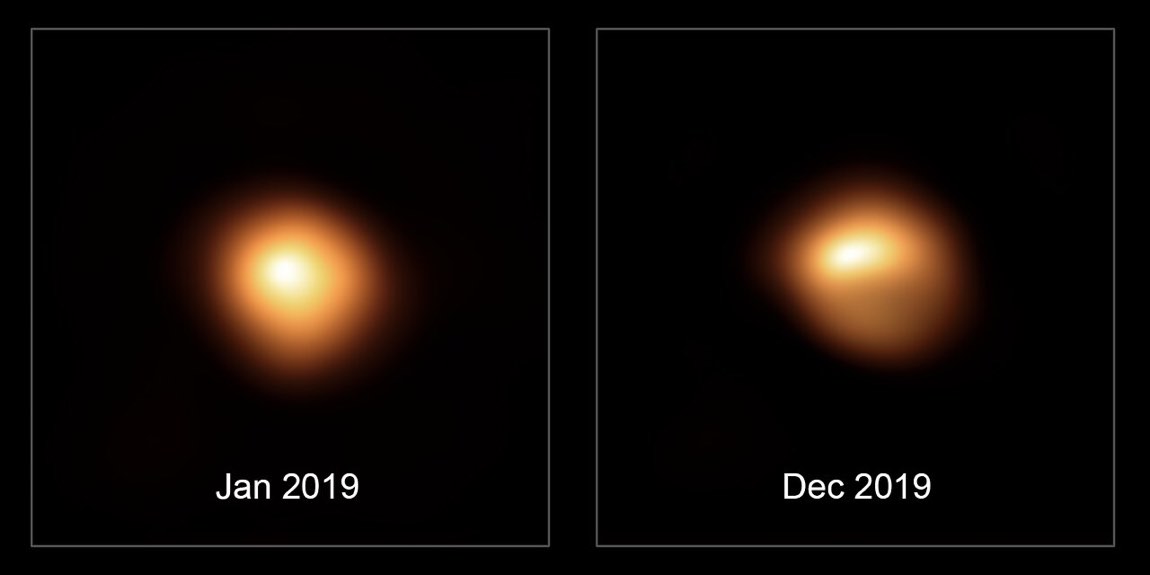
Between late 2019 and early 2020 Betelgeuse dropped to a third of its usual light, fueling supernova rumors. The verdict: the star burped a cloud of gas that condensed into dust across its face — the largest surface mass ejection ever watched in real time. It was a reminder that we can now image the surfaces of other stars.
The deep dive
Researched for the Atlas from Wikipedia — Betelgeuse (58,000 characters read) · updated Sep 20, 2026
04 A name born from a medieval mistranslation
The word Betelgeuse traces back to the Arabic phrase Yad al-Jawzā', meaning "the hand of al-Jawzā'" — the Arabic name for the constellation Orion. Somewhere in the 13th century, a copyist misread the Arabic letter yā' as bā', a confusion that differs by only a single diacritical dot. That small scribal slip sent the name on a journey through European languages until it settled into its modern form. Today the IAU formally recognizes the spelling Betelgeuse, catalogued in its first bulletin of approved star names in July 2016. As for how to say it, there is no single correct pronunciation in English: versions with a soft g (as in the 1988 film Beetlejuice) have become especially common, though hard-g pronunciations also exist and were historically standard. The recently discovered candidate companion star has received its own Arabic-derived name, Siwarha, meaning "her bracelet" — officially recognized by the WGSN on 22 September 2025.
05 Betelgeuse seen through history's eyes
The star's color has not always looked the same to observers across the centuries. The astronomer Ptolemy described it as hypókirrhos — roughly "orange-tawny" — while Chinese astronomers observing three centuries before Ptolemy recorded it as yellow. If that Chinese observation is accurate, it could mean Betelgeuse was passing through a yellow supergiant phase at the time, a possibility that current research into circumstellar environments does not rule out. A 2022 review of historical records supports the idea that the star changed color from yellow to red within the last few thousand years, and uses that color shift to estimate an initial mass of 14 solar masses and a distance between 125 and 150 parsecs. By the 19th century the star's variability was well enough documented that Sir John Herschel described it in his 1836 Outlines of Astronomy, noting that Betelgeuse outshone the normally brighter Rigel in October 1837 and again in November 1839. Aboriginal groups in South Australia had already been sharing oral accounts of its changing brightness for an unknown but likely far longer period.
 ⤢
⤢
06 The 1920 measurement that changed everything Deeper
On 13 December 1920, Betelgeuse became the first star beyond the Sun to have the angular size of its photosphere directly measured — a milestone in observational astronomy. Albert Michelson and Francis Pease mounted a six-meter interferometer on the front of the 2.5-meter telescope at Mount Wilson Observatory, assisted by John August Anderson. Using a uniform disk model they found an angular diameter of 0.047 arcseconds, which — combined with the then-assumed parallax of 0.018 arcseconds — translated to a physical diameter of 3.84×10⁸ km, or 2.58 AU. Limb darkening and measurement errors introduced uncertainties, but the number proved remarkably durable: a study published in December 2000 using the Infrared Spatial Interferometer at mid-infrared wavelengths produced a limb-darkened estimate of 55.2±0.5 milliarcseconds, described as entirely consistent with Michelson's findings eighty years earlier. The 1920 experiment worked because interferometry mimics the depth perception gained by using two eyes instead of one, a concept first proposed by Hippolyte Fizeau in 1868 and later embodied in the Michelson interferometer of the 1880s.
07 Why its distance is so hard to pin down Deeper
For a star only a few hundred light-years away, Betelgeuse has proven frustratingly difficult to locate precisely. Early interferometric work in 1920 assumed a parallax of 0.018 arcseconds, placing it at roughly 180 light-years — an underestimate that made every other calculated property wrong. By 1991 a measurement gave 9.8±4.7 milliarcseconds (about 330 light-years); the 1993 Hipparcos Input Catalogue gave 5±4 mas (about 650 light-years). The official Hipparcos mission result in 1997 was 7.63±1.64 mas, or roughly 427 light-years, but later analysis showed the uncertainty had been underestimated for variable stars. A 2007 recalculation tightened the error to 6.55±0.83 mas, yielding 500±65 light-years. Very Large Array radio observations in 2008 gave 5.07±1.10 mas, or 643±146 light-years. An updated result combining ALMA and e-MERLIN data puts the parallax at 4.51±0.8 mas, implying 724 light-years with an asymmetric uncertainty of +111/−156 light-years. A 2020 study using the Solar Mass Ejection Imager aboard the Coriolis satellite suggested the star is nearly 25% smaller and 25% closer than previously thought, at 548 light-years. The European Space Agency's Gaia mission could not help: Betelgeuse is far too bright for Gaia's instruments, which saturate at around magnitude 6, and the star appears in neither Data Release 2 nor Data Release 3.
08 A surface that churns like a slow boil
Betelgeuse does not have a placid surface. Imaging breakthroughs using aperture masking interferometry, pioneered by J.E. Baldwin and colleagues of the Cavendish Astrophysics Group, revealed bright hotspots on the photosphere — the first optical and infrared images of any stellar disk other than the Sun. These hotspots, each thought to emit 5–10% of the star's total light, appear to be enormous convection cells, a fraction of the star's own diameter across. The idea of massive convection cells dominating a red supergiant's surface was first put forward by Martin Schwarzschild decades before the imaging confirmed it. Gas in the extended atmosphere has been observed moving vigorously up and down, creating bubbles as large as the supergiant itself. In 2009, the Very Large Telescope Interferometer detected a vast plume of gas extending at least 30 AU from the star — a distance equal to that between the Sun and Neptune — in the southwest direction. At least six shells surrounding Betelgeuse have been identified by astronomers, and the star is not shedding mass evenly in all directions, suggesting that convection or rotation-driven polar outflows are shaping the outflow.
09 Layers of atmosphere stacked like an onion Deeper
Beyond the visible photosphere, Betelgeuse is wrapped in at least six distinct atmospheric layers. Closest in sits a molecular shell called the MOLsphere, located roughly 0.45 stellar radii above the photosphere, with a temperature of about 1,500±500 K. It contains water vapor and carbon monoxide, and possibly silicon monoxide and aluminum oxide — molecules that could seed dust grain formation. Surrounding that is an asymmetric gaseous envelope extending 10–40 AU from the photosphere, enriched in oxygen and especially nitrogen relative to carbon, the result of CNO-processed material dredged up from the stellar interior. The chromosphere, directly imaged by the Hubble Space Telescope's Faint Object Camera in ultraviolet light, had an average radius about 2.2 times the optical disk in 1996, with a temperature no higher than 5,500 K; later STIS observations suggested the chromosphere may stretch up to 200 AU from the star at a distance of 197 parsecs. Two outer shells of carbon monoxide (labeled S1 and S2) push even farther out — preliminary estimates place the outer CO shell as far as 7.0 arcseconds from the star, which at assumed distances corresponds to roughly 250 stellar radii, nearly fourteen times the size of the Solar System as measured by the Sun's heliopause at 100 AU.
10 A runaway star trailing a four-light-year wake
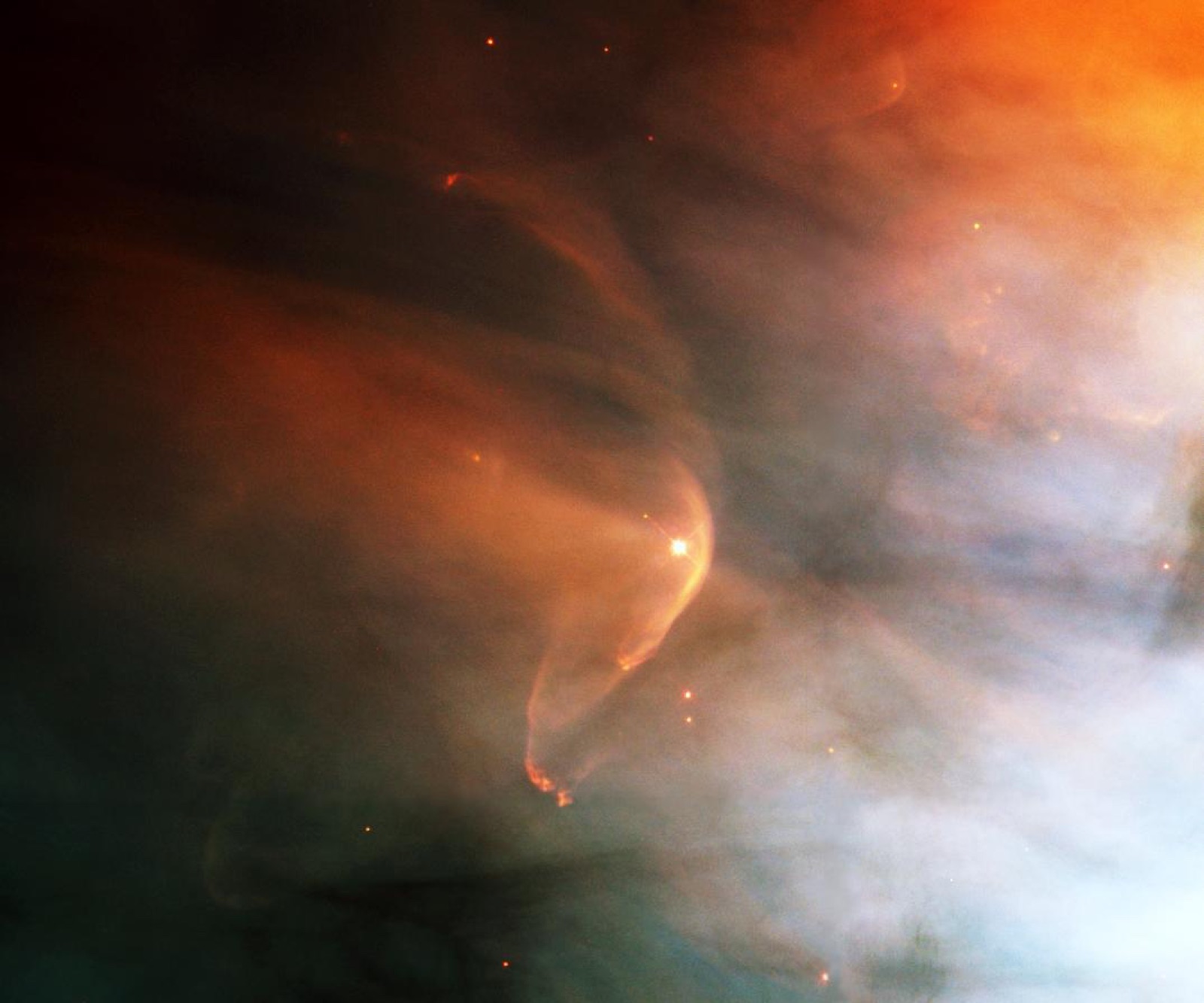
Betelgeuse is a runaway star, having been ejected from its birthplace in the Orion OB1 association — the same stellar nursery that produced the stars of Orion's Belt. It is now moving through the interstellar medium at 30 km/s, or about 6.3 AU per year. As it travels, its powerful stellar wind — blowing outward at 17 km/s — plows into the surrounding interstellar gas, heating it and creating a bow shock visible in infrared light. The cometary-shaped shock structure is estimated to be at least one parsec (roughly four light-years) wide, assuming a distance of 643 light-years. So bright is Betelgeuse that this bow shock was only first imaged in 1997, despite being enormous. Hydrodynamic simulations published in 2012 indicate the bow shock is very young — less than 30,000 years old — suggesting either that Betelgeuse recently entered a region of the interstellar medium with different properties, or that the star itself underwent a significant transformation, possibly transitioning from a blue supergiant to its current red supergiant state. If future research confirms that hypothesis, Betelgeuse may have traveled close to 200,000 AU as a red supergiant, scattering as much as 3 solar masses of material along its path.
 ⤢
⤢
11 The strange secondary brightness cycles Deeper
Betelgeuse's brightness never sits still. Its main pulsation period runs near 400 days, with a shorter first-overtone period of 185 days also detected. The ratio between these two periods carries information about the star's internal structure and age. The General Catalogue of Variable Stars lists a possible period of 2,335 days, and detailed analyses also identify a long secondary period of around 2,100 days. What drives these long secondary periods remains an open question. Radial pulsations — the straightforward expansion and contraction of the stellar envelope — cannot account for them. Competing explanations include the slow evolution of giant convection cells combined with stellar rotation, interactions with a close binary companion, chromospheric magnetic activity influencing mass loss, or non-radial oscillation modes such as gravity waves. Small-amplitude stochastic variations are layered on top of all these cycles, thought to result from granulation on a vastly larger scale than the Sun's. Betelgeuse's rotation adds another wrinkle: it spins slowly at 5.45 km/s, and has been calculated to take about 36 years to complete one rotation on an axis inclined at roughly 60° to the line of sight from Earth — far slower than Antares, which rotates at 20 km/s.
12 A flickering magnetic personality Deeper
For most of its observational history, Betelgeuse was not thought to host a significant magnetic field. In 2004, astronomers using computer simulations speculated that even a non-rotating Betelgeuse might display large-scale magnetic activity in its extended atmosphere, and that even moderately strong fields could meaningfully influence the star's dust, wind, and mass-loss behavior. Direct confirmation came in 2010, when spectropolarimetric observations made with the Bernard Lyot Telescope at the Pic du Midi Observatory revealed a weak magnetic field at the stellar surface. The field is thought to arise from a small-scale dynamo effect triggered by the giant convective motions characteristic of red supergiants. This finding linked magnetism directly to the convective engine driving the star's surface upheaval. Separate ultraviolet imaging with the Hubble Space Telescope's Faint Object Camera in 1995 captured a bright patch in the southwestern quadrant of the disk some 2,000 K hotter than the surrounding photosphere. Subsequent spectra from the Goddard High Resolution Spectrograph suggested this hotspot coincides with one of Betelgeuse's poles of rotation, implying a rotational axis inclined about 20° toward Earth at a position angle of roughly 55° from celestial north.
13 What the star is losing, and why it matters Deeper
Betelgeuse is shedding mass at a prodigious rate — estimates reach as high as one solar mass every 10,000 years, though a 2001 estimate by Graham Harper put the stellar wind contribution at 0.03 solar masses per 10,000 years. Research since 2009 has revealed that mass loss is episodic rather than steady, making any firm total uncertain. The first claim of a surrounding dust shell appeared in 1977, noting that excess infrared emission originates beyond about 12 stellar radii — roughly equivalent to the distance of the Kuiper belt at 50–60 AU, depending on the assumed stellar radius. By 1994 it was reported that Betelgeuse undergoes sporadic decades-long episodes of dust production followed by inactivity, and by 1997 significant year-to-year changes in the dust shell's shape were documented. The mechanism driving all this mass loss remains poorly understood. Martin Schwarzschild originally proposed that massive convection cells were responsible, and more recent work supports that hypothesis, but the precise structure of the convection, how dust forms in the extended atmosphere, and what triggers the eventual supernova all remain active areas of research. As one 2009 paper stated, stellar mass loss is "the key to understanding the evolution of the universe from the earliest cosmological times to the current epoch, and of planet formation and the formation of life itself."
14 How to find it in the sky tonight
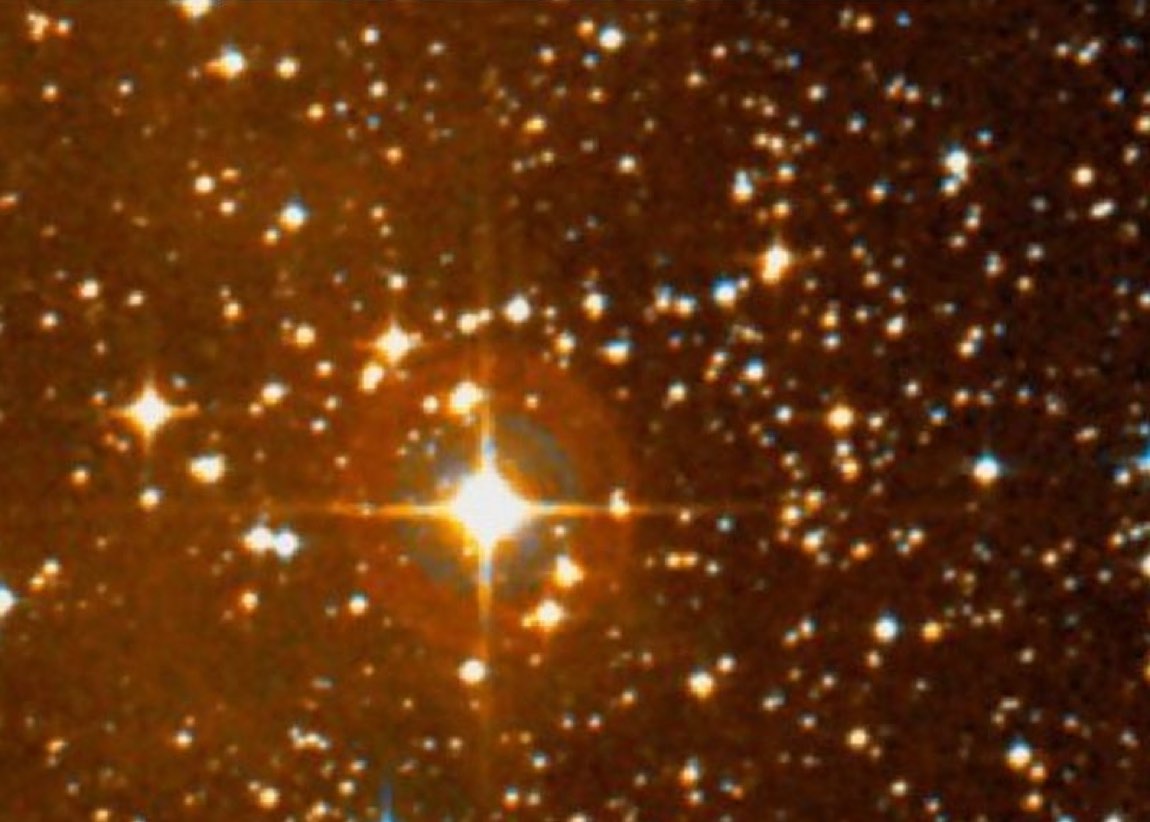
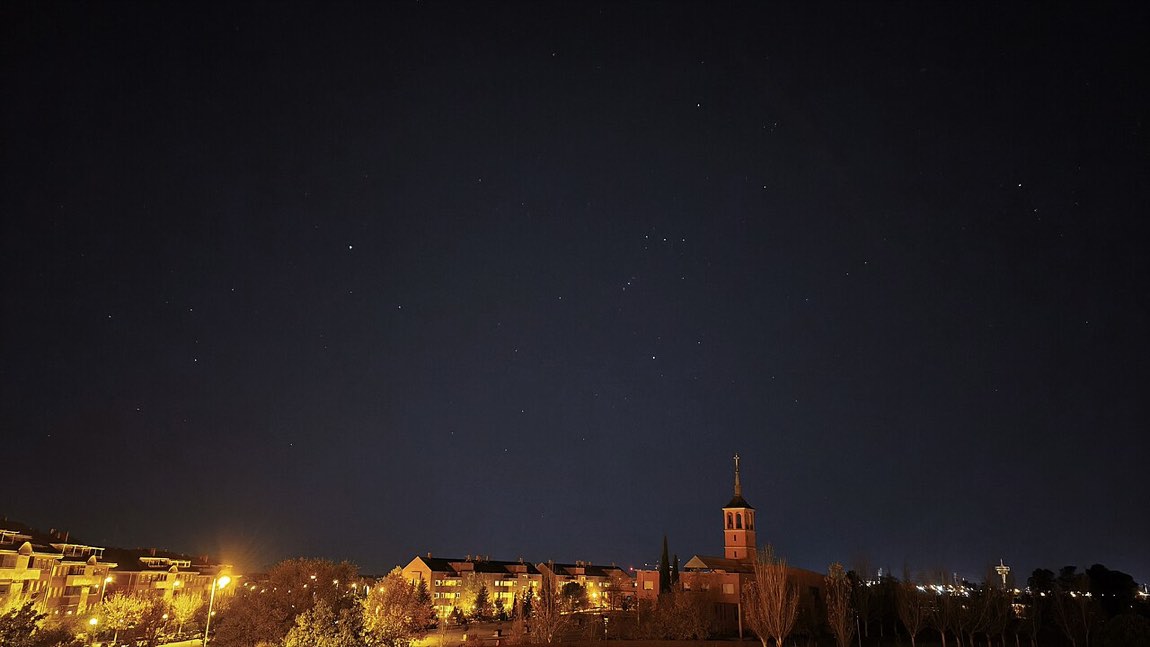
Betelgeuse is one of the easier bright stars to locate. Its distinctly orange-red color sets it apart from its neighbors, and it sits at the shoulder of Orion, one of the sky's most recognizable constellations. It rises in the east just after sunset in early January each year and is visible to virtually every inhabited location on Earth between mid-September and mid-March, with mid-December offering the best views — the only exceptions being Antarctic latitudes south of 82°. The star forms one vertex of the Winter Triangle asterism and marks the center of the larger Winter Hexagon. Only about 13% of its radiant energy emerges as visible light; at near-infrared wavelengths it is actually the brightest star in the entire sky, with a J-band magnitude of −2.99. If human eyes could perceive all wavelengths, Betelgeuse would outshine every other star. Its B−V color index of 1.85 quantifies how red it appears compared to a neutral white star. At its brightest it can surpass Rigel to become the sixth-brightest star in the sky; at its faintest it can drop to twentieth place, trailing even Deneb and Beta Crucis.
15 The shadow of a passing asteroid, 2023
Because Betelgeuse lies far from the ecliptic, the major planets never pass in front of it, but smaller asteroids do — and occasionally the geometry is dramatic. On 12 December 2023 at 01:12 UTC, the 14th-magnitude asteroid 319 Leona was predicted to occult Betelgeuse. The projected totality lasted approximately five seconds along a roughly 60-kilometer-wide path on Earth's surface stretching from Tajikistan and Armenia through Turkey, Greece, Italy, and Spain, across the Atlantic, and reaching Miami, Florida, the Florida Keys, and parts of Mexico. Because the angular diameter of the star is larger than that of most asteroids, earlier asteroid occultations had only been partial — a 2012 event involving the 19th-magnitude asteroid (147857) 2005 UW381 dimmed Betelgeuse by only about 0.01 magnitudes. The 2023 event was coordinated in part by astrophysicist Miguel Montargès and colleagues at the Paris Observatory, with at least 80 amateur astronomers across Europe participating. Beyond the drama of watching one of the sky's most famous stars briefly vanish, the occultation also offered a rare opportunity to measure the size and shape of 319 Leona itself.
 ⤢
⤢
16 The quiet possibility of a hidden companion
For most of its documented history Betelgeuse was treated as a single star, but evidence has been accumulating that it may not be alone. In 1985 and 1986, a team led by Margarita Karovska analyzed polarization data from 1968 through 1983, concluding that two companions existed: a closer one with an orbital period of about 2.1 years located at roughly 9 AU (potentially inside the star's own chromosphere), and a more distant one at about 77 AU. Those findings were contested and no subsequent study confirmed them. Then in 2024 two independent research groups reinvestigated the question. One found that the star's 2,170-day (5.94-year) secondary brightness period, its fluctuating radial velocity, and its moderate radius variations are best explained by a companion of 1.17±0.07 solar masses orbiting at 8.60±0.33 AU. The second group examined a century of observational data and also inferred a close companion with an orbital period of 5.78 years, possibly less massive and less luminous than the Sun. The companion, if confirmed as gravitationally bound, has been named Siwarha — Arabic for "her bracelet" — and officially recognized by the IAU Working Group on Star Names since 22 September 2025.
Could life exist here?
A star this short-lived (and soon to sterilize its neighborhood) never gives planets time for biology. Life needs slower, calmer suns.
Our labels: Confirmed · Strong Evidence · Estimated · Hypothesis · Theoretical · Speculative (see Methodology).
How would we get there?
At light speed: five to six centuries. It is a destination for telescopes, not vessels.
Weird & wonderful
- Betelgeuse may have already exploded — if it blew 400 years ago, the light just hasn't arrived.
- It is so big that telescopes can (barely) photograph it as a disk, not a point.
- It rotates so slowly one spin takes ~30 years — yet its surface boils in continent-sized cells.
- Its name comes from Arabic, roughly 'the hand of the giant' (yad al-jauzā).