- Surface temperature
- 8,840 K
- Radius
- 106 × the Sun
- Luminosity
- 61,376 × the Sun
Cataloged star · Database record + computed analysis
3C 273
HIP 60936
A real star from the HYG catalog in the constellation Virgo.
Temperature from its color
No spectral type is recorded, but its measured color implies a surface around 8,839 K (8,566 °C), computed from the color index.
How far away is it?
The catalog lists no reliable parallax for this star, so its distance is honestly unknown. It is one of many stars still awaiting a precise measurement.
How powerful is it?
Its computed luminosity is 61,376 times the Sun's output, a genuine searchlight (derived from its brightness and distance).
Can you see it?
At apparent magnitude 12.88, it is a telescope target only. It is visible from both hemispheres.
Everything above is computed from the catalog’s measured values for this star. Where a value is missing, the statement is omitted rather than guessed.
The deep dive
Researched for the Atlas from Wikipedia — 3C 273 (5,469 characters read) · updated Nov 15, 2026
01 The Night It Became the First Quasar
The story of 3C 273's identification is one of the great detective stories in modern astronomy. Its name encodes its origin: it was the 273rd object, ranked by right ascension, in the Third Cambridge Catalogue of Radio Sources published in 1959. Radio astronomers knew something bright was sitting in Virgo, but pinning down its exact position proved maddeningly difficult. The breakthrough came when Cyril Hazard used a clever trick at the Parkes Radio Telescope — he watched the Moon slowly drift in front of the source, a technique called lunar occultation, to measure its position with enough precision to match it to an optical counterpart. That counterpart looked utterly ordinary, like an unresolved point of starlight. In 1963, Maarten Schmidt and Bev Oke published back-to-back papers in Nature revealing that the object's spectrum showed a redshift of 0.158, placing it several billion light-years away. At that distance, its brightness implied an almost incomprehensible energy output, and the word "quasar" — quasi-stellar radio source — entered the scientific vocabulary.
02 A Luminosity That Humbles the Imagination
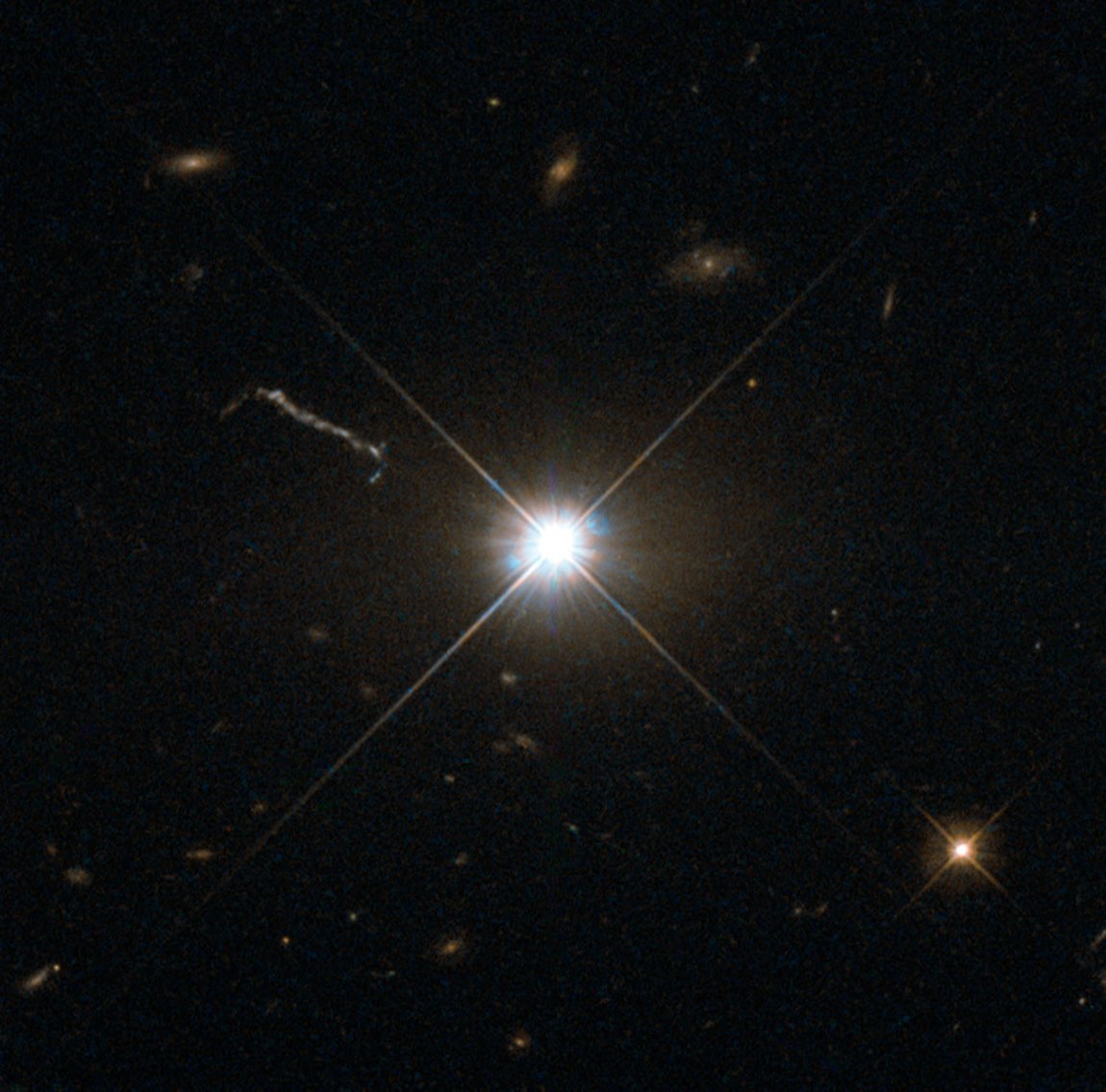
Numbers alone rarely land, so consider this one carefully: 3C 273 has an absolute magnitude of −26.7, making it over 4 trillion times more luminous than the Sun at visible wavelengths. The article frames this vividly — if the quasar were placed just 10 parsecs away, roughly the distance to the nearby star Pollux, it would blaze in our sky nearly as bright as the Sun itself. That single statistic collapses the intuitive gap between a backyard star and a galaxy-core monster. The energy source is accretion: matter spiraling into the supermassive black hole releases gravitational energy with an efficiency no nuclear furnace can match. No other known astrophysical process could account for the observed output, which is why 3C 273 serves as the prototype of the broader class called Active Galactic Nuclei. Its luminosity is also not constant — it varies at nearly every wavelength from radio waves all the way up to gamma rays, on timescales ranging from a few days to decades, meaning the powerhouse at its center is dynamic and restless.
 ⤢
03 Weighing the Monster at the Center Deeper
Measuring the mass of a black hole billions of light-years away demands ingenuity. For 3C 273, astronomers used a technique called broad emission-line reverberation mapping. The accretion disk and surrounding gas clouds are illuminated by the central engine; when the engine flickers, the gas clouds respond with a measurable time delay. That delay encodes the physical size of the region, and combined with the velocity of the gas inferred from emission-line widths, it yields a mass estimate. The result: 886 ± 187 million solar masses. To put that in perspective, our own Milky Way harbors a central black hole of roughly 4 million solar masses — 3C 273's black hole is therefore roughly 220 times heavier. The uncertainty of ±187 million solar masses is itself larger than many galaxy-center black holes, reflecting just how hard the measurement is across 2.4 billion light-years. This black hole is also classified as the defining example of a type called a radio-loud quasar, meaning the jets it drives are strong emitters of radio waves, not merely a faint afterthought.
04 The Jet Stretching 200,000 Light-Years
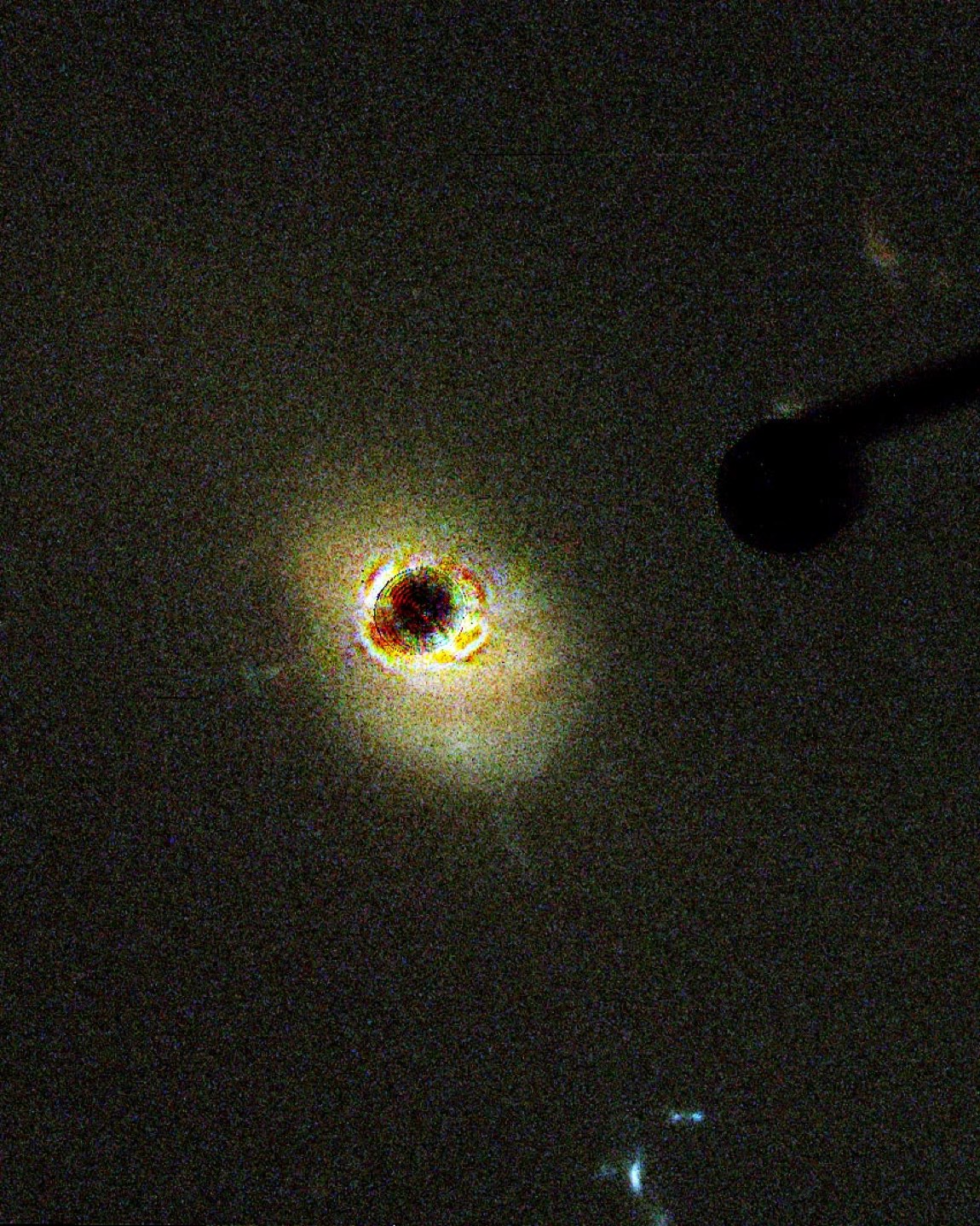
Shooting away from the central black hole is a jet of charged particles moving at relativistic speeds — a stream so long it spans approximately 200,000 light-years, or 61 kiloparsecs, with an apparent angular size of 23 arcseconds as seen from Earth. That single jet is roughly twice the diameter of the entire Milky Way. Such jets are believed to emerge from the interaction between the spinning black hole and the surrounding accretion disk, though the precise launching mechanism remains an open research question. In 1995, the Hubble Space Telescope resolved the jet's internal structure for the first time in optical light, revealing a striking pattern: bright compact knots of emission separated by dimmer regions, like beads on a string. The radiation from these knots — observed consistently across radio, infrared, and optical wavelengths with matching polarization orientation — is almost certainly synchrotron radiation, produced when relativistic electrons spiral around magnetic field lines. Radio interferometry using VLBI has also detected proper motion within the jet, confirming that material is genuinely moving outward at speeds that appear, due to projection effects, to exceed the speed of light.
 ⤢
05 When the Jet Bent and Nobody Expected It Deeper
Even a jet spanning 200,000 light-years is not rigidly straight. In 2003, observations revealed that 3C 273's jet abruptly changed direction by an intrinsic angle of 2 degrees. That number sounds small, but it is actually larger than the jet's own intrinsic opening angle of just 1.1 degrees — meaning the bend is wider than the jet itself is broad, a structurally significant kink rather than a gentle curve. The viewing geometry adds another layer: Earth sees the jet at an angle of only about 6 degrees from its axis, which greatly compresses apparent distances and amplifies apparent speeds through line-of-sight projection. The jet is also not punching through empty space peacefully. It is inflating an expanding cocoon of heated gas around itself, and that cocoon appears to be interacting with an inclined disk of gas within the central roughly 6 kiloparsecs of the host galaxy. These interactions between the jet and surrounding material may play a role in shaping star formation across the entire host galaxy, though that causal chain continues to be studied.
06 The Galaxy Hiding Behind the Glare
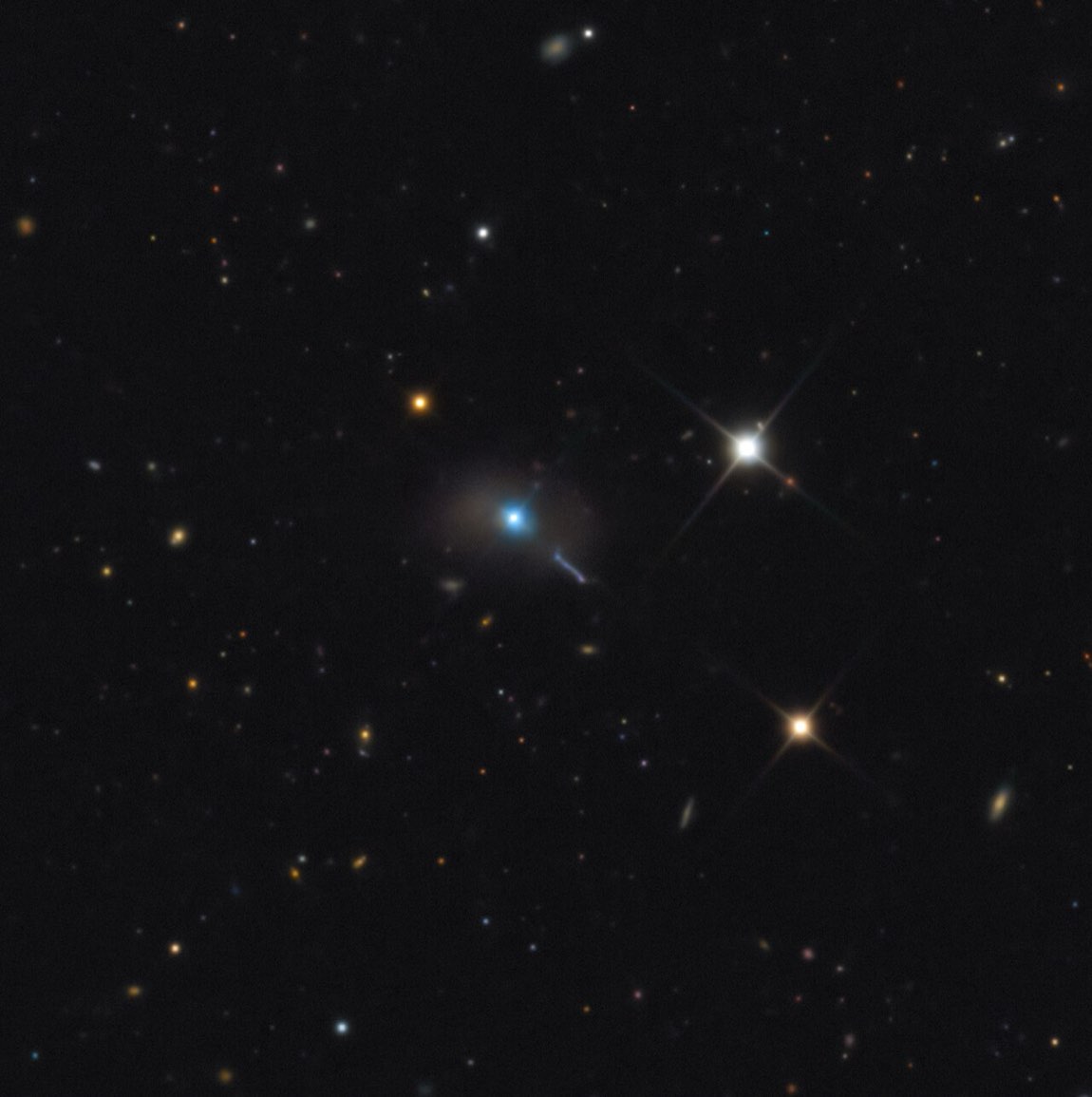
3C 273 is so bright that for decades it masqueraded as a point source — a star — and the giant galaxy cradling it was nearly invisible beneath the quasar's overwhelming glare. That host galaxy has an apparent magnitude of 16, more than three magnitudes fainter than the quasar itself, which outshines the entire galaxy by a factor of more than 16 times. The galaxy's morphological classification is E4, meaning it is an elliptical galaxy with a moderate degree of flattening — not perfectly round, but not dramatically elongated either. Its apparent size spans 29 arcseconds on the sky. Its estimated mass is approximately 2 × 10¹¹ solar masses, or about 200 billion times the mass of the Sun, making it a genuinely large elliptical by galaxy standards. Giant ellipticals like this one are the preferred homes for the most massive black holes in the universe, and 3C 273's host fits that pattern well. Understanding the host's structure matters because the jet driven by the central engine may be reshaping it over cosmic time.
 ⤢
07 X-Rays, Gamma Rays, and an Unsolved Process Deeper
3C 273 was among the first extragalactic sources detected in X-rays, with that discovery coming in 1970. The fact that a quasar radiates across such an enormous range of the electromagnetic spectrum — from long-wavelength radio waves through infrared, optical, ultraviolet, X-ray, and all the way to gamma rays — is itself a clue about the extreme physical conditions near the black hole. Yet the precise mechanism responsible for X-ray emission from 3C 273 had not been settled even decades after the first detection. As of 2006, when new observations were reported using the Spitzer Space Telescope, the process giving rise to the X-ray emissions was still described as controversial. Competing models invoke inverse Compton scattering of photons by relativistic electrons, direct synchrotron emission from very high-energy particles, or a combination of processes occurring at different locations along the jet and in the corona above the accretion disk. That a source discovered more than sixty years ago still harbors active scientific debate illustrates how quasars continue to push the limits of our understanding of extreme physics.
08 Catching It With a Six-Inch Telescope
Despite lying 2.4 billion light-years away, 3C 273 is accessible to amateur astronomers with a 6-inch (150 mm) aperture telescope — a size that fits in the trunk of a car. Its apparent visual magnitude of 12.9 places it comfortably within reach of even modest instruments under dark skies. The best observing window runs from March through July, when the constellation Virgo climbs high enough in both the northern and southern hemispheres to give clear views. Finding it requires patience and a good star chart, since it appears as an indistinguishable point of light among thousands of similarly faint stars. What makes the experience remarkable is the context: an amateur pointing a backyard telescope at this unremarkable dot is looking at the most distant object most amateur astronomers will ever personally observe. The photons arriving at the eyepiece left the quasar 2.4 billion years ago — before complex multicellular life had diversified on Earth. That temporal depth, delivered through a modest tube of glass and metal, is a quietly staggering thought.
09 How 3C 273 Anchors the Sky Itself Deeper
Beyond its scientific fame, 3C 273 plays a surprisingly practical role in how humanity keeps track of direction in space. Its right ascension, as recorded in the Fifth Fundamental Catalogue (FK5), is used to help standardize the positions of 23 extragalactic radio sources that together define the International Celestial Reference System, or ICRS. The ICRS is the global standard reference frame used by navigation satellites, spacecraft guidance systems, and all precision astronomical measurements. Quasars are ideal anchors for such a framework because they are so enormously distant that any true proper motion on the sky is negligible over human timescales — they are, to excellent approximation, fixed points on the celestial sphere. The radio luminosity of 3C 273, combined with its status as the first identified quasar, made it a natural choice for inclusion in this reference network. In a very real sense, every time a GPS receiver or a space probe checks its orientation, it is indirectly referencing a measurement tied back to this distant black hole in Virgo.
10 The Objects That Almost Got There First
3C 273 is remembered as the first identified quasar, but history almost played out differently. Before its redshift was understood in 1963, several other radio sources had already been matched to optical counterparts — 3C 48 being the first such association made. And a range of active galaxies had been catalogued and even given variable-star designations, including the objects now known as BL Lac, W Com, and AU CVn. What none of these earlier identifications achieved was an understanding of what the objects actually were. Their optical spectra looked strange, resembling no known type of star and carrying spectral lines that seemed to match nothing in standard stellar atlases. The critical step was recognizing that the unfamiliar lines were simply familiar atomic transitions shifted dramatically to longer wavelengths by cosmological redshift — a shift so large that nobody had initially thought to look for it. Once Schmidt and Oke made that interpretive leap for 3C 273 in 1963, the other peculiar objects quickly fell into place, and an entirely new class of cosmic phenomena was born.
11 Measuring Distance Across Billions of Light-Years Deeper
Calculating how far away 3C 273 sits involves several distinct methods that each yield subtly different answers — a point the article is careful to preserve rather than paper over. The most commonly quoted figure is the luminosity distance of 749 megaparsecs, equivalent to 2.4 billion light-years, derived from the measured redshift of z = 0.158. But astronomers also use the concept of angular diameter distance, which relates the object's apparent size to its true physical size; for 3C 273 this was estimated using the Very Large Telescope interferometer as 1.80 gigalight-years, with an uncertainty range of +0.32 to −0.28 gigalight-years, or equivalently 552 megaparsecs with an asymmetric uncertainty. The relationship between these two distances is not arbitrary: luminosity distance equals angular diameter distance multiplied by (1 + z) squared, where z is the redshift. That factor of (1 + z)² arises because the universe expanded while the light was traveling, stretching both the photon wavelengths and diluting the photon arrival rate. Having multiple independent distance estimates for the same object is valuable precisely because it allows consistency checks of the cosmological model itself.
About this record
Data: the HYG stellar database v4.1 (Hipparcos + Yale + Gliese, CC BY-SA, © David Nash / astronexus). Want the full stories? Our deep star guides cover Sirius, Betelgeuse, Proxima Centauri, Vega and three dozen more. You can also browse the catalog or learn how stars live and die.