Virgo ☉ Zodiac
“The Maiden” · Both (straddles the celestial equator) · best around May evenings
Real star positions and magnitudes (HYG database via D3-Celestial, BSD-3). Lines are the conventional stick figure; north is up.
The story
The second-largest constellation — a reclining harvest goddess holding an ear of wheat (Spica). Behind her stars lies the Virgo Cluster: some 2,000 galaxies, the massive heart of our local corner of the universe, including the black-hole-famous M87. Our own galaxy is slowly falling toward it.
How to find it
Spring: follow the Big Dipper's handle — 'arc to Arcturus, then spike to Spica.'
✦ What lives inside it
- The Virgo galaxy cluster
- M87 and its imaged black hole
The deep dive
Researched for the Atlas from Wikipedia — Virgo (constellation) (9,349 characters read) · updated Sep 20, 2026
01 The sky's largest zodiac constellation
Size alone sets Virgo apart among the zodiac's twelve figures. It ranks as the second-largest constellation in the entire sky, surpassed only by the sprawling water-snake Hydra, and it comfortably beats every other zodiac constellation for sheer area. That size has a practical consequence for timekeeping: the Sun spends 44 days crossing Virgo's boundaries, longer than it lingers in any other constellation. From 1990 until 2062, that passage runs from September 16 to October 30. Virgo also straddles a cosmically important line — the ecliptic crosses the celestial equator within its borders, meaning the September equinox, the moment the Sun passes directly overhead of Earth's equator in autumn, occurs inside Virgo. The constellation is visible from latitudes between +80° and −80°, making it accessible to almost every inhabited place on Earth, and it can be seen at some point during the night throughout much of the year.
02 A shifting equinox and the year 2440 Deeper
The autumn equinox point does not stay fixed against the stars. Because Earth wobbles slowly on its axis — a process called precession — the point where the ecliptic crosses the celestial equator drifts westward over millennia. Today, the autumn equinox lies inside Virgo, very close to the star β Virginis (Zavijava). From the 18th century BC to the 4th century BC, the Sun was actually in the neighboring constellation Libra on the autumnal equinox before precession moved it into Virgo, where it has remained ever since. The drift does not stop there: astronomers calculate that the autumn equinox point will eventually cross into the adjacent constellation Leo around the year 2440. This slow celestial migration is why the traditional astrological associations of constellations with particular seasons diverged long ago from the actual positions of the Sun, a tension that sits at the heart of the difference between astronomical and astrological coordinate systems.
03 Spica and the named stars of Virgo
Virgo's stellar cast is larger than most constellations' named rosters. Beyond dazzling Spica — whose Latin name means "ear of grain," echoing Babylonian tradition — the constellation holds several stars with individual identities recognized by modern astronomy. β Virginis carries the name Zavijava; γ Virginis is Porrima; δ Virginis is Auva; and ε Virginis is Vindemiatrix. Fainter stars also bear historic names: ζ Virginis is Heze, η Virginis is Zaniah, ι Virginis is Syrma, κ Virginis is Kang, λ Virginis is Khambalia, and φ Virginis is Elgafar. Five of the constellation's main stars — Beta, Gamma, Delta, Epsilon, and Eta Virginis — form an asterism called the Bowl of Virgo. When Spica and Theta Virginis are added to the Bowl, the enlarged pattern traces a distinct Y-shape in the sky, a useful signpost once observers have already located the region.
04 Planetary systems hidden in the maiden Deeper
Virgo hosts a striking collection of confirmed planetary systems. Across the constellation, 35 verified exoplanets orbit 29 different stars — a testament to how thoroughly modern surveys have combed this region. Among the historically important systems, 70 Virginis was recognized as one of the first stars known to host an extrasolar planetary system; its single confirmed planet carries a mass 7.5 times that of Jupiter. Chi Virginis takes the mass record higher still, harboring one of the most massive planets ever detected, tipping the scales at 11.1 times Jupiter's mass. At the other end of the size spectrum, the Sun-like star 61 Virginis hosts three planets: one classified as a super-Earth and two with masses comparable to Neptune. The pulsar PSR B1257+12 adds three planets of its own to the tally, and NY Virginis contributes two more, rounding out a constellation that has been a productive hunting ground for planet hunters since the earliest days of exoplanet discovery.
05 SS Virginis and the art of watching variables
Not every interesting star in Virgo is a distant giant. SS Virginis is a variable star notable for its conspicuously red color and its slow, dramatic brightness swings. Over approximately one year it cycles from a maximum magnitude of 6.0 — just at the threshold of naked-eye visibility under dark skies — down to a minimum of 9.6, where binoculars become necessary to pick it up. That four-magnitude range represents a difference of roughly 40 times in apparent brightness from peak to trough. The star's redness betrays its cool surface temperature, characteristic of the long-period variable stars that pulsate in size and luminosity. For amateur observers who enjoy monitoring stars over weeks and months, SS Virginis offers an accessible long-term project: a single binocular field, a noticeable color, and brightness changes dramatic enough to track by eye without specialist equipment.
06 M87 and the first black hole photograph
Messier 87 is the undisputed heavyweight of the Virgo Cluster, sitting about 60 million light-years from Earth. It is an elliptical galaxy and a powerful radio source, partly because its central supermassive black hole flings a jet of electrons outward — a jet visible across multiple wavelengths of light. That visibility across the electromagnetic spectrum made M87 an ideal laboratory for studying black holes directly. On April 10, 2019, the Event Horizon Telescope collaboration released an image of M87's central black hole — the first direct image of a black hole ever obtained. The black hole's mass is at least 7.2 billion times that of the Sun, making it the most massive black hole in the immediate vicinity of the Milky Way. To put that in perspective, if the Sun were replaced by this black hole, its event horizon would extend well past the orbits of the outer planets of our solar system.
07 Radio galaxies and hidden black holes nearby Deeper
M87 is not the only radio-loud galaxy Virgo has to offer. M84, also at a distance of 60 million light-years, is another elliptical galaxy with strong radio emissions. Astronomers studying the speeds of gas clouds orbiting M84's core found velocities of approximately 400 km/s — fast enough to imply a central object with a mass around 300 million times that of the Sun, almost certainly a black hole. NGC 4261, sitting 45 million light-years away, adds a third case: it harbors a black hole with a mass of 1.2 billion solar masses, located just 20 light-years from the galaxy's center and surrounded by an unusually dusty disk spanning 300 light-years in diameter. NGC 4261 shares strong radio emissions with M84 and M87, making the trio a remarkable concentration of active galactic nuclei within one constellation. Meanwhile, NGC 4438, at 50 million light-years, is ejecting jets of matter from its own supermassive black hole, inflating bubbles up to 78 light-years across.
08 3C 273 — the quasar that started it all Deeper
Tucked inside Virgo's borders is an object with an outsized place in the history of astronomy: 3C 273, the first quasar ever to be identified. Despite being unimaginably remote, it shines at approximately magnitude 12.9, making it the optically brightest quasar in the entire sky — reachable with a modest amateur telescope. Its identification as a quasar was a landmark moment that forced astronomers to reckon with the existence of objects radiating energy far beyond what any known stellar process could explain, powered by accretion onto supermassive black holes. The fact that such an extreme and distant object can be logged by backyard observers on a clear night speaks to the extraordinary luminosity of quasars. For anyone with a telescope of sufficient aperture sweeping through Virgo, 3C 273 represents the most distant object routinely accessible to amateur observation anywhere on the sky.
09 Calibrating the universe with NGC 4639 Deeper
One of cosmology's most important measuring challenges is pinning down distances to galaxies too far away for conventional methods. NGC 4639, a face-on barred spiral galaxy 78 million light-years from Earth, played a quiet but crucial role in solving that problem. Its outer spiral arms contain an unusually high number of Cepheid variable stars — stars whose pulsation periods are directly linked to their true luminosities, allowing astronomers to use them as reliable "standard candles" for measuring distance. By carefully measuring the Cepheids in NGC 4639, astronomers were able to calibrate type Ia supernovae as distance indicators for galaxies far beyond what Cepheids alone can reach. Type Ia supernovae, which all explode with roughly the same intrinsic brightness, then become the yardstick for measuring billions of light-years. NGC 4639's Cepheids thus form one link in a measurement chain that ultimately helped establish the accelerating expansion of the universe.
10 Babylon's Furrow and the grain of the sky
The figure we call Virgo is ancient. In the Babylonian star catalogue known as the MUL.APIN, composed around the 10th century BC, part of this constellation was recognized as "The Furrow," representing the goddess Shala holding an ear of grain. Spica, Virgo's brightest star, inherits that identity directly: its Latin name simply means "ear of grain," preserving a Mesopotamian agricultural image across more than three thousand years. The western portion of what became the Greek Virgo corresponded to a separate Babylonian figure, the "Frond of Erua," depicted as a goddess clutching a palm frond. That palm-frond motif occasionally reappeared in later artistic depictions of Virgo, a subtle echo of Babylonian iconography surviving into illustrations made centuries after Greek and Roman mythology had largely replaced the original story. The agricultural connection also explains why Virgo became broadly associated with fertility and the harvest across multiple ancient cultures.
11 Greek tales behind the maiden figure
Classical antiquity offered several competing stories for who the constellation's maiden actually was. The most widespread identification linked Virgo to Demeter, goddess of grain, or her daughter Persephone — both figures tied directly to harvest and seasonal cycles, which reinforced the Babylonian agricultural meaning. A separate tradition associated the figure with Astraea, a goddess of justice who abandoned Earth at the end of the Silver Age of humanity and ascended to become the constellation. The 1st-century BC mythographer Hyginus recorded yet another origin: Parthenos, daughter of the god Apollo and Chrysothemis, who died a maiden and was honored with a place in the stars. Diodorus Siculus presented a livelier version of this story, in which Parthenos and her sister Molpadia accidentally broke their father Staphylus's prized wine jar, fled in terror, and were saved by Apollo, who placed them among the stars. The story of Erigone, daughter of Icarius of Athens, offered still another candidate, with Dionysus said to have placed her in the sky as Virgo and her father as Boötes.
12 Virgo across medieval and Hindu traditions
The constellation's identity continued to evolve as it passed into new cultural hands. During the Middle Ages, European Christian tradition associated Virgo with the Virgin Mary, weaving the ancient maiden figure into religious cosmology. A specific expression of this appears in Mexican tradition, where the tilma — the cloak bearing the image of Our Lady of Guadalupe — is interpreted as reflecting several constellations in its pattern, with Virgo placed over the heart, Leo over the womb, and Libra and Boötes along the lower mantle. In Hindu astrology the constellation became Kanyā (कन्या), the sixth sign of the sidereal zodiac, ruled by the planet Budha — Mercury. Classified as an earth sign with a dual or mutable nature, Kanyā is associated in classical texts including the Brihat Parashara Hora Shastra with intellect, analytical ability, service, health, and disciplined work, and its natives are described as detail-oriented, practical, modest, and skilled in communication.
13 The Sombrero Galaxy's dust and old stars
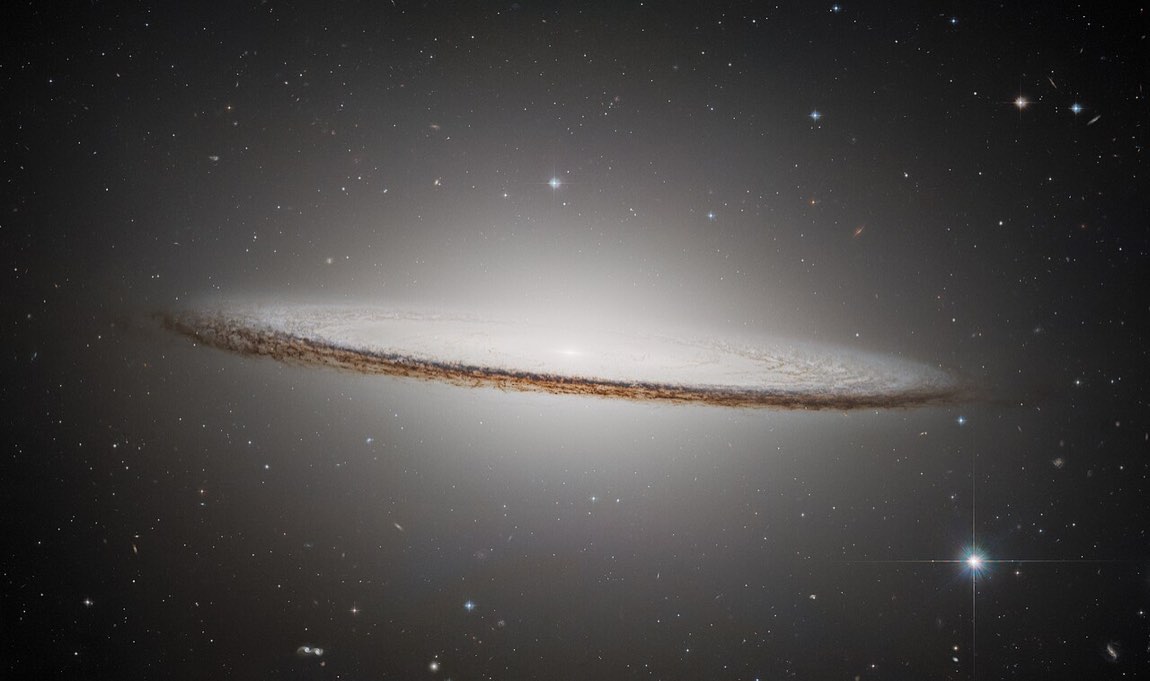
About 10° due west of Spica lies one of the most visually distinctive galaxies in the sky: the Sombrero Galaxy, catalogued as M104. At 28 million light-years from Earth it is not part of the Virgo Cluster proper, making it a notable loner in the field. Its most striking feature is a very prominent dust lane composed of polycyclic aromatic hydrocarbons — complex carbon molecules also found in interstellar clouds throughout the universe. The galaxy's central bulge is built from older stars that are larger than typical, giving the core an unusually bright and puffy appearance. Surrounding the whole system is a rich retinue of large, bright globular clusters, which stand out even in moderate telescopes. The combination of the sharp dark dust lane slicing across the bright central bulge — the brim of the "sombrero" — makes M104 one of the most photographed galaxies in the night sky and an iconic target for amateur and professional observers alike.