Cosmology
Redshift
ConfirmedThe idea
Light from receding things stretches to redder colors, like a siren dropping pitch as it passes. For distant galaxies the stretching is done by expanding space itself while the light travels — so redshift simultaneously tells you how far away a galaxy is, how fast space has stretched since, and how long ago you're seeing. One number, three readings: cosmology's odometer, speedometer and clock.
Go deeper Advanced
z = Δλ/λ. JWST's record galaxies sit above z≈13 — their light left when the universe was under 400 million years old, stretched 14-fold en route. Peculiar velocities add Doppler noise locally (Andromeda is blueshifted, approaching). Gravitational redshift — climbing out of gravity wells — is the third, distinct flavor, measured from white dwarfs to GPS.
The deep dive
Researched for the Atlas from Wikipedia — Redshift (40,294 characters read) · updated Sep 20, 2026
01 The man who named the wave shift
The story of redshift begins with Christian Doppler, an Austrian mathematician who in 1842 offered the first known physical explanation for why a wave source in motion produces a shifted frequency. Doppler boldly predicted the effect would apply to all waves, including light, and even speculated that the varying colors of stars might reflect their motion relative to Earth. His idea sat untested for three years until 1845, when Dutch scientist Christophorus Buys Ballot confirmed the principle experimentally — using sound waves and, reportedly, a locomotive carrying trumpeters. Meanwhile, French physicist Hippolyte Fizeau independently proposed in 1848 that stellar spectral lines could betray a star's motion, unaware Doppler had arrived there first. A 1850 publication by François-Napoléon-Marie Moigno synthesized both men's ideas and was read by James Clerk Maxwell and William Huggins, setting the stage for the first real stellar velocity measurement. It was Huggins who, by 1868, became the first person to actually determine the velocity of a star moving away from Earth by analyzing the shift in its spectral lines.
02 Early laboratory proof and solar fingerprints
Theoretical prediction is one thing; seeing the shift in real light is another. In 1871 optical redshift was confirmed by observing Fraunhofer lines in sunlight, exploiting the Sun's own rotation to produce a measurable Doppler shift of about 0.1 ångströms in the red part of the spectrum. Then in 1887, Hermann Carl Vogel and Julius Scheiner discovered what they called the "annual Doppler effect" — the yearly oscillation in the Doppler shift of stars near the ecliptic caused by Earth's own orbital velocity around the Sun. As the Earth swings toward a star for half the year and away for the other half, the measured shift rocks back and forth predictably. By 1901, Aristarkh Belopolsky had gone further still, verifying optical redshift entirely in the laboratory using a cleverly arranged system of rotating mirrors that mimicked the motion of a receding light source. These three milestones — solar, stellar-annual, and laboratory — firmly established that spectral shifts obeyed Doppler's 1842 prediction across multiple independent experimental settings.
03 Slipher's quiet revolution: spiral nebulae move
Starting in 1912, Vesto Slipher began measuring the spectra of the fuzzy "spiral nebulae" that astronomers were still debating. His first surprise was that Andromeda showed a blueshift, implying it was rushing toward Earth at roughly 300 km/s — a speed that stunned contemporaries. Slipher published this in the inaugural volume of the Lowell Observatory Bulletin, then summarized his growing dataset in the journal Popular Astronomy, reporting velocities for 15 spiral nebulae scattered across the entire celestial sphere. All but three showed positive (recessional) velocities. At the time the nature of these nebulae was still unclear — it was not until 1923 that Edwin Hubble established they were entire galaxies far beyond the Milky Way. Hubble's distance measurements using the period-luminosity relation of Cepheid variable stars then made it possible to test a 1917 prediction by Willem de Sitter that redshift should correlate with distance. Combining Hubble's distances with Slipher's redshifts and new measurements by Milton Humason, Hubble reported in 1929 the approximate linear relationship now called Hubble's law.
04 Three kinds of redshift, not one
Astronomers encounter three distinct physical mechanisms that stretch light to longer wavelengths, and conflating them leads to real errors. Doppler redshift arises when a source moves away from the observer; at low speeds the redshift parameter z is simply the recession velocity divided by the speed of light. Gravitational redshift — sometimes called the Einstein shift — occurs because time runs more slowly deep inside a gravitational well; a photon climbing out of that well loses energy, lengthening its wavelength. The formula for this involves the mass M of the object and the radial distance r from its center, and it grows without limit as r approaches the event horizon of a black hole. The third type, cosmological redshift, results from the universe itself expanding while light travels through it; the ratio of the universe's scale factor now to its scale factor at the moment of emission equals 1 + z. Critically, a galaxy's total observed redshift blends its cosmological redshift with a "peculiar velocity" component, and the two cannot simply be added — they must be multiplied in the form (1 + z) = (1 + z̄)(1 + z_p).
 ⤢
⤢
05 Relativistic twist: redshift without recession Deeper
Classical Doppler physics says a source must be moving away to redshift its light, but special relativity adds a subtler effect. Because a moving clock runs slow — time dilation — a source moving at right angles to the line of sight still produces a measurable redshift, with no recession component at all. This is the transverse redshift, and it equals 1/(√(1 − v²/c²)). Even for an approaching source, if it has a large enough transverse velocity component, the time-dilation redshift can cancel and then overpower the expected blueshift, turning the approaching object red. The relativistic Doppler formula, incorporating the Lorentz factor γ, was experimentally confirmed in a 1938 experiment conducted by Herbert E. Ives and G. R. Stilwell, now known as the Ives–Stilwell experiment. Their work provided direct laboratory evidence that time dilation is real and that the full relativistic formula — not just the classical approximation — is needed for sources moving near the speed of light.
06 Weighing the universe through gravitational redshift Deeper
Gravitational redshift is tiny near everyday masses but measurable with sensitive enough instruments. On Earth, the first detection used the Mössbauer effect — which produces extremely sharp gamma-ray lines — in the Pound–Rebka experiment, confirming Einstein's prediction that photons lose energy climbing out of even Earth's modest gravitational well. Near a black hole the effect becomes dramatic: as an object approaches the event horizon, the redshift grows toward infinity, meaning photons emitted there can never be fully received by a distant observer. Gravitational redshift also leaves its imprint on the cosmic microwave background at the largest angular scales, through the Sachs–Wolfe effect, where photons climbing out of or falling into evolving density fluctuations in the early universe gain or lose energy unequally. The same physics that shifts frequencies also shifts the perceived temperature of blackbody radiation, which is how the 3000 K glow of the early universe has been redshifted down to the 3 K CMB we detect today.
07 The universe's farthest light: record redshifts
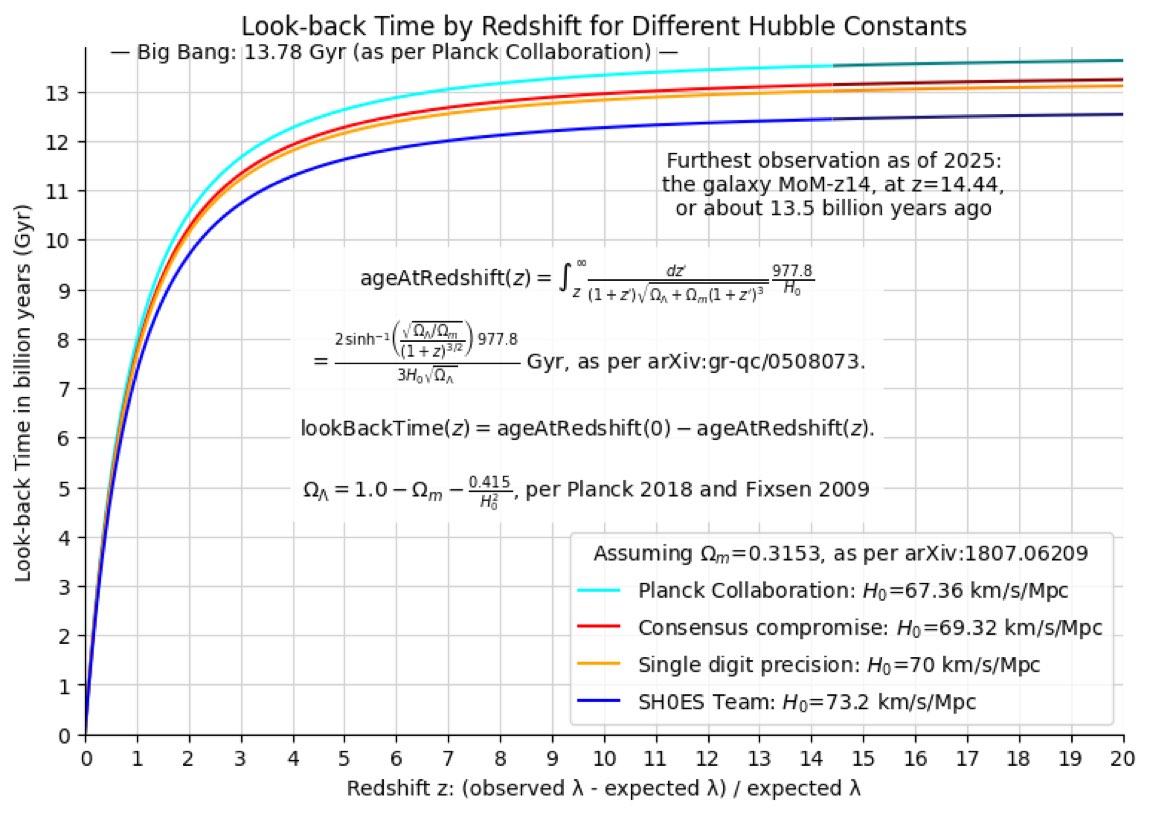
Observers have pushed the redshift frontier repeatedly as telescope technology improved. Among spectroscopically confirmed galaxies, GN-z11 held a notable record with z = 11.1, corresponding to a universe only 400 million years old. It was subsequently surpassed by JADES-GS-z14-0 at z = 14.32 (290 million years after the Big Bang) and then MoM-z14 at z = 14.44 (280 million years). The most distant known quasar, UHZ1, sits at z = 10.1, while the highest-known redshift radio galaxy, ILT J2336+1842, is at z = 6.6. Even these staggering distances pale beside the cosmic microwave background, whose redshift of z = 1089 represents light released about 379,000 years after the Big Bang, now arriving from a proper distance of more than 46 billion light-years. Theoretical predictions extend the frontier further: cosmic neutrino background radiation from about two seconds after the Big Bang carries a redshift exceeding z > 10¹⁰, and gravitational waves from inflation itself are predicted to carry redshifts exceeding z > 10²⁵.
08 Mapping the cosmos in redshift space
Combine a galaxy's angular position on the sky with its redshift and you get a three-dimensional address in the universe. Since the 1970s astronomers have been doing exactly this at industrial scale. The CfA Redshift Survey, launched in 1977 and completing its initial data collection in 1982, was the first systematic effort. The 2dF Galaxy Redshift Survey measured redshifts for over 220,000 galaxies, finishing data collection in 2002 and releasing its final dataset on 30 June 2003. The Sloan Digital Sky Survey began in 1998 and had published its eighteenth data release by 2023; it recorded redshifts for galaxies as high as z = 0.8 and logged over 100,000 quasars at z = 3 and beyond. The DEEP2 Redshift Survey, using the Keck telescopes with the DEIMOS spectrograph, targeted faint galaxies above z = 0.7 and recorded redshifts for over 38,000 objects before concluding in 2013. One payoff of such surveys is the discovery of structures like the Great Wall, a supercluster over 500 million light-years wide, visible only because redshifts reveal depth.
 ⤢
⤢
09 Reddening vs. redshift: an important distinction
Not every reddening of starlight is a true redshift. Interstellar dust scatters blue light more efficiently than red — a process called interstellar reddening — making distant stars look redder than they really are. Rayleigh scattering in Earth's own atmosphere does the same thing at sunrise and sunset. The crucial difference is that genuine redshift shifts every spectral line by the same fractional amount z, regardless of wavelength, and that z is constant across the whole spectrum of a single object. Scattering, by contrast, produces wavelength-dependent color changes and does not shift the positions of absorption or emission lines; it also adds dimming and distortion as photons scatter in and out of the line of sight. Astronomers guard against confusion by checking whether multiple identified spectral lines all yield the same z. If they do, it is a genuine redshift. If the reddening has no line shifts, it is dust. The term "reddening" is deliberately reserved for scattering processes in astrophysics jargon, while "redshifting" refers only to the three physical mechanisms involving relative motion, expansion, or gravity.
10 Tired light: a failed alternative
When cosmological redshifts were first discovered, not everyone accepted that the universe was expanding. Fritz Zwicky proposed an alternative called "tired light," in which photons gradually lose energy and thus redden as they travel across vast distances, without any actual motion or expansion required. It was an appealing idea because it avoided the startling implication that the cosmos had a beginning and a history. However, the tired-light hypothesis has been largely ruled out by a specific observational test: if light from distant supernovae were merely tired rather than cosmologically stretched, the apparent duration of supernova events should remain constant regardless of distance. Instead, Type Ia supernovae at high redshift show timescale stretching — their light curves are drawn out by exactly the factor (1 + z) predicted by expansion. This timescale stretch is a fingerprint of true cosmological redshift and cannot be explained by a simple energy-loss model like tired light.
11 Redshift as a working tool across astronomy
Beyond mapping the universe's grand structure, redshifts serve as a precision instrument throughout astronomy. Tiny Doppler shifts in stellar spectra reveal planets tugging their host stars back and forth — one of the primary techniques for detecting exoplanets — and astronomers have even tracked redshift variations during planetary transits to pin down orbital parameters. Helioseismologists use finely detailed redshift measurements to map movements in the Sun's photosphere. Measuring how the 21-centimeter hydrogen line is redshifted or blueshifted in different directions across our galaxy reveals the rotation curve of the Milky Way. Doppler broadening of emission or absorption lines — essentially the spread of redshifts and blueshifts within a single line from a cloud of gas — allows temperature measurements of emitting and absorbing objects. In binary star systems, alternating redshifts and blueshifts as the two stars orbit each other allow astronomers to calculate masses. And at the violent extreme, accretion flows around neutron stars and black holes show both Doppler shifts and gravitational redshifts simultaneously, providing tests of general relativity in the strongest-field regime.
12 Acceleration, dark energy, and an open question Deeper
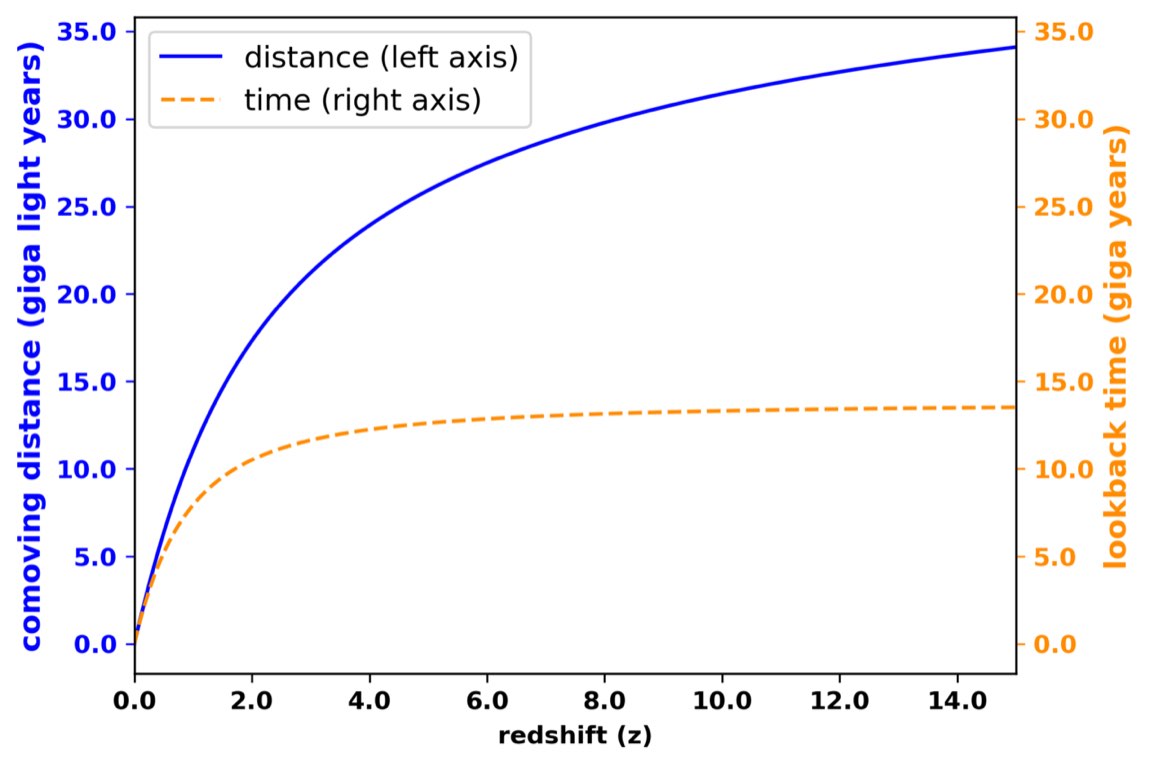
For decades cosmologists assumed the universe's expansion was slowing down, gradually braked by gravity. Then observations beginning in 1988 of the redshift-distance relationship using Type Ia supernovae suggested something shocking: in comparatively recent cosmic history the expansion rate has been accelerating. Distant supernovae appeared fainter — that is, farther — than a decelerating universe would place them. The culprit is typically labeled dark energy, but its nature remains one of the deepest open questions in physics. The redshift-distance relation is no longer a simple linear Hubble law at large distances; it becomes a non-linear integral that encodes the entire history of the expansion rate, and thus the matter and energy content of the universe. Redshift surveys that map how large-scale structure grew over cosmic time — through "redshift-space distortions" produced by peculiar velocities — offer an independent probe of this history. The CMB redshift of z = 1089 anchors one end of this timeline, and the accelerating nearby universe anchors the other, bracketing the unsolved puzzle of what is driving the cosmos apart.
✦ Keep exploring