Astrophysics
How Black Holes Work
ConfirmedThe idea
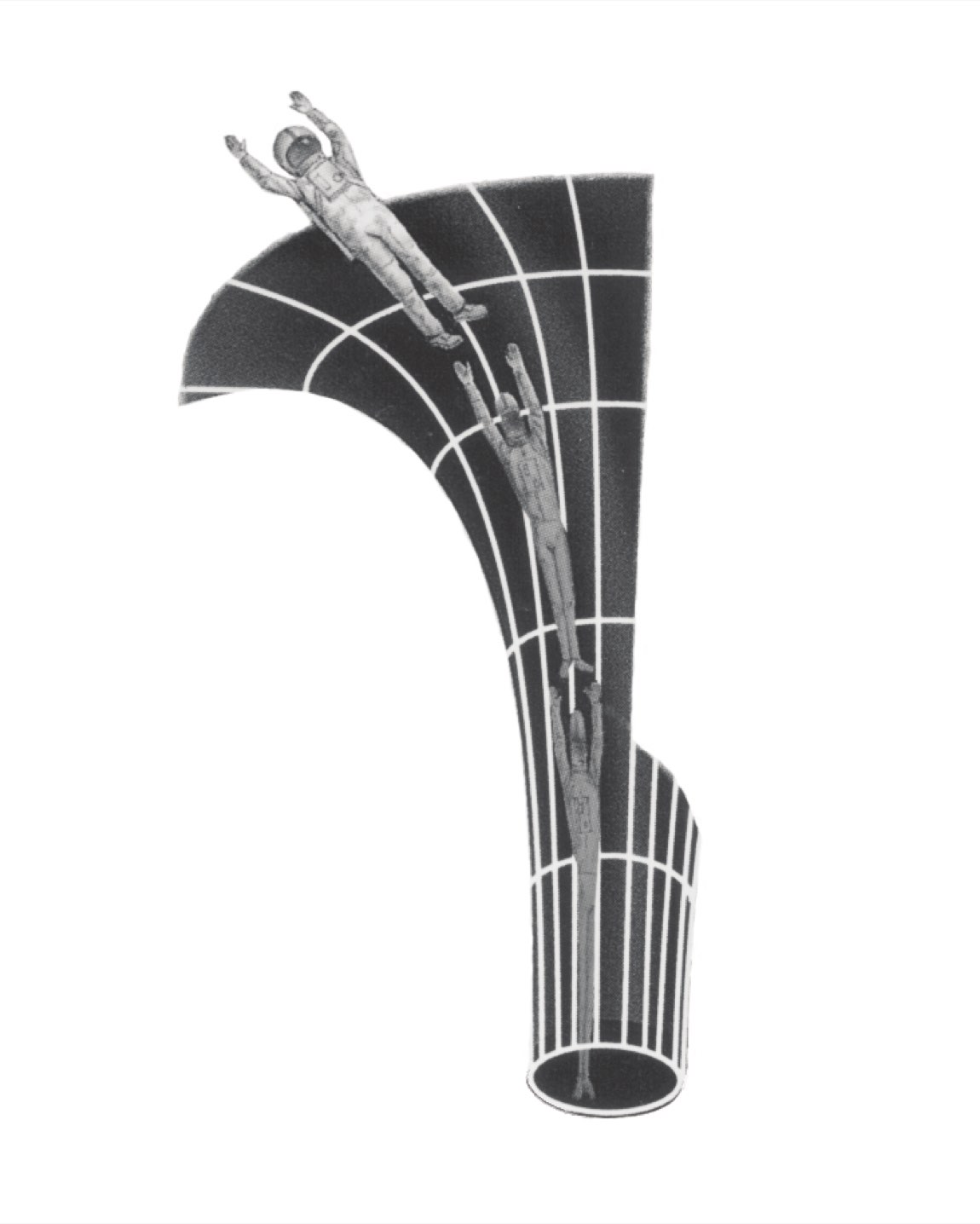
Squeeze anything hard enough and its escape velocity, the speed needed to leave, eventually exceeds the speed of light. Then nothing can leave: a black hole. They aren't cosmic vacuum cleaners; orbit one at a distance and it pulls exactly like any equal mass. Cross the event horizon, though, and every road leads inward, as surely as every road leads to tomorrow.
Go deeper Advanced
Stellar black holes (3–100 M☉) come from collapsing giants; supermassive ones (millions–billions M☉) anchor galaxies, origins still debated; LIGO found the in-between class. A black hole is pure geometry: mass, spin, charge — 'no hair.' Hawking radiation implies slow evaporation (a solar-mass hole needs 10⁶⁷ years), spawning the unresolved information paradox at the theory's edge.
The deep dive
Researched for the Atlas from Wikipedia — Black hole (58,000 characters read) · updated Sep 20, 2026
01 John Michell's 1784 dark star idea
Long before Einstein rewrote the rules of gravity, an English clergyman and astronomer named John Michell worked out something startling with nothing more than Newtonian mechanics. In a short section of a letter published in 1784, Michell calculated that a star with the same density as the Sun but 500 times the radius would have a surface escape velocity exceeding the speed of light. He called such objects "dark stars" and correctly reasoned that, even though we could never see them directly, we might detect them through their gravitational pull on nearby visible companions. Independently, the French mathematician Pierre-Simon Laplace reached a similar qualitative conclusion in his 1796 book Exposition du Système du Monde, and later supplied a mathematical treatment at the request of Franz Xaver von Zach, published in von Zach's journal Allgemeine Geographische Ephemeriden. Both thinkers imagined very large, low-density stars rather than the extraordinarily compact objects modern physics describes, but the core insight — gravity trapping light — was already present more than a century before general relativity.
02 Schwarzschild solves Einstein in weeks
Einstein published the field equations of general relativity in 1915, and within only a few months the German astrophysicist Karl Schwarzschild produced the first exact solution describing the spacetime around a spherical, non-rotating, uncharged mass. Schwarzschild assumed perfect spherical symmetry and found that at a particular radius — now bearing his name — some terms in Einstein's equations blew up to infinity. At the time, nobody understood what that singularity meant physically. Independently and shortly after, Johannes Droste, a student of Hendrik Lorentz, arrived at the identical solution. The Schwarzschild radius for a non-spinning, uncharged black hole is given by r_s = 2GM/c², which works out to approximately 2.95 kilometres for every solar mass. So a black hole with the mass of the Sun would have an event horizon roughly 3 km across — smaller than a city. Einstein himself, in 1939, attempted to prove such objects could never actually form, missing the crucial possibility that implosion could drive a collapsing star below that critical radius.
03 Chandrasekhar, Oppenheimer, and the mass limits Deeper
The road to accepting black holes as real ran through a sequence of mass-limit arguments spanning the 1920s and 1930s. In 1926, Ralph Fowler showed that white dwarfs are held up not by heat but by quantum-mechanical electron degeneracy pressure, a consequence of the Pauli exclusion principle. By 1931, Subrahmanyan Chandrasekhar discovered that electron-degenerate matter is stable only below a certain mass, establishing the upper boundary for white dwarfs. When he announced this result, Arthur Eddington dismissed its implication — that more massive stars must collapse further — as absurd. In 1939, J. Robert Oppenheimer and George Volkoff extended the argument into general relativity, predicting that neutron stars are stable only below the Tolman–Oppenheimer–Volkoff limit; above it, collapse must continue. That same year, John Archibald Wheeler and students Harrison and Masami Wakano computed the full equilibrium curve for cold matter through both electron and neutron degeneracy and found nothing that would halt the collapse, meaning the only escape from black hole formation was ejecting enough mass before the star cooled completely.
04 The golden age: theorems, hair, and horizons Deeper
The decade stretching from the mid-1960s to the mid-1970s is called the golden age of black hole research. In 1963, Roy Kerr found the exact solution for a rotating black hole. Two years later, Ezra Newman found the solution for a black hole that is both rotating and electrically charged. Meanwhile, research groups led by Yakov Zeldovich, John Wheeler, and Dennis Sciama uncovered a remarkable simplicity: no matter how complex the star that collapsed, the resulting black hole retains only three measurable properties — mass, electric charge, and angular momentum. Werner Israel proved in 1967 that any non-spinning, uncharged collapse produces a perfectly spherical black hole; Richard Price showed in 1972 that asymmetries are radiated away as gravitational waves. The resulting no-hair theorem, assembled over roughly 15 years by many physicists, states that a stationary black hole is completely described by just these three parameters, captured in the Kerr–Newman metric. Roger Penrose proved in 1965 that singularities are not a mathematical quirk of perfect symmetry but appear inevitably in all black holes — a result that earned him half the 2020 Nobel Prize in Physics.
 ⤢
⤢
05 Cygnus X-1: the first real black hole
Theoretical arguments were one thing; finding an actual black hole in the sky was another. The breakthrough came from X-ray astronomy. In 1971, Riccardo Giacconi's team observed that the X-ray source Cygnus X-1 flickered rapidly and sporadically, behaviour consistent only with a very compact object. Optical spectroscopy and detailed astrophysical modelling then revealed a binary system: an ordinary massive star losing gas to an invisible compact companion that heated the infalling material to X-ray-emitting temperatures. By 1974 the object was widely accepted as a black hole, though researchers acknowledge that 100% certainty may never be possible. A 2011 estimate put the masses at 14.1 ± 1.0 solar masses for the black hole and 19.2 ± 1.9 solar masses for its stellar companion. Cygnus X-1 remained a stellar-mass benchmark for decades, while the parallel case for supermassive black holes took much longer to build, ultimately requiring the Hubble Space Telescope, Very Long Baseline Array observations of water masers in NGC 4258 in 1995, and independent stellar-orbit studies of Sagittarius A* by teams led by Andrea Ghez and Reinhard Genzel.
06 Black hole thermodynamics and Hawking radiation Deeper
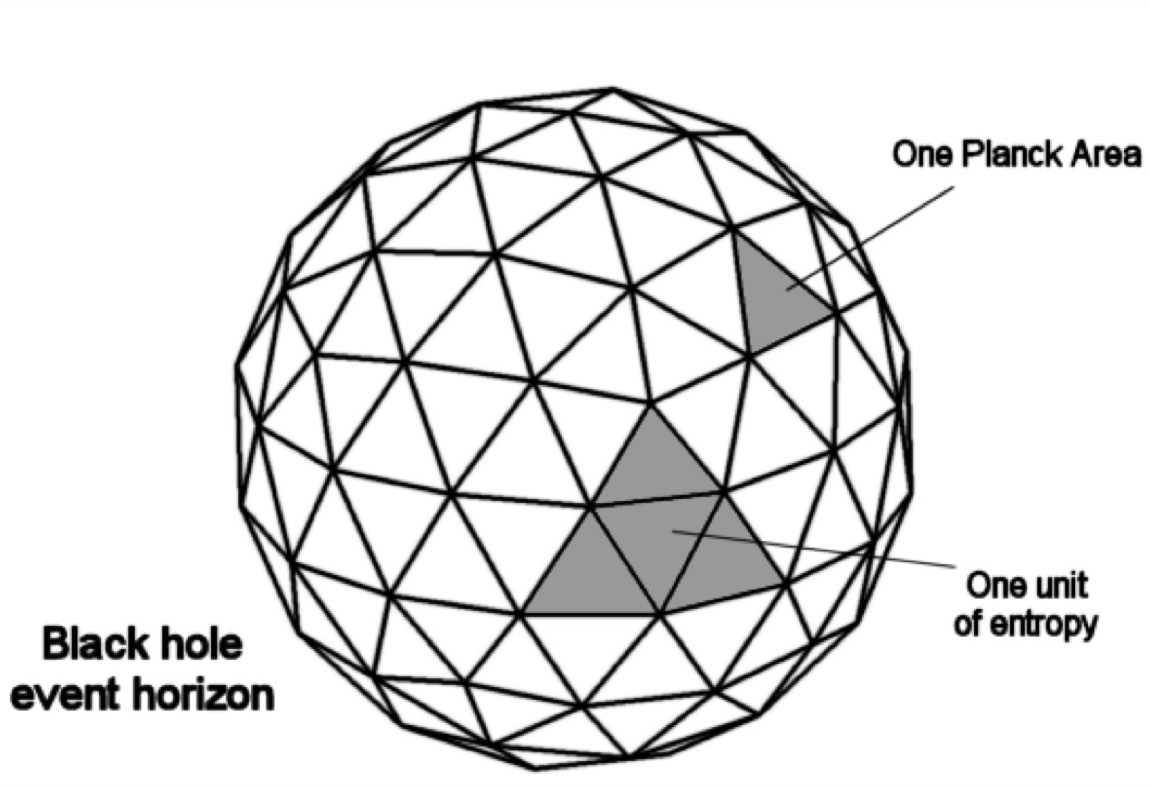
In the early 1970s, James Bardeen, Brandon Carter, and Stephen Hawking formulated four laws governing black hole behaviour that are mathematically analogous to the four laws of thermodynamics. Jacob Bekenstein deepened the analogy by linking black hole mass to energy, surface area to entropy, and surface gravity to temperature. The analogy became physical reality in 1974, when Hawking showed using quantum field theory in curved spacetime that black holes must emit thermal radiation — now called Hawking radiation — with a temperature proportional to the black hole's surface gravity and therefore inversely proportional to its mass. The smaller the black hole, the hotter it radiates and the faster it loses mass, eventually evaporating entirely. In practice, even the smallest observed black holes — stellar-mass objects — are currently gaining mass from the cosmic microwave background faster than they are losing it through Hawking radiation, so no observed black hole is actually shrinking yet. Hawking's extraordinary contributions to this field could not be recognised by the Nobel Committee because he died in 2018, and the prize cannot be awarded posthumously.
07 Spinning black holes and the ergosphere
A rotating black hole drags the very fabric of spacetime around with it in a phenomenon called frame dragging. Close enough to the hole, this drag becomes so powerful that nothing — not even light travelling in the opposite direction — can remain stationary. This region, bounded by the event horizon on the inside and a bulging outer surface called the ergosurface, is the ergosphere. Unlike the event horizon, the ergosphere is not a point of no return: matter and radiation can still escape from it. More striking, through a mechanism called the Penrose process, objects entering the ergosphere can actually leave with more energy than they brought in, stealing rotational energy from the black hole and slowing its spin. One stellar black hole, GRS 1915+105, has been estimated to spin at over 1,000 revolutions per second. Sagittarius A*, the Milky Way's central black hole, rotates at about 90% of the maximum theoretically possible rate, and the supermassive black hole at the centre of the galaxy Messier 87 has a measured rotational parameter of 0.90 ± 0.05, likewise near the theoretical maximum.
08 Photon spheres, shadows, and EHT images
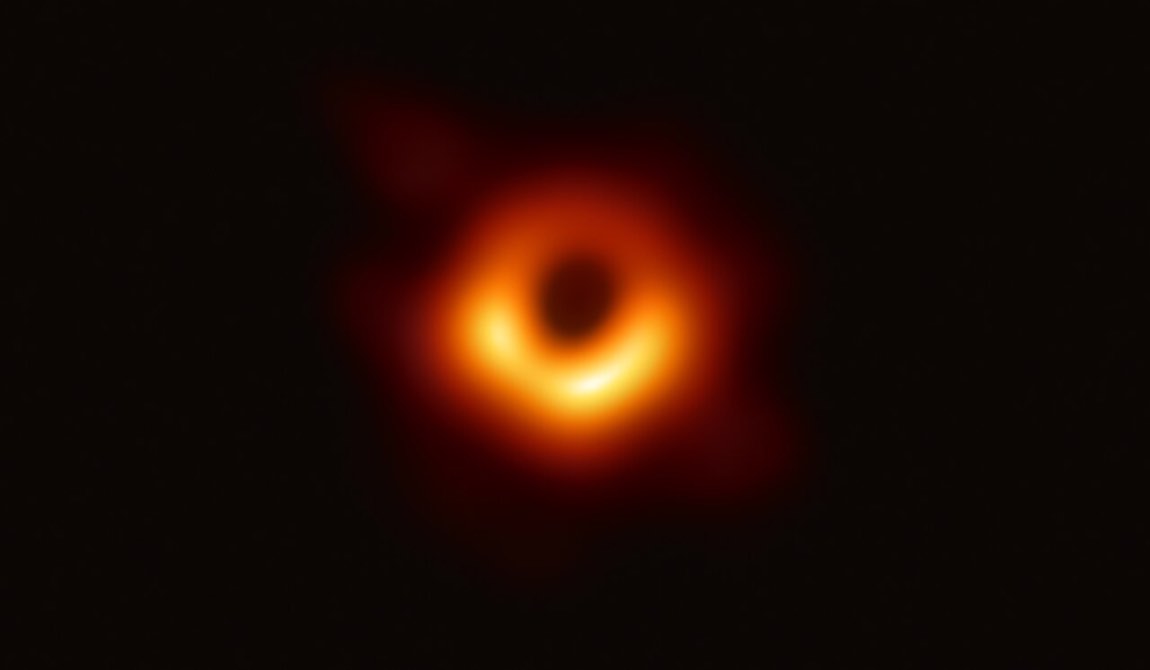
Just outside a black hole's event horizon lies the photon sphere, a region where gravity is strong enough to bend light into closed or nearly closed loops. For a non-spinning Schwarzschild black hole, the photon sphere sits at 1.5 times the Schwarzschild radius. For a rotating black hole, the situation splits: a photon orbiting in the same direction as the spin (prograde) has a photon sphere as close as 0.5 Schwarzschild radii from the centre, while a retrograde photon's sphere can lie between 3 and 4 Schwarzschild radii out. Photons that stray slightly inward from the photon sphere fall into the black hole, creating a dark region against the background sky called the shadow. It is this shadow — not the event horizon itself — that the Event Horizon Telescope photographed. The first such image, of the supermassive black hole in the centre of Messier 87, was published on 10 April 2019. A second image, of Sagittarius A*, was released in 2022 from data collected in 2017. The characteristic warped shape of shadows from two merging black holes could allow astronomers to identify imminent collisions.
 ⤢
⤢
09 Relativistic jets: power and mystery
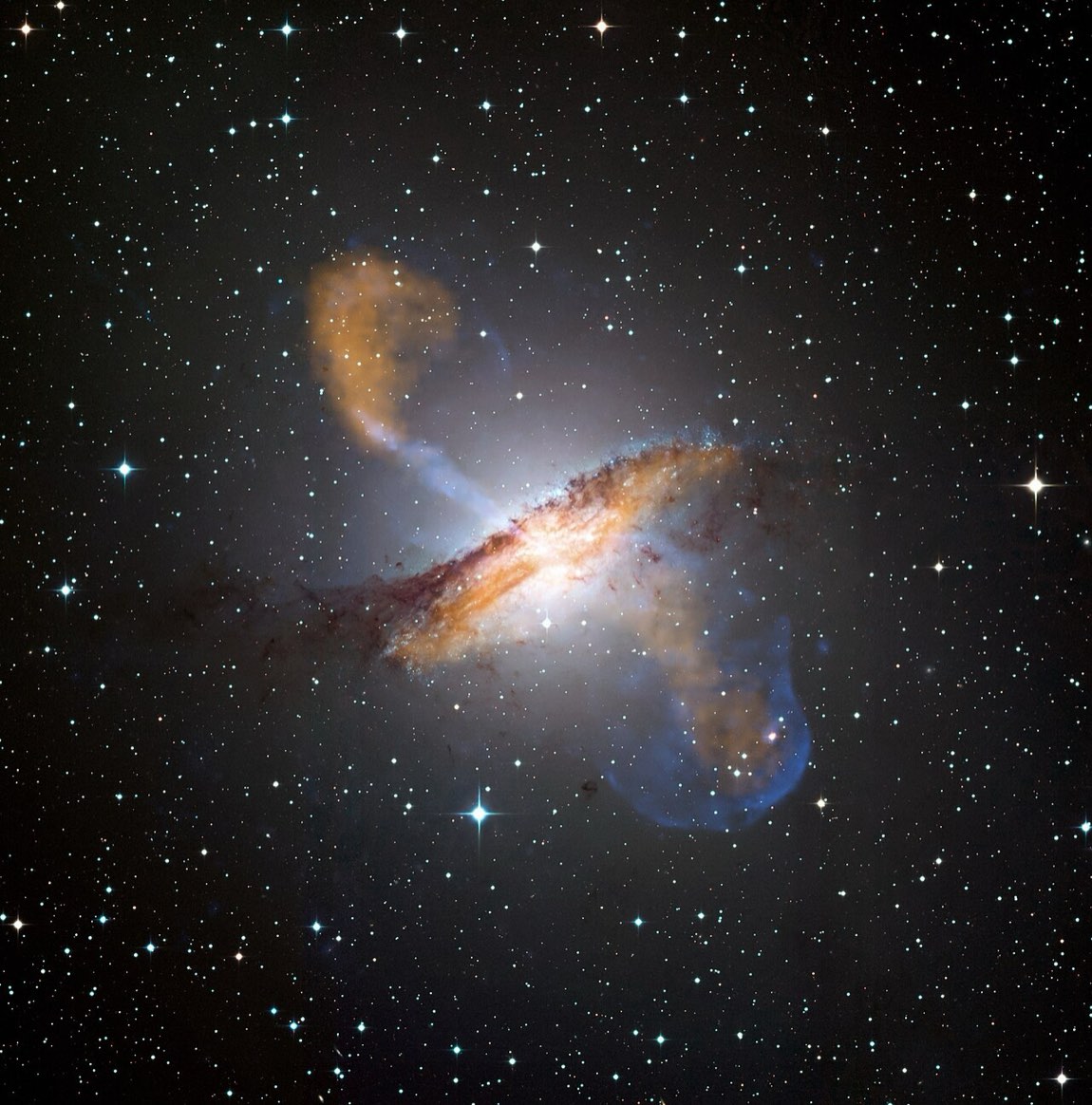
Some black holes launch thin streams of plasma — relativistic jets — from their poles at speeds exceeding 90% of the speed of light. These jets can extend millions of light-years from the black hole, dwarfing entire galaxies. Jets appear to require both a spinning black hole and a strongly magnetised accretion disk, and were more common in the early universe when black holes were rapidly growing. Quasars, among the brightest objects ever observed, are believed to be supermassive black holes with jets; their smaller analogues within the Milky Way, called microquasars, are thought to be stellar-mass black holes with jets. Two leading mechanisms have been proposed to power these jets: the Blandford–Znajek process, in which the rotation of the black hole drags magnetic field lines and flings matter outward, and the Penrose process, which extracts rotational energy from the ergosphere. There is evidence suggesting that jets across all scales, from microquasars to gamma-ray bursts, may share a single underlying mechanism, but no complete model has yet emerged to confirm this.
10 Accretion disks: color, heat, and geometry Deeper
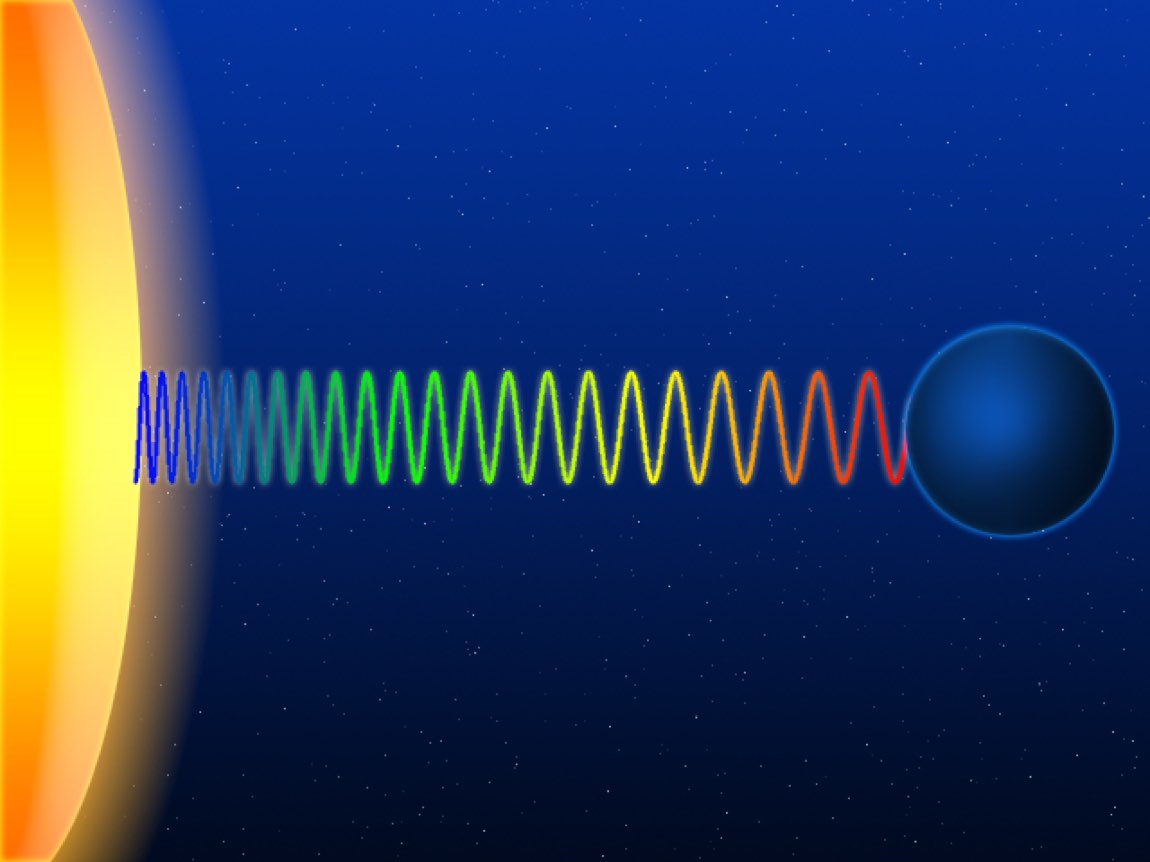
Gas spiralling into a black hole almost never falls straight in. Conservation of angular momentum shapes it into a disk, and friction within the disk transfers angular momentum outward while converting gravitational potential energy to heat. Disk temperatures range from thousands to millions of kelvins across a single disk, so they radiate across the entire electromagnetic spectrum. For a quasar, the disk is expected to have a blue spectral shape with flux per frequency proportional to frequency to the power one-third, though dust emission obscured this signature for a long time. A stellar black hole's disk, by contrast, would likely appear orange, yellow, or red, with its inner regions the brightest. The Doppler effect adds another layer: the side of the disk sweeping toward an observer appears bluer and brighter, while the receding side appears redder and dimmer. Disks accreting beyond the Eddington limit take on a thick, toroidal shape nicknamed "polish donuts." By the time infalling matter reaches the innermost stable circular orbit, between 5.7% and 42% of its mass has been converted to energy depending on the black hole's spin — a far higher efficiency than any nuclear process.
11 Classifying black holes by mass
Astronomers sort black holes into broad mass classes that correspond roughly to how they form. Stellar black holes, born from collapsing massive stars, range from a minimum of roughly 2 to 4 solar masses — set by the maximum mass a neutron star can sustain — up to perhaps 10 to 100 solar masses at formation, with higher limits for stars poor in heavy elements. Intermediate-mass black holes, a small and still contested population, occupy the range of roughly 100 to 10,000 solar masses; some gravitational wave detections have found merged remnants of 110 to 350 solar masses consistent with this class. Supermassive black holes exceed one million solar masses and are believed to inhabit the centres of almost every large galaxy. An average density comparison reveals something counterintuitive: because volume grows with the cube of radius while the Schwarzschild radius scales linearly with mass, a black hole of 100 million solar masses has an average internal density comparable to that of water. Proposed ultramassive black holes exceed one billion to ten billion solar masses, with theoretical models suggesting that accretion disk instabilities set a rough upper mass limit around 50 billion to 100 billion solar masses.
12 Gravitational waves: hearing black holes merge
In late 2015, the LIGO Scientific Collaboration and Virgo Collaboration announced the first direct detection of gravitational waves, an event labelled GW150914. The signal came from two black holes, with masses of roughly 30 and 35 solar masses, merging approximately 1.4 billion light-years from Earth. Rainer Weiss, Kip Thorne, and Barry Barish, who led the project, were awarded the Nobel Prize in Physics in 2017 for the achievement. Since that initial detection, hundreds more gravitational wave events have been observed. Merging black holes provide a uniquely clean signal: because the objects have no surface to complicate the emission, the waveform matches general relativistic predictions with extraordinary precision. Gravitational wave observations also yield spin measurements for both the progenitor black holes and the merged remnant, adding a new observational tool alongside X-ray spectroscopy. The signal from a merger involving two supermassive black holes is expected to be far more powerful but at lower frequencies, requiring future space-based detectors to observe.
13 Open questions: singularities, hair, and information Deeper
Despite a century of progress, black holes leave several fundamental questions unanswered. The singularities predicted at their cores — points of infinite spacetime curvature — are widely regarded as breakdowns of general relativity rather than physical reality, yet no agreed quantum theory of gravity exists to replace them. The no-hair conjecture, which proposes that all dynamic collapses settle into a state described by only mass, charge, and spin, remains unproven. The weak cosmic censorship hypothesis, proposed by Penrose, holds that naked singularities — singularities unshielded by an event horizon — cannot form from realistic matter, but this too is unproven and remains an active research area. At the interior Cauchy horizon of rotating or charged black holes, the so-called mass-inflation singularity and shock singularity may prevent classical general relativity from predicting what happens to infalling observers, though some physicists argue that realistic accretion and Hawking radiation would prevent mass inflation from occurring. Alternative frameworks such as loop quantum gravity and the string-theory-based fuzzball model propose black holes without true singularities, but neither has been observationally tested. The electric charge of Sagittarius A* has been measured to be at least ten orders of magnitude below the theoretical maximum, illustrating how hard these intrinsic properties are to pin down.
✦ Keep exploring