Cosmology
Dark Matter
Strong EvidenceThe idea
Galaxies spin too fast. Count their stars and gas, add the gravity, and the outskirts should fly off. Yet they don't. Something invisible outweighs the visible five to one, holding everything together. It isn't dim ordinary stuff (the accounting rules that out); it seems to be a kind of matter that ignores light entirely, revealing itself only through gravity.
Go deeper Advanced
Evidence stack: rotation curves (Rubin), cluster dynamics (Zwicky 1933), gravitational lensing maps, the Bullet Cluster's mass/gas separation, CMB acoustic peaks, structure-formation simulations — all point to cold non-baryonic matter (~27% of the universe). Particle identity unknown: WIMP searches keep nulling; axions and lighter candidates rise. Modified-gravity alternatives struggle with the full evidence stack. 'What is it?' remains physics' most expensive question.
The deep dive
Researched for the Atlas from Wikipedia — Dark matter (55,661 characters read) · updated Sep 20, 2026
01 Lord Kelvin's missing stars in 1884
The story of dark matter begins not with galaxies but with stars near our own Sun. In 1884, Lord Kelvin delivered a series of lectures in Baltimore and, in the appendices of the resulting book, tried to count how many stars might surround the Sun within 1 kiloparsec — the distance at which a star's parallax would be 1 milli-arcsecond. He used the measured velocity dispersion of nearby stars and assumed the Sun was between 20 and 100 million years old. His arithmetic led him to a striking conclusion: "Many of our supposed thousand million stars — perhaps a great majority of them — may be dark bodies." Twenty-two years later, in 1906, Henri Poincaré picked up Kelvin's work and introduced the French term matière obscure — dark matter — into scientific writing. Poincaré concluded the amount of dark matter must be less than visible matter, a judgment later shown to be wrong by a large margin. Even so, the vocabulary was now in place, and a genuine physical puzzle had been named.
02 Zwicky's Coma Cluster calculation
In 1933, Swiss astrophysicist Fritz Zwicky was working at Caltech when he turned the virial theorem on the Coma Cluster. The virial theorem connects the average kinetic energy of a bound system to its gravitational potential energy, so by measuring how fast galaxies near the cluster's edge were moving, Zwicky could estimate the cluster's total mass. He then compared that dynamical mass to an estimate based on the cluster's brightness and galaxy count. The gap was enormous: Zwicky found the cluster had about 400 times more mass than was visually observable. He called this hidden component dunkle Materie — dark matter in German. His estimates were off by more than an order of magnitude, mainly because he used an obsolete value of the Hubble constant, and the same calculation done with modern values gives a smaller but still dramatic ratio. Critically, Zwicky correctly concluded that most of the gravitational matter in the cluster was dark, even if his numbers were imprecise. Unlike today's theories, though, Zwicky thought this dark matter was simply non-luminous ordinary matter rather than something fundamentally new.
03 Flat rotation curves and what they demand
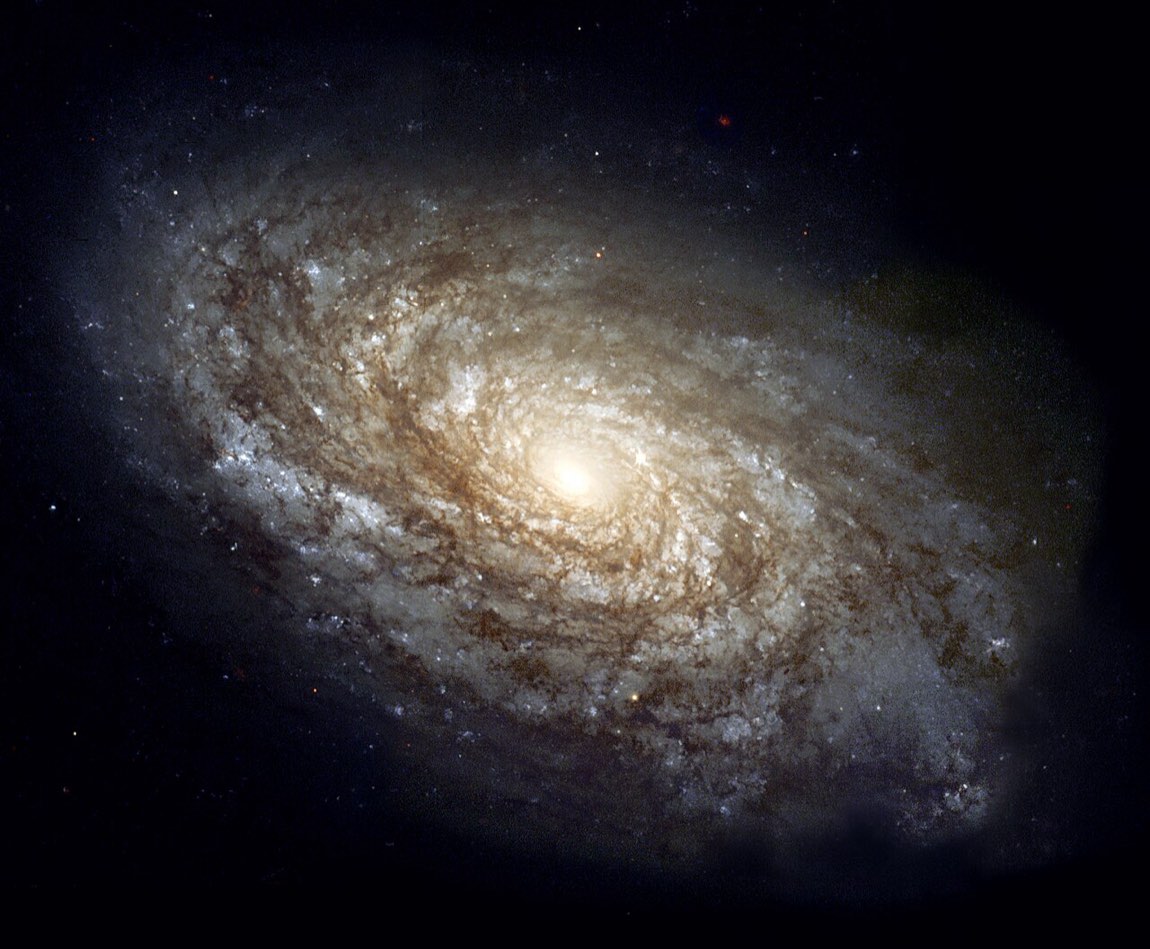
If a spiral galaxy's mass were concentrated in its bright center — like the Sun concentrating mass in our Solar System — then stars and gas clouds in the outer arms should orbit more and more slowly with distance, just as Neptune moves far slower than Mercury. This is Kepler's third law in action. What observers actually found defied that expectation. Vera Rubin and Kent Ford used a new spectrograph to measure the velocity curves of edge-on spiral galaxies with high precision, and radio astronomers mapped the 21-centimeter line of atomic hydrogen, which extends to far greater distances than starlight. Roberts and Whitehurst traced the rotation of the Andromeda Galaxy out to 30 kiloparsecs in 1975, well beyond earlier optical measurements, and the curve stayed flat rather than declining. Albert Bosma confirmed flat rotation curves in 1978 using data from the Westerbork Synthesis Radio Telescope. The logical resolution is that a large, invisible mass — a dark halo — surrounds each galaxy and keeps the outer stars moving at unexpectedly high speeds by contributing its gravity to the system.
04 How the Bullet Cluster settled a debate
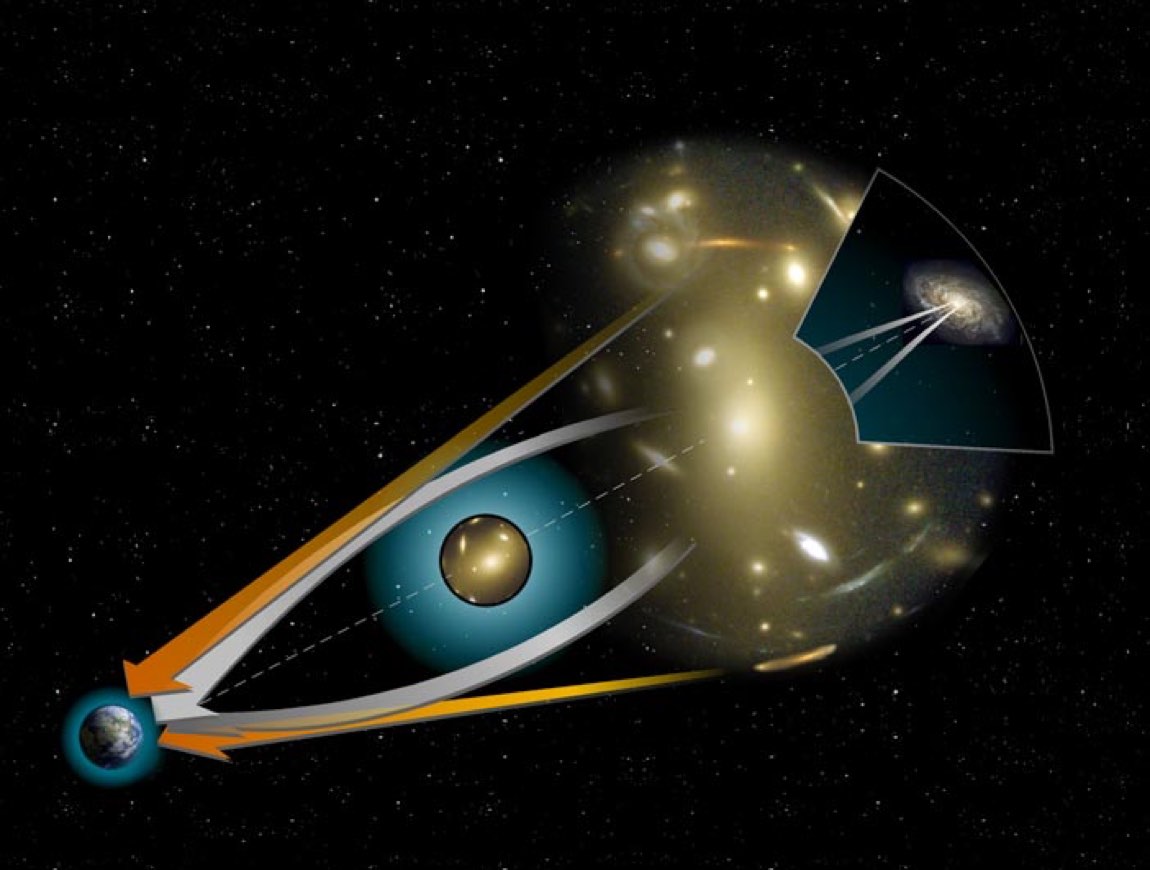
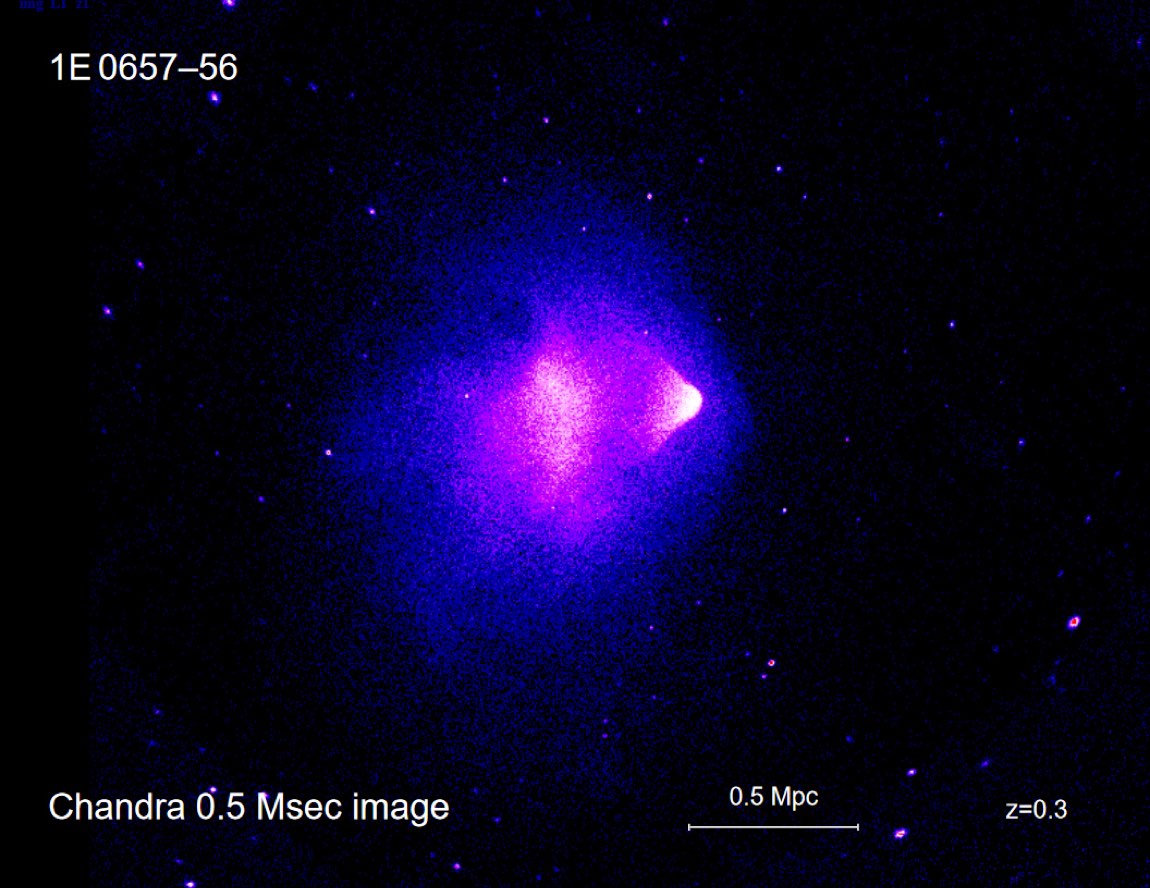
The Bullet Cluster is the wreckage of two galaxy clusters that collided recently in cosmic terms. When clusters collide, the hot gas in each — the dominant visible component — slows down and heats further because gas clouds interact electromagnetically and ram into each other. Stars and galaxies, being widely spaced, mostly pass through without colliding. Dark matter, interacting only through gravity, should pass through unimpeded as well. Astronomers can locate the gravitational center of mass using gravitational lensing, which bends background light regardless of what type of matter is doing the bending. What they found is decisive: the lensing peaks, showing where most mass is concentrated, are offset from the hot X-ray-emitting gas. The gas got left behind at the collision point; the dark matter sailed on with the stars. Modified gravity theories generically predict that lensing follows visible matter, so they struggle to reproduce this separation. Standard dark matter theory predicts it naturally. The Bullet Cluster therefore provides some of the most direct observational evidence that a non-baryonic mass component genuinely exists and behaves differently from ordinary matter.
 ⤢
⤢
05 Three independent ways to weigh a cluster Deeper
Galaxy clusters are uniquely useful because their masses can be measured in three completely independent ways, each relying on different physics. First, the scatter in the radial velocities of member galaxies tracks the cluster's gravitational well through the virial theorem. Second, clusters contain enormous reservoirs of hot X-ray-emitting gas; from the X-ray energy spectrum and flux, astronomers can extract the gas temperature and density, which gives the pressure, and then balance that pressure against gravity to derive the mass profile. Third, gravitational lensing — the distortion of background galaxy images into arcs — depends only on how much mass lies between us and those distant sources, with no assumptions about dynamics needed at all. That three such different measurement strategies consistently agree that dark matter outweighs visible matter by approximately 5 to 1 is a powerful cross-check. Any alternative theory of gravity must simultaneously reproduce all three results, which is a demanding test none of the current modified-gravity proposals fully passes.
06 What the cosmic microwave background reveals Deeper
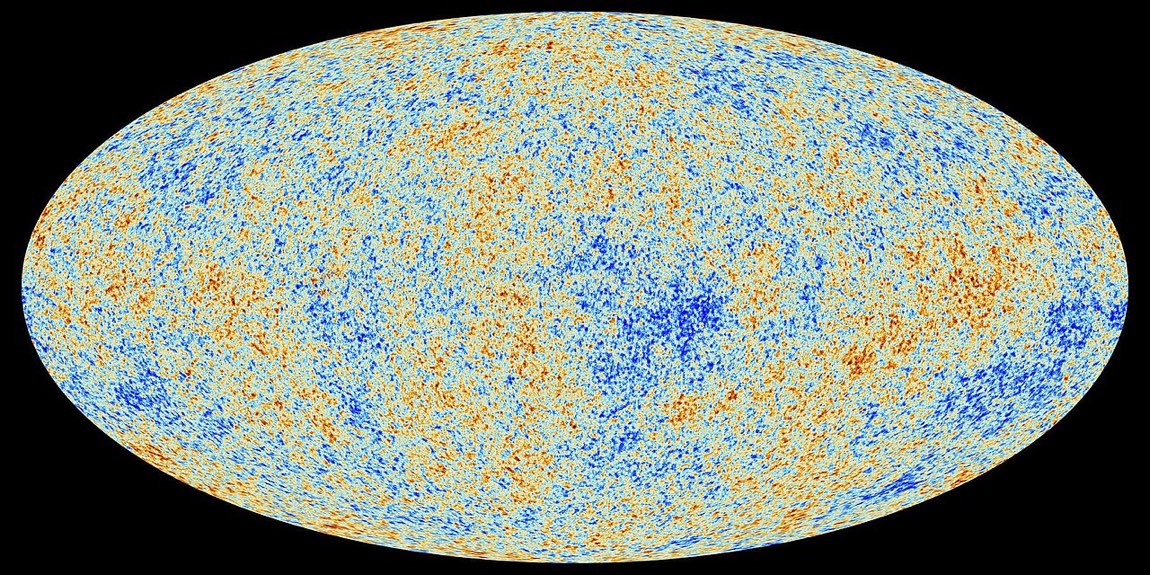
The cosmic microwave background (CMB) is a nearly perfect blackbody glow left over from when the universe was about 380,000 years old, but it carries tiny temperature variations — a few parts in 100,000 — that encode the universe's composition at that moment. Those anisotropies can be decomposed into an angular power spectrum showing a series of acoustic peaks at near-equal spacing but different heights. The heights and positions of those peaks are sensitive to how much ordinary matter and how much dark matter the universe contained. Ordinary matter was ionized in the early universe and interacted strongly with radiation through Thomson scattering, while dark matter did not interact with radiation at all, only with gravity. These different behaviors left distinct fingerprints on the peak structure. COBE first detected the CMB anisotropy in 1992 but lacked resolution to see individual peaks. The BOOMERanG balloon experiment detected the first acoustic peak in 2000. WMAP then precisely mapped the spectrum from 2003 to 2012, and the Planck spacecraft refined the picture further between 2013 and 2015. All results are well described by the Lambda-CDM model and are difficult to reproduce with modified gravity theories such as MOND.
07 Cold, warm, and hot — a matter of speed Deeper
Physicists classify dark matter candidates by how far their particles moved due to random thermal motions in the early universe before cosmic expansion slowed them — a quantity called the free streaming length. The reference scale is the size of the region that would later collapse into a dwarf galaxy. Hot dark matter particles, like neutrinos travelling at nearly the speed of light, stream so far that they erase galaxy-scale density fluctuations entirely; the first structures to form would be enormous supercluster-size sheets that then fragment downward. Cold dark matter particles move so slowly that their free streaming length is much smaller than a protogalaxy, leaving galaxy-scale fluctuations intact and allowing structures to grow from the bottom up — small objects first, then clusters. Deep-field observations showing that galaxies formed before clusters clearly favor the cold scenario and rule out neutrinos as the bulk of dark matter. Warm dark matter sits between the two extremes with a free streaming length comparable to a dwarf galaxy's progenitor. A mixed dark matter theory combining categories was briefly popular in the mid-1990s but was abandoned after the discovery of dark energy.
08 Why dark matter cannot easily form planets or stars Deeper
A natural question is whether dark matter particles could clump into their own compact objects — planets, stars, or black holes made entirely of dark matter. The answer from current theory is almost certainly no, for two reasons rooted in physics. Ordinary matter forms dense structures partly because it can radiate energy away: gas clouds collapse into stars because atoms emit photons and cool, allowing gravity to win over thermal pressure. Dark matter appears to have no such energy-loss channel; it interacts negligibly with radiation and probably only weakly with itself. A dark matter particle that falls inward under gravity gains kinetic energy it cannot shed, so it speeds up and tends to escape the forming object rather than settling into it — a consequence of the virial theorem. Ordinary matter also uses a rich variety of interactions to build complex structures: electromagnetic forces bind electrons to nuclei, the strong force binds protons and neutrons, nuclear fusion powers stars. Dark matter, apparently interacting only through gravity and possibly a force no stronger than the weak nuclear force, simply lacks the toolkit to do the same kind of hierarchical structure-building.
 ⤢
⤢
09 The WIMP miracle and its fading appeal Deeper
For decades the favored dark matter candidate was the WIMP — weakly interacting massive particle. To produce the observed cosmic dark matter density through thermal production in the early universe, a WIMP needs a self-annihilation cross-section of roughly 3×10⁻²⁶ cm³·s⁻¹. Remarkably, a new particle with mass around 100 GeV/c² that interacts through the electroweak force naturally yields almost exactly that cross-section. Because supersymmetric extensions of the Standard Model readily predict such a particle — the lightest neutralino — this apparent coincidence was called the "WIMP miracle." Experimental pursuit was intense: liquid-xenon detectors including XENON, LUX, PandaX, and LUX-ZEPLIN pushed sensitivity down by orders of magnitude. As of late 2025, LZ had excluded WIMP–nucleon cross-sections above interactions corresponding to 9 GeV/c² and had detected boron-8 solar neutrinos via coherent elastic neutrino-nucleus scattering — marking entry into the so-called neutrino floor or "fog," an irreducible neutrino background that complicates future searches. Meanwhile the Large Hadron Collider found no supersymmetric particles through Run 3, with gluino exclusion limits pushed beyond 2.4 TeV and electroweak-ino limits beyond 1 TeV in many scenarios.
10 Axions: dark matter from particle physics Deeper
Axions were not invented to explain dark matter. Frank Wilczek and Steven Weinberg independently theorized them in 1978 as a consequence of the Peccei–Quinn theory proposed in 1977 to solve a different problem entirely — the strong CP problem in quantum chromodynamics, which asks why the strong force does not violate the symmetry between matter and antimatter. The axion emerges as the Goldstone boson of that theory. Its mass must be much less than 60 keV/c² for it to be long-lived and weakly interacting, making it a natural dark matter candidate. With a mass above 5 μeV/c² — that is, about 10⁻¹¹ times the electron mass — axions produced through the misalignment mechanism could account for the observed dark matter density while simultaneously solving the strong CP problem. Ultralight axions also have very large de Broglie wavelengths, which could help smooth out small-scale structure problems in the Lambda-CDM model. The Axion Dark Matter Experiment (ADMX) achieved sensitivity to the plausible DFSZ axion model in the micro-electronvolt range by the early 2020s. Axion searches use resonant microwave cavities rather than the nuclear-recoil detectors used for WIMPs, relying on the Primakoff effect to convert axions into photons inside a strong magnetic field.
11 Primordial black holes and a revival of interest Deeper
Primordial black holes (PBHs) are hypothetical objects that formed in the early universe when extremely dense pockets of matter collapsed gravitationally without the supernova mechanism needed for stellar black holes. The idea was first proposed by Yakov Zeldovich and Igor Novikov in 1966 and independently by Stephen Hawking in 1971. Because they form before any stars exist, PBHs count as non-baryonic dark matter candidates and are not confined to the narrow mass range of stellar black holes — they could range from Planck-mass relics to supermassive scales. Interest surged after LIGO detected gravitational waves in September 2015 from a merger involving black holes of approximately 30 solar masses, which are difficult to explain through standard stellar collapse but fit the mass range expected for PBHs formed during the QCD phase transition. In November 2025, the LIGO/Virgo/KAGRA collaboration reported a candidate gravitational wave signal from a sub-solar mass merger; no known astrophysical process produces black holes below the Chandrasekhar limit of about 1.4 solar masses, so a confirmed detection would be strong evidence for a primordial origin. Observations by the James Webb Space Telescope of galaxies at redshift above 7 — less than 500 million years after the Big Bang — found supermassive black holes already outweighing their host galaxies' stars, which standard accretion models struggle to explain but which PBHs formed as "heavy seeds" could account for.
12 Baryon acoustic oscillations as a cosmic ruler Deeper
Before the universe was about 380,000 years old, ordinary matter and radiation formed a hot, coupled fluid in which sound waves propagated. When the universe cooled enough for electrons to combine with protons — the epoch called recombination — those sound waves froze in place, imprinting a preferred separation scale on the distribution of matter. That frozen scale, called the baryon acoustic oscillation (BAO) length, acts as a cosmic standard ruler. Because dark matter and baryons clumped together after recombination, the signal is diluted in the galaxy distribution but still detectable as a subtle — roughly 1 percent — preference for pairs of galaxies to be separated by 147 megaparsecs rather than the immediately neighboring scales of 130 to 160 megaparsecs. This preference was predicted theoretically in the 1990s and then detected observationally in 2005 in two independent large galaxy redshift surveys: the Sloan Digital Sky Survey and the 2dF Galaxy Redshift Survey. Combining BAO measurements with CMB observations provides precise estimates of the Hubble constant and average matter density. All results support the Lambda-CDM model, in which dark matter plays the essential role of gravitational scaffolding that seeds the structures those acoustic oscillations eventually inhabit.
13 Open questions and the neutrino fog problem
Despite decades of searching, no dark matter particle has been identified in a laboratory, and the field is navigating genuine uncertainty. The most pressing experimental challenge is the neutrino floor — now sometimes called the neutrino fog — an irreducible background of neutrino scattering events inside detectors that mimic the signal expected from a dark matter particle collision. In late 2025, LZ reported the first detection of boron-8 solar neutrinos through coherent elastic neutrino-nucleus scattering inside a dark matter detector, marking the formal entry into this fog. Future liquid-xenon and argon experiments will need new strategies to distinguish dark matter signals from this background. On the theoretical side, the failure of the Large Hadron Collider to find supersymmetric particles through Run 3 has closed much of the most-favored WIMP parameter space, shifting significant attention toward axions, primordial black holes, and exotic dark-sector models. Modified gravity theories such as MOND can explain individual observations but have not successfully reproduced all observational evidence simultaneously, and most astrophysicists conclude that even if gravity must be modified, some form of dark matter would still be required. The total amount of dark matter within the orbit of Neptune would sum to only about 10¹⁷ kilograms — equivalent to a large asteroid — underlining how tenuous its local presence is even as it dominates the universe's mass budget.