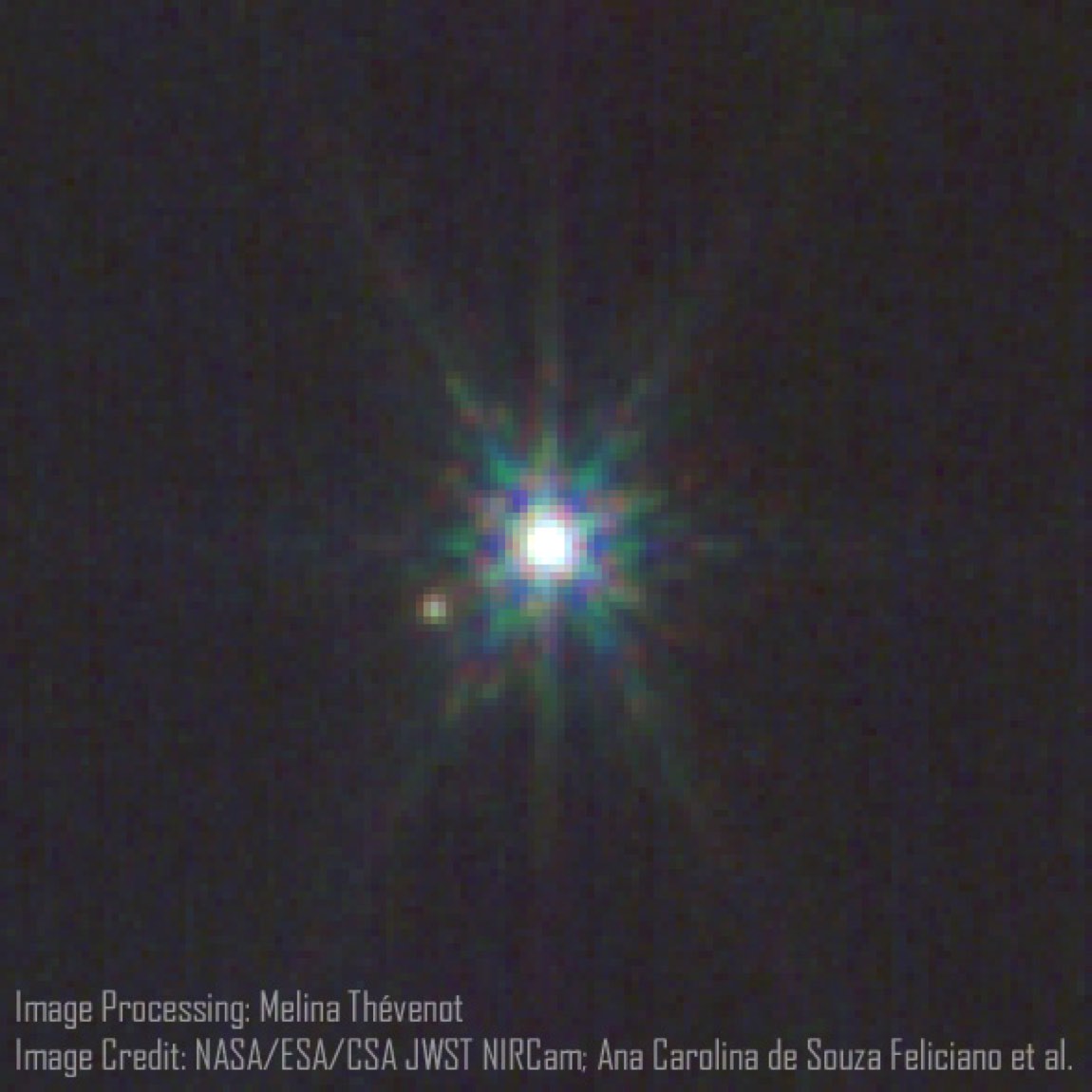
 Photograph · NASA/ESA/CSA JWST NIRCam; Ana Carolina de Souza Feliciano et al. & Melina Th · CC BY-SA 4.0
Dwarf Planet · Deep guide
Eris
Pluto's distant, denser twin, and the world that ended the nine-planet era.
What is it?
Eris, discovered in 2005, is the reason Pluto is a dwarf planet: nearly Pluto's size and slightly more massive, it forced astronomers to decide what 'planet' means. It patrols the scattered disk almost 96 times farther from the Sun than Earth, with one moon, Dysnomia, and a surface of collapsed methane frost that may revive into a thin atmosphere when its 559-year orbit brings it closer in.
The deep dive
Researched for the Atlas from Wikipedia — Eris (dwarf planet) (22,331 characters read) · updated Sep 20, 2026
01 How Eris upended the definition of planet
When Mike Brown's team announced Eris on July 29, 2005, NASA described it as the Solar System's tenth planet, because it appeared larger than Pluto. That single announcement forced a crisis that had been simmering for years: if Eris counted as a planet, so might dozens of other large Kuiper belt objects yet to be found. The International Astronomical Union convened a working group and, on August 24, 2006, adopted its first-ever formal definition of the word "planet." Under that definition, both Eris and Pluto were reclassified as "dwarf planets" — a brand-new category. The planet count dropped back to eight, the same number as before Pluto's discovery in 1930. Brown, who had effectively killed Pluto's planet status, expressed approval of the decision. It was a remarkable case of a single discovery reshaping the conceptual architecture of an entire scientific field, and it happened in less than fourteen months from announcement to ruling.
02 A nickname called Xena
Long before Eris had an official name, the discovery team used the informal nickname "Xena" for it internally, inspired by the television series Xena: Warrior Princess. Brown's team had reportedly saved that nickname specifically for the first body they found that was larger than Pluto. Its moon received the companion nickname "Gabrielle," after the warrior princess's sidekick. The nickname leaked to the press when a New York Times reporter — a college friend of Brown — asked what the team called the object informally, and Brown told him just that once. "I only sorta felt bad about it," Brown later said, adding that he genuinely liked the name. When the IAU ruling required an official mythological name, Xena was set aside. The final name, Eris, was chosen in part because Brown described the goddess as his favorite, and because, as he put it in 2006, "Eris caused strife and discord by causing quarrels among people — and that's what this one has done too."
03 The discovery hidden in plain sight since 1954 Deeper
Eris was imaged on October 21, 2003, by the 1.2-metre Samuel Oschin Schmidt telescope at Palomar Observatory in California, but its discovery had to wait until January 2005 — more than a year later. The culprit was software: the team's automatic image-searching program discarded any object moving slower than 1.5 arcseconds per hour to cut down on false positives. Eris moved so slowly across the sky that it fell below that threshold. When Sedna was found in 2003 moving at just 1.75 arcseconds per hour, the team realized they might be missing things, lowered the cutoff, and re-examined the rejected images by eye. That painstaking reanalysis revealed Eris. Even more striking, precovery images — archival photographs taken before the formal discovery — have been traced back to September 3, 1954. Eris was hiding in telescope archives for more than half a century before anyone knew what they were looking at, a reminder of how much data can outpace the tools used to search it.
04 An orbit tilted wildly from the crowd
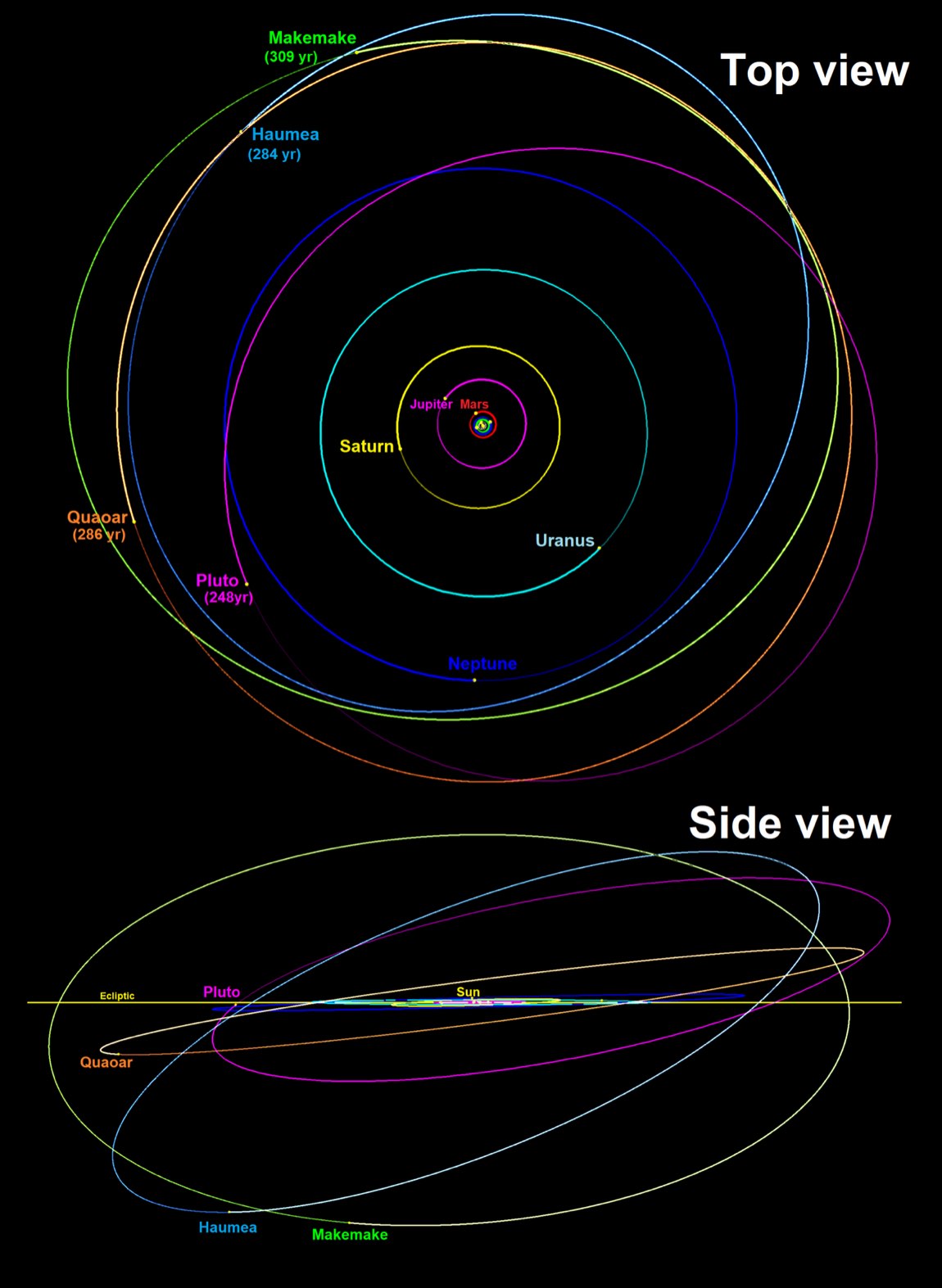
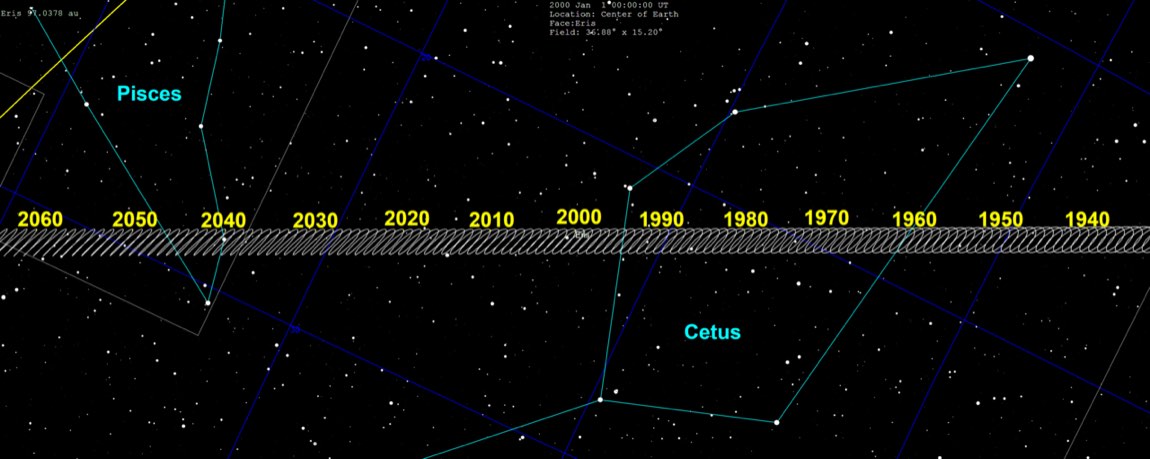
Every one of the eight recognized planets orbits the Sun within a few degrees of Earth's orbital plane, the ecliptic. Eris ignores that convention entirely: its orbit is tilted about 44 degrees to the ecliptic, more than twice the inclination of any recognized planet. This steep tilt is the main reason Eris was not spotted until 2005 — sky surveys hunting for large outer Solar System objects concentrate near the ecliptic, where most bodies cluster. The orbit is also highly elongated. Eris swings between a closest approach of 38.4 AU and a maximum distance of 97.7 AU from the Sun. Its orbital period is 558 years, more than twice Pluto's. Numerical integration shows that Eris last reached perihelion around 1699, reached its farthest point around 1977, and will next swing back to perihelion on December 6, 2257. In about 800 years, Eris will actually be closer to the Sun than Pluto for a period — two worlds briefly trading places across the outer Solar System.
 ⤢
⤢
05 Density, rock, and a possible hidden ocean Deeper
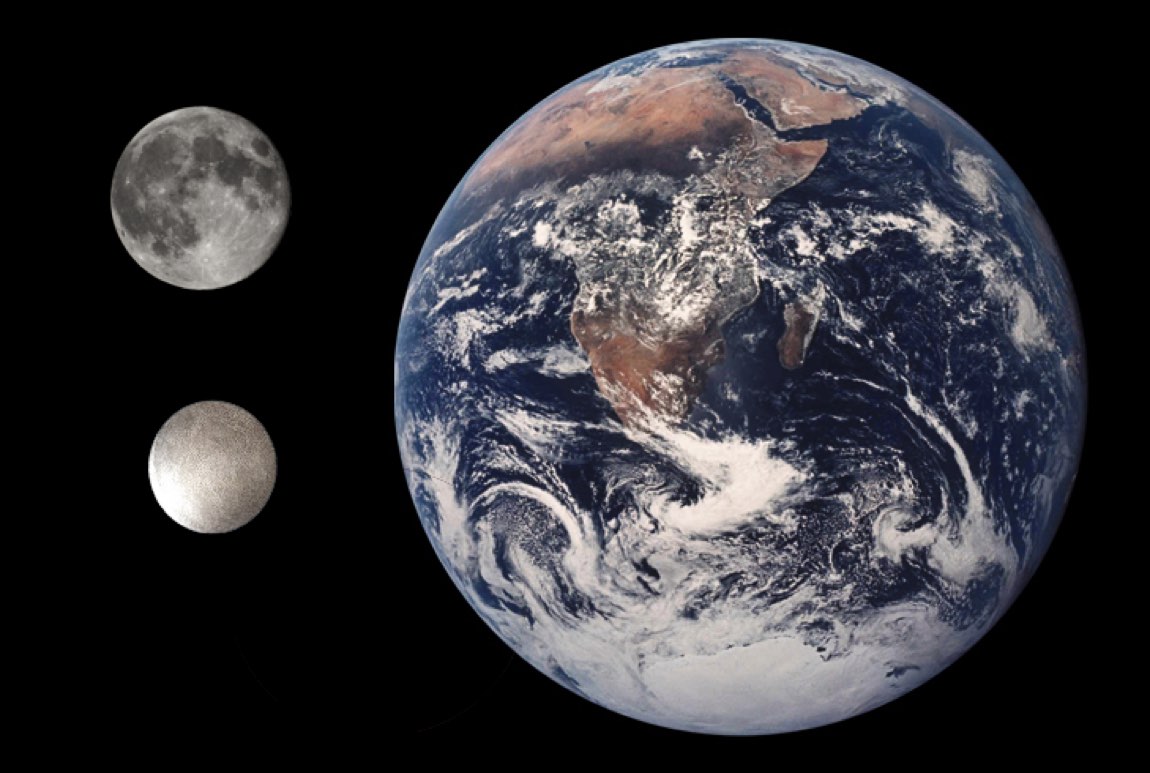
A stellar occultation observed in November 2010 — one of the most distant such events ever measured from Earth — pinned Eris's diameter at 2,326 ± 12 kilometres. Combined with its well-known mass, that yields a density of 2.52 ± 0.07 grams per cubic centimetre, substantially higher than Pluto's. That density means Eris must be composed largely of rocky material rather than ice. Yet ice is far from absent. Models of internal heating through radioactive decay suggest that Eris could harbour a subsurface ocean of liquid water at the boundary between its mantle and core. Tidal heating from its moon Dysnomia may also help keep any such ocean from freezing. More recent research concluded that Eris, Pluto, and Makemake could all harbour active subsurface oceans and show active geothermal activity. These are not confirmed findings, but the density and thermal models make the possibility physically plausible rather than speculative, and geothermal activity could also explain why Eris's surface chemistry looks freshly replenished rather than ancient.
06 A surface so bright it rivals fresh snow
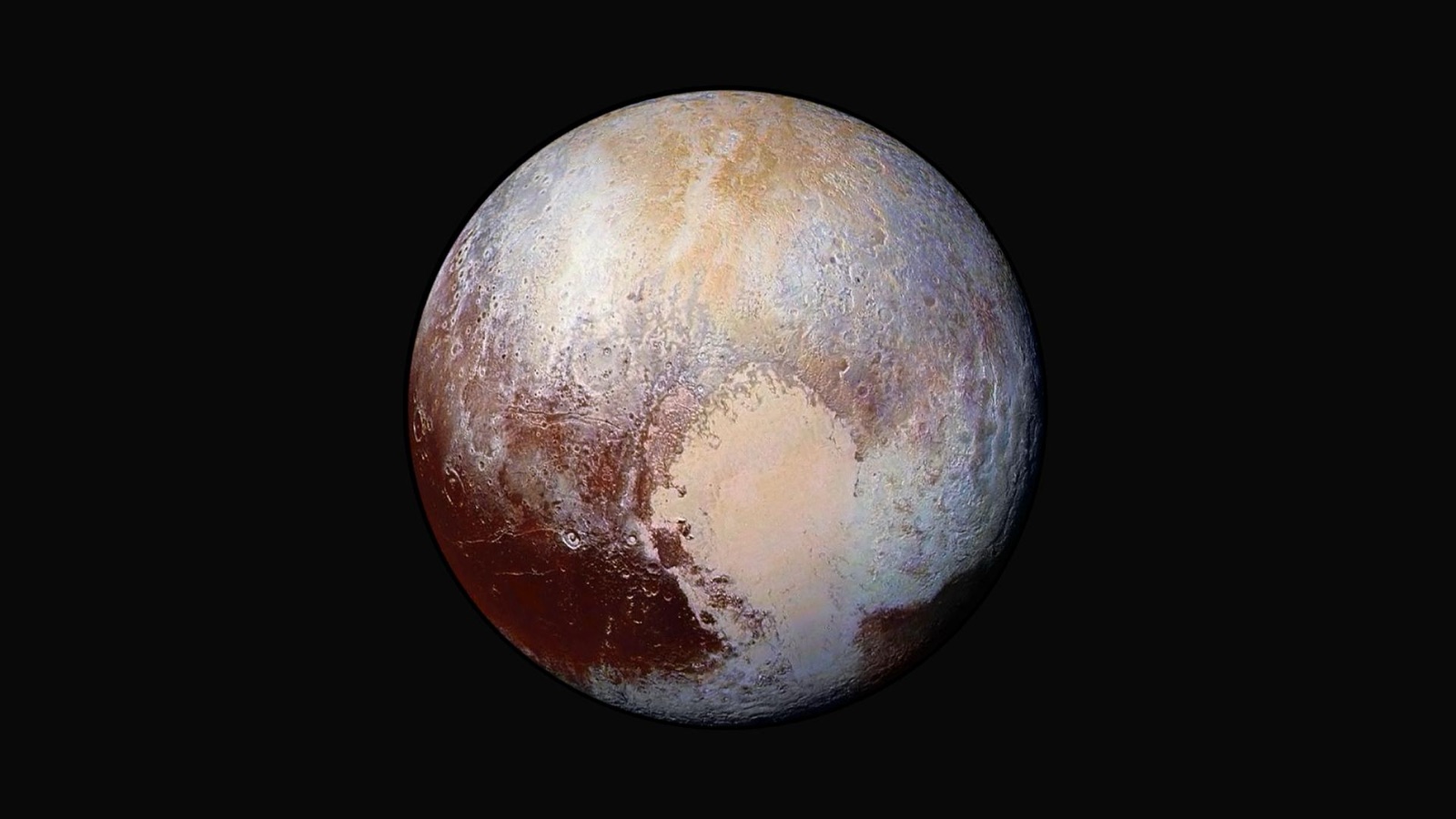
Eris has a geometric albedo of 0.96, meaning it reflects 96 percent of the sunlight that hits it — comparable to freshly fallen snow and far brighter than most solar System bodies. Unlike Pluto, which has a reddish, varied surface stained by deposits of complex organic molecules called tholins, Eris appears almost uniformly white. The explanation involves Eris's eccentric orbit. Because it wanders so far from the Sun, methane ice can condense even onto darker patches of its surface, covering any tholin deposits that might otherwise absorb light and create color contrasts. This continuous condensation keeps the surface looking fresh and uniform. The James Webb Space Telescope confirmed in 2022 that Eris's surface shows no detectable ethane, which would be a byproduct of methane broken down by radiation. The absence of ethane strongly supports the idea that Eris's surface is being continuously refreshed, either through sublimation and recondensation of ices or through radiogenic convection of a global methane and nitrogen ice glacier.
07 What JWST revealed about Eris's strange chemistry Deeper
Near-infrared spectroscopy by the James Webb Space Telescope in 2022 delivered two significant surprises about Eris's surface chemistry. First, JWST detected deuterated methane ice — methane in which some ordinary hydrogen atoms are replaced by the heavier isotope deuterium — at abundances lower than those found in Jupiter-family comets such as 67P/Churyumov–Gerasimenko. That low deuterium abundance is telling: it suggests Eris's methane is not primordial leftover gas from the early Solar System. Instead, it may have been produced by geochemical processes inside Eris itself, bubbling up from the interior. Second, JWST detected substantial quantities of nitrogen ice on Eris, estimated at about one-third the volume of methane ice, and this nitrogen is also presumed to have come from subsurface processes rather than surviving from the planet-forming era. Together, these findings paint a portrait of a geologically active world still venting materials from within, rather than a frozen, inert time capsule from the Solar System's birth.
08 Tidal locking and double-synchronous spin Deeper
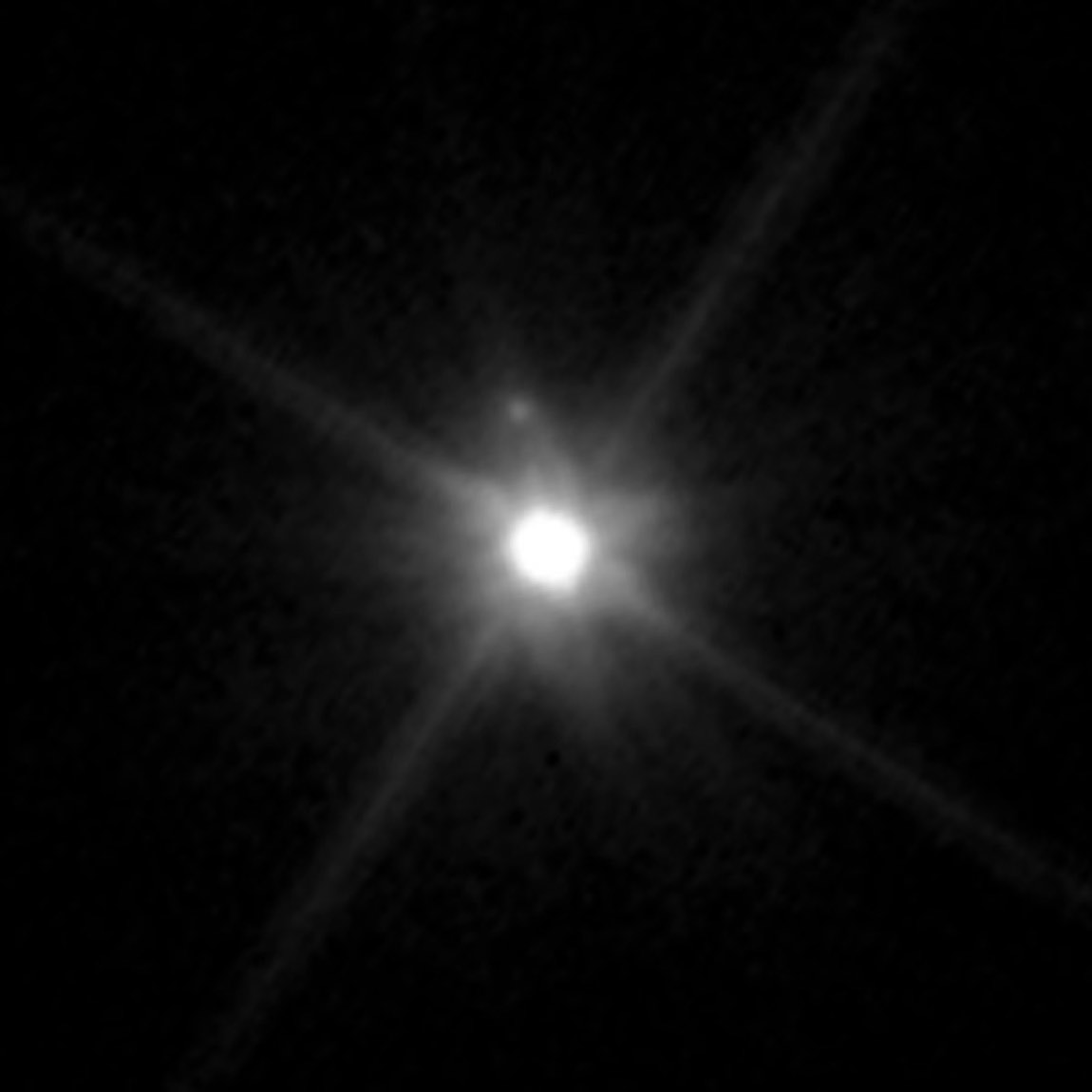
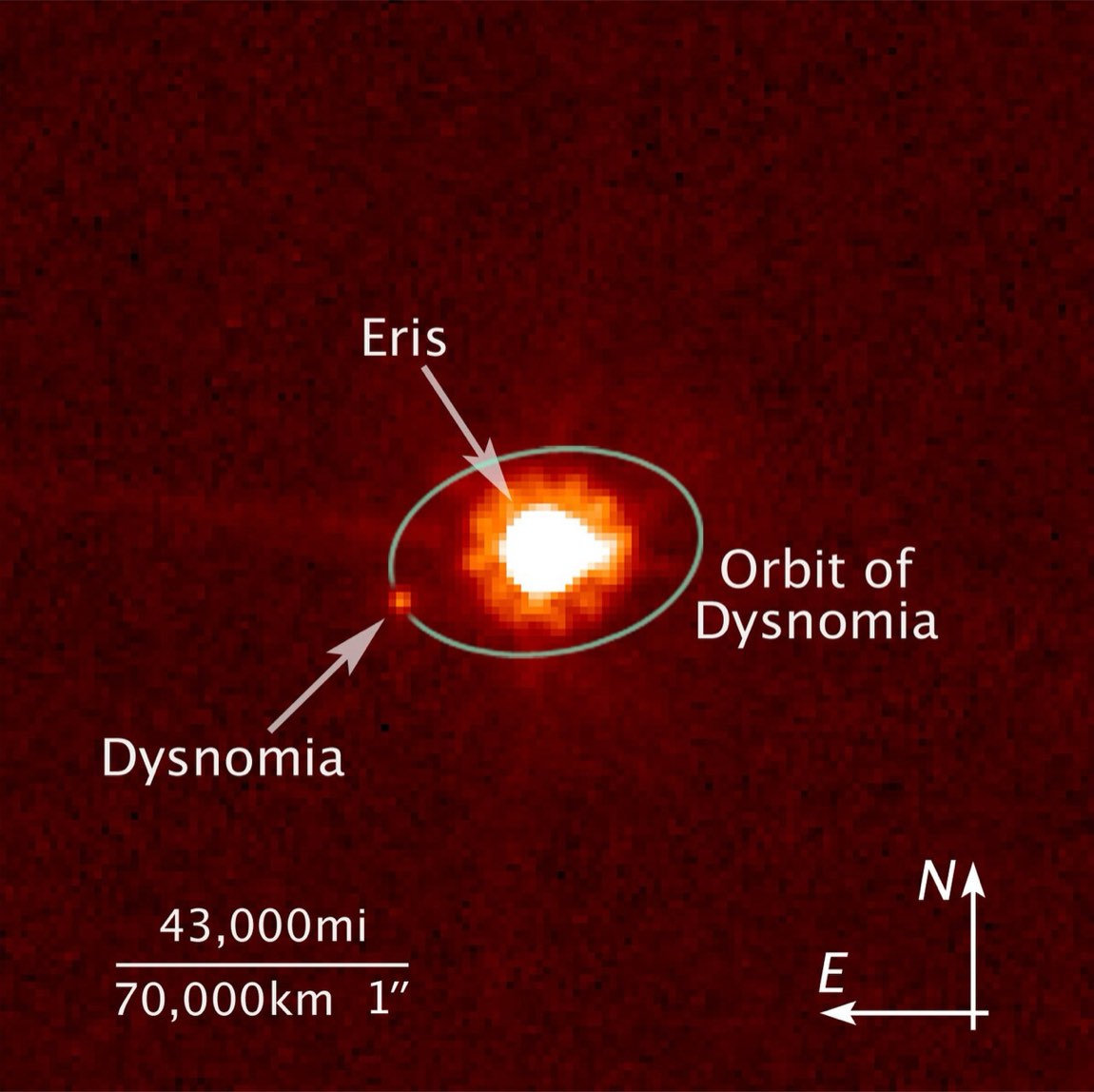
Measuring Eris's rotation period proved frustratingly difficult because its surface is so uniform that it barely brightens or dims as it spins. Precise long-term monitoring eventually showed that Eris is tidally locked to Dysnomia, with a rotation period synchronized to the moon's orbital period of 15.78 Earth days. Dysnomia is also tidally locked to Eris, making the pair the second known case of mutual double-synchronous rotation in the Solar System — the first being Pluto and its moon Charon. Each world perpetually shows the same face to the other, like two dancers always facing their partner. Although Eris's axial tilt has not been directly measured, it can be reasonably inferred from Dysnomia's orbital inclination to be about 78 degrees relative to the ecliptic — an extreme tilt that would mean most of its northern hemisphere faces the Sun for extended periods, with 30 percent of that hemisphere in constant sunlight as of 2018.
 ⤢
⤢
09 A possible inner moon hiding near Eris Deeper
Dysnomia's orbit does not behave as a simple Keplerian ellipse; a 2021 study led by Bryan Holler found that the orbit is precessing, implying an unseen gravitational source is tugging at it. The leading candidate proposed by Marina Brozović and Robert Jacobson in 2023 is an undiscovered inner moon locked in a mean-motion orbital resonance with Dysnomia. Supporting this idea, the Gaia spacecraft detected a subtle brightness variation in Eris with a period of 18.853 ± 0.015 hours that cannot be explained by the rotation of either Eris or Dysnomia. A 2025 study led by Jose-Luis Ortiz proposed that this 18.85-hour signal could be caused by a moon roughly 1,000 kilometres in diameter orbiting just 5,050 or 8,010 kilometres from Eris — closer than Dysnomia. Such a moon would also help explain Eris's apparently overestimated density, albedo, and thermal emission. However, a puzzling inconsistency remains: if a massive inner moon exists, Eris should be tidally locked to it, not to the more distant Dysnomia. The question is genuinely open.
10 Observing Eris: harder than you might think
Despite being the most massive dwarf planet, Eris is extremely difficult to find in the sky. As of 2007, it has an apparent magnitude of 18.7 — far beyond the reach of the naked eye or ordinary binoculars, but detectable with a 200-millimetre (7.9-inch) telescope equipped with a CCD under favorable conditions. Its steep orbital inclination means it wanders far from the ecliptic, the strip of sky where most Solar System searches focus. In 2026, Eris sits in the constellation Cetus; it will move into Pisces in 2036, then Aries in 2065, eventually drifting into the northern constellations Perseus in 2128 and Camelopardalis in 2173, where it will reach its northernmost declination. Its slow motion — the very property that hid it for so long — means it creeps across star fields, requiring careful comparison of images taken nights apart to distinguish it from a background star. It is the largest known Solar System object never visited by a spacecraft, meaning every fact we know about it has been extracted from the faint light that travels billions of kilometres to reach our telescopes.
11 How a flyby mission might reach Eris
No spacecraft has ever visited Eris, making it the largest known object in the Solar System without a close-up portrait. Planning studies from the 2010s calculated that a flyby mission using a Jupiter gravity assist could reach Eris in 24.66 years from launch. Two candidate launch windows were identified: April 3, 2032, and April 7, 2044. At arrival, Eris would be 92.03 AU or 90.19 AU from the Sun, respectively — roughly 90 times the Earth-Sun distance. For context, light takes about 12.5 hours to travel that far. New Horizons, which flew through the Pluto system in 2015, observed Eris from afar in May 2020 during its extended Kuiper Belt mission. At the time, New Horizons was actually farther from Eris, at 112 AU, than Eris was from Earth at 96 AU. Even so, the spacecraft's unique geometry inside the Kuiper Belt allowed it to study Eris at high-phase angles impossible to achieve from Earth, revealing details about how the Eridian surface scatters light.
12 The name's mythology and its Discordian symbols
The name Eris comes from the Greek goddess of strife and discord, a fitting choice for an object whose existence forced astronomers to redefine the Solar System. The name was formally proposed by the Caltech discovery team on September 6, 2006, and accepted by the IAU on September 13, 2006, after an unusually long period during which the object carried only the provisional designation 2003 UB313. Brown had considered other names first: "Lila," inspired by a Hindu mythological concept describing the cosmos as a game played by Brahman — and coincidentally the name of his newborn daughter — was quietly abandoned after he accidentally left it on a public webpage. Persephone was also considered but ruled out because a minor planet, 399 Persephone, already carried that name. The symbol NASA uses for Eris is the Hand of Eris, borrowed from Discordianism, a religion centered on the goddess. The Sternberg Astronomical Institute uses a separate symbol derived from either the "all rights reversed" symbol of the Principia Discordia or a stylized Apple of Discord.
 ⤢
⤢
You would weigh…
Surface gravity 0.82 m/s² vs Earth’s 9.81 m/s². Try every world →
Could life exist here?
A deep-frozen relic at −240 °C; chemistry is essentially paused.
Our labels: Confirmed · Strong Evidence · Estimated · Hypothesis · Theoretical · Speculative (see Methodology).