 Diagram · Tomruen · CC BY-SA 4.0
Dwarf Planet · Deep guide
Haumea
The spinning egg of the Kuiper Belt, complete with its own ring.
What is it?
Haumea is unlike anything else known: a dwarf planet spun so fast (one rotation every 3.9 hours) that it has stretched into an egg shape roughly twice as long as it is wide. It carries two moons, a shattered family of icy siblings from some ancient collision, and — discovered in 2017 when it passed in front of a star — a ring, the first ever found around a world beyond Neptune.
The deep dive
Researched for the Atlas from Wikipedia — Haumea (24,694 characters read) · updated Sep 20, 2026
01 A spinning football at the edge of the Solar System
Haumea's most immediately striking property is its shape. While nearly every large body in the Solar System settles into a sphere or a flattened sphere under its own gravity, Haumea spins so violently — completing one full rotation every 3.9 hours — that it has been wrenched into a triaxial ellipsoid, essentially a rocky egg, with its major axis roughly twice as long as its minor axis. The best-fit dimensions from modeling are approximately 2,000 × 1,500 × 1,000 km. To put that in perspective, the longest axis is close to the width of the contiguous United States. No other body in hydrostatic equilibrium anywhere in the Solar System rotates this quickly. Physicists note that if Haumea were spinning even faster, gravity could no longer hold it together as one piece: it would stretch into a dumbbell shape and split in two. This extreme spin is almost certainly a relic of the giant collision billions of years ago that also launched Haumea's moons and the surrounding family of smaller objects into space.
02 Inside Haumea: rock wrapped in a skin of ice Deeper
For years, astronomers argued over what Haumea is made of on the inside. Early light-curve analyses implied a surprisingly high density — between 2.6 and 3.3 g/cm³ — which is close to the Moon's density of 3.3 g/cm³ and far above Pluto's 1.86 g/cm³. That pointed to a body dominated by rock rather than ice. A 2019 numerical modeling study that tried to reconcile conflicting size measurements found the best-fit dimensions to be approximately 2,100 × 1,680 × 1,074 km, with a dense silicate core of roughly 1,626 × 1,446 × 940 km, composed largely of hydrated silicates such as kaolinite and carrying a density of about 2.68 g/cm³. Surrounding that core is an icy mantle that ranges from about 70 km thick at the poles to about 170 km along the longest axis, and which makes up as much as 17% of Haumea's total mass. The resulting mean density of the whole body is estimated at approximately 2.018 g/cm³. Whether Haumea is in true hydrostatic equilibrium — the internal balance that is one criterion for dwarf-planet status — remains uncertain after the 2017 occultation revealed a shape inconsistent with a uniform, homogeneous interior.
03 A surface as bright as fresh snow — and just as puzzling
Haumea reflects between 60 and 80 percent of the sunlight that hits it, making it about as reflective as freshly fallen snow and among the brightest known objects in the outer Solar System. Spectra taken in 2005 by the Gemini and Keck telescopes revealed the signature of crystalline water ice — the same structured, ordered form of ice that Pluto's moon Charon displays. The puzzle is that crystalline ice only forms above 110 K, yet Haumea's surface sits well below 50 K, a temperature at which ice should form in the disordered, amorphous state. Worse still, the constant bombardment of cosmic rays and solar energetic particles should convert any crystalline ice back to amorphous ice within roughly ten million years — a blink compared to the billions of years Haumea has existed in the cold outer Solar System. Something must be replenishing or refreshing the surface, but no convincing mechanism has been identified. Best-fit models suggest that 66 to 80 percent of the surface is pure crystalline water ice, with possible traces of hydrogen cyanide, phyllosilicate clays, or inorganic cyanide salts such as copper potassium cyanide contributing to the high albedo.
04 A dark red scar on a bright white world
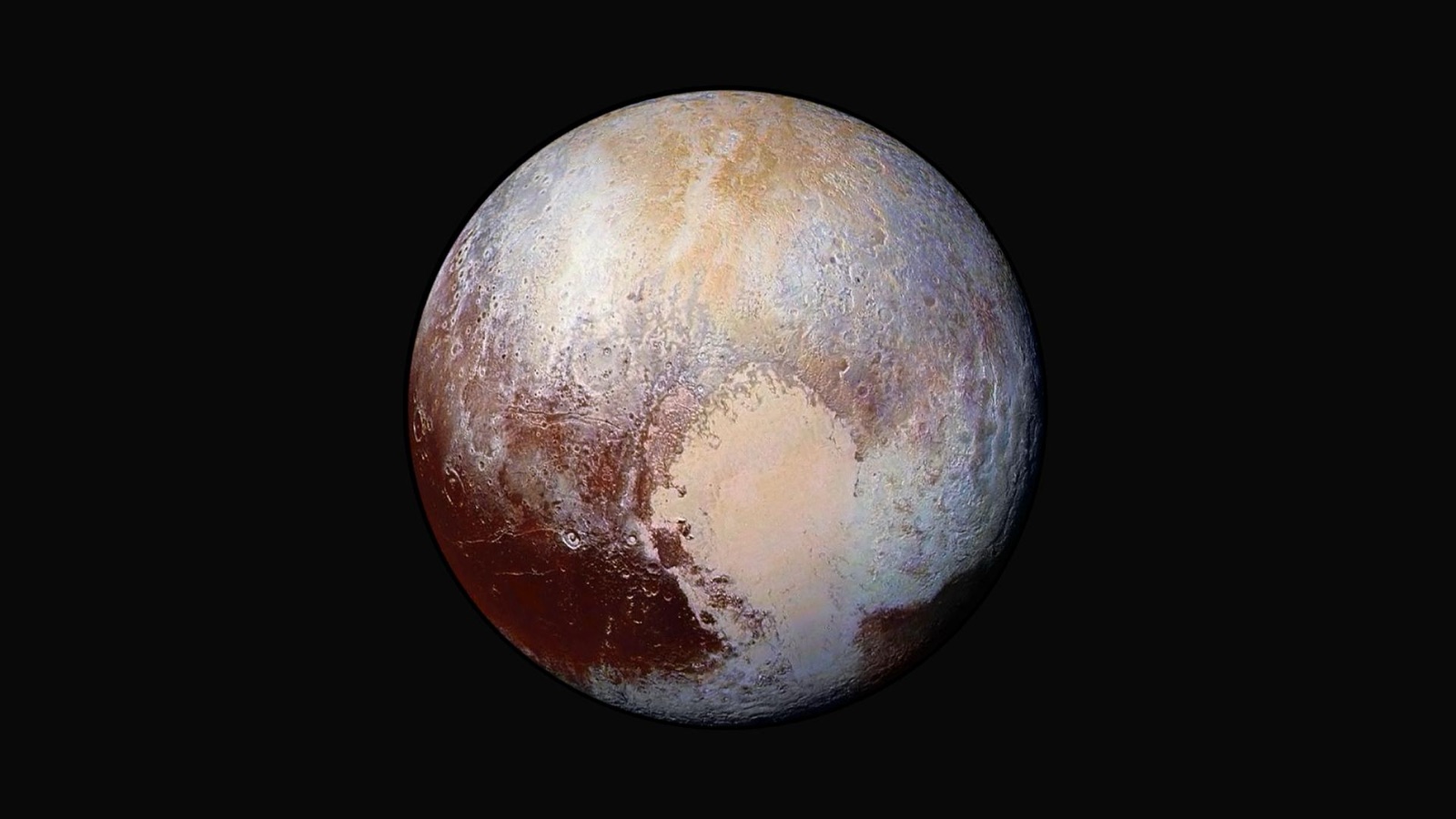
Haumea is not uniformly dazzling white. Observations in September 2009 revealed a large dark red region on the otherwise brilliant surface, detectable as a smaller but distinct color variation on top of the body's overall brightness fluctuations. This patch shows a different albedo and a redder hue compared to the surrounding crystalline ice, and it appears at a consistent rotational phase — meaning it rotates with Haumea rather than being an artifact of the viewing geometry. Astronomers interpret it as a possible impact feature enriched in minerals and carbon-rich organic compounds, or alternatively as a region with a higher proportion of crystalline ice of a different character. The presence of this mottled coloration is reminiscent of Pluto's famously varied surface, though Haumea's contrast between the dark patch and the surrounding white ice is less extreme than Pluto's dramatic color variations. The absence of detectable methane in Haumea's spectra — unlike Makemake — is also consistent with a warm collisional history that volatilized and removed such compounds long ago.
05 The first ring ever found around a distant world
On 21 January 2017, multiple telescope teams around the world watched Haumea pass in front of a distant star — a stellar occultation — and the careful timing of that brief wink of light revealed something nobody had seen around a trans-Neptunian object before: a ring. Announced in October 2017 in the journal Nature, the ring sits at a radius of about 2,287 km from Haumea's center, is roughly 70 km wide, and has an opacity of 0.5, meaning it blocks about half the light passing through it. It contributes an estimated 2.5% to the system's total brightness. The ring lies well inside Haumea's Roche limit — the distance within which tidal forces would shred a loosely bound moon — which sits at roughly 4,400 km if Haumea were spherical. The ring is close to the 1:3 spin-orbit resonance with Haumea's rotation, at a calculated resonance radius of 2,285 ± 8 km. A 2019 dynamical study found that the exact resonance point is actually unstable, but that stable circular periodic orbits exist just outside it, suggesting ring particles naturally cluster there rather than at the resonance itself.
06 Two moons born from a catastrophe
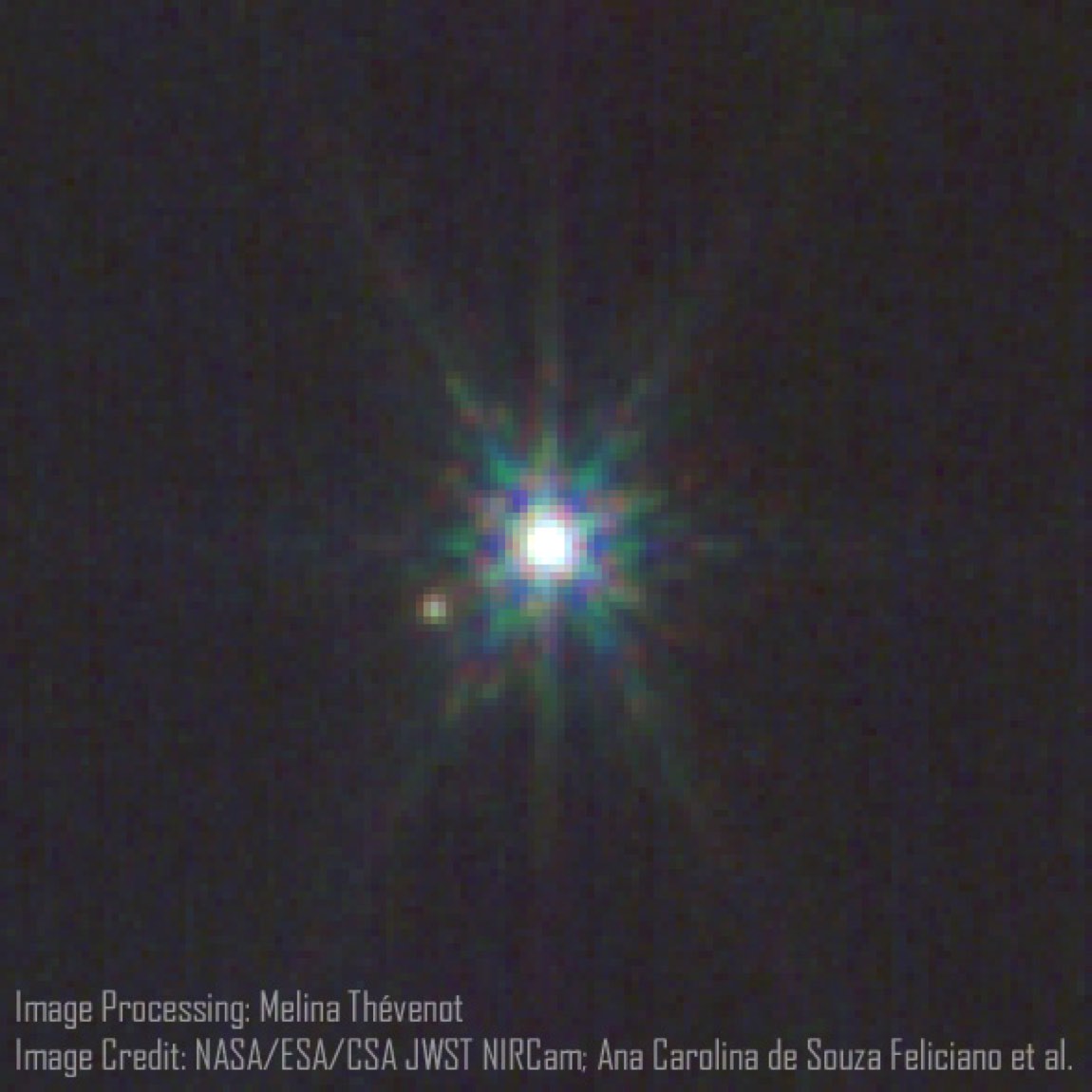
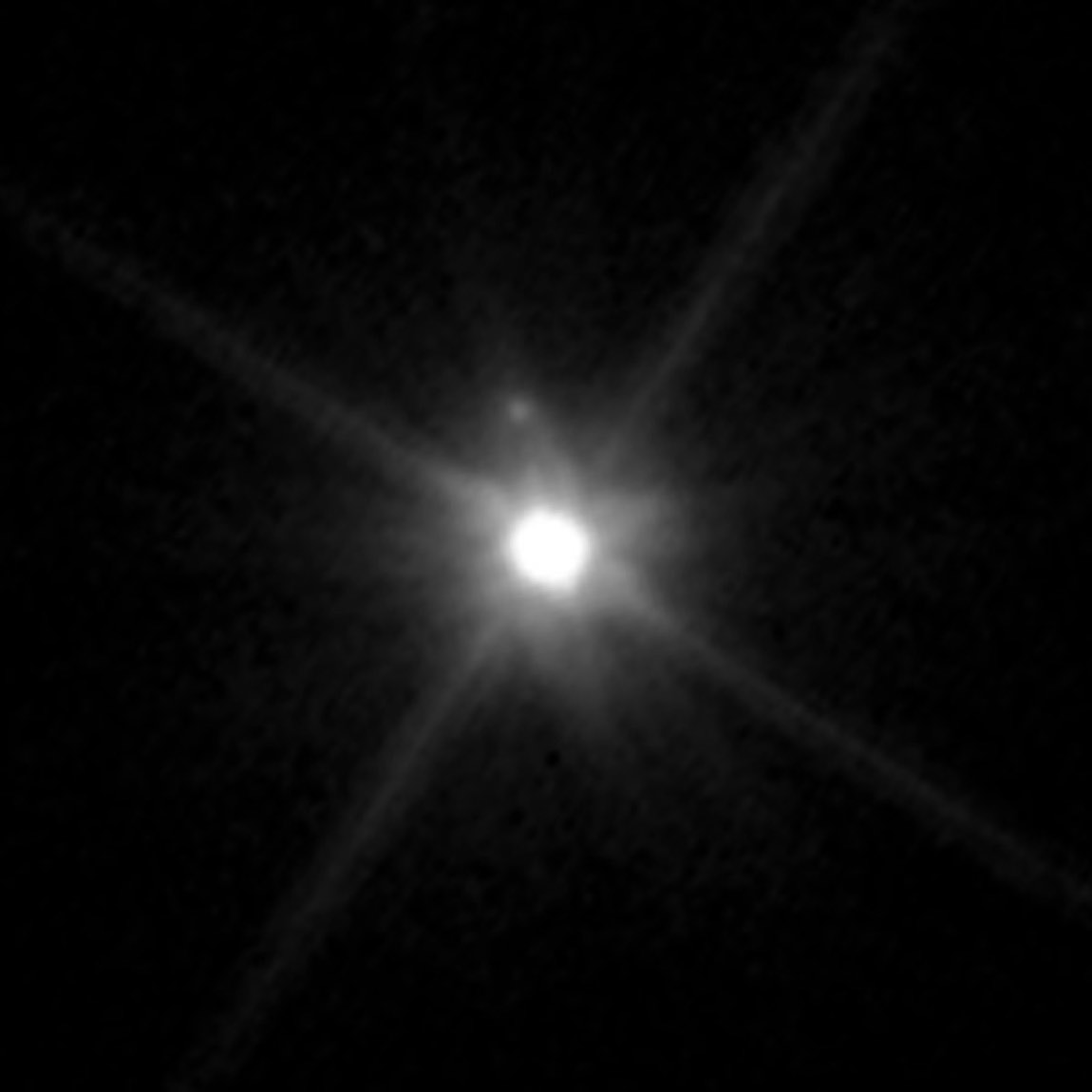
Haumea has two known moons, both discovered in 2005 by Darin Ragozzine and Michael Brown using the W. M. Keck Observatory. The larger, outer moon Hiʻiaka — nicknamed "Rudolph" by the Caltech team — measures roughly 310 km in diameter and completes a nearly circular orbit around Haumea every 49 days. Its infrared spectrum shows strong absorption at 1.5 and 2 micrometres, consistent with a surface of nearly pure crystalline water ice — the same material that coats Haumea itself, which is strong evidence that Hiʻiaka is a fragment of Haumea rather than a captured object. The smaller inner moon Namaka, nicknamed "Blitzen," was found on 30 June 2005. It has only one-tenth the mass of Hiʻiaka and completes an orbit in 18 days, but its path is highly elliptical and non-Keplerian. As of 2008, Namaka's orbit was inclined 13° from Hiʻiaka's, and gravitational tugging by the larger moon continuously distorts Namaka's path. One mutual occultation between Namaka and Haumea was observed on 19 June 2009 from the Pico dos Dias Observatory in Brazil. Hiʻiaka last occulted Haumea in 1999 and will not do so again for about 130 years.
07 A family of icy worlds shattered from one body Deeper
Haumea anchors the first collisional family ever identified among trans-Neptunian objects. The family includes not just Haumea and its two moons but several sizeable independent bodies: (55636) 2002 TX300 at roughly 364 km, (120178) 2003 OP32 at roughly 230 km, (145453) 2005 RR43 at roughly 252 km, (19308) 1996 TO66 at roughly 200 km, and (24835) 1995 SM55 at roughly 174 km. All share similar orbital and physical properties traceable to a common origin event. Two competing formation stories exist. In the simpler version, a single giant impact stripped away Haumea's ice mantle and flung the fragments outward. In the more complex version, the initially ejected material first coalesced into a large temporary moon of Haumea, which was then destroyed in a second collision — a scenario that better reproduces the observed spread of velocities among family members. The collision must have occurred at least a billion years ago, because that is the minimum time needed for gravitational interactions to disperse the family as widely as it is now observed. The current Kuiper belt is too sparsely populated for such a collision to happen today — the odds are less than 0.1 percent over the Solar System's lifetime — pointing to the denser scattered disc as the probable birthplace of the original impacting bodies.
08 An orbit tilted, stretched, and slowly wandering Deeper
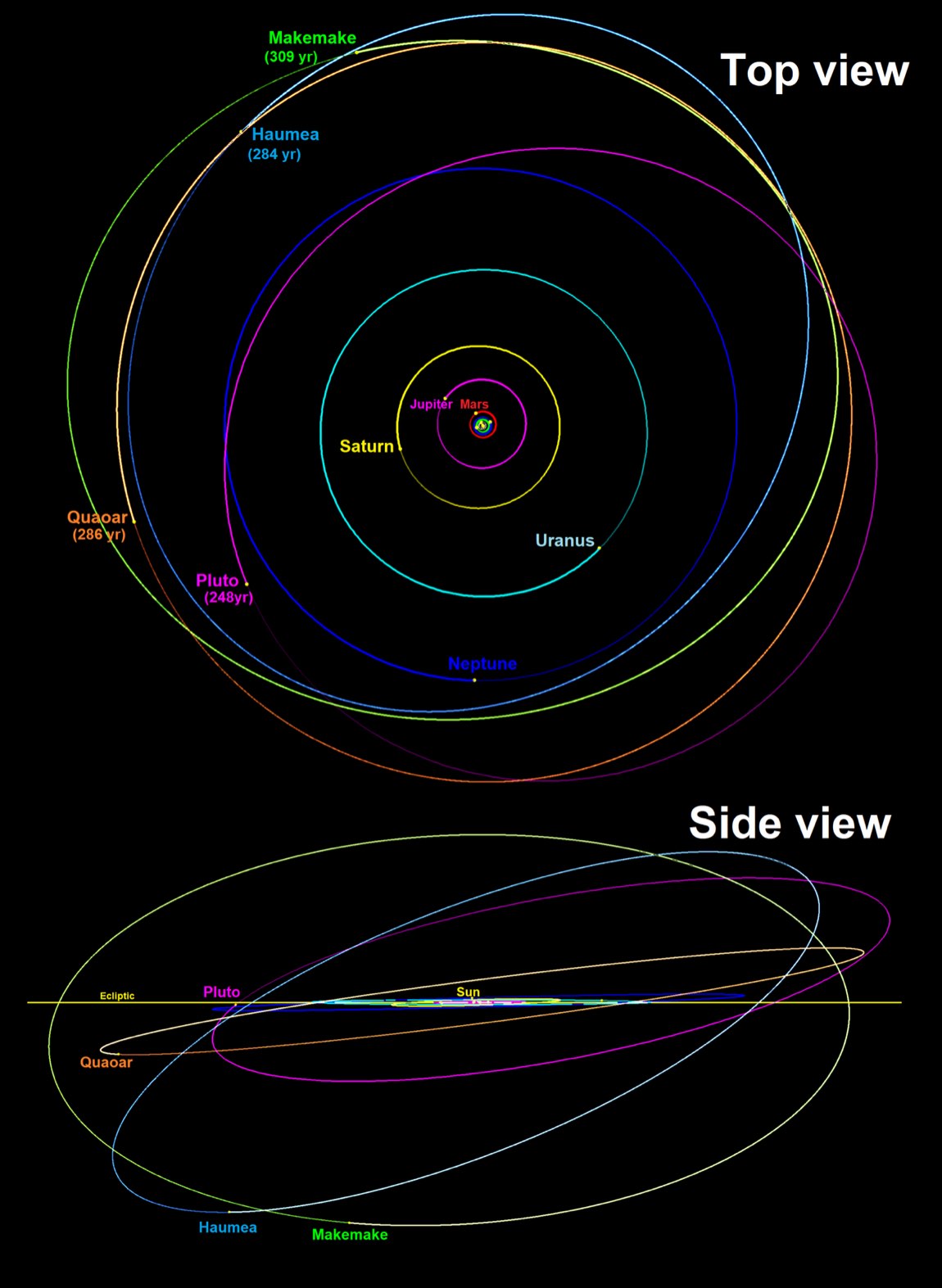
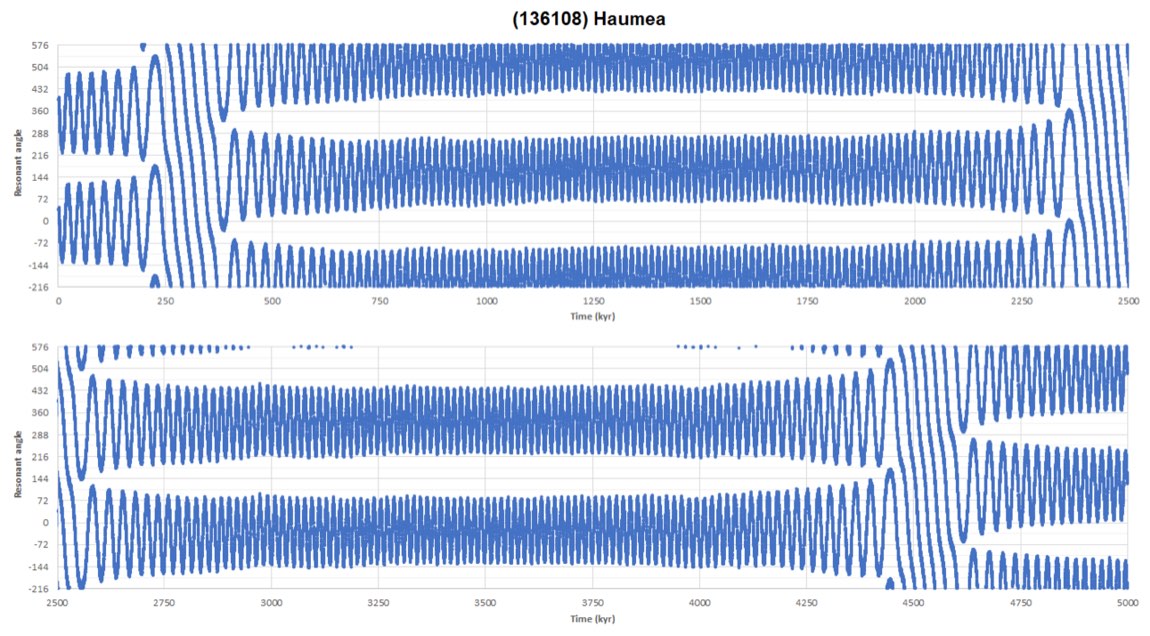
Haumea's path around the Sun is unusual even among trans-Neptunian objects. It orbits with an inclination of 28° relative to the ecliptic — steeply tilted compared to most Solar System bodies — and a perihelion of 35 AU, meaning even at its closest it never comes inside Neptune's general neighborhood. Its orbital period spans 284 to 285 Earth years; it passed aphelion in early 1992 and is currently more than 50 AU from the Sun, with the next perihelion not arriving until 2133. Haumea is thought to occupy a weak 7:12 orbital resonance with Neptune, meaning it completes 7 orbits for every 12 Neptune completes — but this resonance is not permanent. Its ascending node precesses over roughly 4.6 million years, and the resonance breaks twice per cycle, roughly every 2.3 million years, before re-establishing itself about 100,000 years later. This intermittent gravitational relationship, operating through the Kozai effect, has gradually traded orbital inclination for eccentricity over a billion years, leaving Haumea's orbit slightly more eccentric than those of its collisional family members. Simulations suggest Haumea is actually the trans-Neptunian object most statistically likely to be ejected into interstellar space or the inner Solar System within the next billion years.
09 The bitter dispute over who discovered it
The discovery of Haumea is officially contested. Mike Brown's Caltech team imaged it on 6 May 2004 and planned to announce it at a conference in September 2005. Before that announcement, José Luis Ortiz Moreno's team in Spain found Haumea in their own archival images from March 2003 and filed a claim with the Minor Planet Center on 27 July 2005, beating Brown's team to submission. The IAU protocol awards discovery credit — and naming rights — to whoever first submits sufficient positional data to the Minor Planet Center. Brown initially conceded, but then discovered that the Spanish observatory had accessed his team's online observing logs the day before their announcement, without disclosing this. Those logs contained enough information to locate Haumea in earlier images. Ortiz later acknowledged accessing the Caltech logs but denied wrongdoing, saying he was only verifying whether the object was already known. The IAU's September 2008 naming announcement navigated the conflict carefully: the location of discovery was listed as the Sierra Nevada Observatory in Spain, but the accepted name — Haumea, a Hawaiian goddess, proposed by the Caltech team — was not Ortiz's proposal of Ataecina, the ancient Iberian goddess of spring.
10 What the name Haumea actually means
The name was proposed by David Rabinowitz of the Caltech team and chosen to honor Hawaiian mythology in recognition of the observatories on Mauna Kea — Gemini and W. M. Keck — where the moons were discovered. Haumea is the matron goddess of the island of Hawaiʻi, and she carries multiple layers of meaning that the team found scientifically apt. She is identified with Papa, goddess of the earth and wife of Wākea (space), which resonated with the then-believed rock-dominated composition of the dwarf planet. She is also the goddess of fertility and childbirth whose many children sprang from different parts of her body — a vivid parallel to the swarm of icy fragments thought to have broken off Haumea during its ancient collision. The two moons, Hiʻiaka and Namaka, are named after two of Haumea's daughters. The body received the provisional designation 2003 EL61 in July 2005 and was formally catalogued as (136108) 2003 EL61 in September 2006, before being officially named on 17 September 2008. Its Unicode planetary symbol, ⟨🝻⟩ at U+1F77B, was designed by software engineer Denis Moskowitz; it combines simplified Hawaiian petroglyphs meaning 'woman' and 'childbirth.'
11 How New Horizons watched from across the void
No spacecraft has visited Haumea close up, but NASA's New Horizons — the same probe that flew past Pluto in 2015 — has observed it from afar on three occasions. In October 2007 it viewed Haumea from 49 AU away, in January 2017 from 59 AU, and in May 2020 from 63 AU. These distances are staggering — 63 AU is roughly 9.4 billion km, or about 63 times the Earth-Sun distance — yet even those remote observations were scientifically valuable. Because New Horizons was traveling outward at a different angle than Earth, it could observe Haumea at high phase angles — geometries where sunlight strikes the surface at large angles relative to the observer — that are simply impossible to achieve from Earth. This allowed astronomers to study how Haumea's surface scatters light and to characterize its phase curve behavior. Looking ahead, mission planners have studied the possibility of a dedicated flyby: preliminary calculations indicate that a spacecraft launched on 1 November 2026, 23 September 2037, or 29 October 2038 could reach Haumea in approximately 16.45 years, though no such mission has been approved. Probe mass, power source, and propulsion technology are identified as the critical challenges.
12 Observing Haumea with a large amateur telescope
Despite sitting more than 50 AU from the Sun at its current location — farther than any planet — Haumea is surprisingly accessible to dedicated amateur astronomers. Its visual magnitude of 17.3 makes it the third-brightest object in the Kuiper belt, behind only Pluto and Makemake, and it is detectable with a large amateur telescope under good conditions. Historically, finding it was not straightforward: early surveys for distant Solar System objects focused on the ecliptic, the plane of the Solar System's disk as projected on the sky, and Haumea's high orbital inclination of 28° placed it well away from that busy search corridor. It was only when later sky surveys extended their reach to higher inclinations — and to objects with the slower sky motion that comes with greater distance — that Haumea's sky position was eventually covered. Precovery images of Haumea have since been traced back as far as 22 March 1955, decades before any astronomer knew what they were looking at. Its light fluctuates noticeably over just a few hours due to its rapid spin, which means a patient observer tracking it across a single night can actually watch a world's rotation in real time.
13 Open questions that still keep researchers busy Deeper
Haumea is better studied than most outer Solar System objects, yet it presents an unusually long list of unresolved problems. The status of hydrostatic equilibrium — a core criterion for dwarf-planet classification — became unclear after the 2017 occultation revealed a shape inconsistent with a uniform body in equilibrium, though a 2019 differentiated-body model restored some compatibility with equilibrium. The surface ice mystery is equally stubborn: crystalline water ice should not persist at Haumea's surface temperatures, and no resurfacing mechanism has been convincingly identified. The collision origin of the family is broadly accepted, but whether the family formed in a single impact or a two-stage event remains debated. The orbital eccentricities and mutual inclination of the two moons are larger than tidal damping models predict, possibly explained by a recent passage through a 3:1 resonance between the moons, but this has not been confirmed. The dark red surface region observed in 2009 lacks a definitive compositional identification. And the ring's long-term stability — the 1:3 resonance that coincides with its location is itself dynamically unstable, with particles instead surviving on nearby periodic orbits — is an active area of dynamical modeling. Each of these questions would benefit enormously from a close flyby mission, which remains unscheduled.
 ⤢
⤢
You would weigh…
Surface gravity 0.40 m/s² vs Earth’s 9.81 m/s². Try every world →
Could life exist here?
A tumbling crystalline-ice world at −240 °C.
Our labels: Confirmed · Strong Evidence · Estimated · Hypothesis · Theoretical · Speculative (see Methodology).