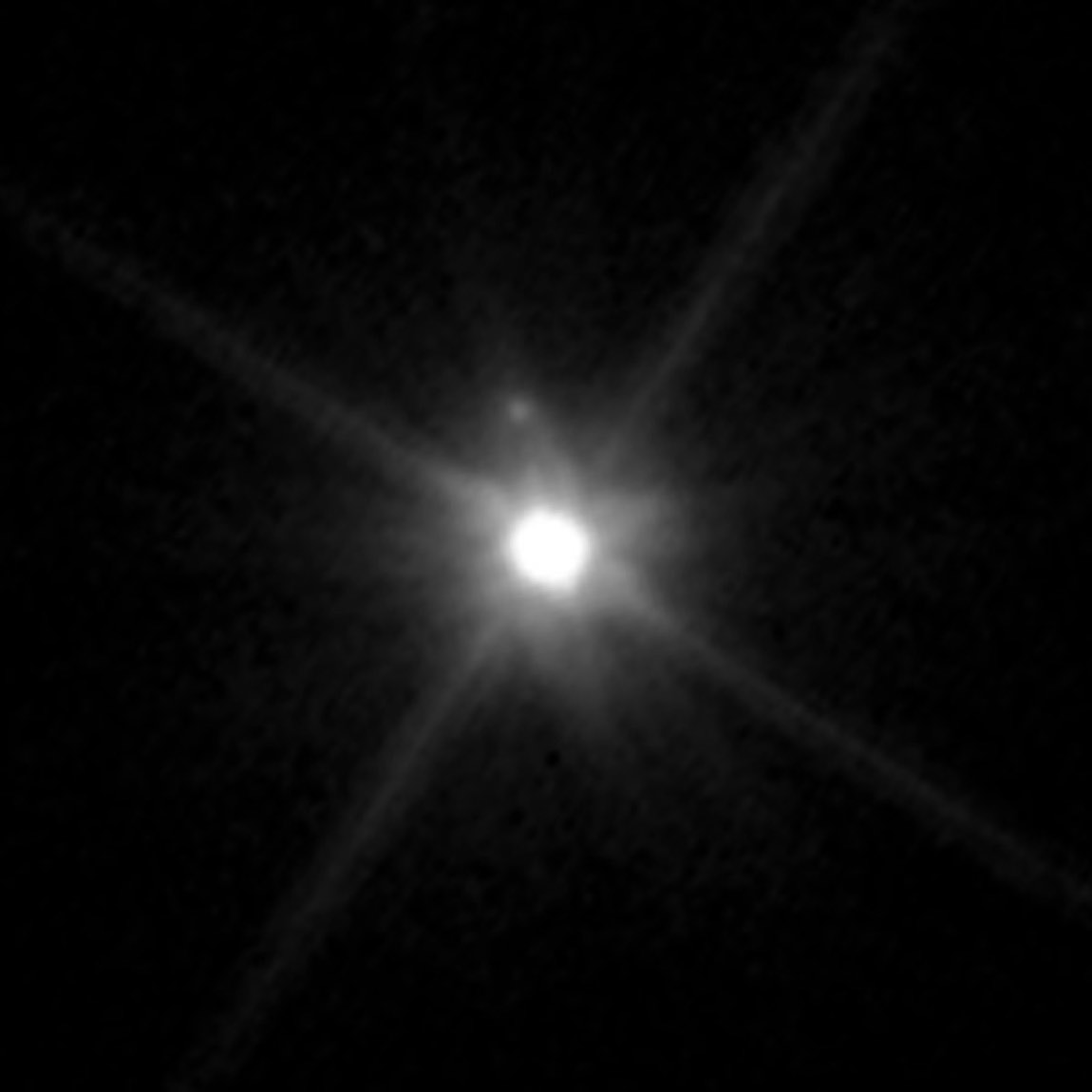
 Photograph · NASA, ESA, and A. Parker and M. Buie (Southwest Research Institute) · CC BY 4.0
Dwarf Planet · Deep guide
Makemake
The bright Easter dwarf is a frozen world that refused to have air.
What is it?
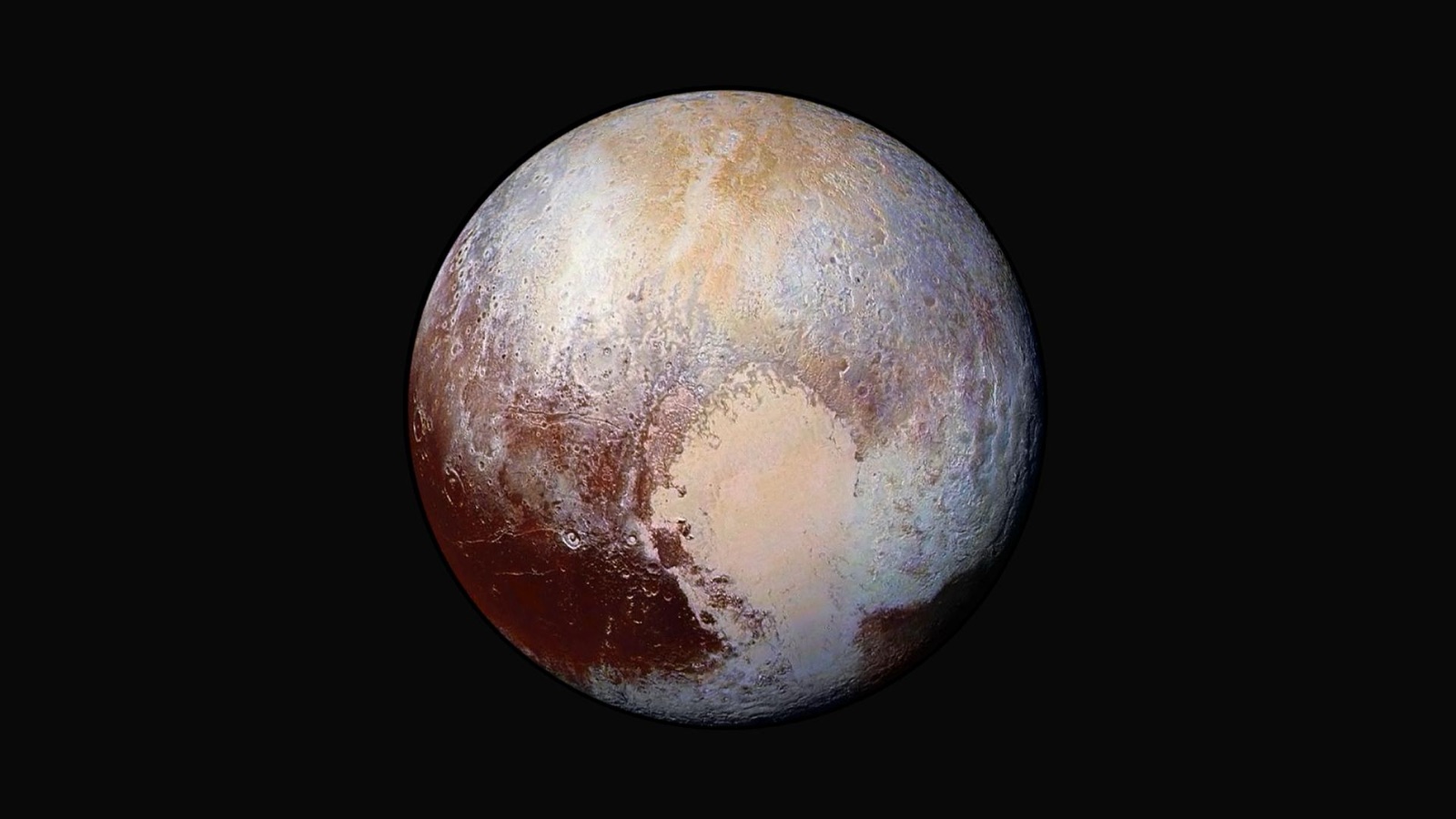
Makemake, named for the creator god of Rapa Nui because it was discovered at Easter 2005, is the second-brightest Kuiper Belt object after Pluto, coated in reddish methane frost. When it crossed in front of a star in 2011, its shadow's sharp edge revealed something surprising: no atmosphere at all, unlike Pluto. It has one known moon, nicknamed MK2, and recent JWST hints of warm dust have scientists intrigued.
The deep dive
Researched for the Atlas from Wikipedia — Makemake (31,749 characters read) · updated Sep 20, 2026
01 A discovery born from rivalry and accident
Makemake's announcement was shaped as much by academic competition as by telescope time. Michael Brown's team at Palomar Observatory found it in images taken March 31, 2005, but the formal announcement was forced early when Brown realized his team's observing logs — containing the positions of Haumea, Eris, and Makemake — had been left unintentionally public and accessed by a computer at a rival institution in Spain. Fearing his remaining discoveries would be scooped, Brown contacted Brian G. Marsden of the Minor Planet Center on July 29, 2005, triggering simultaneous announcements of both Eris and Makemake. The objects were bright enough to ignite a public debate about what a planet actually is, which the International Astronomical Union resolved in August 2006 by reclassifying Pluto as a dwarf planet — a direct consequence of Makemake's existence. Before its formal name, Brown's team called it "Easterbunny" because it was found shortly after Easter, a nickname that eventually pointed toward its mythological home on Easter Island.
02 How Makemake got its name
Naming a world is harder than finding one. Brown later wrote that he struggled because Makemake's known characteristics did not easily connect to any mythology. He considered the Anglo-Saxon goddess Ēostre and the Anishinaabe trickster rabbit Manabozho to preserve the Easter connection, but found both unusable. The IAU requires classical Kuiper belt objects to be named after creator deities, which narrowed the options considerably. The solution was Makemake, the creator of humanity and god of fertility in the mythology of the Rapa Nui people of Easter Island — a name that satisfied both the Easter theme and the naming rule. The IAU approved it in July 2008. A dedicated Unicode symbol, U+1F77C, was introduced in January 2022; it was designed by Denis Moskowitz and John T. Whelan to resemble a traditional Rapa Nui petroglyph of Makemake's face while also stylizing as the letter M. The IAU discourages planetary symbols in scientific publications, so the glyph is used mainly by astrologers.
03 An extreme, tilted orbit far from the Sun
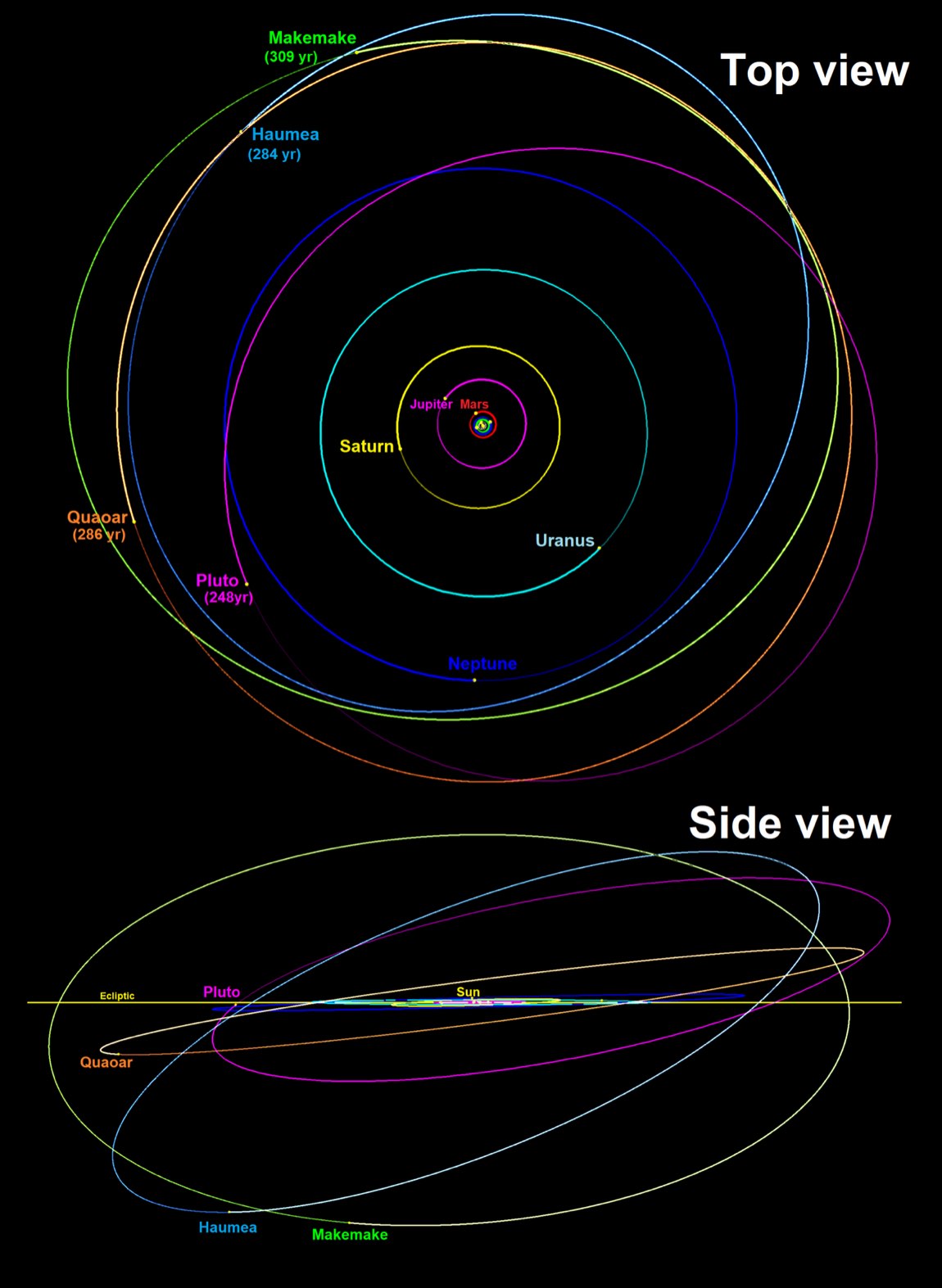
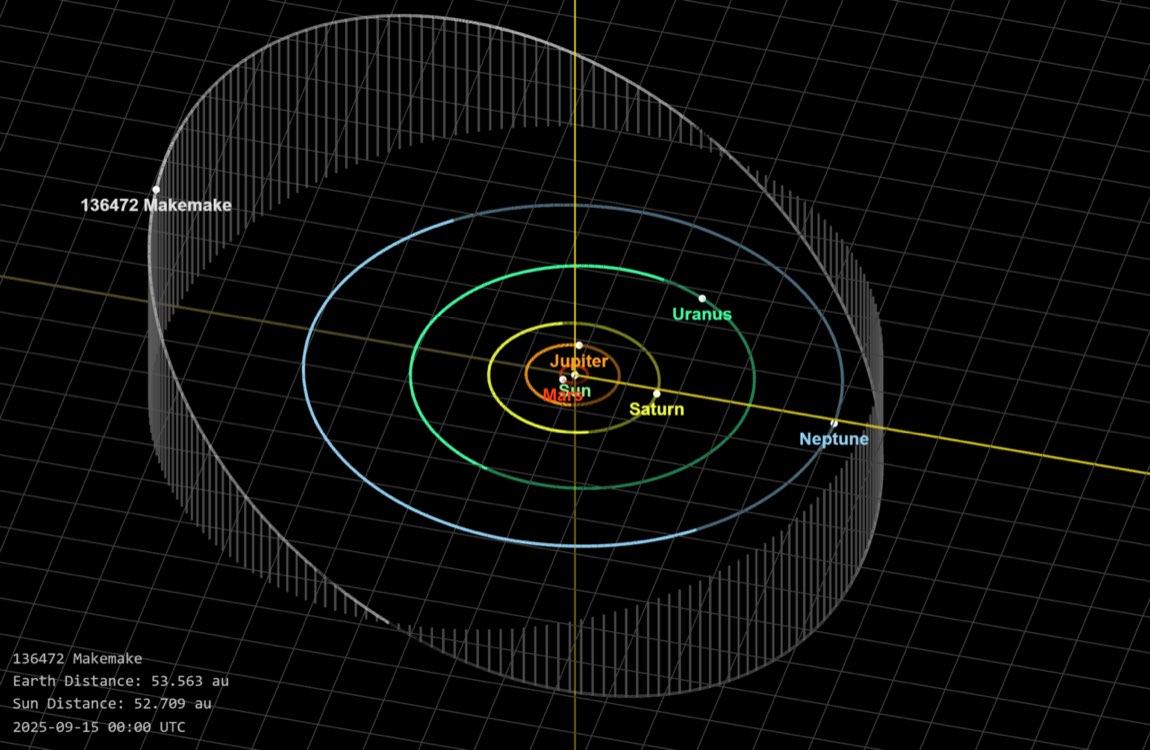
Makemake orbits the Sun at an average distance of 45.5 AU — about 6.81 billion km — and takes 307 years to complete one circuit. Its orbit is moderately elliptical with an eccentricity of 0.16, swinging between 38.2 AU at closest approach and 52.8 AU at its farthest. As of November 2025, Makemake sits near that far extreme at 52.7 AU and will reach true aphelion in May 2033. Its orbit is also steeply inclined at 29° to the ecliptic, which explains why it was discovered so late despite being one of the brightest trans-Neptunian objects: earlier sky surveys concentrated near the ecliptic plane and simply never swept high enough to catch it. N-body simulations confirm the orbit is stable on a timescale of billions of years. Makemake's high inclination is the calling card of the "dynamically hot" classical Kuiper belt population — objects that planetary scientists believe were gravitationally flung outward by Neptune early in the Solar System's history.
04 A world of pure methane ice and red stains
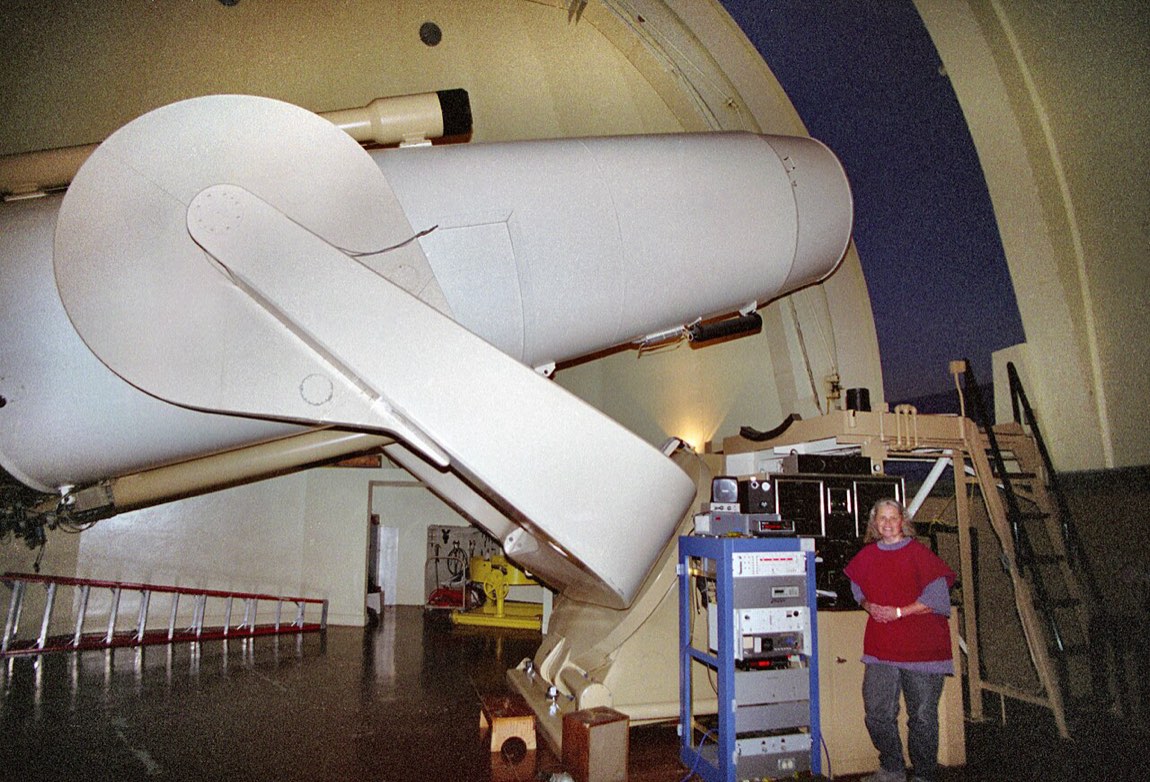
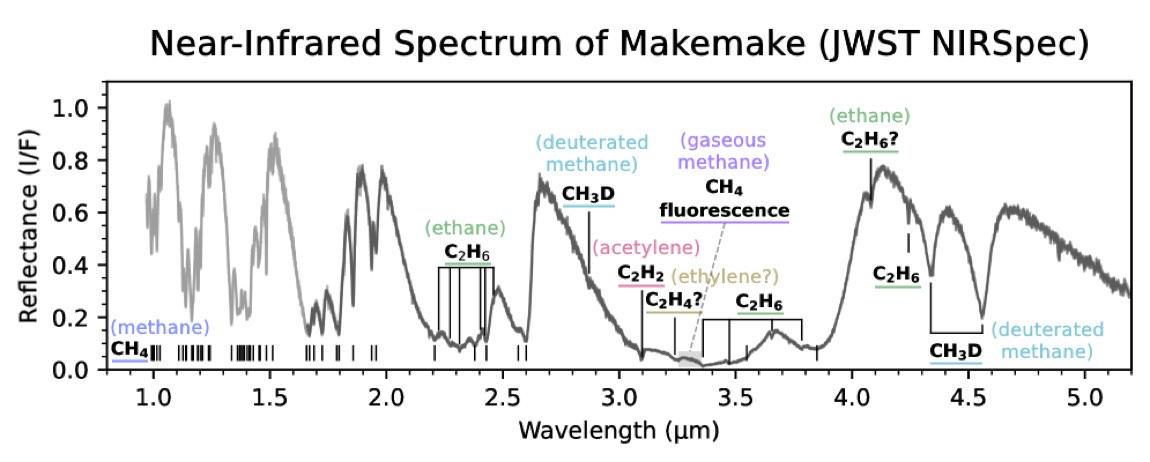
Makemake's surface sits at a frigid 30 to 40 K (−243 to −233 °C) — cold enough that methane freezes solid. Spectroscopy shows the surface is dominated by frozen methane, accompanied by smaller amounts of ethane, ethylene, acetylene, and propane. What makes Makemake's methane chemically unusual is its purity: unlike Pluto and Eris, Makemake apparently has no detectable nitrogen or carbon monoxide ice — the James Webb Space Telescope found less than 3% nitrogen and less than 1 part per million of carbon monoxide. Without those diluting companions, methane can grow into unusually large forms: the near-infrared absorption signature suggests either centimeter-sized pellets or thick sintered slabs. Despite constant bombardment by ultraviolet sunlight and cosmic rays that convert methane into dark, reddish tholins, Makemake's surface has a geometric albedo of 82% — more reflective than Pluto — because fresh methane continuously resurfaces and buries those dark stains. The result is a world that is redder than Eris but less red than Pluto.
 ⤢
⤢
05 Seasons driven by a wildly tilted axis Deeper
Makemake's axial tilt has never been measured directly, but planetary scientists can infer it from the orbit of its moon. If Makemake's rotation pole aligns with its moon's orbital pole — a reasonable assumption — then its axial tilt lies somewhere between 46° and 78° relative to its orbital plane, or 63° to 87° relative to the ecliptic. Earth's tilt is 23.4° by comparison, so Makemake likely leans nearly on its side. Combined with an orbital eccentricity of 0.16 and a year lasting 307 Earth-years, this geometry produces extreme seasonal swings: polar regions spend decades in continuous sunlight or darkness, and the difference in solar heating between perihelion and aphelion is substantial. These conditions are expected to drive volatile transport — methane sublimating at warmer locations and refreezing elsewhere — similar to the seasonal cycles observed on Pluto. The moon's orbit also suggests Makemake was near equinox when the moon was discovered; predicted eclipse windows of 2009–2013 and 2023–2027 may mark those equinox passages.
06 Signs of a warm, geochemically active interior Deeper
Makemake's bulk density of about 1.76 g/cm³ points to an interior of water ice and rock, most likely differentiated into a rocky core surrounded by ice layers. More provocative is what the James Webb Space Telescope found in 2025: heavy isotopologues of methane, specifically those containing deuterium and carbon-13. The measured deuterium-to-hydrogen ratio is (2.9±0.6)×10⁻⁴ — much lower than the D/H ratios of methane in comets, but similar to the D/H ratios of water in comets. Scientists interpret this as a fingerprint of hydrothermal chemistry: Makemake's methane may have formed inside the body through reactions in hot subsurface water at temperatures reaching 150 °C (302 °F), inheriting hydrogen from that water and diluting its deuterium content. That would require a persistently warm interior, heated by radionuclides and leftover primordial heat. The methane would then have migrated to the surface through outgassing or cryovolcanic eruptions. A simpler alternative — that the deuterium-poor methane was inherited directly from the protosolar nebula — cannot yet be ruled out, so the case for geochemical activity remains strong but not settled.
07 Evidence for a cryovolcanic hotspot Deeper
Since the Spitzer Space Telescope first detected it in 2008, Makemake has emitted an unusually high ratio of mid-infrared to far-infrared radiation that defied early explanations involving dark terrain patches or the moon's contribution. In 2025, Csaba Kiss and collaborators proposed a new solution: a cryovolcanic hotspot on Makemake's surface reaching about 150 K (−123 °C) — warm enough to glow in mid-infrared against the otherwise 30–40 K background. The hotspot is estimated to cover an area of roughly 350 km² (equivalent to a circle about 10 km in radius) and may emit heat at a rate comparable to the south-polar geysers of Saturn's moon Enceladus. Possible erupted material includes cryolava containing ammonia and various salts dissolved in liquid water. The same team considered an alternative explanation — a ring of tiny carbonaceous dust grains in orbit around Makemake — but found it unlikely to persist because solar radiation pressure would destroy such fine particles within a decade, unless continuously replenished by cryovolcanic activity. The location of this hotspot on Makemake's surface remains unknown.
08 Gaseous methane: atmosphere or plume? Deeper
JWST spectroscopy published in 2025 detected gaseous methane fluorescing in near-infrared around Makemake, making it only the second trans-Neptunian object confirmed to have gas, after Pluto. The key unresolved question is whether this gas forms a gravitationally bound atmosphere or represents temporary outgassing. If it is an atmosphere, the surface pressure would be roughly 10 picobars — 100 billion times less than Earth's and 1 million times less than Pluto's — at a temperature of about 40 K. A 2011 stellar occultation already constrained any global atmosphere to less than 4–12 nanobars, consistent with only a patchy or extremely tenuous layer. If the gas is instead pure outgassing, Makemake would be releasing roughly 266 kg of methane per second from 4–30% of its surface, a rate comparable to Enceladus's water plumes at 300 kg/s. Escaping methane could even form a comet-like coma. JWST found no detectable nitrogen gas, suggesting most nitrogen has already been lost to atmospheric escape. Both scenarios remain live possibilities, and resolving them would require a spacecraft flying through the region.
 ⤢
⤢
09 The dark, tiny moon and what it reveals
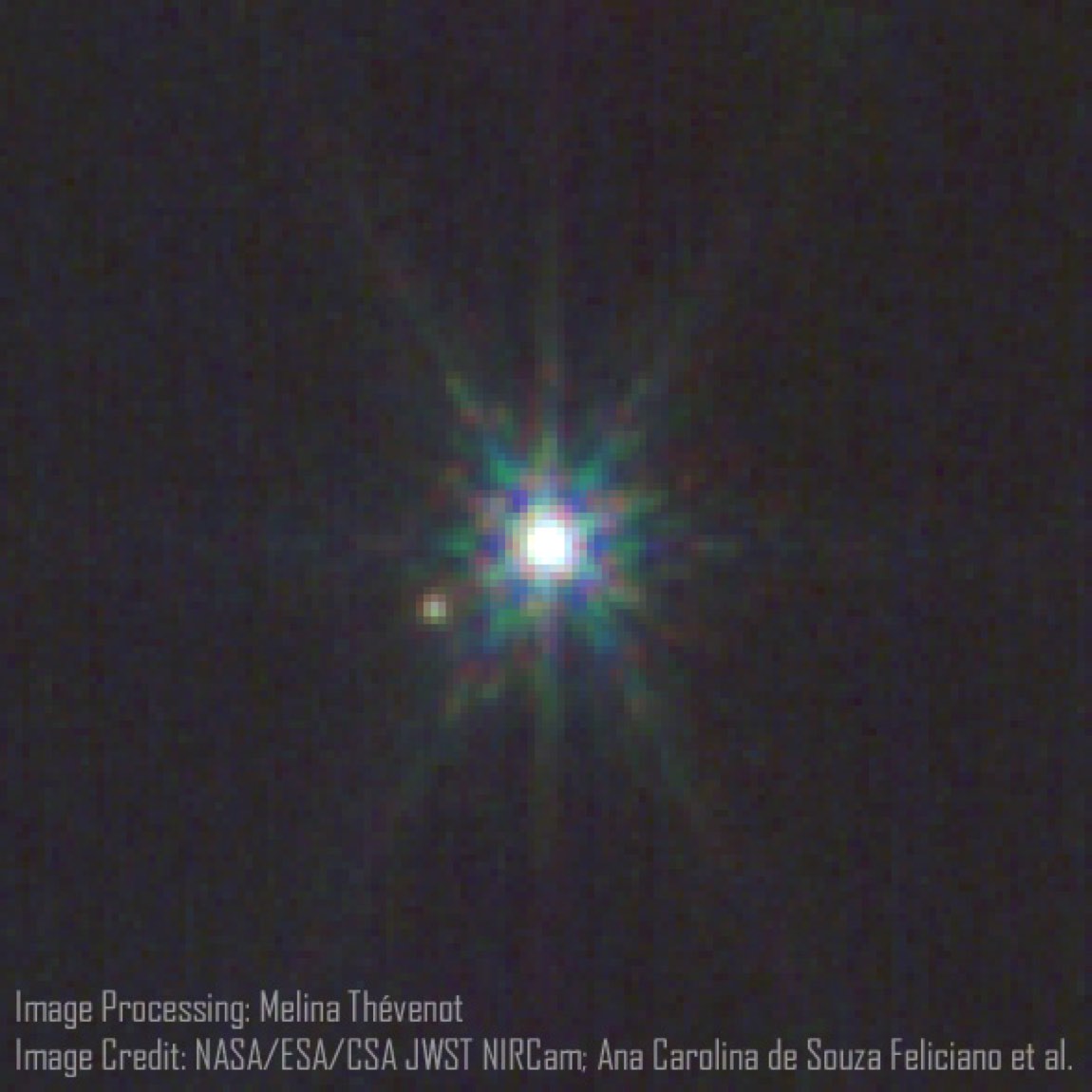
Makemake's only confirmed moon, provisionally designated S/2015 (136472) 1 and nicknamed MK 2, was found by Alex H. Parker, Marc W. Buie, William M. Grundy, and Keith S. Noll in Hubble Space Telescope images from April 27, 2015, and announced on April 26, 2016. The moon is about 175 km across — roughly the width of Jamaica — and is approximately 1,300 times fainter than Makemake in visible light, suggesting an extremely dark surface. It follows a likely circular orbit with a period of 18 days and a semi-major axis of 22,250 ± 780 km. When discovered, the orbit appeared nearly edge-on from Earth, meaning the moon was passing in front of and behind Makemake regularly. It is hypothesized that MK 2 formed from a massive collision with another body early in Makemake's history, similar to how Earth's Moon is thought to have formed. Makemake's mass of roughly 2.5–2.9 × 10²¹ kg was derived directly from the moon's orbital period and distance — the first reliable mass measurement the system allowed.
10 How the earliest known observation happened in 1955
Although Makemake was not recognized until 2005, it appears on a photographic plate taken at Palomar Observatory on January 29, 1955 — more than 50 years before its discovery, which is about 16% of Makemake's full 307-year orbit. This earliest known precovery and several others were only identified after the fact, once Brown's team had computed Makemake's orbit well enough to predict where it would have been in archival images. The reason Makemake was missed for so long despite being the second brightest trans-Neptunian object in the sky is purely geometric: its orbit is inclined 29° to the ecliptic, carrying it high above the plane where most sky surveys were scanning. Even Makemake's peak apparent magnitude of about 17 — bright enough for a high-end amateur telescope — was not enough to attract attention from surveys that pointed elsewhere. Opposition, when Makemake reaches peak brightness, occurs during March to April each year, and the dwarf planet is currently found in the northern constellation Coma Berenices, where it has remained since its discovery, moving into Boötes only in late 2028.
11 What it would take to reach Makemake
No spacecraft has ever visited Makemake, but mission designers have mapped out realistic trajectories. A 2011 study calculated that a flyby using a Jupiter gravity assist, launched August 24, 2036, would arrive in just over 16 years — finding Makemake roughly 52.3 AU from the Sun. A more ambitious 2024 study from the University of Tennessee found that a powered Jupiter gravity assist could shorten travel time to as little as 9.6 years for the same 2036 launch window, depending on payload mass, with an alternative optimal date of September 27, 2048. A 2019 study by Amanda Zangari and colleagues also found that a Saturn gravity assist offers a competitive route, particularly for lower-energy launches in 2032–2033. So far, only New Horizons has observed Makemake at all, doing so remotely in October 2007 and again in January 2017 from distances of 52 AU and 70 AU respectively. Those off-axis views at high phase angles — angles impossible to achieve from Earth — provided the first measurements of how Makemake's surface scatters light, a data type useful for designing future instruments.
12 Where Makemake stands among the dwarf planets
Makemake occupies a specific and well-defined rank in the outer Solar System. With an average diameter of about 1,430 km — roughly 60% of Pluto's diameter or 11% of Earth's — it is the fourth-largest known dwarf planet and trans-Neptunian object, behind Pluto, Eris, and Haumea. Its mass of roughly 2.5–2.9 × 10²¹ kg is about 20% of Pluto's mass and 3.7% of the Moon's mass, giving it a surface gravity of about 0.35 m/s² (3.6% of Earth's) and an escape velocity of about 0.71 km/s — less than a third of Earth's escape velocity. Makemake was the fourth object ever formally announced as a dwarf planet by the IAU (after Ceres, Pluto, and Eris), and it was also the first object named by the IAU under revised procedures for objects expected to be dwarf planets. More specifically, it is classified as a plutoid — the subcategory of dwarf planets orbiting beyond Neptune — and as the largest member of the "dynamically hot" classical Kuiper belt population.
 ⤢
⤢
13 Formation from the scattered disk, 4.5 billion years ago Deeper
Makemake is believed to have formed around 4.5 billion years ago from small planetesimals that grew by accreting material over a few million years in a cold environment cold enough for methane to condense into solid ice. During those early, violent years, frequent impacts and greater solar irradiance may have been warm enough to drive off some of Makemake's primordial methane before it could be locked in. A 2020 update to the Nice model of Solar System formation proposes that Makemake, like nearly all other Kuiper belt objects, did not form where it orbits today. Instead, it originated closer to the Sun in a massive circumstellar disk between 15 and 30 AU. Tens of millions of years after the Solar System formed, gravitational interactions among the giant planets caused Neptune to migrate abruptly outward, scattering objects from that disk into the configurations now recognized as the hot classical Kuiper belt and scattered disk. Makemake's moon MK 2 may have formed separately during this period, produced by a large collision between Makemake and another sizable body — a formation mechanism analogous to the giant impact hypothesis for Earth's Moon.
You would weigh…
Surface gravity 0.40 m/s² vs Earth’s 9.81 m/s². Try every world →
Could life exist here?
Frozen methane plains at −240 °C.
Our labels: Confirmed · Strong Evidence · Estimated · Hypothesis · Theoretical · Speculative (see Methodology).