Moon · Deep guide · orbits Eris
Dysnomia
Also called: Eris I · S/2005 (2003 UB313) 1 · Gabrielle
Eris's large, coal-dark moon, the key that let astronomers weigh its parent.
What is it?
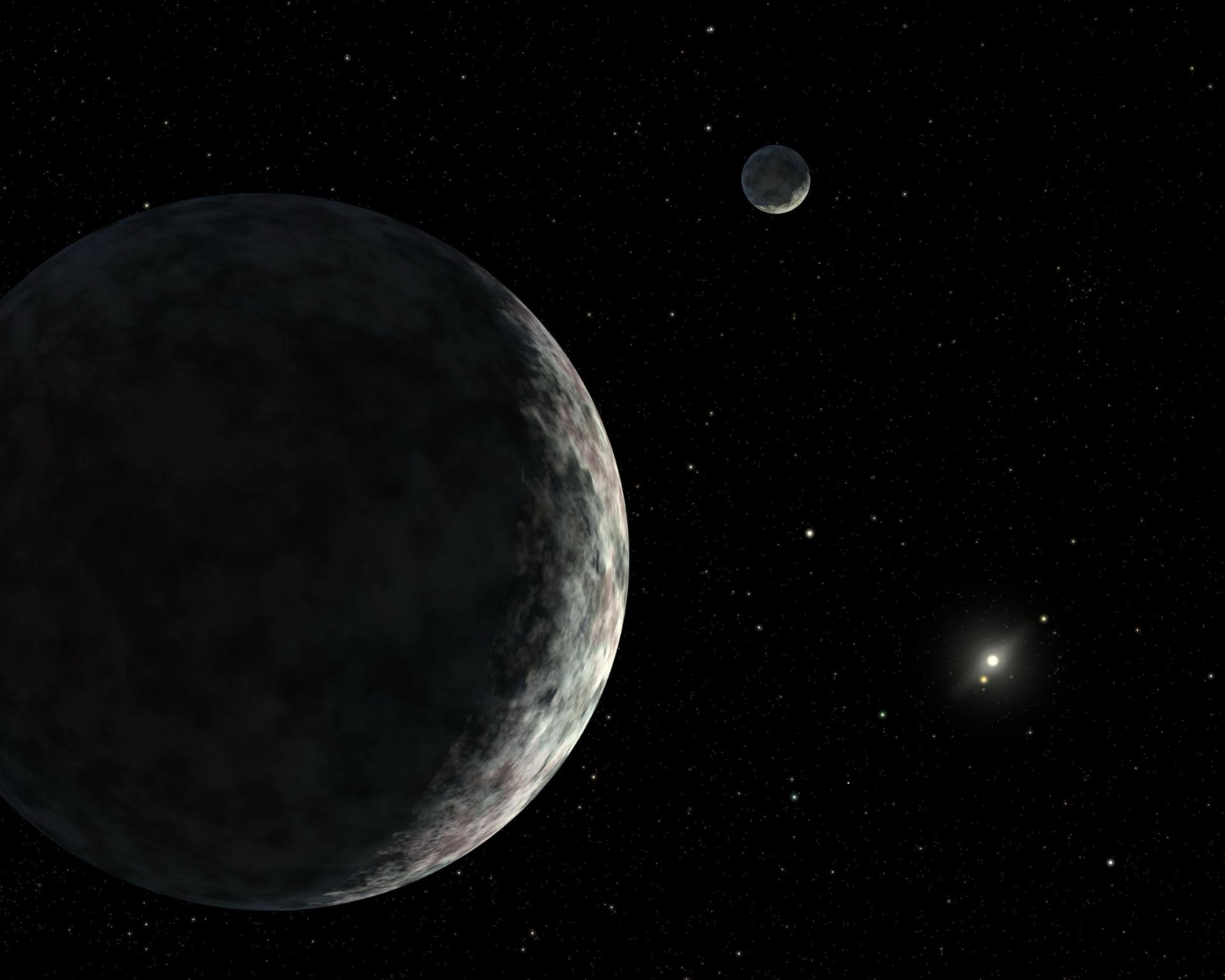
Dysnomia was discovered in September 2005 by Mike Brown's team using the Keck telescopes' new laser-guided adaptive optics. About 615 km across, it is a surprisingly big companion, roughly a quarter of Eris's width. Its surface is darker than coal, a striking contrast with brilliant white Eris. Dysnomia circles Eris every 15.8 days, and timing that orbit allowed astronomers to calculate Eris's mass. The two are thought to be tidally locked to each other.
The deep dive
Researched for the Atlas from Wikipedia — Dysnomia (moon) (7,358 characters read) · updated Nov 15, 2026
01 Discovered with laser guide stars
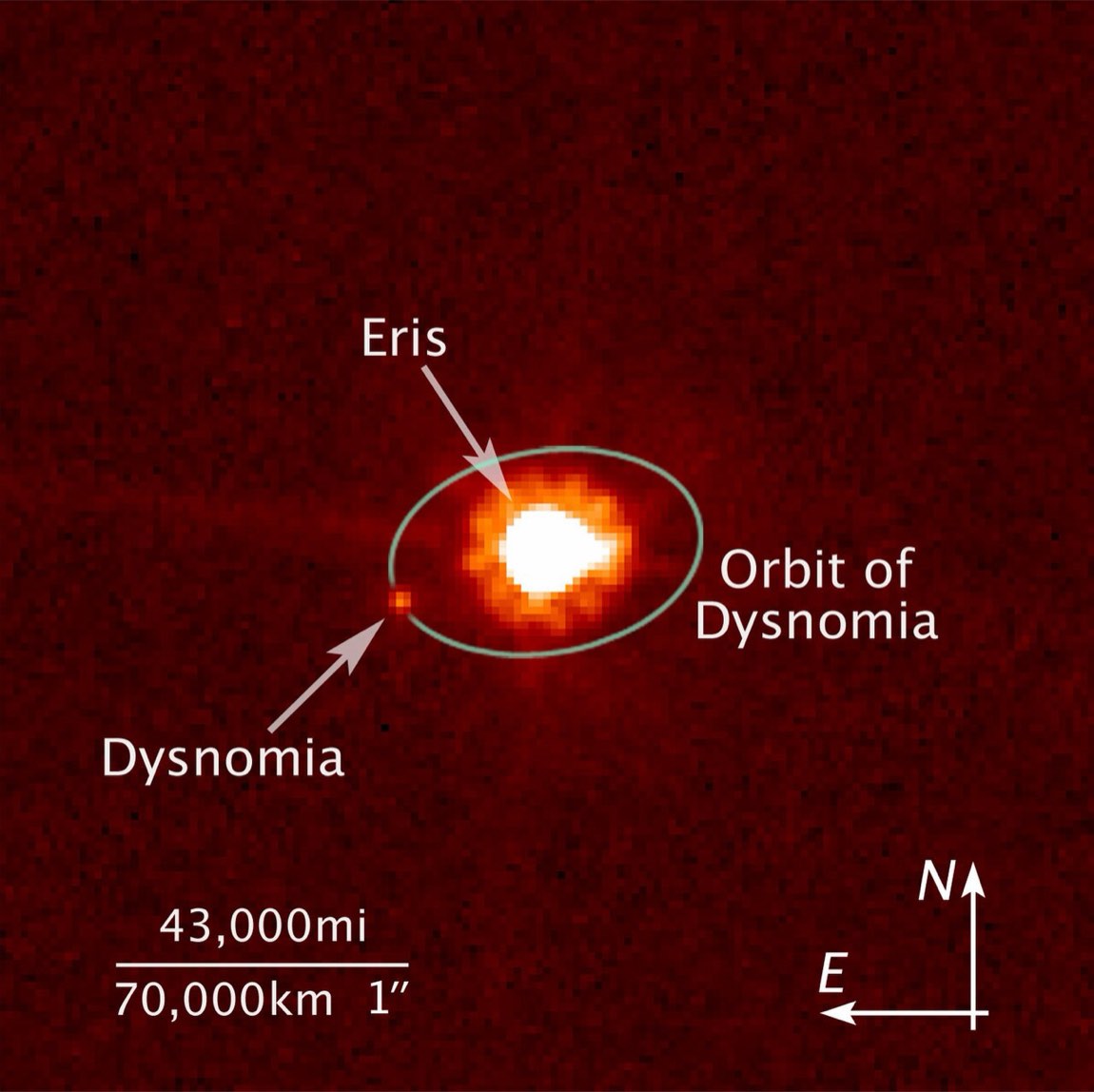
Dysnomia came to light on 10 September 2005, when Mike Brown and the Laser Guide Star Adaptive Optics team trained the W. M. Keck Observatory's newly commissioned LGSAO system on the four brightest Kuiper Belt objects: Pluto, Makemake, Haumea, and Eris. The laser guide star technique artificially creates a bright reference point in the upper atmosphere, allowing the telescope's optics to cancel out the blurring caused by air turbulence in real time. Without that correction, spotting a dim moon huddled close to a distant, bright body would have been nearly impossible from the ground. The discovery image revealed a faint companion in orbit around Eris, tagged with the cumbersome provisional label S/2005 (2003 UB313) 1. Because Eris was already nicknamed "Xena" among the team, the new moon immediately picked up the affectionate nickname "Gabrielle" — after Xena's sidekick in the television series — before receiving its formal name a year later.
02 A name hiding several inside jokes
When Mike Brown chose the name Dysnomia in September 2006, he was threading together at least three separate threads of meaning simultaneously. First, it follows the mythological rule: Dysnomia is the daughter of the goddess Eris in Greek tradition, just as moons of Jupiter are named for Jupiter's lovers and moons of Saturn for his fellow Titans. Second, the English translation of the Ancient Greek Δυσνομία is "lawlessness," a wink at actress Lucy Lawless, who played Xena in the show that inspired the body's earlier nickname. Brown has stated that connection was accidental rather than planned. Third — and most personally — the name echoes Brown's wife Diane, sharing her first initial. Brown was consciously following a tradition: James Christy named Charon by grafting a Greek suffix onto "Char," his wife Charlene's nickname, and Pluto's name partly honors Percival Lowell's initials P.L. All three layers coexist in a single seven-letter word.
03 How ALMA revealed a dark, icy world Deeper
Early estimates of Dysnomia's size came from visible and near-infrared light, but those wavelengths struggled to separate Dysnomia's faint glow from Eris's glare. The breakthrough came from the Atacama Large Millimeter Array (ALMA), which observes submillimeter-wavelength thermal emissions — essentially the faint heat radiated by cold objects. ALMA's 2015 observations of the Eris–Dysnomia system gave the first solid evidence that Dysnomia is large and very dark, with an initial diameter estimate of 700 ± 115 km. Follow-up ALMA observations in 2018 refined that to 615 with a range of +60 to −50 km, and nailed the albedo at 0.05 ± 0.01, meaning the surface reflects just 5% of incoming visible light. By comparison, Eris has an albedo of 0.96, one of the highest in the Solar System, so the two bodies look almost nothing alike in reflected sunlight. Dysnomia's surface has been described as darker than coal — a typical property among trans-Neptunian objects of similar size, where ancient organic material and radiation-processed ices tend to produce a dark, reddish crust.
04 Weighing Eris through Dysnomia's orbit
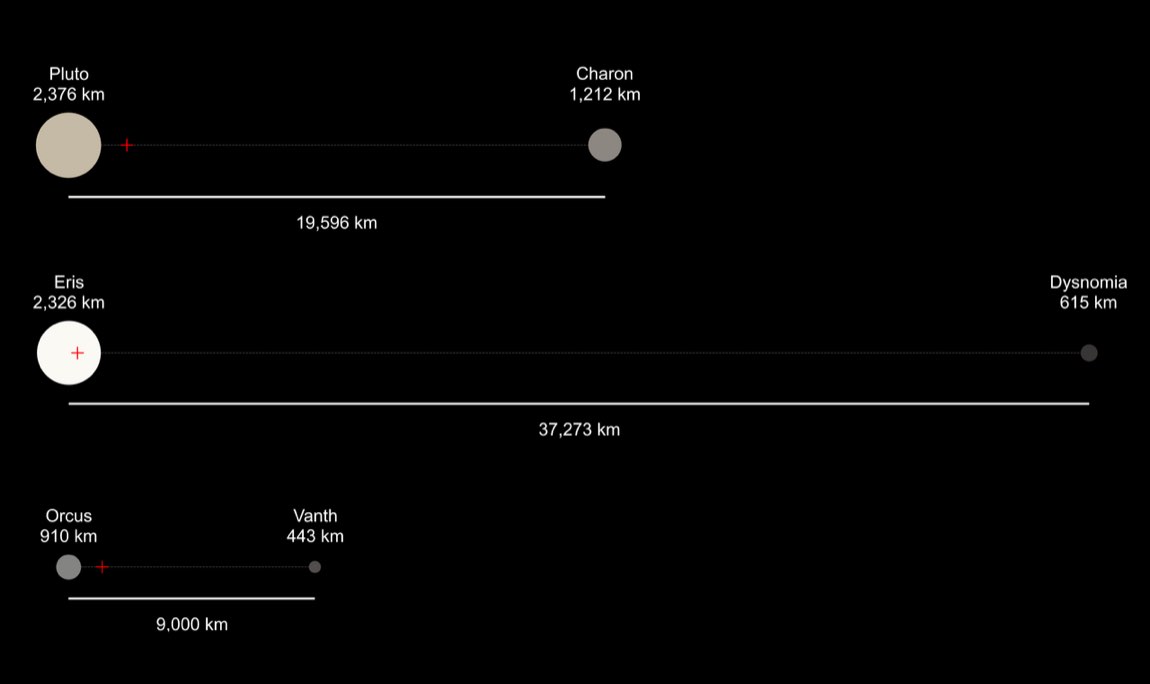
One of Dysnomia's most valuable scientific contributions has nothing to do with the moon itself — it is what its orbit reveals about its host. By combining observations from both the Keck telescopes and the Hubble Space Telescope, astronomers applied Kepler's third law of planetary motion to calculate Eris's mass precisely. Dysnomia orbits Eris at an average distance of approximately 37,300 km — roughly one tenth of the Earth–Moon distance — and completes one orbit every 15.786 days, just over half a month. Plugging those numbers into Kepler's formula yields a mass for Eris that is 1.27 times that of Pluto, confirming that Eris is the more massive body even though Pluto is physically larger. Without a moon, measuring a distant dwarf planet's mass is extraordinarily difficult; Dysnomia's very existence turned Eris from a mysterious dot into a precisely weighed world.
05 An almost perfectly circular path Deeper
Dysnomia's orbit is remarkably close to circular, with a measured eccentricity of only 0.0062 ± 0.0010. Because of that slight deviation from a perfect circle, Dysnomia's distance from Eris varies by just 462 ± 105 km over the course of each orbit — a variation smaller than the diameter of the moon itself. That near-circularity is actually puzzling: dynamical simulations predict that mutual tidal forces between Eris and Dysnomia should have fully circularized the orbit within 5 to 17 million years, regardless of the moon's density. The Solar System is about 4.5 billion years old, so any primordial eccentricity should have been erased long ago. The fact that a small but non-zero eccentricity still appears in the data has led some researchers to wonder whether an additional, as-yet-undetected inner satellite of Eris might be perturbing Dysnomia's orbit. Alternatively, the apparent eccentricity could be a measurement artifact caused by albedo patterns on Eris's surface or by systematic errors in astrometry.
06 Mutual tidal locking — a frozen partnership
Eris and Dysnomia are mutually tidally locked, meaning each body always keeps the same face turned toward the other — exactly the same relationship that Pluto and Charon share. For an observer standing on Dysnomia, Eris would hang permanently in the same spot in the sky, never rising or setting. For an observer on Eris, Dysnomia would similarly never move across the sky. This state of mutual locking develops over time as tidal forces dissipate rotational energy, slowing both bodies until their spin periods match the orbital period. What makes the Eris–Dysnomia case scientifically interesting is a tension in the data: ALMA observations show that Dysnomia does not cause a detectable wobble in Eris's position, constraining Dysnomia's mass to less than 1.4 × 10²⁰ kg. At that low a mass, models suggest tidal forces should not have been strong enough to lock Eris's rotation within the age of the Solar System — implying that Eris must be unusually dissipative, meaning it converts orbital energy into heat more efficiently than typical icy bodies.
 ⤢
07 A moon lighter than expected Deeper
Dysnomia's mass turns out to be one of the hardest numbers to pin down in the whole system. Because the moon is so much less massive than Eris, it barely tugs its host off-center. ALMA astrometry places an upper limit on the mass ratio at 0.0050 ± 0.0035, putting Dysnomia's mass below 1.4 × 10²⁰ kg. That upper limit corresponds to a maximum density of less than 1.2 g/cm³ — lower than liquid water's density of 1.0 g/cm³, implying Dysnomia must be composed predominantly of ice with very little rock. For comparison, a denser, rockier body of the same size would comfortably exceed that density. The low density also has a structural implication: Dysnomia is unlikely to be in hydrostatic equilibrium, meaning self-gravity has probably not been strong enough to pull it into a smooth sphere. Its true shape remains unknown. The mass range of (2–5) × 10²⁰ kg that would be needed to produce standard tidal locking in Eris is well above what ALMA's data allow, sharpening the puzzle of how the system reached its present configuration.
08 Red in infrared, dark in visible light Deeper
Dysnomia looks very different depending on which wavelength you observe it at, and that contrast carries real physical meaning. In visible light, Hubble Space Telescope measurements show Dysnomia is 500 times fainter than Eris — a 6.70-magnitude difference. Shift to near-infrared wavelengths and the gap narrows dramatically: Keck telescope observations show Dysnomia is only about 60 times fainter, a 4.43-magnitude difference. The fact that Dysnomia brightens relative to Eris as wavelength increases means Dysnomia is redder in color and has a substantially different spectrum. This kind of red, dark surface is a hallmark of irradiated organic compounds called tholins, which are common on the surfaces of outer Solar System bodies that have been bombarded by cosmic rays and ultraviolet light over billions of years. Eris, by contrast, is coated in fresh, bright nitrogen and methane ices that reset its surface color. The spectral mismatch between the two bodies is one more line of evidence pointing to a violent, differentiated origin for the system.
09 Born from a giant impact on Eris
The physical mismatch between Eris and Dysnomia — one bright and icy, the other dark and probably ice-rich but spectrally different — fits neatly into the giant impact model of moon formation. The leading idea is that early in Solar System history, a large body collided with Eris, blasting material off its surface that then coalesced into Dysnomia. This mirrors how Earth's Moon is thought to have formed when a Mars-sized impactor struck the young Earth, and also resembles the origin stories proposed for the Pluto–Charon and Orcus–Vanth pairs. Supporting the picture statistically: eight of the ten largest known trans-Neptunian objects have at least one satellite, while only about 10% of fainter trans-Neptunian objects do. That steep size dependence suggests that large Kuiper Belt bodies were frequent collision targets in the crowded early Solar System, and that impacts among bodies roughly 1,000 km across were energetic enough to throw off enough debris to build a companion moon.
10 A future eclipse season in 2239
Dysnomia's orbital plane is tilted approximately 78° with respect to Eris's path around the Sun. Because that inclination is less than 90°, the orbit is technically prograde — Dysnomia moves in the same direction as Eris's heliocentric motion. The tilt also means that from Earth's vantage point, the orbital plane is usually tipped away from edge-on, so Dysnomia passes above or below Eris in the sky rather than in front of or behind it. That geometry changes periodically, however. Calculations show that in 2239, Eris and Dysnomia will enter a season of mutual events: for a period, Dysnomia's orbital plane will be aligned edge-on to the Sun, causing Eris and Dysnomia to alternately eclipse and occult each other as seen from Earth. Such mutual event seasons are scientifically prized because the precise timing of eclipses can reveal the sizes, shapes, and albedo distributions of both bodies far more accurately than imaging alone.
11 How Dysnomia ranks among dwarf-planet moons
With an estimated diameter of 615 +60/−50 km, Dysnomia holds the title of second-largest known moon of any dwarf planet. Only Charon, which orbits Pluto, is larger. Dysnomia spans 24% to 29% of Eris's own diameter, making it a substantial companion relative to its host — though still far smaller than Charon, which is about half of Pluto's diameter. The ranking matters scientifically because larger moons are more likely to have formed in giant impacts rather than through capture, and they provide stronger gravitational signals for measuring their host's mass. Dysnomia's diameter is roughly comparable to the width of France — about 600 km from north to south. Despite its size, it is significantly less massive than Eris, and its density is consistent with a mostly icy interior, in contrast to rockier or denser bodies of similar dimensions found elsewhere in the Solar System.
12 Open questions that remain unsolved Deeper
Several important facts about Dysnomia remain genuinely unknown or contested. Its shape has never been resolved — the low density hints at a non-spherical, possibly irregular body, but no observation has confirmed this. Its exact mass is bounded only by an upper limit from ALMA, leaving a wide uncertainty range that makes density estimates imprecise. The slight residual orbital eccentricity of 0.0062 ± 0.0010 defies easy explanation: it could point to a hidden inner moon perturbing the orbit, to measurement errors from albedo features on Eris, or to some unusual property of the tidal interaction itself. The mechanism that makes Eris unusually dissipative — necessary to explain how the two bodies achieved tidal locking given Dysnomia's apparently low mass — is not understood. And the surface composition of Dysnomia, while inferred to be dark and icy from albedo and spectral data, has never been characterized by direct spectroscopy. Future missions or next-generation telescopes would be needed to settle these questions.
 ⤢