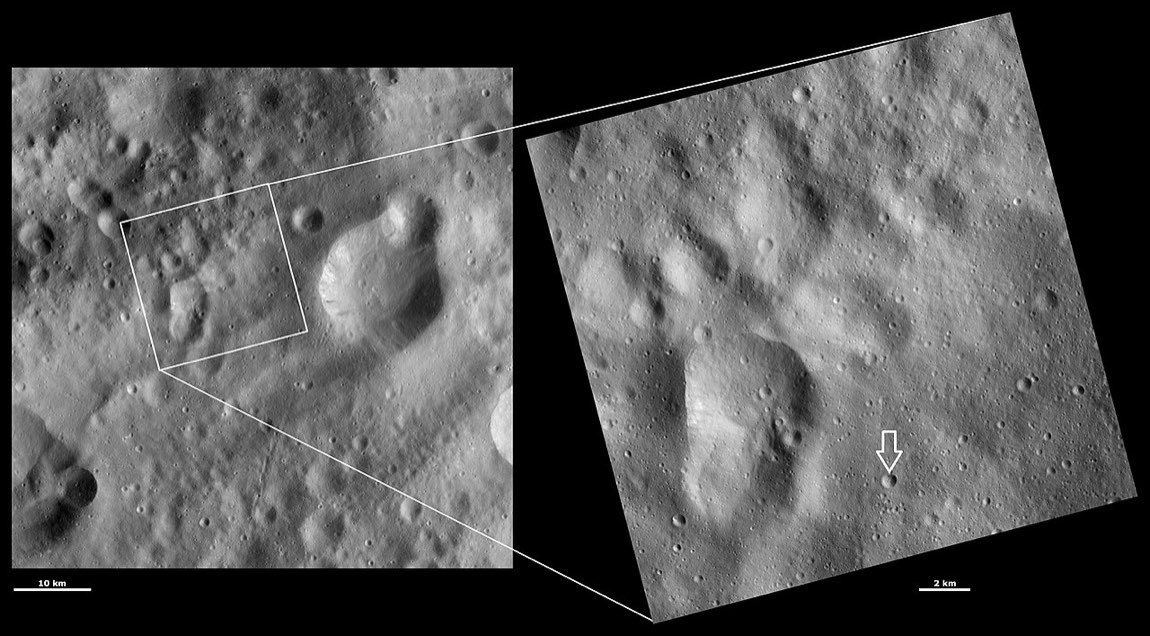
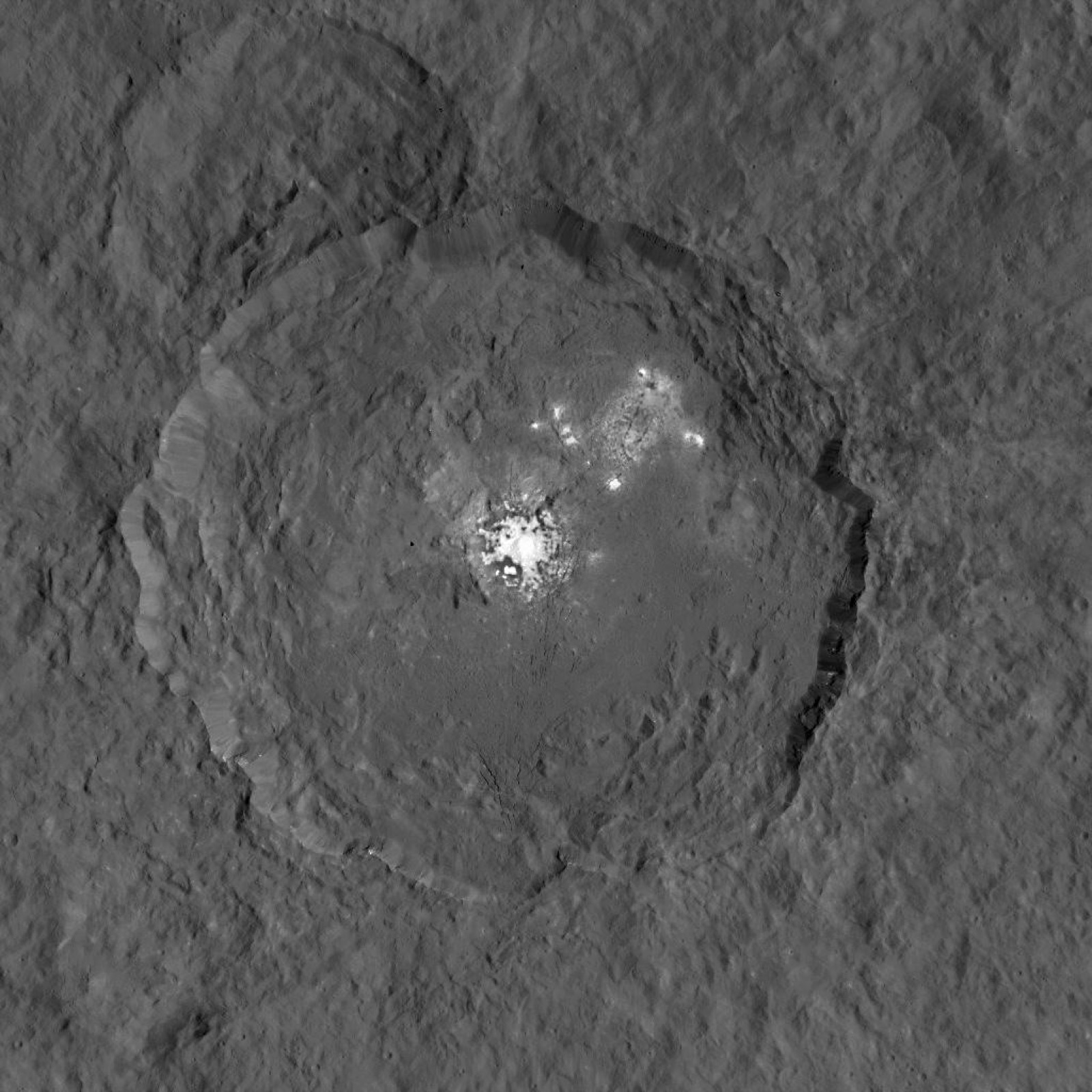
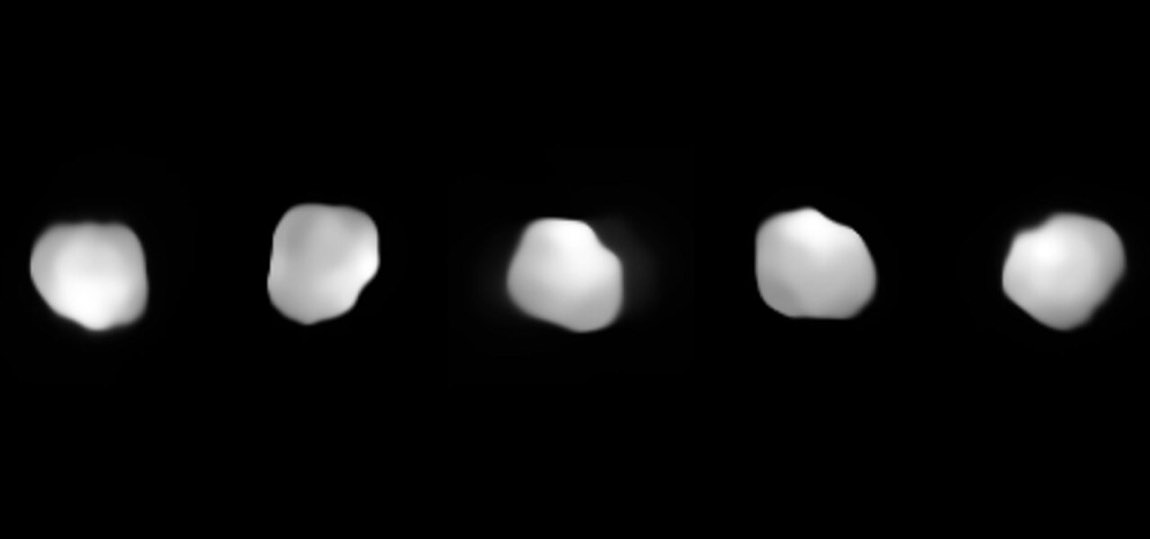
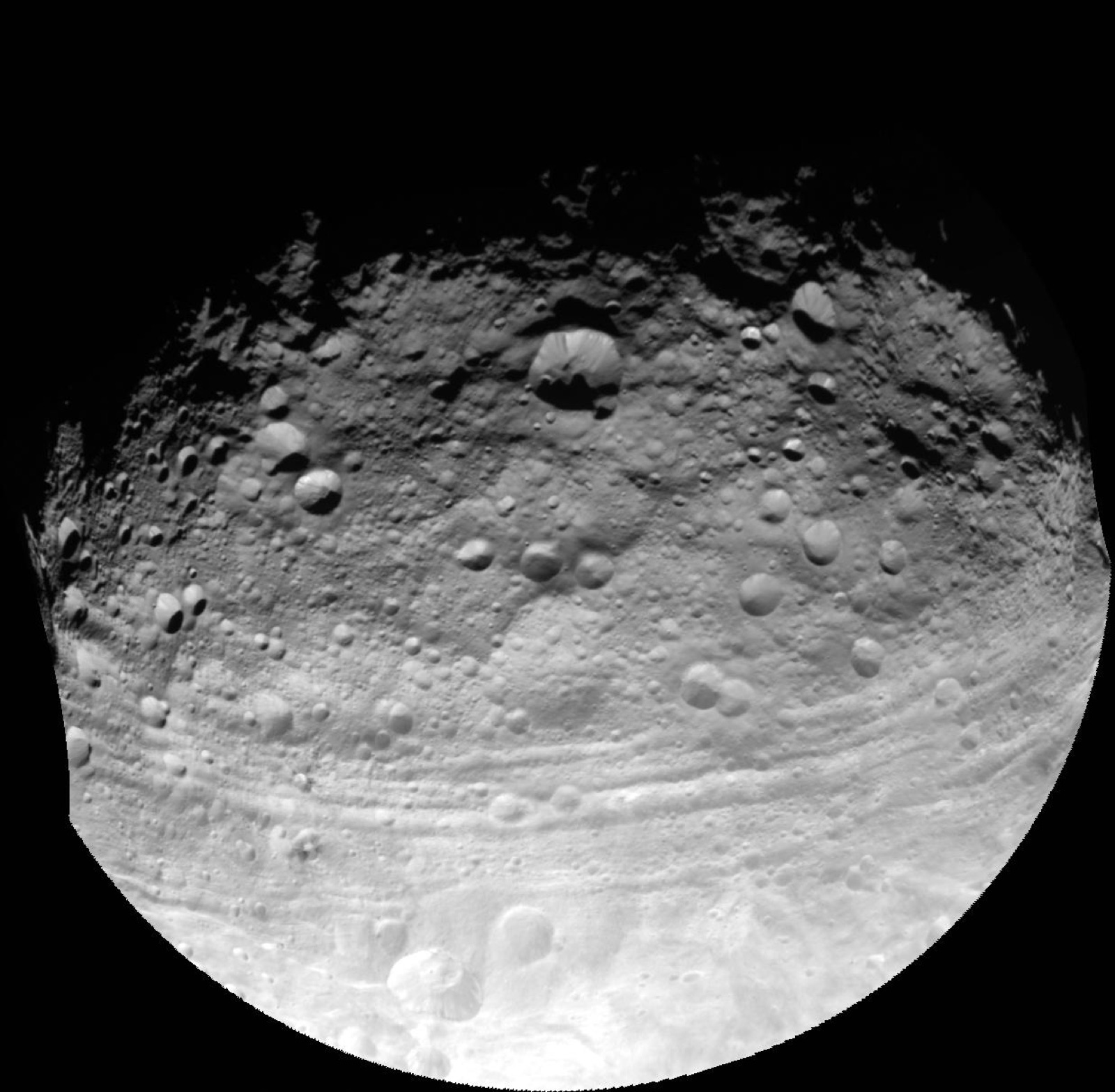
 Photograph · NASA/JPL-Caltech/UCLA/MPS/DLR/IDA
Asteroid · Deep guide
Vesta
Also called: 4 Vesta
The brightest asteroid. This battered protoplanet has a mountain twice Everest's height.
What is it?
Vesta is the second-most-massive object in the asteroid belt and the only asteroid sometimes visible to the naked eye. It is not a boring rock: Vesta is a surviving protoplanet — a body that started forming into a planet 4.5 billion years ago and then simply stopped, complete with an iron core, ancient lava plains, and a south-pole impact basin so deep its central peak rises about 20 km.
Go deeper
NASA's Dawn orbited Vesta in 2011–12, confirming it as a differentiated protoplanet — core, mantle, basaltic crust — essentially a fossil of planet formation's first million years. The Rheasilvia basin excavated so deeply that fragments blasted free reach Earth: the HED meteorites, ~6% of all falls, are chemically fingerprinted pieces of Vesta — making it one of only a handful of bodies (with the Moon and Mars) whose samples we hold without a return mission.
01 A planet that never finished
Planets grow by collisions: pebbles to boulders to protoplanets to worlds. Jupiter's gravity stirred the asteroid belt so violently that its residents mostly smashed instead of merging — and Vesta is the great survivor of that halted construction project, a planet embryo preserved for 4.5 billion years. Studying it is studying Earth's own first chapter.
02 Meteorites with a return address Deeper
Spectra of Vesta match the HED meteorite family so precisely that scientists treat them as delivered samples: lava rocks from an asteroid's ancient crust, datable in Earth labs. They show Vesta was volcanically alive within the Solar System's first few million years — molten by the decay of short-lived aluminum-26, planet-formation's briefly available battery.
The deep dive
Researched for the Atlas from Wikipedia — 4 Vesta (29,752 characters read) · updated Sep 20, 2026
03 How Olbers found Vesta — and why he was wrong
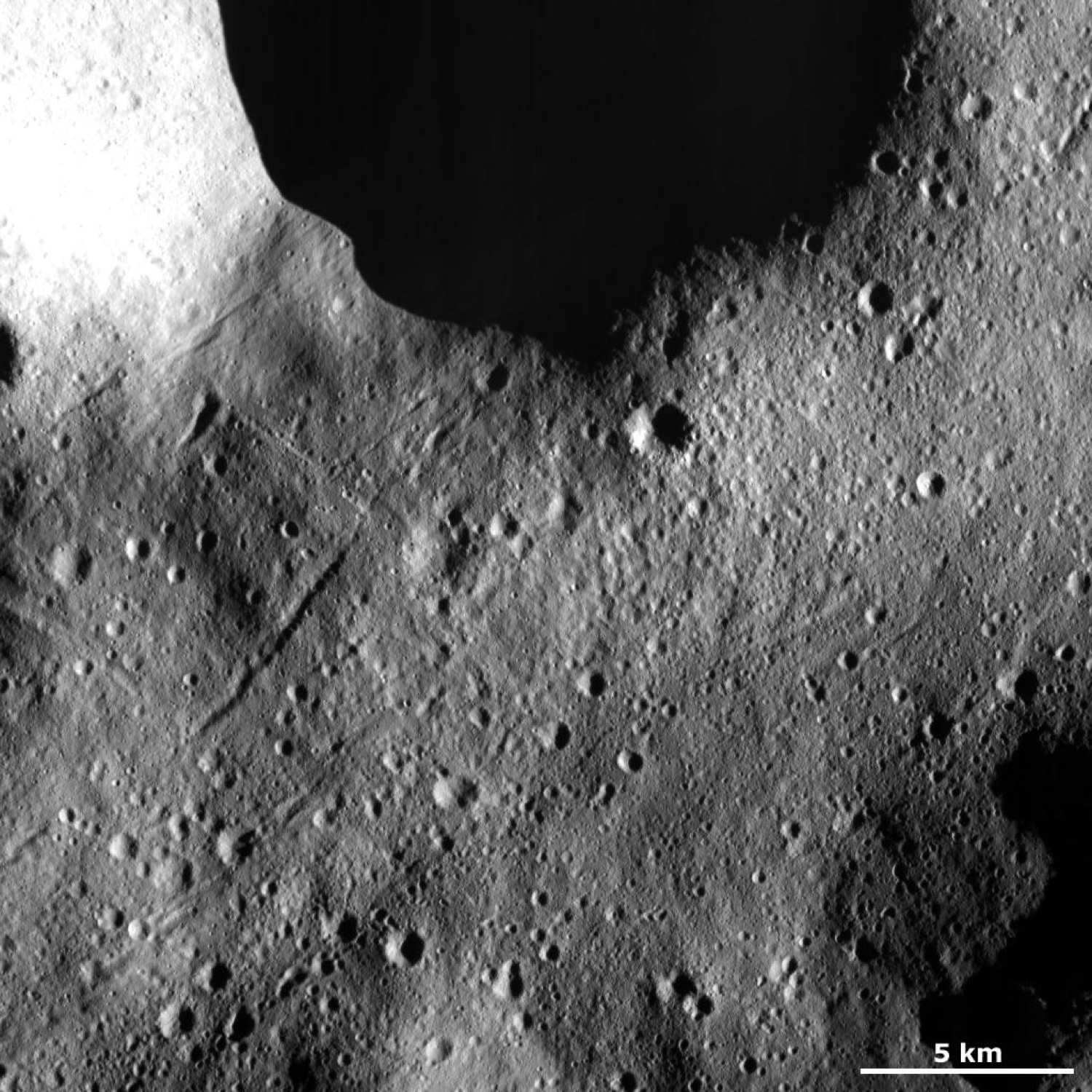
Heinrich Wilhelm Matthias Olbers had already discovered Pallas in 1802, just a year after Ceres turned up. Convinced the two were rubble from a shattered planet, he wrote to William Herschel proposing that more fragments should be found wherever the orbits of Ceres and Pallas crossed — in the constellations Cetus and Virgo. He began searching in 1802 and kept at it for five years, finally spotting Vesta on 29 March 1807 in Virgo. The irony is that his theory was completely wrong: Ceres, Pallas, and Vesta are not related fragments at all. Still, the search strategy worked, and Vesta became the fourth asteroid ever identified. Because Olbers already had a "planet" (Pallas) to his name — asteroids were counted as planets at the time — he graciously handed the naming rights to mathematician Carl Friedrich Gauss, who had computed Vesta's orbit in a remarkable ten hours and who chose the Roman goddess of home and hearth.
 ⤢
⤢
04 Weighing Vesta from a distance Deeper
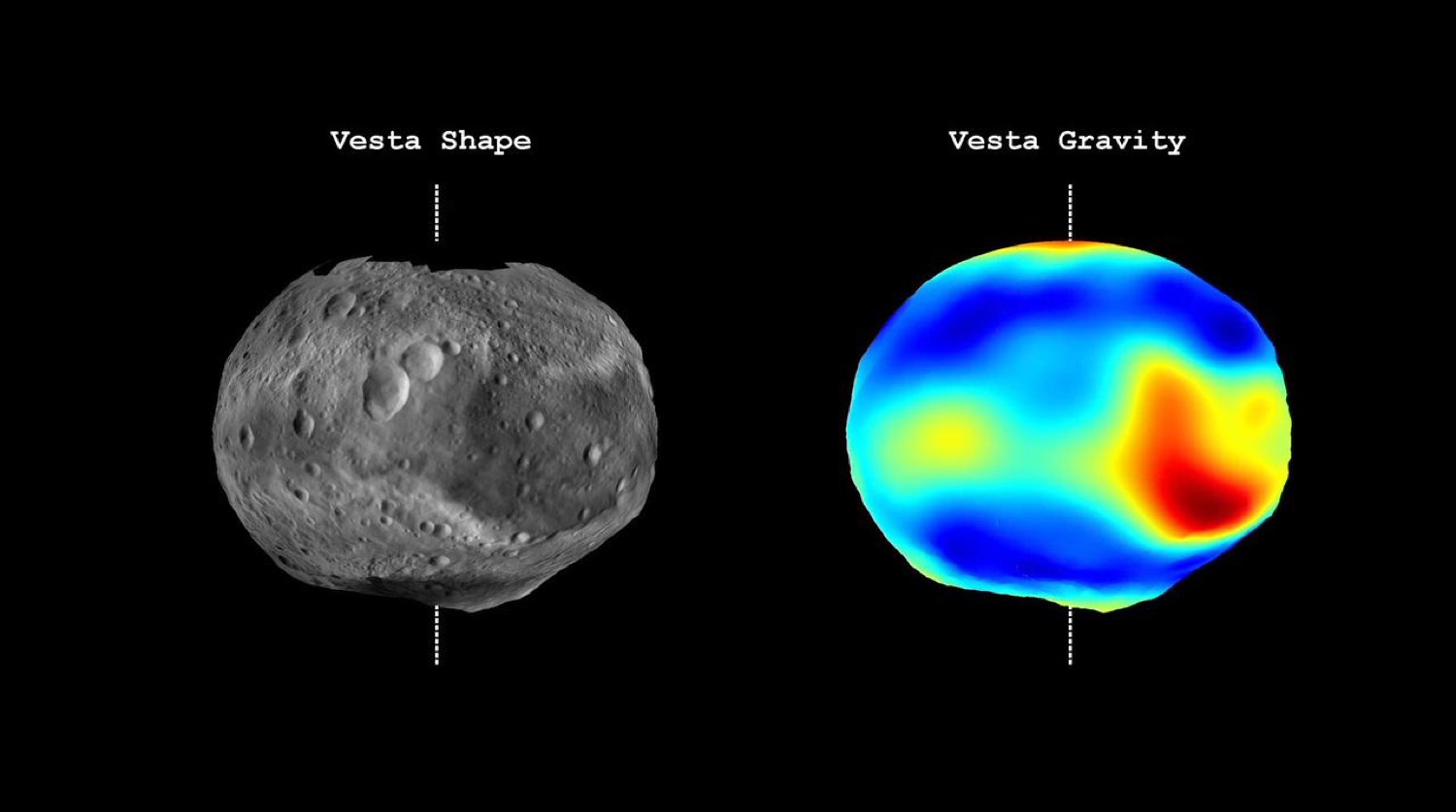
Vesta holds a quiet distinction: it was the first asteroid ever to have its mass determined. The method exploited a fortunate coincidence in the solar system's clockwork — every 18 years, the small asteroid 197 Arete swings within 0.04 AU of Vesta, close enough that Vesta's gravity gives it a detectable nudge. In 1966, Hans G. Hertz analyzed those gravitational perturbations and arrived at a mass of (1.20 ± 0.08) × 10⁻¹⁰ solar masses. Later, the perturbations of a different asteroid, 17 Thetis, refined the figure to (1.31 ± 0.02) × 10⁻¹⁰ solar masses in 2001. When the Dawn spacecraft finally arrived and could measure Vesta's gravity field directly, it confirmed a value of 1.3029 × 10⁻¹⁰ solar masses — vindicating the patient ground-based work that preceded it by decades. Dawn then went further, using the J2 component of the gravity field to estimate a core diameter of about 220 km, assuming a crustal density similar to the HED meteorites.
05 A world of extreme temperature swings
Without a meaningful atmosphere to buffer heat, Vesta's surface temperatures swing between extremes that would destroy most machinery. When the Sun is directly overhead, the surface can warm to around −20 °C — cold by Earth standards but almost balmy for the asteroid belt. At the winter pole, however, the temperature plunges to approximately −190 °C. Typical daytime readings hover around −60 °C, while a typical night drops to −130 °C. These figures were estimated for 6 May 1996, when Vesta was very close to perihelion, its nearest point to the Sun. Because Vesta's axial tilt is 29° and it takes 3.6 Earth years to orbit the Sun, each season lasts roughly eleven months — long enough that the Dawn spacecraft, which arrived during late southern-hemisphere summer, could watch the northern hemisphere gradually rotate into sunlight during its year in orbit.
06 Two colossal craters dominate the south
The most dramatic fact about Vesta's surface is that its entire southern hemisphere is dominated by two overlapping impact basins. The older one, Veneneia, stretches 400 kilometres across. Partly overprinting it is the younger Rheasilvia, 500 kilometres wide — spanning 95% of Vesta's mean diameter. Rheasilvia is roughly 19 km deep, and the highest point of its rim stands 31 km above the crater floor's lowest point. The impact that carved it is estimated to have excavated about 1% of Vesta's total volume, flattening the southern hemisphere and distorting the asteroid's shape enough that Vesta failed to qualify as a dwarf planet under IAU rules. Hydrocode computer simulations suggest the impactor was likely 60–70 km across, hitting at roughly 5.4 km/s at an angle of around 30–45 degrees from vertical. Crater-counting on Rheasilvia's floor places the event at approximately 1 billion years ago — geologically recent for a body that formed in the solar system's first few million years.
 ⤢
⤢
07 The tallest peak most people have never heard of
Rising from the floor of the Rheasilvia basin is a central peak that ranks among the tallest mountains identified anywhere in the solar system. It stands 23 km above the lowest measured part of the crater floor, with a base roughly 180 km wide. For comparison, Olympus Mons on Mars is about 22 km tall — so Rheasilvia's central peak is comparable in height to the largest volcano in the solar system, yet sits inside a crater on a body with a mean diameter of only 525 km. Standard crater-scaling laws developed for smaller asteroids cannot explain such a massive rebound structure; numerical models instead require that the underlying material — possibly upper mantle rock — collapsed and rebounded during the impact, which itself implies that Vesta must be a differentiated body with enough internal layering and gravity for that dynamic to operate.
08 Canyon systems that dwarf the Grand Canyon
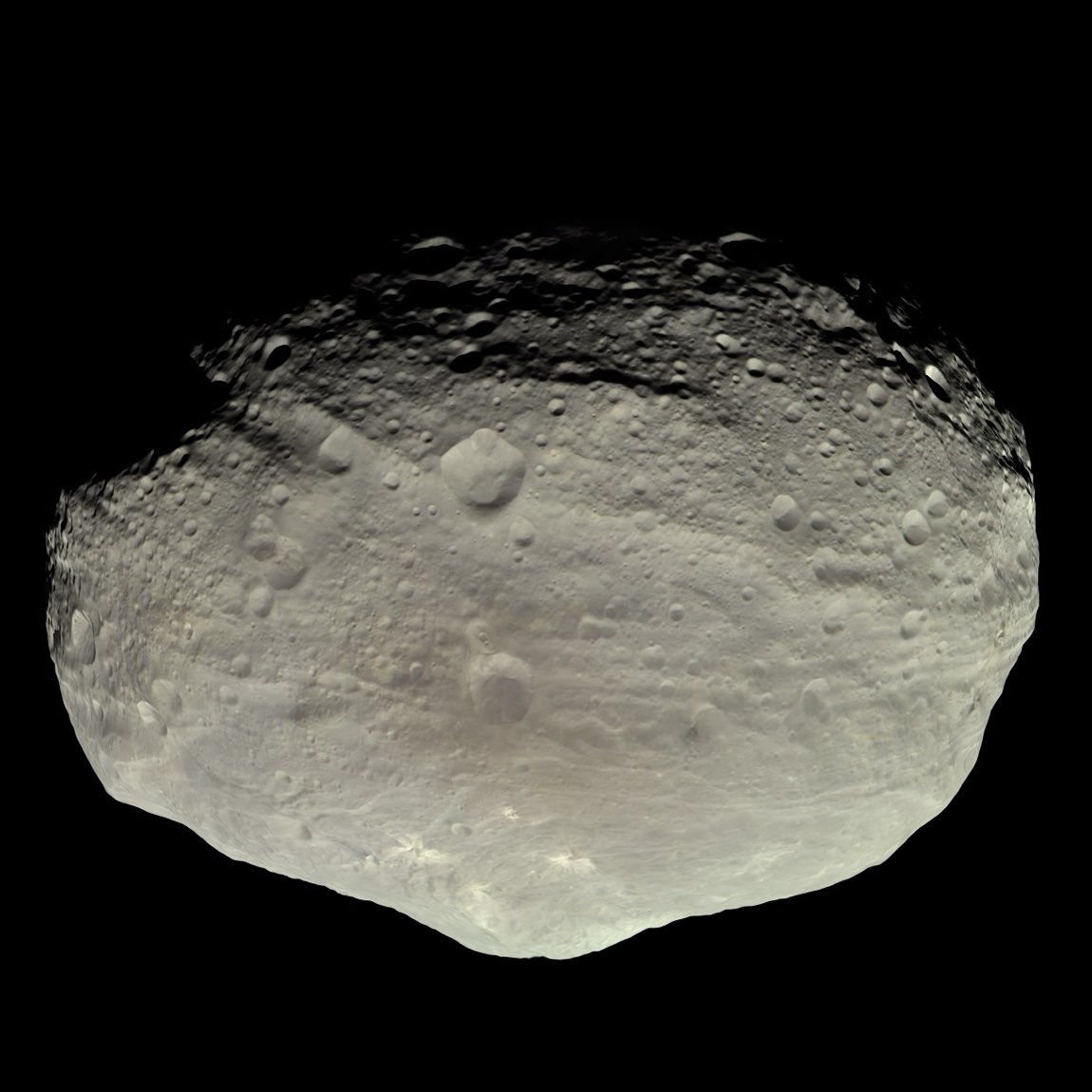
Encircling Vesta's equator is one of the more surprising geological features in the asteroid belt: a series of parallel troughs called Divalia Fossae. The longest individual trough in this system is 10–20 km wide and 465 km long. Although Vesta is one-seventh the size of the Moon, Divalia Fossae dwarfs the Grand Canyon. A second trough system, Saturnalia Fossae, cuts across the northern latitudes at an angle to the equator; its largest trough is roughly 40 km wide and over 370 km long. Together they are among the longest chasms in the solar system, described as nearly as long as Ithaca Chasma on Saturn's moon Tethys. Scientists think Divalia Fossae formed as graben — blocks of crust that dropped between parallel faults — when the Rheasilvia impact sent enormous stress waves through the body, while Saturnalia Fossae was probably triggered by the older Veneneia impact. The fact that graben can form at all suggests at least some degree of differentiation.
09 The olivine mystery Dawn couldn't fully solve Deeper
Before Dawn arrived, planetary scientists expected to find abundant olivine in and around the Rheasilvia and Veneneia basins, because both craters punched 60–100 km into Vesta — far deeper than the estimated 30–40 km thickness of the crust — and should have hauled up mantle material. Olivine is the dominant mineral expected in that mantle. Yet Dawn's infrared spectrometer found no significant olivine inside either giant basin. Instead, olivine signatures turned up only in scattered patches in the northern hemisphere. Three competing explanations remain on the table: Vesta's crust may simply be far thicker than the models predicted; the violence of the impacts may have mixed and diluted the olivine signal beyond recognition; or the olivine Dawn detected might have arrived aboard olivine-rich impactors from elsewhere, having nothing to do with Vesta's interior. None of these explanations is fully satisfying, leaving the internal structure of the best-studied protoplanet still genuinely uncertain.
 ⤢
⤢
10 Signs of water on a seemingly dry world Deeper
Vesta looks dry at a glance — it has no liquid water and no significant atmosphere — but Dawn found subtle evidence that water has played a role in shaping its surface. Pitted terrain, thought to form when impact heat drives off volatile-bearing material as gas, appears in at least four craters: Marcia, Cornelia, Numisia, and Licinia. More strikingly, curvilinear gullies in Marcia and Cornelia craters end in lobate deposits that are sometimes covered by the same pitted terrain. Researchers propose that buried ice, melted by the heat of impacts, produced transient flows of liquid water that carved those gullies before quickly freezing or evaporating. Hydrated minerals have also been detected, often near patches of dark material. That dark material is thought to consist largely of carbonaceous chondrite deposited by impacting bodies — material that is comparatively rich in mineralogically bound hydroxyl (OH), meaning water arrived on Vesta from outside even if it did not originate there.
11 Vesta's long road to a dedicated spacecraft Deeper
Getting a spacecraft to Vesta took decades of rejected proposals. In 1981 the European Space Agency received a mission concept called AGORA — the Asteroidal Gravity Optical and Radar Analysis mission — intended to fly by two large asteroids between 1990 and 1994, with Vesta as the preferred target. ESA turned it down. A joint NASA–ESA concept followed, the Multiple Asteroid Orbiter with Solar Electric Propulsion, which included a Vesta orbit option; NASA declined interest in an asteroid mission at all. France, Germany, Italy, and the United States all floated proposals in the 1980s, none approved. A Soviet mission called Vesta, developed with European partners and aimed at a 1991–1994 launch, was canceled when the Soviet Union dissolved. NASA's Discovery Program finally broke the logjam: by 2004 the Dawn spacecraft had cleared its critical design review, it launched on 27 September 2007, and on 16 July 2011 NASA confirmed it had entered Vesta's orbit — the first spacecraft ever to do so.
12 What Dawn actually mapped and measured Deeper
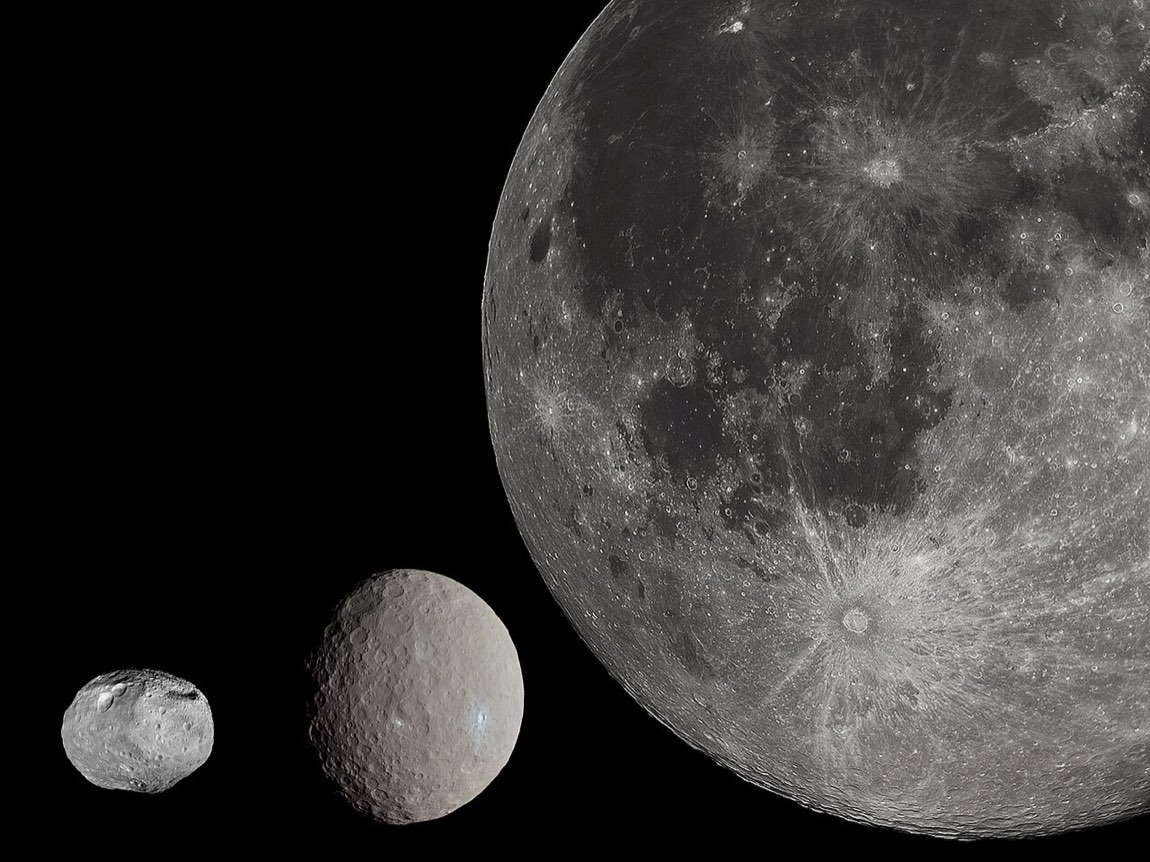
During its roughly fourteen months at Vesta, Dawn conducted observations from several distinct orbital altitudes. A survey orbit was followed by two high-altitude mapping orbits that produced images at 60–70 meters per pixel, and then a low-altitude mapping orbit achieving about 20 meters per pixel — fine enough to reveal features the size of a city block. The mission released digital terrain models, videos, and full atlases of the surface. Three scientific instruments — the visible and infrared spectrometer (VIR), the gamma-ray and neutron detector (GRaND), and the framing camera (FC) — together confirmed that the bulk of Vesta's surface composition matches the howardite, eucrite, and diogenite meteorite suite. Scientists also calculated Vesta's precise mass and gravity field, and the J2 gravitational harmonic yielded a core diameter estimate of about 220 km assuming HED-like crustal density. Dawn's publicly accessible data archive is hosted at UCLA.
 ⤢
⤢
13 A coordinate system dispute that lasted years Deeper
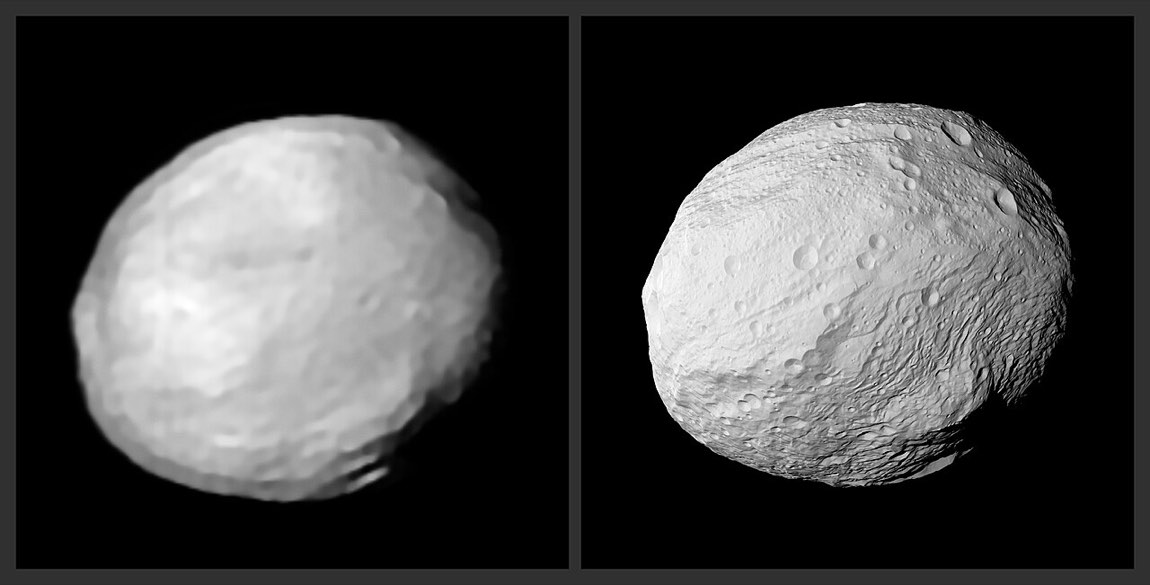
Even defining where things are on Vesta turned into a scientific controversy. The International Astronomical Union established a coordinate system in 1997 based on Hubble Space Telescope photos, placing the prime meridian through Olbers Regio, a dark feature about 200 km across. When Dawn arrived it found two problems: the assumed pole position was off by 10°, causing the coordinate grid to drift across the surface at 0.06° per year, and Olbers Regio was indistinct up close and unsuitable as a precision reference. The Dawn team corrected the pole and defined a new prime meridian 4° from the center of Claudia, a sharply defined crater only 700 meters across. All NASA maps of Vesta use this Claudian meridian. The IAU found it unacceptable and recommended rotating the Claudian longitude by 150° to keep alignment with Olbers Regio, producing two coordinate systems separated by 150° that are used simultaneously in the literature — one by NASA, one by the IAU.
14 Tracking Vesta across your own night sky
Vesta is the brightest asteroid in the solar system, and its relatively reflective surface means it regularly reaches magnitude 5.1 — faintly detectable without optical aid from a truly dark site. At its best recent apparitions it has done even better: magnitude +5.4 in May–June 2007 (the brightest since 1989, when opposition and perihelion nearly coincided) and +5.3 at the 22 June 2018 opposition. Even at less favorable oppositions, such as late 2008 in the Northern Hemisphere, it held between magnitude 6.5 and 7.3, well within binocular range. When Vesta is in conjunction with the Sun — on the far side from Earth — it still only fades to about magnitude 8.5, meaning binoculars can follow it through most of its orbit from a light-pollution-free location. Vesta orbits the Sun in 3.63 years and overtakes the slower Ceres every 17.4 years; the two came within one degree of each other on the sky in July 2014, offering a striking visual pairing for anyone watching.
 ⤢
⤢
You would weigh…
Surface gravity 0.25 m/s² vs Earth’s 9.81 m/s². Try every world →
Could life exist here?
Dry, airless, and frozen since the beginning.
Our labels: Confirmed · Strong Evidence · Estimated · Hypothesis · Theoretical · Speculative (see Methodology).
How would we get there?
Dawn needed 4 years with ion propulsion. Belt objects are years away with any current technology.
| Technology | Status | Travel time (one way, straight line) |
|---|---|---|
| Apollo-style spacecraft, about 39,000 km/h | Flown technology | 378 days |
| Ion-propulsion probe, about 90,000 km/h | Flown technology | 163 days |
| Voyager 1, about 61,000 km/h | Flown technology | 240 days |
| Parker Solar Probe, about 690,000 km/h | Flown technology | 21 days |
| Nuclear-thermal rocket, about 120,000 km/h cruise | In development | 124 days |
| Laser light-sail at 20% of light speed | Proposed concept | 98 minutes |
| Light itself, 299,792 km/s | Physical limit | 20 minutes |
Simplified straight-line times at cruise speed. Real missions fly curved orbital paths and take longer. Full travel calculator →
Weird & wonderful
- About one in every 16 meteorites that lands on Earth is a piece of Vesta.
- Its south-pole mountain rivals Olympus Mons for the Solar System height record.
- Vesta's day is under 6 hours — a spinning fossil.
More real images of Vesta
Genuine spacecraft and telescope imagery, every frame credited and licensed. Tap any photo to enlarge.