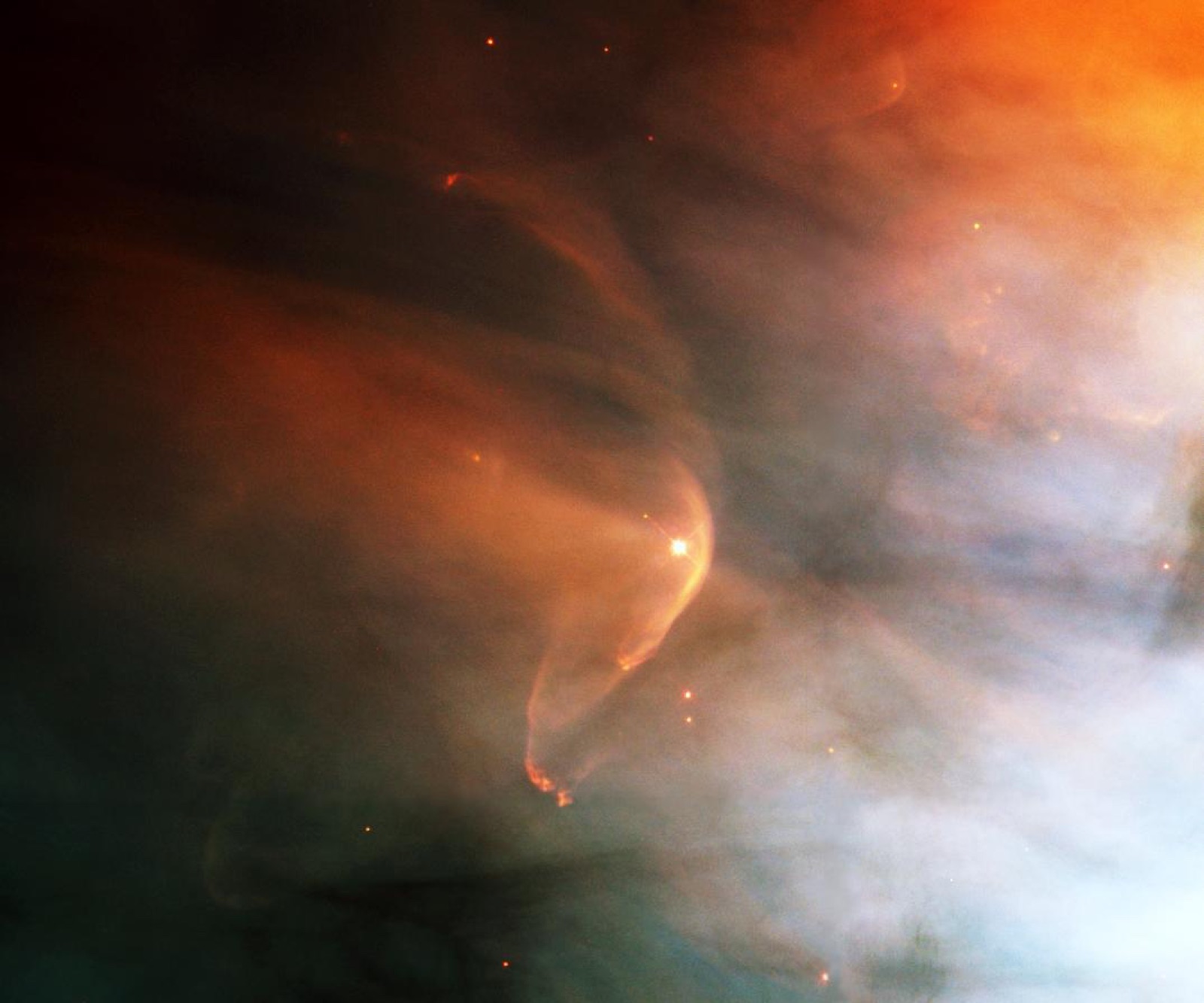
 Photograph · NASA and the Hubble Heritage Team STScI/AURA
Nebula · Deep guide
The Orion Nebula
Also called: M42
The sky's brightest star nursery. Suns are being born in this glowing cloud right now.
What is it?
The Orion Nebula is the nearest massive star-forming region to Earth — 1,344 light-years away, and the only nebula most people have unknowingly seen: it is the fuzzy middle 'star' in Orion's sword, visible to the naked eye. Inside its glowing folds of gas, thousands of stars are condensing out of collapsing cloud cores — a live broadcast of how our own Sun formed 4.6 billion years ago.
Go deeper
M42 is a blister on the near side of the Orion Molecular Cloud, ionized into visibility by the Trapezium's O-type stars (mainly θ¹ Ori C). Hubble and JWST resolve hundreds of 'proplyds' — protoplanetary disks silhouetted against the glow, planet formation caught in the act — plus free-floating planetary-mass objects (the puzzling JWST-discovered 'JuMBOs'). The whole complex will disperse within ~100,000 years as stellar winds shred it; the newborn cluster will drift apart much as the Sun's birth-siblings scattered.
01 Where to look
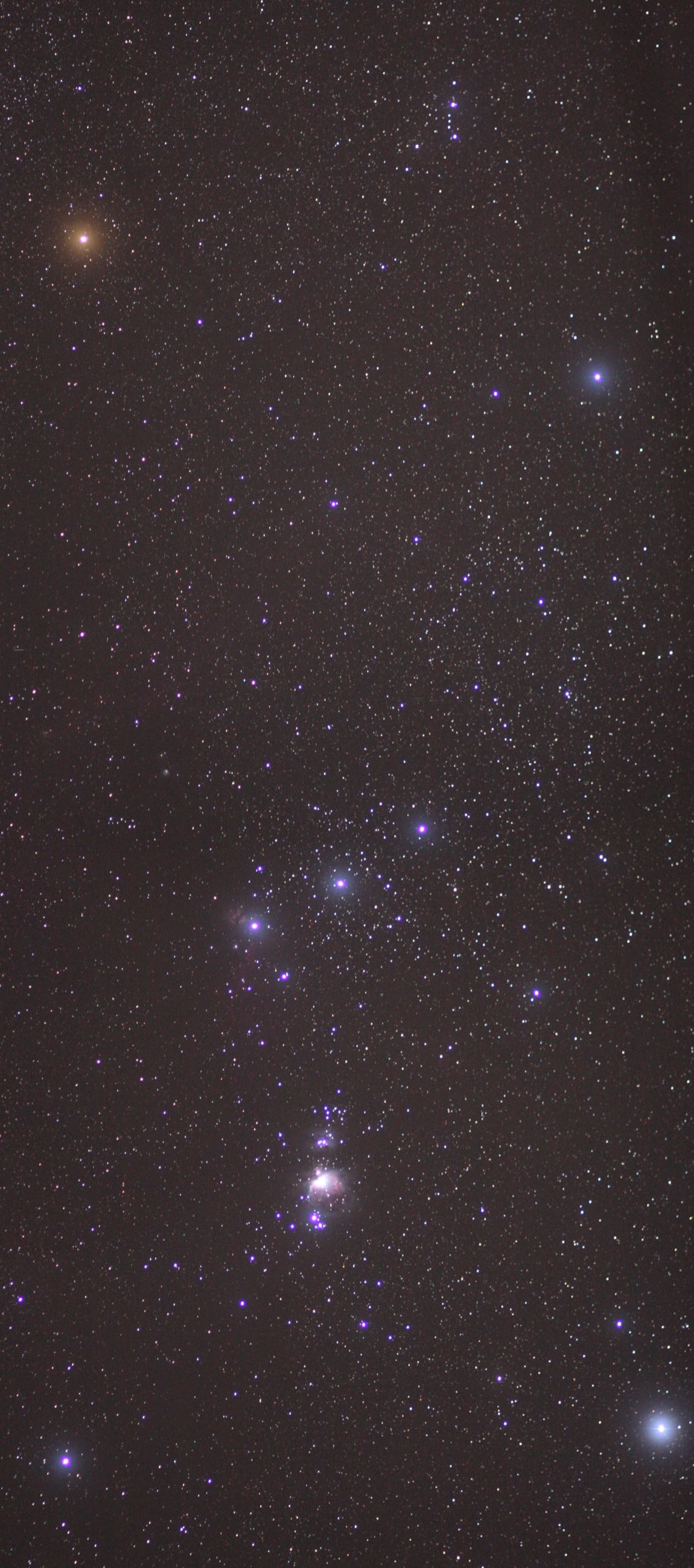
Winter evenings: find Orion's three-star belt, then the short line of 'sword' stars hanging below it. The middle one looks slightly fuzzy — that fuzz is M42. Binoculars show a glowing fan; a small telescope reveals the four Trapezium stars in their green-gray cavern. You are watching starbirth with your own eyes.
02 Nurseries make solar systems Deeper
The proplyds — dark disks around Orion's infant stars — are snapshots of our own origin: the Sun condensed in just such a cluster, its planets from just such a disk. Isotopes in meteorites suggest a nearby supernova salted the young Solar System, meaning the Sun had massive neighbors like the Trapezium. Orion is a family photo from before we were born.
The deep dive
Researched for the Atlas from Wikipedia — Orion Nebula (19,062 characters read) · updated Sep 20, 2026
03 A green glow that baffled science
Look at the Orion Nebula through a telescope and you will notice something odd: a greenish tint sits alongside the expected reds and blue-violets. The red comes from hydrogen gas re-emitting light at a wavelength of 656.3 nm, a process called Hα recombination. The blue-violet is starlight reflected from the massive O-class stars buried in the nebula's core. But the green stumped astronomers for decades. In the early twentieth century no known spectral line could account for it, and some scientists seriously proposed that it was produced by an entirely new element, which they named nebulium. The mystery was eventually solved when a deeper understanding of atomic physics revealed the culprit: a "forbidden transition" in doubly ionized oxygen. This transition has an extraordinarily low probability of occurring and can only happen in the near-perfect vacuum of deep space, where atoms are so rarely disturbed that an electron has time to make the jump. The process was literally impossible to reproduce in any laboratory on Earth at the time, making the Orion Nebula a unique natural physics experiment visible to anyone with a backyard telescope.
 ⤢
⤢
04 Who actually discovered it first
The Orion Nebula sits in plain sight, bright enough to see without any optical aid, yet it went unrecorded by Ptolemy, al-Sufi, and even Galileo — who pointed his telescope at the surrounding region in 1610 and again in 1617 without noting the nebula itself. Some historians speculate that a flare-up of the illuminating stars may have brightened the nebula sometime after those early observations were made. The credit for the first discovery of its diffuse, nebulous nature generally goes to French astronomer Nicolas-Claude Fabri de Peiresc, who recorded it on November 26, 1610, using a refracting telescope his patron Guillaume du Vair had purchased. The first published description came a few years later, in 1619, from the Jesuit mathematician Johann Baptist Cysat of Lucerne. He compared it to a bright comet he had watched in 1618, noting a white, cloud-like light poured out around and between the stars. He also described the central stars as forming a rectangle — possibly the earliest written hint of what we now call the Trapezium Cluster, though the first detection of three of that cluster's four stars is credited to Galileo on February 4, 1617.
05 The Trapezium and its stellar family Deeper
At the blazing heart of the Orion Nebula sits the Trapezium Cluster, named for the asterism made by its four primary stars arranged within a diameter of just 1.5 light-years. On nights with steady seeing, two of those four stars can be split further into their component binary pairs, bringing the resolved total to six individual stars. The Trapezium is embedded in the far larger Orion Nebula Cluster, an association of roughly 2,800 stars spread across a diameter of 20 light-years. The single most influential member is Theta1 Orionis C, which emits three to four times as much photoionizing radiation as the next brightest star in the group, Theta2 Orionis A. That torrent of ultraviolet light is what carves and illuminates the nebula's interior cavity. The youngest and brightest stars visible in the nebula today are thought to be less than 300,000 years old, with the brightest possibly only 10,000 years old. Intriguingly, the cluster may have violently ejected members in the distant past: the runaway stars AE Aurigae, 53 Arietis, and Mu Columbae are all currently racing away from the nebula at speeds greater than 100 km/s, and two million years ago their trajectories converge back on this region.
06 Interior anatomy: cavities, wings, and a fish's mouth Deeper
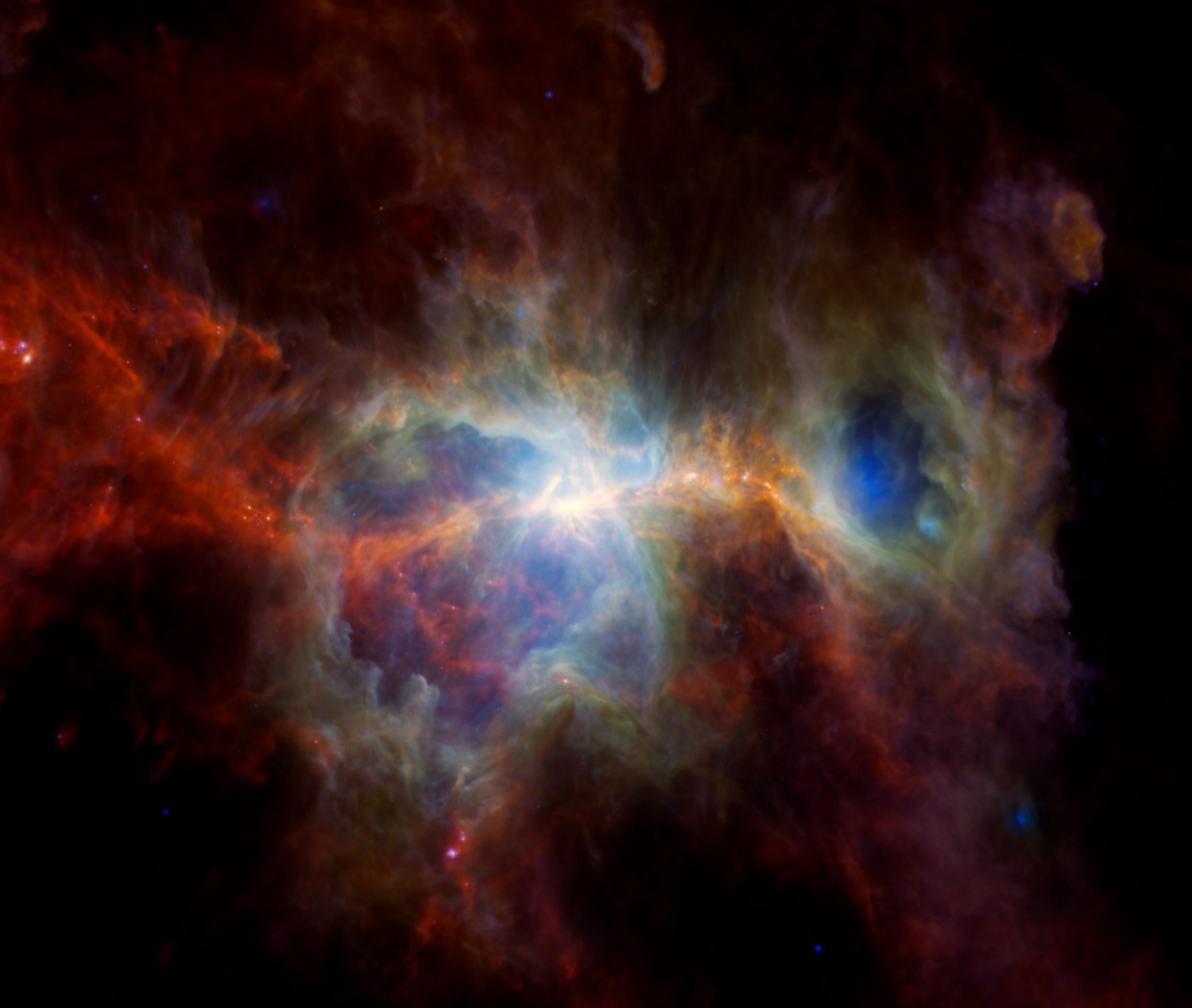
The Orion Nebula is not a simple cloud but a layered, three-dimensional structure astronomers have painstakingly mapped using Hubble imagery. At its core lies an ionized H II region, roughly centered on Theta1 Orionis C, with temperatures reaching up to 10,000 K. That temperature drops sharply toward the nebula's edges. The H II region sits inside a cavity scooped out of an elongated molecular cloud; the glowing emission we see comes primarily from photoionized gas on the back wall of that cavity. Surrounding this ionized zone is an irregular, concave bay of denser, more neutral gas. Gas in the molecular cloud moves with relative velocities up to 10 km/s, but local variations can spike to 50 km/s or more. Observers have given informal names to the visible features: a dark intrusion from the north is called the "Fish's Mouth" or Sinus Magnus, and the bright regions flanking it are the "Wings." Other named features include "The Sword," "The Thrust," and "The Sail." The overall gas motion is complex but trends outward through the opening of the bay and toward Earth, while the large neutral region behind the ionized zone is actively contracting under its own gravity.
 ⤢
⤢
07 Three kinds of shocks shaping the gas Deeper
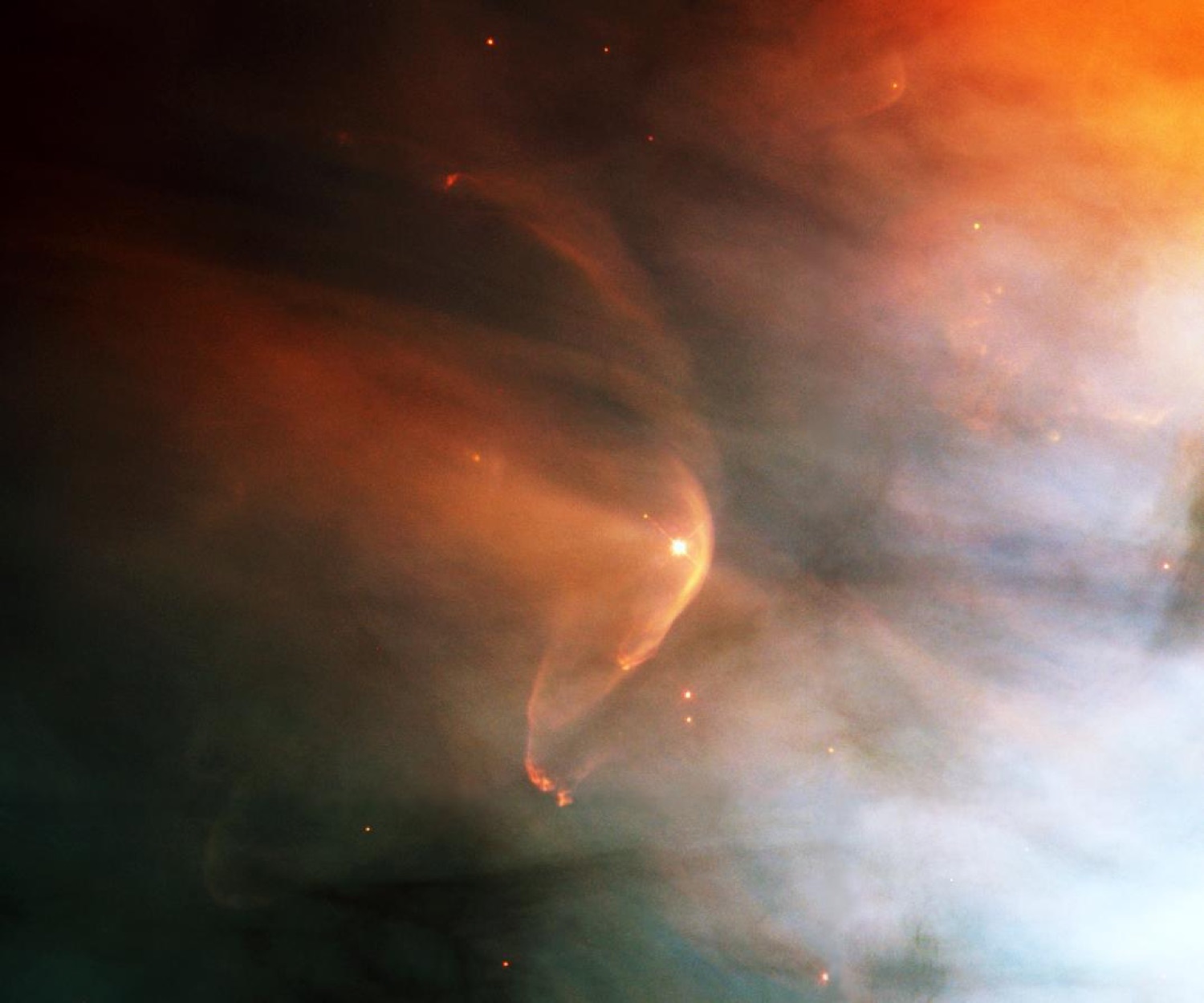
The interior of the Orion Nebula is far from tranquil. Massive and newborn stars pour out charged particles as stellar winds, and where those winds slam into the surrounding gas they create shock waves that sculpt the cloud and can even trigger new rounds of star formation by compressing gas to the point of gravitational collapse. Three distinct shock types operate here. Bow shocks are stationary collisions between two particle streams; they appear near the hottest stars where stellar wind speeds can reach thousands of kilometers per second, and also in the nebula's outer regions at tens of kilometers per second. Jet-driven shocks originate in the narrow, fast-moving jets that spray from newborn T Tauri stars; these jets travel at hundreds of kilometers per second and shock when they hit slower ambient gas. Warped shocks look bow-shaped from Earth but form when a jet-driven shock collides with gas flowing in a cross-current. Compounding all of this, the boundary between the stellar wind and the surrounding cloud produces wave-like disturbances attributed to the Kelvin-Helmholtz hydrodynamic instability. Piercing through everything are supersonic "bullets" of gas, each roughly ten times the diameter of Pluto's orbit and tipped with iron atoms that glow in the infrared, thought to have been launched by some violent, still-unidentified event about a thousand years ago.
08 Photography's biggest night: 1880 and 1883
Before the camera, every detail astronomers knew about the Orion Nebula came from laborious hand drawings. That changed on September 30, 1880, when Henry Draper attached a new dry-plate photographic detector to an 11-inch (28 cm) refracting telescope and held the shutter open for 51 minutes. The result was the first astrophotograph of any nebula in history. Three years later the technology took another leap, this time from an amateur. Andrew Ainslie Common built a 36-inch (91 cm) reflecting telescope in the backyard of his home in Ealing, west London, and in 1883 used the same dry-plate process to record exposures as long as 60 minutes. For the first time a photograph showed stars and nebula detail that no human eye, pressed to any eyepiece, had ever detected. These two milestones — a professional's pioneering first and an amateur's backyard triumph — transformed the Orion Nebula from a visual curiosity into a tool for discovery. Early spectroscopic work followed quickly: in 1865 William Huggins used visual spectroscopy to confirm the nebula was made of luminous gas, and by 1902 Vogel and Eberhard had detected differing velocities within it, with interferometric confirmation of rotation and irregular motions coming from astronomers at Marseille by 1914.
09 What Hubble found across 104 orbits
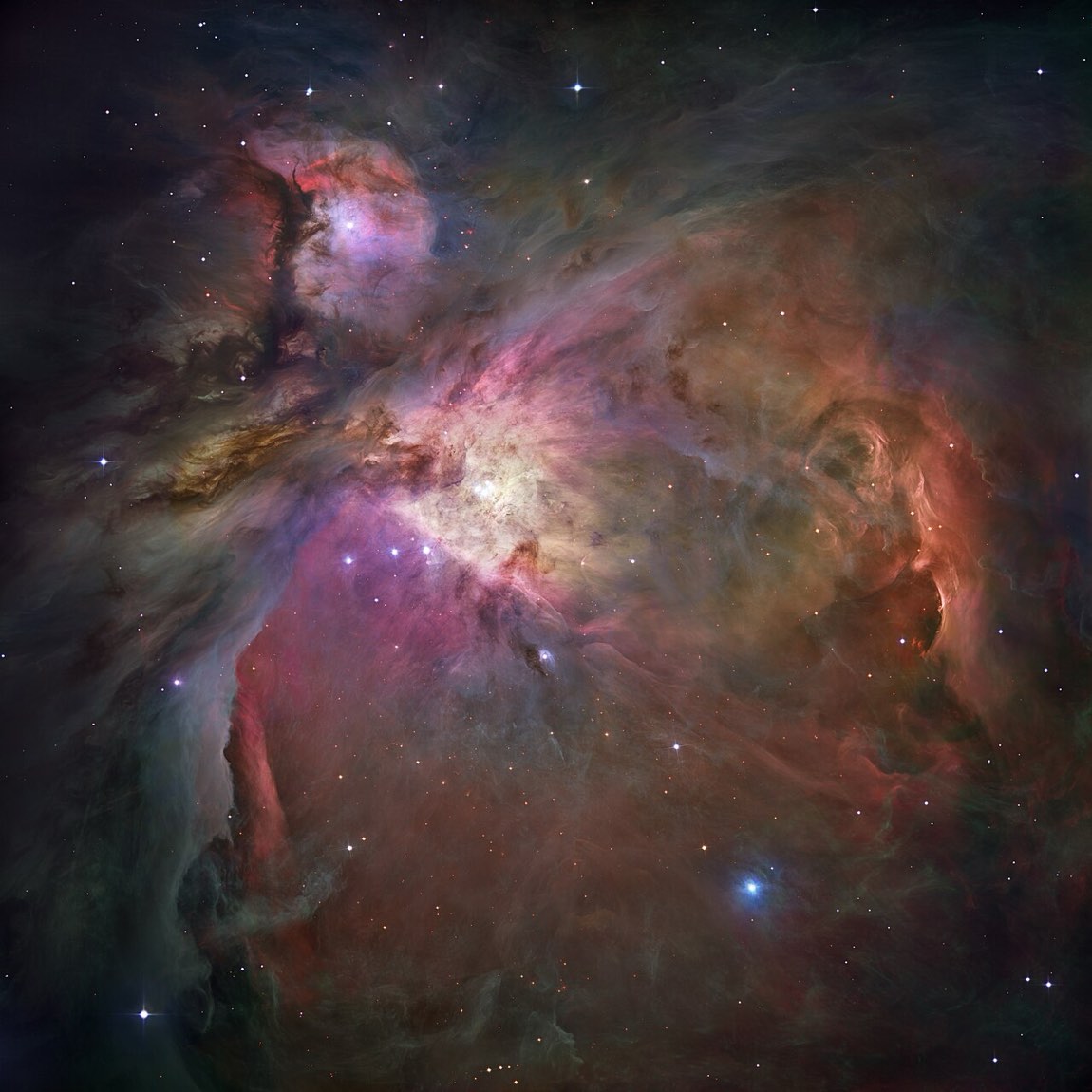
When the Hubble Space Telescope first turned toward the Orion Nebula in 1993, it confirmed the existence of protoplanetary disks — structures that had been theorized but never cleanly seen. Hubble went on to reveal more than 150 of these so-called proplyds within the nebula alone, providing powerful evidence that the formation of planetary systems is a common event across the universe rather than a rare accident. In 2005 the telescope's Advanced Camera for Surveys completed what was then the most detailed image ever taken of the nebula, assembled from 104 separate orbits. That mosaic captured over 3,000 individual stars down to 23rd magnitude, faint enough to include infant brown dwarfs and possible brown dwarf binary pairs. The following year, astronomers used HST data to measure the first-ever masses of an eclipsing binary pair of brown dwarfs designated 2MASS J05352184−0546085, located within the nebula. Their approximate masses are 0.054 and 0.034 times the mass of the Sun, with an orbital period of just 9.8 days. A striking surprise: the more massive of the two turned out to be the less luminous — behavior that challenged existing models of how young brown dwarfs shine.
 ⤢
⤢
10 JWST opens an entirely new window
The James Webb Space Telescope has added two remarkable chapters to the Orion Nebula's story in quick succession. In October 2023, astronomers reported the discovery of pairs of rogue planets drifting freely through the nebula with masses comparable to Jupiter. These objects, dubbed JuMBOs — Jupiter Mass Binary Objects — were unexpected; existing planetary formation theory struggles to explain how Jupiter-scale objects could form in pairs without being anchored to a parent star. Then in July 2025, a combined campaign using JWST and the ALMA radio telescope array produced something even more striking: direct imagery of a planet in the act of forming. The protostar in question, HOPS-315, is still in the active phase of its own formation, yet a fortuitous gap in the dust and gas surrounding it allowed observers to see straight through to the protoplanetary disk and catch the very moment planetary formation was being initiated. Normally that process is completely hidden behind dense clouds. The HOPS-315 observation represents the earliest stage of planet formation ever directly imaged, turning a long-standing theoretical process into something that can actually be watched.
11 How the nebula will erase itself
The Orion Nebula as we see it today is a temporary phenomenon. The massive stars at its center are steadily destroying the very cloud that created them through a process called photoevaporation: their intense ultraviolet radiation pushes outward, slowly clearing the surrounding gas and dust. That outward pressure is already responsible for carving the interior cavity that lets us see the Trapezium stars at all. Within about 100,000 years — an eyeblink in cosmic time — astronomers expect that most of the remaining gas and dust will have been ejected entirely. What will be left is a young open cluster: a tight grouping of bright, hot, newly formed stars surrounded by wispy filaments, the last ghostly remnants of the cloud. The most massive stars in that cluster will not last long; they will exhaust their fuel and explode as supernovae, seeding the region around them with heavy elements and possibly triggering yet another generation of star formation in nearby molecular clouds. The Orion Nebula is therefore not just a stellar nursery but a preview of its own inevitable transformation into something entirely different.
12 Possible black hole hiding in the cluster Deeper
Among the more speculative ideas in current Orion Nebula research is the suggestion that the nebula may harbor an intermediate-mass black hole with a mass of around 200 times that of the Sun. Intermediate-mass black holes occupy a theoretically important but observationally elusive gap between the stellar-mass black holes produced by individual supernovae and the supermassive black holes found at galactic centers. Their existence has been debated for decades, and confirmed examples remain rare. A dense, young star cluster like the one in the Orion Nebula is considered one of the plausible environments where such an object could form, either through runaway stellar mergers or early dynamical processes. The article notes this idea as speculation rather than established fact, and no detection has been confirmed. Nevertheless, the possibility makes the Orion Nebula interesting not only as a star-forming region but as a potential laboratory for understanding how the largest black holes in the universe may have assembled themselves in the early cosmos.
 ⤢
⤢
13 Mayan hearthstones and a nebula as embers
Long before European astronomers catalogued it, the Orion Nebula may have held a place in Indigenous cosmology. Researchers have speculated that the ancient Maya of Central America incorporated it into their creation mythology through what is called the "Three Hearthstones" narrative. In this interpretation, three prominent stars — Rigel and Saiph at the base of Orion, and Alnitak at the left tip of the hunter's belt — form the vertices of a nearly equilateral triangle, mirroring the triangular shape of a traditional Mayan hearth. The Orion Nebula, lying close to the center of that triangle within Orion's Sword, was understood in this framework as the literal or symbolic embers of a fiery act of creation smoldering at the hearth's center. The tradition did not vanish with the ancient Maya: modern Lacandon Maya reportedly regard the same feature as smoke rising from burning copal incense. Whether this reading of the mythology is accurate remains a matter of scholarly debate, but it places the nebula at the heart of one of the most enduring creation stories in the Western Hemisphere, one that may predate European telescopes by many centuries.
14 Messier, Herschel, and the catalog that stuck
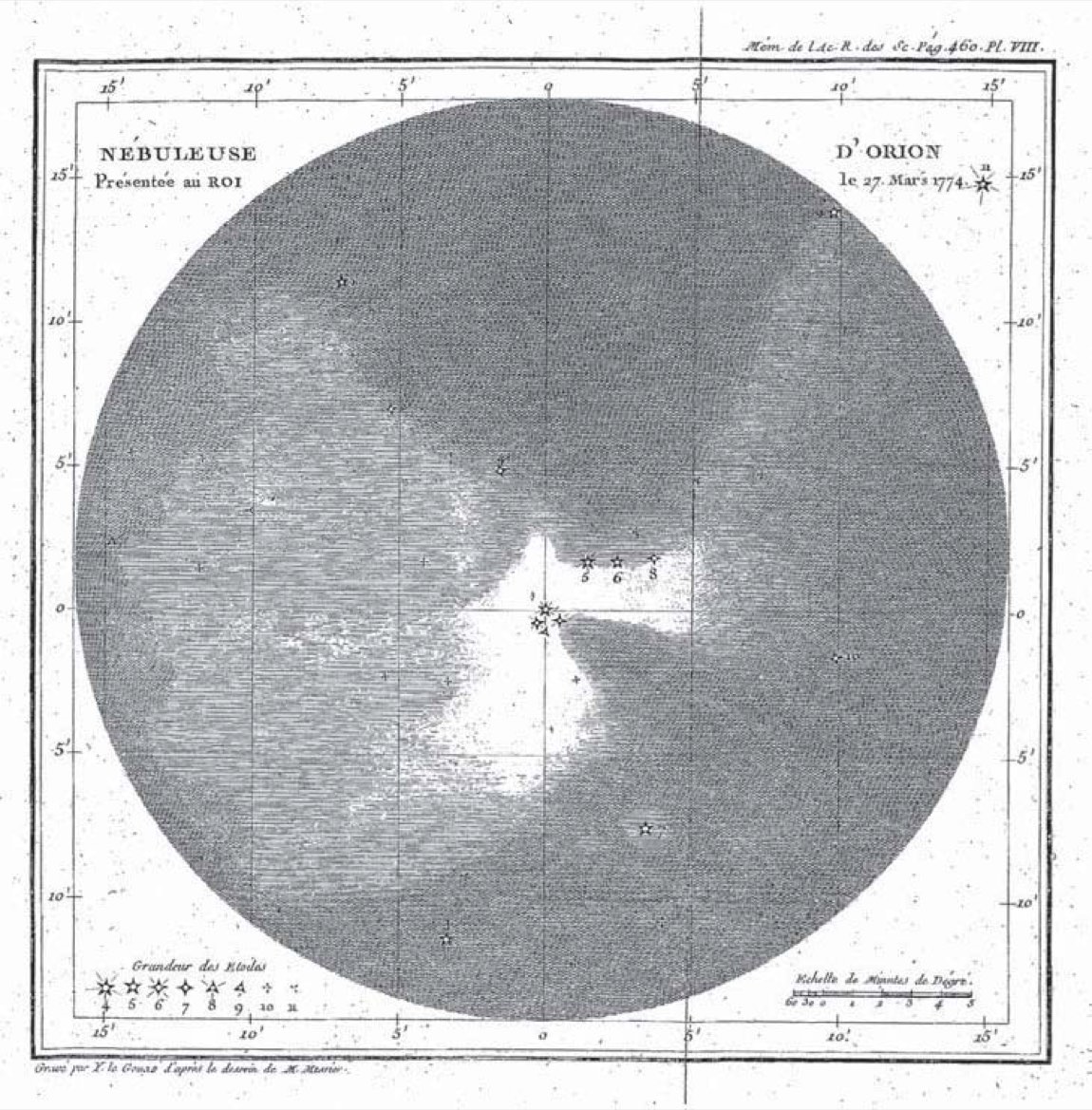
The Orion Nebula's modern identity as "M42" traces directly to Charles Messier, who observed it on March 4, 1769, also noting three of the four Trapezium stars. Messier compiled his catalog of deep-sky objects primarily to help comet hunters avoid being misled by fuzzy, comet-like patches of sky. He published the first edition in 1774, having completed the observations in 1771. Because the Orion Nebula was the 42nd entry, it became M42 — a label still in universal use. Decades later, John Herschel extended the nebula's observational history to the southern sky. Between 1834 and 1838 he conducted what amounted to the first southern-hemisphere survey of the nebula, working from a private 21-foot (6.4 m) telescope in what is today Cape Town, South Africa. That survey was part of his broader ambition to chart the entire visible sky. In 1931 Robert J. Trumpler gave the central star grouping its enduring name, "Trapezium Cluster," and used the stars' magnitudes and spectral types to derive a distance estimate of 1,800 light-years — three times larger than the commonly accepted figure of his day, and much closer to the modern measured value of 1,267.0 ± 5.4 light-years.
 ⤢
⤢
Could life exist here?
Systems here are newborn — planets still assembling, sterilized by impacts and radiation. Give it a few billion years.
Our labels: Confirmed · Strong Evidence · Estimated · Hypothesis · Theoretical · Speculative (see Methodology).
How would we get there?
1,344 years at light speed. New Horizons would need ~25 million years.
Weird & wonderful
- The nebula glows partly teal-green to the eye — a color from oxygen atoms so rarefied the transition was once thought impossible ('nebulium').
- JWST found pairs of planet-sized objects floating free in Orion — belonging to no star, and not yet explained.
- Everything you see there will evaporate within 100,000 years — nebulae are fireworks, not monuments.
- The Maya, the Egyptians, and Aboriginal Australians all told stories about Orion's sword region.