 Photograph · Haktarfone · CC BY-SA 3.0
Star · Deep guide
VY Canis Majoris
One of the largest stars known, this red hypergiant would swallow Saturn's orbit.
What is it?
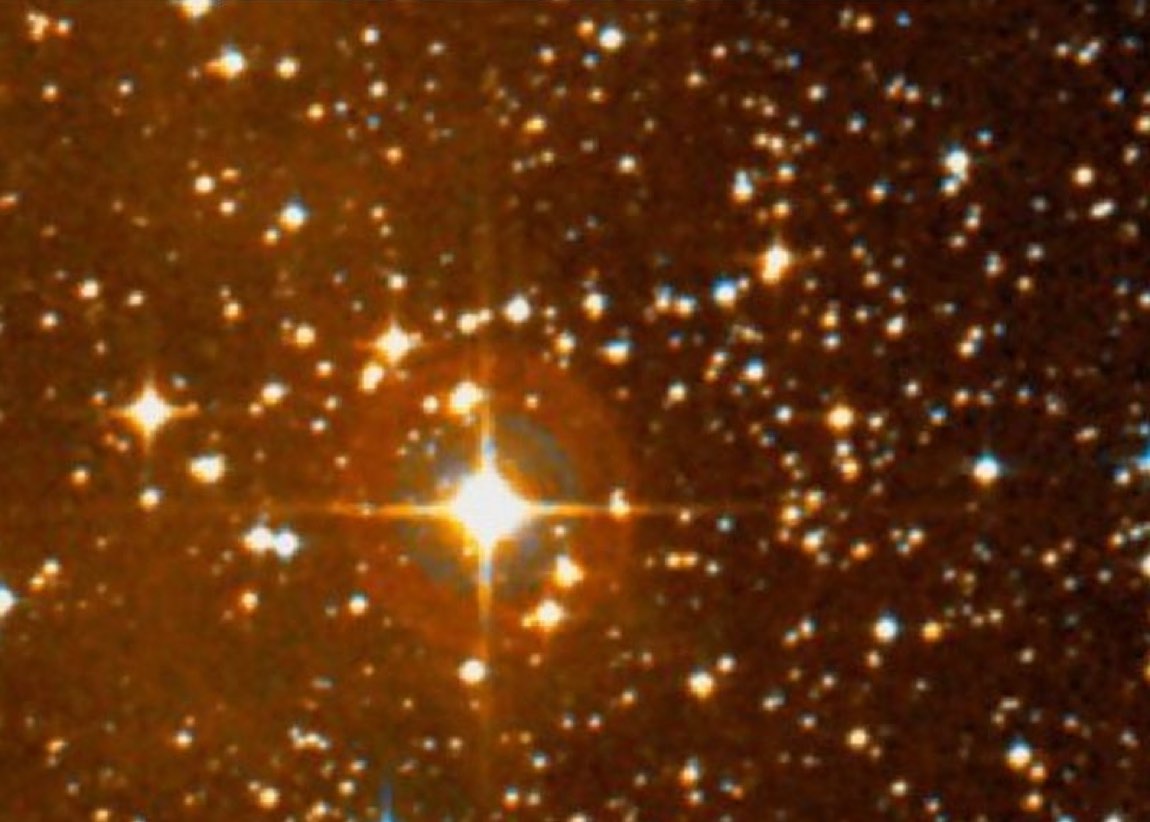
VY Canis Majoris is a red hypergiant roughly 3,900 light-years away and one of the largest stars ever measured — around 1,400 times the Sun's radius. Put it where the Sun is and its surface would reach past Jupiter, near Saturn's orbit. It is in the final, unstable act of a massive star's life, flinging off great clouds of gas and dust in eruptions astronomers can map directly.
Go deeper
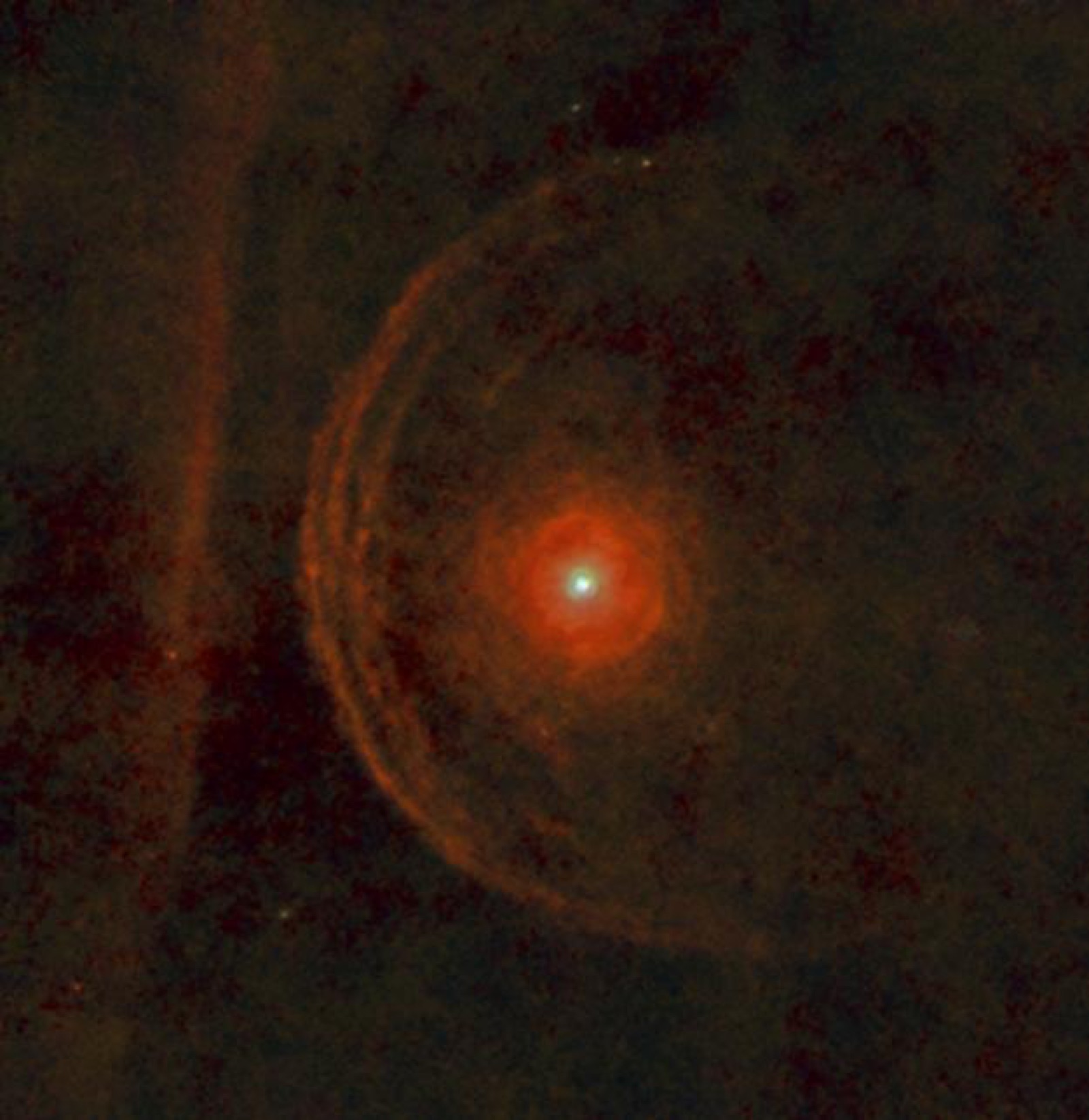
VY CMa loses mass at a rate ~30 times Earth's mass per year in episodic eruptions, wrapping itself in a reflection nebula of its own making — Hubble and ALMA resolve distinct outburst clumps like a slow-motion explosion. Its luminosity (~270,000 L☉) and size sit near the empirical Hayashi limit for how large a star can be. Radius estimates for all hypergiants carry big error bars — 'largest star' rankings shuffle with each study (UY Scuti, Stephenson 2-18, WOH G64 all contend). It will likely end as a supernova — possibly collapsing directly to a black hole.
01 How big can a star get?
Light itself would take about 6 hours just to cross VY Canis Majoris — compared with 4.6 seconds to cross the Sun. A jet airliner circling its equator at top speed would need roughly 1,100 years for one lap. And yet its outer layers are so puffed out they are thinner than the air on Everest: enormous, but mostly glowing near-vacuum.
02 A star tearing itself apart Deeper
Hypergiants sit at the edge of stability: radiation pressure nearly balances gravity, so the surface convulses and hurls off gas in continent-of-the-Sun-sized clumps. VY CMa's surrounding nebula is a fossil record of individual eruptions over the last ~1,200 years — we are watching, in real time, how the most massive stars dismantle themselves before exploding.
The deep dive
Researched for the Atlas from Wikipedia — VY Canis Majoris (27,025 characters read) · updated Sep 20, 2026
03 First recorded and how its name was born
The earliest known record of VY Canis Majoris appears in a star catalogue compiled by the French astronomer Jérôme Lalande in 1801, which logged it as a 7th-magnitude object — faint but visible in principle. Through the 19th century, observers watching through modest telescopes noticed what looked like at least six separate companion stars clustered around it. We now know those were not companions at all, but bright zones in the surrounding nebula; high-resolution imaging in 1998 all but ruled out any true stellar companion. The star's variability was formally noted in 1931, when a German catalogue listed it as a long-period variable with a photographic magnitude ranging from 9.5 to 11.5. It received its official variable-star designation — the letters VY in front of the constellation name — in 1939, making it the 43rd variable star catalogued within Canis Major. Since 1847, every observer who described its colour used the word crimson, and the star's light as seen from Earth appears to have dimmed steadily since around 1850, possibly because denser material in its own surrounding envelope has drifted into the line of sight.
04 Pinning down the distance — not so simple Deeper
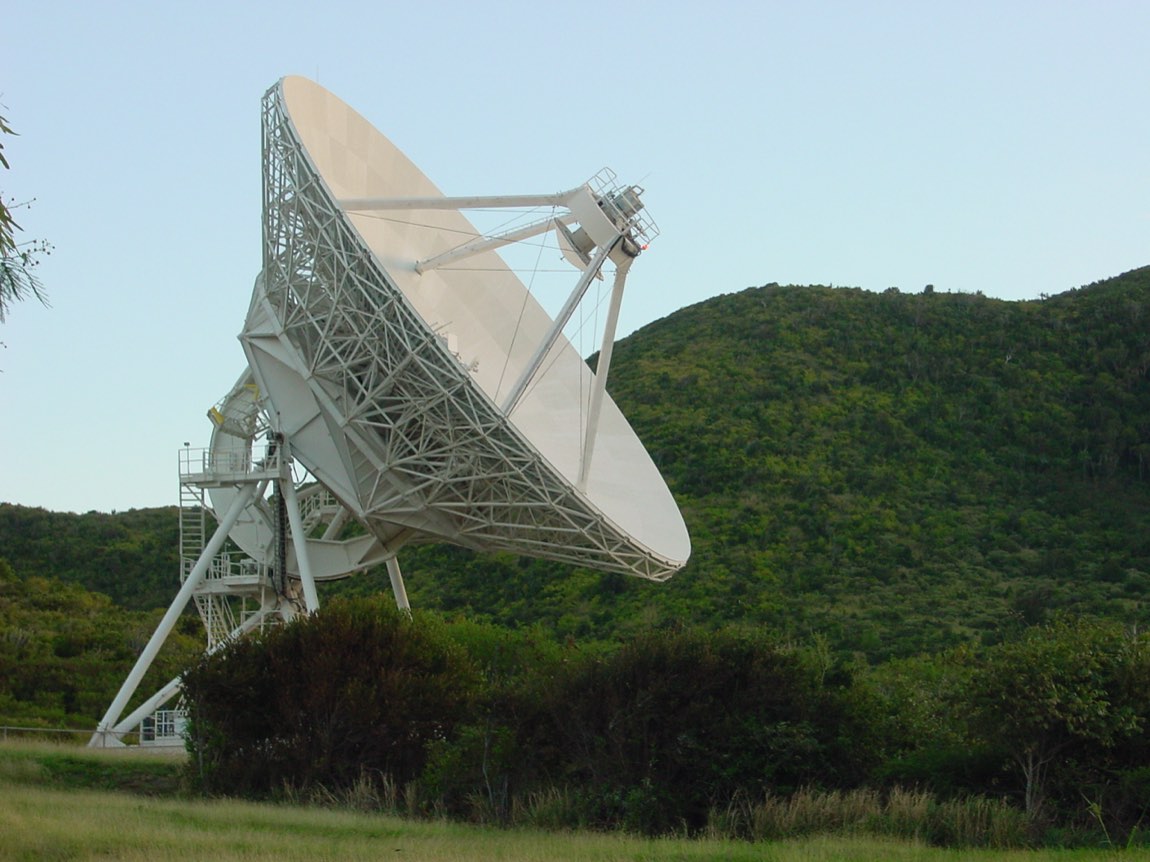
Measuring how far away VY Canis Majoris sits has been surprisingly contentious. The classic method — stellar parallax — is almost useless here: the star is so distant and its circumstellar envelope so extended that the Hipparcos satellite's 1997 catalogue returned a parallax of 1.78±3.54 milliarcseconds, an error margin nearly twice the measurement itself, and Gaia DR2 produced a nonsensical negative parallax of −5.92±0.83 mas. The breakthrough came from radio astronomy. In 2008, the Japanese VERA interferometer measured the parallax of the star's water-maser emission at 0.88±0.08 mas, placing the star at 1.14 kiloparsecs — roughly 3,720 light-years. An independent 2012 campaign using the Very Long Baseline Array and the star's silicon-monoxide masers gave 0.83±0.08 mas, corresponding to about 3,910 light-years. Both radio results converge on a distance near 1.2 kiloparsecs, or about 3,900 light-years, and this value is now the community's preferred figure. The association with the molecular cloud Sh 2-310 and the nearby young open cluster NGC 2362, whose velocity vectors closely match the star's own, lend strong independent support.
05 A spectrum that defies easy classification Deeper
The light from VY Canis Majoris presents spectroscopists with a puzzle that the standard classification system was simply not designed to handle. Its spectrum is dominated by titanium-oxide bands that suggest spectral class M5, yet vanadium-oxide features push the classification as late as M7 — a temperature extreme highly unusual for any supergiant. Meanwhile, its hydrogen lines show P Cygni profiles, a feature normally associated with luminous blue variables, not red supergiants. Neutral sodium and calcium appear in emission, which is also peculiar. Luminosity class estimates range all the way from bright giant (class II) to extreme hypergiant (class Ia+), depending on which part of the spectrum is examined. A 2006 paper derived a spectral class as early as M2.5, while the 2011 interferometric study settled on M4, corresponding to an effective temperature of 3,490±90 K. Authors repeatedly note that the present spectral classification system is frankly inadequate for a star this complex, and that key spectral features change over time, making any single label only a snapshot rather than a settled identity.
06 Brightness that swings over nearly three years
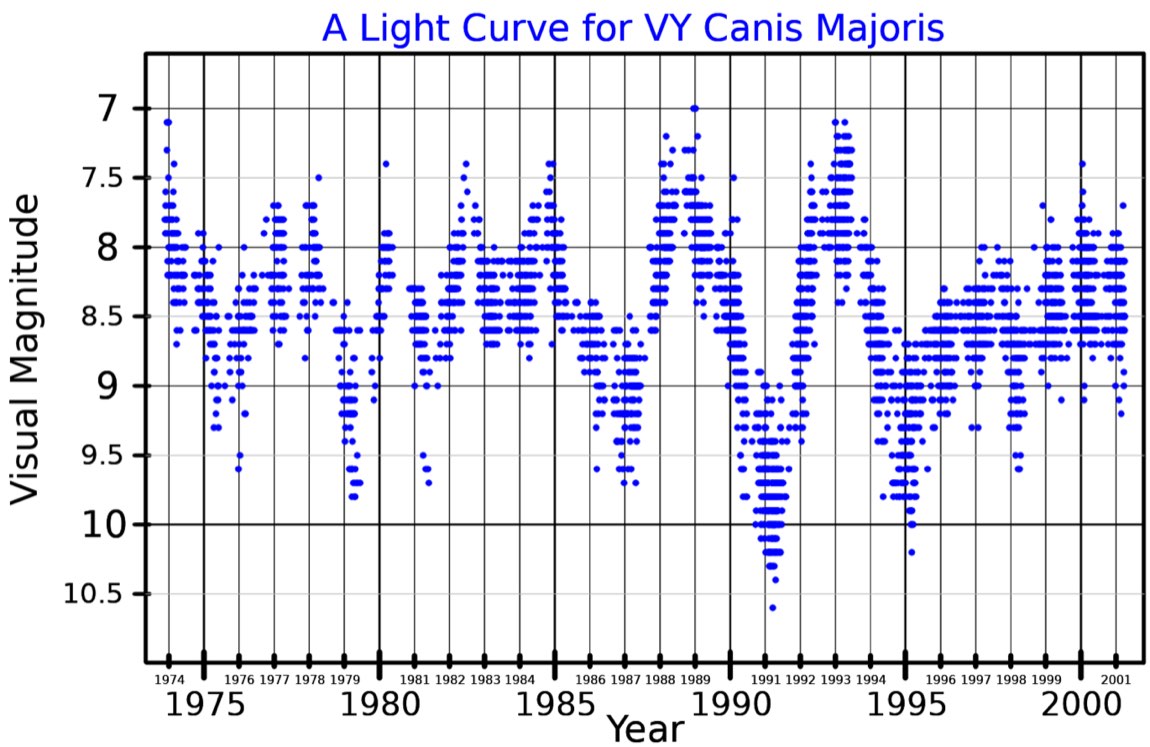
VY Canis Majoris is not a steady beacon. Its apparent visual magnitude swings from a minimum of 9.6 — too faint to see without a telescope — up to a maximum of 6.5, which is right at the edge of naked-eye visibility, though the star is still heavily veiled by its own dusty envelope. The dominant pulsation period is estimated at 956 days, close to two and a half years. The General Catalogue of Variable Stars classifies it as a semiregular variable of subtype SRc, the cool supergiant category, while the American Association of Variable Star Observers treats it as a slow irregular variable of type LC, reflecting how far from clockwork its brightness swings actually are. Researchers have also extracted secondary periods of 1,600 and 2,200 days lurking in its light curve. This irregular pulsation is connected to the violent convective churning in the star's outer layers, which also drives the catastrophic mass loss that makes VY Canis Majoris so extreme. The star is sometimes treated as the prototype for a whole class of heavily mass-losing OH/IR supergiants distinct from the more common asymptotic giant branch stars.
07 A radio lighthouse: masers and molecules Deeper
One of the most scientifically productive things about VY Canis Majoris is the extraordinary variety of microwave and radio signals beaming from its envelope. The star produces strong maser emission in hydroxyl (OH) at 1,612 MHz, water (H₂O) at 22,235.08 MHz, and silicon monoxide (SiO) at 43,122 MHz — a combination that is the hallmark of a class of objects called OH/IR stars, where intense infrared radiation from the star pumps molecules in the surrounding shell into laser-like emission at radio wavelengths. VY CMa was among the first radio masers ever discovered. Beyond masers, the envelope is a chemist's treasure chest: molecules including hydrogen cyanide (HCN), sodium chloride (NaCl), phosphorus nitride (PN), carbon monoxide (CO), methanol (CH₃OH), titanium oxide (TiO), and titanium dioxide (TiO₂) have all been detected there, and in total 25 molecules have been identified in its ejecta. The 2008 distance measurement exploited the precision of the water-maser emission using long-baseline radio interferometry, showing that masers are not only chemically interesting but also serve as a precision ruler for some of the galaxy's most extreme stars.
 ⤢
⤢
08 Anatomy of the dusty nebula around it
Surrounding VY Canis Majoris is an extensive, asymmetric red reflection nebula built entirely from material the star has thrown off. Its total ejected mass is estimated at 0.2 to 0.4 solar masses, and the dust in the nebula glows at around 800 K. The nebula's inner shell is only 0.12 arcseconds across — equivalent to roughly 140 AU at the star's distance — while the outer shell stretches to 10 arcseconds, or about 12,000 AU (0.19 light-years). The gas-to-dust ratio works out to roughly 500, about five times higher than is typical for red supergiants, suggesting an unusually dust-rich outflow. The nebula is bright enough that it was discovered in 1917 using just an 18 cm telescope during a clear dark night, and its bright knots were mistaken for companion stars throughout the 19th century. Detailed Hubble Space Telescope imaging later revealed filaments and arcs shaped by past eruptions. Researchers noticed a structural resemblance to the nebula around IRC +10420, a star thought to have already evolved past the red supergiant stage, which has led to proposals that VY Canis Majoris itself may eventually evolve to higher temperatures.
09 Violent outbursts carved in the nebula
The complex nebula around VY Canis Majoris is not a smooth, symmetrical shell but a record of catastrophic episodes. Six distinct outflows or ejecta have been identified from an active period spanning roughly the last 25 years, though the broader active phase appears to have begun about 1,200 years ago. Mass-loss events have been traced back to approximately 70, 120, 200, and 250 years ago. One clump shed between 1985 and 1995 is the source of the star's hydroxyl maser emission. The jets associated with these outbursts move away from the star at different speeds and in randomly oriented directions, suggesting that each episode originates from a different explosive region of the photosphere — more like coronal mass ejections from the Sun, but on a scale that dwarfs anything in our solar system. The total mass shed during the four main observed knots and clumps exceeds 0.05 solar masses, implying an effective mass-loss rate of at least 10⁻³ solar masses per year within a 30-year window. This episodic, directionally chaotic mass loss is believed to be driven by unusually strong convection in the star's outer layers, probably interacting with magnetic fields.
10 Where VY CMa sits in the stellar life cycle
Despite looking ancient in its bloated, crimson state, VY Canis Majoris is less than 10 million years old — a youngster by most cosmic standards. It almost certainly began its life as a hot, dense O9-type main sequence star with a radius of only about 5 solar radii. High mass accelerated its evolution dramatically, and the star has already begun fusing helium into carbon on a large scale. It has spent or will spend somewhere between 100,000 and 500,000 years in the red hypergiant phase, meaning it most likely left its main sequence life more than a million years ago. The star's interior, per evolutionary models assuming it is rotating, probably started with an initial mass of 25±10 solar masses and has since shed material down to around 15 solar masses, with an age of approximately 8.2 million years. A non-rotating model pushes the initial mass to about 32 solar masses, currently reduced to 19 solar masses. The star occupies the upper-right corner of the Hertzsprung–Russell diagram — high luminosity, low temperature — in a region where stars are short-lived, violently unstable, and shedding mass at rates that will determine their ultimate fate.
11 What kind of explosion might it become? Deeper
The eventual death of VY Canis Majoris is genuinely uncertain, and the answer matters for understanding how the most massive stars end their lives. Because its initial mass almost certainly exceeded the 18-solar-mass upper limit for progenitors of ordinary Type IIP supernovae, a straightforward core-collapse explosion is only one of several possibilities. Its structural resemblance to the post-red-supergiant star IRC +10420 raises the possibility that VY CMa will first evolve blueward on the HR diagram, passing through a yellow hypergiant phase, then a luminous blue variable stage, and finally a Wolf–Rayet star phase before exploding. Alternatively, a 2022 study linked stars with mass-loss rates exceeding 10⁻⁴ solar masses per year — including VY CMa — to superluminous supernovae, noting that its dense circumstellar shell could power an extraordinarily bright Type IIn supernova. An even more radical 2016 scenario proposed that VY CMa could skip the supernova entirely and directly collapse to a black hole, analogous to the candidate failed supernova N6946-BH1. If it does explode, the remnant is widely expected to be a black hole rather than a neutron star, and the blast wave hitting the surrounding envelope could sustain strong emission for many years afterward.
12 Membership in a busy stellar neighborhood
VY Canis Majoris does not float in isolation. It is embedded in the large molecular cloud Sh 2-310, a star-forming HII region spanning 480 arcminutes — or 681 light-years — across, located on the outer edge of the Milky Way's Orion Arm. The star is projected onto the very tip of the cloud's bright rim, and velocity measurements show the cloud's motion matches the star's so closely that astronomers consider their physical association essentially certain. Sh 2-310 also harbors three dark nebulae — LDN 1660, LDN 1664, and LDN 1667 — and several other massive stars: Tau Canis Majoris, the brightest member of the nearby young open cluster NGC 2362; UW Canis Majoris; and HD 58011. VY Canis Majoris is thought to be a probable source of ionizing radiation within the cloud alongside those companions. NGC 2362, whose estimated distance of 1.5±0.5 kiloparsecs is consistent with VY CMa's own distance, is the cluster the star is thought to belong to — placing this hypergiant in a region of recent, active star formation where its neighbors are themselves young, hot, and energetic.
13 An unusual chemistry with 25 molecules Deeper
The ejecta of VY Canis Majoris are chemically unlike those of most other red supergiants. Astronomers have identified 25 different molecules within its outflowing material, 21 of which are shared with the similar extreme hypergiant NML Cygni. The suite includes relatively exotic species: sodium chloride, phosphorus nitride, titanium dioxide, and methanol, among others. But what makes the chemistry particularly intriguing is the ratio of carbon-12 to carbon-13 found in different structural features of the ejecta. These ratios are significantly higher than those measured in typical oxygen-rich red giants and supergiants, and researchers interpret this as possible evidence of additional dredge-up events — episodes where nuclear-processed material from deeper in the star is stirred up into the outer layers, likely connected to the star's violent surface activity. Different arcs, clumps, and outflows show different ratios, and mapping those differences against the expansion ages of the structures could in principle reconstruct a timeline of the star's deep interior history. The star also carries a gas-to-dust ratio of about 500 in its nebula, roughly five times the typical red supergiant value, underlining how unusual its mass-loss chemistry really is.
14 Its enormous infrared glow across the galaxy
Most of VY Canis Majoris's energy does not escape as visible light — it emerges as infrared radiation. The peak of its emission falls at wavelengths of 5 to 10 micrometres, pushed there by the surrounding dusty envelope, which absorbs the star's optical light and re-radiates it at lower energies. This makes VY CMa one of the brightest objects in the local part of the galaxy, the Orion Arm, at wavelengths between 5 and 20 micrometres. In 2006, researchers integrated the total flux across the entire nebula to account for this reprocessing and derived a luminosity of 430,000 times the Sun's. More recent work using photometry at more wavelengths arrived at a lower figure of 178,000 solar luminosities, with the 2011 study settling on 270,000±40,000 solar luminosities. Despite this immense output, so much of the star's visible light is absorbed by its circumstellar envelope that VY CMa requires a telescope to observe. Strip away the envelope and the star would be a naked-eye object. The dust shell responsible for this infrared dominance has an inner boundary around 140 AU from the star and outer material extending to about 12,000 AU, a testament to centuries of violent outflow.
 ⤢
⤢
Could life exist here?
A few million years of violent life leaves no room for biology.
Our labels: Confirmed · Strong Evidence · Estimated · Hypothesis · Theoretical · Speculative (see Methodology).
How would we get there?
3,900 years at light speed — VY CMa is a laboratory in the sky, not a destination.
Weird & wonderful
- About 3 billion Suns would fit inside VY Canis Majoris by volume.
- Its 'surface' is thinner than mountain-top air on Earth.
- It has shed dozens of Suns' worth of material — and we can see the discarded pieces.