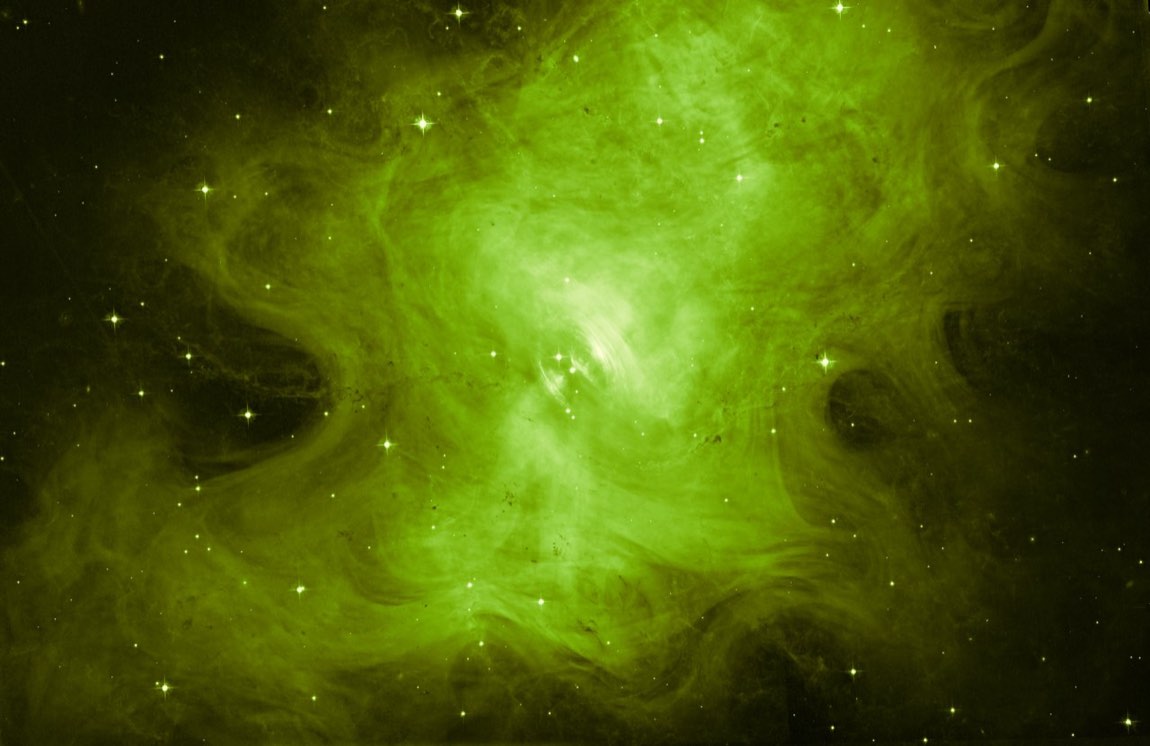
 Photograph · NASA/ESA/JPL/Arizona State Univ.
Nebula · Deep guide
The Crab Nebula
Also called: M1
The shredded corpse of a star seen exploding in 1054, with a lighthouse heart spinning 30 times a second.
What is it?
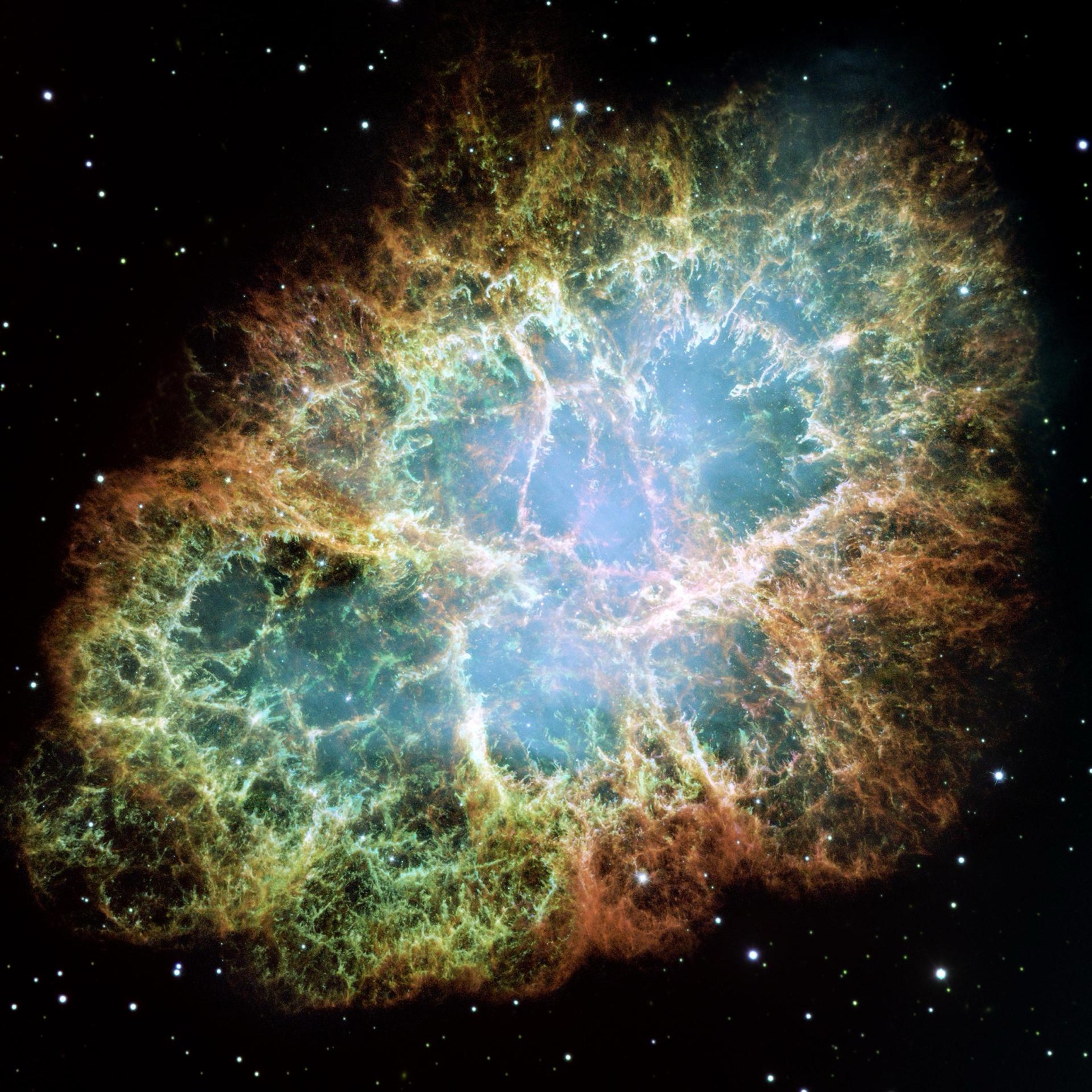
The Crab Nebula is the expanding wreckage of a supernova that Chinese and Japanese astronomers watched blaze in the daytime sky in July 1054. Nearly a thousand years later, the debris spans 11 light-years and is still flying outward at 1,500 km/s. At its heart spins the Crab Pulsar — a city-sized neutron star rotating 30 times per second, sweeping lighthouse beams of radiation across the galaxy.
Go deeper
M1 is astronomy's Rosetta stone: the first supernova remnant tied to a recorded explosion, the first pulsar associated with one (1968, clinching that supernovae birth neutron stars), and for decades the sky's standard candle in X-rays (fluxes measured in 'crabs'). The pulsar's braking spin powers the nebula's eerie blue synchrotron glow — a wind of electron–positron pairs at near light speed. JWST's 2023–24 imaging mapped its dust and filament chemistry, refining the progenitor as an ~8–10 M☉ electron-capture-supernova candidate.
01 The guest star
Song-dynasty astronomers logged a 'guest star' beside the Moon's horn in 1054 — bright enough to see at noon for over three weeks, and at night for two years. Modern telescopes pointed at their coordinates found the Crab, still expanding on schedule. It is one of history's most satisfying handshakes between ancient records and modern physics.
02 A teaspoon of pulsar Deeper
The Crab's neutron star packs 1.4 solar masses into ~20 km: a teaspoon of its material outweighs a mountain range. Its magnetic field, a trillion times Earth's, funnels radiation into beams; each 33-millisecond flash reaching your radio is the metronome of a star's corpse. Pulsar timing is so stable that arrays of them now serve as a galaxy-sized gravitational-wave detector.
The deep dive
Researched for the Atlas from Wikipedia — Crab Nebula (20,581 characters read) · updated Sep 20, 2026
03 How the nebula got its unlikely name
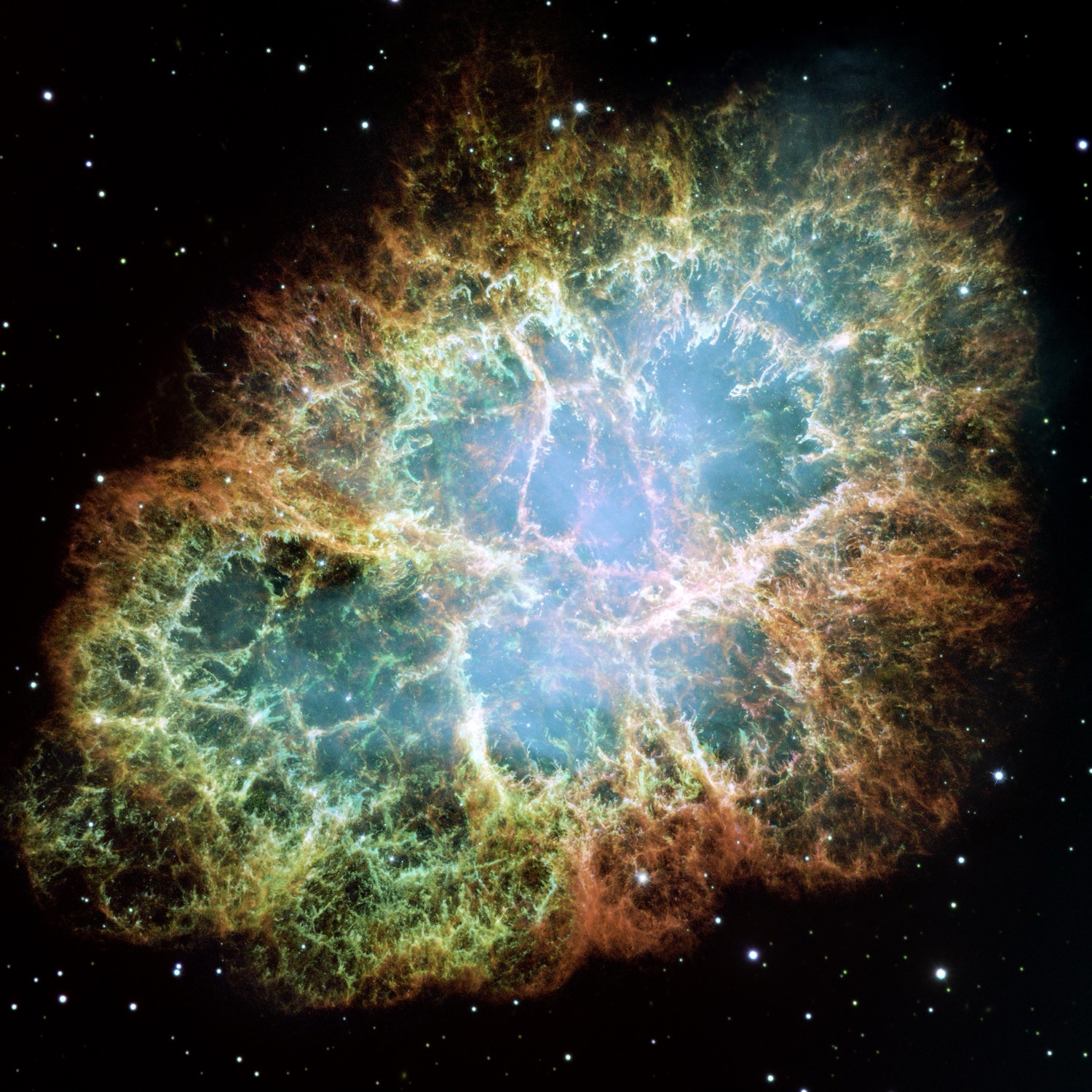
The name "Crab Nebula" has a surprisingly shaky origin. In 1842 or 1843, William Parsons, the 3rd Earl of Rosse, trained a 36-inch (91 cm) telescope on the object at his estate, Birr Castle, and sketched what he saw. His drawing showed the nebula with protruding features that reminded him of a crab's legs. The name stuck — but only because of a certain amount of inertia. When Parsons returned to the nebula in 1848 with a much more powerful 72-inch (1.8 m) telescope, he could not actually confirm the resemblance he had originally described. By then, however, the name had already entered the astronomical vocabulary and no one replaced it. The catalog labels tell a different story of the object's discovery history: M1 because Charles Messier listed it first in his famous catalog of comet-like objects in 1758, NGC 1952 from the New General Catalogue, and Taurus A because it is the brightest radio source in the constellation Taurus. Messier himself stumbled onto it while searching for Halley's Comet, initially mistaking the fixed fuzzy patch for the approaching comet before realizing it never moved.
 ⤢
⤢
04 The catalogue that began with a mistake
Charles Messier's famous catalog of nebulae and star clusters — one of the most widely used reference lists in amateur astronomy — owes its existence entirely to a moment of confusion involving the Crab Nebula. In 1758, Messier was hunting for Halley's Comet, whose return had been predicted by Alexis Clairaut, working alongside Jérôme Lalande and Nicole-Reine Lepaute. Their calculations refined Edmund Halley's original work by accounting for gravitational perturbations from planets such as Jupiter, and they concluded the comet would appear in the constellation Taurus. Messier found a fuzzy object there and initially believed it was his target. After watching it carefully, he noticed it did not drift against the background stars the way a comet should, and he realized his error. That frustrating false alarm gave him a practical idea: a list of fixed, cloud-like objects that could trap unwary comet-hunters. The result was the Messier Catalogue. The Crab Nebula sits at position M1 — the original mistake that launched an enduring legacy in observational astronomy.
05 Inside the glowing shell: what it is made of Deeper
The Crab Nebula has two visually distinct zones that are physically quite different. The outer region consists of a network of tangled filaments that are the tattered remains of the progenitor star's atmosphere, composed largely of ionised helium and hydrogen, with smaller amounts of carbon, oxygen, nitrogen, iron, neon, and sulfur. These filaments reach temperatures of between 11,000 and 18,000 Kelvin and have particle densities of about 1,300 particles per cubic centimeter. Embedded within them is a peculiar east–west band called the helium-rich torus, which crosses through the pulsar region and accounts for roughly 25 percent of the visible ejecta; calculations suggest that about 95 percent of the torus is helium, though no convincing explanation for why this structure exists has yet been put forward. The inner region is visually and physically different: a diffuse blue glow that Iosif Shklovsky identified in 1953 as synchrotron radiation — light emitted by electrons spiraling through a magnetic field at speeds up to half the speed of light. Three years after his proposal, observations confirmed it. In the 1960s, scientists established that the magnetic field responsible for those curving electron paths originates with the neutron star at the nebula's center.
06 The shape hiding inside the cloud Deeper
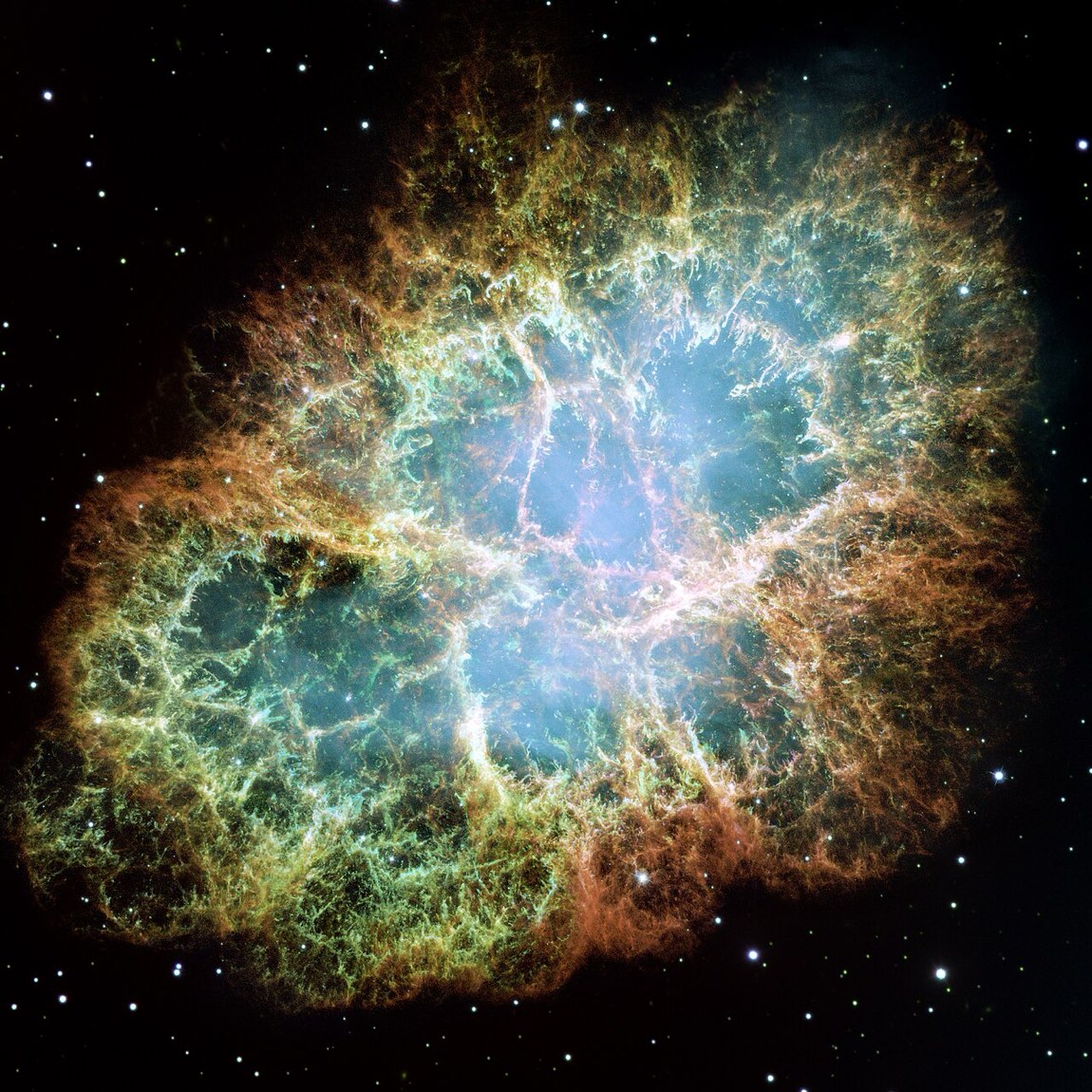
Seen in visible light, the Crab Nebula presents itself as a broadly oval mass of filaments roughly 6 arcminutes long and 4 arcminutes wide — for comparison, the full Moon spans 30 arcminutes, so the nebula fits comfortably inside a small fraction of the lunar disk. But that two-dimensional silhouette does not resolve what the nebula actually looks like in three dimensions, and here astronomers face a genuine fork in the road. If the nebula is an oblate spheroid — flattened like a pumpkin — the geometry places it at approximately 1,380 parsecs, or about 4,500 light-years away. If it is instead a prolate spheroid — elongated like an egg — the same angular measurements imply a distance of about 2,020 parsecs, or 6,600 light-years. The current consensus distance of 2.0 ± 0.5 kiloparsecs, reached after comparing angular expansion rates with spectroscopically measured expansion velocities, sits between those two extremes. Along its longest visible dimension the nebula measures about 4.1 ± 1 parsecs, or 13 ± 3 light-years, across. The distance question remains genuinely open: every method used to estimate it carries its own uncertainties, and as of 2008 the error bar was still ± 1,600 light-years.
 ⤢
⤢
07 A dynamic inner zone that changes in days
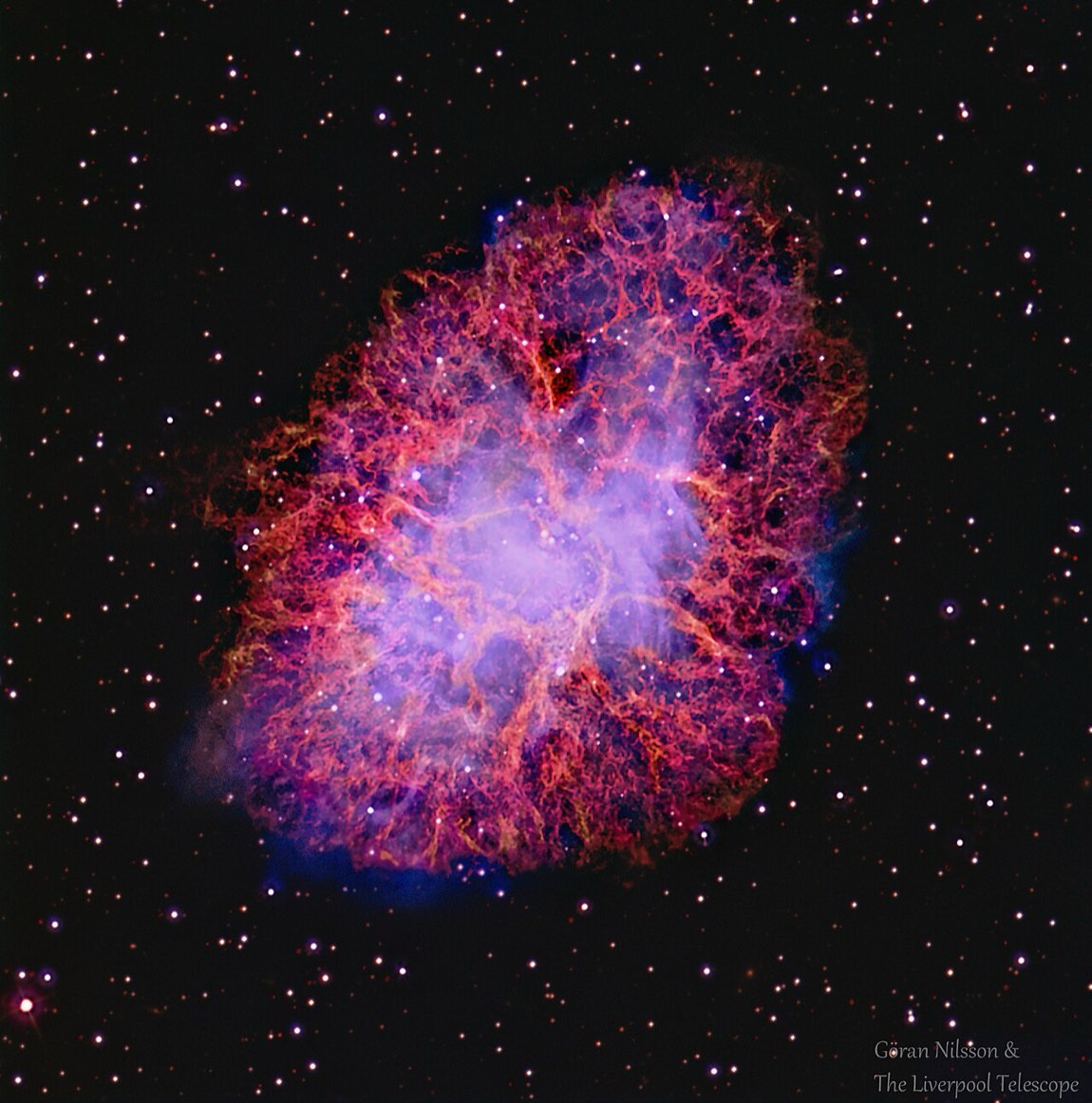
Most nebulae change so slowly that a human lifetime is not nearly long enough to notice any difference. The Crab Nebula's inner region is a striking exception. Right around the pulsar, structures shift and evolve on timescales of just a few days — something almost unheard of in deep-sky objects. The most active feature is a shock front that forms where the pulsar's equatorial wind collides with the main body of the surrounding nebula. This boundary is not a smooth surface; it appears as a series of wisp-like features that brighten, steepen, and then fade as they race outward from the pulsar. These wisps move at roughly 50 percent the speed of light within the inner 2 light-years of the nebula. Farther out, the speed drops and the wisps can merge into one another. The energy driving all of this activity comes directly from the pulsar slowing its rotation. The total luminosity powered by the pulsar's spin-down is about 148,000 times greater than that of the Sun. This makes the Crab Nebula one of the very few places in the universe where astronomers can watch, in near real time, the mechanics of a pulsar feeding energy into its surrounding cloud.
08 How the Sun's corona was mapped through it
Every June, the Sun's corona — the wispy, superheated outer atmosphere that reaches far into space — drifts directly in front of the Crab Nebula as seen from Earth. The Sun itself never crosses the nebula, but its corona does, and that alignment turned out to be scientifically priceless. Radio waves traveling from the Crab Nebula must pass through the corona on their way to us, and the corona's gas subtly distorts and scatters those waves. By comparing what the Crab's radio signal looks like before and during the solar transit, astronomers in the 1950s and 1960s were able to map the corona in detail for the first time. Two key findings emerged: the corona extends far greater distances from the Sun than had previously been believed, and it contains substantial variations in density rather than being smooth and uniform. The Crab Nebula functioned, in effect, as a cosmic backlight whose well-characterized radio output let scientists read the properties of material billions of times closer to home.
09 When Saturn became a scientific instrument
An extremely rare celestial lineup on 4 January 2003 gave astronomers an unexpected laboratory. Saturn passed directly in front of the Crab Nebula — the first such transit since 31 December 1295, and one that will not repeat until 5 August 2267. Researchers trained the Chandra X-ray Observatory on Saturn's moon Titan as it crossed the nebula and measured how Titan blocked the X-rays streaming from the Crab. What they found was telling: Titan's X-ray shadow was noticeably larger than Titan's solid surface, because the moon's thick atmosphere was absorbing X-rays before they could pass through. From the size of that extra shadow, scientists calculated that Titan's atmosphere extends to a thickness of 880 km (550 mi). The planet Saturn itself could not be observed during the event because the Chandra spacecraft was passing through Earth's Van Allen radiation belts at the critical moment. The transit of the Crab Nebula by a moon of another planet, used to measure that moon's atmospheric depth, stands as one of the more inventive applications of the nebula as a scientific tool.
 ⤢
⤢
10 The missing mass problem no one has solved Deeper
One of the most persistent puzzles in Crab Nebula research is a straightforward arithmetic problem that does not add up. Theoretical models suggest the progenitor star had a mass of between 9 and 11 solar masses. Yet when astronomers total the mass of everything left behind — the nebula's filaments plus the pulsar at its center — the sum falls well short of that figure. The nebula's ejecta mass is estimated at 4.6 ± 1.8 solar masses, the neutron star itself at between 1.4 and 2 solar masses, giving a combined range well below the predicted starting point. The leading explanation is that a large fraction of the progenitor's mass was carried away before the explosion in a fast stellar wind, a process regularly observed in massive Wolf–Rayet stars. If that happened, the expelled material should have formed a detectable shell surrounding the nebula. Astronomers have searched for that shell across multiple wavelengths. None has been found. Whether the shell exists but lies below detection thresholds, or whether the mass loss happened in some other way, remains unresolved. The Crab Nebula is studied intensely enough that this gap is unlikely to be ignored — but after decades of effort, the missing mass has not reappeared.
11 Why this pulsar proved what pulsars really are Deeper
When pulsars were first detected in 1967, they were such a mystery that the team who found the first one seriously considered whether the signals might be transmissions from an extraterrestrial civilization. Two competing models quickly emerged: were pulsars rapidly rotating neutron stars, or were they oscillating white dwarfs? The discovery of the Crab Pulsar resolved the debate. On 10 November 1968, Richard V. E. Lovelace and collaborators measured the pulsar's precise period of 33 milliseconds using the Arecibo Radio Observatory. Crucially, the Crab Pulsar's known age — fixed almost to the day by the 1054 supernova record — allowed physicists to check predicted properties like characteristic age and spin-down luminosity directly against observation. White dwarfs spinning 30 times per second would fly apart; only a neutron star could survive such a rotation. Shortly after, David Richards used Arecibo to show that the pulsar is spinning down, losing rotational energy — and Thomas Gold demonstrated that the rate of energy loss was exactly sufficient to power the synchrotron radiation of the surrounding nebula. No other historical supernova has produced a pulsar whose age is known with comparable certainty, making the Crab uniquely valuable for calibrating pulsar physics.
12 Record-breaking gamma rays above 100 TeV Deeper
The Crab Nebula holds a string of records at the extreme high-energy end of the electromagnetic spectrum that make it the benchmark source for very-high-energy astrophysics. At X-ray and gamma-ray energies above 30 keV, it is generally the brightest persistent gamma-ray source in the entire sky, with measured flux extending above 10 TeV — that is 10 trillion electron-volts, an energy scale far beyond anything achievable in any particle accelerator on Earth. The Whipple Observatory's 10-meter gamma-ray telescope first confirmed in 1989 that the Crab emits radiation above 100 GeV, opening the field of very-high-energy gamma-ray astronomy and eventually leading to the detection of many other VHE sources. Then in 2019, observations revealed gamma rays from the Crab exceeding 100 TeV, making it the first source ever identified at that energy threshold. The nebula's reliability and brightness across this range has made it the standard candle of high-energy astrophysics — when a new gamma-ray instrument is commissioned, the Crab Nebula is typically the first target used to verify the detector is working correctly.
 ⤢
⤢
13 Watching it in the sky yourself
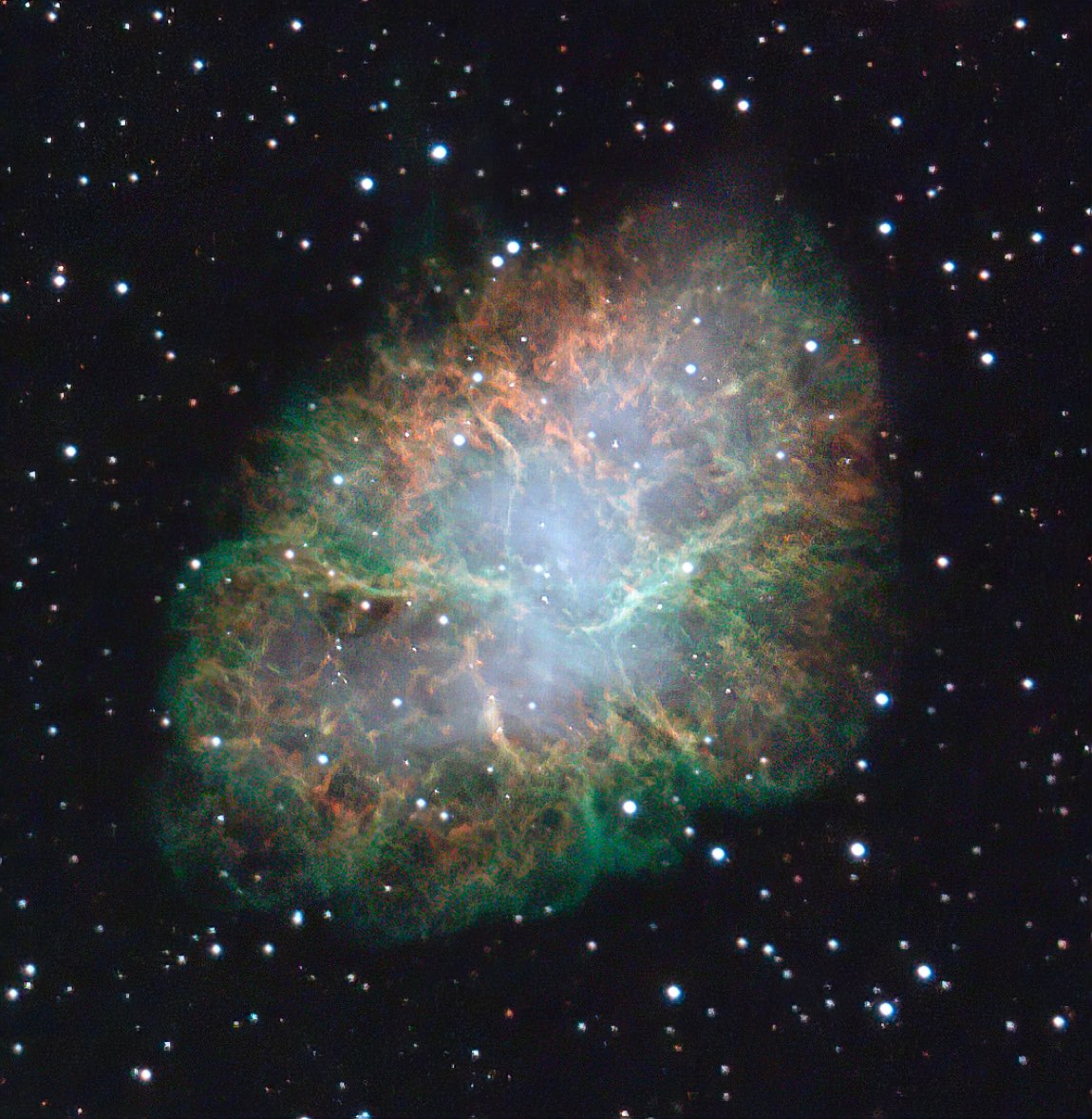
The Crab Nebula sits in the constellation Taurus and carries an apparent magnitude of 8.4 — roughly comparable to Saturn's moon Titan. That is too faint for the unaided eye under normal conditions, but a pair of binoculars will reveal it as a small, faint smudge under good dark-sky conditions. A modest backyard telescope brings out more detail, though the intricate filamentary structure seen in famous observatory images requires large apertures and long photographic exposures. In the sky, the nebula appears about 7 arcminutes across, which is roughly a quarter of the apparent diameter of the full Moon. Its position in the Perseus Arm of the Milky Way, at a distance of about 6,500 light-years, places it well within our own galaxy. Because the nebula lies only about 1.5 degrees from the ecliptic, the Moon passes in front of it occasionally, and very rarely a planet does too. Those transit events, while inconvenient for casual viewing, have historically been exploited by professional astronomers to produce high-resolution maps of the nebula's X-ray emission, using the Moon's sharp, precisely known edge as a moving aperture.
14 Finding records the world almost missed
The historical detective work connecting the Crab Nebula to the supernova of 1054 unfolded across many decades and several cultures. Chinese astronomers recorded the guest star on 4 July 1054, and Japanese observers documented it around the same time. For a long while, the Islamic astronomical tradition — known for its meticulous record-keeping — seemed to have no mention of the event at all, which historians found puzzling. That gap closed in 1978, when researchers found a reference in a 13th-century copy, made by Ibn Abi Usaibia, of a work written by Ibn Butlan, a Nestorian Christian physician who was living in Baghdad at the time of the explosion. A connection to Japanese records came earlier: in 1934, scholars linked the event to a 13th-century Japanese text called the Meigetsuki, which referenced a guest star appearing a few weeks before the Chinese record. Separately, Native American records and Arab stargazers also documented the brilliant new star. The supernova reached its peak brightness somewhere between apparent magnitude −7 and −4.5, brighter than Venus at its best (−4.2) and outshone only by the Moon among objects in the night sky. It remained visible to the naked eye for about two years.
 ⤢
⤢
Could life exist here?
A radiation-flooded blast zone.
Our labels: Confirmed · Strong Evidence · Estimated · Hypothesis · Theoretical · Speculative (see Methodology).
Weird & wonderful
- The Crab Pulsar has been slowing by a hundredth of a second per century — the energy loss lights the whole nebula.
- For decades X-ray astronomers literally measured brightness in units of 'millicrabs.'
- When the light of the 1054 explosion left, the debris that became the pulsar was already 5,500 years into its journey toward being seen.