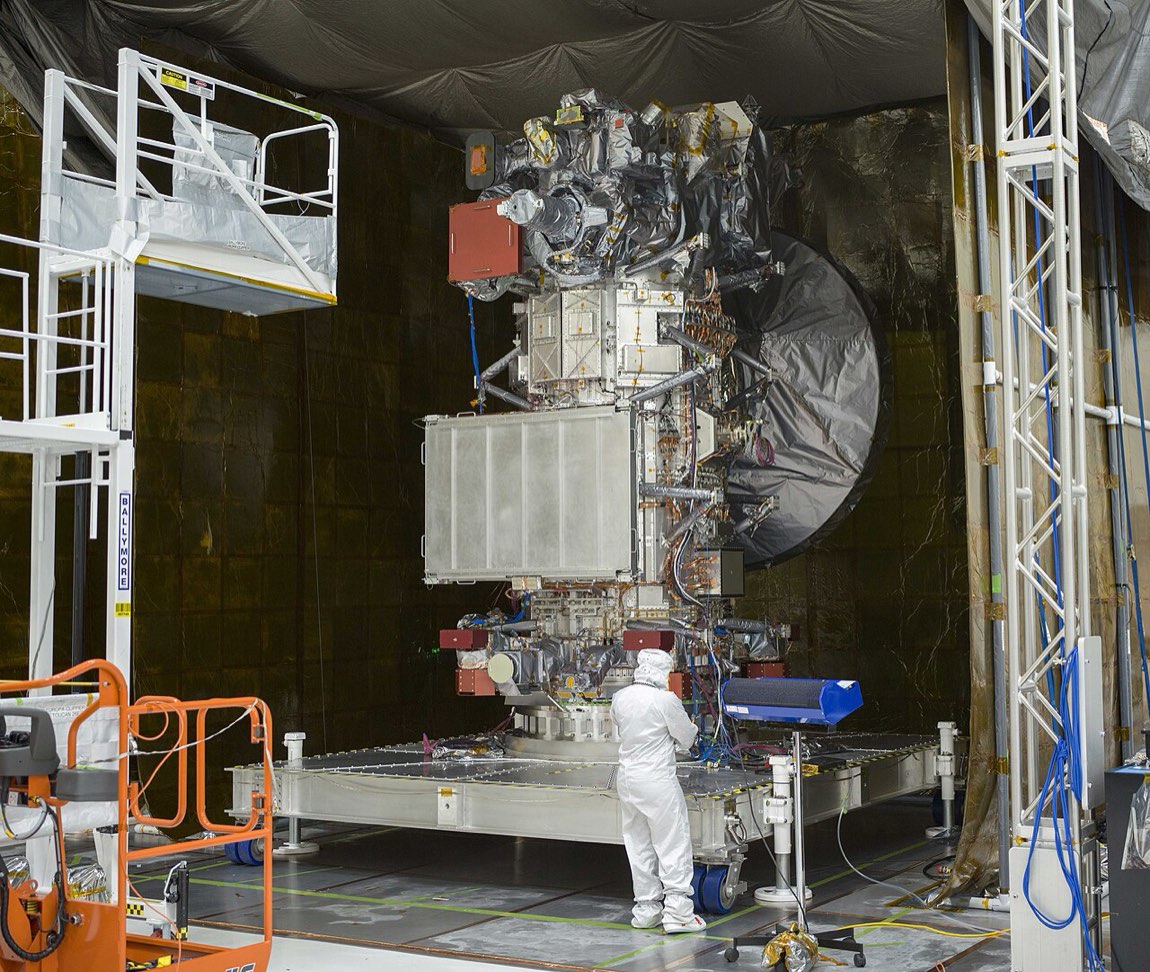
 Photograph · NASA/JPL-Caltech · Public domain
Spacecraft · Deep guide
Europa Clipper
The biggest planetary spacecraft NASA has ever launched, now en route to the ocean moon.
What is it?
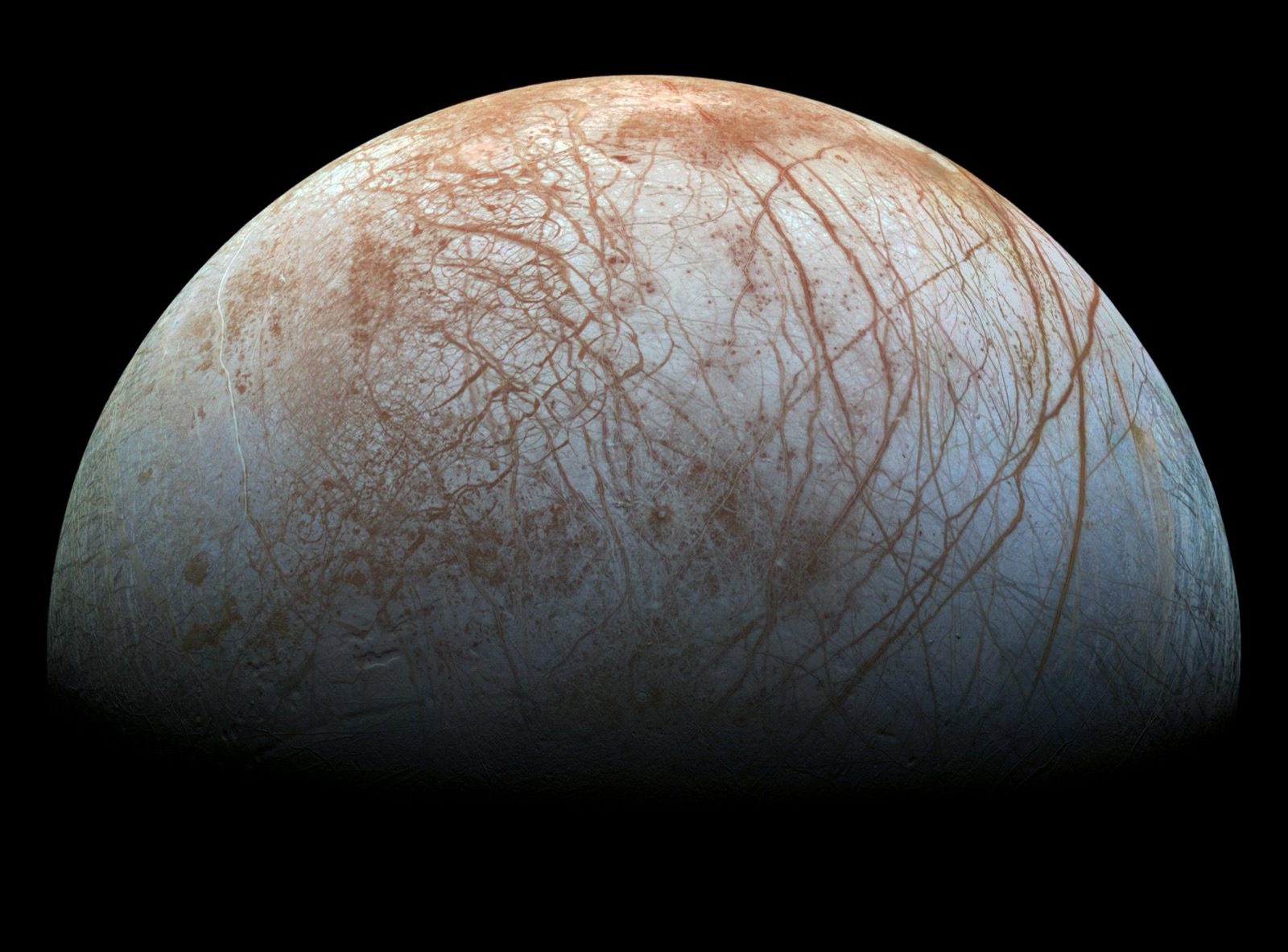
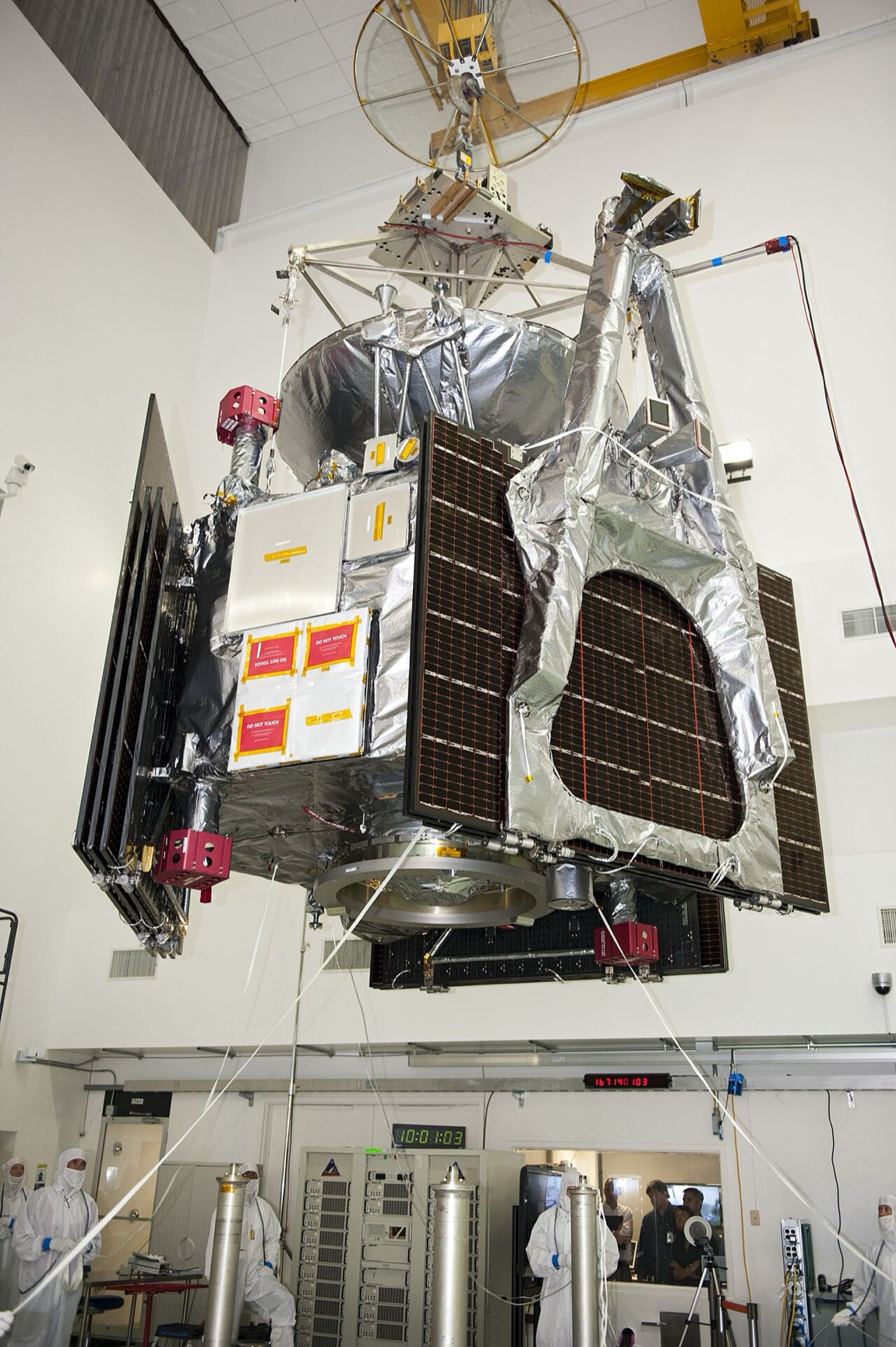
Europa Clipper launched on October 14, 2024 aboard a Falcon Heavy — NASA's largest planetary-mission spacecraft ever, with solar wings spanning a basketball court. Arriving at Jupiter in 2030, it will make about 50 close flybys of Europa, using ice-penetrating radar, cameras, and chemistry instruments to answer one question: can that buried ocean support life?
Go deeper
Clipper 'orbits' Jupiter, not Europa — flyby geometry limits radiation dose while its nine instruments build global coverage pass by pass: REASON radar sounds the shell for water pockets and ocean interface; MASPEX/SUDA sniff sputtered surface and any plume material; E-THEMIS maps warm fractures. Cruise path: Mars flyby (Feb 2025), Earth flyby (Dec 2026), arrival Apr 2030. It carries a vault like Juno's, plus a plate etched with 'water' in 103 languages and Ada Limón's poem 'In Praise of Mystery.'
01 Flybys instead of orbit — why? Deeper
Orbiting Europa means marinating permanently in Jupiter's worst radiation — a months-long mission at best. Clipper's ellipses dip into the hot zone for hours per flyby, then recover in cleaner space, stretching the mission to years while stitching flyby swaths into global maps. Same science, a tenth of the dose: orbital mechanics as radiation medicine.
The deep dive
Researched for the Atlas from Wikipedia — Europa Clipper (31,203 characters read) · updated Sep 20, 2026
02 A radiation vault keeping brains alive
Jupiter's magnetosphere is one of the most hostile radiation environments in the solar system, and Europa sits deep inside it. To keep the spacecraft's electronics functioning across a 3.5-year science mission, engineers designed a shielded vault with walls of 9.2-millimeter-thick aluminum alloy — roughly the thickness of a finger — enclosing the most sensitive components. On top of that physical barrier, the electronics are nested in the core of the spacecraft body itself, adding a second layer of passive shielding. Even so, the spacecraft is expected to absorb a total ionizing dose of 2.8 megarads, equivalent to 28 kilograys, over the course of its mission. That is an enormous cumulative punishment; for comparison, a dose of around 8 grays is lethal to a human being. The vault alone weighs 150 kilograms and is constructed from titanium, zinc, and aluminum. In mid-2024, re-testing revealed that certain transistor components were less radiation-hardened than originally believed, threatening the launch schedule, but intensive analysis concluded they would likely self-heal through a process called annealing.
03 Solar power at the edge of the inner system
Powering a spacecraft at Jupiter is a genuine engineering puzzle. Sunlight at Jupiter is only 4% as intense as it is at Earth's orbit, which means the enormous solar panels that would comfortably power a spacecraft near Earth are barely adequate so far out. Europa Clipper carries two panels, each with a surface area of 18 square meters — roughly the footprint of a large living room — and each produces only 150 watts continuously while pointed at the Sun near Jupiter, comparable to two old-fashioned incandescent light bulbs. The decision to go solar rather than nuclear was driven mainly by cost and practicality: the solar option was simply less expensive than using multi-mission radioisotope thermoelectric generators fueled with plutonium-238, even accounting for the extra mass of the panels. The Juno mission had already demonstrated that solar power could work in Jupiter orbit. During the brief periods when Europa Clipper passes through Europa's shadow, onboard batteries keep the instruments running. Radiation gradually degrades the panels as the mission progresses, which is one more reason the team designed the flyby strategy rather than a long residency close to the moon.
04 Nine instruments, one shared goal Deeper
Europa Clipper's science payload weighs a combined 82 kilograms across nine instruments announced in May 2015. Each targets a different thread of the habitability question. E-THEMIS, derived from a Mars Odyssey instrument designed by Philip Christensen of Arizona State University, hunts for heat anomalies in the mid-to-far infrared that might betray active vents or cryovolcanoes. MISE, an imaging near-infrared spectrometer led by Diana Blaney of JPL, maps the distribution of organics including amino acids and tholins, salts, acid hydrates, and different phases of water ice across the surface. The Europa Imaging System carries two cameras — a wide-angle camera resolving 11 meters per pixel from 50 kilometers altitude, and a narrow-angle camera capable of 0.5 meters per pixel from the same distance — together designed to map more than 95% of Europa's surface at 50 meters per pixel or better. For context, only about 14% of Europa's surface has previously been imaged at 500 meters per pixel or better. REASON, a dual-frequency ice-penetrating radar operating at 9 and 60 MHz, is designed to sound the full depth of the ice shell down to the ocean interface up to 30 kilometers below. Each instrument complements the others, and the full suite working in concert across 49 flybys is meant to answer questions no single pass could resolve.
05 Reading the ocean through its magnetic whisper Deeper
One of the most elegant techniques aboard Europa Clipper involves listening to a magnetic signal that the hidden ocean itself generates. Jupiter's powerful magnetic field threads through Europa and, if a salty liquid ocean lies beneath the ice, it should drive electric currents within that brine, which in turn produce a secondary, induced magnetic field. The Europa Clipper Magnetometer, known as ECM, carries three flux-gate sensors mounted along an 8.5-meter boom that was stowed during launch and later deployed. By measuring the strength and orientation of Europa's magnetic field across many flybys approaching from different angles, scientists led by instrument team leader Margaret Kivelson of the University of Michigan hope to confirm the ocean's existence, estimate the ice shell's thickness, and gauge the water's depth and salinity. However, plasma currents surrounding Europa can mask the ocean's induction signal, which is why the Plasma Instrument for Magnetic Sounding, PIMS, flies alongside ECM. PIMS characterizes those plasma currents so they can be mathematically subtracted, leaving the cleaner ocean signature. ECM replaced an earlier, more complex magnetometer concept called ICEMAG that was cancelled because of cost overruns.
06 Sampling an ocean without landing on it
Perhaps the most extraordinary capability on the spacecraft is the Surface Dust Analyzer, SUDA — a mass spectrometer that can scoop up tiny solid particles ejected from Europa's surface and analyze their chemistry in real time. On low-altitude passes, if the spacecraft flies through the plumes of water vapor believed to erupt from cryovolcanoes in the ice, SUDA could directly sample material from the subsurface ocean without needing to land, drill, or melt through kilometers of ice. The instrument is sensitive enough to detect signatures of life even if the collected ice grain contains less than a single bacterial cell. The Mass Spectrometer for Planetary Exploration, MASPEX, complements SUDA by measuring the composition of Europa's extremely tenuous atmosphere and any material ejected into space, characterizing the surface and subsurface ocean through the gas-phase chemistry rather than solid particles. Jack Waite, who led MASPEX's development, previously led the Ion and Neutral Mass Spectrometer on the Cassini spacecraft, the instrument that found organic molecules and hydrogen in the plumes of Saturn's moon Enceladus.
07 The gravity-assist relay race to Jupiter
Getting to Jupiter without a direct-shot rocket requires borrowing speed and trajectory changes from planets along the way. Europa Clipper's path began with a Mars flyby on March 1, 2025, which slowed the probe by about 2 kilometers per second and bent its orbit around the Sun so that it could swing past Earth on December 3, 2026, gaining additional speed. After that Earth flyby, the spacecraft arcs outward to reach aphelion — its farthest point from the Sun — beyond Jupiter's orbit on October 4, 2029, before falling inward toward Jupiter and executing its orbital insertion burn in April 2030. The decision to use this route came from the switch away from NASA's Space Launch System. An SLS launch would have allowed a direct trajectory to Jupiter in less than three years. The Falcon Heavy, despite being a capable rocket costing approximately 178 million dollars for the launch contract, needed the longer 5.5-year gravity-assist route to accumulate enough energy for the journey. The switch to the commercial rocket saved an estimated 2 billion dollars in launch costs alone.
08 Why the Falcon Heavy beat the Space Launch System
Congress originally mandated that Europa Clipper launch on NASA's Space Launch System, the agency's own super heavy-lift rocket. NASA pushed back, and the argument played out over several years. Three specific concerns drove the final switch to Falcon Heavy. First, there was the question of SLS availability: the Artemis program would consume SLS rockets heavily, and there was genuine uncertainty about whether one would be free for Europa Clipper on schedule. Second, the SLS uses solid rocket boosters that generate stronger vibrations than a vehicle without them, and the cost of redesigning Europa Clipper's structure to survive those vibrations was estimated at 1 billion dollars. Third, the Falcon Heavy launch contract came in at approximately 178 million dollars, a reasonable price given the overall mission budget. On January 25, 2021, NASA formally directed the mission team to stop maintaining SLS compatibility. The spacecraft ultimately launched on October 14, 2024, at 12:06 p.m. Eastern time from Launch Complex 39A at Kennedy Space Center on a Falcon Heavy in fully expendable configuration, meaning both the side boosters and the center core were not recovered.
09 Galileo's extended mission laid the groundwork Deeper
The scientific case for Europa Clipper rests heavily on what a lean, underfunded extended mission of a previous spacecraft managed to discover. After its primary mission ended on December 7, 1997, the Galileo spacecraft embarked on the Galileo Europa Mission, or GEM, which ran until December 31, 1999 on a budget of only 30 million dollars. A skeleton crew of roughly 40 to 50 people — compared with the 200-person primary mission team — operated the spacecraft, relying on former team members called tiger teams to handle unexpected problems. During GEM, Galileo made eight close flybys of Europa, ranging from 196 to 3,582 kilometers altitude, plus four flybys of Callisto and two of Io. The catch was that on each encounter, the spacecraft could collect only two days' worth of data rather than the seven days gathered during the primary mission. Yet even that compressed dataset yielded enough evidence of a subsurface ocean to make Europa a top priority for future exploration. The discoveries from Galileo directly inspired a cascade of proposed follow-on missions — a 16-billion-dollar Jupiter Icy Moons Orbiter concept, a 4.3-billion-dollar Jupiter Europa Orbiter, a 2-billion-dollar orbiter, and ultimately the multi-flyby strategy that became Europa Clipper.
10 A poem, a portrait, and 2.6 million names
Before Europa Clipper left Earth, NASA attached a message meant for any audience that might one day encounter it — and for the public who sent it. A tantalum metal plate, about 7 by 11 inches, seals an opening into the radiation vault. On its inward-facing side is engraved a poem called 'In Praise of Mystery: A Poem for Europa,' written by U.S. Poet Laureate Ada Limón in her own handwriting, alongside a microchip etched with the names of 2,620,861 people who signed up through the Message in a Bottle campaign. Also engraved on the plate are the Drake equation, spectral representations of a hydrogen atom and the hydroxyl radical — together called the water hole — and a portrait of planetary scientist Ron Greeley. The outward-facing side carries waveforms of the word 'water' spoken in 103 languages, radiating outward from a symbol for the American Sign Language sign for water. The audio files were collected by the research organization METI International, and its president Douglas Vakoch designed the water hole component. Linguists sourced the recordings from language families around the world. The plate travels 2.9 billion kilometers from Earth, carrying a message that is simultaneously scientific, poetic, and deeply human.
11 A planned death dive to protect a pristine world
Europa Clipper is not expected to simply run out of fuel and drift forever. To protect Europa's potentially life-bearing ocean from contamination by Earth microbes that might have survived the journey aboard the spacecraft, mission planners are required to dispose of the probe deliberately. The leading plan, described by lead project scientist Robert Pappalardo in June 2022, is to crash the spacecraft into Ganymede — Jupiter's largest moon — rather than allowing any chance of an accidental impact on Europa. A 2024 paper by Pappalardo set a specific target date of September 3, 2034, for disposal if NASA does not approve a mission extension. A controlled impact on Ganymede would not be entirely wasted science: it could provide useful data about that moon's surface chemistry for ESA's JUICE mission, which is intended to ultimately orbit Ganymede. The spacecraft could alternatively be targeted at Jupiter or Callisto. The concern over forward contamination of Europa is taken seriously enough that it shaped the entire mission architecture, contributing to the decision to orbit Jupiter rather than Europa itself.
12 Working alongside Europe's own Jupiter mission Deeper
Europa Clipper does not operate in isolation. ESA's Jupiter Icy Moons Explorer, known as JUICE, launched in April 2023 and is expected to arrive at Jupiter in July 2031, about 15 months after Europa Clipper inserts into Jupiter orbit in April 2030. Despite launching 18 months later than JUICE, Europa Clipper will arrive earlier because it uses a more powerful launch vehicle and a faster flight plan with fewer gravity assists. The two missions are complementary rather than redundant. JUICE plans to fly past Europa twice and Callisto multiple times before ultimately entering orbit around Ganymede, becoming the first spacecraft to orbit a moon other than Earth's own. Europa Clipper, by contrast, will remain in an elliptical orbit around Jupiter and perform 49 close flybys of Europa. The overlap period, when both spacecraft are operating in the Jovian system simultaneously, offers the possibility of coordinated observations, with different instruments at different vantage points characterizing the same phenomena at the same time — something no single mission could achieve on its own.
13 How the flyby data actually gets home Deeper
Collecting data near Europa is only half the challenge — transmitting it across roughly 800 million kilometers to Earth is the other half. Europa Clipper's primary communication tool is a high-gain antenna 3.1 meters in diameter operating across multiple frequency bands. On X-band, uplink from Earth arrives at 7.2 gigahertz and the spacecraft replies at 8.4 gigahertz at downlink rates reaching approximately 16 kilobits per second. The Ka-band channel at 32 gigahertz — about 12 times higher than typical cellular communications — can achieve up to 500 kilobits per second under optimal conditions, and is the primary route for high-rate science data return. Between each of the 49 Europa flybys, the spacecraft has seven to ten days to transmit stored data, and JPL studies concluded that this architecture would allow Europa Clipper to return almost three times as much data to Earth as a dedicated Europa orbiter would have managed, while also reducing radiation exposure. The same antenna system doubles as a science instrument: coherent two-way X-band Doppler tracking and radio occultation techniques will reveal Europa's internal structure, ice shell thickness, and gravitational field by measuring tiny velocity changes in the spacecraft as it passes the moon.
 ⤢
⤢
Weird & wonderful
- Its radar should see through miles of ice — sonar for a frozen ocean, from space.
- The spacecraft carries a poem to an ocean world, and 2.6 million people's names etched on a chip.
- If Europa's plumes are active, Clipper may fly straight through ocean spray.