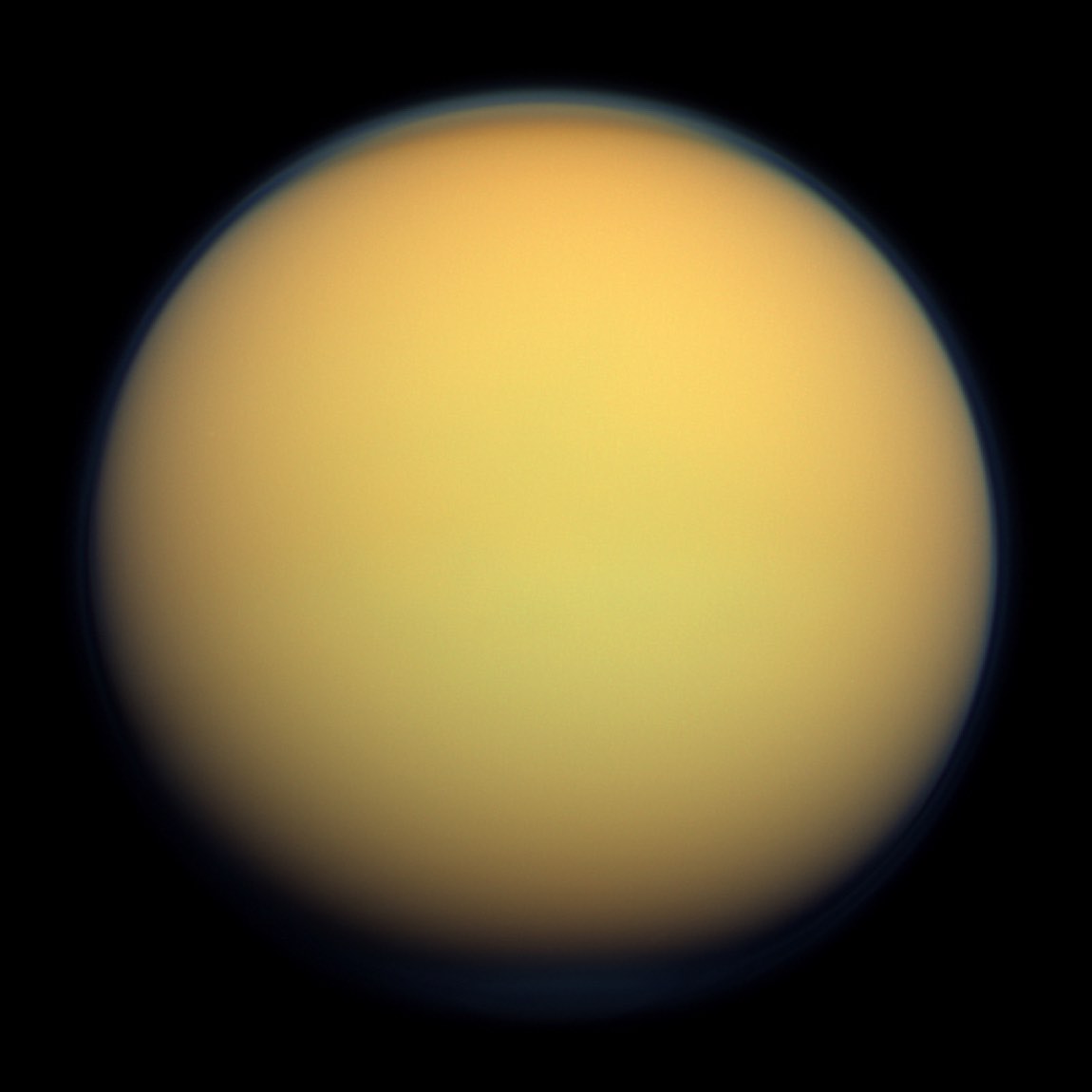
 Photograph · NASA/JPL-Caltech/Space Science Institute · Public domain
Spacecraft · Deep guide
Cassini–Huygens
In thirteen years at Saturn, this mission found oceans where none should be.
What is it?
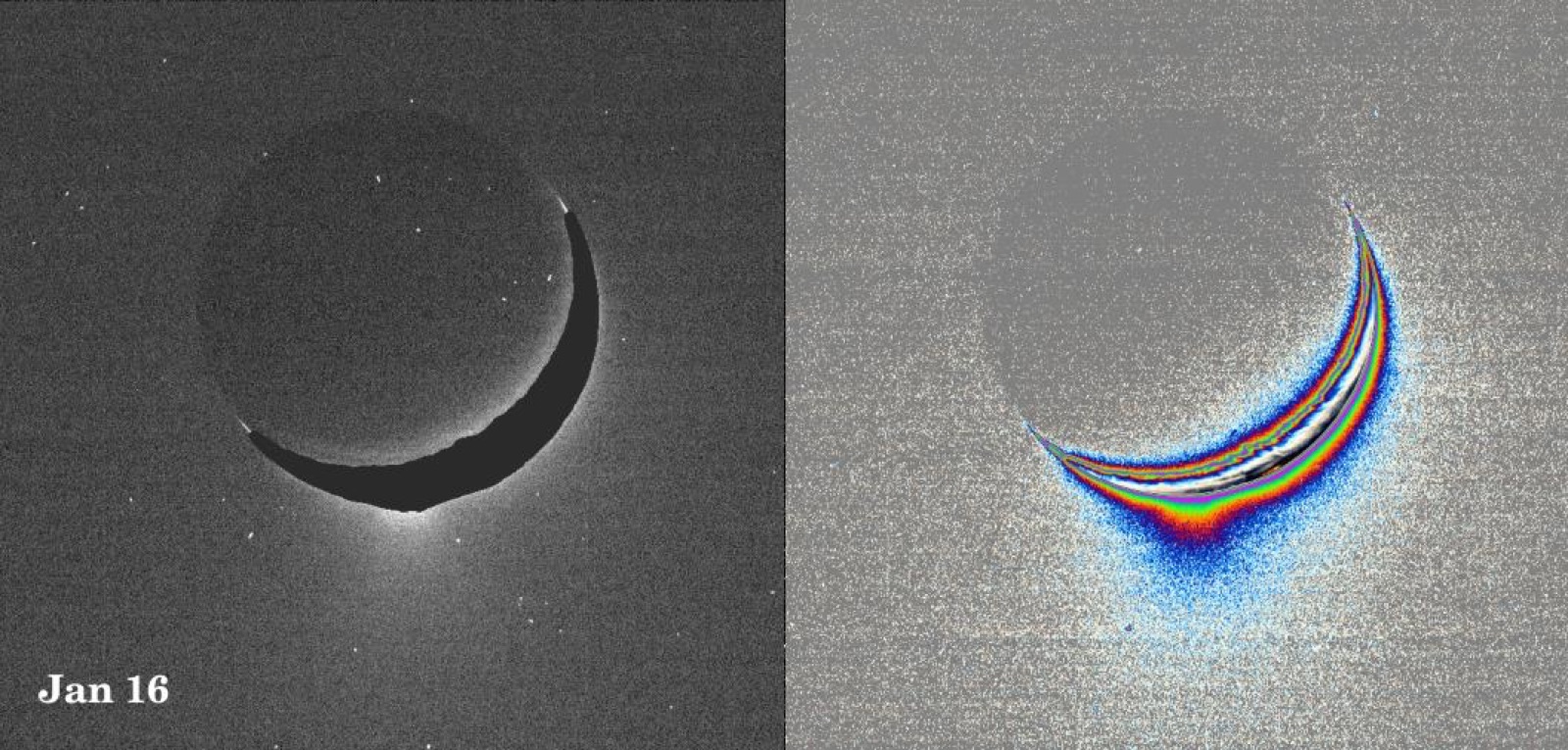
Cassini orbited Saturn from 2004 to 2017 — 294 orbits, 162 targeted moon flybys, and two discoveries that redrew the map of habitability: Enceladus's ocean-fed geysers and Titan's methane seas. It carried Europe's Huygens probe to history's most distant landing, and ended by design: a plunge into Saturn to protect the ocean moons it had revealed.
Go deeper
Cassini's greatest hits: diving through Enceladus plumes to taste salt, H₂ and organics; radar-stripping Titan's haze; solving ring-age via the Grand Finale's 22 ring-gap orbits (young rings, ring rain); the hexagon time-lapse; and the 'Day the Earth Smiled' portrait. Its final signal ended 20 years of flight on September 15, 2017 — vaporized deliberately because its own findings made crashing into Enceladus or Titan a contamination risk. The definitive giant-planet-system mission until a successor exists.
01 Why crash a healthy-ish spacecraft?
Cassini's fuel was nearly gone, and a dead spacecraft drifts. Its own discoveries created the dilemma: Enceladus and Titan might host life, and an uncontrolled crash there — carrying Earth microbes — could contaminate them forever. So while control remained, engineers flew it into Saturn. The mission's last act was protecting its own legacy.
The deep dive
Researched for the Atlas from Wikipedia — Cassini–Huygens (52,477 characters read) · updated Sep 20, 2026
02 A Mission Born from Cold War Rivalry
Cassini–Huygens did not spring from a single inspired moment but from a decade of political maneuvering. The story begins in 1982, when the European Science Foundation and the American National Academy of Sciences formed a working group to explore cooperative missions. By 1983, NASA's Solar System Exploration Committee had independently recommended a Saturn Orbiter and Titan Probe pair as a core NASA project, and a joint NASA–ESA study followed from 1984 to 1985. The decisive nudge came in 1988, when NASA's Associate Administrator for Space Science, Len Fisk, wrote personally to his ESA counterpart, Roger Bonnet, strongly suggesting that ESA choose Cassini from three candidate missions and promising that NASA would commit the moment ESA did. Behind that letter lay a geopolitical calculation: the Soviet Union was actively courting ESA, and NASA feared losing a key partner. ESA chose Cassini–Huygens as its next major mission later that year. The collaboration proved its worth when congressional budget cutters targeted the project in both 1992 and 1994; NASA successfully argued that killing the mission after ESA had already invested funds could damage broader foreign-policy relationships, and the project survived.
03 The Spacecraft That Nearly Never Flew
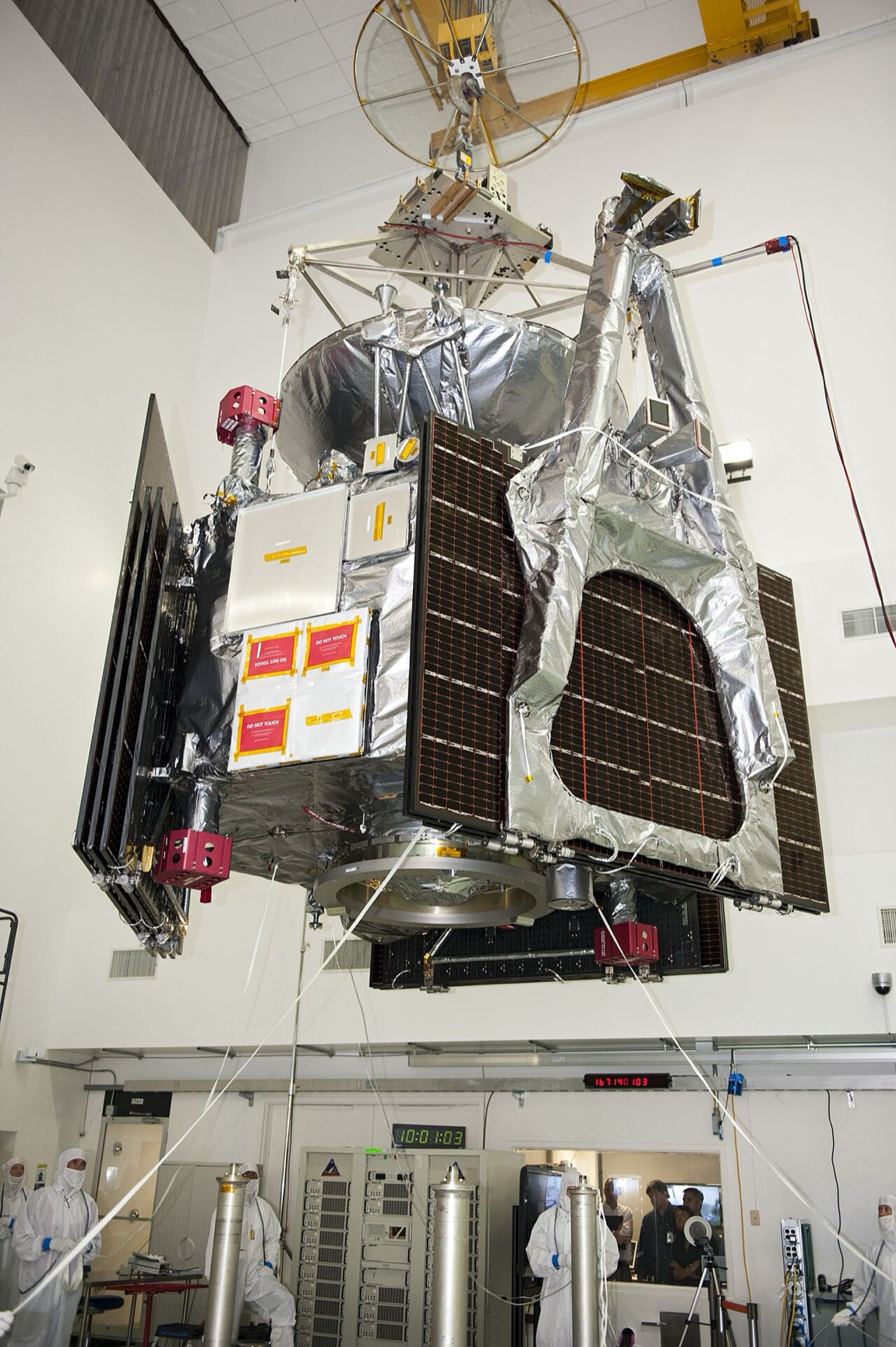
Designing Cassini was as much a financial battle as an engineering one. The 1990s brought NASA's "faster, better, cheaper" philosophy, and JPL — whose flagship missions like Voyager and Galileo employed hundreds of people for decades — had little experience with small, cheap projects. Cassini alone "directly supported maybe 500 work-years, about 10 percent of total lab staff" and "provided close to 20 percent of the lab budget," leaving Caltech leadership worried JPL itself might be shuttered. To save the mission, engineers removed the scan platform from the design to cut $250 million. What remained was the third-largest uncrewed interplanetary spacecraft ever successfully launched at the time, behind only the Soviet Phobos 1 and 2 probes. The finished orbiter had a mass of 2,150 kg, the Huygens probe added 350 kg, and with 3,132 kg of propellants loaded at launch the combined stack weighed 5,600 kg — roughly as heavy as a loaded cement mixer. Total mission cost reached approximately US$3.26 billion, with the United States contributing $2.6 billion, ESA $500 million, and the Italian Space Agency $160 million.
04 Inside the Machine: Wires, Chips, and Rockets Deeper
Cassini's interior was famously intricate. The spacecraft stood 6.8 meters high and 4 meters wide, its body a twelve-sided prism sitting atop a conical frustum that connected to a cylinder housing the propellant tanks. Threading it all together were 14 kilometers of cabling — long enough to stretch across a mid-sized city — linking 1,630 interconnected electronic components through 22,000 wire connections. The core control computer used a redundant MIL-STD-1750A instruction set architecture. Propulsion came from one prime and one backup R-4D bipropellant rocket engine, each producing 490 N of thrust, giving the spacecraft a total delta-v budget of 2,352 m/s. Attitude control used smaller monopropellant rockets. Power distribution relied on 192 solid-state MOSFET switches that doubled as circuit breakers, chosen for efficiency and longevity over conventional switches, though they proved vulnerable to erroneous tripping from cosmic rays, occasionally causing losses of experimental data. The main propulsion engine fired during Saturn Orbital Insertion to decelerate the spacecraft by 622 m/s, allowing Saturn's gravity to capture it — a maneuver executed while Cassini was too far away for real-time ground commands, since radio signals took 68 to 84 minutes to travel between Earth and the spacecraft.
05 Nuclear Power at the Edge of the Solar System
Saturn receives so little sunlight — Cassini orbited between 8.2 and 10.2 astronomical units from Earth — that solar panels large enough to power the spacecraft would have been too heavy to launch. Instead, Cassini drew electricity from three GPHS-RTG radioisotope thermoelectric generators, fueled by approximately 33 kg of plutonium-238 in the form of plutonium dioxide. The RTGs used the heat of radioactive decay to generate current through thermoelectrics, the same design flown on New Horizons, Galileo, and Ulysses. Even at the end of the nominal 11-year mission they still produced 600 to 700 watts of electrical power, and leftover RTG hardware from the Cassini program was later modified to power New Horizons on its journey to Pluto. The plutonium source was controversial: citizens' groups worried about a launch failure and filed protests and lawsuits up to and after the 1997 launch. NASA's own environmental impact study estimated that a worst-case re-entry — in which the spacecraft gradually burned up and dispersed nuclear fuel — could have exposed up to five billion people to some level of radiation, potentially causing up to an estimated 5,000 additional cancer deaths over subsequent decades, though the probability of that scenario was estimated at less than one in one million.
06 The Grand Tour Before Saturn
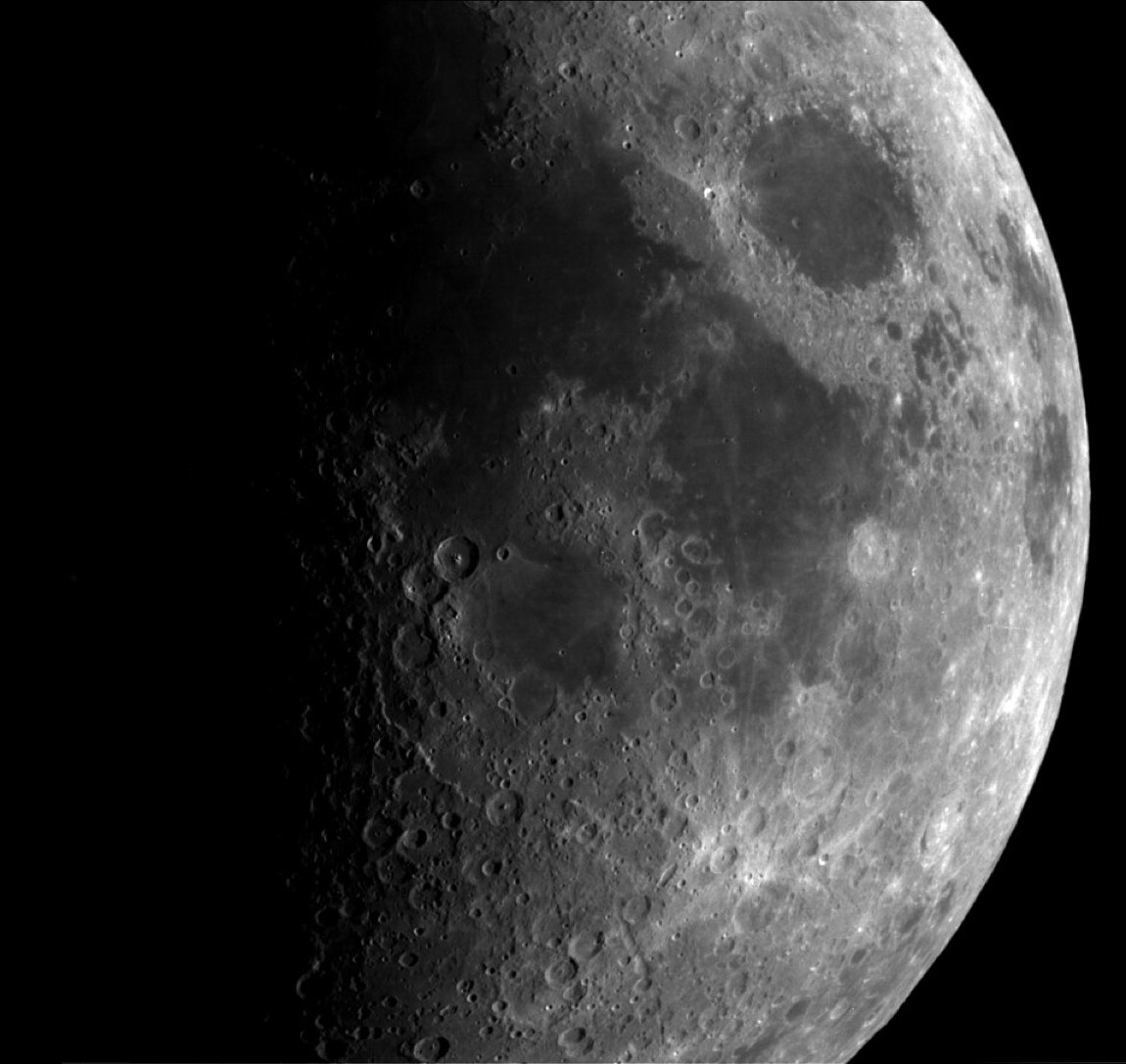
Getting to Saturn required Cassini to first travel inward toward Venus, not outward. Launched on October 15, 1997, the spacecraft executed gravitational-assist flybys of Venus on April 26, 1998, and June 24, 1999, each pass adding speed. The Sun's gravity then pulled Cassini back into the inner Solar System, setting up a flyby of Earth on August 18, 1999, at 03:28 UTC, passing just 1,171 km above the surface — the last moment the probe posed any conceivable risk to humans. One hour and twenty minutes before that closest approach, Cassini swung within 377,000 km of the Moon and took calibration photographs. On January 23, 2000, the spacecraft photographed the asteroid 2685 Masursky from a distance of about 1.6 million km, estimating its diameter at 15 to 20 km. The final gravity assist came at Jupiter on December 30, 2000, when Cassini passed within 9.7 million kilometers of the giant planet. During six months near Jupiter, the probe collected about 26,000 images, producing the most detailed global color portrait of Jupiter at the time, with the smallest visible features approximately 60 km across. In total, Cassini spent nearly seven years in transit before reaching Saturn.
07 What Jupiter Taught Cassini Before Saturn Deeper
The Jupiter flyby was far more than a speed boost — it produced genuine scientific surprises. Announced on March 6, 2003, a major finding concerned atmospheric circulation. Scientists had long assumed that Jupiter's bright zones were regions of rising air, partly by analogy with cloud formation on Earth. But Cassini imagery revealed that individual storm cells of upwelling bright-white clouds appear almost exclusively inside the dark belts, not the zones. According to Anthony Del Genio of NASA's Goddard Institute for Space Studies, "the belts must be the areas of net-rising atmospheric motion on Jupiter," meaning the zones represent sinking air — essentially the reverse of what had been assumed. The flyby also revealed a swirling dark oval of high atmospheric haze near Jupiter's north pole, roughly the size of the Great Red Spot, and infrared data showed adjacent bands of globe-encircling winds moving in opposite directions near the poles. Regarding Jupiter's rings, Cassini found that particles scatter light in ways indicating they are irregularly shaped rather than spherical, and likely originate as ejecta kicked up when micrometeorites strike the small inner moons Metis and Adrastea. Additionally, Cassini used its Jupiter passage to conduct one of the most precise tests of general relativity ever performed, measuring gravitational redshift and blueshift in radio waves passing near the Sun to an accuracy of about one part in 51,000, far better than the one part in one thousand achieved by Viking and Voyager.
08 Huygens: Parachuting Into Another World
On December 25, 2004, Cassini released the Huygens probe using a spring-and-spiral-rail mechanism that imparted a separation speed of 0.35 metres per second and a spin rate of 7.5 rpm for stability. Three weeks later, on January 14, 2005, Huygens entered Titan's atmosphere and spent two and a half hours descending by parachute before landing on solid ground — the first landing ever accomplished in the outer Solar System and the first on any moon other than Earth's own. It returned data to Earth for about 90 minutes, relayed through the orbiting Cassini. The descent was automatically managed by an onboard command system because the mission could not be telecommanded from Earth given the distance involved. A software-design flaw had earlier threatened to make the data unreadable: the bandwidth of Cassini's receiver was too narrow for the anticipated Doppler shift caused by the probe's motion relative to the orbiter. Engineers devised a workaround by modifying Cassini's trajectory to reduce line-of-sight velocity, replacing two planned orbits with three shorter ones. Even so, a malfunction in one communications channel caused the loss of 350 of the roughly 700 pictures Huygens transmitted; Cassini successfully relayed the other 350 images of Titan's cloud layers and landing site.
09 Saturn's Weather: Storms, Hexagons, and Spokes
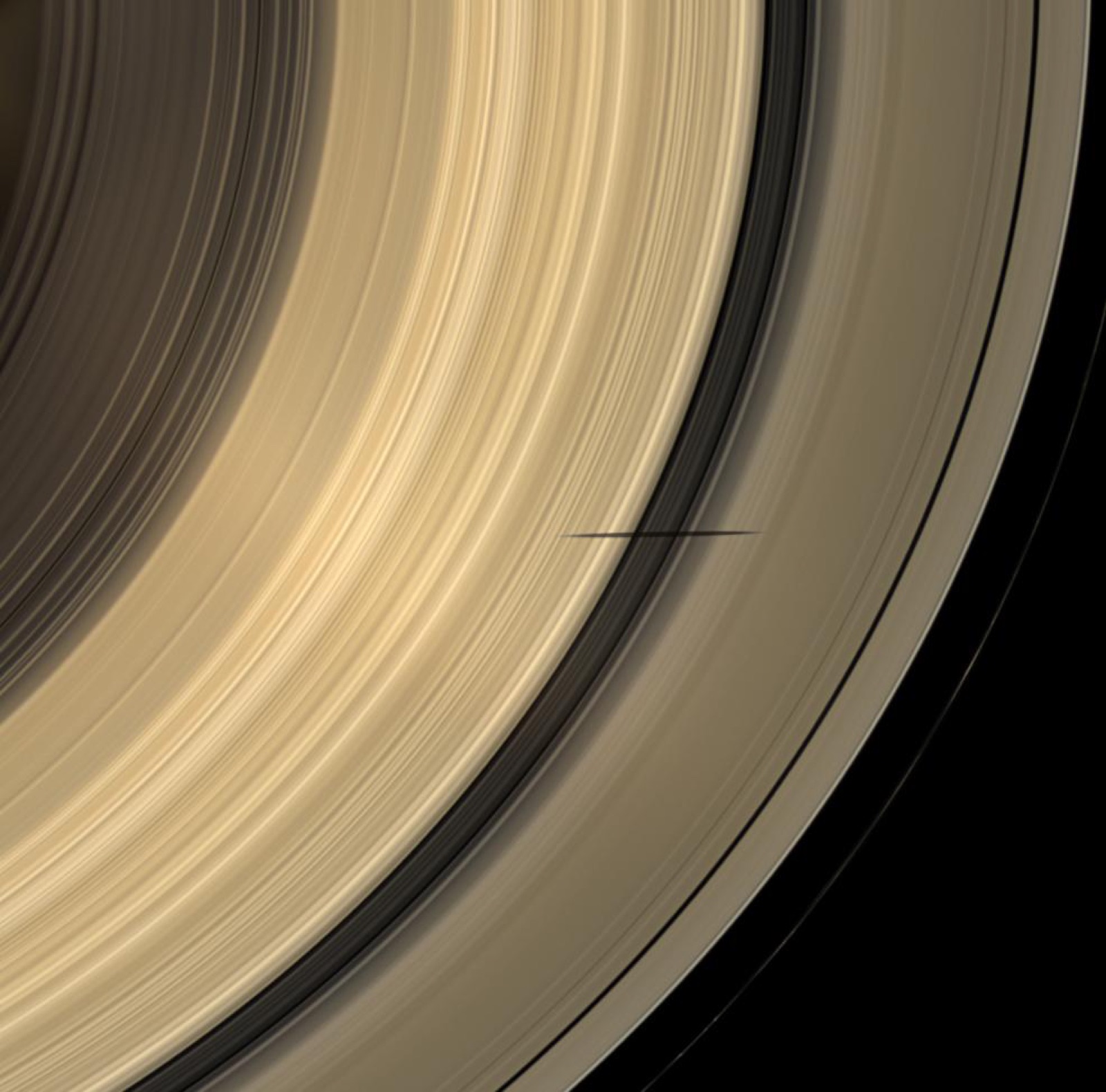
Saturn's atmosphere delivered spectacle after spectacle during Cassini's thirteen years in orbit. In November 2006, scientists discovered a hurricane-like storm at the planet's south pole with a distinct eyewall — a feature characteristic of tropical cyclones on Earth and never before seen on another planet. Unlike Earth hurricanes, it appeared stationary at the pole. The storm measured 8,000 km across and 70 km high, with winds of 560 km/h. Then in December 2010 Cassini observed the beginning of the Great White Spot, a massive storm that recurs roughly every 30 years on Saturn. Data from the infrared spectrometer recorded a stratospheric temperature spike 83 K above normal, and ethylene gas surged to levels 100 times higher than scientists thought possible on Saturn. The storm produced the largest, hottest stratospheric vortex ever detected in the Solar System, initially larger than Jupiter's Great Red Spot. Meanwhile, between 2012 and 2016, the famous hexagonal cloud pattern at Saturn's north pole gradually shifted from mostly blue to a golden hue, possibly because increasing sunlight as the northern hemisphere moved toward summer was producing photochemical haze. Cassini also confirmed in September 2005 the existence of spokes — radial dark features — in Saturn's rings, first spotted by visual observer Stephen James O'Meara in 1977 and later confirmed by the Voyager probes.
10 Seven New Moons and One Possible Eighth Deeper
Cassini's cameras extended Saturn's known family of moons considerably. The mission discovered seven new satellites in total. In 2004, researchers using Cassini images identified Methone, Pallene, and Polydeuces, though later analysis revealed that Voyager 2 had inadvertently photographed Pallene during its 1981 flyby without recognizing it. On May 1, 2005, Cassini spotted a new moon inside the Keeler gap, designated S/2005 S 1 and later named Daphnis. A fifth moon, now called Anthe, was found on May 30, 2007. A sixth, Aegaeon, was announced in February 2009; it sits within Saturn's G ring and measures only about 500 meters in diameter — smaller than many city blocks. The seventh moon, announced in November 2009, is labeled S/2009 S 1, lies in the B ring, and is approximately 300 meters in diameter, making it little more than a large boulder by planetary standards. Then in April 2014, NASA scientists reported what may be the early formation of an eighth new moon observed in Saturn's A Ring — a possible moonlet still in the process of coalescing from ring material, though the article stops short of confirming it as a fully formed satellite.
11 Titan's Lakes: Methane Instead of Water
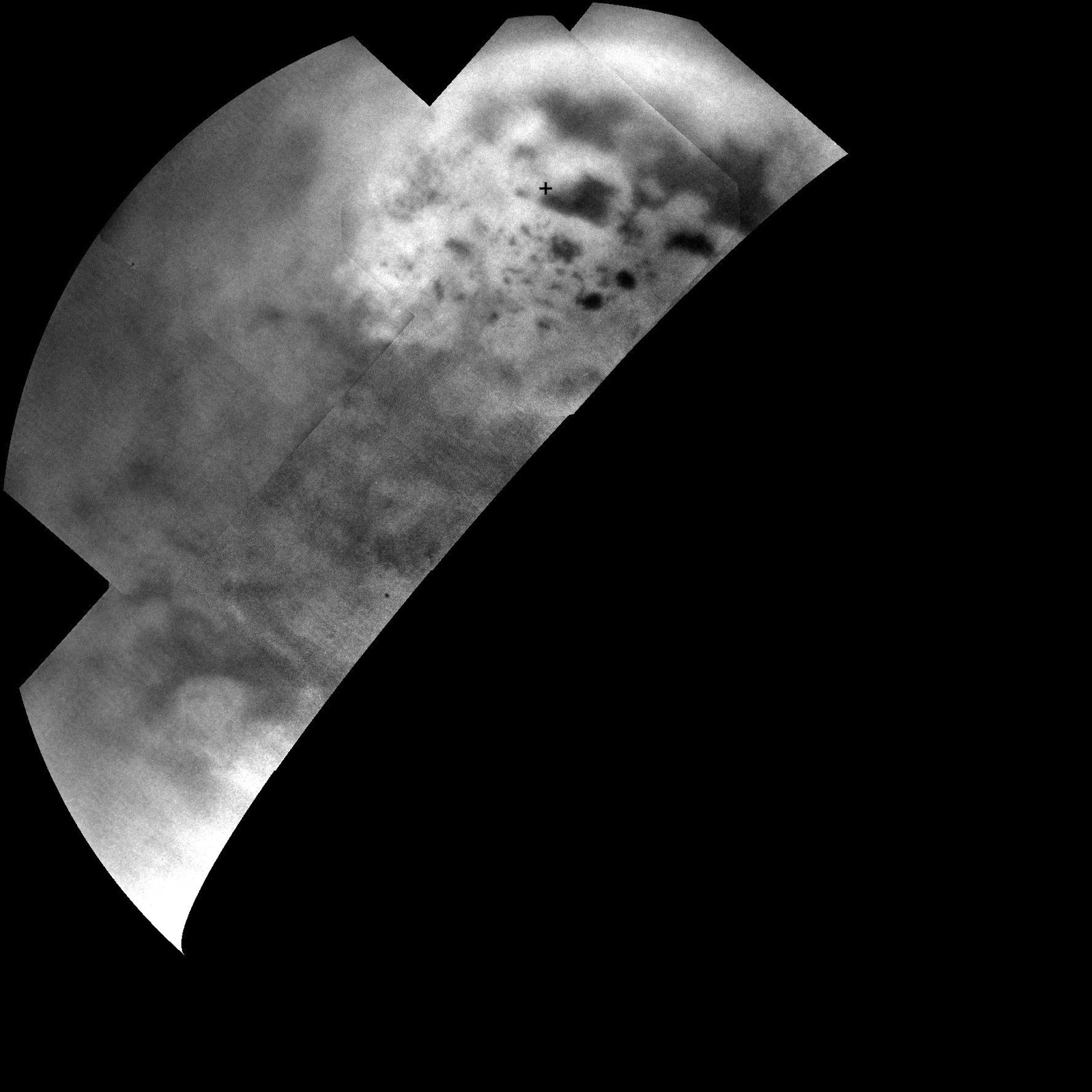
One of Cassini's most visually arresting discoveries was the confirmation of standing liquid on another world. Radar images acquired on July 21, 2006, showed features in Titan's northern latitudes that unmistakably resembled lakes — the first discovery of currently existing lakes anywhere in the Solar System besides Earth. The lakes ranged in size from one to one hundred kilometers across and were composed of liquid hydrocarbons, primarily methane and ethane, not water, because Titan's surface temperature hovers around minus 179 degrees Celsius. By March 2007, JPL announced strong evidence of entire seas in Titan's northern hemisphere, at least one larger than any of the Great Lakes in North America. Earlier radar data from October 2004 had already shown that much of Titan's surface is remarkably flat, with topographic relief reaching no more than about 50 meters in altitude over the areas surveyed. Cassini's first Titan flyby on July 2, 2004, passed within 339,000 km and through special filters revealed south polar clouds thought to be made of methane, while its October 27, 2004, close pass at just 1,200 km altitude collected nearly four gigabits of data including the first radar glimpse of the haze-shrouded surface.
12 The Grand Finale: Science Inside the Rings Deeper
Cassini's final chapter was engineered to extract maximum science from a doomed machine. The Grand Finale began on November 29, 2016, when a Titan flyby redirected the spacecraft toward the F-ring region. A final Titan flyby on April 22, 2017, bent the orbit so that Cassini passed through the gap between Saturn and its innermost ring on April 26, coming about 3,100 km above Saturn's cloud layer and 320 km from the visible edge of the inner ring. Over 22 such proximal orbits, instruments sampled material and fields in a region never previously probed. The effort was approved by the U.S. government in late 2014 at a cost of $200 million, described as far cheaper than building two separate Discovery-class missions. Two results from Grand Finale data published in January 2019 stood out: scientists used ring seismology — measuring how vibrations from Saturn's interior create waves in ring particles — to pin down the planet's rotation period as 10 hours, 33 minutes, and 38 seconds, resolving a puzzle that had persisted since Voyager 1 measured a different radio-rotation period in 1980. Grand Finale data also indicated that Saturn's rings are geologically young, only 10 to 100 million years old. The spacecraft's signal was lost at 11:55:46 UTC on September 15, 2017, about 30 seconds later than predicted, with the craft estimated to have burned up roughly 45 seconds after that final transmission.
13 The Dark Mystery of Iapetus
Among Cassini's formal objectives was determining the nature and origin of the dark material coating Iapetus's leading hemisphere — one of the Saturn system's most striking and long-standing puzzles. Cassini's closest look at this strange, walnut-shaped moon came on September 10, 2007, when the spacecraft flew within 1,600 km of its surface. The flyby produced detailed imagery, though the return of data was briefly interrupted when a cosmic ray struck the spacecraft and forced it into safe mode; all the stored flyby data was ultimately recovered. The article does not resolve what causes the dramatic two-toned coloring that makes Iapetus one of the most visually distinctive moons in the Solar System, honestly reflecting that the question remained a scientific goal rather than a closed finding at the time of the mission. Cassini's objectives list also included determining the composition of other satellite surfaces, studying the geological history of individual moons, and characterizing Titan's surface on a regional scale — together forming a comprehensive geological survey of Saturn's diverse family of moons, ranging from the geologically active Enceladus to the battered, heavily cratered Phoebe, which Cassini first imaged close up on June 11, 2004, revealing bright patches believed to overlie water ice.
14 Open Questions Cassini Left Behind Deeper
For all its triumphs, Cassini left Saturn's system with important questions unanswered or freshly sharpened. The nature and origin of the dark material on Iapetus remained a named objective without a definitive conclusion in the article. Saturn's ring age — now estimated at 10 to 100 million years old, young in planetary terms — raises the question of what event produced them so recently. The radio-rotation period of Saturn had already shifted 6 minutes longer between Voyager 1's 1980 measurement and Cassini's arrival, and scientists concluded this does not reflect an actual change in the planet's spin but rather variations in the upper atmosphere and ionosphere magnetically connected to the radio-emission source, though the precise mechanism was still debated. In December 2023, astronomers reported the detection in Enceladus's plumes of hydrogen cyanide — described as a possible chemical essential for life — along with other organic molecules some of which are "yet to be better identified and understood." The researchers noted these compounds "could potentially support extant microbial communities or drive complex organic synthesis leading to the origin of life," framing Enceladus's subsurface ocean as an open astrobiological frontier that a future mission would need to investigate. Analysis of the vast archive of returned data, the article notes, will continue for many years after the mission's 2017 end.
 ⤢
⤢
Weird & wonderful
- On its final dives, Cassini flew through the gap between Saturn and its rings — 22 times.
- It watched a moon (Enceladus) snow on itself.
- In its last photo session, it caught Earth as a dot beneath the rings — 'The Day the Earth Smiled.'