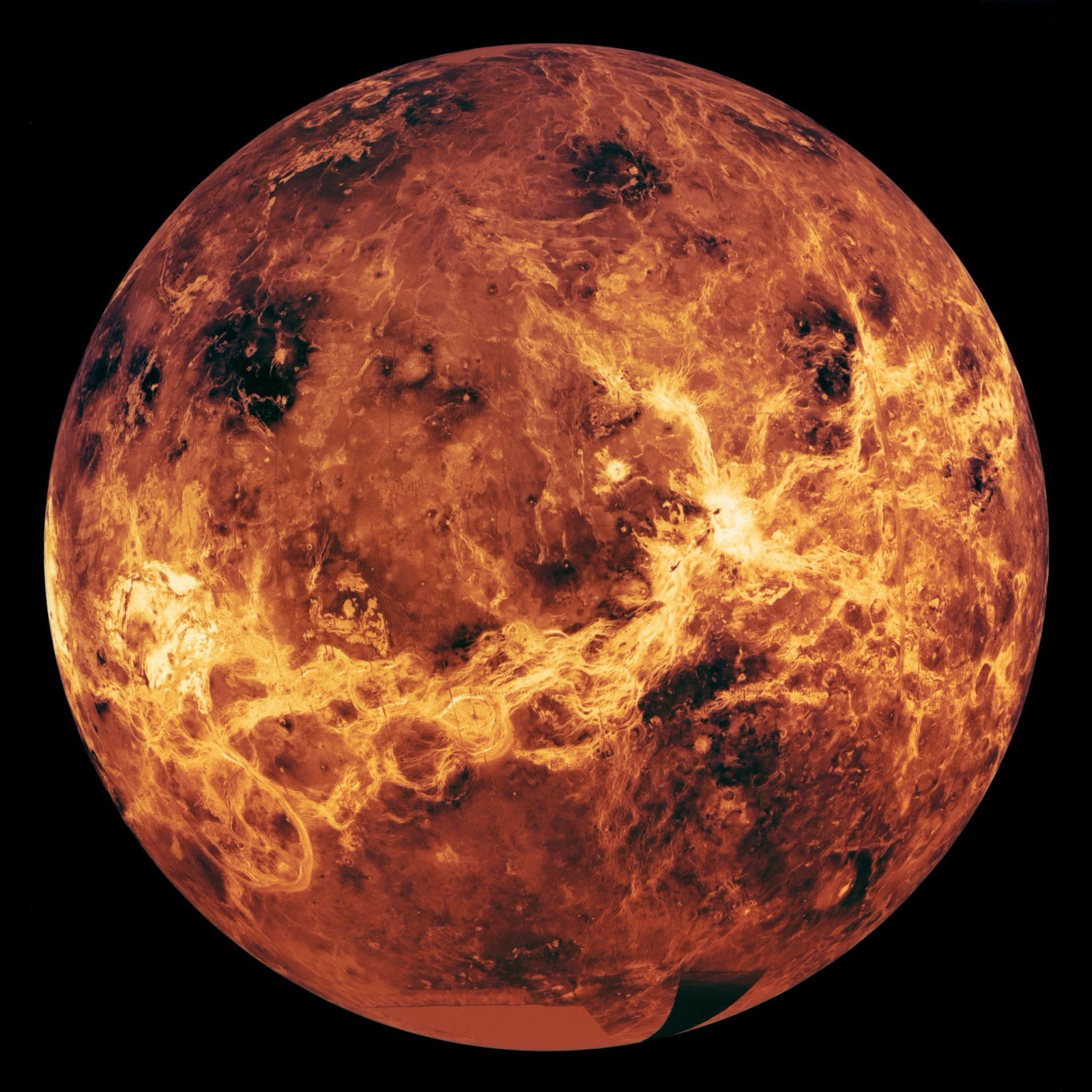
 Photograph · JSC / NASA Image Library
Planet · Deep guide · orbits The Sun
Venus
Also called: The Evening Star · The Morning Star
Earth's overheated twin is a runaway greenhouse world hidden under acid clouds.
What is it?
Venus is almost exactly Earth's size, but it went down a very different road. A crushing carbon-dioxide atmosphere traps heat so effectively that the surface stays around 464 °C — hot enough to melt lead — day and night, pole to pole. Thick clouds of sulfuric acid hide the surface completely. After the Moon, Venus is the brightest natural object in our night sky.
Go deeper
Venus is the textbook runaway greenhouse: 96.5% CO₂ at 92 bars of surface pressure. Radar mapping (Magellan) revealed a young volcanic surface, and re-analysis of Magellan images published in 2023 showed a vent changing shape between passes — direct evidence of ongoing eruptions. Venus rotates backwards (retrograde) once every 243 Earth days, longer than its 224.7-day year, while its upper atmosphere super-rotates in just four days. Whether early Venus had oceans remains an open question; the 2020 report of phosphine in its clouds — a possible biosignature — remains contested.
01 What is it like there?
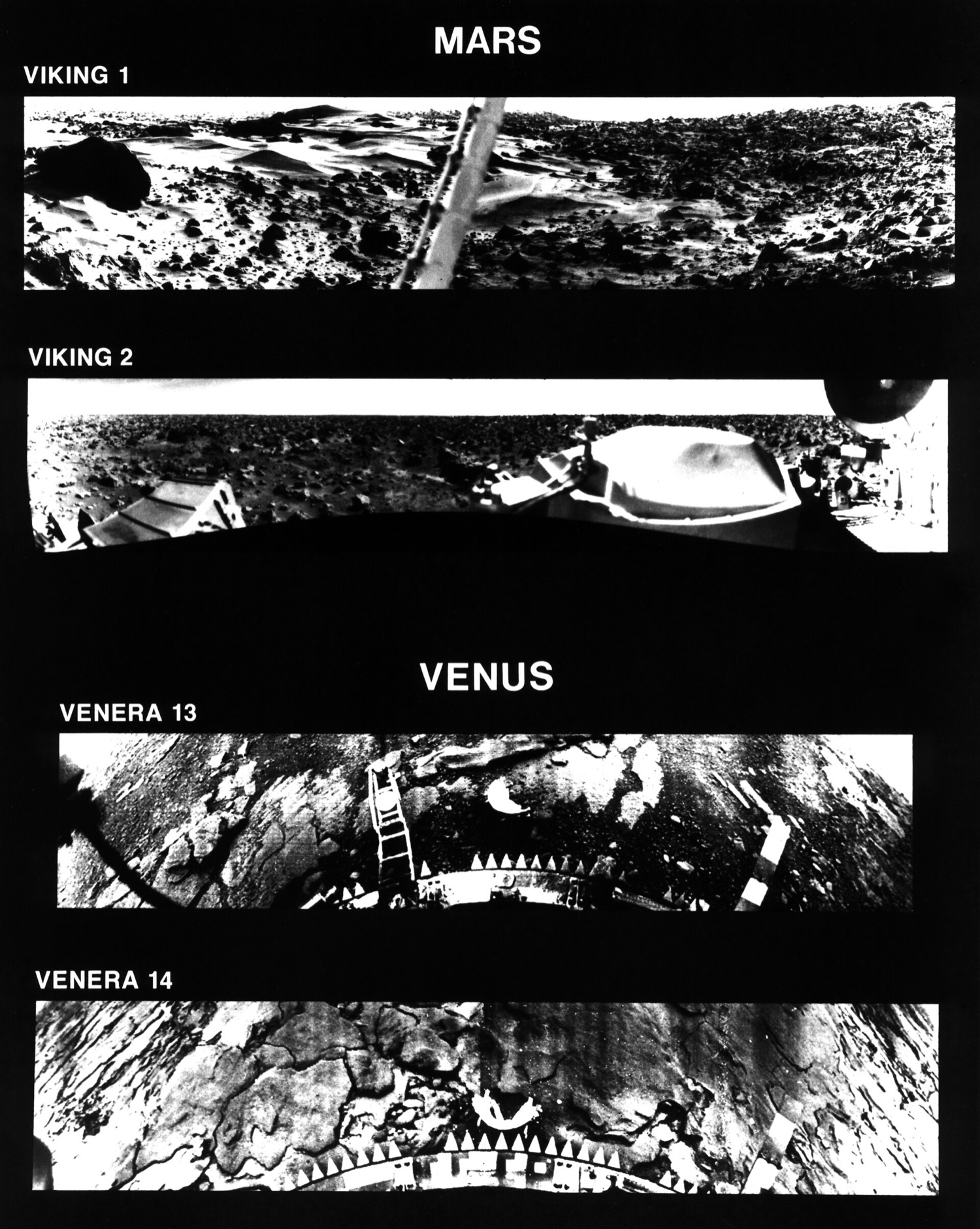
The surface is a dim, orange-lit rock desert under a permanently overcast sky. The air is so thick that walking would feel like wading through water, and so hot that the Soviet Venera landers — the only spacecraft ever to land there — survived at most about two hours before being cooked. Above the clouds, though, sunlight is bright and the view is dazzling white.
02 A warning written in the sky
Venus shows what a greenhouse effect can do when it runs away completely. Earth and Venus started with similar ingredients; on Venus, all the carbon that Earth locks into rocks and oceans sits in the atmosphere instead. Climate scientists study Venus partly to understand the physics of heat-trapping gases.
03 The cloud-layer puzzle Deeper
About 50 km up, Venus's atmosphere has a layer where temperature and pressure are almost Earth-like — the most Earth-like conditions anywhere else in the Solar System. That is why scientists have seriously proposed balloon missions and even 'cloud city' concepts, and why the contested phosphine detection caused such a stir: if any niche on Venus could host microbial chemistry, it would be the clouds, not the surface.
04 Upcoming missions Deeper
NASA's DAVINCI (an atmosphere-diving probe) and VERITAS (a radar mapper), and ESA's EnVision, are in development to answer whether Venus ever had oceans and how active it is today. Launch dates have moved several times — see the News tab for current status.
 ⤢
⤢
The deep dive
Researched for the Atlas from Wikipedia — Venus (58,000 characters read) · updated Sep 20, 2026
05 A twin planet gone terribly wrong
Venus and Earth began as near-identical siblings. Venus has a diameter of 12,103.6 km — only 638.4 km less than Earth's — and its mass is 81.5% of Earth's. The two planets are thought to have formed through the same five-stage process: dust settling, planetesimal formation, planetary embryos, giant impacts, and finally atmosphere formation. Early Venus may even have hosted active plate tectonics during its first billion years, with volcanic outgassing producing much of the nitrogen still present in the atmosphere today. Some researchers argue that tessera terrain — the oldest rocky highlands measured by Venus Express and Magellan — shows lower thermal emissivity than surrounding plains, hinting at a more felsic, possibly water-formed, crustal composition. Since felsic crust normally requires liquid water and plate tectonics to generate, this is tantalising evidence that habitable conditions once existed. Yet other analyses of gas decomposition in the current atmosphere suggest volcanic activity has always produced too little water to fill oceans, leaving the question of how Earth-like early Venus truly was genuinely unresolved.
06 Inside a planet with no magnetic heartbeat Deeper
Beneath its crushing atmosphere, Venus almost certainly has the same layered interior as Earth: a crust, a mantle, and a core. The crust averages roughly 40 km thick and reaches at most 65 km. Pressure in the deep interior is about 24% lower than inside Earth because of Venus's slightly smaller size. Planetary models predict a core radius of 2,900 to 3,450 km, and a more recent estimate based on the measured rate of axial precession — tracked between 2006 and 2020 — puts it at 3,500 km. The core is most likely at least partially liquid, since Venus and Earth have been cooling at similar rates, though a fully solid core cannot be ruled out. What Venus conspicuously lacks is an internally generated magnetic field. A dynamo needs a conducting liquid, rotation, and convection; scientists think the first two conditions are probably met, but convection appears to be absent. One leading hypothesis is that periodic global resurfacing events act as an insulating lid, trapping heat in the mantle and preventing the temperature gradient in the core that drives convection on Earth. The concentration of sulfur in the core — currently unknown — may be decisive in determining whether any part of it has solidified.
 ⤢
⤢
07 How the solar wind is stealing Venus's sky Deeper
Without an internal dynamo, Venus has only a weak induced magnetosphere, generated by the solar wind pressing against the ionosphere rather than by any engine inside the planet. This feeble shield offers negligible protection against solar and cosmic radiation. The consequences for the atmosphere are severe and ongoing: ultraviolet radiation splits water molecules into hydrogen and oxygen ions, and the solar wind then accelerates these lightweight ions to escape velocity. The result is a continuous, slow bleeding away of hydrogen, helium, and oxygen, while heavier molecules like carbon dioxide remain trapped. Over geological time this process is thought to have stripped away most of Venus's original water supply, possibly within its first billion years — though Venus may have retained an internal dynamo for its first two to three billion years, so the stripping could be more recent. The most dramatic fingerprint of this erosion is the ratio of deuterium to hydrogen in the atmosphere, which is 100 times greater than the solar system average, because the lighter hydrogen escaped preferentially while the heavier isotope stayed behind. The 2013 ESA finding that Venus's ionosphere streams outward like a comet tail under solar wind pressure makes this loss process visible in near-real time.
08 A surface younger than the dinosaurs' extinction
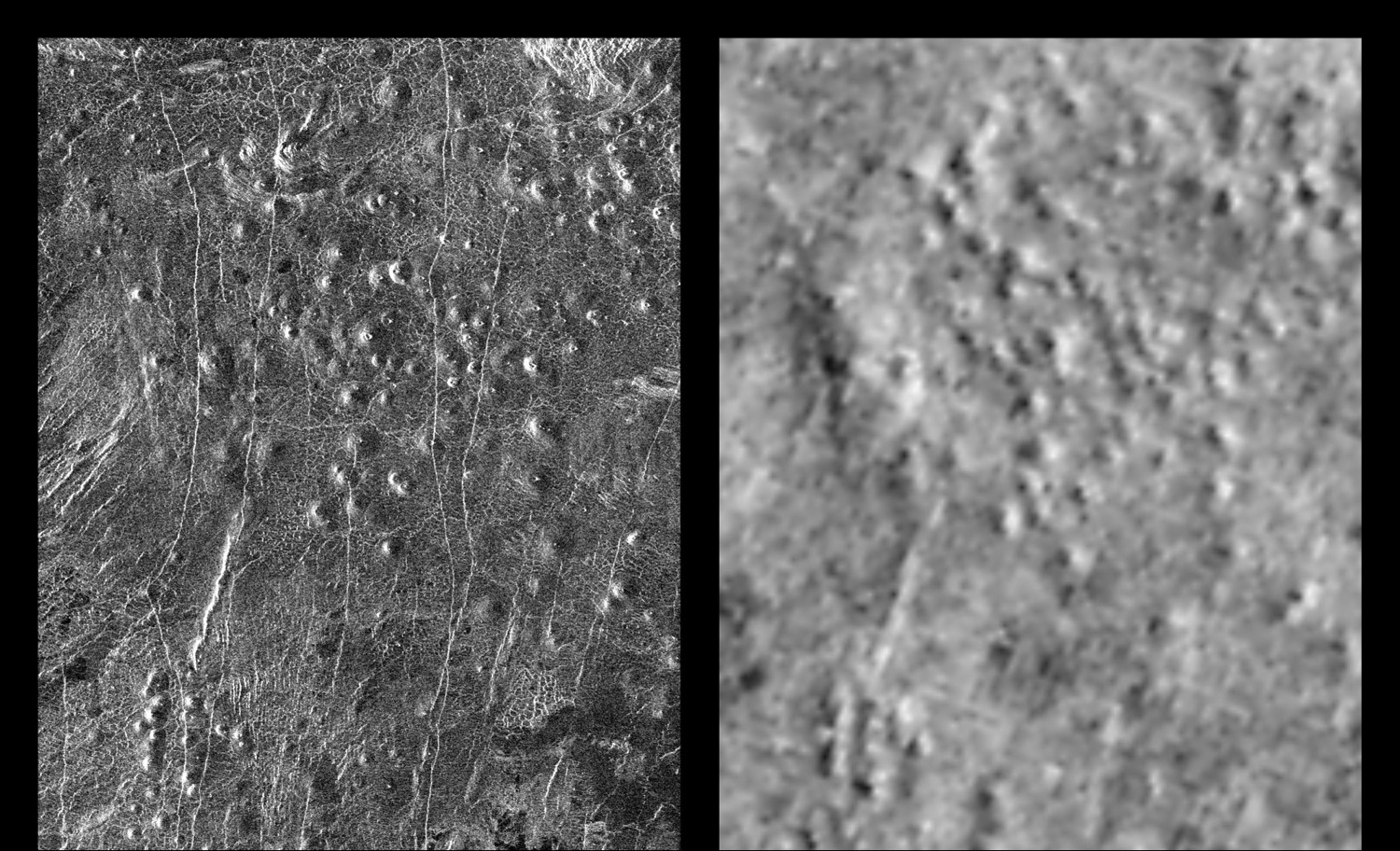
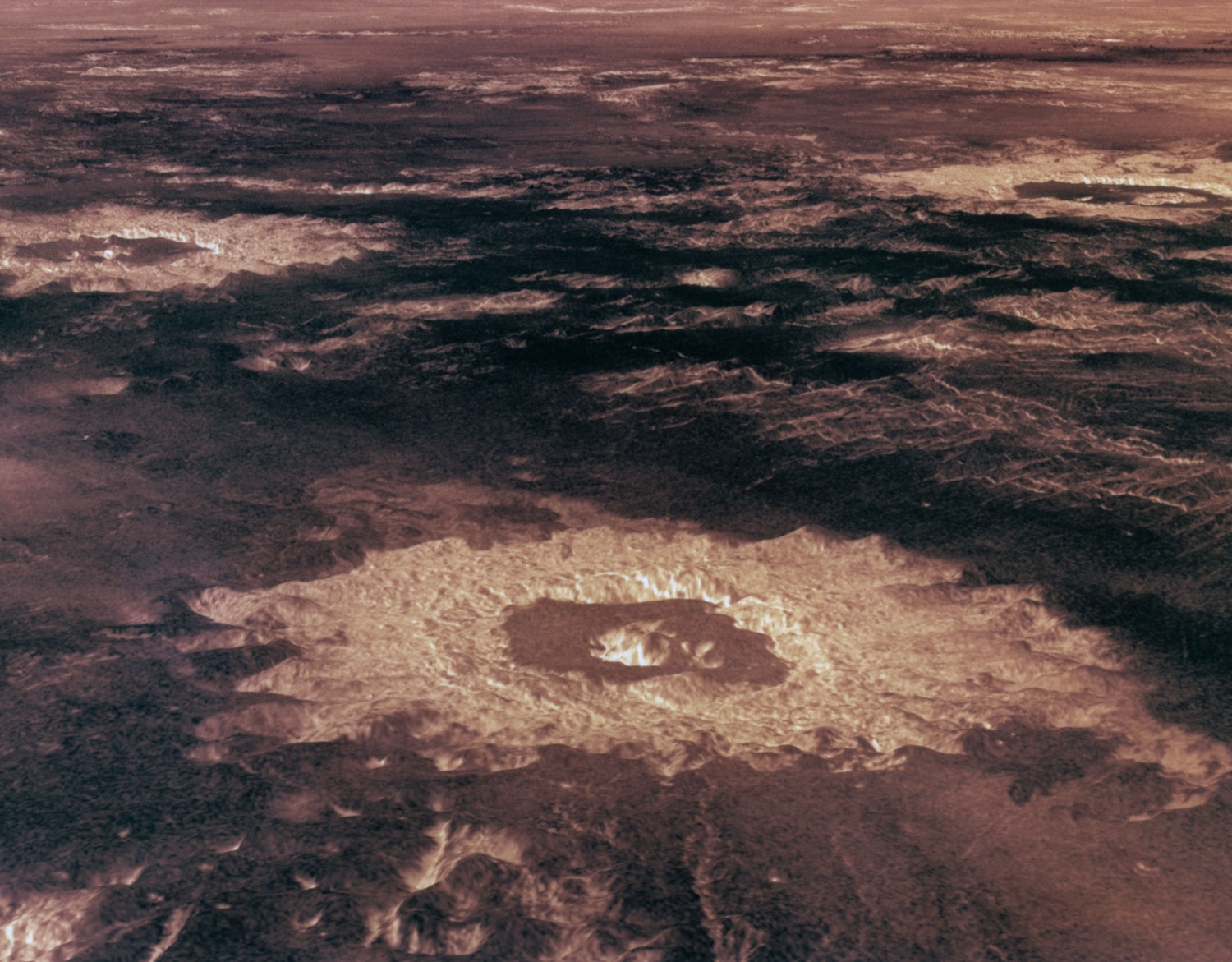
About 80% of Venus is blanketed by smooth volcanic plains, and what lies beneath tells a story of dramatic planetary reinvention. Venus has almost a thousand impact craters, and roughly 85% of them are in pristine condition — not eroded by wind or water, not buried by shifting plates. That near-perfect preservation, combined with the total count, points to a global resurfacing event somewhere between 300 and 600 million years ago, making the surface younger than many of Earth's mountain ranges. Scientists think Venus periodically overheats from within: without plate tectonics to steadily release mantle heat, temperatures build until the crust catastrophically weakens, triggering planet-wide subduction over roughly 100 million years before things settle again. No craters smaller than 3 km exist anywhere on the surface, because the dense atmosphere burns or slows incoming objects less than about 50 m across before they can reach the ground. Craters that do form range up to 280 km in diameter.
09 Volcanoes, pancakes, and spider webs in stone
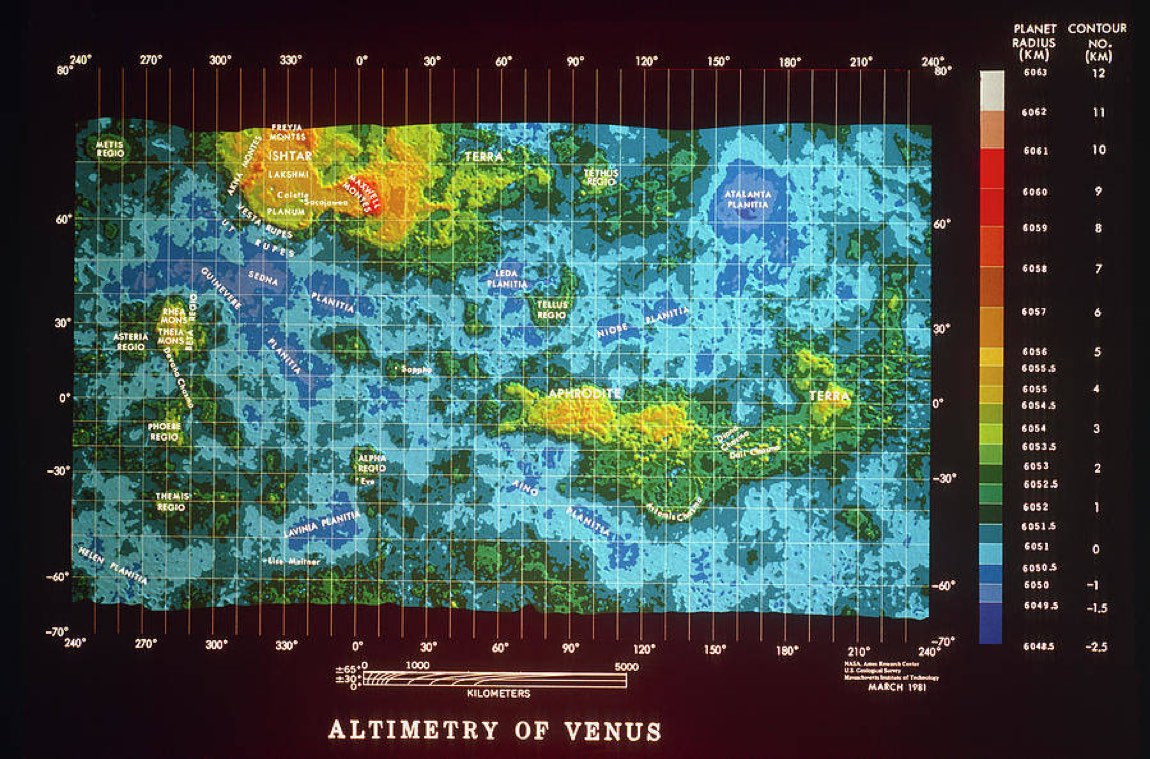
Venus has more than 85,000 identified and mapped volcanoes — not because it is more active than Earth, but because its ancient, tectonics-free crust preserves features that would long since have been recycled on our planet. Among those, 167 individual volcanoes exceed 100 km across; the only comparable structure on Earth is the Big Island of Hawaii. The two great highland continents, Ishtar Terra in the north (roughly the size of Australia) and Aphrodite Terra near the equator (roughly the size of South America), are draped with unique volcanic landforms found nowhere else in the solar system. Flat-topped "farra" look like stone pancakes, ranging from 20 to 50 km wide and 100 to 1,000 m tall. Radial fracture systems called "novae" resemble exploding stars. "Arachnoids" combine radial and concentric fractures into patterns that genuinely look like spider webs. "Coronae" are circular fracture rings, sometimes surrounded by depressions. All are volcanic in origin. In 2024, evidence of recent lava flows was confirmed at Sif Mons and on Niobe Planitia, adding to earlier detections of infrared hot spots near Maat Mons observed by Venus Express in 2008 and 2009.
 ⤢
⤢
10 Winds that lap a planet in four days
Venusian weather operates on a scale difficult to grasp. At the surface, winds crawl at a few kilometres per hour, but the atmosphere is so dense — 65 kg/m³ at ground level, 50 times denser than Earth's air — that even that gentle breeze exerts a significant force, capable of pushing dust and small stones. Higher up, the situation becomes extreme. Cloud-top winds reach 300 km/h and carry the entire upper atmosphere around the planet in about four Earth days, a phenomenon called atmospheric super-rotation that spins the cloud layer 60 times faster than the solid planet beneath it. By contrast, Earth's fastest winds reach only 10 to 20% of its rotational speed. In 2007, Venus Express discovered a huge double atmospheric polar vortex at the south pole. In December 2015 and again in 2016, Japan's Akatsuki probe detected enormous bow-shaped structures in the atmosphere interpreted as the largest stationary gravity waves in the solar system. A cyclical variation in wind speed tied to the Sun's 11-year sunspot cycle was identified in 2019, suggesting the atmosphere responds to solar activity in ways still being studied.
11 The mystery snow and the UV dark streaks Deeper
At the highest elevations on Venus, temperatures drop enough to produce a puzzling bright coating on mountain peaks. In 1995, the Magellan spacecraft imaged a highly reflective substance at the tops of the Maxwell Montes range that resembled terrestrial snow in radar return. Scientists think the material — too volatile to remain stable at lower, hotter elevations — rises as a gas and condenses in the cooler heights, analogous to how water snow forms on Earth but at far higher temperatures. Its exact identity remains unknown; speculation ranges from elemental tellurium to lead sulfide (galena). Meanwhile, from orbit, Venus appears almost featureless in visible light, yet ultraviolet images reveal distinct banding and streaks. The ultraviolet absorber responsible for this has not been identified with certainty. Candidates include OSSO, a compound of oxygen and sulfur with a double bond between sulfur atoms, or polysulfur compounds ranging from S₂ to S₈. The same unknown absorbers may be connected to the long-term albedo and absorbance changes reported in 2019 by astronomers led by Yeon Joo Lee, who noted that their light-absorption profile is almost identical to that of microorganisms found in Earth's clouds.
12 How humans first decoded Venus from Earth
For most of human history, Venus was just an unusually brilliant wandering light, and several cultures independently assumed the brilliant morning object and the evening object were two different stars. A Babylonian cylinder seal from the Jemdet Nasr period and the Venus tablet of Ammisaduqa from the First Babylonian dynasty show that ancient Sumerians knew both were the same object. The Greeks called the morning apparition Phosphorus and the evening one Hesperus before Pythagoras, credited by Pliny the Elder, recognised them as one. When Galileo turned a telescope on Venus in December 1610, he saw it cycling through phases just like the Moon — full when far beyond the Sun, a thin crescent when nearby. He reported this in 1613 in his Letters on Sunspots, making it one of the first clear observational arguments against the geocentric model. The atmosphere of Venus was discovered in 1761 by Russian polymath Mikhail Lomonosov, and German astronomer Johann Schröter confirmed it in 1790 by noticing that the cusps of the crescent extended beyond 180°, interpretable only as sunlight scattering through a dense atmospheric layer.
 ⤢
⤢
13 Fifty years of robot explorers
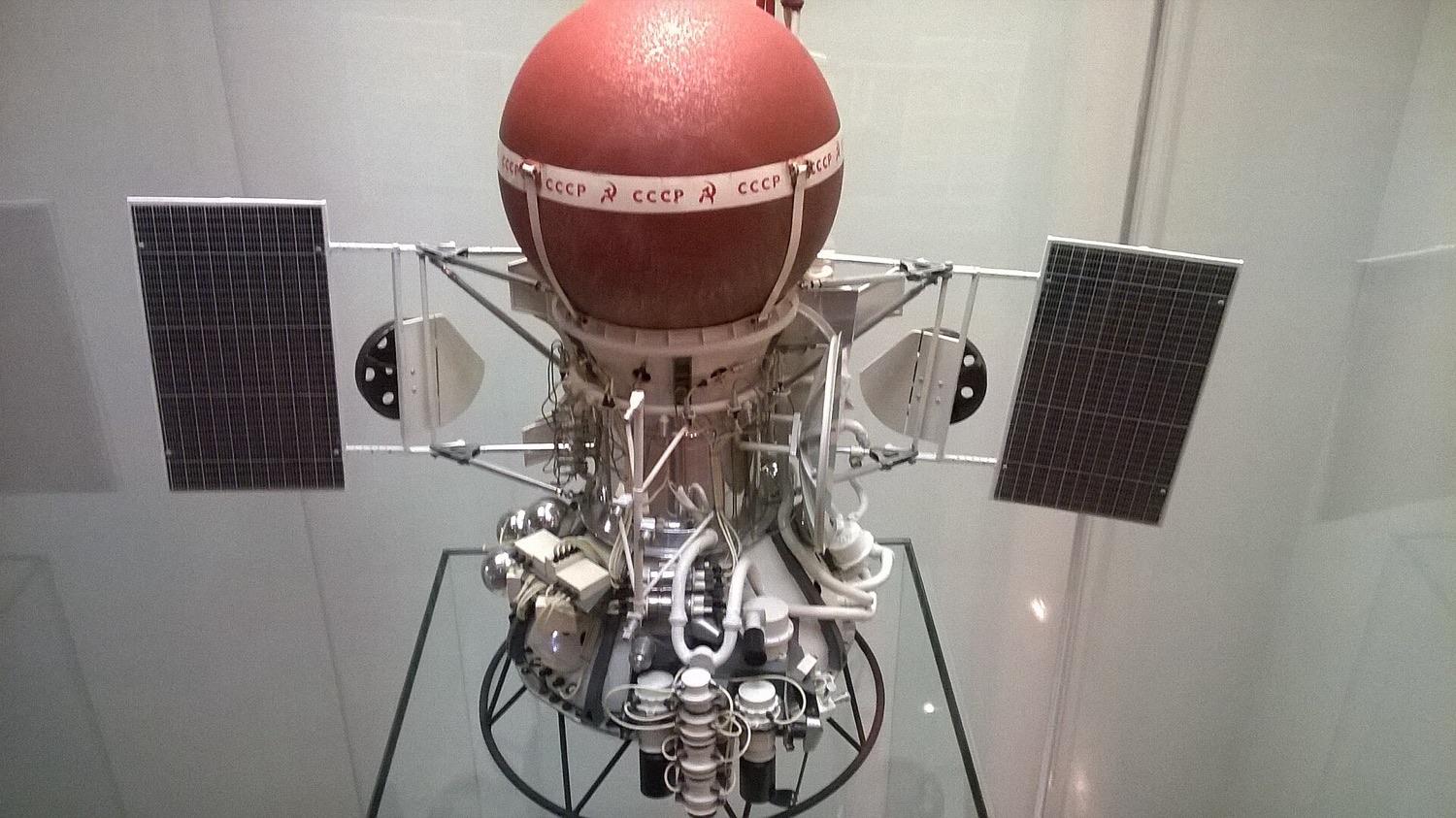
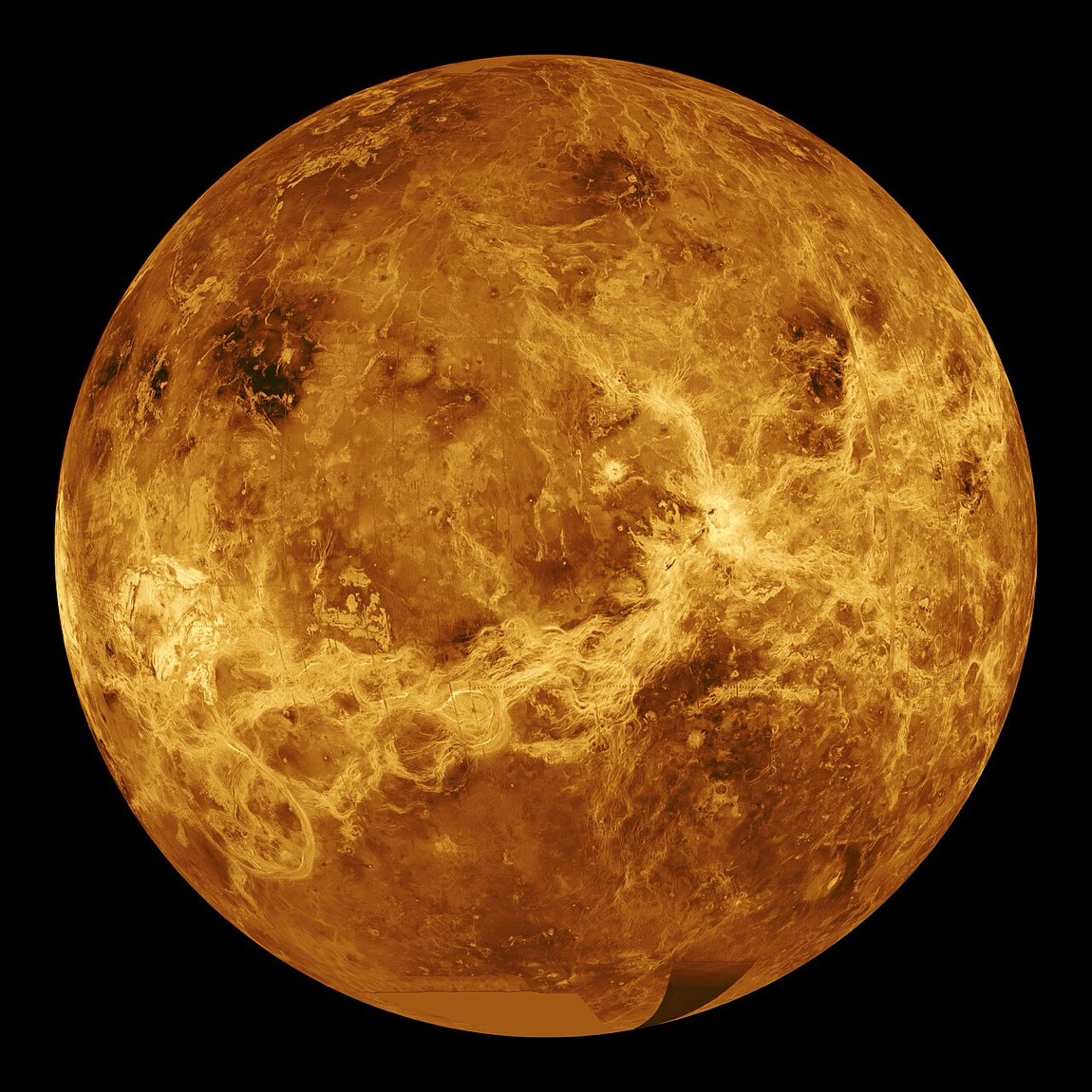
The first interplanetary spaceflight in history was launched toward Venus: the Soviet Venera 1 in 1961, which lost contact en route. Mariner 2 achieved the first successful interplanetary mission, passing 34,833 km above Venus on 14 December 1962 and returning the first data from another planet. Venera 4 in 1967 became the first craft to return science data from inside another planet's atmosphere, measuring surface temperatures near 500 °C and finding the atmosphere was 95% carbon dioxide. Venera 7 on 15 December 1970 made the first soft landing on another planet and the first transmission of data from its surface. The first images from the Venusian surface arrived in 1975 from Venera 9 and 10, in black and white; colour-filtered images followed from Venera 13 and 14 in 1982. Magellan mapped the surface between 1990 and 1994. The European Venus Express orbited from April 2006 until January 2015, discovering the south polar double vortex and an ozone layer high in the atmosphere, and providing the clearest evidence yet of ongoing volcanism. Japan's Akatsuki was active in orbit from 2015 to 2024. In 1974, Mariner 10's Venus flyby was the first gravity assist ever performed, a technique now routine in interplanetary navigation.
14 The strange arithmetic of a Venusian day
Venus rotates backwards relative to most planets — clockwise as seen from above the solar system's north pole — and it does so extraordinarily slowly. Its sidereal day lasts 243 Earth days, which is actually longer than its year of 224.7 Earth days. Because the rotation is retrograde, the solar day — the time from one sunrise to the next — works out to 116.75 Earth days, roughly half a Venusian year. To an observer on the surface, the Sun would rise in the west and set in the east, though the opaque cloud cover makes this impossible to see directly. The day length is not even constant: it fluctuates by up to 20 minutes because of the massive atmosphere's interaction with solar heating. Data from Magellan over 500 days gave a rotation period measurably different from the value obtained across the 16-year gap between Magellan and Venus Express, with a discrepancy of about 6.5 minutes. The current slow retrograde spin is thought to be the equilibrium outcome of two opposing forces: gravitational tidal locking by the Sun, which tries to slow and then reverse rotation, and atmospheric tides driven by solar heating of the thick atmosphere, which resist that locking.
15 Venus in the sky: how to spot and follow it
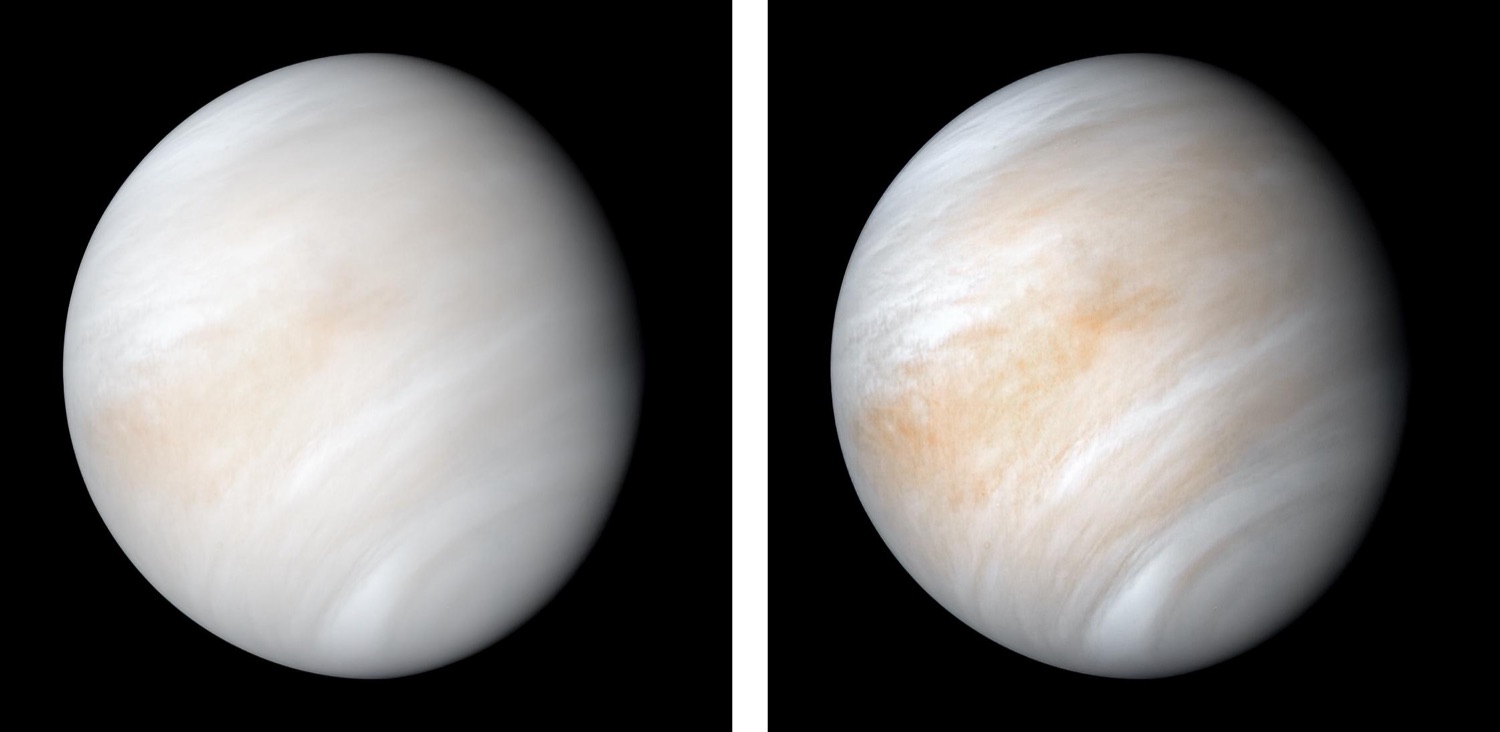
No natural point of light in the night sky rivals Venus. Its maximum apparent magnitude reaches −4.92, and even at its faintest during a transit it shines at −2.98. The planet is brilliant enough to see in full daylight once you know where to look — astronomer Edmund Halley calculated its peak daytime brightness in 1716, when Londoners alarmed by the apparition began reporting it as something extraordinary. Napoleon Bonaparte reportedly witnessed a daytime Venus sighting, as did observers at Abraham Lincoln's inauguration on 4 March 1865. Venus switches between morning star and evening star every 584 days as it overtakes Earth in its faster inner orbit. Its maximum elongation from the Sun reaches about 47°, meaning it can hang in a fully dark sky well after sunset or before sunrise. Because its orbit is inclined to Earth's, Venus can appear more than 8° north or south of the ecliptic — more than any other planet or the Moon — and can actually be north of the Sun while simultaneously visible as both morning and evening star on the same day from the northern hemisphere. Its phases, visible in a 4-inch telescope, cycle through crescent, quarter, and full just as the Moon does, and its apparent disc size changes dramatically between inferior and superior conjunction.
 ⤢
⤢
16 Transits, pentagram orbits, and cosmic geometry Deeper
The geometry of Venus and Earth's orbits produces patterns of remarkable elegance. The two planets share a near 13:8 orbital resonance — Earth orbits eight times for every 13 orbits of Venus — which brings them to inferior conjunction in synodic periods averaging 584 days. Plotted geocentrically over five successive conjunctions, Venus traces a pentagram, shifting 144° each time, sometimes called the "petals of Venus" for its flower-like appearance. Transits of Venus — when the planet crosses the face of the Sun — follow an 8-year, 105.5-year, 8-year, 121.5-year repeating pattern within 243-year cycles. Johannes Kepler first predicted them in 1621; Jeremiah Horrocks made the first confirmed observation on 4 December 1639, along with his friend William Crabtree watching from their separate homes. Captain Cook's 1768 voyage to Tahiti to record the third observed transit indirectly led to the exploration of Australia's east coast. Only seven Venus transits have been observed in recorded history; the most recent pair occurred on 8 June 2004 and 5–6 June 2012, and the next will not happen until December 2117 and December 2125 — beyond any living person's lifetime. Historically, measuring transit timings allowed astronomers to calculate the astronomical unit and thus determine the true scale of the solar system.
17 What the ancient world saw in that bright star
Across nearly every culture that recorded the sky, Venus earned special status. In ancient Babylon, it was known first as Ninsi'anna — "divine lady, illumination of heaven" — with early cuneiform spellings using a sign meaning "to be red," possibly referencing the coloured horizon where Venus appears. Babylonian records including the Venus tablet of Ammisaduqa tracked it systematically, and the goddess Inanna's mythological journeys — descending to the underworld and returning — appear to mirror Venus disappearing below the western horizon and reappearing in the east. The Maya ranked Venus as the most important celestial body after the Sun and Moon, calling it Noh Ek', "the Great Star," and incorporated its cycles into their calendar and codices including the Dresden Codex. In Chinese tradition Venus was the metal star, Jīnxīng, associated with the element metal in five-element philosophy, a classification still shared across Chinese, Japanese, Korean, and Vietnamese cultures. In Old English the planet was called Ēarendel, meaning "ray of light." The Romans named it after their goddess of love, tracing a lineage back through the Greek Aphrodite to the Sumerian Inanna, and the weekday Friday — Venus's day — is named after the Germanic goddess Frigg, who was associated with Venus.
 ⤢
⤢
Diagram · Status as of September 2026
Half a century at Venus, and the return being planned
Soviet landers ruled the 1970s and 1980s. Then radar orbiters mapped the ground through the clouds. No orbiter has worked at Venus since Akatsuki fell silent in April 2024, and three new missions are planned for the early 2030s.
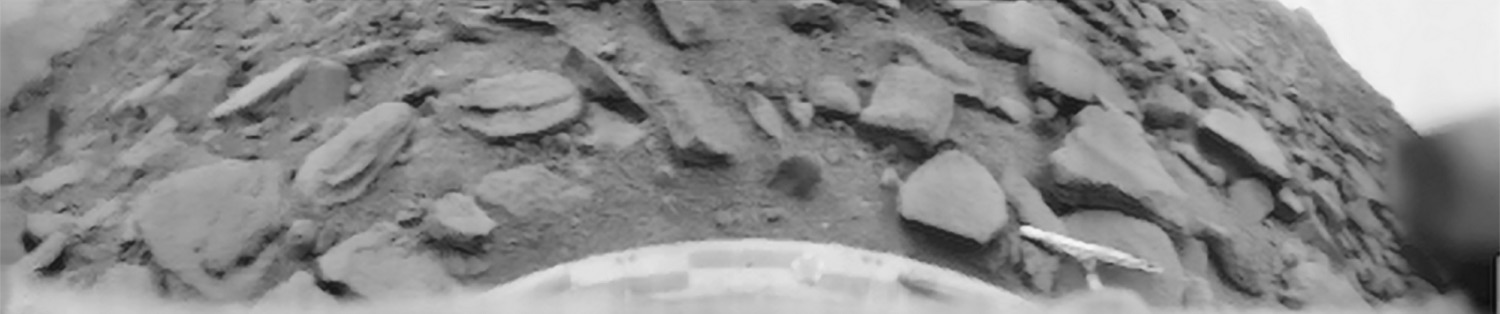
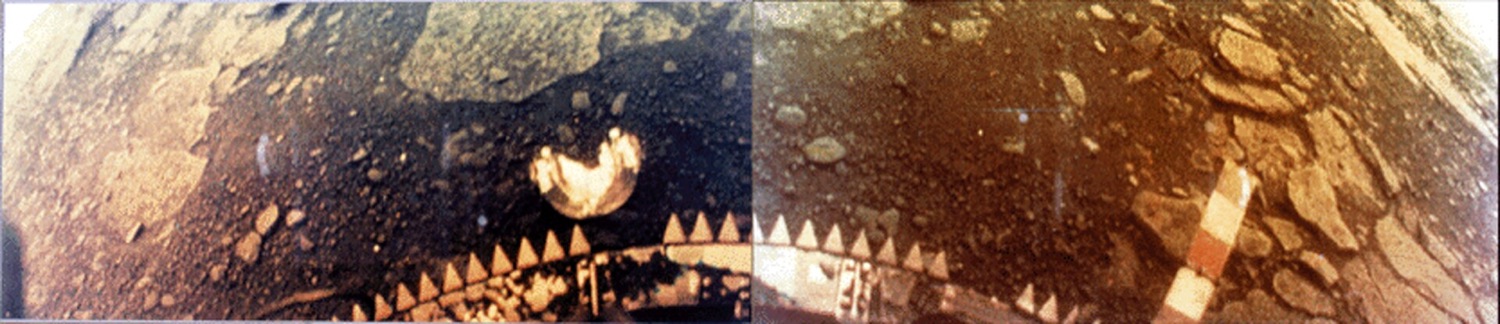
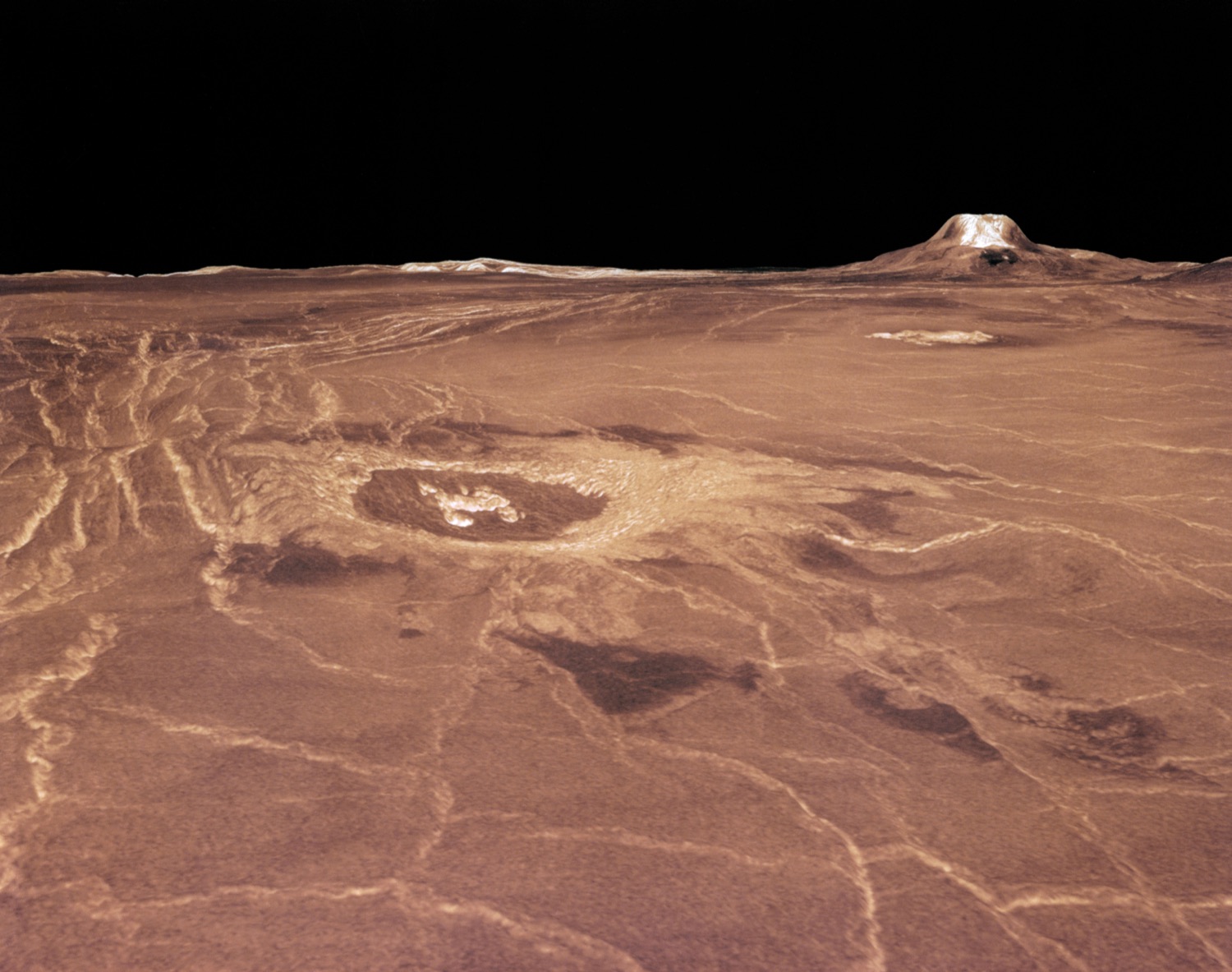
Every mission on this timeline, in order
- Venera 7 USSR · December 1970
The first signals ever received from the surface of another planet: 23 minutes of data. - Venera 8 USSR · July 1972
Sent back 50 minutes of data from the surface. - Mariner 10 NASA · February 1974
The first ultraviolet pictures of Venus, taken on the way to Mercury. - Venera 9 and 10 USSR · October 1975
The first pictures taken on the surface of another planet. - Venera 9 and 10 orbiters USSR · October 1975
The first spacecraft to orbit Venus. - Pioneer Venus Orbiter NASA · 1978 to 1992
Nearly 14 years of radar mapping and atmosphere studies. - Pioneer Venus 2 NASA · December 1978
Dropped four probes into the atmosphere at once. - Venera 11 and 12 USSR · December 1978
Landers that picked up signs of lightning on the way down. - Venera 13 and 14 USSR · March 1982
The first colour pictures of the surface. - Venera 15 and 16 USSR · 1983 to 1984
Radar maps of the northern hemisphere. - Vega 1 and 2 USSR · June 1985
Two landers, and the first balloons ever flown in another planet's atmosphere. - Galileo NASA · February 1990
A gravity assist on the way to Jupiter. - Magellan NASA · 1990 to 1994
Mapped 98% of the surface with radar. - Cassini NASA and ESA · 1998 and 1999
Two gravity assists on the way to Saturn. - Venus Express ESA · 2006 to 2014
Eight years studying the atmosphere. - MESSENGER NASA · 2006 and 2007
Two passes on the way to Mercury. - Akatsuki JAXA · 2015 to 2024
Tracked the winds that race around Venus far faster than the planet turns. Contact was lost in April 2024 and JAXA ended the mission in September 2025. - Parker Solar Probe NASA · Seven passes, 2018 to 2024
Its cameras caught the night-side surface glowing through the clouds. - BepiColombo ESA and JAXA · 2020 and 2021
Two passes on the way to Mercury. - DAVINCI NASA · Launch targeted for the early 2030s Planned
An orbiter carrying a descent probe, selected by NASA in 2021. - VERITAS NASA · Launch no earlier than 2031 Planned
A radar orbiter to map the surface in high resolution. - EnVision ESA · Launch planned for 2031 Planned
An orbiter with radar and spectrometers. - DAVINCI probe NASA · About two years after launch Planned
Samples the atmosphere all the way down and photographs the Alpha Regio highlands.
Earlier, Mariner 2 flew past in 1962 and Venera 4 sent back the first data from inside the atmosphere in 1967. Photographs: Mariner 10 (NASA/JPL-Caltech), Venera 9 (image processing by Ted Stryk), Venera 13 (USSR/NASA) and Magellan (NASA), all public domain. Sources: The Planetary Society’s mission list; NASA, ESA and JAXA. Planned launch dates can move.
You would weigh…
Surface gravity 8.87 m/s² vs Earth’s 9.81 m/s². Try every world →
Could life exist here?
The surface is sterilizingly hot. The one debated possibility is microbial chemistry in the temperate cloud layer — the phosphine claim remains unconfirmed and contested. There is no evidence of life on Venus.
Our labels: Confirmed · Strong Evidence · Estimated · Hypothesis · Theoretical · Speculative (see Methodology).
Could humans live here?
Not on the surface — no cooling system we can build survives 464 °C at 92 bars for long. Floating habitats at ~50 km altitude, where pressure and temperature are nearly Earth-like, are a serious (if far-off) concept: breathable air is itself a lifting gas on Venus, so a city could float like a balloon.
How would we get there?
Venus is the easiest planet to reach: launch windows open every 19 months and transfers take 3–5 months with current rockets. Many missions use Venus flybys as a free gravity slingshot on their way elsewhere.
| Technology | Status | Travel time (one way, straight line) |
|---|---|---|
| Apollo-style spacecraft, about 39,000 km/h | Flown technology | 182 days |
| Ion-propulsion probe, about 90,000 km/h | Flown technology | 79 days |
| Voyager 1, about 61,000 km/h | Flown technology | 116 days |
| Parker Solar Probe, about 690,000 km/h | Flown technology | 10 days |
| Nuclear-thermal rocket, about 120,000 km/h cruise | In development | 60 days |
| Laser light-sail at 20% of light speed | Proposed concept | 47 minutes |
| Light itself, 299,792 km/s | Physical limit | 9 minutes |
Simplified straight-line times at cruise speed. Real missions fly curved orbital paths and take longer. Full travel calculator →
Weird & wonderful
- A day on Venus is longer than its year.
- The Sun rises in the west on Venus, because the planet spins backwards.
- Venus's clouds would dissolve your umbrella — they are made of sulfuric acid.
- Air pressure at the surface equals diving 900 meters under Earth's ocean.