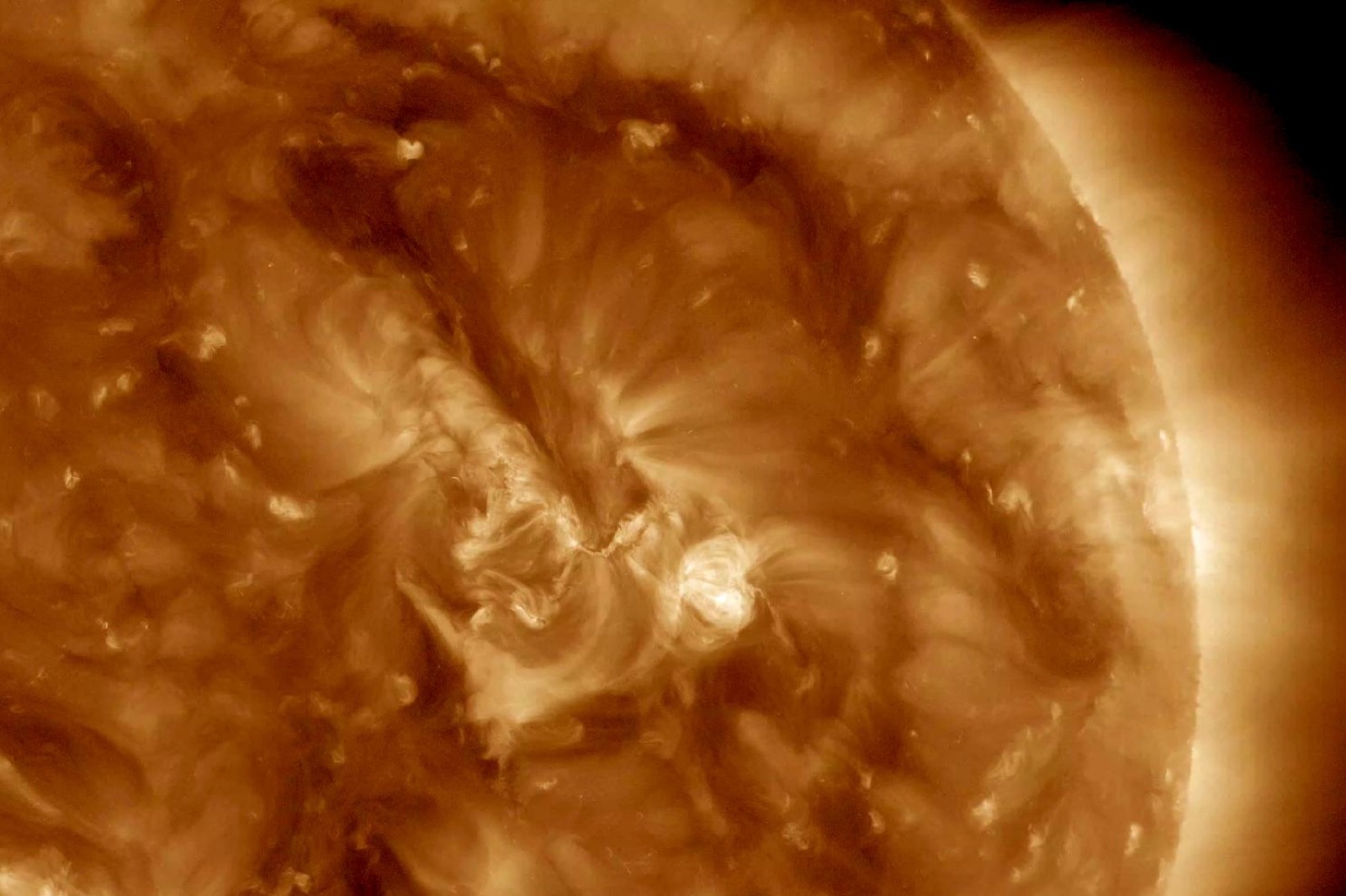
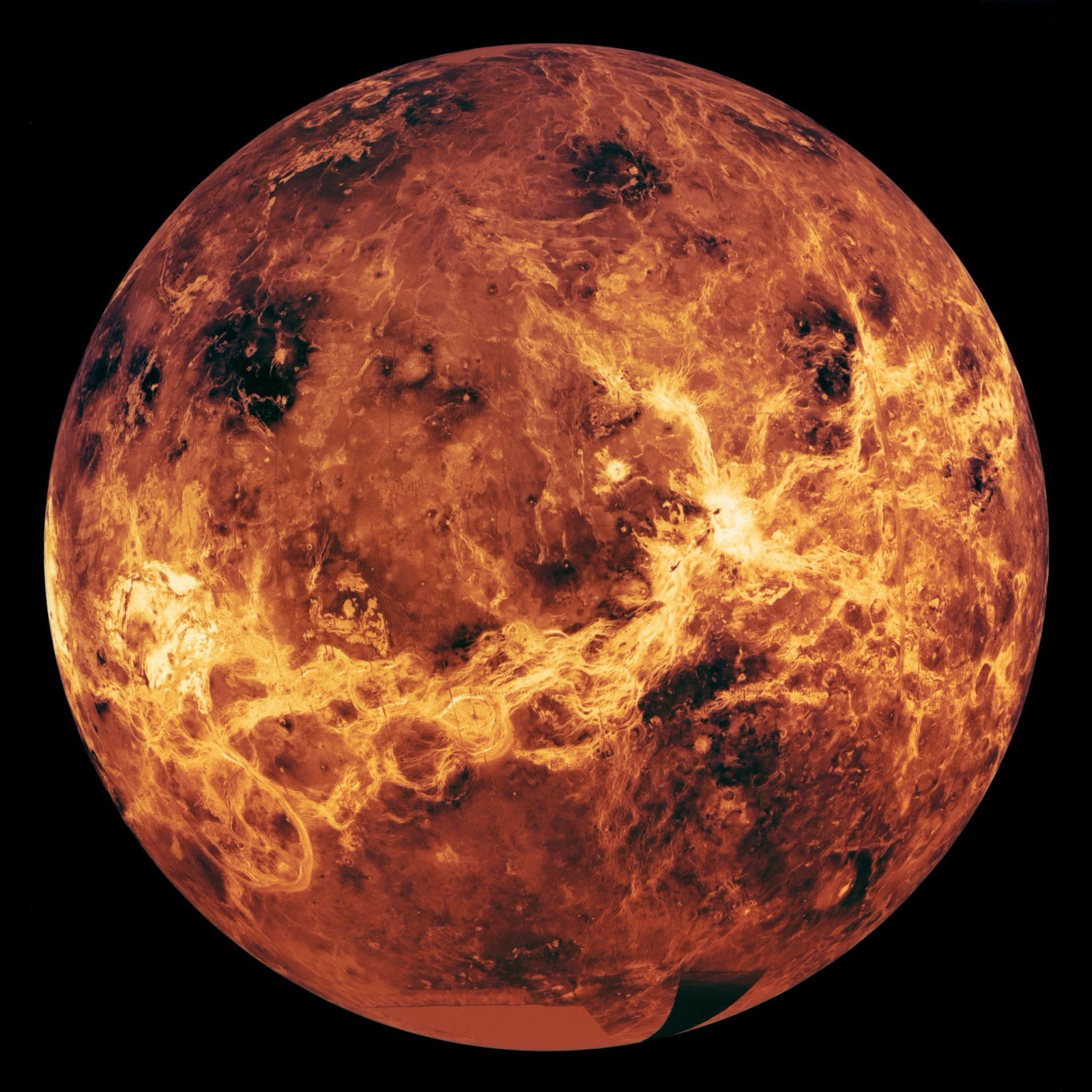
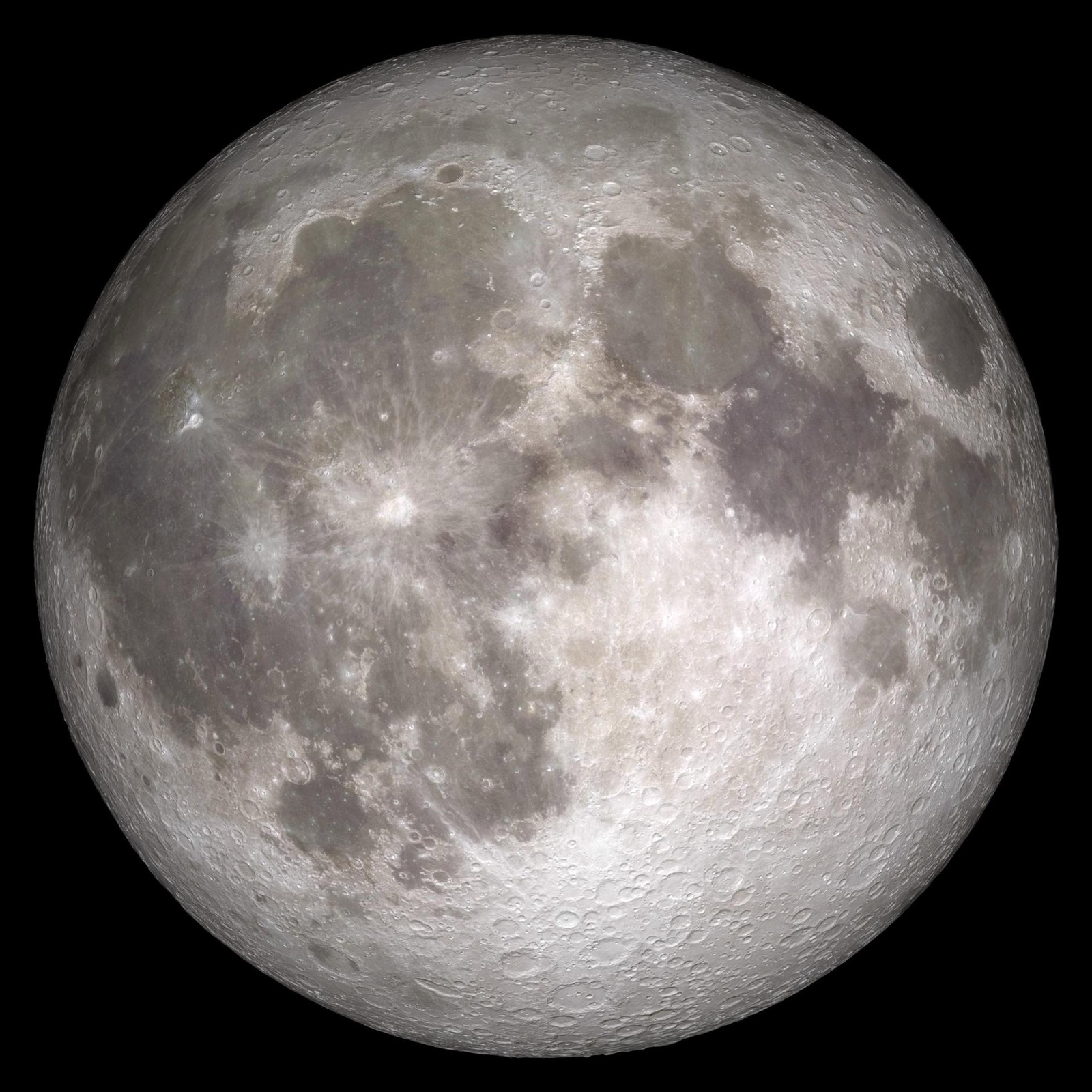
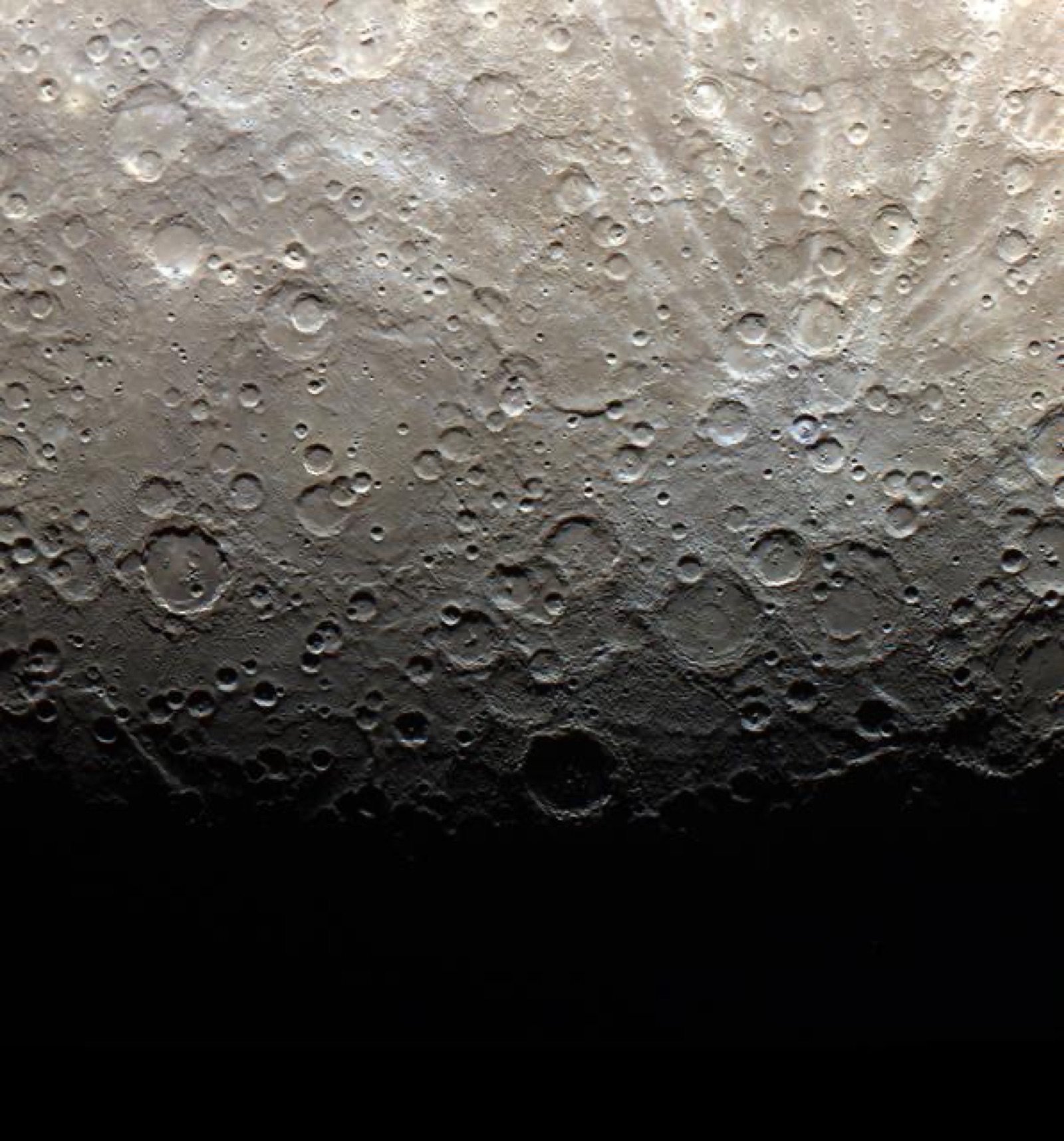
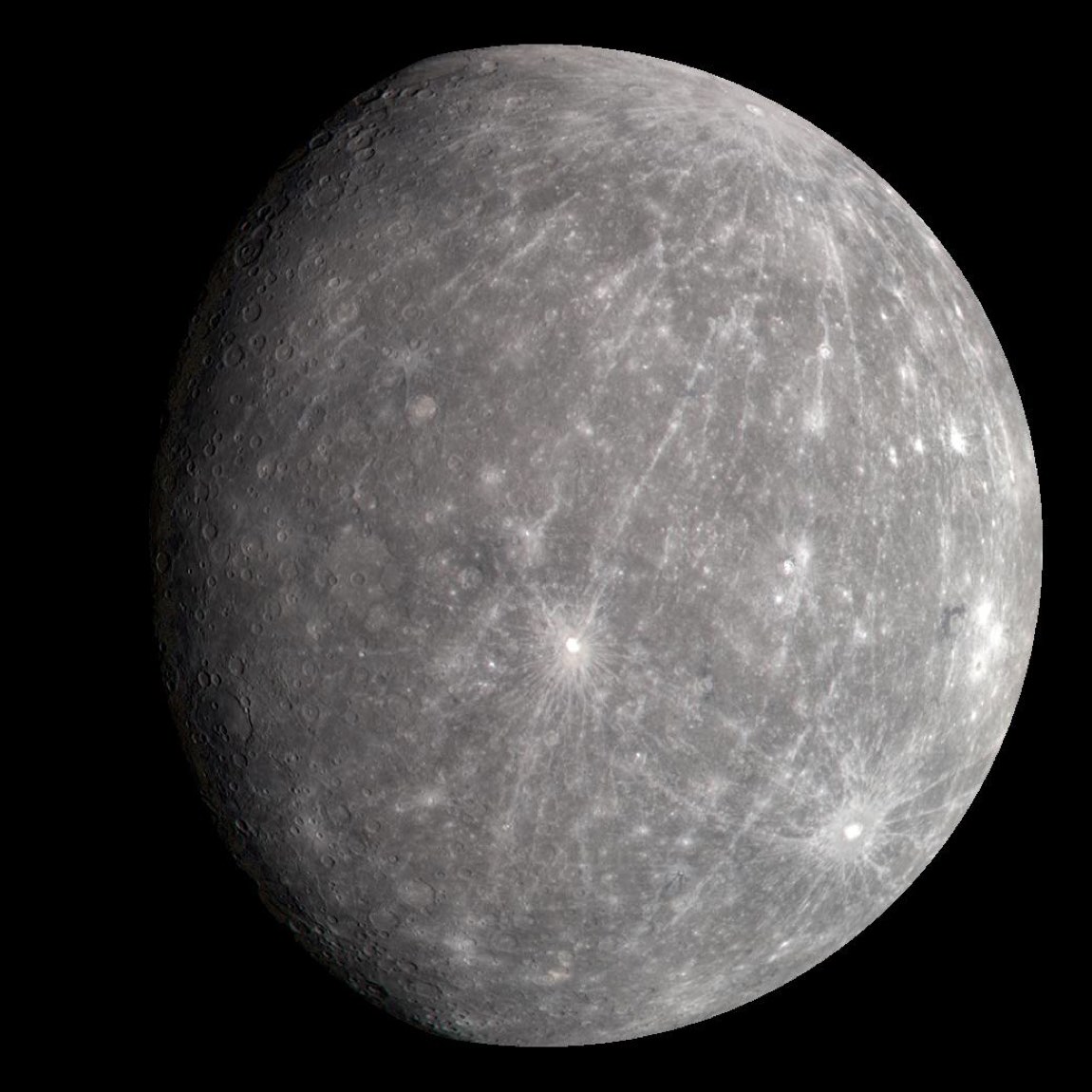
 Photograph · GSFC / NASA Image Library
Planet · Deep guide · orbits The Sun
Mercury
Smallest of the planets and closest to the Sun, Mercury is a cratered world of brutal extremes.
What is it?
Mercury is the Solar System's smallest planet, only a little larger than Earth's Moon, and the closest one to the Sun. It has almost no atmosphere, so its surface swings between scorching days and freezing nights — the biggest temperature swing of any planet. Its gray, crater-covered face looks a lot like the Moon's.
Go deeper
Mercury is a rocky world with an oversized iron core — about 85% of the planet's radius — likely the remnant of a larger body stripped by giant impacts or formed iron-rich in the hot inner nebula. It is locked in a 3:2 spin–orbit resonance: three rotations for every two orbits, which stretches a single solar day (sunrise to sunrise) to 176 Earth days. Despite the daytime heat, permanently shadowed polar craters hold confirmed water ice.
01 What is it like there?
Standing on Mercury you would see a black sky even in daytime (no air to scatter light), a Sun up to three times bigger than it looks from Earth, and gray cratered plains in every direction. With no atmosphere to hold heat, stepping from sunlight into shadow could mean a swing of hundreds of degrees.
02 A shrinking planet Deeper
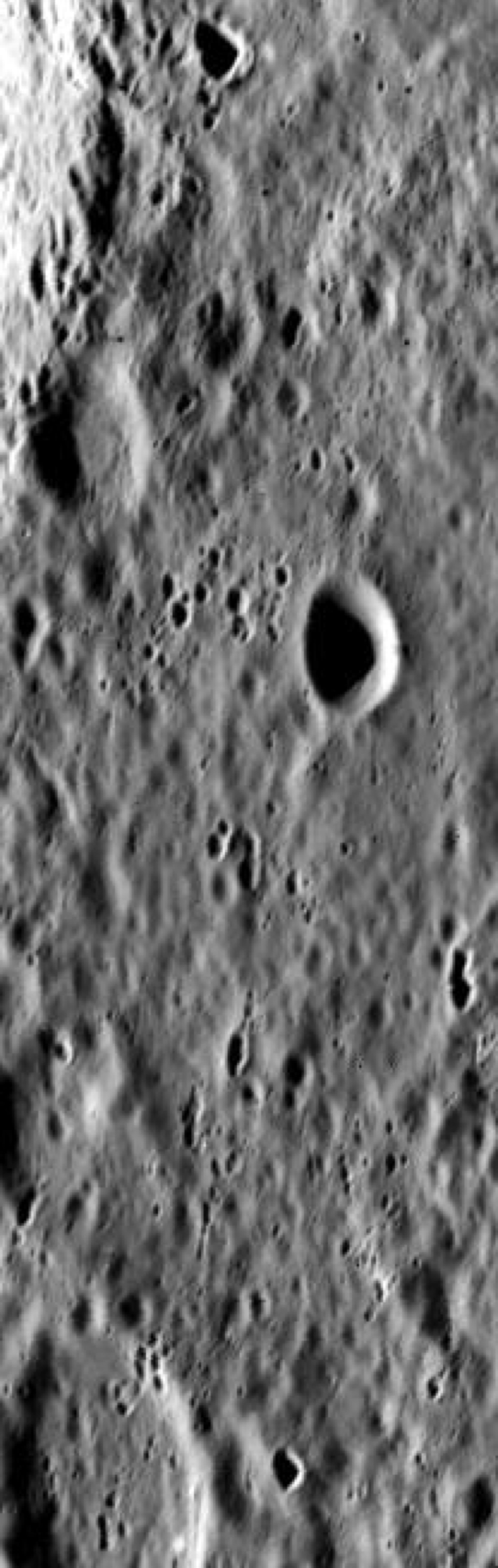
As Mercury's huge iron core slowly cools, the whole planet contracts. Great cliff-like faults called lobate scarps — some hundreds of kilometers long — wrinkle its surface. Mercury has shrunk several kilometers in radius over its history and may still be shrinking today.
03 Why is Mercury hard to visit? Deeper
Falling toward the Sun means picking up enormous speed, so a spacecraft needs huge braking to enter orbit. MESSENGER took six planetary flybys over 6.5 years to arrive; BepiColombo needed nine. That is why Mercury has had fewer visitors than Mars, despite being closer.
The deep dive
Researched for the Atlas from Wikipedia — Mercury (planet) (50,802 characters read) · updated Sep 20, 2026
 ⤢
⤢
04 A name carried across cultures
Long before anyone knew it was a planet, Mercury was two separate things in the sky. Ancient observers saw a morning apparition and an evening apparition and gave them different names. By about 350 BC, the ancient Greeks had worked out that both were the same object, calling it Stilbōn — "twinkling" — and also Hermēs, for its fleeting motion across the sky. That Greek name survives in modern Greek today as Ermis. The Romans renamed it Mercurius after their swift-footed messenger god, a choice that made obvious sense: Mercury moves across the sky faster than any other planet. Babylonians knew it as Nabu, their divine messenger. In medieval and modern East Asian cultures, the planet is called the "water star" based on the Five Phases system of metaphysics — an association it still carries in Chinese, Korean, Japanese, and Vietnamese. Hindu tradition named it Budha, presiding deity of Wednesday. The Maya may have represented it as an owl serving as a messenger to the underworld. Even the astronomical symbol ☿ is ancient — a stylized version of Hermes' caduceus, to which a Christian cross was added only in the 16th century.
05 An iron world unlike any other Deeper
Mercury's interior is extraordinary even by planetary standards. Its core radius is estimated at 2,020 ± 30 km, meaning the core occupies about 57% of the planet's total volume — compared to just 17% for Earth's core. That iron-rich core is the reason Mercury's density reaches 5.427 g/cm³, the second highest in the Solar System behind only Earth's 5.515 g/cm³. The comparison becomes even more striking when you remove the effect of gravitational compression: Mercury's uncompressed density would be 5.3 g/cm³ versus Earth's 4.4 g/cm³, meaning Mercury's raw materials are intrinsically denser. Research published in 2007 suggests the core is at least partly molten, likely kept liquid by tidal heating driven by the planet's highly eccentric orbit. Above the core sits a layered structure: a liquid outer core, a solid metallic outer-core layer, and a mantle-crust combination totaling just 420 km thick. The crust itself may be only 26–35 km thick depending on the model used. The core's composition almost certainly includes nickel and silicon, and probably sulfur and carbon as well, though the exact mix remains uncertain.
06 Three ideas for why Mercury is so dense Deeper
Scientists have proposed three main hypotheses to explain why Mercury has such a disproportionately large iron core. The most widely accepted is a giant impact: early in Solar System history, a planetesimal roughly one-sixth of Mercury's mass and several thousand kilometers across slammed into the proto-planet, blasting away much of its original silicate crust and mantle and leaving the dense core behind — a process analogous to the giant impact thought to have formed Earth's Moon. A second hypothesis holds that when the Sun was still contracting, temperatures near Mercury reached between 2,500 and 10,000 K, vaporizing surface rock into an atmosphere of "rock vapor" that was then swept away by the solar wind, stripping the planet of lighter material. A third idea suggests that drag from the solar nebula preferentially removed lighter particles during Mercury's formation, so the planet never accreted them in the first place. Crucially, MESSENGER found higher-than-expected levels of potassium and sulfur on the surface — volatile elements that would have been driven off by the extreme heat of the first two scenarios — which appears to favor the third hypothesis. BepiColombo, expected to enter orbit in 2026, is designed to make observations that may finally settle the question.
 ⤢
⤢
07 Surface features and who gets named there
Mercury's surface is a catalog of geological violence: craters, ridges, plains, valleys, escarpments, and mountains, all governed by a strict International Astronomical Union naming system. Craters honor deceased artists, musicians, painters, and authors who made outstanding contributions — each must have been famous for more than fifty years and dead for more than three years before the crater is formally named. The ridges called dorsa are named for scientists who studied Mercury. Depressions called fossae take their names from works of architecture. The mountains, or montes, are named for the word "hot" in various languages. Plains, or planitiae, carry Mercury's name in different languages. Escarpments called rupes are named for ships of scientific expeditions, while valleys take their names from abandoned ancient settlements. Among the most unusual features is Apollodorus crater — nicknamed "the Spider" — which has a series of radiating troughs extending outward from the impact site. At the antipode of the giant Caloris Basin sits the "Weird Terrain," a region of disrupted, hilly ground thought to have been shattered by shock waves that traveled all the way around the planet from the Caloris impact and converged on the opposite side.
08 Mercury's ancient craters and young scars
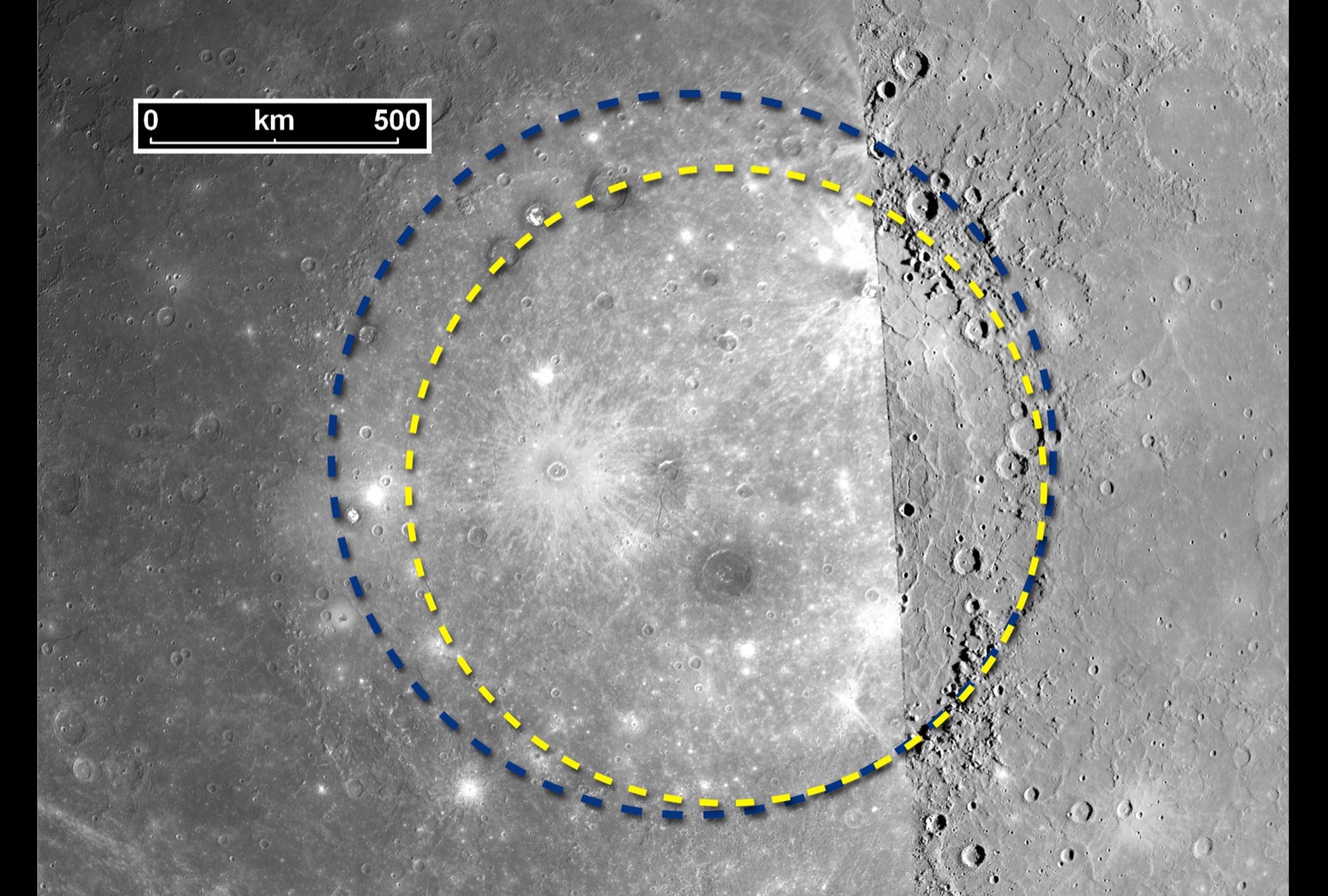
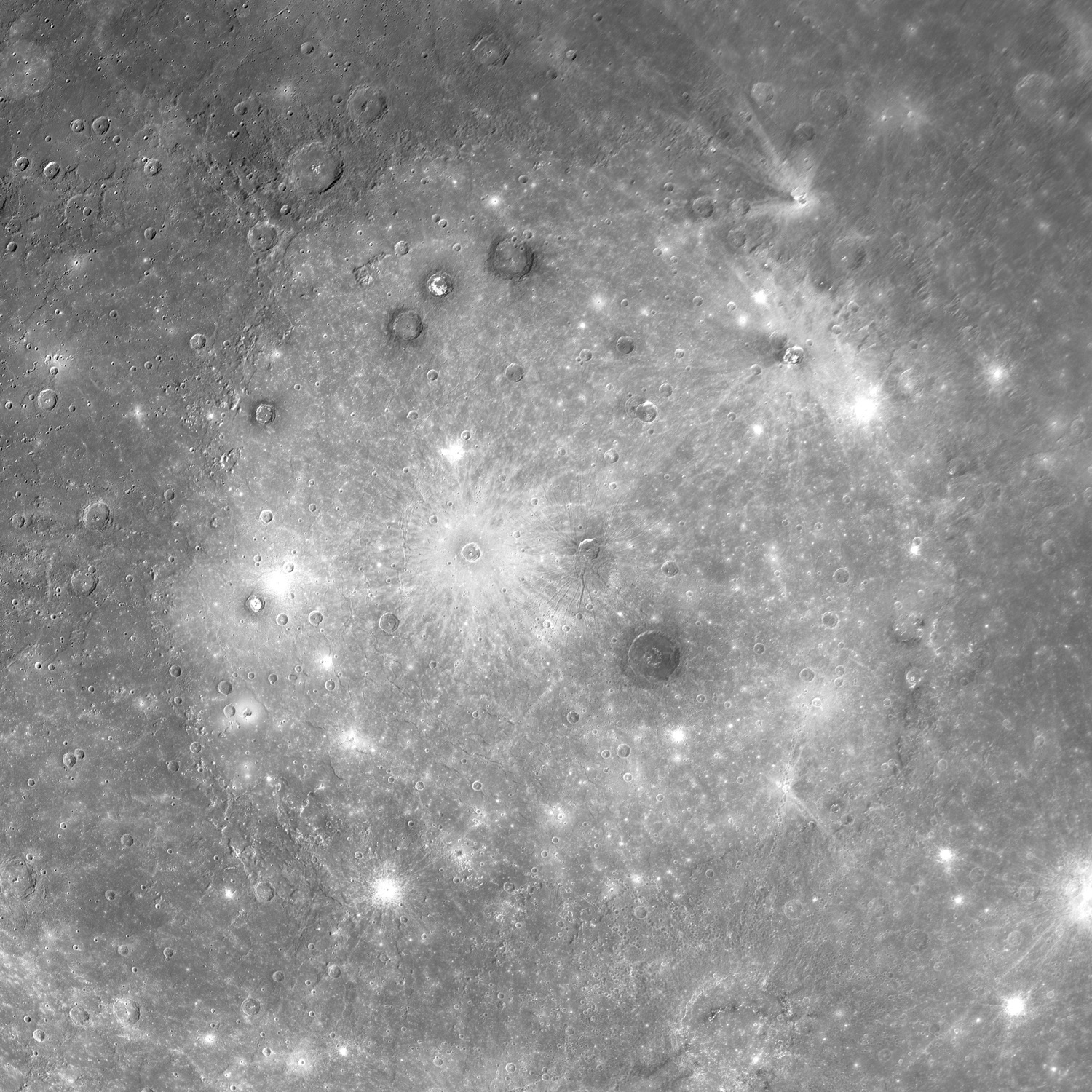
Mercury was pummeled heavily during two overlapping periods of early Solar System history: the initial formation phase roughly 4.6 billion years ago and a subsequent episode called the Late Heavy Bombardment that ended about 3.8 billion years ago. With no atmosphere to slow incoming rocks, every impactor hit the surface at full speed. The Caloris Basin, 1,550 km in diameter — roughly a third of Mercury's entire width — is the most dramatic result. The impact that formed it was powerful enough to trigger lava eruptions and raise a concentric mountainous ring about 2 km tall around the rim. Forty-six impact basins have been identified in total. The Tolstoj Basin measures 400 km across and its ejecta blanket spreads up to 500 km from the rim. Beethoven Basin has a rim 625 km in diameter. Yet not all geological scars are ancient: small-scale thrust fault scarps, tens of meters high and a few kilometers long, appear to be less than 50 million years old, confirming that Mercury's interior is still slowly contracting and reshaping the surface right now. Craters on Mercury also differ subtly from those on the Moon — the ejecta blankets are smaller because Mercury's stronger surface gravity pulls material back down more quickly.
09 Volcanoes, vents, and ancient lava floods Deeper
Mercury was once far more volcanically alive than its battered, quiet face suggests today. Scientists have identified 51 pyroclastic deposits — the remnants of explosive volcanic eruptions — and about 90% of them sit inside impact craters, where the fractures caused by impacts apparently created pathways for magma to reach the surface. A compound volcanic structure inside the southwest rim of the Caloris Basin consists of at least nine overlapping vents, each up to 8 km in diameter, with floors at least 1 km below their rims; the scientists who studied it could not pin down its age precisely but estimated it could be on the order of a billion years old. Broader lava flooding produced smooth plains across the planet, closely resembling the maria found on the Moon. These smooth plains all formed significantly later than the Caloris basin itself, as shown by their lower crater densities. There are also two geologically distinct older plains: gently rolling inter-crater plains that predate the heavy cratering and appear to have obliterated earlier craters, and the younger, flat smooth plains that fill depressions of various sizes. Whether the fill material inside the Caloris Basin itself is volcanic lava or a sheet of impact melt remains an open question.
 ⤢
⤢
10 The Sun does something strange in Mercury's sky
Standing on certain parts of Mercury near perihelion would give you a solar spectacle that exists nowhere else in the Solar System. As Mercury approaches its closest point to the Sun, its angular orbital velocity overtakes its angular rotational velocity. From the surface, the Sun would appear to slow down, stop, reverse direction, stop again, then resume its normal westward motion — all within the same day. At two specific points on the equator, separated by 180 degrees of longitude, the Sun passes directly overhead, then reverses and passes overhead again, then reverses a second time and passes overhead a third time, with the entire process taking about 16 Earth days. Because Mercury is also nearest the Sun during this period, the Sun appears at its largest and most brilliant — making these two equatorial points the hottest places on the entire planet. Maximum temperature at these spots occurs not exactly at noon but when the Sun is about 25 degrees past the noon position, due to a thermal lag of 0.4 Mercury days. At two other equatorial points 90 degrees away, the opposite is true: the Sun passes overhead only during aphelion, travels more quickly across the sky, and delivers far less heat.
11 Magnetic tornadoes and a leaky shield Deeper
Mercury's magnetic field is roughly 1.1% the strength of Earth's, with an equatorial field strength of about 300 nT, but it has a character all its own. Like Earth's, it is dipolar and nearly aligned with the planet's spin axis — tilted just 10 degrees, compared to 11 degrees for Earth. It is almost certainly generated by a dynamo driven by the circulation of the planet's iron-rich liquid outer core, kept partially molten by the strong tidal heating that Mercury's eccentric orbit produces. However, during its second flyby on October 6, 2008, MESSENGER discovered that this magnetic shield is remarkably "leaky." The spacecraft encountered twisted bundles of magnetic field lines — called flux transfer events — connecting Mercury's field to interplanetary space and forming open windows up to 800 km wide, roughly a third of the planet's radius. Through these magnetic tornadoes, the solar wind can pour directly onto Mercury's surface via magnetic reconnection. The reconnection rate at Mercury was found to be ten times higher than at Earth, though Mercury's proximity to the Sun explains only about a third of that difference. The result is that the surface is exposed to intense space weathering despite the planet having a magnetic field at all.
12 How perihelion helped prove Einstein right Deeper
Mercury delivered one of the most important observational tests in the history of physics. In 1859, the French astronomer Urbain Le Verrier reported that Mercury's orbit precesses — its ellipse slowly rotates around the Sun — faster than Newtonian gravity could account for, even after including the gravitational tugs of all known planets. The unexplained excess was 42.980 ± 0.001 arcseconds per century, a tiny but stubbornly persistent discrepancy. Various explanations were proposed, including a hypothetical inner planet named Vulcan and a slight flattening of the Sun, but none worked. When Albert Einstein published his general theory of relativity in the early 20th century, it explained the excess exactly by treating gravity as the curvature of spacetime. At Mercury's distance from the Sun, where spacetime curvature is strongest among the planets, the effect accumulates to 0.43 arcseconds per year — enough to require more than 12.5 million orbits, or about 3 million years, for one full extra rotation of the orbit. The same effect exists for other bodies — 8.6247 arcseconds per century for Venus, 3.8387 for Earth — but Mercury's combination of proximity and eccentricity made it the place where the discrepancy was first noticed and finally explained.
 ⤢
⤢
13 How astronomers finally learned to observe it
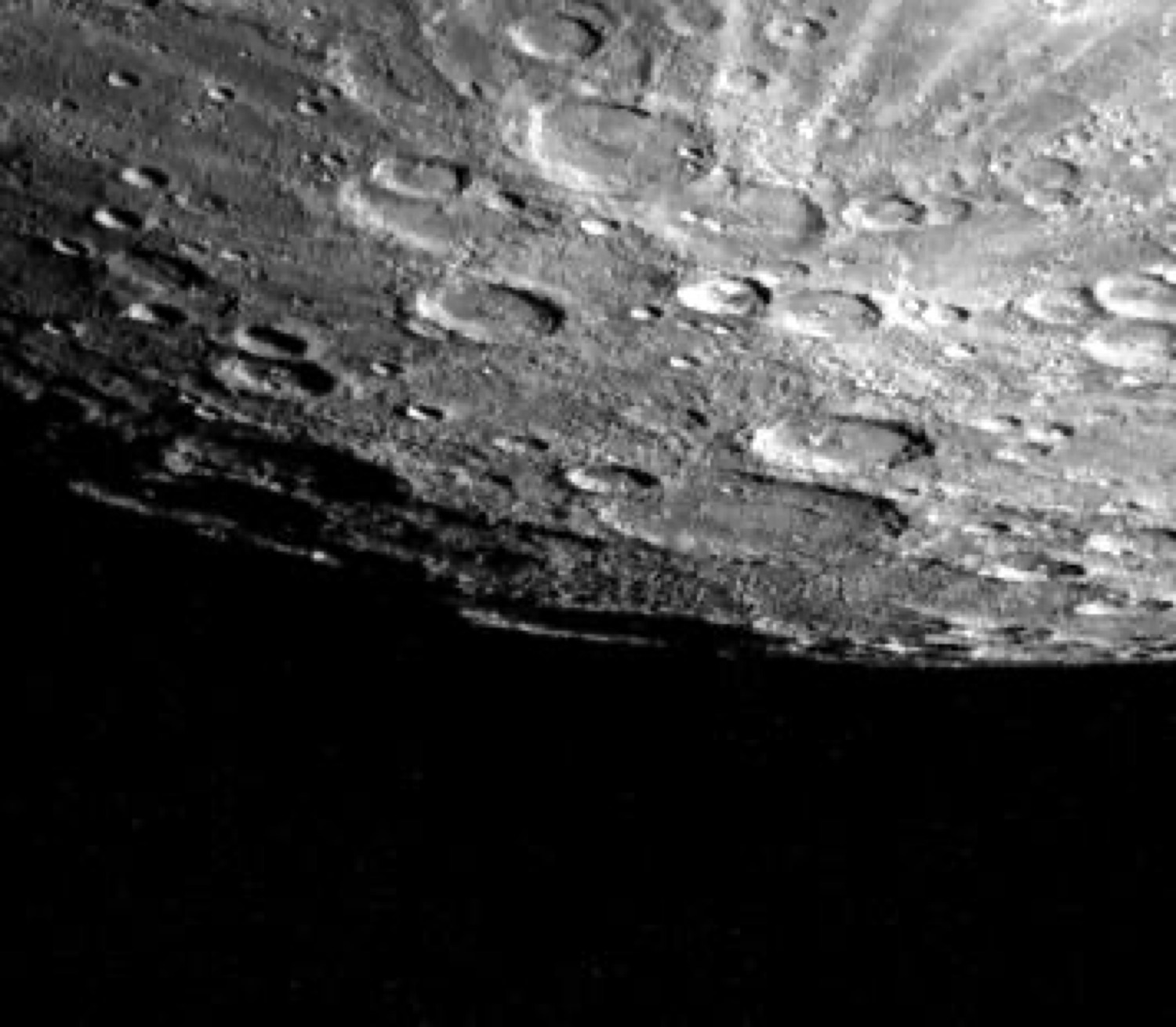
Mercury is notoriously difficult to study from Earth. It never strays far from the Sun in the sky, its separation ranging from only 17.9 degrees at perihelion to 27.8 degrees at aphelion during greatest elongation, so it can only be seen during twilight. Its apparent magnitude swings dramatically — from −2.48, brighter than Sirius, near superior conjunction, to +7.25, below naked-eye visibility, near inferior conjunction — giving it the largest standard deviation in apparent magnitude of any planet. The Hubble Space Telescope cannot observe it at all because safety rules prevent pointing the telescope that close to the Sun. Ground-based telescopes show only a partially lit disk with little detail. Interestingly, observers in the Southern Hemisphere get better views because the geometry of Mercury's orbit places its greatest elongations at steeper angles above the horizon there. A daytime telescopic method works surprisingly well: at greatest elongation, Mercury can be found even with an 8 cm aperture telescope during daylight, when the planet rides higher and atmospheric turbulence is lower — though extreme care to block the Sun is essential. Radar has proven especially powerful: the 300-metre Arecibo telescope confirmed Mercury's true rotation period in 1965, and later radar mapping achieved 5 km resolution of the entire surface.
14 A long history of being misread
The story of how humans slowly decoded Mercury is full of confident errors. The earliest known recorded observations come from Assyrian astronomers around the 14th century BC, preserved on MUL.APIN tablets where Mercury is described as "the jumping planet." Telescopic observation began with Thomas Harriot and Galileo in 1610. In 1631 Pierre Gassendi made the first telescopic observation of a planetary transit across the Sun, watching Mercury cross the solar disk as Johannes Kepler had predicted. By the 1880s, Giovanni Schiaparelli had concluded — incorrectly — that Mercury was tidally locked and rotated once per orbit, always showing the same face to the Sun. Eugenios Antoniadi published maps based on this assumption in 1934, and those maps became authoritative. The error persisted until 1965, when radar observations by Gordon Pettengill and Rolf Dyce using the Arecibo telescope proved the rotation period was about 59 days. In the same year, Italian astronomer Giuseppe Colombo recognized this was exactly two-thirds of the orbital period and proposed the 3:2 spin-orbit resonance that Mariner 10 later confirmed. Schiaparelli's and Antoniadi's maps were not entirely wrong — they had simply mapped the same hemisphere each time, because the orbital geometry always brought that face into view under the best observing conditions.
15 What three spacecraft have taught us
Only three spacecraft have ever visited Mercury. Mariner 10, launched by NASA, made three close approaches between 1974 and 1975, coming as near as 327 km from the surface. It was the first spacecraft to use a gravitational slingshot off another planet — Venus — to reach its target, and the first NASA mission to visit multiple planets. Its cameras mapped less than 45% of the surface because the same hemisphere happened to be sunlit on each visit, but its instruments detected an unexpected magnetic field, astonishing scientists who assumed Mercury's slow rotation could not sustain a dynamo. On March 24, 1975, just eight days after its last flyby, Mariner 10 ran out of fuel and was shut down; it is thought to still orbit the Sun. MESSENGER launched in 2004 and entered orbit in March 2011, spending years mapping the full surface, measuring elemental abundances, and confirming water ice at the poles. It ended its mission by crashing into Mercury on April 30, 2015, leaving a crater estimated at 16 m in diameter. The joint European-Japanese BepiColombo mission, launched October 20, 2018, completed its sixth Mercury flyby on January 9, 2025, and is scheduled to enter orbit in 2026, carrying spectrometers sensitive to infrared, ultraviolet, X-ray, and gamma-ray wavelengths to test the competing formation hypotheses.
 ⤢
⤢
Diagram
An iron planet with a thin rocky skin
Mercury’s metal core reaches about 85% of the way from its centre to its surface, so the rock above it is only about 400 km thick. Earth’s core reaches just over halfway.
- CrustA thin outer skin of rock, cratered by billions of years of impacts.
- Rocky mantleAbout 400 km thick, crust included.
- Iron coreReaches about 2,074 km from the centre, 85% of the way out. At least part of it is molten.
- Solid inner coreBetween 30 and 70% of the core’s radius, worked out from MESSENGER’s radio tracking. The soft edge shows that range.
How far the core reaches toward the surface
Cut drawn to scale. Sources: NASA Science, Mercury facts; Genova et al. (2019), Geophysical Research Letters; Earth’s outer core radius of about 3,480 km from seismology.
Diagram
Three turns for every two orbits
Mercury spins once every 58.6 Earth days and circles the Sun every 88. The two rhythms are locked at 3 to 2, so one full day, from noon to noon, lasts 176 Earth days. Watch the orange meridian: at one perihelion it faces the Sun, and at the next the far side does.
The Sun seen from the orange meridian
The orbit is drawn to its true shape; Mercury and the Sun are not to scale. Rotation 58.646 days and orbit 87.969 days (NASA/JPL); a solar day of 176 Earth days (NASA Science).
You would weigh…
Surface gravity 3.70 m/s² vs Earth’s 9.81 m/s². Try every world →
Could life exist here?
No atmosphere, extreme temperature swings, and heavy radiation make Mercury one of the least habitable places in the Solar System. Its polar ice is intriguing chemistry, not evidence of life.
Our labels: Confirmed · Strong Evidence · Estimated · Hypothesis · Theoretical · Speculative (see Methodology).
Could humans live here?
Only in theory, and only at the poles: some crater rims near the poles get near-constant gentle sunlight next to permanently shadowed ice — a plausible spot for a heavily shielded base in far-future scenarios. Everywhere else, the day–night furnace-freezer cycle rules it out.
How would we get there?
Crewed missions are not planned. Robotic transfers take years: BepiColombo launched in 2018 on a seven-year, nine-flyby route. With current technology, cargo to Mercury is harder than cargo to Jupiter.
| Technology | Status | Travel time (one way, straight line) |
|---|---|---|
| Apollo-style spacecraft, about 39,000 km/h | Flown technology | 166 days |
| Ion-propulsion probe, about 90,000 km/h | Flown technology | 72 days |
| Voyager 1, about 61,000 km/h | Flown technology | 106 days |
| Parker Solar Probe, about 690,000 km/h | Flown technology | 9 days |
| Nuclear-thermal rocket, about 120,000 km/h cruise | In development | 54 days |
| Laser light-sail at 20% of light speed | Proposed concept | 43 minutes |
| Light itself, 299,792 km/s | Physical limit | 9 minutes |
Simplified straight-line times at cruise speed. Real missions fly curved orbital paths and take longer. Full travel calculator →
Weird & wonderful
- A single Mercury day (sunrise to sunrise) lasts two Mercury years.
- In some spots you could watch the Sun rise, stop, go backwards, then rise again — an effect of Mercury's stretched orbit.
- Mercury is shrinking as its iron heart cools.
- Despite roasting days, Mercury's shadowed polar craters are among the coldest places in the Solar System.