 Photograph · GSFC / NASA Image Library
Star · Deep guide
Alpha Centauri
Also called: Rigil Kentaurus & Toliman
The nearest star system you can see. Its two suns circle each other four light-years away.
What is it?
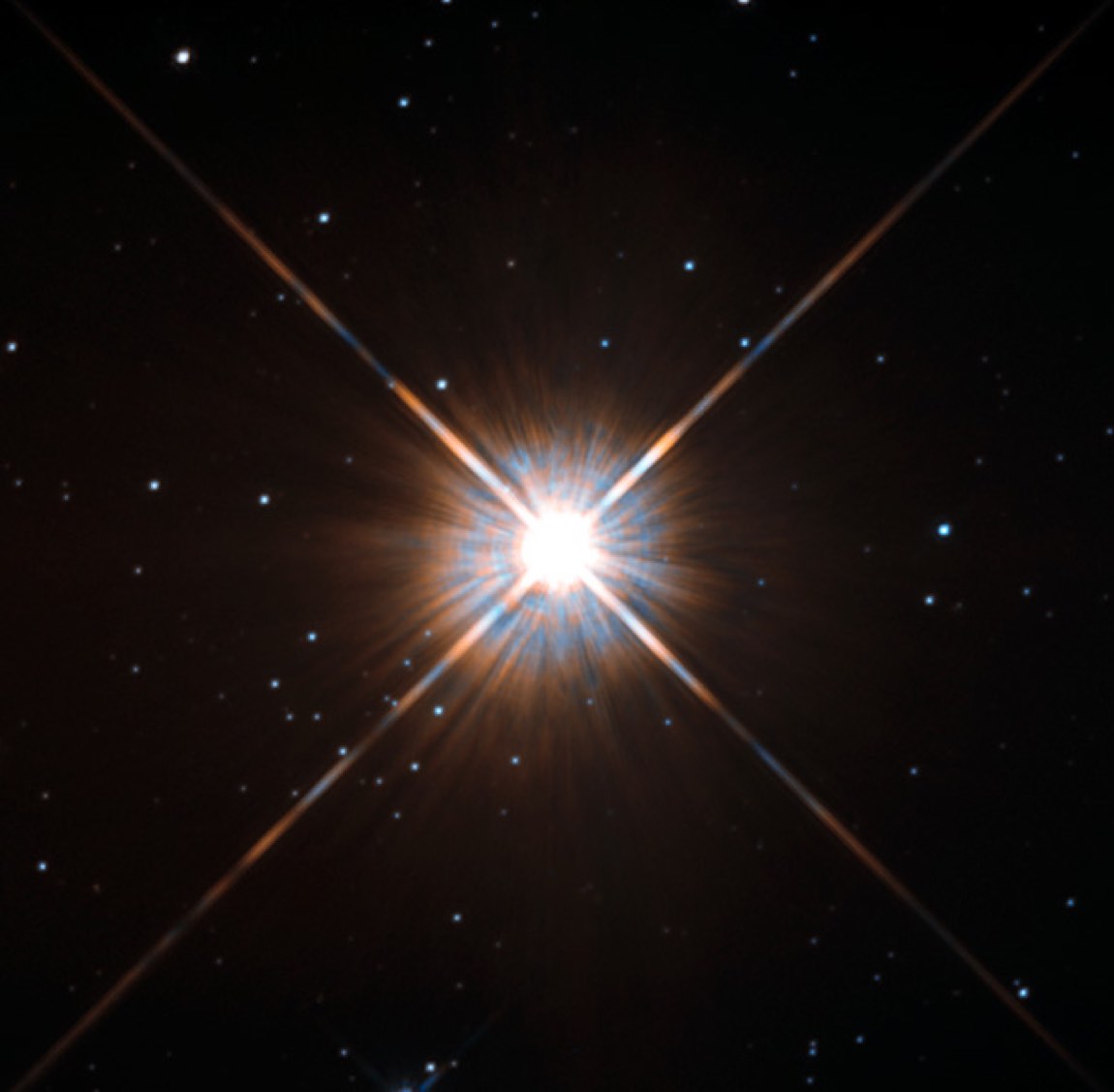
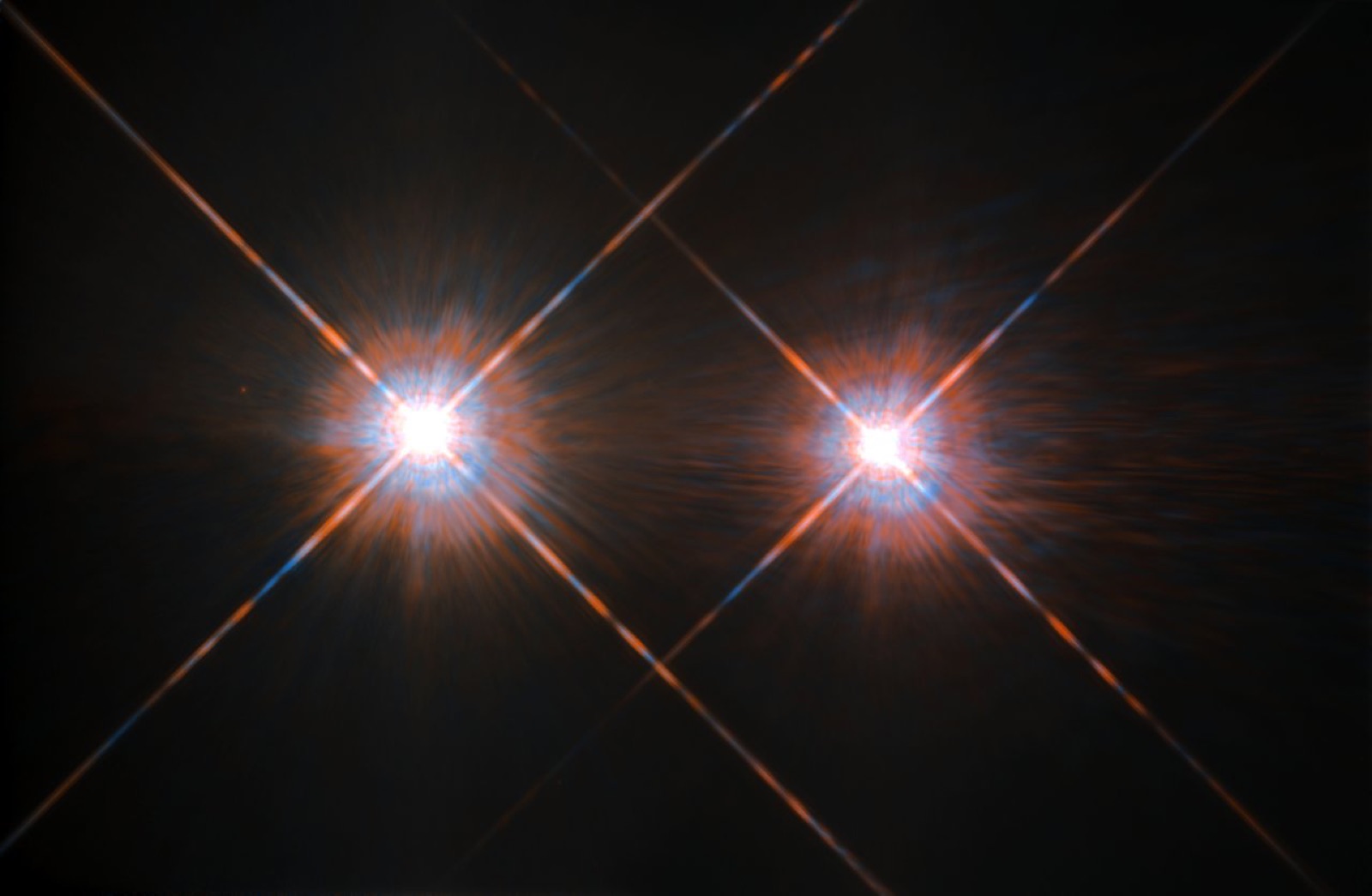
Alpha Centauri is the closest star system visible to the naked eye — the third-brightest star in Earth's night sky, though you need to be in the southern hemisphere to see it. What looks like one star is actually two suns much like ours (Alpha Centauri A and B) orbiting each other every 80 years, with the faint red dwarf Proxima Centauri as a distant third member.
Go deeper
A (G2V, near-solar twin) and B (K1V, slightly cooler) swing between 11 and 35 AU apart — roughly Saturn-to-Pluto separations — close enough to complicate, but not forbid, stable planets in each star's habitable zone. No confirmed planet orbits A or B yet; a candidate around A from JWST imaging (announced 2025) awaits confirmation, and claimed planets around B have historically evaporated under scrutiny. As the nearest sun-like pair, the system anchors every next-generation direct-imaging effort.
01 Two suns in one sky
A planet orbiting Alpha Centauri A would have a day star like ours — and a second brilliant 'evening sun' (B) outshining our full Moon hundreds of times over. Double sunsets, double shadows: the Tatooine image is real physics at our nearest neighbors.
02 The obvious first destination Deeper
Alpha Centauri offers three stars and at least one confirmed planet (Proxima b) in one package four light-years away. That's why it is the default target of interstellar concepts from Project Orion (1958) to Breakthrough Starshot — and the fictional destination of every second space epic, Avatar's Pandora included.
The deep dive
Researched for the Atlas from Wikipedia — Alpha Centauri (34,965 characters read) · updated Sep 20, 2026
03 A name borrowed from the wrong stars
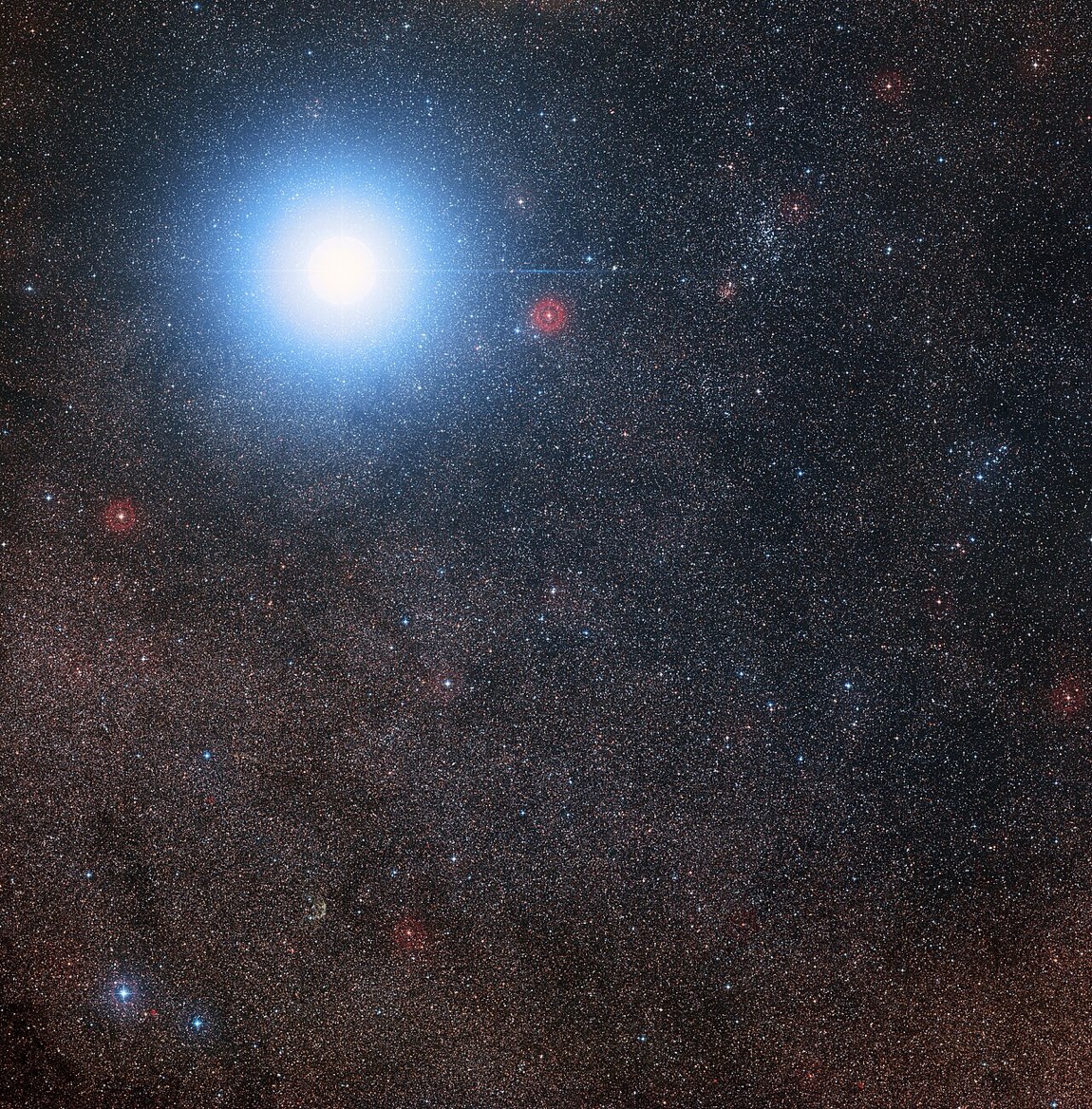
The name Toliman, now officially assigned to Alpha Centauri B, has a wonderfully tangled history. It traces back to the Arabic الظليمان, meaning "the two male ostriches," a name that the medieval scholar Zakariya al-Qazwini had originally applied to the pair of stars Lambda and Mu Sagittarii — a completely different part of the sky. Over centuries, the name migrated on star maps until Jacob Golius, in his 1669 edition of Al-Farghani's Compendium, latinised a related Arabic form as Tolimân and attached it to Alpha Centauri. Meanwhile, the name Rigil Kentaurus comes from the Arabic رجل القنطورس, meaning "the Foot of the Centaur," a far more straightforward description since the star marks the right front hoof of the mythological centaur. The IAU only formalised these assignments in 2016 and 2018, giving Rigil Kentaurus officially to component A and Toliman to component B — names that had been casually and inconsistently applied for centuries before anyone drew the boundary precisely.
 ⤢
⤢
04 How the binary was first spotted
The fact that Alpha Centauri is two stars rather than one was not recognised until December 1689, when the French Jesuit astronomer Jean Richaud was stationed in Puducherry, India, tracking a passing comet. While following the comet, he noticed that the bright southern star was clearly double through his telescope. Alpha Centauri AB was only the third binary star ever discovered, coming after Mizar AB and Acrux. Measuring the system's distance proved almost as dramatic. Thomas Henderson made painstaking observations at the Royal Observatory, Cape of Good Hope, between April 1832 and May 1833. His parallax results showed Alpha Centauri to be staggeringly close, but he feared the numbers were too large to be credible and sat on them for years. He finally published in 1839, only after Friedrich Bessel released his independently measured parallax for 61 Cygni in 1838. Because Henderson's caution delayed recognition of his work, Alpha Centauri is sometimes considered only the second star to have had its distance properly measured.
05 An orbit that swings like a slow pendulum Deeper
The orbit of Alpha Centauri A and B around their common centre of mass is far more stretched than the planets' paths around the Sun. With an eccentricity of almost 0.52, the pair swings between a closest approach of 11.2 AU — roughly the Sun-to-Saturn distance — and a widest separation of 35.6 AU, comparable to the Sun-to-Pluto distance. The most recent periastron occurred in August 1955 and the next will arrive in May 2035; apastron last happened in May 1995 and will repeat in 2075. As seen from Earth, this elongated, tilted orbit means the apparent separation between the two stars as projected on the sky varies dramatically: it ranged from just 1.7 arcseconds at minimum to about 22 arcseconds at maximum, with the widest observed separation occurring in February 1976 and the next due in January 2056. For comparison, the human naked eye resolves about 60 arcseconds, so even at maximum the pair blends into a single point without optical aid, but through small binoculars or a modest telescope they split cleanly for most of their 79.762-year cycle.
06 Proxima's long orbit around its siblings Deeper
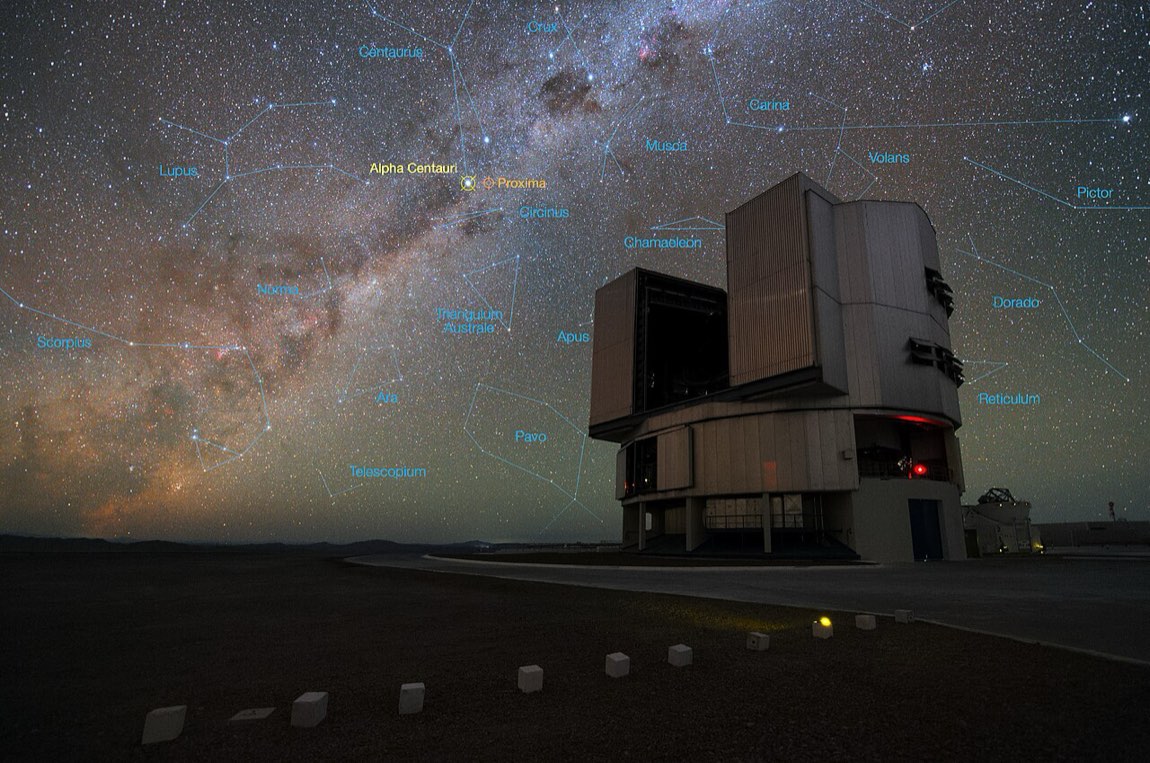
For decades astronomers debated whether Proxima Centauri is truly gravitationally bound to Alpha Centauri AB or merely a passing neighbour. The answer had to wait until 2017, when radial velocity measurements became precise enough to settle the question: Proxima is indeed bound to the pair. Its orbital period is approximately 511,000 years, with an uncertainty range of plus 41,000 and minus 30,000 years, and its orbit is strikingly eccentric at 0.5 — more eccentric than Mercury's path around the Sun. At its closest approach to AB, called periastron, Proxima comes within 4,100 AU, with an uncertainty of plus 700 and minus 600 AU. At its farthest, apastron, it retreats to 12,300 AU, with an uncertainty of plus 200 and minus 100 AU. Currently it sits about 13,000 AU from Alpha Centauri AB — equivalent to about 430 times the radius of Neptune's orbit, or roughly 5% of the entire distance from the Alpha Centauri system to our own Sun. That enormous separation makes Proxima a very loosely held companion, bound by gravity but orbiting on a timescale that dwarfs the entire recorded history of human civilisation many times over.
 ⤢
⤢
07 How old are these stars, and why is it hard to say? Deeper
Pinning down the ages of Alpha Centauri A and B turns out to be surprisingly difficult, and different methods give answers that span more than 2 billion years. Asteroseismic analyses — which probe a star's interior by studying the way sound waves make its surface oscillate — have produced estimates of 4.85 ± 0.5 Gyr, 5.0 ± 0.5 Gyr, 5.2 ± 1.9 Gyr, 6.4 Gyr, and 6.52 ± 0.3 Gyr. Chromospheric activity, measured through calcium H and K emission lines that trace magnetic heating, gives 4.4 ± 2.1 Gyr. Gyrochronology — the idea that stars spin down predictably as they age — yields 5.0 ± 0.3 Gyr. Stellar evolution theory, based on the stars' masses and spectral characteristics, suggests both are slightly older than the Sun at 5 to 6 billion years. All of these approaches agree on a broad picture: this system is similar in age to, or slightly older than, our own Sun, whose age is about 4.6 billion years. The scatter in the estimates reflects genuine uncertainties in each method rather than errors in the data, and the debate has not been fully resolved.
08 Alpha Centauri A's quiet magnetic slumber Deeper
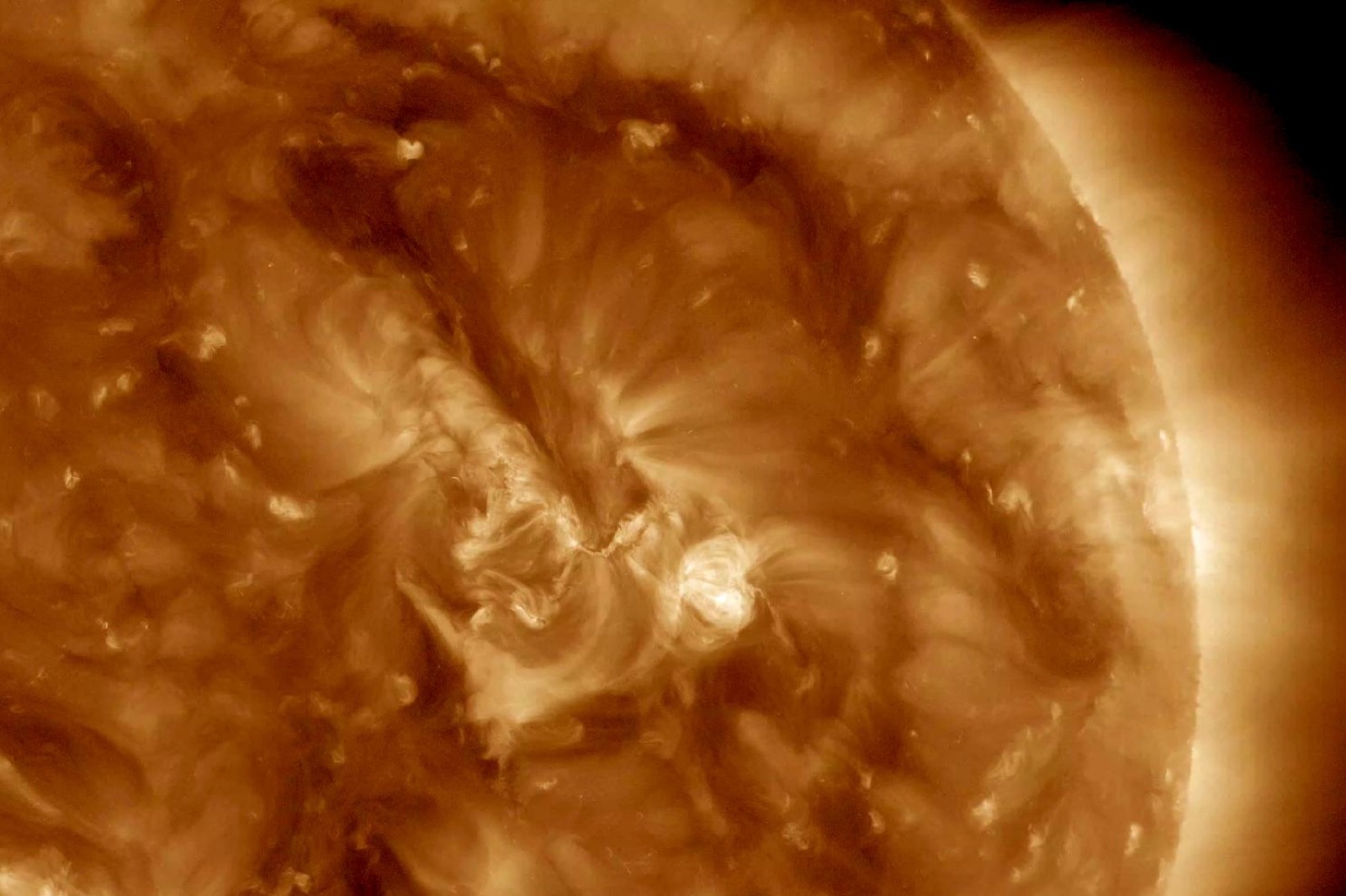
Alpha Centauri A shares the same G2V spectral classification as the Sun, with a surface temperature of about 5,790 K, a mass roughly 10% greater, and a radius about 22% larger, producing a luminosity of 1.5 times the Sun's. Its magnetic behaviour closely resembles the Sun's as well, with coronal variability driven by star spots that rotate across the stellar disk. However, since 2005 the star's activity level has fallen into a deep minimum that may parallel the Sun's historical Maunder Minimum — a prolonged episode of reduced sunspot activity that lasted from roughly 1645 to 1715 on Earth. Alternatively, the star may simply have a very long magnetic activity cycle and is slowly recovering from a minimum phase rather than being stuck in one. The Sun itself has an approximately 11-year activity cycle; Alpha Centauri A's cycle length is not yet firmly established. If the star is indeed in a Maunder-like minimum, it offers a rare live comparison case for understanding how solar magnetic activity can switch off and restart, with direct implications for how such quiet periods affect any orbiting planets.
09 The livelier, X-ray-brighter companion star
Alpha Centauri B, officially named Toliman, is classified as a K1-V main-sequence star — slightly smaller, cooler, and more orange than its partner. It holds about 90% of the Sun's mass and has a diameter roughly 14% smaller. Despite being less luminous overall, Toliman is the more magnetically restless of the two. It emits more energy in the X-ray band than Alpha Centauri A, and its light curve has been observed to vary on short timescales, including at least one recorded flare. Its magnetic activity cycle runs about 7.8 ± 0.2 years — re-estimated recently from more than 20 years of high-resolution spectroscopic observations of the calcium H and K lines — compared to roughly 11 years for the Sun. The minimum-to-peak swing in coronal luminosity across Toliman's cycle is about half that of the Sun's equivalent variation. With an apparent magnitude of +1.35, it is slightly dimmer than the star Mimosa in the Southern Cross, and on its own would rank as one of the twenty brightest stars visible from Earth.
 ⤢
⤢
10 The planet search: confirmed, disputed, and possible
The Alpha Centauri system has been at the centre of planet-hunting hopes and disappointments for over a decade. The only confirmed planets orbit Proxima Centauri: Proxima b, an Earth-sized world discovered in 2016 with a minimum mass of 1.17 Earth masses orbiting just 0.049 AU from the star, and Proxima d, a sub-Earth confirmed in 2025 with a mass of about 0.29 Earth masses orbiting even closer. A third candidate, Proxima c, was formally published in 2020 as a possible super-Earth or mini-Neptune of roughly 7 Earth masses at 1.49 AU, but a 2022 study disputed its existence and observations with the NIRPS spectrograph have not confirmed it, leaving its status inconclusive as of 2025. For Alpha Centauri A, a candidate object detected in 2021 and again imaged by the James Webb Space Telescope in August 2024 at a separation of about 2 AU may be a planet with a mass between 90 and 150 Earth masses and a temperature of 225 K, but it was not recovered in follow-up observations and requires confirmation. The earlier claim of a planet around Alpha Centauri B — designated Bb and announced in 2012 — was disproven in 2015 as an artefact of data processing.
11 A star drifting toward a future spectacle
Alpha Centauri is moving through space at a speed of 32.4 km/s relative to the Sun, carrying it noticeably across the sky over human timescales. The system's proper motion sweeps it about 6.1 arcminutes every century — roughly one-fifth the angular diameter of the full Moon. This drift will eventually produce some striking celestial events. Around 6,200 CE, Alpha Centauri's motion will bring it into an extremely rare first-magnitude conjunction with Beta Centauri, creating a dazzling optical double in the southern sky. The system will then drift past the Southern Cross before heading northward. By roughly 26,700 CE — or possibly 27,000 CE according to later calculations — Alpha Centauri will reach its closest point to the Sun, a perihelion of just 0.90 parsecs, equivalent to 2.9 light-years. At that closest approach, it will shine at an apparent magnitude of −0.86, as bright as Canopus appears today. It will not, however, surpass Sirius, which will itself be brightening incrementally over the next 60,000 years and is expected to remain the brightest star in the night sky other than the Sun for at least the next 210,000 years.
12 What skywatchers can actually see
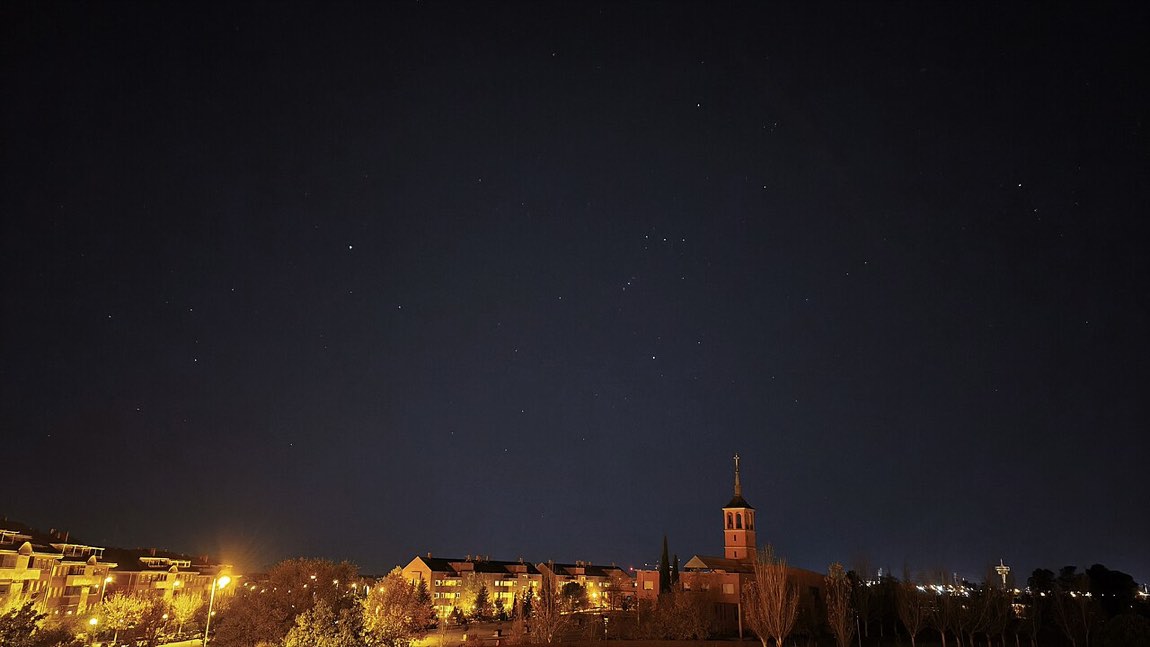
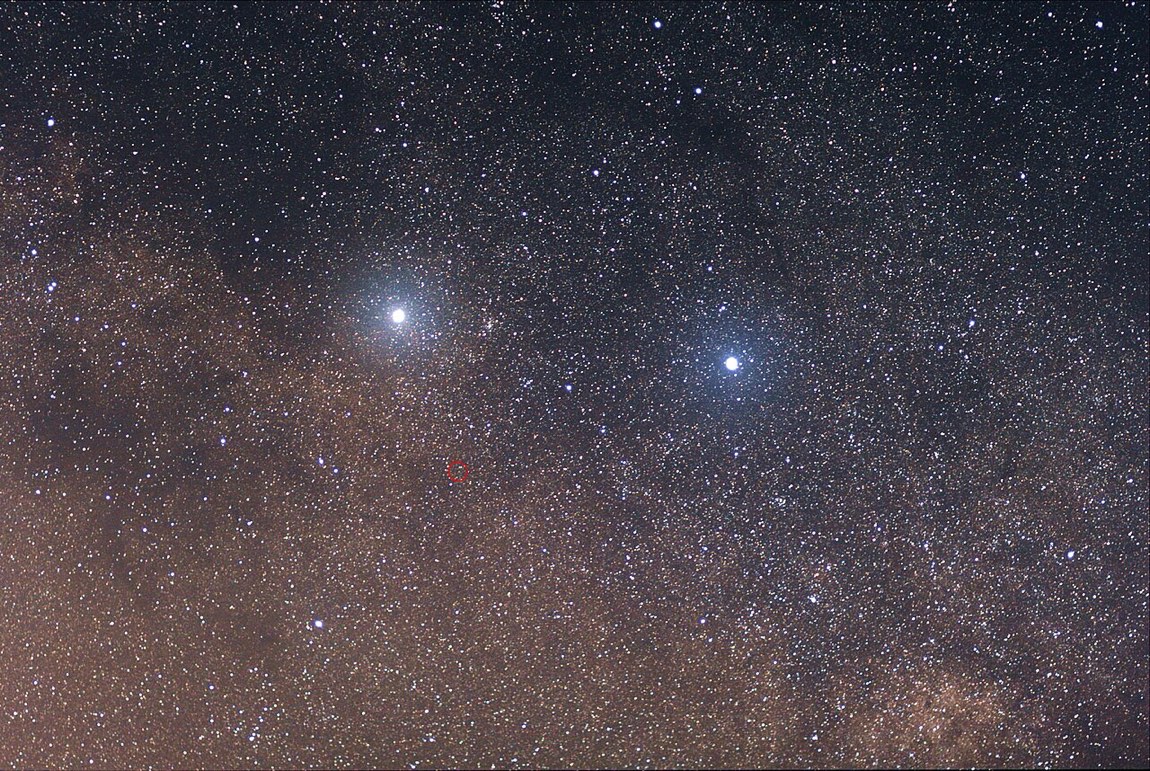
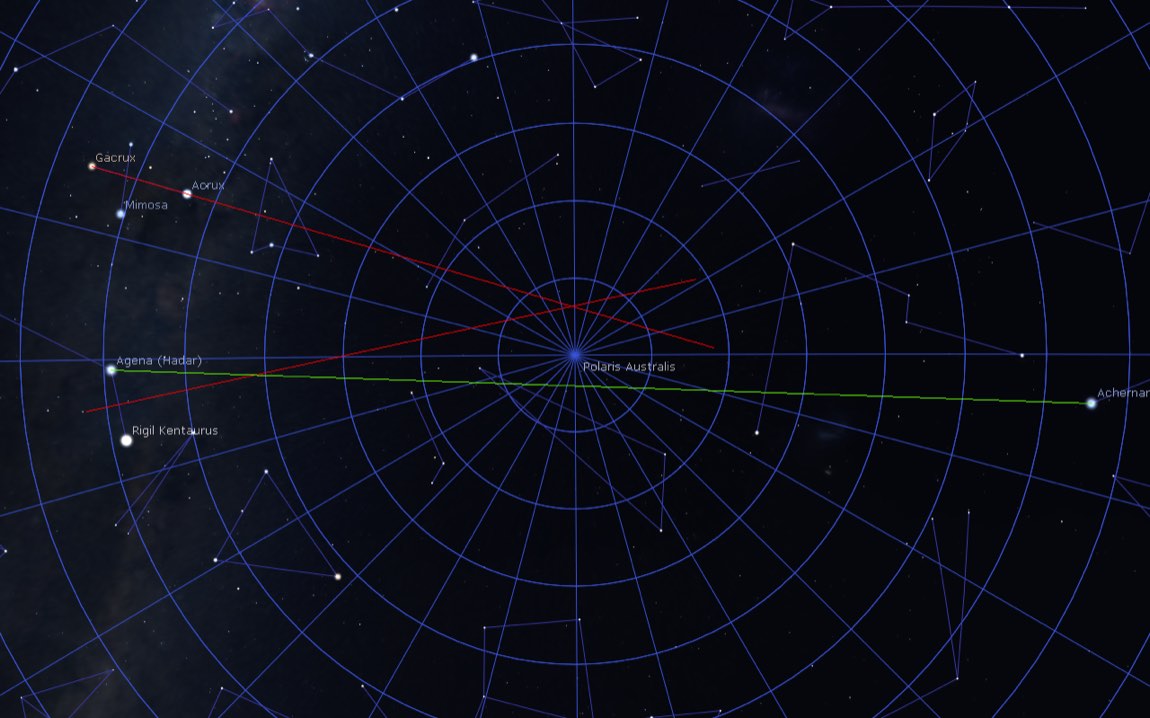
From most of the Southern Hemisphere and tropical latitudes, Alpha Centauri is one of the sky's great showpieces. The combined light of A and B registers at an apparent magnitude of −0.27, making the system the third-brightest object in the night sky after Sirius and Canopus, and the single brightest point of light in the constellation Centaurus. It culminates at local midnight on 24 April each year and at 9 p.m. on 8 June. South of about 29° south latitude, it never sets at all. Observers north of about 29° north — which cuts through northern Mexico, the Gulf Coast of the United States, and the Canary Islands — never see it rise. The pair is also one of the two Southern Pointers: a line drawn through Beta Centauri and Alpha Centauri, separated by about 4.5 degrees, points directly toward the Southern Cross. Proxima Centauri lies 2.2 degrees southwest of AB — about four times the Moon's angular diameter — but at a typical apparent magnitude of 11.1 it is invisible to the naked eye. Proxima is a UV Ceti flare star that can brighten suddenly by as much as 0.6 magnitudes at visual wavelengths, then fade within minutes; in August 2015 the largest recorded outburst made it 8.3 times its normal brightness in blue light.
 ⤢
⤢
13 The sky as seen from over there
An observer standing on a hypothetical planet around Alpha Centauri A would look out at a sky that is mostly familiar — the same constellations, the same distant galaxies — with a few striking differences. The Sun would be a white star shining at apparent magnitude +0.5, roughly the same brightness as Betelgeuse appears from Earth today, positioned in the eastern part of Cassiopeia and easily the brightest star in that constellation. The familiar "W" shape of Cassiopeia would gain an extra bright point, reshaping it into a "/W" form. Sirius, still about 9.2 light-years from the Alpha Centauri system, would remain the brightest star in the night sky at magnitude −1.2, though it would appear in the constellation Orion, less than a degree from Betelgeuse rather than in its familiar position. On such a planet orbiting Alpha Centauri A at 1.25 AU, the companion star Alpha Centauri B would illuminate the sky at between magnitude −21.0 and −18.2 depending on its orbital position — always 150 to 2,100 times brighter than a full Moon, making true darkness essentially impossible whenever B is above the horizon.
14 Cultural fingerprints across the southern world
Across the cultures of the Southern Hemisphere, Alpha Centauri has gathered a remarkable variety of identities. The Indigenous Boorong clan of the Wergaia people of northwestern Victoria, Australia, knew Alpha Centauri and Beta Centauri together as Bermbermgle — two courageous and destructive brothers who speared and killed Tchingal, the Emu, which they identified with the Coalsack Nebula. In the Wotjobaluk language the pair is called Bram-bram-bult. In the Ngarrindjeri culture of Australia the same two stars represent two sharks chasing a stingray — the Southern Cross. Polynesian navigators called the star Kamailehope and used it for ocean wayfinding. In Incan tradition, Alpha Centauri and Beta Centauri form the eyes of a llama-shaped dark constellation traced out in the dusty bands of the Milky Way. The Mursi people of Ethiopia name it Sholbi and group it with three stars of the Southern Cross region into a single asterism. In Chinese astronomy it is 南門二 Nán Mén Èr, the Second Star of the Southern Gate, part of the asterism 南門 meaning Southern Gate alongside Epsilon Centauri. Each tradition reflects how prominent and unmistakable this star has been to anyone who has lived under southern skies.
Could life exist here?
Sun-like stars with stable habitable zones make A and B excellent places to look; the search for planets there is active and unresolved.
Our labels: Confirmed · Strong Evidence · Estimated · Hypothesis · Theoretical · Speculative (see Methodology).
Could humans live here?
The most-studied target for hypothetical interstellar travel; see Proxima Centauri for the honest travel-time arithmetic.
How would we get there?
4.37 light-years = 41 trillion km. Voyager-speed: ~78,000 years. Proposed light sails: decades. There is no shortcut.
Weird & wonderful
- From Alpha Centauri, our Sun is a bright star in the constellation Cassiopeia — turning its W into a zigzag of six.
- A and B come as close to each other as Saturn is to the Sun.
- It's the third-brightest star in our sky, yet most people in Europe and North America have never seen it — it never rises there.