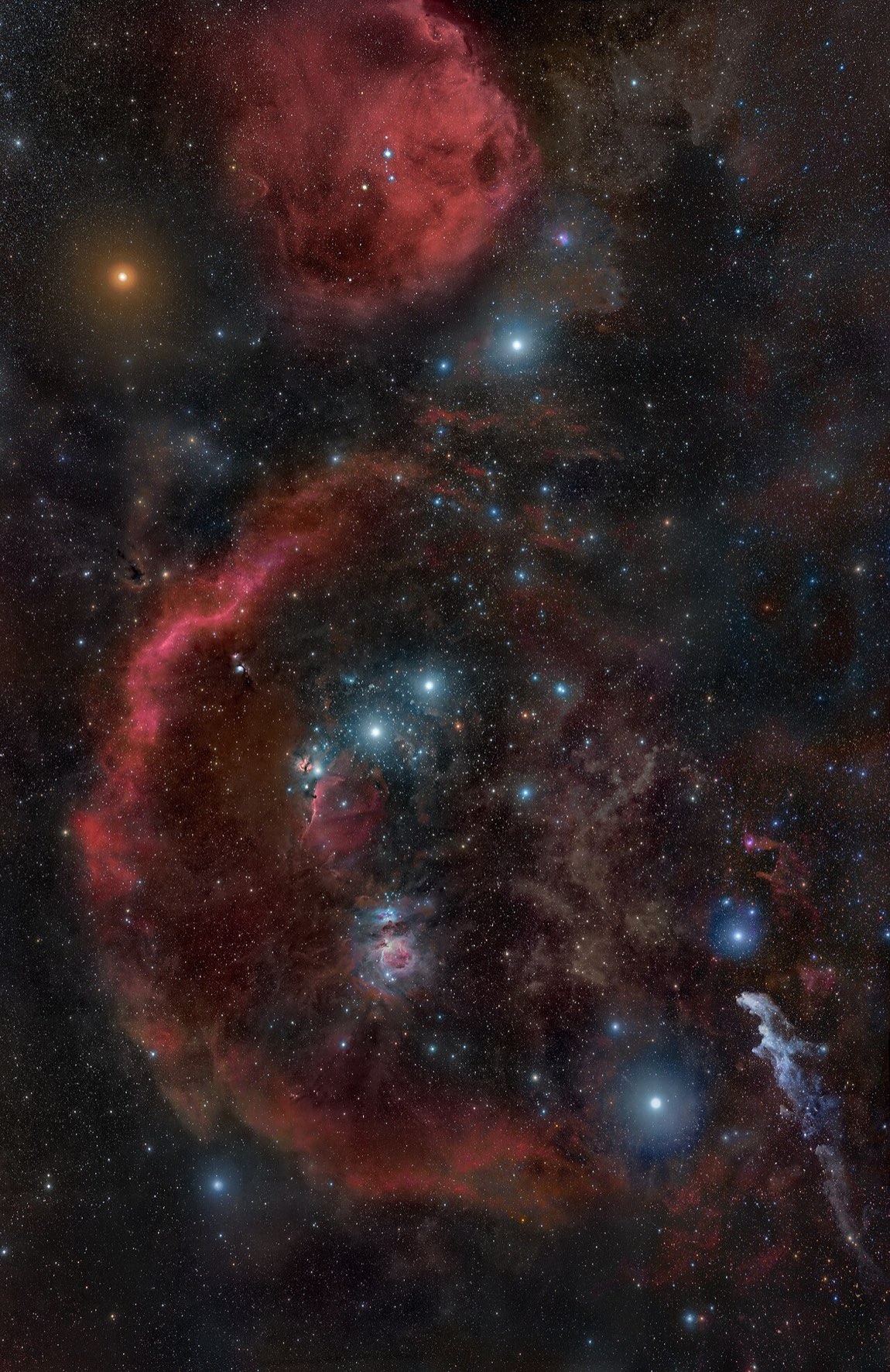
 Photograph · Rogelio Bernal Andreo · CC BY-SA 3.0
Star · Deep guide
Rigel
A supergiant outshining 100,000 Suns marks Orion's blue-white foot.
What is it?
Rigel is the brightest star in Orion, a blue supergiant roughly 860 light-years away burning with around 120,000 times the Sun's luminosity. It is young, enormous, and doomed: within a few million years it will exhaust its fuel and explode as a supernova. A small telescope splits off its fainter companion star.
The deep dive
Researched for the Atlas from Wikipedia — Rigel (23,340 characters read) · updated Sep 20, 2026
01 A Name Rooted in Arabic Astronomy
The name Rigel is far older than the telescopes that revealed its true nature. The earliest known written record of the name appears in the Alfonsine tables of 1521, but the Arabic root stretches back to at least the 10th century. The original phrase was Rijl Jauzah al Yusrā, meaning "the left leg (foot) of Jauzah" — Jauzah being a proper Arabic name for the figure we call Orion. A parallel Arabic name, rijl al-jabbār, translated as "the foot of the great one," gave rise to the rarely used variants Algebar and Elgebar. The Alphonsine tables actually preserved both strands, recording the star under the note et dicitur Algebar. Nominatur etiam Rigel — "it is also called Algebar. It is also named Rigel." Seventeenth-century European scholars spelled it inventively: Italian astronomer Giovanni Battista Riccioli wrote Regel, German astronomer Wilhelm Schickard wrote Riglon, and English scholar Edmund Chilmead rendered it Rigel Algeuze or Algibbar. The International Astronomical Union formally enshrined "Rigel" in its Catalog of Star Names in 2016, applying it exclusively to the primary star, component A.
02 How Rigel Got the "Wrong" Greek Letter
Johann Bayer assigned stellar designations to Orion's stars in 1603, and the convention was broadly to label the brightest star in a constellation alpha, the second-brightest beta, and so on. Yet Rigel — almost always the brighter of the two — ended up as Beta Orionis, while the dimmer and redder Betelgeuse became Alpha Orionis. Astronomer James B. Kaler has speculated that Bayer made his catalog during a rare period when the variable star Betelgeuse was unusually bright and genuinely outshone Rigel, causing the labeling to be reversed. There is another explanation in Bayer's own method: he did not rank stars within a magnitude class strictly by brightness. Instead, stars of the same magnitude class in Orion appear to have been ordered roughly north to south, which would place Betelgeuse, sitting higher in the sky, ahead of Rigel regardless of their relative brightness at any given moment. Because Rigel already carries a Bayer designation, the General Catalogue of Variable Stars assigned it no separate variable-star designation when it was added to that catalog — an unusual distinction that reflects its long-recognized brightness.
03 Rigel's Unstable, Pulsating Atmosphere Deeper
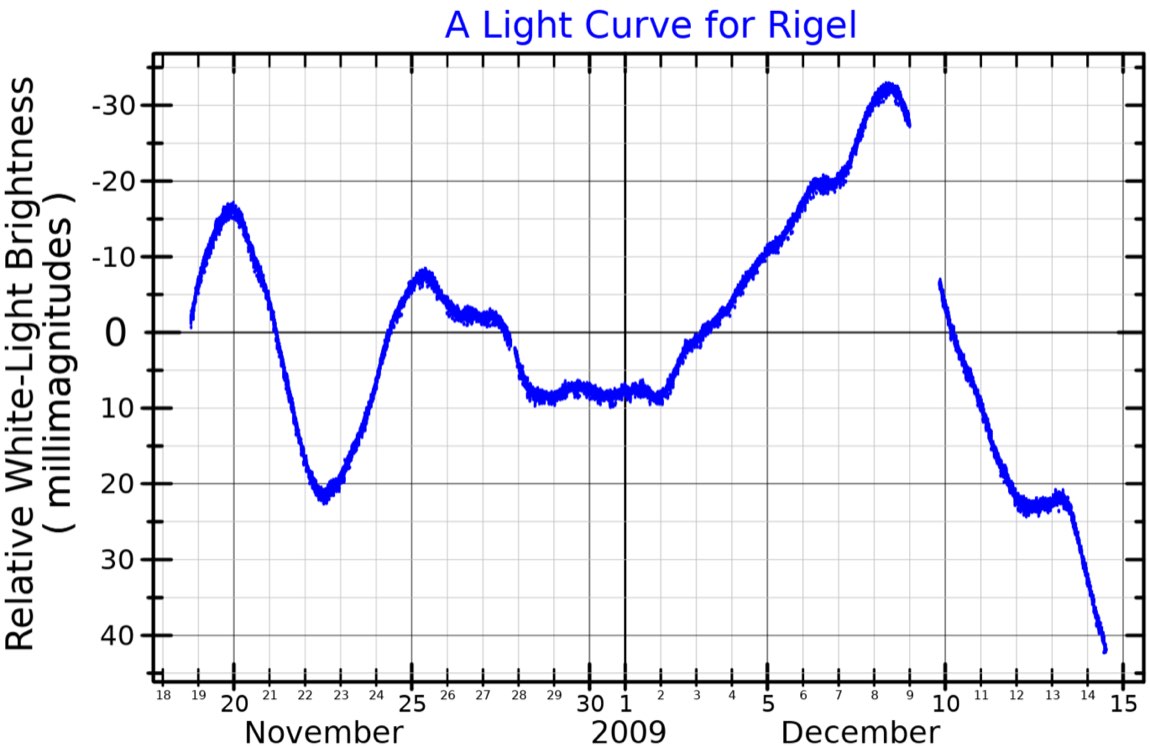
Rigel's light output is not constant. Brightness variations had been noted since at least 1930, and in 18 nights of observations in 1984, astronomers recorded swings of up to 0.13 magnitudes at red, blue, and yellow wavelengths on timescales ranging from a few hours to several days, without any obvious repeating period. Analysis of data from the Hipparcos satellite classified Rigel as an Alpha Cygni variable — a category defined as non-radially pulsating supergiants of spectral types Bep through AepIa. When the Canadian MOST satellite monitored Rigel for nearly 28 continuous days in 2009, milli-magnitude fluctuations were detected, and gradual flux changes pointed to long-period pulsation modes. Radial velocity measurements indicate that Rigel simultaneously oscillates in at least 19 non-radial modes, with periods spanning roughly 1.2 to 74 days. These pulsations are thought to be powered by nuclear reactions in a hydrogen-burning shell that is at least partially non-convective. Stellar evolution models suggest the pulsations would be stronger and more numerous if Rigel has already passed through a red supergiant phase and subsequently warmed back toward blue supergiant temperatures — a contested point in understanding where exactly Rigel sits in its evolutionary story.
04 A Stellar Wind Ten Million Times Fiercer Deeper
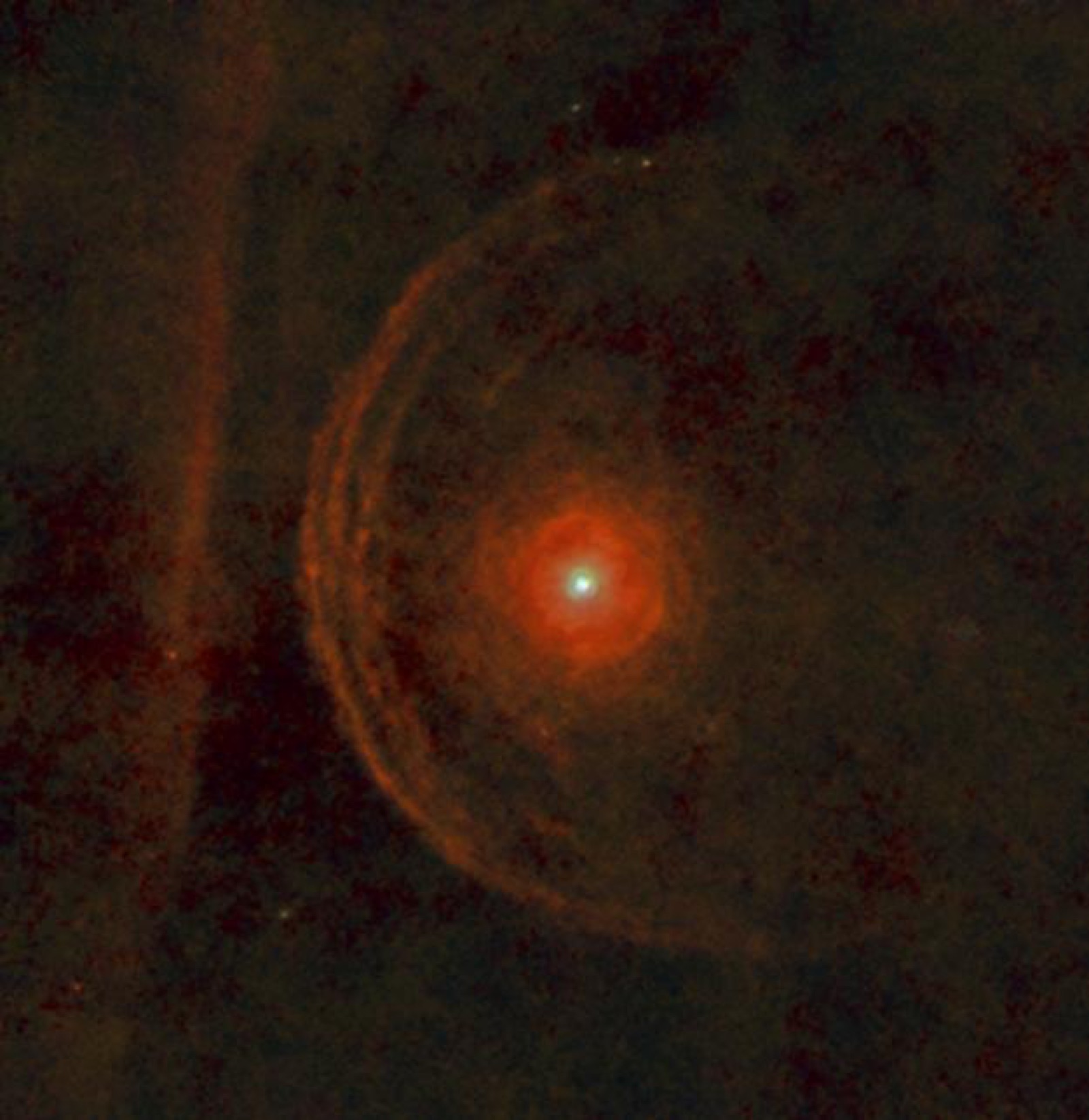
Rigel bleeds mass into space at a rate that dwarfs what the Sun loses. Observations of its variable Hα spectral line yield a mass-loss rate of approximately (1.5±0.4)×10⁻⁷ solar masses per year — about ten million times the Sun's own rate. More detailed measurements tell a richer story. Optical and K-band infrared spectroscopy combined with VLTI interferometry, collected between 2006 and 2010, revealed that Rigel's stellar wind is far from smooth or uniform. Loop and arm structures were detected within the wind. Calculations from the Hγ line gave (9.4±0.9)×10⁻⁷ solar masses per year for 2006–7, falling to (7.6±1.1)×10⁻⁷ solar masses per year by 2009–10, while the Hα line consistently returned lower values around 1.5×10⁻⁷ solar masses per year. The wind ultimately streams outward at a terminal velocity of 300 km/s. Integrating this mass loss over Rigel's lifetime suggests the star has shed roughly three solar masses since it began life as a star of 24±3 solar masses, seven to nine million years ago. The Hα line itself cycles unpredictably through four or five distinct profile shapes — normal absorption, double-peaked, P Cygni, inverse P Cygni, and rarely pure emission — each reflecting different quantities and velocities of expelled material, including occasional very high-velocity outflows and, more rarely, infalling material.
 ⤢
⤢
05 The Uncertain Distance to a Brilliant Neighbor Deeper
Pinning down Rigel's distance has proved surprisingly difficult, and different methods disagree by hundreds of light-years. Older estimates placed it as close as 166 parsecs (541 light-years). The 2007 Hipparcos new reduction measured a parallax of 3.78±0.34 mas, yielding a distance of approximately 863 light-years (265 parsecs) with a margin of error of about 9%. The companion Rigel B has a Gaia Data Release 3 parallax of 3.2352±0.0553 mas, suggesting a distance of around 1,000 light-years (310 parsecs), though Gaia's own documentation flags the measurement as potentially unreliable. An indirect approach uses the Witch Head Nebula (IC 2118), a 5°-long cloud of gas that Rigel illuminates and that sits just 2.5° away — a projected distance of roughly 39 light-years. Measurements of other stars embedded in IC 2118 place that nebula at 949±7 light-years (291±2 parsecs). A still larger distance of 1,170±130 light-years (360±40 parsecs), derived by other methods, would push Rigel's luminosity to 219,000 times that of the Sun. There is no Rigel entry in Gaia DR3 at all, leaving the Hipparcos value as the best direct measurement for the primary star, and the uncertainty it carries ripples through every estimate of Rigel's size, luminosity, and mass.
06 The Quadruple Star System Around Rigel
What the naked eye sees as a single blue-white point is actually at least four stars. William Herschel first noticed a companion on 1 October 1781, cataloguing the pair as H II 33. Friedrich Georg Wilhelm von Struve measured the companion's precise position in 1822, logging it as Σ 668. That companion, Rigel B, sits 9.5 arc seconds to Rigel's south and shines at visual magnitude 6.7 — roughly 1/400th as bright as Rigel A, meaning the glare makes it a tough target for telescopes smaller than 15 cm (6 in). In 1871, Sherburne Wesley Burnham suspected Rigel B was itself a double, and by 1878 he had resolved it into two components. Speckle interferometry in 2009 confirmed the two nearly identical components separated by just 0.124 arc seconds, with visual magnitudes of 7.5 and 7.6 and an orbital period of about 63 years. Beyond that visual pair, Rigel B is also a double-lined spectroscopic binary: two hot stars of spectral type around B9 orbit each other every 9.86 days, far too close to separate in any optical telescope. Together, these three companions form an inner triple system orbiting Rigel A with an estimated period of 24,000 years, at a projected separation of over 2,200 astronomical units. A fourth possible member, a roughly 12th-magnitude K-type star found by Burnham in 1878, sits about 44.5 arc seconds away; if gravitationally bound, its orbital period would be around 250,000 years.
07 Rigel's Place in Its Stellar Neighborhood
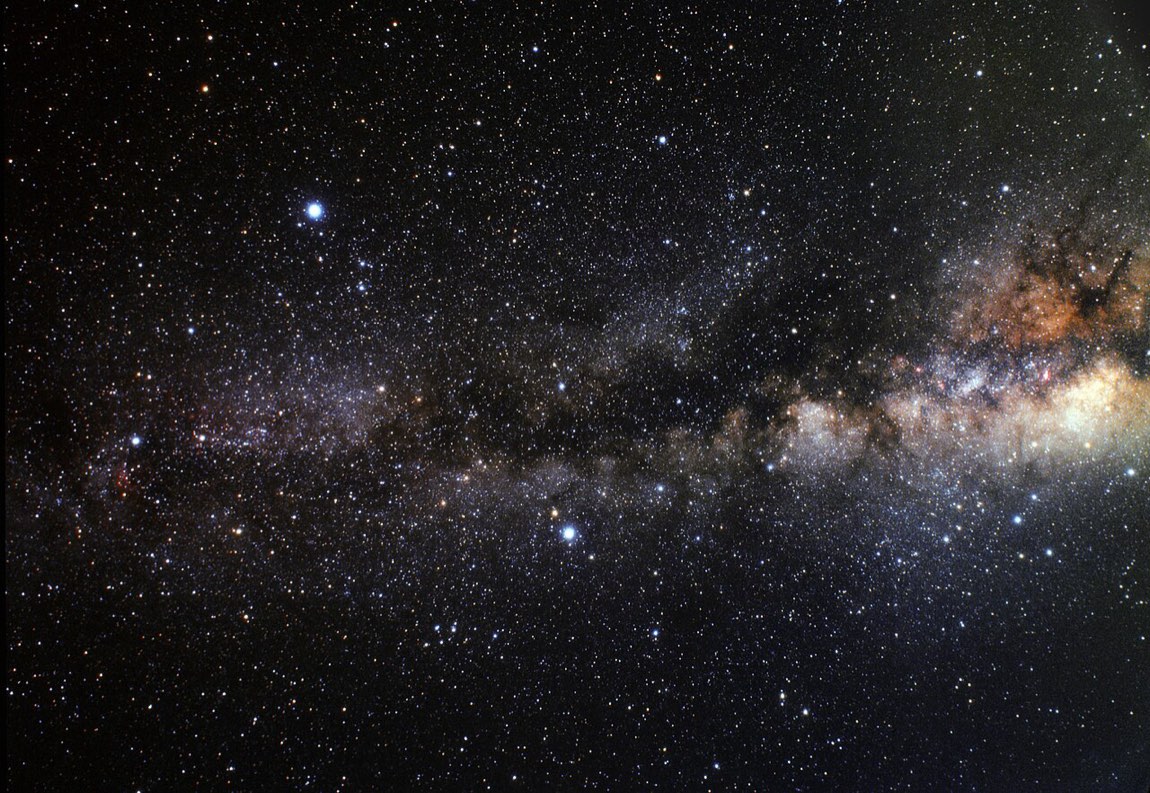
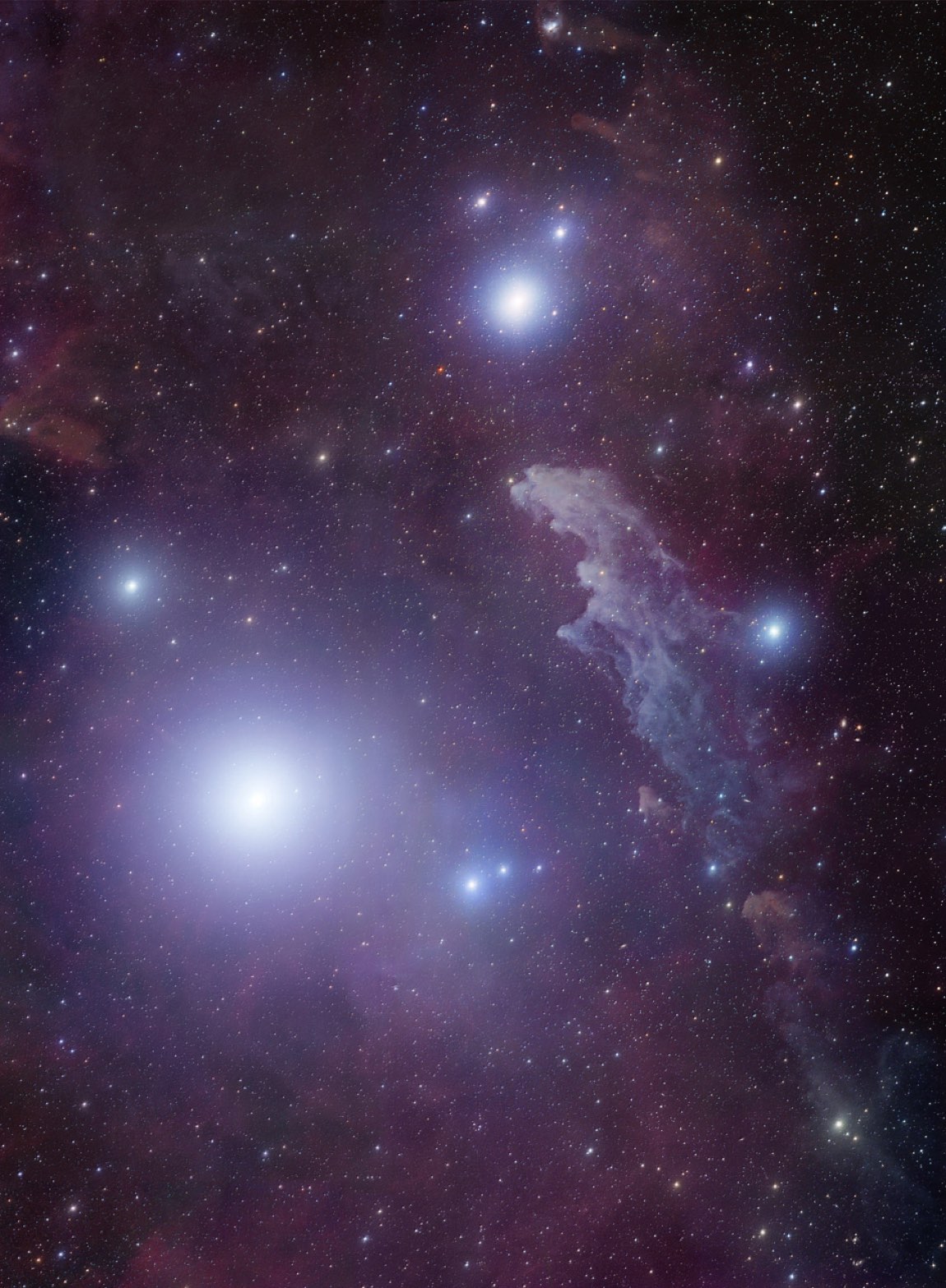
Rigel is not a lone wanderer but a member of loosely connected stellar communities. It belongs to the Taurus-Orion R1 Association, a scattered grouping lying roughly 1,200 light-years (360 parsecs) away, and is an outlying member of the larger Orion OB1 association, which extends up to 1,600 light-years (500 parsecs) from Earth. Rigel is thought to sit considerably closer than most Orion OB1 members and the famous Orion Nebula. Its neighbor Betelgeuse and the star Saiph lie at comparable distances, though Betelgeuse is classified as a runaway star with a complicated history and may have originally formed deeper in the main body of the association before being flung outward. Most visibly, Rigel is responsible for illuminating the Witch Head Nebula, formally designated IC 2118 — a ghostly, 5°-long reflection nebula floating just 2.5° away from the star on the sky, separated from it by a projected distance of about 39 light-years (12 parsecs). For observers at night, Rigel itself serves as one vertex of the Winter Hexagon, a large asterism connecting six brilliant stars: Aldebaran, Capella, Pollux, Procyon, Sirius, and Rigel itself — a useful landmark spanning nearly the entire winter sky.
08 Helium Enrichment and Where Rigel Has Been Deeper
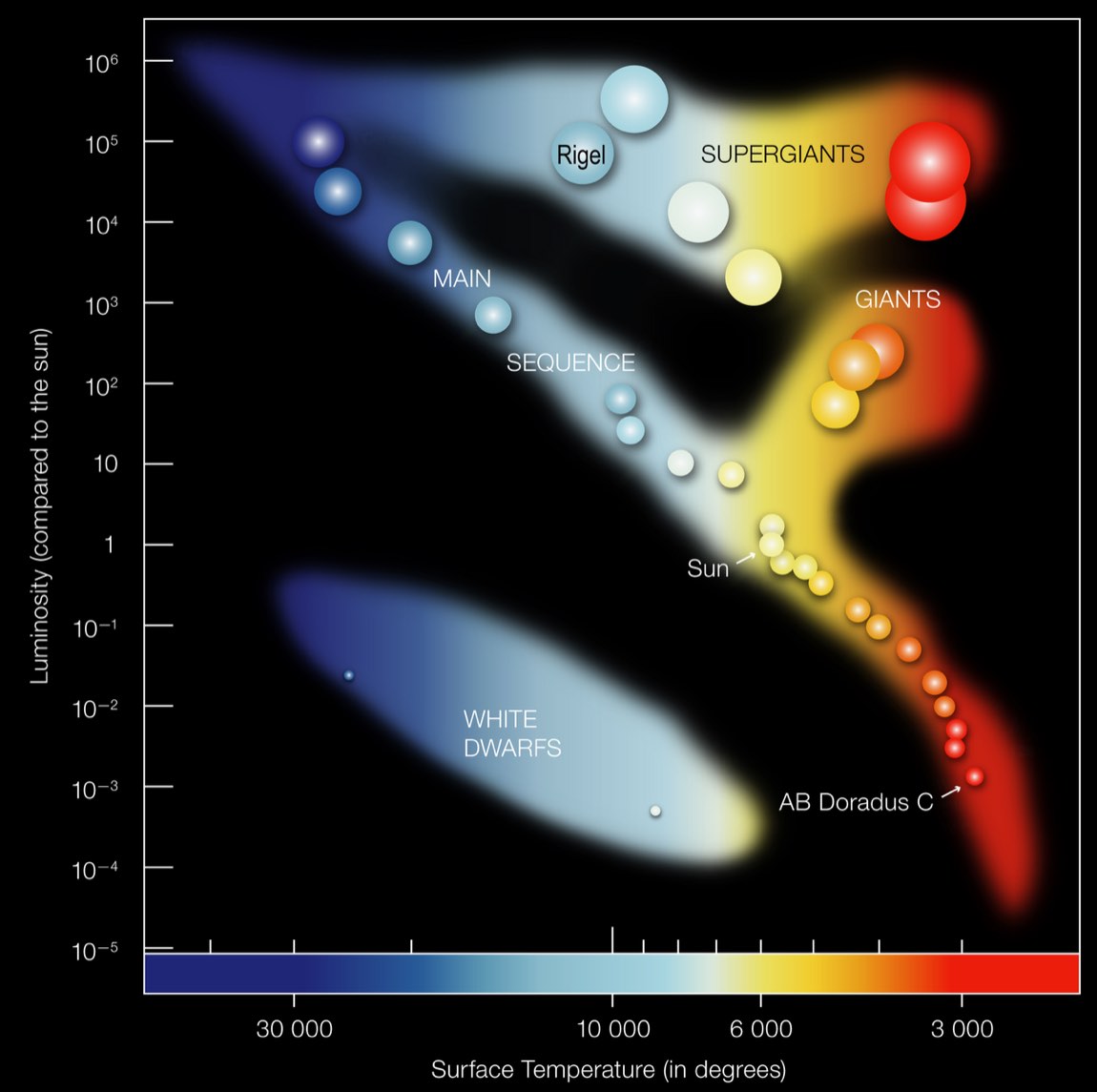
Rigel's surface today carries chemical fingerprints of the nuclear processing happening deep inside it. When the star formed seven to nine million years ago, its surface helium fraction was 26.6%. Now it stands at 32%, reflecting the strong convection that has dredged helium produced in the core up toward the surface — first during Rigel's main-sequence life and again since it became a supergiant burning hydrogen in a shell. Rigel is likely fusing helium in its core at present. The surface abundances of carbon, nitrogen, and oxygen observed in its spectrum are consistent with a star that has already passed through a red supergiant phase and returned toward higher temperatures, but only if the internal convection zones are modeled using non-homogeneous chemical conditions described by the Ledoux Criteria. When Rigel was on the main sequence, its effective temperature would have been around 30,000 K — more than twice its current surface temperature of 12,100 K. The pulsation behavior also lends indirect support to a post-red-supergiant interpretation: models predict that stars which have evolved through the red supergiant stage and warmed back to blue supergiant temperatures should show stronger and more numerous pulsation modes, driven by their reduced mass and higher concentrations of fusion products at the surface, consistent with Rigel's observed 19 simultaneous non-radial oscillation modes.
 ⤢
⤢
09 How Bright Would Rigel's Supernova Be?
Rigel is one of the closest known potential supernova progenitors to Earth, which makes its eventual death a topic of genuine astronomical interest. Having exhausted the hydrogen fuel in its core, expanded, and cooled into a blue supergiant, Rigel is expected to end its life as a Type II supernova — the violent core collapse of a massive star that has run out of fuel to sustain nuclear fusion. The remnant left behind will be either a neutron star or a black hole, depending on exactly how much mass the star had at the moment of collapse, a number still uncertain given the ongoing debate about Rigel's initial mass. When the explosion finally comes, observers on Earth would see a new "star" blazing at a maximum apparent magnitude of around −11. To put that in perspective, that is roughly the brightness of a quarter Moon, and about 300 times brighter than Venus ever appears in our sky. A supernova at that brightness would be visible in broad daylight. The event is not expected soon by human timescales — Rigel still has nuclear fuel to burn — but given its age of seven to nine million years, it is in the final stages of its stellar life.
10 Rigel Across World Cultures
Few stars have accumulated as rich a cultural record as Rigel. Norse mythology apparently knew it as "Aurvandil's toe." In the Caribbean, Rigel represented the severed leg of Trois Rois — a folkloric figure whose own body was formed by the three stars of Orion's Belt — cut off by the maiden Bįhi, identified as Sirius. The Lacandon people of southern Mexico called it tunsel, meaning "little woodpecker." In southeastern Australia, the Wotjobaluk koori knew Rigel as Yerrerdet-kurrk, cast as the mother-in-law of Totyerguil (Altair); the distance between the two stars in the sky was said to embody the cultural taboo preventing a man from approaching his mother-in-law. The Wardaman people of northern Australia named it Unumburrgu, the Red Kangaroo Leader, conducting ceremonies along a songline when Orion rides high. To the Māori of New Zealand, Rigel is Puanga, daughter of Rehua (Antares), chief of all stars; its heliacal rising heralds the appearance of the Pleiades and marks the Māori New Year in late May or early June. In Japan, the Minamoto (Genji) clan chose Rigel and its white color as their symbol — calling it Genji-boshi — while their rivals, the Taira (Heike) clan, claimed the red star Betelgeuse; the two stars were seen as opposing forces held apart only by Orion's Belt.
11 Rigel as a Tool for Navigation and Discovery
Rigel's brilliance and its position almost exactly on the celestial equator have made it a practical tool for navigators across centuries and disciplines. It is a prominent equatorial navigation star, visible from virtually all of the world's oceans — the only exception is the region north of the 82nd parallel north. Sailors can locate it with ease as one of seven bright stars in the Winter Hexagon asterism, and its blue-white color gives it a distinctive identity against the night sky. Astronomers have also pressed Rigel into service as a calibration standard: its spectral type B8Ia is a defining anchor point in the classification sequence for supergiant stars, meaning the way spectra of other supergiants are categorized is partly referenced back to what Rigel looks like. The star's spectral lines were being used for heliocentric radial velocity work as early as 1888. In Antarctica, Rigel proved useful enough as an astrofix — a navigation reference point for precise positioning — that a chain of small islands originally called Utskjera was renamed the Rigel Skerries in its honor. Mount Rigel, also in Antarctica, stands at an elevation of 1,910 m (6,270 ft) and carries the star's name as a further geographical tribute.
12 What We Still Do Not Know About Rigel Deeper
Despite being one of the most studied stars in the sky, Rigel harbors deep uncertainties. Its luminosity is genuinely unknown within a factor of roughly six: estimates range from 61,515±11,486 to 363,000 times the Sun's output, depending on the distance assumed and the modeling approach taken. The distance itself is contested, with direct parallax measurements from Hipparcos and indirect estimates from the Witch Head Nebula disagreeing by hundreds of light-years, and Gaia offering no parallax for the primary star at all. Whether Rigel is currently a first-crossing blue supergiant — expanding away from the main sequence for the first time — or a post-red-supergiant returning to higher temperatures is debated; the pulsation character and surface chemistry each offer clues, but neither settles the question definitively. A spectroscopic companion to Rigel was once reported from radial velocity variations and even had its orbit calculated, but subsequent work concluded the star does not exist and that the velocity changes are intrinsic pulsations. The nature of the wide companion Rigel D — whether it is truly a fifth gravitationally bound member of the system or merely a line-of-sight coincidence — also remains unresolved. Even Rigel's mass carries an uncertainty of several solar masses depending on which method is used, ranging from 18 to 24 solar masses.
 ⤢
⤢