 Photograph · NASA, ESA Credit: A. Fujii · Public domain
Star · Deep guide
Deneb
The Summer Triangle's distant beacon may be the most luminous star you can easily see.
What is it?
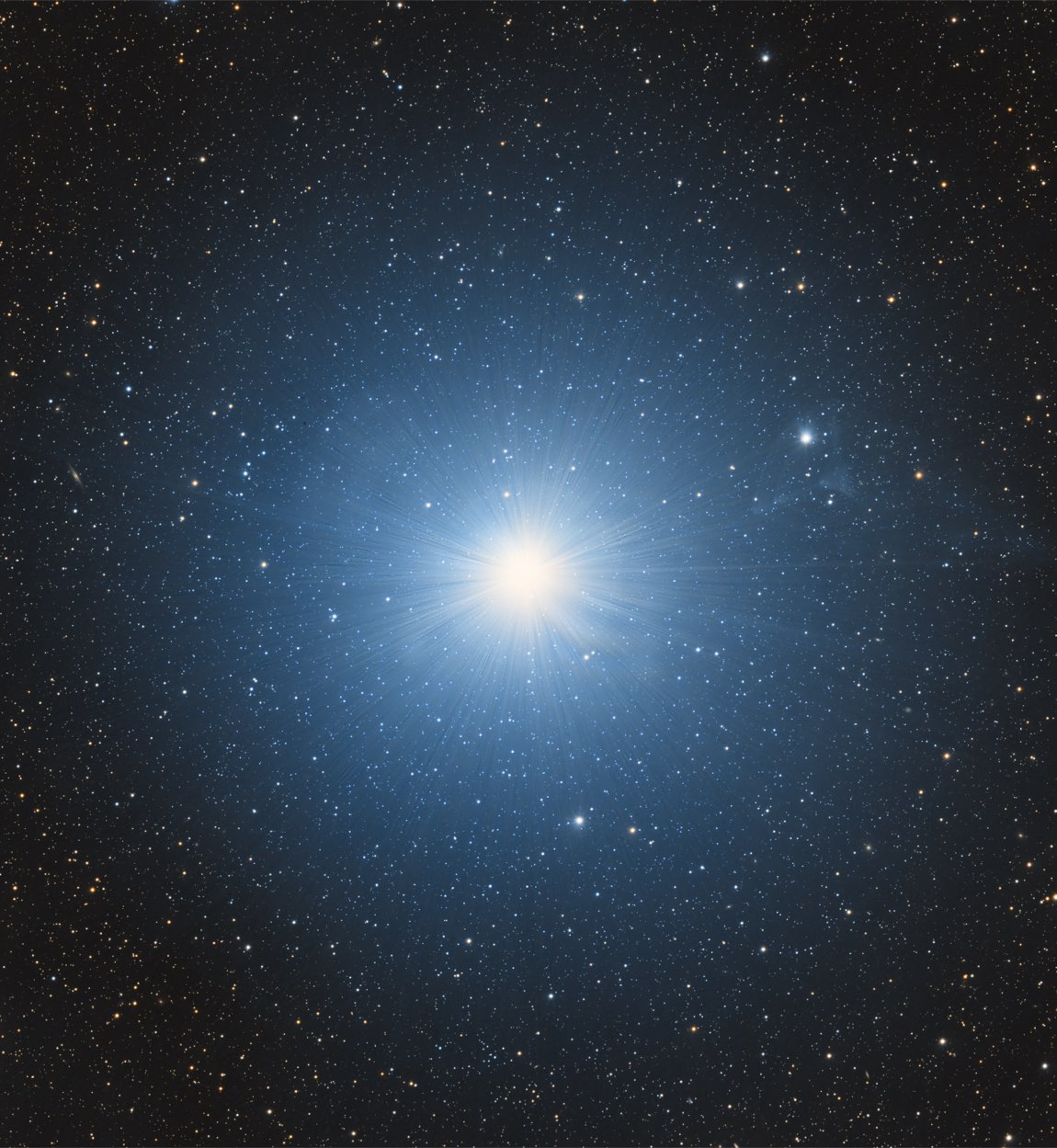
Deneb marks the Swan's tail in Cygnus and anchors the Summer Triangle with Vega and Altair. It looks comparable to them, yet sits vastly farther away — best estimates put it near 2,600 light-years, which would make it one of the most luminous stars visible to the naked eye, shining like roughly 200,000 Suns. Its distance remains genuinely uncertain, and this page says so.
The deep dive
Researched for the Atlas from Wikipedia — Deneb (10,391 characters read) · updated Sep 20, 2026
01 A Name That Means Tail — and Always Has
The name Deneb traces back to the Arabic phrase Dhanab al-Dajājah, meaning "tail of the hen," which perfectly describes the star's position at the rear of Cygnus the Swan (or hen, in older readings). That origin is not unique — at least seven different stars have been given names derived from the same Arabic root, among them Deneb Kaitos (brightest star in Cetus), Deneb Algedi (brightest in Capricornus), and Denebola (second brightest in Leo), each marking the tail of its own constellation's animal. Before the name Deneb settled into common use, the star carried a parade of alternatives: Arided, Aridif, and Denebadigege all appear in historical tables, and the Alfonsine Tables used Denebadigege. Johann Bayer, who gave the star its formal Greek-letter designation α Cygni in 1603, called it Arrioph. German scholar Philippus Caesius went further still, dubbing it Os rosae — "Rosemund" in German — and even Uropygium, the technical term for a bird's parson's nose. The International Astronomical Union has since officially recognized Deneb as the star's proper name and entered it in the Catalog of Star Names.
02 Deneb in Chinese Sky-Lore and a Love Story
In the Chinese astronomical tradition, Deneb belongs to an asterism called 天津 (Tiān Jīn), meaning "Celestial Ford" — a crossing point over the river of the Milky Way. The group includes eight other stars in Cygnus, and Deneb itself carries the name 天津四, meaning the Fourth Star of the Celestial Ford. That image of a ford or bridge is central to one of China's most beloved myths: the story of Qi Xi. In the tale, the cowherd Niu Lang (represented by Altair) and the weaver girl Zhi Nü (represented by Vega) are separated by the Milky Way but are allowed to reunite once a year on a special night in late summer. Deneb marks the magpie bridge that forms across the galaxy for that reunion. In some versions of the story, Deneb is not a bridge at all but a fairy chaperone present to supervise the lovers when they meet. The same three stars — Vega, Altair, and Deneb — form the Summer Triangle asterism visible to modern observers, so the ancient story and the modern star pattern are built from exactly the same celestial architecture, just interpreted through very different eyes.
03 How to Find Deneb in the Sky
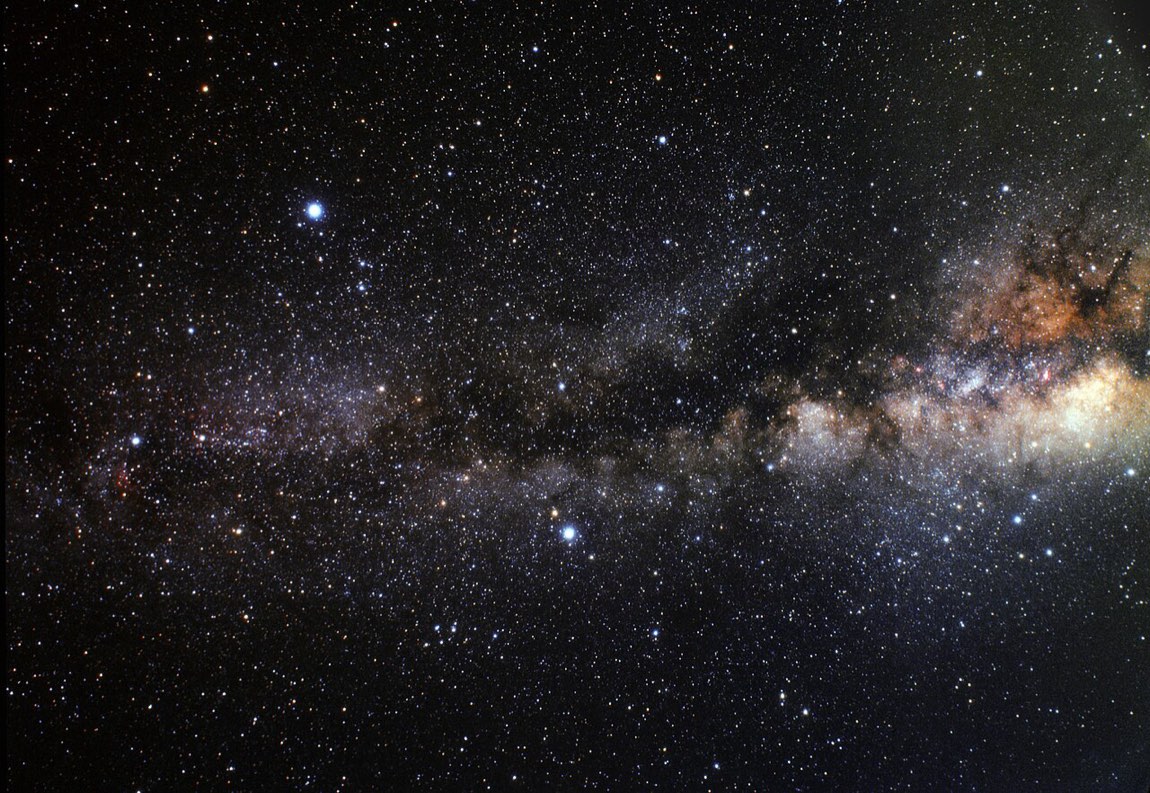
Deneb is one of the easier bright stars to locate because it anchors two prominent patterns at once. It sits at the tip of the Northern Cross, the distinctive shape formed by the brightest stars of Cygnus — Albireo (Beta Cygni), Gamma Cygni, Delta Cygni, and Epsilon Cygni complete the figure. Simultaneously, Deneb is one of the three vertices of the Summer Triangle, the large right-triangle asterism shared with Vega in Lyra and Altair in Aquila, where Deneb occupies one of the acute angles. For observers in the Northern Hemisphere, the star culminates each year on October 23 at 6 PM and September 7 at 9 PM local time, making it a fixture of summer and autumn evenings. At latitudes of 45° north and above — cities like Minneapolis, Montréal, and Turin fall right on that line — Deneb is circumpolar, meaning it never dips below the horizon at all. In the Southern Hemisphere the situation reverses: the star is not visible south of latitude 45° south, so observers in South Africa, southern Australia, and the northern part of New Zealand can only glimpse it barely above the horizon, and only during the southern winter.
04 Deneb's Spectrum: A Stellar Measuring Stick Deeper
Deneb carries the spectral classification A2Ia, placing it firmly in the blue supergiant category despite the "A" designation, which denotes a white-to-bluish-white surface color. What makes its spectrum especially important is institutional: since 1943, Deneb's spectrum has served as one of the stable anchor references used by astronomers to classify all other stars. When a new star is observed, its spectrum is compared against this and other standard references to assign it a type — Deneb is, in a real sense, one of the rulers on the cosmic measuring tape. Astronomers have been observing its spectrum since at least 1888, and by 1910 it was clear the radial velocity — the speed at which the star's surface moves toward or away from Earth — was varying. Early observers, including E. B. Frost, suggested this meant Deneb had an unseen companion, making it a binary system. By 1954, however, detailed study of the star's calcium H and K spectral lines revealed a stationary core within the varying signal, showing that the changes were caused by the motion of Deneb's own atmosphere rather than an orbiting companion. That radial velocity variation ranges from +6 to −9 km/s around the star's mean value.
05 The Pulsating Giant: Alpha Cygni Variables Deeper
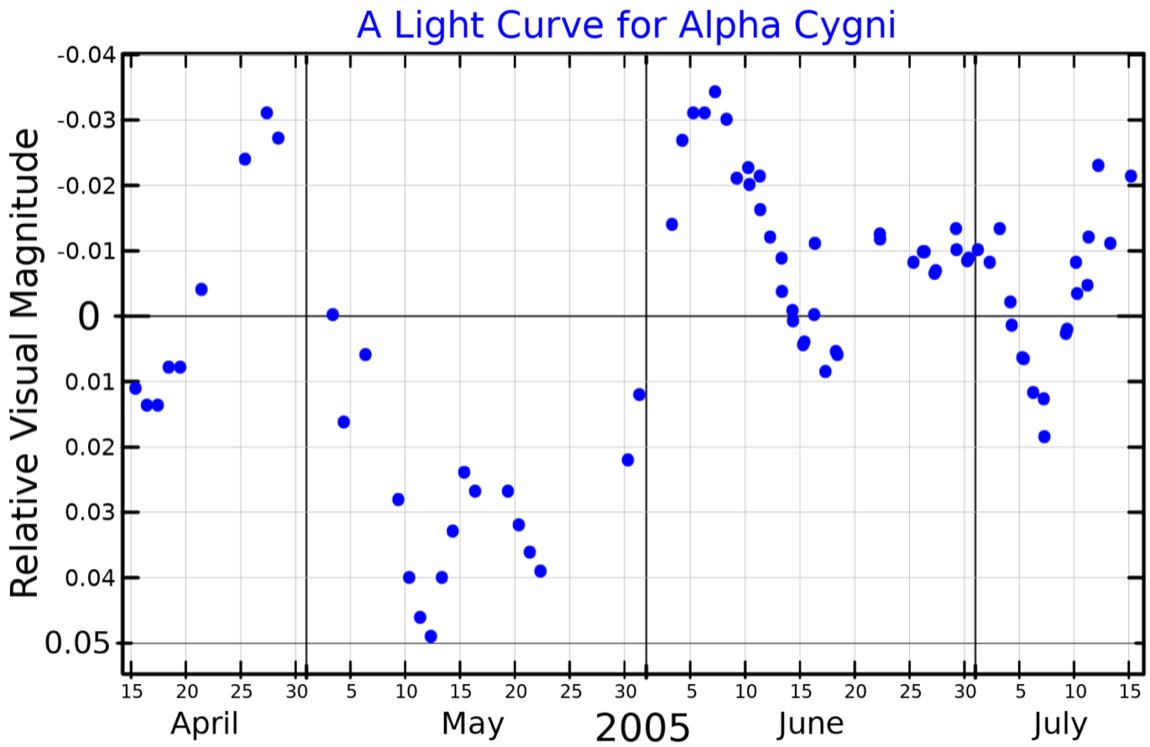
Deneb is not just a supergiant — it is the defining example, the prototype, of an entire class of variable stars called Alpha Cygni variables. Their light output fluctuates irregularly, and in Deneb's case the apparent magnitude wanders between 1.21 and 1.29. The variability in radial velocity was first identified by an astronomer named Lee in 1910, but Alpha Cygni variables were not formally recognized as a distinct category until the 1985 fourth edition of the General Catalogue of Variable Stars — a gap of 75 years between discovery and classification. The pulsations are thought to arise from the beating of multiple overlapping oscillation modes rather than a single clean rhythm. Analysis of Deneb's radial velocity data has identified 16 different harmonic pulsation modes with periods ranging from 6.9 to 100.8 days. A still longer period of approximately 800 days is also thought to exist. What physically drives these pulsations is not fully understood. Adding further complexity, Deneb has been reported as a possible single-line spectroscopic binary with a period of about 850 days, but later investigations found no supporting evidence for a companion — leaving the near-coincidence of that 850-day claimed orbital period and the ~800-day long pulsation period unexplained and possibly just coincidental.
06 A Star Eating Itself: The Stellar Wind
Deneb is not a static object sitting peacefully in space. It is steadily blowing itself away. Its stellar wind carries material off the surface at an average rate of 8 (plus or minus 3) times 10⁻⁷ solar masses per year. To make that number tangible: the Sun loses mass through its own wind, but Deneb sheds material at roughly 100,000 times that rate. Put another way, Deneb loses approximately one Earth-mass of material every 500 years. Over cosmic timescales that pace is ferocious, and it matters enormously for the star's future. Deneb is estimated to currently hold about 19 solar masses, but models suggest it began its life on the main sequence at around 23 solar masses as an O-type star — so substantial mass has already been shed. The rate of mass loss is one of the key variables that determines what kind of violent death Deneb will eventually have. Stars of similar mass can evolve into yellow hypergiants, luminous blue variables, or Wolf-Rayet stars depending on how aggressively their winds strip away their outer layers, and each of those paths leads to a different type of supernova: type II-P, type Ib, or type Ic.
07 The Distance Problem: Why Nobody Agrees Deeper
Deneb's distance from Earth is one of the more embarrassing open questions in stellar astronomy, given that the star is bright enough to see with the naked eye on any clear night. Distance estimates range from about 1,400 to 2,600 light-years — a factor-of-nearly-two uncertainty that propagates directly into everything else calculated about the star, including its luminosity, its diameter, and its evolutionary state. The Hipparcos astrometric satellite measured a parallax of 1.01 ± 0.57 milliarcseconds, which is so uncertain that it is almost useless on its own. A 2007 re-analysis of those same Hipparcos data produced a much larger parallax corresponding to a distance of 433 ± 60 parsecs (roughly 1,410 ± 196 light-years). Meanwhile, indirect methods — stellar atmosphere models, membership in the Cygnus OB7 stellar association — favor a distance of about 802 parsecs (2,620 light-years). The tension between trusting the direct satellite measurement versus the indirect model-based scales mirrors a similar and better-publicized controversy over the distance to the Pleiades star cluster. At the nearer distance, Deneb's luminosity would be about 55,000 times that of the Sun; at the farther distance it climbs to nearly 200,000 solar luminosities, making it one of the visually brightest stars known with an absolute magnitude of −8.4.
08 Inside a Supergiant: Structure and Evolution Deeper
Deneb spent the majority of its life as an O-type main-sequence star, fusing hydrogen in its core. It has since exhausted that core hydrogen and ballooned outward into a supergiant, and the question of exactly which stage it is in now is genuinely unresolved. One scenario holds that Deneb is still evolving redward for the first time, currently fusing hydrogen in a shell around a helium core that has not yet grown hot enough to begin fusing helium into carbon and oxygen. In this picture, convection is just beginning to dredge fusion products upward, but those products have not yet reached the surface. The competing scenario is that Deneb already passed through a red supergiant phase and is now evolving blueward again toward higher temperatures. Post-red-supergiant stars are expected to show fusion products at the surface because the intense convection during that red phase, combined with the loss of obscuring outer layers, exposes the deeper material. Current models do not cleanly reproduce the surface elemental abundances observed in Deneb's spectrum under either scenario. A third possibility is that Deneb only recently left the main sequence and is still heading toward its first red supergiant phase — consistent with its current estimated mass — with surface composition explained by a history of rapid rotation during its main-sequence life.
09 An Enormous Star, an Uncertain Size
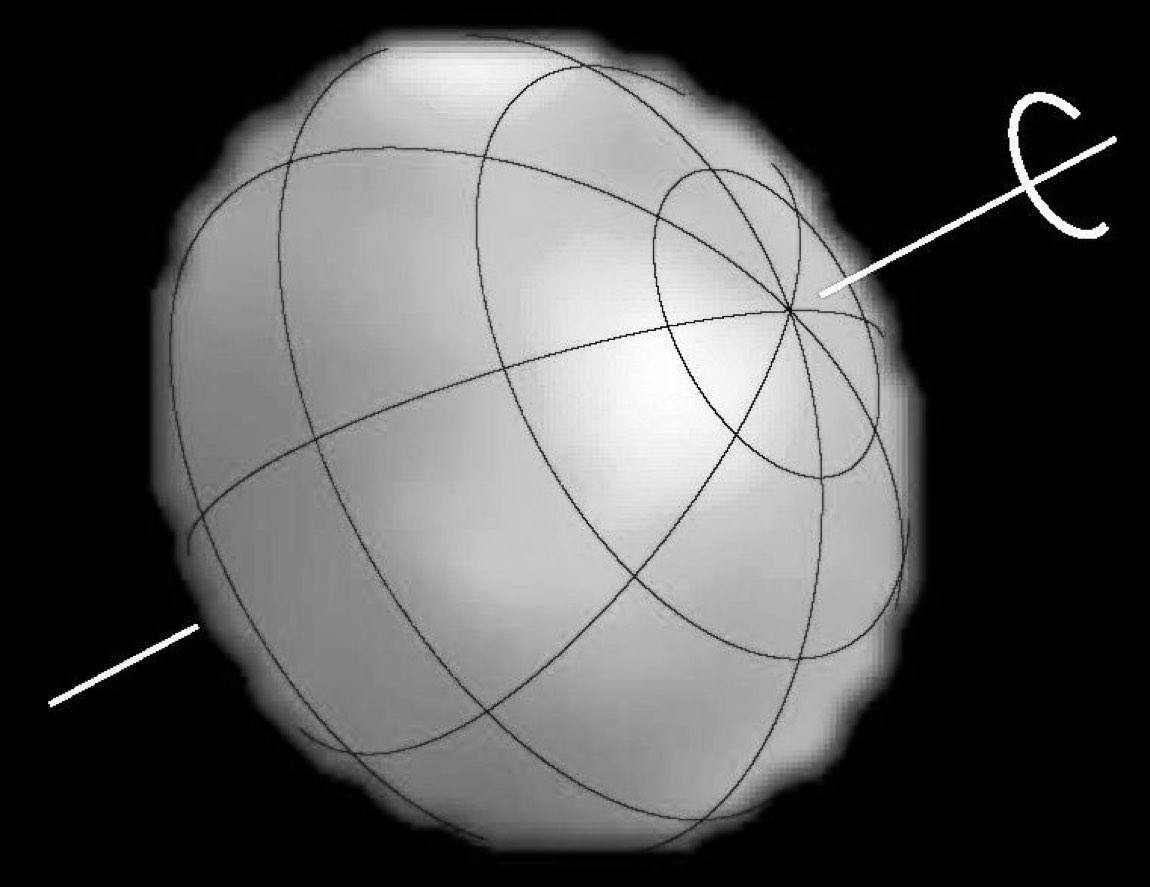
Even with the uncertainty in its distance, Deneb is clearly enormous. Based on its temperature, luminosity estimates, and direct measurements of its angular diameter — a mere 0.002 arcseconds across as seen from Earth, at the very limit of what can be measured — Deneb is estimated to have a physical diameter somewhere between 100 and 200 times that of the Sun. If Deneb were transplanted to the center of our Solar System in place of the Sun, its surface would reach out to somewhere between the orbit of Mercury and the orbit of Earth, depending on where in that size range the true diameter falls. That makes it one of the largest stars classified with a white "A" spectral type known. Its mass, by contrast, is estimated at about 19 solar masses — so while it is vast in volume, it is not proportionally as heavy as it looks, because supergiants expand their outer layers into regions of extremely low density. The combination of size and temperature gives it its extreme luminosity, which at the higher distance estimate approaches 200,000 times the power output of the Sun.
10 Deneb's Fate: Supernova in the Making
Whatever Deneb is doing right now — heading toward a red supergiant phase for the first time, or retreating back from one — the long-term outcome is a foregone conclusion: it will explode. Stars in the mass range that Deneb occupies eventually collapse at their cores, triggering a supernova. The exact flavor of that explosion is where the uncertainty lies. If Deneb retains most of its outer hydrogen envelope, it would likely produce a Type II-P supernova, the most commonly observed type of core-collapse explosion. If mass loss strips away the outer layers before collapse, it might instead explode as a Type Ib or Type Ic supernova, possibly after first passing through a Wolf-Rayet star phase. In between, an explosion as a yellow hypergiant or a luminous blue variable is also possible. This is not merely academic: astronomers want to understand which initial masses and mass-loss histories lead to which explosion types, and Deneb's uncertain evolutionary position means it sits right at the boundary of several of those categories. Resolving which path Deneb is currently on would help constrain the broader theory of how massive stars die. The event is still several million years away.
11 Deneb as a Future Pole Star
Earth's axis wobbles slowly over a cycle of roughly 26,000 years, a process called axial precession, which means the point in the sky that the north pole points toward traces a slow circle among the stars. Polaris is the current pole star, but that will change. Around the year 9800 AD, Deneb will sit approximately 7 degrees from the north celestial pole, making it an approximate pole star for people alive at that distant date — close enough to serve the navigational role that Polaris serves today, though not as precisely centered. In the meantime, Deneb already plays a pole-related role on another world: the north pole of Mars currently points toward the midpoint of the imaginary line connecting Deneb and the nearby star Alderamin (Alpha Cephei). Mars has its own axial precession cycle, so this alignment too will shift over time, but for now Deneb and Alderamin together serve as Mars's polar reference point in a way that no single star does for Earth.
12 Early Spectroscopic History and Who Did the Work Deeper
The scientific story of Deneb is inseparable from the development of stellar spectroscopy as a discipline. Astronomers began observing its spectrum in at least 1888, making it one of the earlier targets of systematic spectral study. In 1910, an astronomer named Lee identified that the star's radial velocity was variable — its spectral lines were shifting in ways that implied the star was not a static source. E. B. Frost was among the first to interpret this as evidence of a binary companion, a reasonable hypothesis at the time since binary orbital motion was already a known cause of radial velocity variation. By 1935, G. F. Paddock and collaborators had moved past the binary hypothesis and established through sustained observation that Deneb varied in luminosity with a dominant period of 11.7 days and likely additional lower-amplitude periods layered on top. The binary interpretation was finally set aside by 1954, when close examination of the calcium H and K spectral lines revealed a stationary core within the varying signal — a signature of the star's own atmospheric motions rather than an orbital companion. This made Deneb an early example of a broader phenomenon: multiple similar supergiants were subsequently found to show the same kind of atmospheric velocity variation, and Deneb became recognized as a typical member of that group.
 ⤢
⤢