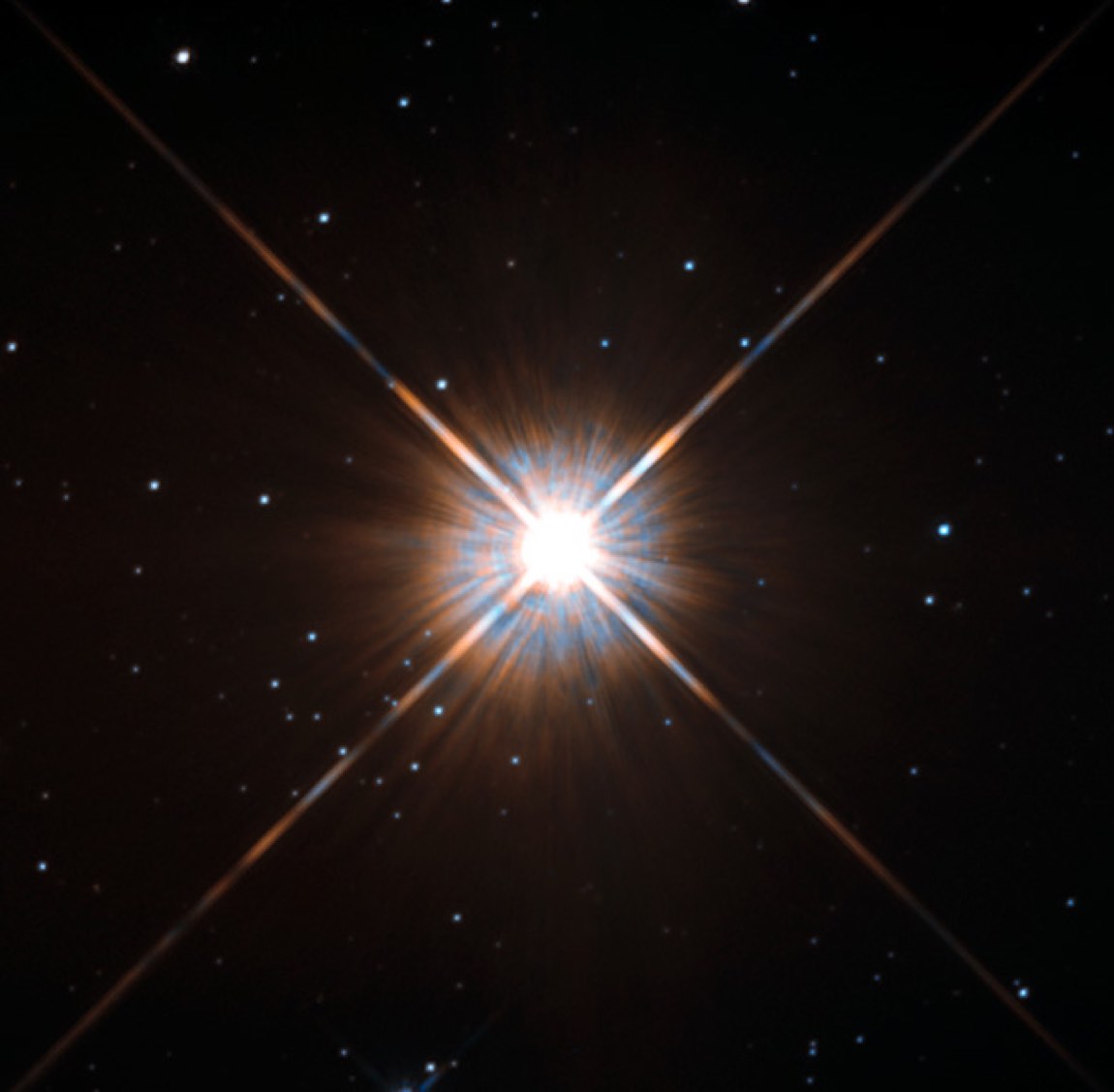
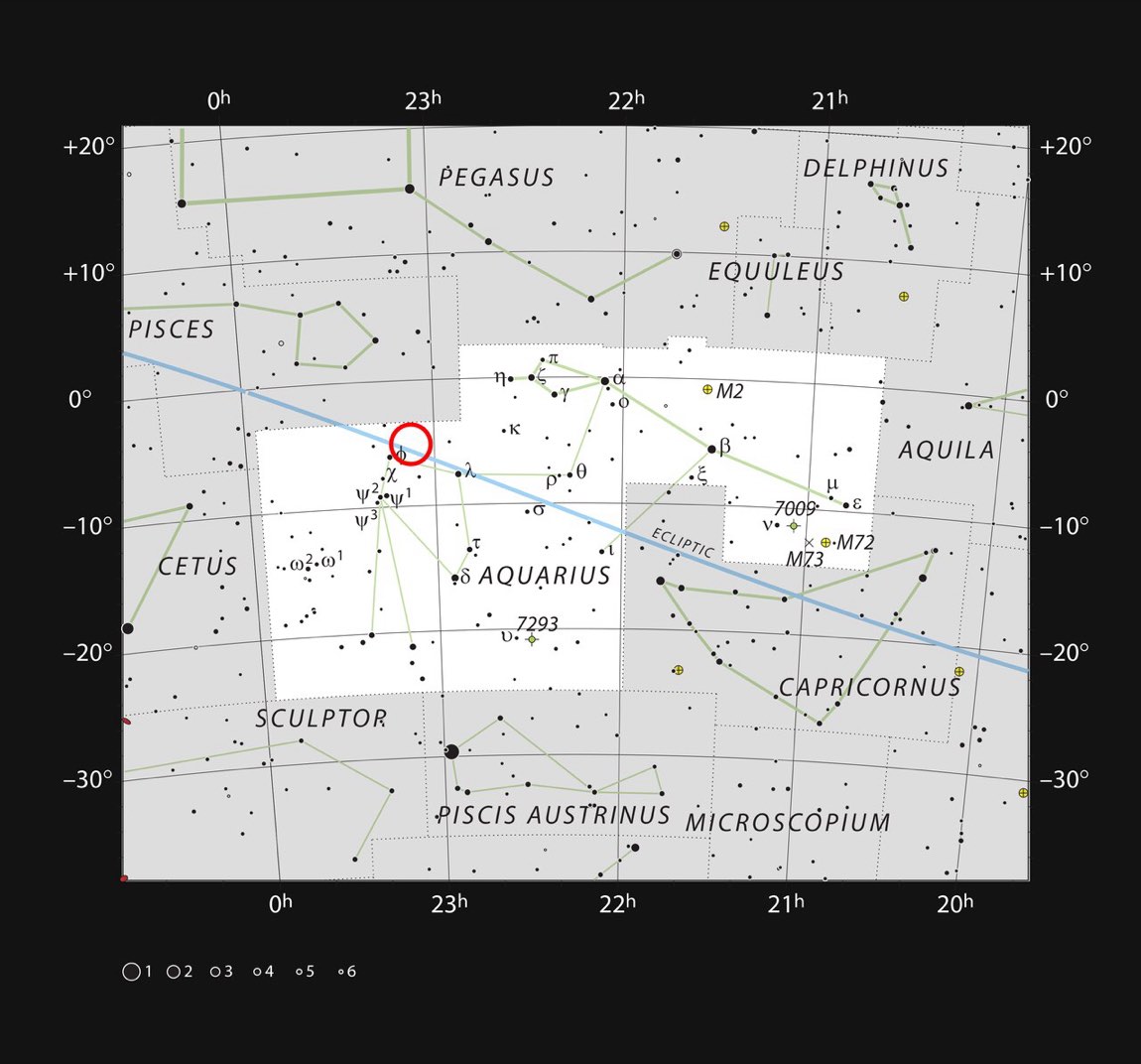
 Photograph · ESO/IAU and Sky & Telescope · CC BY 4.0
Star · Deep guide
TRAPPIST-1
Seven Earth-sized planets around one tiny star make this the most famous planetary system beyond ours.
What is it?
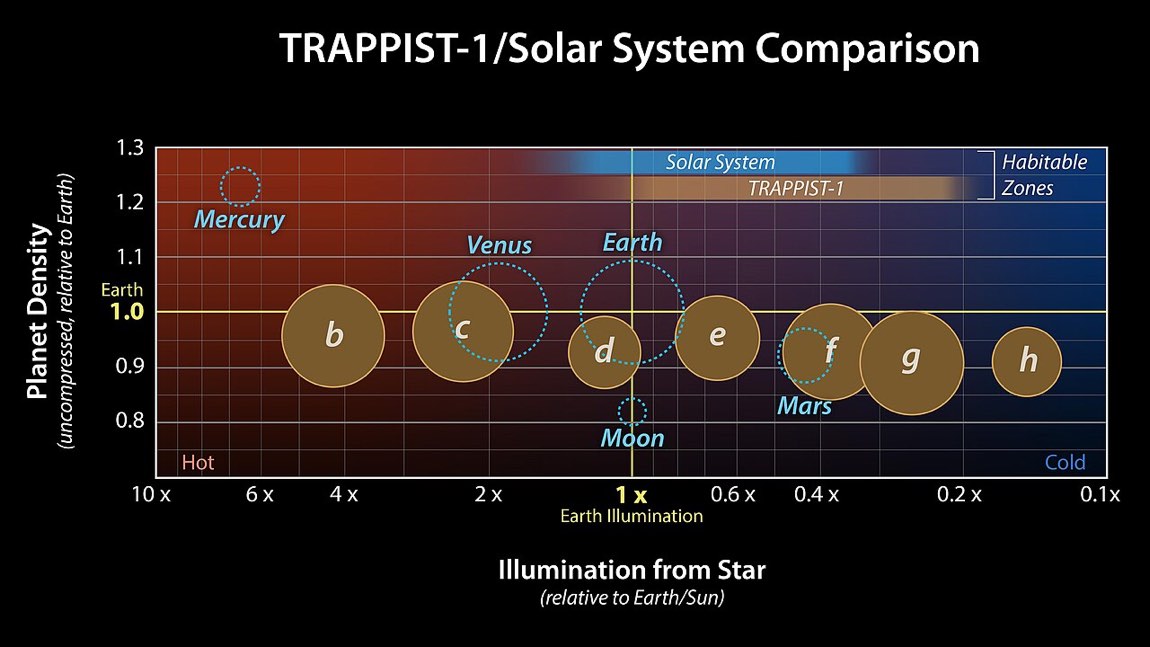
TRAPPIST-1 is a red dwarf 40.7 light-years away, barely bigger than Jupiter — and it hosts seven rocky, roughly Earth-sized planets, more than any other known system. Three or four of them orbit in the habitable zone where liquid water is possible. All seven are packed closer to their star than Mercury is to the Sun: from any one of them, the neighbors would hang in the sky like moons.
Go deeper
The 2017 discovery (TRAPPIST/Spitzer) made TRAPPIST-1 the benchmark system for terrestrial exoplanet science: transiting, resonant-chain orbits allow masses AND radii — hence densities — for all seven, showing volatile-rich rocky worlds. JWST has been working through the system: thermal measurements of 1b and 1c (2023) found no thick atmospheres on the inner two — consistent with red-dwarf flare erosion — while the habitable-zone planets (1e especially) remain the deep question. Whether M-dwarf planets keep atmospheres is THE question this system will answer.
01 Seven worlds in a pocket
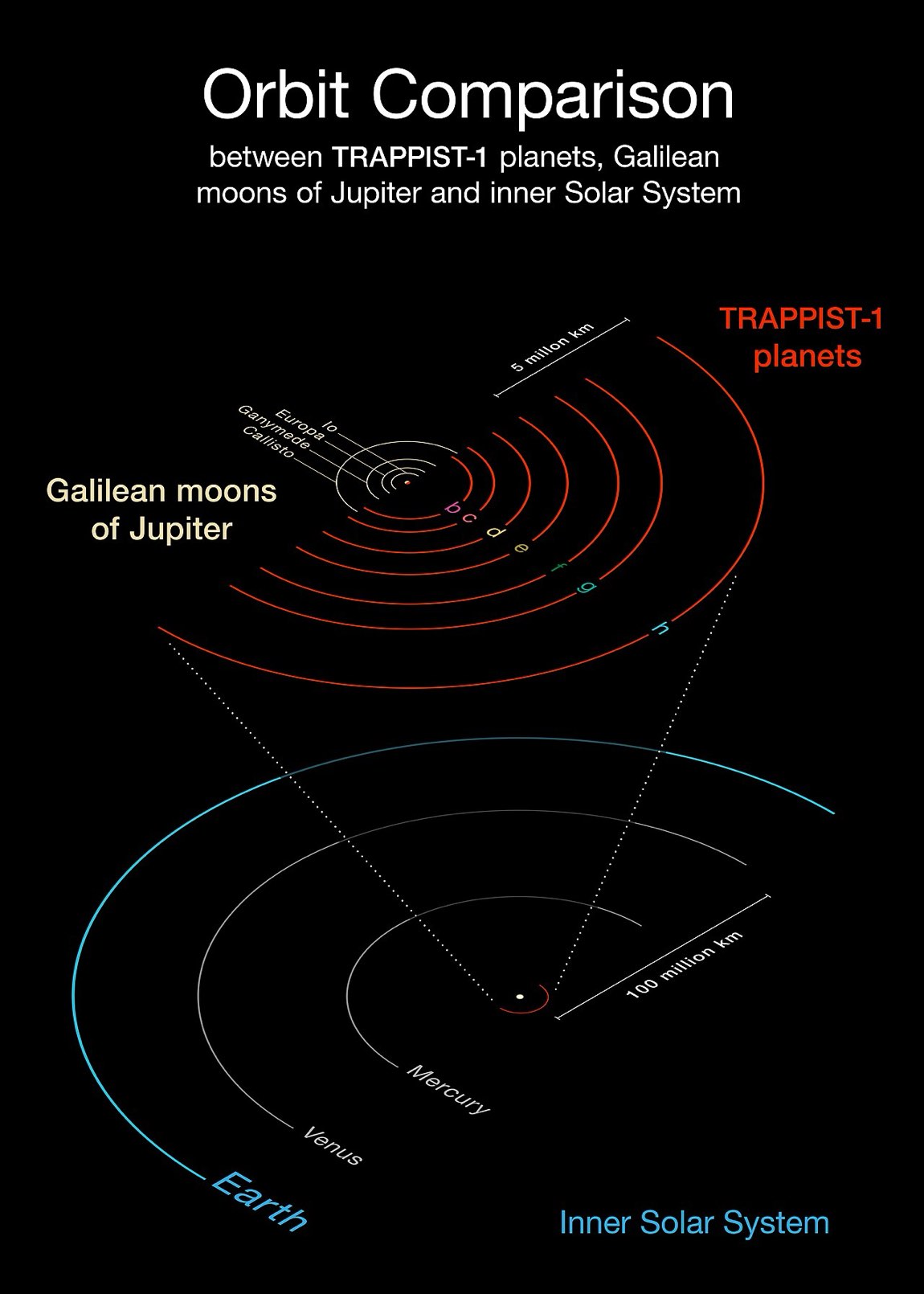
The entire TRAPPIST-1 system would fit comfortably inside Mercury's orbit — yet because the star is so dim and cool, several of those tightly-packed planets get gentle, Earth-like warmth. Stand on TRAPPIST-1e and the star glows salmon-pink, three times the size of our Sun in the sky, while sister planets pass overhead showing visible disks, phases, even weather — if any of them have air.
02 The atmosphere question Deeper
Red dwarfs flare hard, especially young; over billions of years that can sandblast atmospheres away. JWST's secondary-eclipse measurements say 1b and 1c are bare (or nearly so). If even one habitable-zone member kept an atmosphere, red-dwarf systems — 75% of all stars — stay in play for life across the galaxy. If all seven are bare rocks, the galaxy's most common planetary real estate may be mostly dead. Few measurements in science carry such leverage.
The deep dive
Researched for the Atlas from Wikipedia — TRAPPIST-1 (47,542 characters read) · updated Sep 20, 2026
03 A star discovered the old-fashioned way
TRAPPIST-1 did not emerge from a dramatic telescope campaign or a space-agency press conference. Astronomer John Gizis and colleagues quietly catalogued it during a 1999 survey of nearby ultra-cool dwarf stars, and the discovery was published in 2000. The star appeared in what the team called sample C of their survey, collected in June 1999. For years it sat unremarked in star catalogues under the clunky designation 2MASS J23062928−0502285. Its planetary system only came to light when Belgian astronomer Michaël Gillon led observations at the La Silla Observatory in Chile using the TRAPPIST telescope in 2015 and 2016. Anomalies in the light curves from those observations initially suggested three planets. Further analysis in 2016 revealed the third signal was actually multiple worlds, and by 2017 the total confirmed count had grown to seven. Some news outlets credited NASA alone with the discovery, but the TRAPPIST project received funding from both NASA and the European Research Council of the European Union — a nuance the researchers were quick to correct publicly.
04 A fleet of telescopes, two continents, one star
Nailing down the TRAPPIST-1 planetary system required an unusual coalition of observatories. The ground-based TRAPPIST–South telescope at La Silla in Chile made the initial detections, but confirming and characterising seven worlds demanded far more. TRAPPIST–North at the Oukaïmeden Observatory in Morocco joined in, as did the South African Astronomical Observatory, and the Liverpool and William Herschel telescopes located in Spain. The Spitzer Space Telescope contributed data considered among the most important findings of its entire mission. Complementary observations came from the Himalayan Chandra Telescope, the United Kingdom Infrared Telescope, and the Very Large Telescope. Final orbital calculations relied on measurements from both Spitzer and the Kepler Space Telescope. The original discovery team was affiliated with universities spanning Africa, Europe, and North America, and the inclusion of a Moroccan observatory and a Saudi Arabian university has since been cited as an illustration of the Arab and Islamic world's role in contemporary science. The discovery is also counted among the major astronomical achievements of Chilean observatories.
05 How small and how cold is this star, really?
TRAPPIST-1 belongs to spectral class M8.0±0.5 — deep into the red-dwarf territory where stars blur the boundary with giant planets. Its radius is just 12% of the Sun's, making it only slightly larger than Jupiter, though it is far more massive than any planet. Its mass sits at roughly 9% of the Sun's — barely enough for nuclear fusion to ignite in its core. Its surface temperature of 2,566 K (2,293 °C) makes it, as of 2022, the coldest-known star confirmed to host planets; that is cool enough for chemical compounds to condense directly in the photosphere, and these condensates have actually been detected through the polarisation they imprint on light during planetary transits. The star's luminosity is only about 0.055% of the Sun's, and most of that energy comes out as infrared radiation rather than visible light. There are no detectable radio wave emissions, and no evidence of a stellar cycle. The star's density is described as unusually low for a red dwarf — a quirk that remains under study.
06 Ten trillion years of fuel still to burn
TRAPPIST-1 is estimated to be about 7.6±2.2 billion years old, derived from a combination of techniques including the star's composition and movements. That already makes it older than the Solar System, which formed roughly 4.5 billion years ago. But its future dwarfs its past. Because red dwarfs of this mass burn hydrogen so slowly and frugally, TRAPPIST-1 is expected to remain on the main sequence for ten trillion years — approximately 700 times longer than the current age of the universe. The Sun, by comparison, will exhaust its hydrogen and swell into a red giant within a few billion years. The extreme age of the TRAPPIST-1 system has two-sided implications for habitability: any life that arose there has had — and will have — an almost incomprehensibly long window of time to evolve, but the planets have also spent billions of years soaking in the star's radiation and stellar wind, which may have progressively stripped their atmospheres.
07 Starspots, flares, and a 600-gauss field Deeper
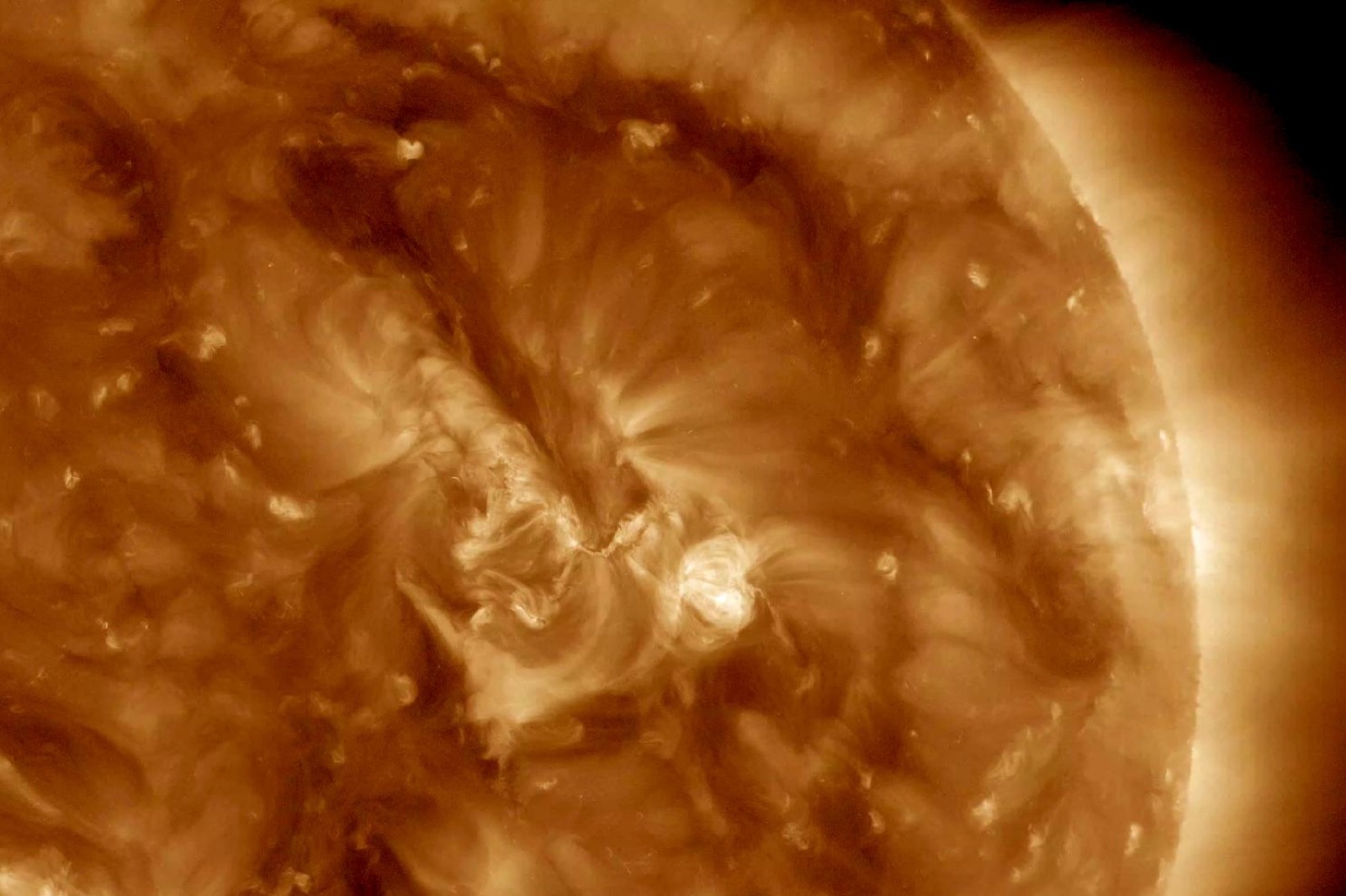
Despite its dimness, TRAPPIST-1 is an energetically restless star. James Webb Space Telescope observations indicate that cold starspots may cover up to one quarter of the stellar photosphere — a huge fraction compared to the Sun. The Kepler and Spitzer telescopes also detected probable bright spots that may be faculae. The star's rotation period has been measured at 3.3 days, though earlier measurements of 1.4 days appear to have been artefacts caused by shifting distributions of starspots rather than the true rotation. The star carries a strong magnetic field with a mean intensity of about 600 gauss — and researchers note this may be an underestimate. This field drives high chromospheric activity and may be capable of trapping coronal mass ejections before they reach the planets. Kepler K2 data recorded 42 flares in just 80 days, including large, complex events. The star averages roughly one flare every two days and about four to six superflares per year. Such flares would have limited effect on atmospheric temperatures but could substantially alter atmospheric chemistry, and according to one 2021 study, the planets are unlikely to retain atmospheres against coronal mass ejection bombardment.
08 The flattest planetary system ever measured Deeper
The seven TRAPPIST-1 planets orbit in an almost perfectly shared plane — their inclinations relative to one another are less than 0.1 degrees, making this the flattest planetary system in the NASA Exoplanet Archive. Their orbits are also highly circular, with minimal eccentricities, and are well aligned with the spin axis of the star itself. All seven worlds sit between 0.011 and 0.059 astronomical units from TRAPPIST-1, meaning the entire system fits comfortably inside Mercury's orbit around the Sun. The compactness is so extreme that the distance between the two innermost planets, TRAPPIST-1b and 1c, at closest approach is only twice the distance between Earth and its Moon. Despite this crowded arrangement, no evidence of comets has been detected, and searches with the Atacama Large Millimeter Array found no circumstellar dust disk and no Kuiper-belt equivalent. Whether a Solar System–style belt around TRAPPIST-1 would even be detectable from Earth remains uncertain.
 ⤢
⤢
09 Orbital music: the resonance chain explained Deeper
The orbital periods of the seven planets are not random — they form a precise resonance chain, with period ratios of 8:5, 5:3, 3:2, 3:2, 4:3, and 3:2 between each neighbouring pair, and each set of three consecutive planets sits in a Laplace resonance. This architecture is similar to the Galilean moons of Jupiter and to the exoplanet system Kepler-223. The resonances are dynamically fragile: simulations show they can be stable over billions of years, but stability is strongly dependent on initial conditions, and many configurations collapse into chaos within less than a million years. The resonances have a practical scientific benefit — they amplify the gravitational tugs planets exert on one another, causing measurable variations in exactly when each planet crosses in front of the star. These transit timing variations allow researchers to calculate planetary masses even when other techniques are unavailable. The resonance chain also hints at the system's formation: it suggests the planets migrated inward through a gas disk and accumulated at its outer edge, locking into resonance as they went, and that the resonance was somehow preserved when the disk dispersed.
10 Tidal heating: a hidden furnace inside each world Deeper
Because the planets are so close together and to their star, they experience gravitational squeezing and stretching — tidal forces — far more intense than anything in the inner Solar System. These deformations generate internal heat. According to Luger et al. (2017), tidal heating of the four innermost planets is expected to exceed Earth's total inner heat flux. For the outer planets, Quick et al. (2020) estimated tidal heating comparable to that inside Europa, Enceladus, and Triton — enough to potentially drive detectable cryovolcanic activity. This internal heat source likely outweighs radioactive decay inside the planets. For the innermost worlds it may be enough to maintain partially or wholly molten mantles — subsurface magma oceans. For the outer, colder planets, localised tidal heating could create liquid-water lakes or ponds even on an otherwise glaciated surface. Tidal forces could also fracture crustal rock even if insufficient to trigger plate tectonics, and tidal effects even extend into the planetary atmospheres. One counter-note: a 2025 study by Thomas et al. argued that atmospheric composition constraints imply volcanic activity on most TRAPPIST-1 planets would be less than on Earth.
11 Where these planets came from Deeper
The leading formation model, developed by Ormel et al. (2017), proposes that a streaming instability at the water-ice line of the protoplanetary disk produced precursor bodies that swept up additional material and migrated inward toward the star. If this is correct, the planets would have formed water-rich — containing roughly 10% water by mass — consistent with some density estimates. Raymond et al. (2021) concluded the planets assembled within one to two million years, after which almost no additional mass was accreted. That rapid assembly is significant: it means the neighbourhood was quickly cleared of spare material, limiting any later delivery of water by impacts. It also means there were few large collisions to blast away volatile material, helping the planets retain whatever ices they formed with. Flock et al. (2019) noted that the orbital distance of the innermost planet, TRAPPIST-1b, is consistent with the expected inner edge of a disk shaped by a star that was once an order of magnitude brighter — and with a cavity carved in the protoplanetary disk by TRAPPIST-1's own magnetic field. An alternative scenario, in which the planets formed roughly where they are today, is less favoured because such planets would likely have lost all their water.
12 Life-spreading between worlds: panspermia nearby
The extraordinary compactness of the TRAPPIST-1 system raises an intriguing biological possibility not available in most planetary systems. Because all seven planets orbit so closely to one another — in some cases appearing in each other's skies as objects larger than Earth's Moon — rock ejected by a major impact on one planet could reach a neighbouring world in a fraction of the time it would take similar material to travel between planets in the Solar System. The article notes that rock-encased microorganisms ripped from one TRAPPIST-1 planet could potentially arrive at another while still viable inside the rock, allowing life to spread between worlds if it originates on any single one. This variant of panspermia — life transfer within one planetary system — is far more plausible here than in most known systems. Conversely, the same proximity that makes cross-contamination possible also means that a sterilising event such as an intense superflare could affect multiple planets nearly simultaneously, potentially resetting the biological clock across several worlds at once.
13 A candidate eighth world, and a record to break
In 2025, JWST transit photometry turned up a tentative signal that researchers labelled TRAPPIST-1i, a candidate planet that would sit beyond TRAPPIST-1h as the outermost member of the system. Its radius, inferred from the transit data, is about 20% of Earth's — roughly the size of Neptune's moon Triton — which would make it the smallest known planet if confirmed. Its predicted existence had already been hinted at by transit timing variations of TRAPPIST-1h, and its estimated orbital location appears consistent with the Titius–Bode law. However, the detection is explicitly tentative. The observed transit signal might instead be explained by TRAPPIST-1c occulting TRAPPIST-1b — one planet blocking the light of another rather than crossing the star. A Bayesian information criterion analysis also statistically prefers excluding TRAPPIST-1i from the model. If the planet is eventually confirmed, the TRAPPIST-1 system would become the first known exoplanetary system with eight confirmed planets, tying the record held by Kepler-90.
14 How scientists actually detect these worlds
Every planet in the TRAPPIST-1 system was found by the transit method: watching for the tiny dimming of the star's light as a planet passes in front of it. This technique is unusually productive here for two reinforcing reasons. First, all seven planets happen to orbit in a plane that, from Earth's perspective, passes directly across the face of the star — so transits actually occur rather than being missed. Second, because the star itself is so small — only slightly larger than Jupiter — even a planet the size of Earth blocks a meaningful fraction of its light. The visibility of an exoplanet and its atmosphere scales with the inverse square of the host star's radius, which is why TRAPPIST-1's diminutive size is scientifically valuable. The resonance chain adds a bonus: gravitational interactions among the planets shift their transit times in measurable ways, yielding mass estimates even without radial-velocity measurements. JWST began investigating the TRAPPIST-1 planets in 2023, and detecting individual atmospheric components such as CO2, ozone, and water is considered possible, though each would require specific observing conditions and different numbers of transits.
15 What it looks like to stand on one of these worlds
Co-discoverer Amaury Triaud has described TRAPPIST-1's skies in vivid terms: because most of the star's radiation is infrared, visible light on the surface would be scarce. The sky would never be brighter than an Earth sunset and only a little brighter than a night with a full Moon. Ignoring any atmospheric effects, the illumination would appear orange-red. On TRAPPIST-1e specifically, the star would appear four times wider across the sky than the Sun appears from Earth. Most strikingly, the other planets would be conspicuous naked-eye objects — many appearing larger than Earth's Moon and clearly recognisable as disks rather than points of light, and each would display noticeable retrograde motion. Observers on planets e, f, and g, however, could never witness a total stellar eclipse. If atmospheres exist, the star's long-wavelength radiation would be absorbed more strongly by water and carbon dioxide than sunlight is on Earth, and scattered less by the atmosphere. The same total radiation input would therefore produce a warmer surface than an equivalent Sun-like star would, and would be absorbed more in the upper atmosphere, making the air column more stable and less prone to convective storms.
 ⤢
⤢
Could life exist here?
Multiple temperate, rocky, water-candidate worlds around one quiet-ish old star — the best-characterized habitable-zone set we have. Everything hinges on atmospheres; JWST is checking now.
Our labels: Confirmed · Strong Evidence · Estimated · Hypothesis · Theoretical · Speculative (see Methodology).
How would we get there?
40.7 light-years. Voyager-speed: ~700,000 years. Light-sail concepts: ~200 years. This one belongs to telescopes for the foreseeable future.
Weird & wonderful
- All seven planets are in a resonant chain — their years form near-perfect musical ratios (8:5, 5:3, 3:2…).
- The star will live 200+ times longer than the Sun.
- From planet e, neighboring planet f can appear about twice the size of our full Moon.
- The system is named after a Belgian telescope, itself winking at Trappist beer.