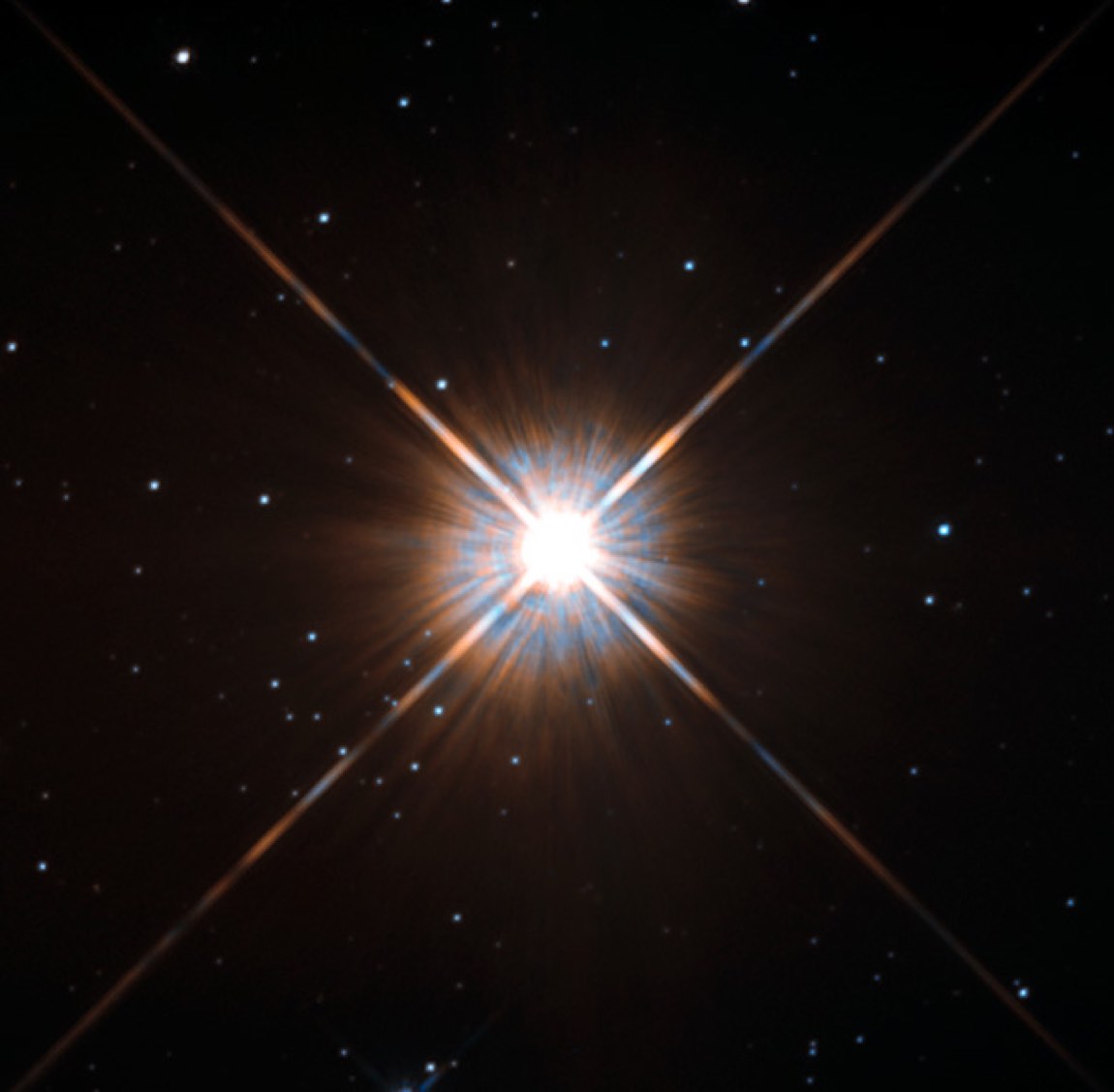
- Surface temperature
- 3,690 K
- Radius
- 0.05 × the Sun
- Luminosity
- 0.000 × the Sun
- Spectral type
- sdM4
Star · Deep guide
Barnard's Star
An ancient red dwarf almost next door, and the fastest-moving star in our sky.
What is it?
Barnard's Star is the second-closest star system to the Sun (after Alpha Centauri), just under 6 light-years away — and the fastest-moving star in Earth's sky, crossing a full-Moon width every 180 years. It is a dim red dwarf nearly twice the age of the Sun. In 2024–2025, astronomers finally confirmed planets there: a family of small, sub-Earth worlds skimming close to the star.
Go deeper
Barnard's Star is an ~10-billion-year-old metal-poor M4 dwarf — a relic of the galaxy's earlier generations. Its record 10.4″/yr proper motion reflects genuine speed plus proximity. Planet claims here have a century of history (van de Kamp's famous false positives from telescope artifacts); the real detection came via ESPRESSO/VLT radial velocities: Barnard b (~0.3 Earth masses, 3.15-day orbit) confirmed in 2024, with three more sub-Earths announced in 2025 — all far too hot for liquid water, all testaments to how precise radial-velocity science has become (centimeters-per-second territory).
01 The runaway star
Every star drifts across the sky, but so slowly the constellations look eternal. Barnard's Star is the exception: photographs taken decades apart show it visibly displaced. It is falling past the Solar System at 140 km/s and will pass within 3.8 light-years around the year 11,800 — briefly taking the 'nearest star' crown.
02 A cautionary tale, then a triumph Deeper
In the 1960s Peter van de Kamp announced planets here from photographic wobbles — a claim that stood for years before being traced to telescope lens changes. The episode became astronomy's standard cautionary tale about instrument systematics. Sixty years later, ESPRESSO's confirmed detection of a one-third-Earth-mass planet at the same star closed the circle: the planets are real; they were just a thousand times harder to see.
The deep dive
Researched for the Atlas from Wikipedia — Barnard's Star (18,403 characters read) · updated Sep 20, 2026
03 How Barnard measured a record proper motion
Edward Emerson Barnard did not discover the star that bears his name — it had already appeared on Harvard University photographic plates in 1888 and 1890 — but in 1916 he measured something no one had seen before. He clocked the star's proper motion at 10.3 arcseconds per year relative to the Sun, the highest proper motion ever recorded for any star. To appreciate how small that sounds, consider that 10.3 arcseconds is a tiny angle, yet it accumulates: over a human lifetime of roughly 70 years, the star drifts about a quarter of a degree across the sky, equivalent to roughly half the angular diameter of a full Moon. It is a testament to careful, long-baseline photography that such a shift was measurable at all with early twentieth-century instruments. The International Astronomical Union formally ratified the name Barnard's Star on 1 February 2017, when its Working Group on Star Names added the designation to the official List of IAU-approved Star Names — making permanent what astronomers had used informally for a century.
04 Faint, dense, and surprisingly Jupiter-sized
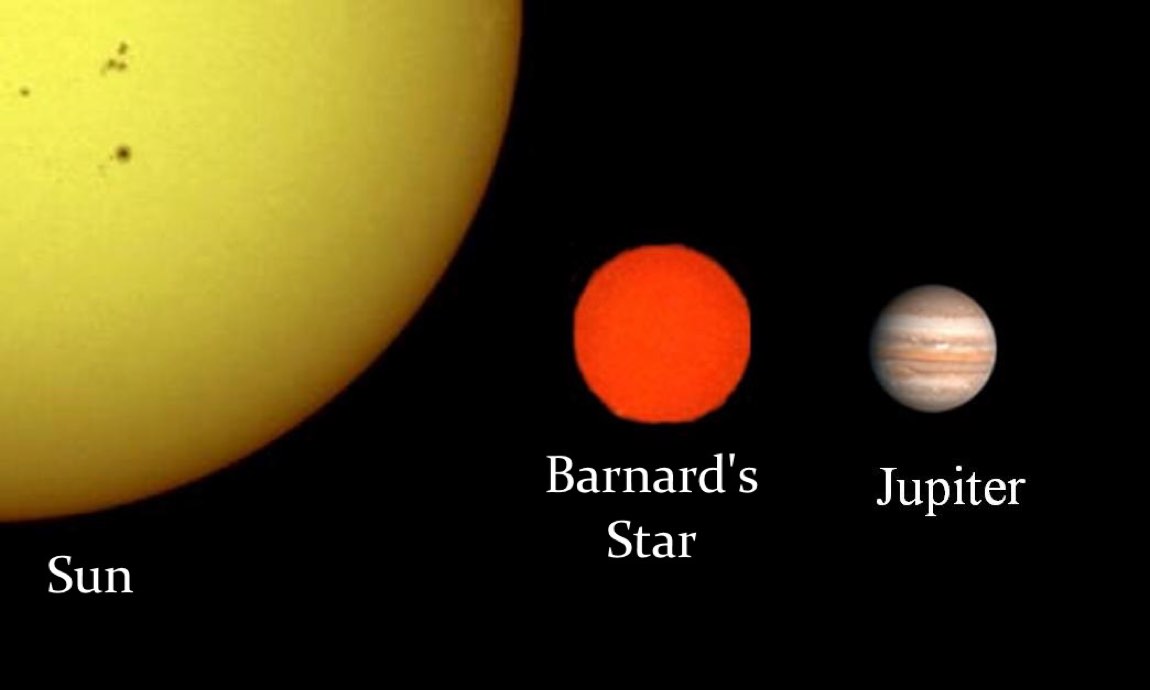
Barnard's Star belongs to spectral type M4, making it a dim red dwarf with an apparent visual magnitude of +9.5 — well beyond the naked-eye limit of about +6.5. Yet its physical proportions are striking in their own way. Its mass is roughly 0.16 solar masses, which works out to approximately 150 times the mass of Jupiter. Despite packing in all that mass, its radius is only about 0.2 times that of the Sun, or roughly twice Jupiter's radius. That comparison captures its extraordinary density: a star containing 150 Jupiter masses squeezed into a ball only twice Jupiter's size. Its effective surface temperature is about 3,220 kelvin — less than 60% of the Sun's surface temperature — and its total luminosity is just 0.0034 solar luminosities. A vivid way to feel that faintness: if Barnard's Star were swapped in for the Sun at exactly 1 astronomical unit from Earth, it would shine only about 100 times brighter than a full Moon, roughly equivalent to the Sun's brightness as seen from 80 astronomical units away, out near the inner edge of the Kuiper Belt.
05 A flare from a star everyone thought was quiet
For most of its observed history, Barnard's Star was assumed to be a quiet, settled object — understandable given its age of 7 to 12 billion years, making it potentially one of the oldest stars in the Milky Way. Old stars rotate slowly, and slow rotation is associated with weak magnetic fields and little explosive activity. Barnard's Star rotates only once every 130 days, compared with the Sun's 25-day rotation period. Then on 17 July 1998, during an unrelated search for variations in proper motion, astronomers caught an intense stellar flare. It took four years to fully analyze, but the results were startling: the flare's temperature reached an estimated 8,000 kelvin, more than twice the star's normal surface temperature of roughly 3,220 kelvin. Researcher Diane Paulson noted that the event made Barnard's Star "fantastic for amateurs to observe," given how unexpected and dramatic it was. Flares are thought to arise from strong magnetic fields suppressing plasma convection until energy releases suddenly, but strong fields are associated with rapid rotation — the opposite of what Barnard's Star displays. The 1998 event is therefore considered a rarity for a star of its age and rotation rate.
06 Two more flares spotted in 2019 Deeper
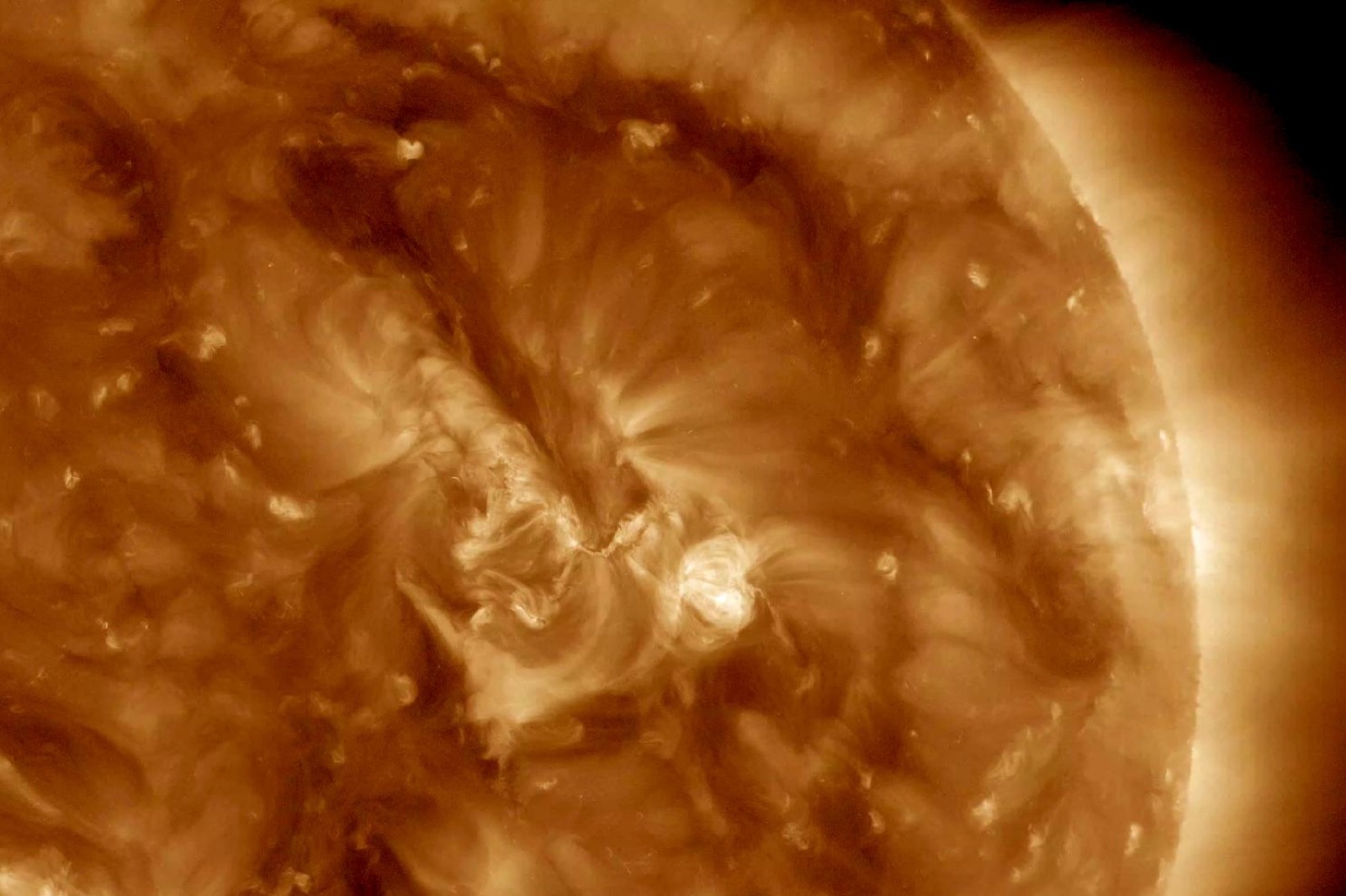
The 1998 event proved not to be an isolated curiosity. In 2019, astronomers detected two additional ultraviolet stellar flares from Barnard's Star, each releasing far-ultraviolet energy of 3×10²² joules, along with one X-ray stellar flare carrying energy of 1.6×10²² joules. Beyond the raw energy figures, researchers calculated a sobering consequence for any planet in the system. The observed flare rate is sufficient to drive the loss of 87 Earth atmospheres per billion years through thermal processes alone, with an additional roughly 3 Earth atmospheres per billion years stripped away through ion loss processes. These estimates were calculated specifically in the context of the then-proposed Barnard's Star b. The broader scientific interest is atmospheric: since the habitable zones of M-dwarf stars sit very close to the star, any planet located there would be continuously battered by flares, stellar winds, and plasma ejection events. Researchers hope that detailed photometric studies of Barnard's Star's X-ray and ultraviolet emissions can serve as a proxy for understanding the large population of old M dwarfs scattered throughout the galaxy, with direct implications for astrobiology.
07 Metallicity: a clue to ancient origins Deeper
The chemical composition of a star carries the fingerprints of when and where in the galaxy it formed. Astronomers measure metallicity — the fraction of a star's mass made up of elements heavier than helium — to place stars within galactic history. Barnard's Star has a metallicity of 10 to 32% of the Sun's, which is notably low but not as extreme as the ancient, nearly metal-free halo stars that formed in the earliest era of the Milky Way. This has prompted a classification debate. Its high space velocity and low metallicity suggest a halo or old disk origin, but its metallicity is actually higher than typical halo stars, placing it in what astronomers call an "intermediate population II star" category — somewhere between the ancient metal-poor halo population and the younger, metal-rich disk population that includes the Sun. Complicating matters, some more recently published papers report much higher metallicity estimates, between 75 and 125% of the Sun's level. This wide range of estimates — from roughly one-tenth solar to slightly above solar — remains unresolved, and the uncertainty affects conclusions about the star's age, origin, and the likely composition of its planets.
08 Van de Kamp's long ghost: four decades of phantom planets
The story of planet-hunting at Barnard's Star is one of the most instructive in the history of astronomy. Beginning in 1938, Peter van de Kamp and colleagues at the Sproul Observatory at Swarthmore College searched photographic plates for tiny wobbles in the star's path — wobbles that would betray an unseen planet's gravitational tug. As many as ten researchers averaged their plate measurements to suppress individual errors. By the early 1960s, Van de Kamp announced a planet of about 1.6 Jupiter masses in a slightly eccentric orbit at 4.4 astronomical units. In 1969 he refined this to two planets of 1.1 and 0.8 Jupiter masses. For roughly a decade, a substantial portion of the astronomical community accepted these findings. The unraveling came in 1973. John L. Hershey, also working from Swarthmore, discovered that astrometric shifts in multiple stars correlated precisely with dates when the telescope's objective lens had been adjusted or modified — the planets were an artifact of instrument maintenance. George Gatewood and Heinrich Eichhorn, working at a different observatory with newer techniques, independently failed to find any planetary signal. Van de Kamp never conceded the error, publishing a further claim as late as 1982 and dying in 1995. His successor at Swarthmore, Wulff Heintz, began publishing formal criticisms from 1976 onward, and the two men reportedly became estranged.
09 Closing in on the truth: 40 years of null results Deeper
Between the collapse of Van de Kamp's claims and the eventual detection of real planets, Barnard's Star was subjected to one of the most sustained negative searches in observational astronomy. Each decade tightened the constraints. Gatewood showed in 1995 that planets of 10 Jupiter masses could be definitively ruled out. In 1999, Hubble Space Telescope interferometric work excluded planets of 0.8 Jupiter mass with orbital periods shorter than 1,000 days — notable because Jupiter's own orbital period is 4,332 days, so this ruled out Jupiter-like planets in much tighter orbits. By 2003, Kuerster determined that within the habitable zone, no planet could exist with an "M sin i" value greater than 7.5 Earth masses, or greater than 3.1 Neptune masses. A 2013 study using 25 years of radial velocity data from the Lick and Keck Observatories, processed with Monte Carlo analysis for both circular and eccentric orbits, excluded planets above two Earth masses in orbits shorter than 10 days, and planets above ten Earth masses out to a two-year orbit. NASA's Space Interferometry Mission had listed Barnard's Star as an early target before the mission was cancelled in 2010; ESA's Darwin interferometry mission lost its funding in 2007. Terrestrial planets remained stubbornly beyond detection — until the instruments finally caught up.
10 The four tiny planets finally confirmed
In August 2024, the ESPRESSO spectrograph on the Very Large Telescope delivered the first genuinely convincing evidence of a planet orbiting Barnard's Star. The confirmed planet, designated Barnard's Star b, has a minimum mass of just 0.37±0.05 Earth masses and completes an orbit in 3.15 days. Three additional candidate planets were proposed in the same study, all orbiting closer to the star than its habitable zone. TESS photometry showed no planetary transits, indicating the system is not viewed edge-on from Earth. In March 2025, an independent follow-up study confirmed all four planets. That study also ruled out planets more massive than 0.57 Earth masses within the habitable zone with 99% confidence. One of the four planets, Barnard's Star e, carries a minimum mass of only 0.193 Earth masses — making it the least massive exoplanet ever detected by the radial velocity method. The best-fit orbital solution gives the planets slightly eccentric orbits, though simulations suggest those eccentricities would produce unstable configurations. Since the planets clearly exist, astronomers suspect the eccentricity values are likely overestimated rather than reflecting the true orbits.
11 Project Daedalus: a blueprint for reaching it
Between 1973 and 1978, the British Interplanetary Society conducted Project Daedalus, a detailed engineering study asking whether rapid, uncrewed travel to another star was achievable with existing or near-future technology. Barnard's Star was selected partly because it was then believed to host planets. The proposed vehicle was a nuclear pulse rocket burning deuterium and helium-3 via electron bombardment. Accelerating for four years, it would reach 12% of the speed of light, allowing it to arrive at Barnard's Star in 50 years — comfortably within a human lifetime, though the craft itself would carry no crew. Along the way it would examine the interstellar medium and perform baseline astrometric readings before investigating the star and any companions. The study inspired follow-on thinking: in 1980, Robert Freitas proposed a more ambitious self-replicating spacecraft concept, to be assembled and launched from Jupiter's orbit. It would reach Barnard's Star in 47 years under similar parameters, then begin automated self-replication — first building exploratory probes, then after roughly 1,000 years constructing a complete copy of itself. Both concepts remain theoretical, but they represent some of the most rigorous early attempts to cost and engineer interstellar travel.
12 What the star's neighborhood looks like
Barnard's Star occupies a corner of the galaxy that feels, in stellar terms, rather familiar. Its nearest neighbor is the red dwarf Ross 154, sitting 1.66 parsecs — 5.41 light-years — away, followed by the Sun itself at 5.98 light-years and then Alpha Centauri at 6.47 light-years. All of the immediate neighbors are red dwarfs, the smallest and most abundant type of star, which is statistically what one would expect in any patch of the Milky Way. From the surface of a hypothetical planet at Barnard's Star, the Sun would appear on the exact opposite side of the sky, positioned at coordinates RA 5h 57m 48.5s, Dec −04° 41′ 36″, in the westernmost part of the constellation Monoceros. At a distance of 1.834 parsecs, the Sun would shine at first magnitude — comparable to how the star Pollux appears from Earth — since the Sun's absolute magnitude is 4.83. That single number captures both how close these two stars are on a cosmic scale and how modest the Sun itself looks from only six light-years away.
13 A first in radial velocity: a star's own motion detected Deeper
In 2003, Barnard's Star achieved a milestone unrelated to planets: it became the first star for which astronomers could directly detect a change in radial velocity caused simply by the star's own motion through space. Radial velocity — the speed at which an object moves toward or away from an observer — is normally treated as a fixed quantity for a given star over the timescale of a human observing program. Barnard's Star moves so quickly, at a radial velocity of −110 km/s toward the Sun, and is so close, that its trajectory produces a measurable shift in that velocity as the geometry between star and observer changes year by year. This so-called secular acceleration is a purely kinematic effect, not caused by any companion or activity on the star, and Barnard's Star was fast enough and near enough to make it the first detectable example. Subsequent variability in its radial velocity was attributed to stellar activity rather than orbital mechanics — a distinction that became critically important when the 2018 planet candidate was later found to be a stellar-activity signal rather than a genuine planet.
14 How close it will actually get — and when
Barnard's Star is racing toward the Sun at a radial velocity of −110 km/s, and when its lateral motion of 90 km/s is combined with that approach speed and its distance, the resulting space velocity — its true speed relative to the Sun — works out to 142.6±0.2 km/s. That trajectory will bring it to a closest approach around the year 11,800 CE, when it will come within about 3.75 light-years of the Sun. At that moment it will not be the nearest star: Proxima Centauri, currently 4.24 light-years away and itself moving, will by then have shifted to an even closer position. Barnard's Star will also remain invisible to the naked eye even at closest approach. Its apparent magnitude will have brightened by only one magnitude, reaching about 8.5 — still 2.5 magnitudes short of the naked-eye threshold of roughly +6.0. For any observer in the year 11,800 CE hoping to glimpse it without optical aid, the star will remain hidden, a reminder that proximity and visibility are very different qualities in a universe built around luminosity.
 ⤢
⤢
Could life exist here?
Its known planets hug the star, well inside the habitable zone's inner edge. An ancient, quiet star is a plus; nothing temperate has been found yet.
Our labels: Confirmed · Strong Evidence · Estimated · Hypothesis · Theoretical · Speculative (see Methodology).
How would we get there?
The 1970s 'Project Daedalus' study — the first serious engineering design for an interstellar probe — chose Barnard's Star as its target: a fusion-powered flyby arriving in ~50 years. It was never built, but its report still shapes the field.
Weird & wonderful
- In 10,000 years, Barnard's Star will be the closest star to the Sun.
- It is older than the galaxy's thin disk — a visitor from the Milky Way's earlier eras.
- Its confirmed planet weighs about a third of Earth — among the lightest ever detected by wobble.