 Photograph · NASA · Public domain
Spacecraft · Deep guide
Voyager 1
After 48 years, the farthest human-made object is still calling home from interstellar space.
What is it?
Voyager 1 launched in 1977 to tour Jupiter and Saturn — and never stopped. In 2012 it crossed the heliopause, where the Sun's wind gives way to interstellar space, becoming the first human object to leave the Sun's bubble. Nearly half a century after launch it is more than 25 billion km away and still transmitting, on 1970s hardware with less memory than a car key.
Go deeper
Voyager 1's grand-tour trajectory used the rare 1970s alignment to slingshot from Jupiter (radiation-belt survey, Io volcanism arrival) to Saturn (Titan flyby chosen over a Pluto option). Its plasma-wave instrument still measures interstellar electron densities via 'whistles' from solar outbursts. Power from its decaying plutonium RTGs drops ~4 W/year; engineers have been switching off instruments and heaters for years, and in 2024 famously revived it from a corrupted-memory silence by remotely repartitioning code across chips 22.5 light-hours away. Science operations are expected to end around the late 2020s; the silent craft then coasts forever — carrying the Golden Record.
01 The Golden Record
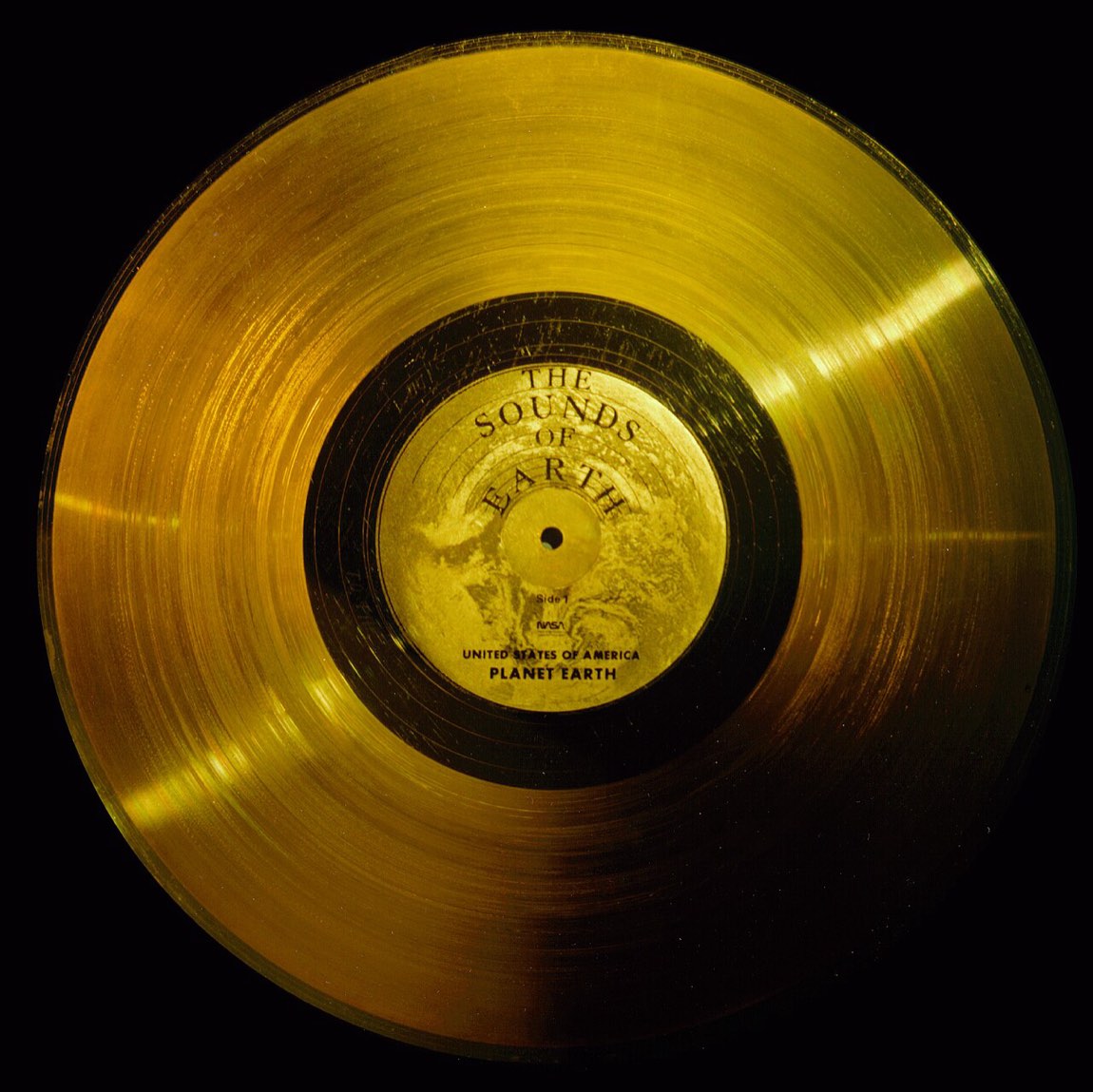
Bolted to Voyager's side is a gold-plated phonograph record: greetings in 55 languages, thunder and birdsong, Bach and Chuck Berry, 115 encoded images, and a map showing Earth's location among pulsars. Carl Sagan's team designed it less as a message likely to be found than as a portrait of humanity worth sending. Estimated playable lifetime: over a billion years — it will outlast the mountains.
02 The Pale Blue Dot
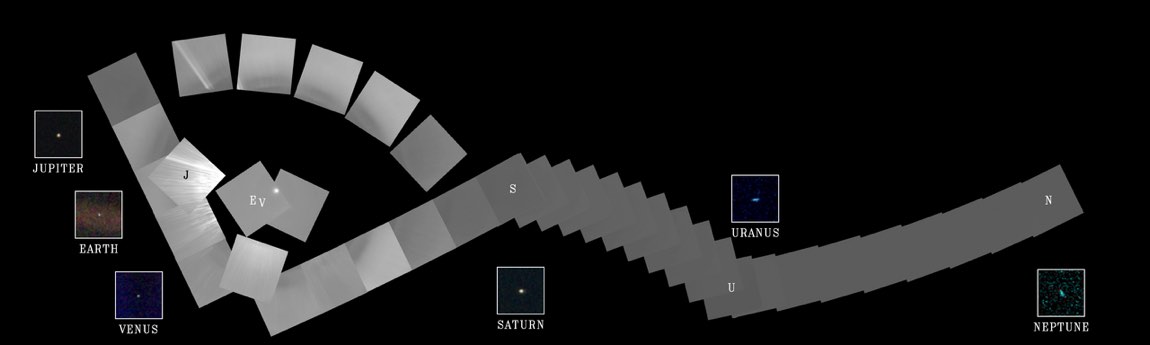
On Valentine's Day 1990, past Neptune, Voyager 1 turned around at Sagan's urging and photographed Earth: a 0.12-pixel speck in a sunbeam. 'That's here. That's home. That's us… every human being who ever was, lived out their lives on a mote of dust suspended in a sunbeam.' It remains the most humbling photograph ever taken.
03 Where is it going? Deeper
Nowhere in particular, forever. In ~300 years it reaches the inner Oort Cloud; in 40,000 years it passes within 1.6 light-years of star Gliese 445. It will never arrive anywhere — space is that empty — but as the first artifact to outlive its makers' star system grows plausible, Voyager has become something no machine was before: a monument.
The deep dive
Researched for the Atlas from Wikipedia — Voyager 1 (33,242 characters read) · updated Sep 20, 2026
 ⤢
⤢
04 A Launch That Almost Ended in Failure
Voyager 1 lifted off from Launch Complex 41 at Cape Canaveral Air Force Station on September 5, 1977, riding a Titan IIIE rocket — but the mission nearly ended before it began. The Titan's LR-91 second stage shut down prematurely, leaving 1,200 pounds (540 kg) of propellant unburned. The Centaur upper stage's onboard computers recognized the shortfall and ordered a burn far longer than planned to compensate. That improvised burn bought Voyager 1 the extra velocity it needed, but the Centaur ran dry with only 3.4 seconds of propellant to spare — roughly the time it takes to blink three times. Had the identical failure struck Voyager 2 a few weeks earlier, that mission would have missed its trajectory entirely, since Jupiter was in a less favorable position relative to Earth during Voyager 2's launch window. The narrow margin of survival at the very start of the mission makes Voyager 1's subsequent 40-plus years of operation all the more remarkable.
05 Io's Volcanoes: the Solar System's Biggest Surprise
Before Voyager 1 arrived at Jupiter in March 1979, no one had ever witnessed active volcanoes anywhere beyond Earth. The discovery of ongoing volcanic activity on Io changed planetary science overnight, and scientists regard it as probably the greatest surprise of the entire mission. The consequences turned out to extend far beyond Io itself. The moon appears to be the primary source of material filling the Jovian magnetosphere: sulfur, oxygen, and sodium, blasted into space by volcanic eruptions and then sputtered off the surface by high-energy particles, were detected all the way out at the outer edge of Jupiter's magnetic domain. Voyager 1 also passed through the Io plasma torus — a doughnut-shaped ring of ionized gas trapped along Io's orbit — and absorbed a radiation dose one thousand times the lethal level for humans. That intense bombardment visibly degraded some of the probe's high-resolution images of Io and Ganymede, a sobering reminder that Jupiter's neighborhood is genuinely hostile to anything not heavily shielded.
06 Jupiter's Rings and Two Hidden Moons
Among the findings that emerged from Voyager 1's 48-hour burst of intensive observations around closest approach to Jupiter on March 5, 1979, were two moons no one had catalogued before. The first, Metis, was found orbiting just outside Jupiter's ring system, making it the first of Jupiter's moons to be identified directly by a spacecraft. The second, Thebe, turned up in the gap between the orbits of Amalthea and Io. The two Voyager probes together also confirmed and detailed Jupiter's faint planetary rings, which had only been hinted at before. On February 25, 1979, when Voyager 1 was still 9.2 million kilometers from the planet, it transmitted the first detailed image of the Great Red Spot, resolving cloud features as small as 160 kilometers across and revealing a complex, wavy wake region to the storm's west where extraordinarily variable cloud motions played out in real time.
 ⤢
⤢
07 Saturn's Winds, Helium, and Mysterious Auroras Deeper
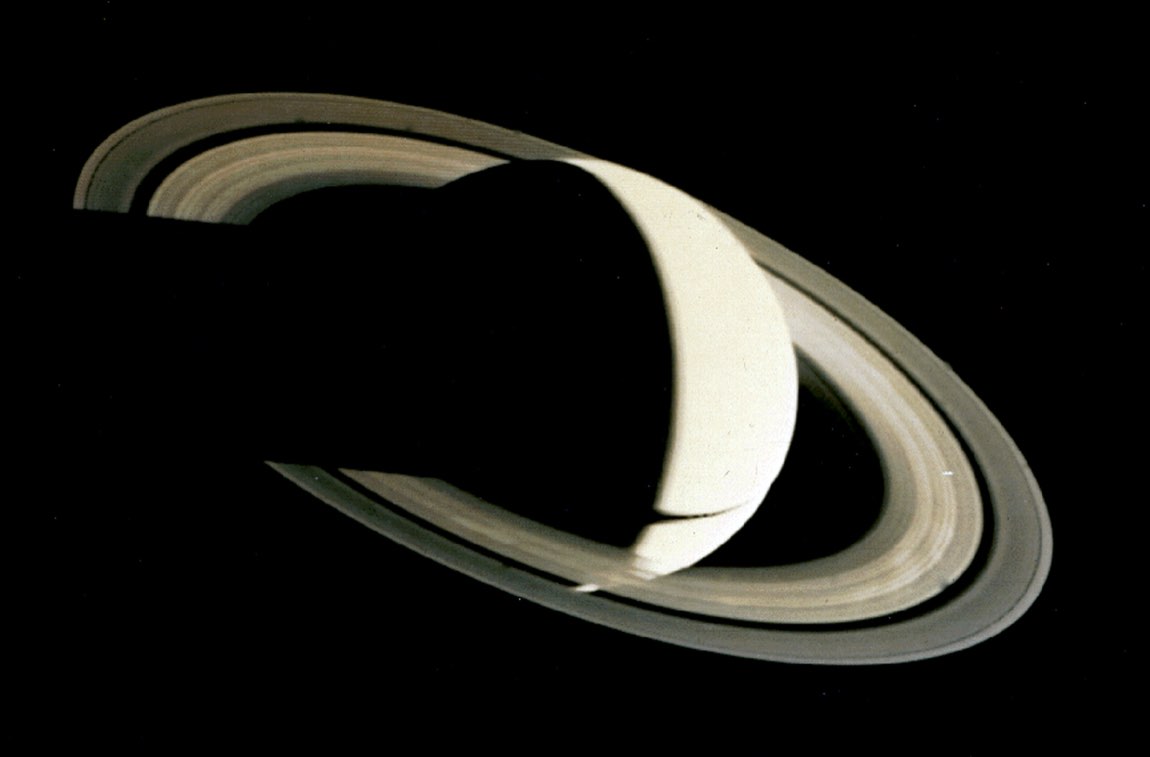
Voyager 1's closest approach to Saturn came on November 12, 1980, passing within 124,000 kilometers of the cloud tops. The probe's instruments found that about seven percent of the volume of Saturn's upper atmosphere is helium, compared with eleven percent in Jupiter's atmosphere. Since Saturn's internal helium abundance was expected to match Jupiter's and the Sun's, scientists proposed that heavier helium may be slowly sinking through Saturn's lighter hydrogen — a process that could explain why Saturn radiates more heat than it receives from the Sun. Winds near Saturn's equator reached approximately 500 meters per second (1,100 mph), blowing predominantly eastward. Voyager also detected aurora-like ultraviolet emissions of hydrogen at mid-latitudes in sunlit regions, a phenomenon that remains unexplained because the electron and ion bombardment known to drive auroras on Earth occurs primarily at high latitudes, not at the sun-facing mid-latitudes where Saturn's puzzling glow was found. Both Voyager probes clocked Saturn's rotation at 10 hours, 39 minutes, and 24 seconds.
08 The Titan Gamble That Shaped the Whole Mission Deeper
The decision to fly past Titan was not a minor scheduling choice — it permanently determined the course of both Voyager spacecraft. Mission planners knew Titan had a substantial atmosphere, confirmed by Pioneer 11 images in 1979 to be complex and thick. Because observing Titan was considered vital, Voyager 1's entire trajectory was designed around achieving the optimal Titan flyby, bringing the probe to within 6,400 kilometers of the moon. That path took Voyager 1 below Saturn's south pole and out of the plane of the ecliptic, ending any further planetary encounters. The stakes were even higher for Voyager 2: if Voyager 1 had failed at Titan, Voyager 2's path would have been redirected to cover it, eliminating the later flybys of Uranus and Neptune entirely. Titan's thick orange haze blocked any view of the surface, but radio occultation measurements and the probe's effect on Voyager 1's trajectory allowed scientists to measure the moon's atmospheric composition, temperature, pressure, and mass — and to speculate for the first time that lakes of liquid hydrocarbons might exist on the surface.
09 Crossing the Termination Shock and Heliosheath Deeper
Beyond Saturn, Voyager 1 entered a decade-long transit through the outermost structures of the Sun's influence. The termination shock — the boundary where the solar wind abruptly slows from supersonic to subsonic speeds — was a major scientific target, but detecting it was complicated by the fact that Voyager 1's solar-wind detector had stopped functioning in 1990. Scientists had to infer the crossing indirectly from other instruments. Evidence presented at the American Geophysical Union meeting on May 25, 2005, by Ed Stone placed the crossing around December 15, 2004, at a distance of 94 AU from the Sun. Beyond that lay the heliosheath, a turbulent region where the solar wind piles up against the pressure of interstellar space. By December 2011, NASA described a "stagnation region" within the heliosheath where charged particles from the Sun slowed and turned inward, the Solar System's magnetic field doubled in strength, energetic particles of solar origin dropped by nearly half, and detections of high-energy electrons from outside the Solar System increased one-hundred-fold. The inner edge of this stagnation region was approximately 113 AU from the Sun.
 ⤢
⤢
10 How Scientists Confirmed Interstellar Space Deeper
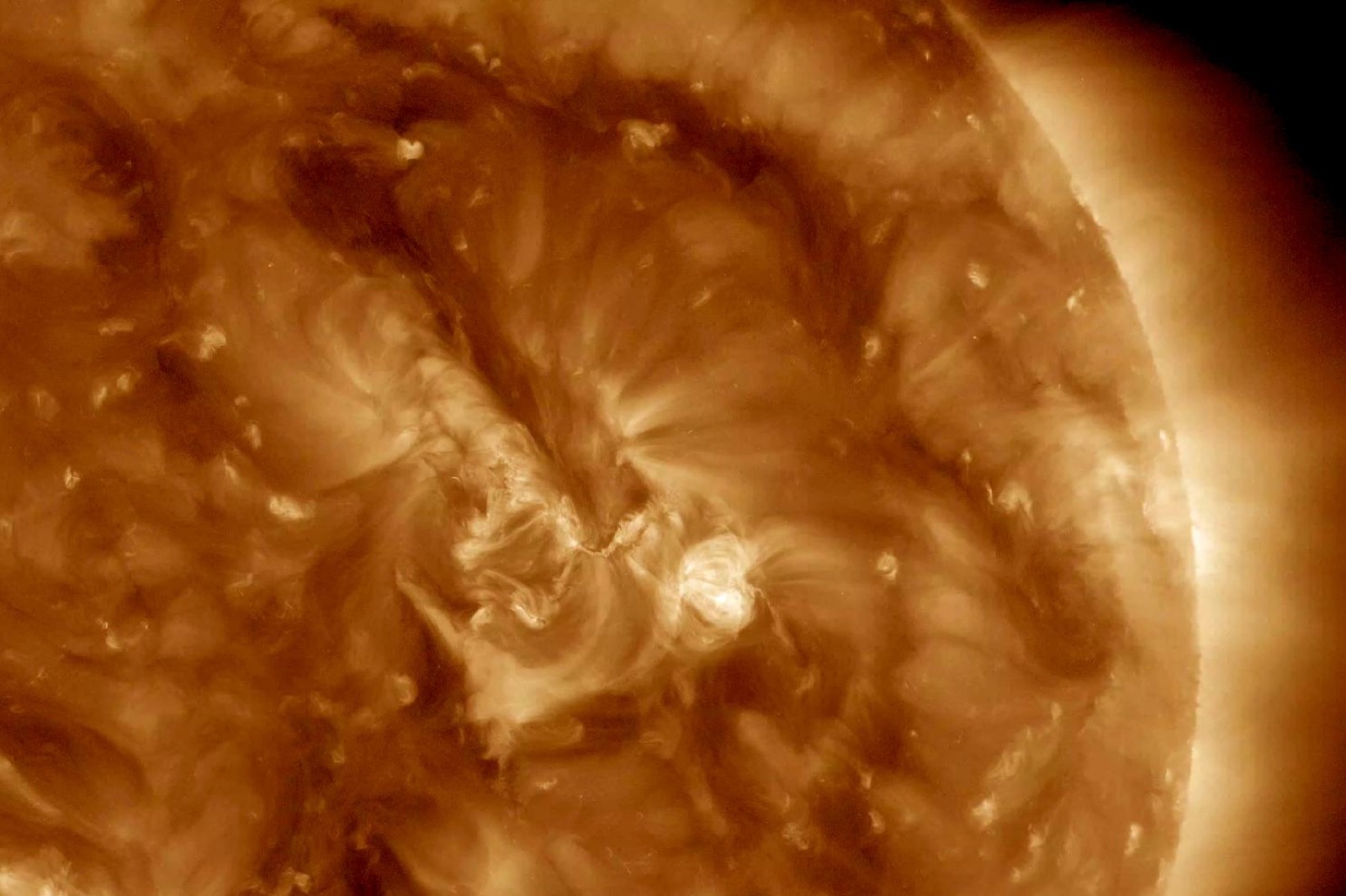
The official confirmation that Voyager 1 had entered interstellar space hinged on an indirect measurement, because the probe's plasma spectrometer had stopped working in 1980. The key evidence came from plasma oscillations detected beginning April 9, 2013, triggered by a solar outburst that had erupted in March 2012. Scientists used the frequency of those oscillations to infer an 80-fold increase in electron density — consistent with theoretical predictions that electron density outside the heliopause should be two orders of magnitude higher than within it. The generally accepted crossing date is August 25, 2012, when durable changes in energetic-particle density were first recorded. An expected flip in magnetic field direction was notably absent — the field changed direction by only 2 degrees — leading scientists to revise their models of the heliopause rather than question the crossing itself. NASA formally confirmed the milestone on September 12, 2013. In May 2021, NASA further reported the first continuous measurement of material density in interstellar space, and in October 2020 both Voyager probes had detected an unexpected and significant increase in density in the very local interstellar medium beyond the Solar System.
11 Engineering a Probe to Last Decades
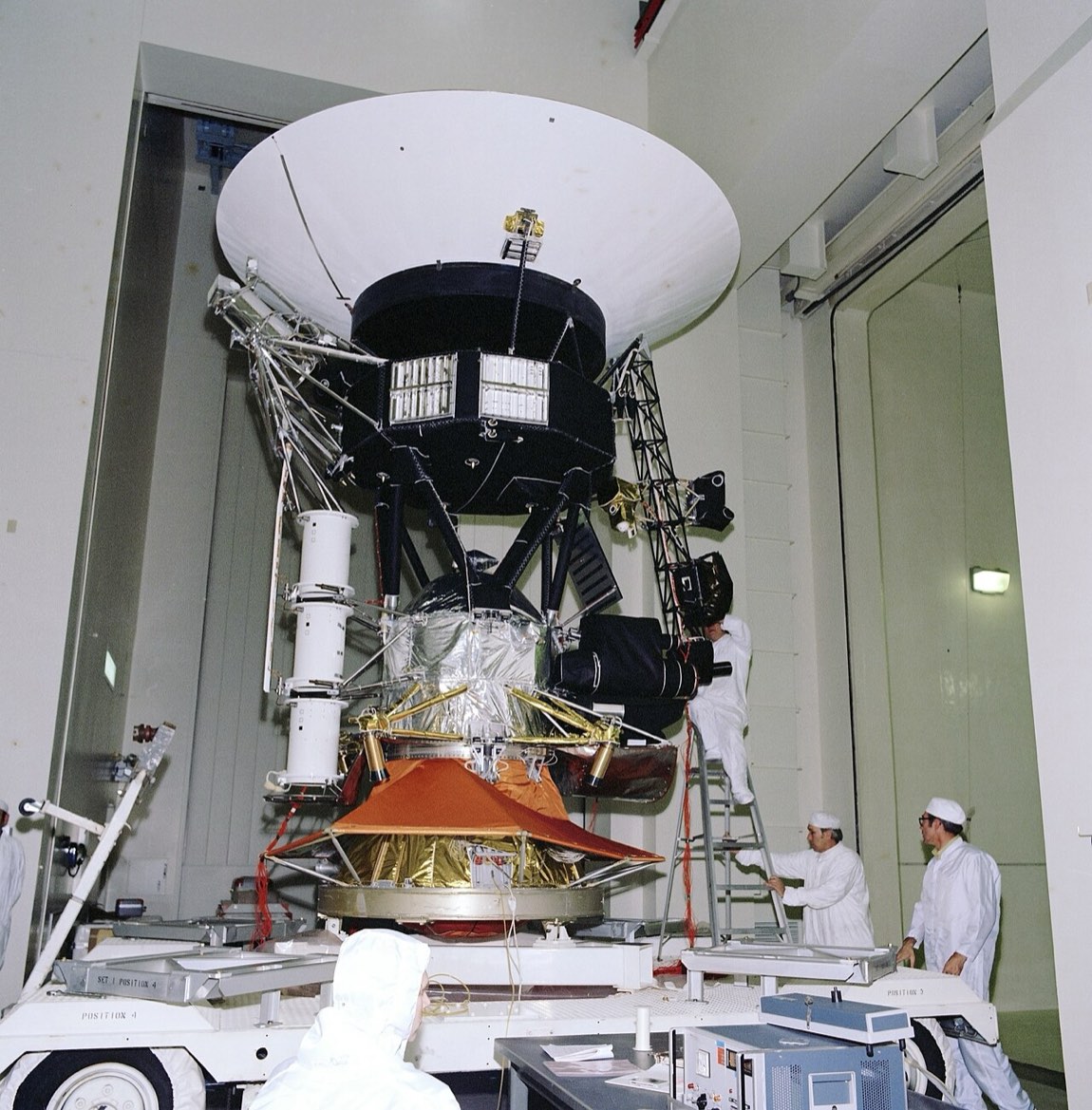
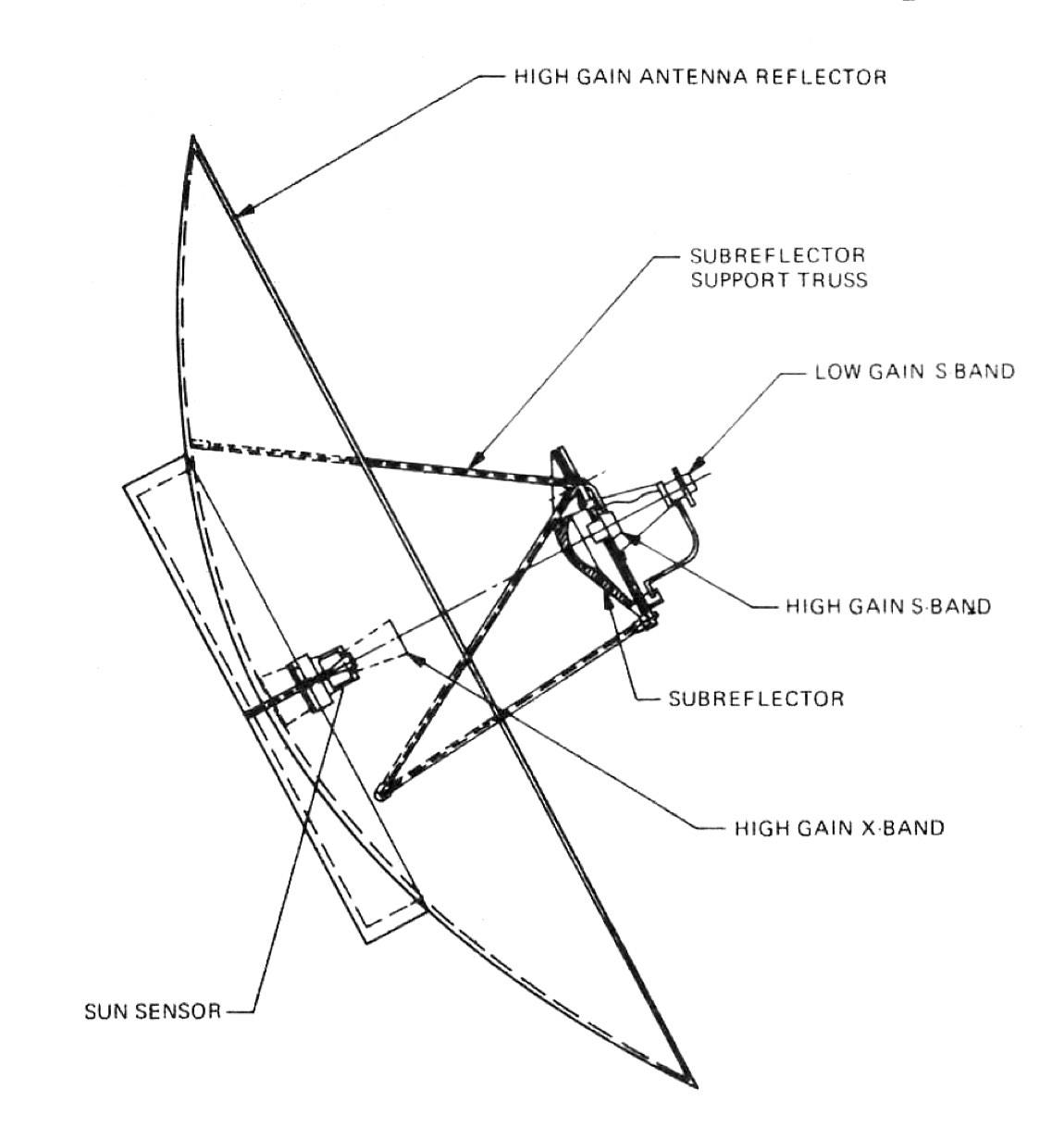
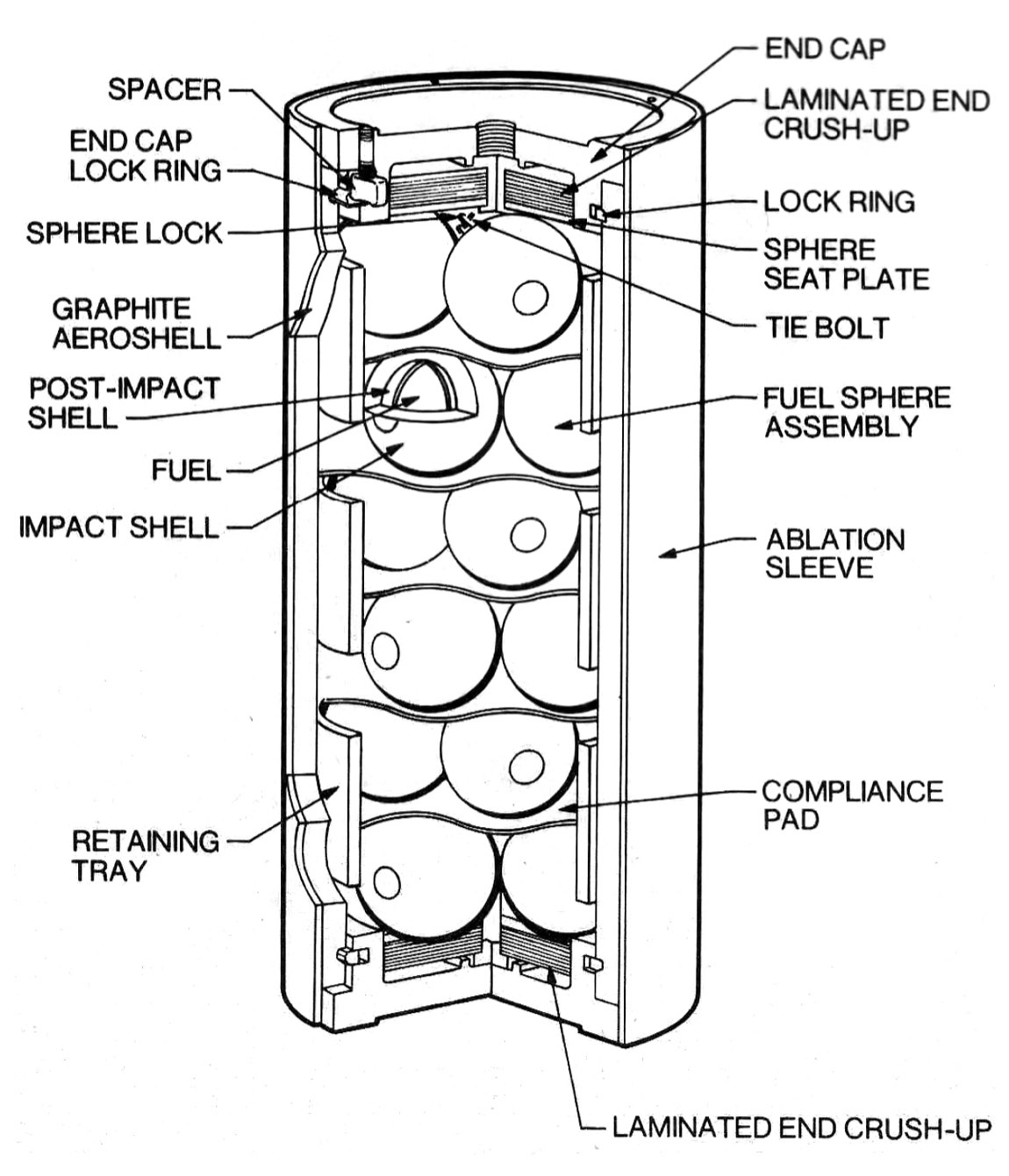
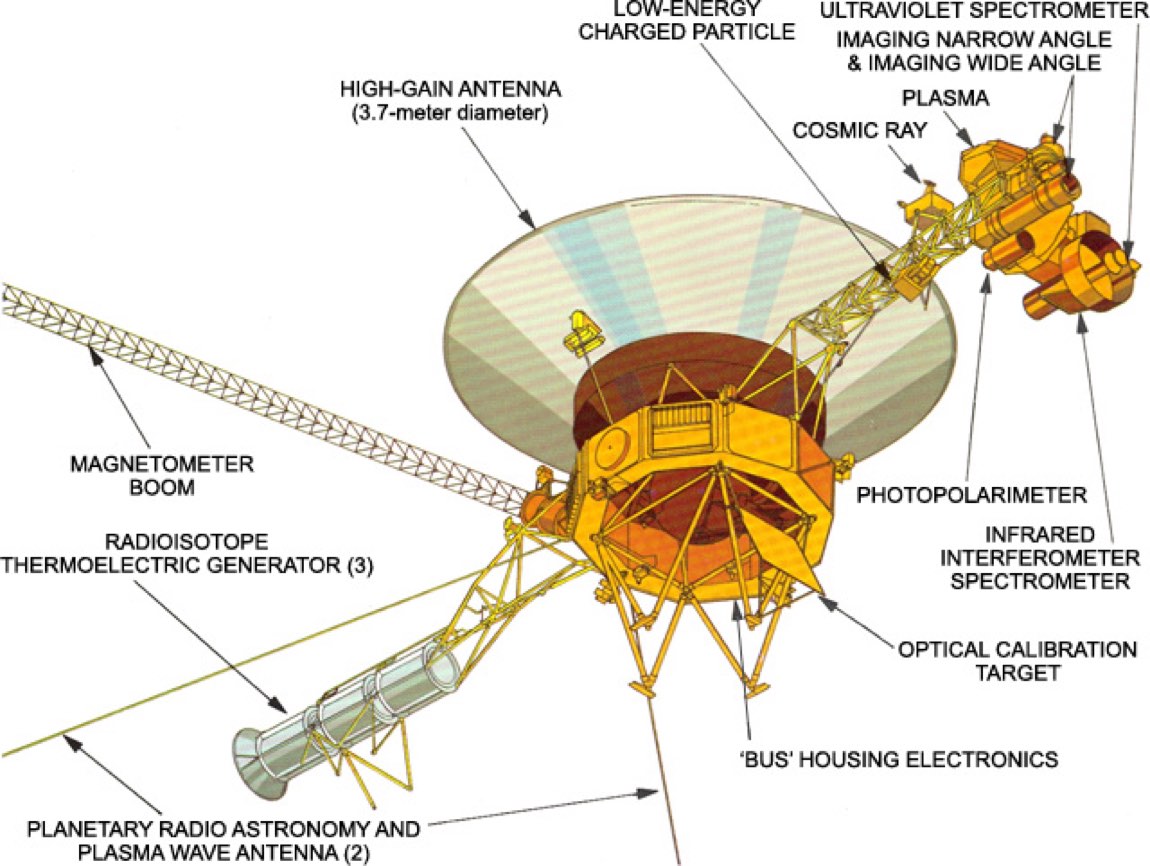
Voyager 1's bus is shaped like a ten-sided decagonal prism and carries 16 hydrazine thrusters, three-axis stabilization gyroscopes, and referencing instruments collectively managed by the Attitude and Articulation Control Subsystem. Its 3.7-meter-diameter high-gain Cassegrain antenna — about as wide as a compact car is long — sends and receives radio signals through NASA's Deep Space Network, normally over Channel 18 at either 2.3 GHz or 8.4 GHz. Signals from Earth travel to the probe at 2.1 GHz. When communication is impossible, an onboard digital tape recorder can store about 64 megabytes of data for later transmission. Power comes from three radioisotope thermoelectric generators, each loaded with 24 pressed plutonium-238 oxide spheres. At launch they generated about 470 watts; they decay along the 87.7-year half-life of their fuel, and thermocouple degradation adds to the power loss. Engineers believe the RTGs may still supply enough electricity to return engineering data until 2036, nearly six decades after launch.
12 The Slow Art of Keeping Old Thrusters Alive
By 2017, the attitude-control thrusters Voyager 1 had used since Saturn were so degraded that engineers reached for an alternative: four trajectory correction maneuver thrusters that had not fired since November 1980, sitting dormant for 37 years. In December 2017, mission controllers fired all four of them successfully, extending the mission by an estimated two to three years. But thruster trouble did not end there. Some attitude-control thrusters suffered clogging in their hydrazine fuel lines, and by the mid-2020s the spacecraft had no backup for its thruster system — everything was, in the words of Voyager project manager Suzanne Dodd, "single-string." Engineers responded by modifying the spacecraft's software to slow the clogging rate, testing it first on the more accessible Voyager 2. In September 2024 a thruster swap shifted control to a less-clogged set unused since 2018, and in May 2025 backup roll thrusters that had been unusable since 2004 were successfully revived — a critical repair completed under a tight deadline imposed by an antenna outage in Canberra.
 ⤢
⤢
13 When a Corrupted Memory Chip Silenced the Probe
On November 14, 2023, Voyager 1 began transmitting unreadable data. Engineers eventually traced the problem to a single memory bank in the Flight Data Subsystem, one of three onboard computers, likely struck by a high-energy particle or simply worn out by age. The corrupted chip prevented the FDS from communicating properly with the telemetry modulation unit, which locked into a repeating pattern of ones and zeros. The probe was still receiving commands and returning a carrier tone, so engineers knew it was alive. The fix required relocating software code away from the damaged chip — but Voyager 1's total memory is only 68 kilobytes, leaving no spare room for the displaced 256 bits. Engineers deleted obsolete code, including routines written to transmit Jupiter data at transmission rates no longer achievable, to make space. On April 20, 2024, health and status data were restored; science data from all four instruments followed by June 13. Three percent of the FDS memory chip remained corrupted beyond repair, and all data from the anomaly period was lost permanently.
14 What Voyager 1 Will Encounter in Deep Time
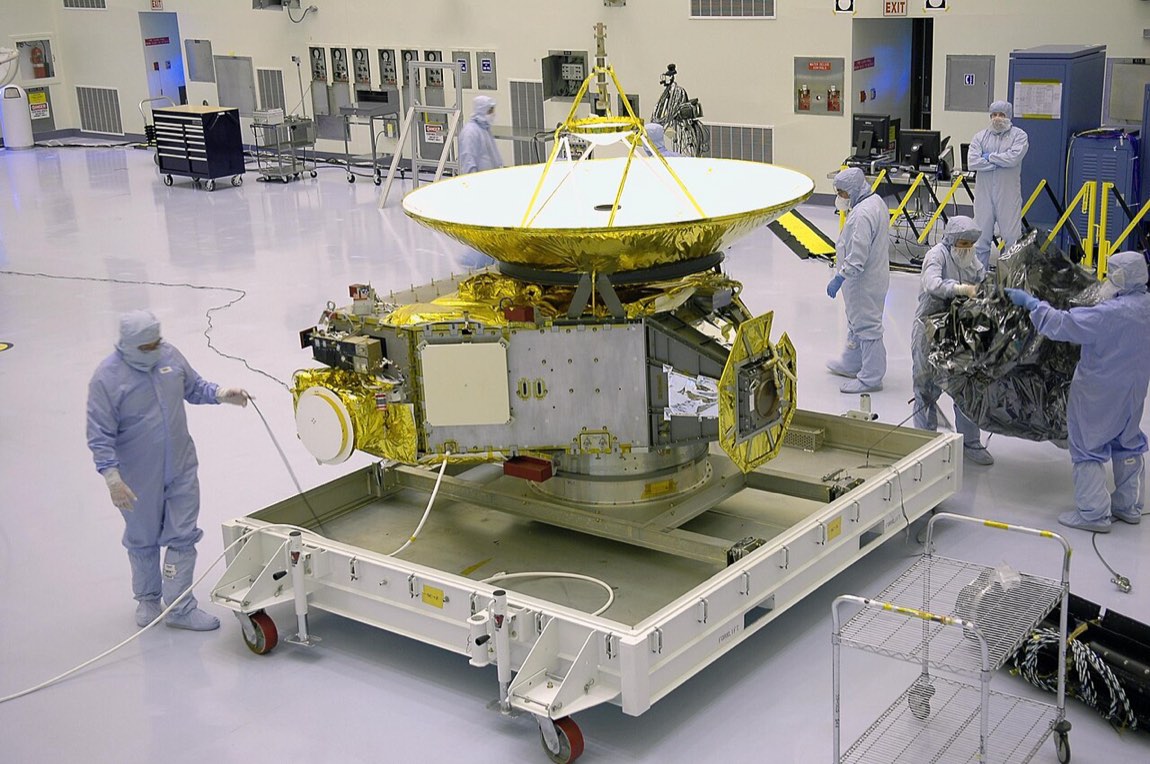
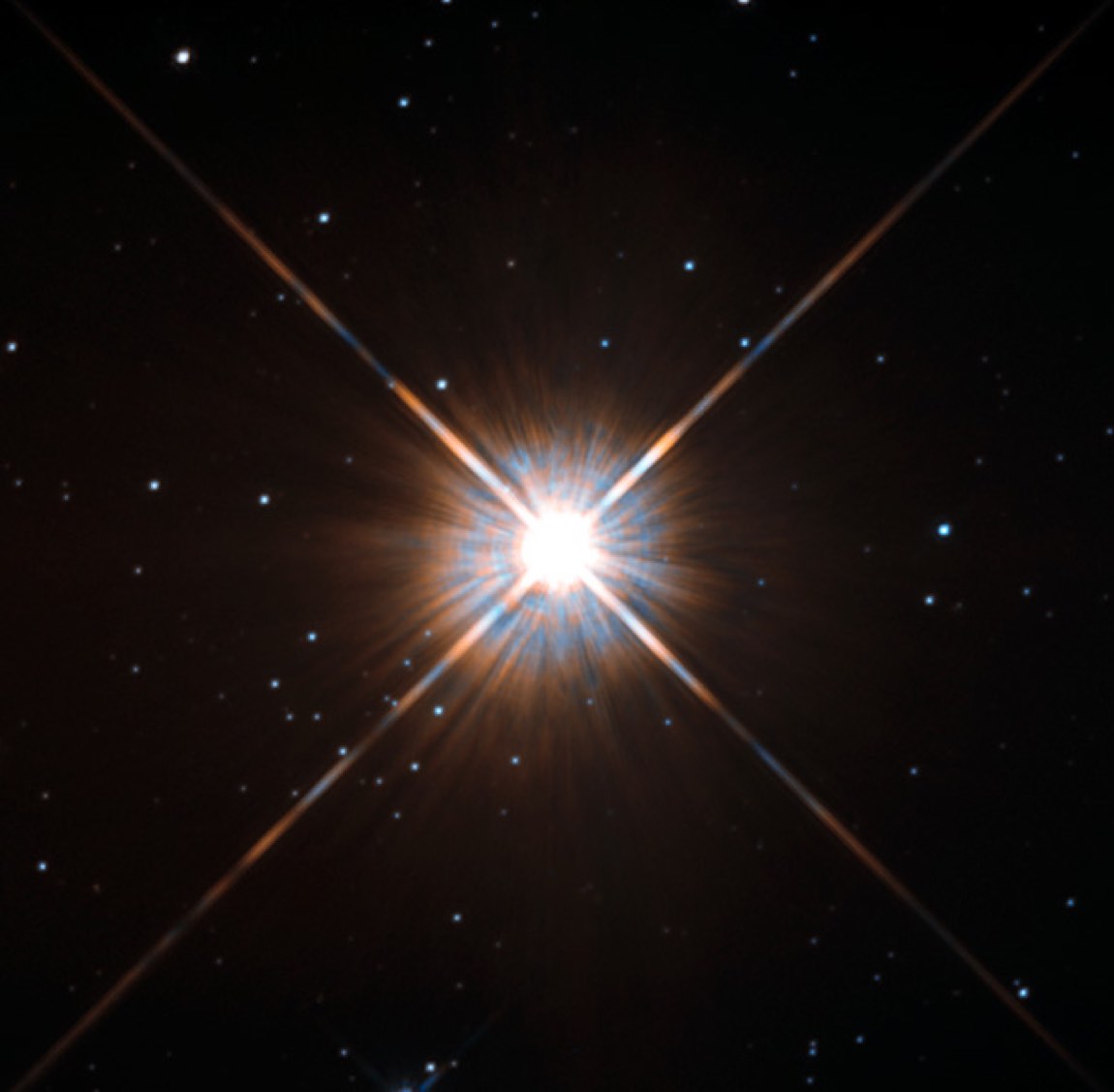
Voyager 1 is not aimed at any particular star, but its trajectory will bring it close to several over geologic timescales. In roughly 300 years it is expected to reach the theorized inner edge of the Oort cloud, the vast reservoir of long-period comets that astronomers consider the true outer boundary of the Solar System; passing all the way through could take another 30,000 years. In about 40,000 years, the probe will pass within 1.6 light-years of Gliese 445, a star in the constellation Camelopardalis currently 17.1 light-years from Earth and moving toward the Solar System at about 119 km/s. In 300,000 years it will pass within less than 1 light-year of the M3V star TYC 3135-52-1. No other spacecraft will overtake it: New Horizons, launched at higher speed from Earth, received only one gravity assist — from Jupiter in 2007 — and as of 2018 was traveling at about 14 km/s, some 3 km/s slower than Voyager 1. As NASA has noted, the Voyagers are destined, perhaps eternally, to wander the Milky Way.
15 Voyager 1's Origins as Mariner 11
Voyager 1 was not always called Voyager 1. The mission grew from a 1960s proposal for a Grand Tour of the outer planets, which NASA began developing in earnest in the early 1970s. The original plan placed Voyager 1 within the Mariner program, designated Mariner 11. Budget cuts forced planners to scale back the ambitious Grand Tour to a more modest flyby of Jupiter and Saturn, and the probe was temporarily renamed the Mariner Jupiter-Saturn probe. As the spacecraft's design diverged increasingly from Mariner heritage hardware, the project received an entirely new identity: Voyager. Despite being launched 16 days after its twin, Voyager 2, Voyager 1 reached both Jupiter and Saturn first by following a shorter, faster trajectory. The design of that trajectory also benefited from knowledge gained by Pioneer 10, whose earlier encounter with Jupiter's ferocious radiation environment taught engineers enough that they added strips of ordinary kitchen-grade aluminum foil to certain cables shortly before launch, improving their radiation shielding at virtually no cost.
 ⤢
⤢
Weird & wonderful
- Voyager 1's computers have 240,000 times less memory than a basic phone.
- Its camera was switched off to save power in 1990 — after one last family portrait of the planets.
- Commands take a full Earth day to arrive — debugging it is chess by mail.
- It runs on about as much power as three LED bulbs.