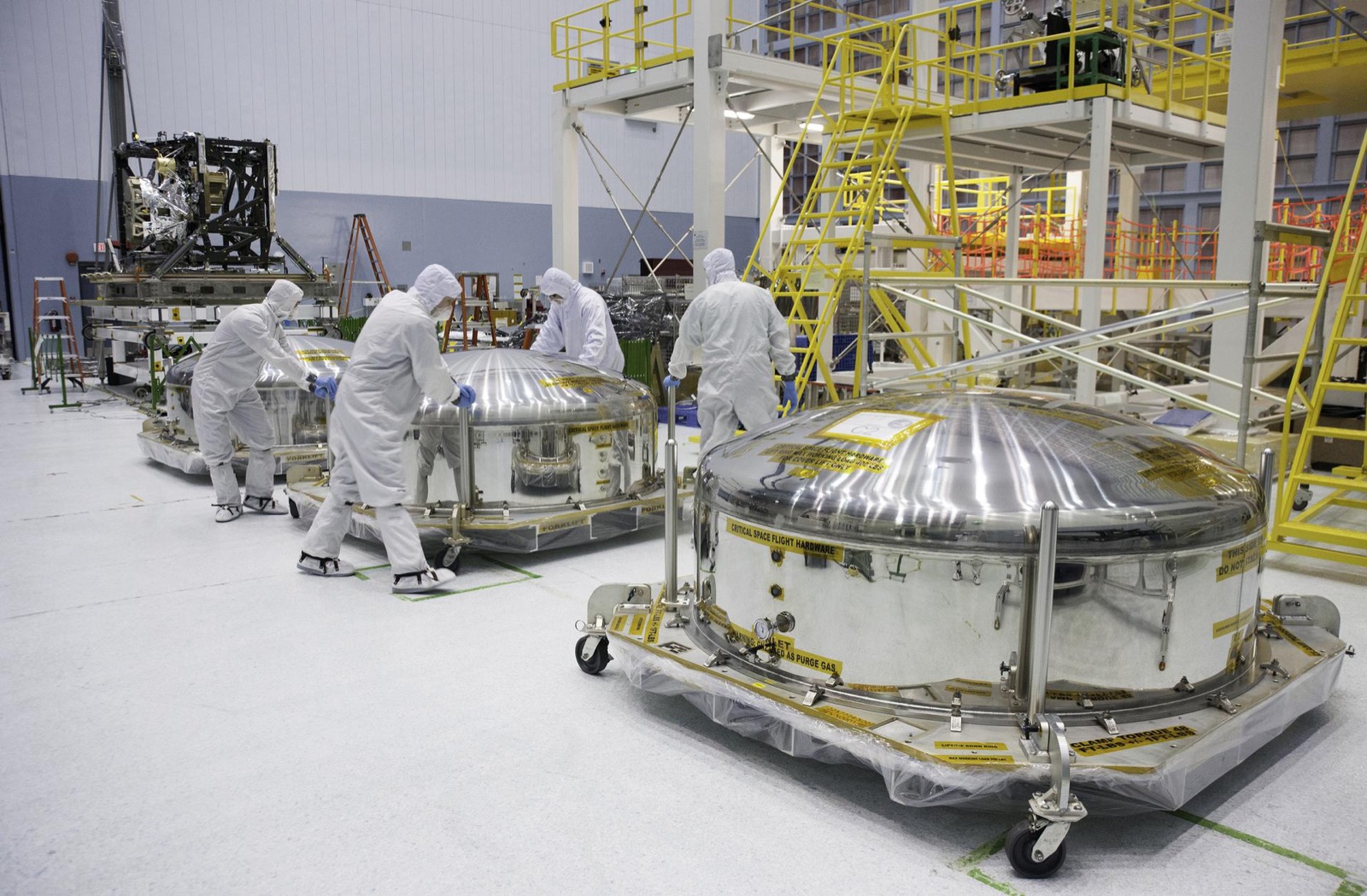
 Photograph · GSFC / NASA Image Library
Spacecraft · Deep guide
James Webb Space Telescope
Also called: JWST · Webb
A million miles from home, the infrared giant is seeing the universe's first galaxies.
What is it?
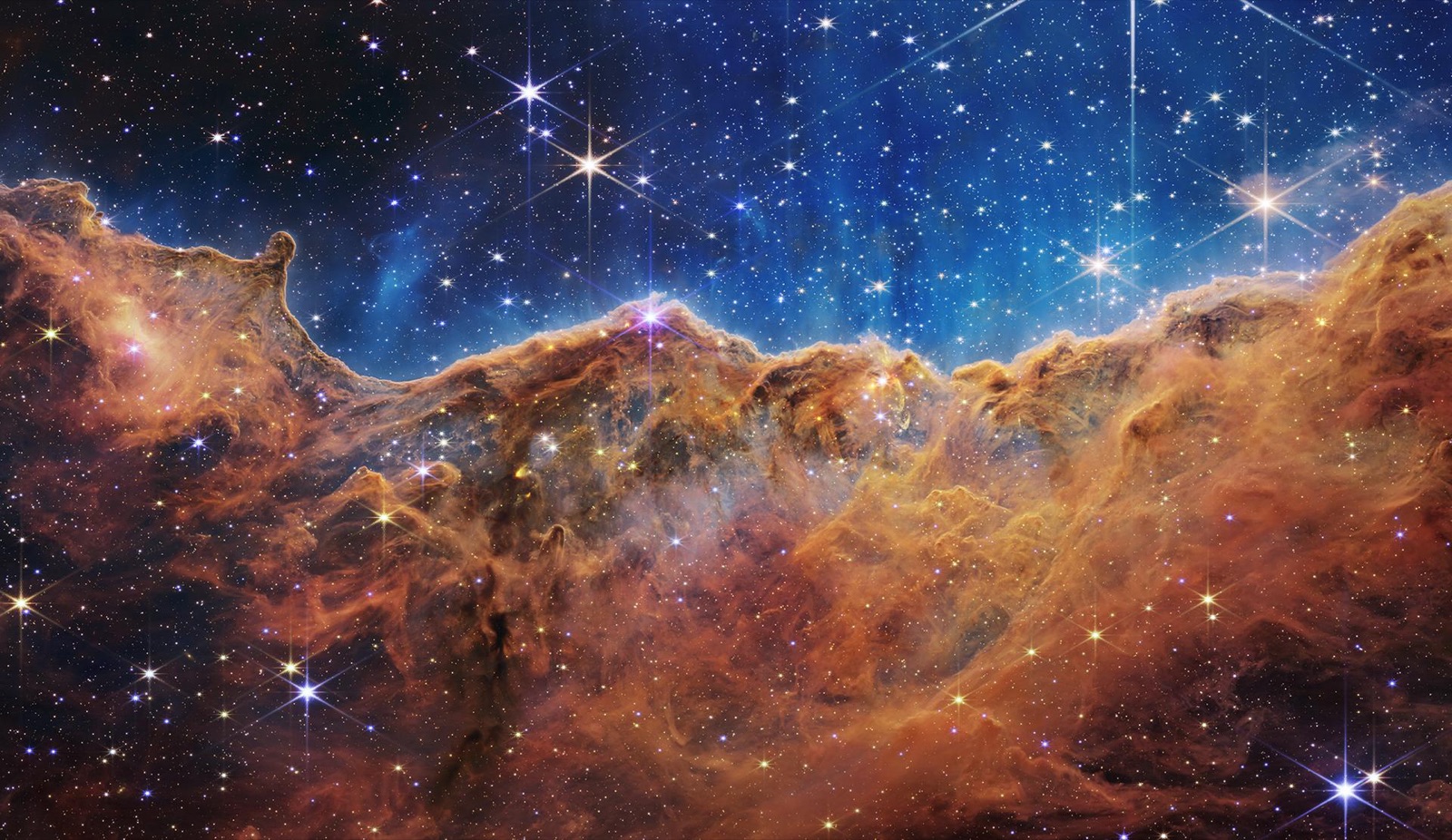
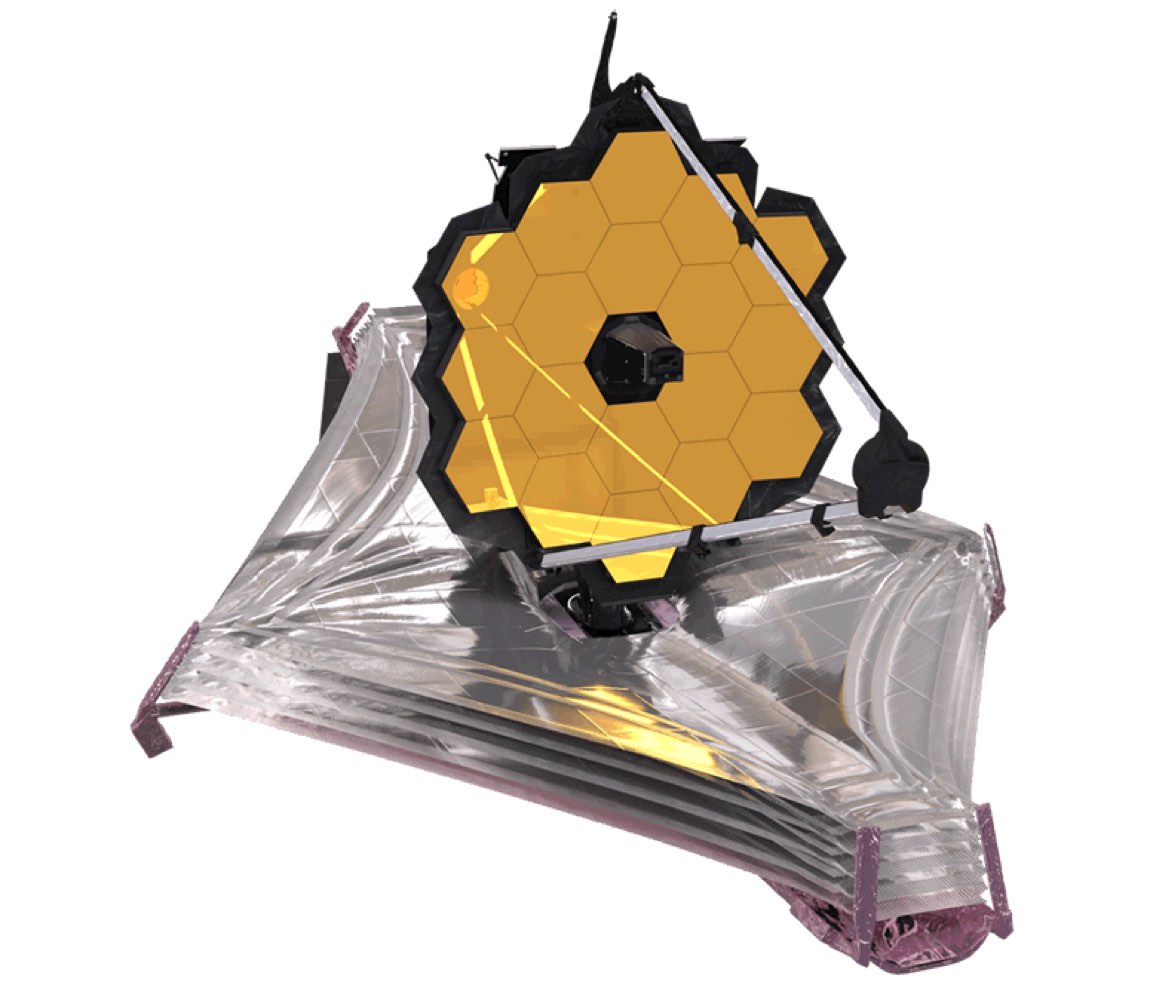
The James Webb Space Telescope is the most powerful space telescope ever built: a 6.5-meter gold-coated mirror of 18 hexagons, parked 1.5 million km from Earth behind a tennis-court-sized sunshield, chilled to −233 °C so it can see faint infrared heat. Since 2022 it has photographed galaxies from the universe's first few hundred million years and sniffed the atmospheres of planets around other stars.
Go deeper
Webb observes at L2, where its five-layer sunshield keeps optics near 40 K — necessary because it IS an infrared instrument: redshifted first-galaxy light, dust-piercing star-formation views, and exoplanet transmission spectra all live there. Its 344 single-point-failure deployment worked flawlessly, and precise launch saved propellant for a 20+ year lifetime. Headlines earned: candidate galaxies at z≳13 (existing 'too early' at surprising masses — a real tension being worked), CO₂ and SO₂ in exoplanet air, and photochemistry on gas giants. It cannot be serviced; every micrometeoroid ding is forever (one notable strike in 2022; performance remains above spec).
01 Why infrared? Why so far away? Why gold?
The universe's expansion stretches the first galaxies' light into infrared — heat-light — so a time machine must be a heat camera. But a warm telescope glows in its own camera, so Webb hides from the Sun, Earth and Moon behind its sunshield at L2, cooling to −233 °C. And gold? It is the best infrared mirror there is — the gold on all 18 segments totals about a golf ball's worth.
02 Looking back in time Deeper
Light takes time to travel, so every telescope is a time machine — Webb just has the longest reach. Its deep fields capture galaxies as they were 13.4+ billion years ago, within a few hundred million years of the Big Bang. The surprise so far: those infant galaxies look too bright, too massive, too soon. Either early star formation was far more efficient than modeled, or something in cosmology needs adjusting. This is science working exactly as designed.
The deep dive
Researched for the Atlas from Wikipedia — James Webb Space Telescope (58,000 characters read) · updated Sep 20, 2026
03 A telescope born from Hubble's blurry mirror
Webb's origin story begins with embarrassment. When the Hubble Space Telescope launched in 1990, its primary mirror had been ground to the wrong shape, producing blurry images. NASA's STS-61 shuttle mission in 1993 installed corrective optics, and Hubble recovered brilliantly. That recovery emboldened a committee called HST & Beyond, formed in 1994, to dream larger. Its 1996 report called for a telescope that was bigger, far colder, and sensitive to infrared light — capable of reaching back to the birth of the first galaxies, a feat Hubble could never manage because its warm mirror blinds itself with infrared glow. That report launched the formal planning process for what would eventually become Webb. The project was initially called the Next Generation Space Telescope, carried an optimistic budget of about US$500 million, and was expected to launch in 2007. None of those numbers survived contact with reality, but the scientific vision of the HST & Beyond report remained intact all the way to launch day in 2021.
04 Why beryllium holds up where other metals fail Deeper
Choosing the right material for Webb's primary mirror was not a cosmetic decision — it was an engineering necessity driven by cryogenic physics. The mirror must survive being cooled to below 50 K (−223 °C) without warping, because even a nanometer-scale distortion would ruin image quality. Beryllium was selected because it has a density of just 1.845 g/cm³, making it exceptionally light, and because it is extraordinarily stiff for its weight. Most critically, beryllium maintains a stable, predictable shape at cryogenic temperatures, unlike many metals that contract unevenly when chilled. NASA and partners sought to reduce mirror mass by a factor of 10 compared to earlier designs, and beryllium achieved that goal. Each of the 18 hexagonal segments was then polished and coated with a thin layer of gold, which reflects infrared light efficiently, topped by a thin layer of glass for durability. The 132 small actuator motors that position those segments can nudge them with an accuracy of 10 nanometers — about one-hundredth the width of a human hair — allowing the mirror to function as a single, perfectly unified surface once aligned.
05 The sunshield: an SPF of one million
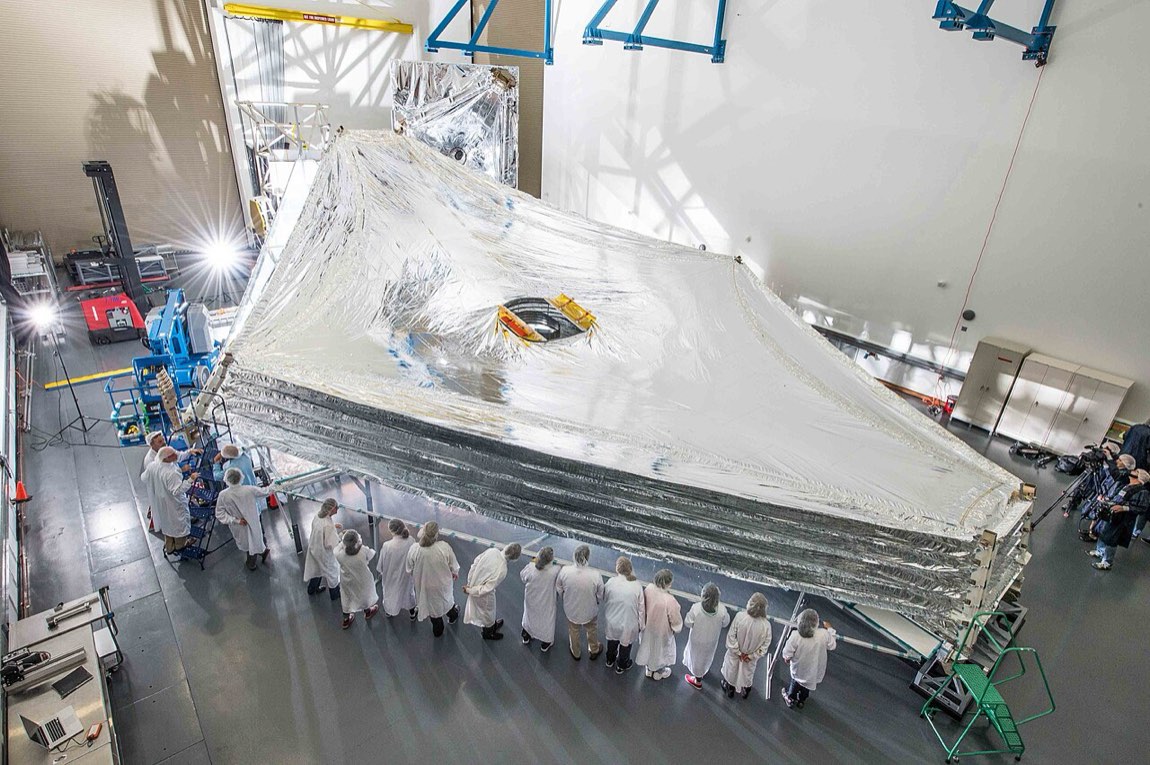
Webb's five-layer sunshield is one of the most extreme pieces of passive thermal engineering ever built. Each layer is roughly 0.1 mm thick and made of Kapton E film coated with aluminum on both sides. The two outermost layers carry an additional coating of doped silicon on their Sun-facing sides to radiate the Sun's heat back into space rather than absorbing it. Together, the five layers give the sunshield an effective sun protection factor of 1,000,000 — compared with the SPF 8 to 50 range of ordinary suntan lotion. The shield had to be folded twelve times to fit inside the Ariane 5 rocket's payload fairing, which is 4.57 m (15.0 ft) in diameter and 16.19 m (53.1 ft) long. Once fully deployed in space, it measured 14.162 m × 21.197 m (46.46 ft × 69.54 ft). That deployment was nerve-racking: in 2018, the delicate film tore during a practice run on the ground, causing further delays. In space, the shield works so well that the telescope's cold side stays below 50 K while the spacecraft bus on the warm side operates at a comparatively balmy 300 K (27 °C; 80 °F).
06 Four instruments and what each one does Deeper
Webb carries four science instruments, each optimized for different tasks. NIRCam, built by a team led by the University of Arizona under principal investigator Marcia J. Rieke, is the observatory's primary camera, covering wavelengths from 0.6 to 5 μm across ten 4-megapixel sensors. It also serves as the wavefront sensor that keeps the mirror segments aligned. NIRSpec, built by ESA at ESTEC in the Netherlands with contributions from Airbus Defence and Space in Germany, is a spectrograph covering the same wavelength range but capable of observing hundreds of objects simultaneously through a complex microshutter mechanism — a miniature venetian-blind array that opens selectively over targets. MIRI covers the mid-to-long infrared from 5 to 27 μm and must be cooled to no more than 6 K (−267 °C; −449 °F), achieved by a dedicated helium gas mechanical cryocooler. MIRI was led jointly by George Rieke of the University of Arizona and Gillian Wright of the UK Astronomy Technology Centre in Edinburgh. Finally, the Canadian-provided FGS/NIRISS combines a Fine Guidance Sensor for spacecraft pointing control with a slitless spectrograph for astronomical imaging between 0.8 and 5 μm, led by René Doyon at the Université de Montréal. NIRCam and MIRI both include coronagraphs to block starlight when studying nearby exoplanets and circumstellar disks.
07 344 ways a single failure could end everything
Engineers classified 344 steps in Webb's launch and deployment as single-point failures — tasks with no backup, no workaround, and no second chance. Every one of them had to succeed. That sobering count emerged from an independent review board assessment in 2018, following a failed practice deployment in which the sunshield's cables did not tighten properly. The consequence was a 10-month launch delay, pushing the date to March 2021. In reality, the telescope launched on 25 December 2021, still later than that revised date, after COVID-19 paused launch window planning in 2020. The 30-day deployment sequence that followed launch was carefully designed to give ground controllers flexibility to modify steps if problems arose — with the exception of two early automatic actions, solar panel unfolding and communication antenna deployment. Mission designers also built in a deliberate asymmetry: because the sunshield must always face the Sun to protect temperature-sensitive instruments, the spacecraft could not turn around or use thrusters to slow down if it flew too fast. Every mid-course correction was therefore designed to slightly undershoot, since too little thrust could be corrected but too much could not.
 ⤢
⤢
08 How the mirror learned to see in seven phases Deeper
Aligning 18 independent mirror segments into a single coherent optical surface required a seven-phase process that took months and was rehearsed repeatedly on a 1:6-scale model before launch. Once the mirrors cooled to 120 K (−153 °C; −244 °F), NIRCam captured 1,560 images of the sky centered on the 7th-magnitude star HD 84406 in Ursa Major. Initially, each segment pointed in a slightly different direction, producing 18 separate blurry images of the star field. Engineers matched each image to its segment, then corrected major focusing errors using phase retrieval, producing 18 sharp but separate images. Those 18 images were then stacked into one. From there, a technique called dispersed fringe sensing compared 20 pairings of mirror segments to remove most remaining errors, followed by introduced light defocus to identify and correct the last residual faults. This coarse and fine phasing cycle was repeated three times. Final alignment required mirror segments to be positioned to within 50 nanometers — a precision NASA compared to aligning Texas-sized mirror segments to within 1.5 inches if the primary mirror were scaled to the size of the United States. Phase 1 was completed on 18 February 2022; phases 2 and 3 finished a week later.
09 Fuel saved at launch may double the mission
Webb was designed to carry enough hydrazine fuel — 159 liters (42 U.S. gallons) at launch, with 79.5 liters (21.0 U.S. gallons) of dinitrogen tetroxide as oxidizer — to maintain its halo orbit for 10 years. Station-keeping around the L2 point requires roughly 2.5 m/s per year from a total velocity budget of 93 m/s. However, the Ariane 5 rocket's trajectory was so precise, and the first mid-course correction so accurate, that far less propellant was consumed than planned. As a result, Webb may be able to maintain its orbit for around 20 years instead of 10. The halo orbit itself has a radius that varies between about 250,000 km (160,000 mi) and 832,000 km (517,000 mi) and takes about half a year to complete. Station-keeping is delicate: because the thrusters sit solely on the Sun-facing side of the spacecraft, every burn is designed to slightly undershoot — pushing Webb too far past L2 would be unrecoverable. Integration and Test Project Scientist Randy Kimble compared it to Sisyphus rolling a rock up a gentle slope near a hilltop, never wanting it to roll over the crest.
10 A budget that ballooned from $500 million to $10 billion
The financial history of Webb is a case study in how large science infrastructure projects evolve in scope and cost. The mid-1990s concept carried a rough estimate of US$500 million. By 1999, the formal design budget stood at US$1 billion with a 2007 launch target. In 2003, NASA awarded the prime contract to TRW — shortly acquired by Northrop Grumman — for US$824.8 million. A 2005 replanning exercise estimated total life-cycle cost at US$4.5 billion, comprising about US$3.5 billion for development and US$1.0 billion for ten years of operations. By 2010, cost overruns were severe enough that Maryland Senator Barbara Mikulski called for an external review. That review found the earliest possible launch was late 2015, at an additional US$1.5 billion. In July 2011, the U.S. House of Representatives appropriations committee proposed canceling the project outright. Congress reversed course in November 2011 and capped additional spending at US$8 billion. The final NASA lifetime cost reached US$9.7 billion, of which US$8.8 billion covered design and development and US$861 million was reserved for five years of operations. ESA contributed approximately €700 million and CSA contributed approximately CA$200 million.
11 Micrometeoroid hits: damage already logged
Space is not empty, and Webb has the dents to prove it. Micrometeoroids — tiny dust-grain-sized particles — strike Webb an average of once or twice per month. Most impacts cause no meaningful damage. But between 23 and 25 May 2022, a larger particle struck the C3 mirror segment, marking the fifth and largest impact since launch. Engineers were able to compensate for the hit using a mirror actuator, and NASA confirmed that all observing modes remained ready for science use as of 10 July 2022. The strike did prompt mission personnel to implement a new observing strategy: Webb now avoids pointing its mirror toward specific "micrometeoroid avoidance zones" at particular points along its orbit, reducing the probability of future large impacts. The telescope cannot be serviced — unlike Hubble, which received astronaut repair visits. NASA noted that limited accommodations for potential future remote servicing were nonetheless built in, including precise guidance markers in the form of crosses on Webb's surface, refillable fuel tanks, removable heat protectors, and accessible attachment points. No crewed servicing mission is planned.
12 What Webb can and cannot look at in the Solar System Deeper
Webb's infrared vision is not reserved exclusively for the distant universe — it also turns inward to examine planets, moons, and smaller bodies in our own Solar System, with some notable geometric constraints. The telescope can observe objects whose angular motion across the sky is less than 0.03 arcseconds per second, and which are located at angles greater than 85° from the Sun. Within those limits it can study Mars, Jupiter, Saturn, Uranus, Neptune, Pluto, their moons, and comets, asteroids, and minor planets at or beyond Mars's orbit. Webb has sufficient near-infrared and mid-infrared sensitivity to observe virtually all known Kuiper Belt Objects. For time-critical targets such as supernovae or gamma-ray bursts, the telescope can begin observations within 48 hours of a decision to do so. During commissioning, Webb tracked moving objects at speeds up to 67 milliarcseconds per second — more than twice the speed originally required. Early commissioning targets already included Jupiter's rings and moons, specifically Europa, Thebe, and Metis, as well as a set of named asteroids. Webb's position near L2 means it can see 40 percent of the sky from any single orientation, but sweeps the entire sky over a six-month period.
13 The software running a $10 billion telescope Deeper
Webb's onboard operations are controlled by a modified version of JavaScript called Nombas ScriptEase 5.00e, following the ECMAScript standard. The design allows a modular approach in which high-level scripts call lower-level scripts defined as functions, making it easier to update or replace individual operational routines. The script interpreter itself is run by flight software written in C++, which handles both spacecraft operations and science instrument control. Data generated by the instruments is digitized close to the cold detectors by a custom chip called the SIDECAR ASIC — System for Image Digitization, Enhancement, Control And Retrieval Application Specific Integrated Circuit — which packages the functions of a 9.1 kg (20 lb) instrument box into a 3 cm (1.2 in) package consuming just 11 milliwatts of power, a necessity given that any waste heat on the cold side of the telescope would compromise infrared sensitivity. The digitized data is stored temporarily on a solid-state drive with a capacity of 68 GB, expected to degrade to 60 GB of usable capacity by mission's end due to radiation and read/write wear. Data is then transmitted to Earth via the NASA Deep Space Network at a rate of 458 gigabits per day, equivalent to a sustained 5.42 Mbps, processed at the Space Telescope Science Institute in Baltimore, and made publicly available after a one-year proprietary period.
14 How observing time is divided and awarded
Time on Webb is a scarce and contested resource. The telescope's schedule is organized through several distinct programs. Guaranteed Time Observations reward scientists who built hardware and software by granting them reserved observing slots. The General Observers program opens the competition to any astronomer in the world, with proposals reviewed annually by peer committees — the same model used for Hubble. A Director's Discretionary Early Release Science program front-loads high-value observations in the first months of science operations; 13 such programs covering 460 hours of time were selected in November 2017, spanning topics from Solar System bodies to quasars. For Cycle 1, 6,000 hours were available; astronomers submitted 1,173 proposals requesting 24,500 hours, and 266 programs were approved. Demand has only grown: by Cycle 4, the community submitted 2,377 proposals requesting 78,000 hours of observing time — nine times more than the available amount. Webb's weekly observation plan is published every Monday by the Space Telescope Science Institute. A separate Director's Discretionary Time program handles urgent, time-critical targets that cannot wait for the regular proposal cycle.
 ⤢
⤢
Weird & wonderful
- Webb is so sensitive it could detect a bumblebee's heat at the Moon's distance.
- It orbits an empty point in space where gravity balances — L2 is a parking spot made of math.
- Its sunshield's sunny side can hit +85 °C while the telescope side sits at −233 °C — a 300-degree sandwich five layers thin.
- Webb sees galaxies whose light is older than the Earth itself.