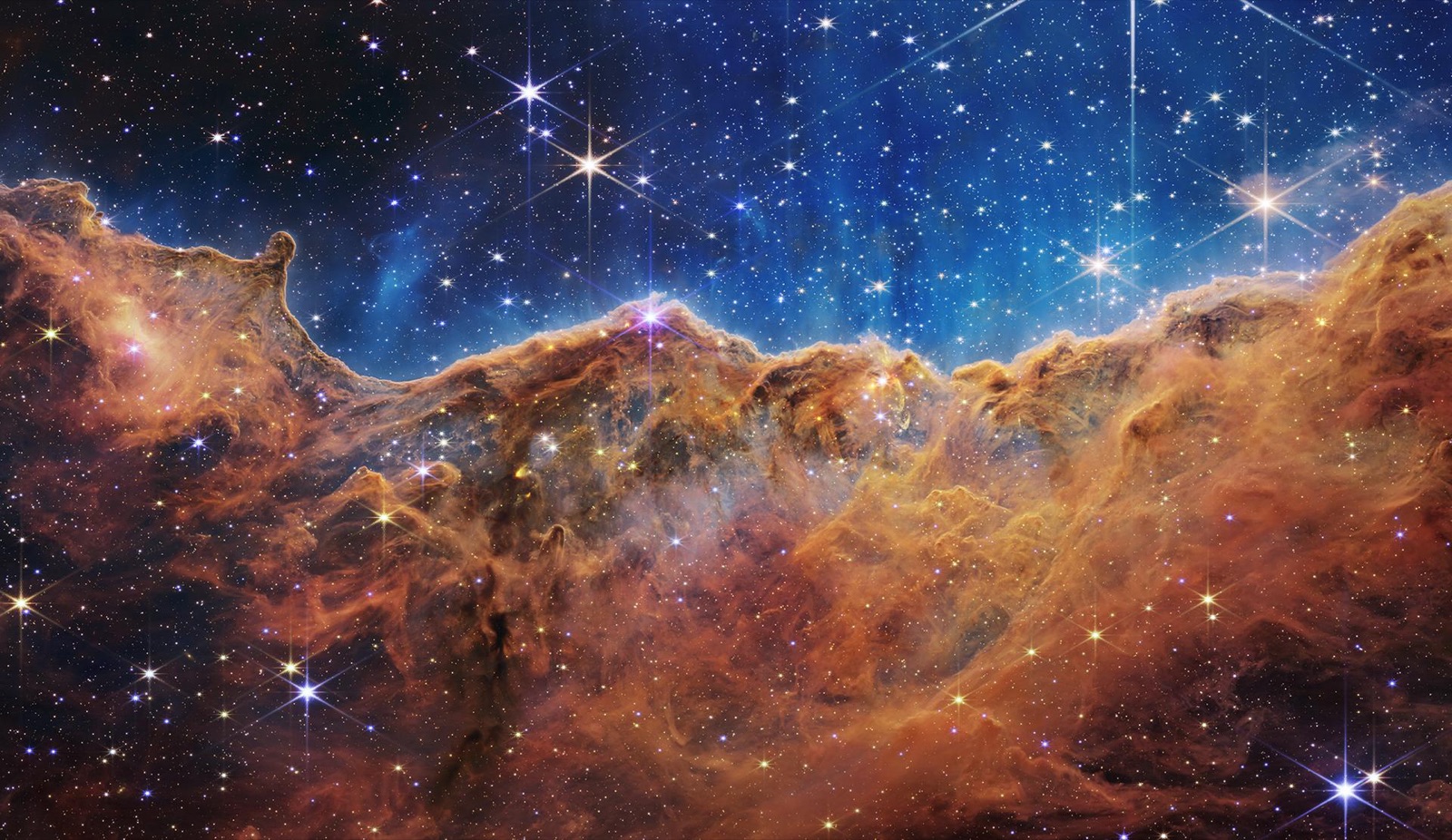
 Photograph · STScI (Webb) / NASA Image Library
Nebula · Deep guide
The Carina Nebula
A southern-sky colossus, home to JWST's 'Cosmic Cliffs' and a star primed to explode.
What is it?
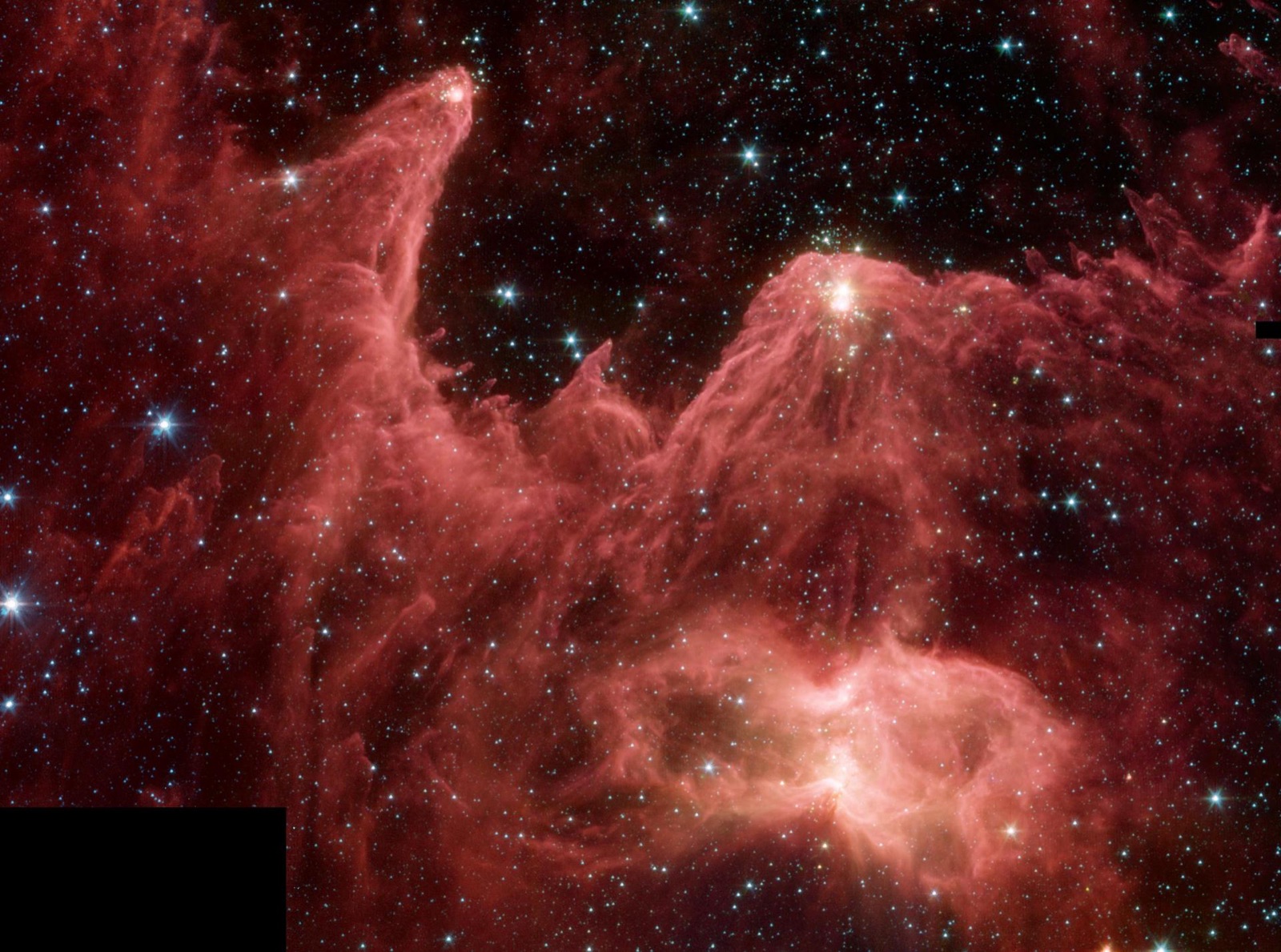
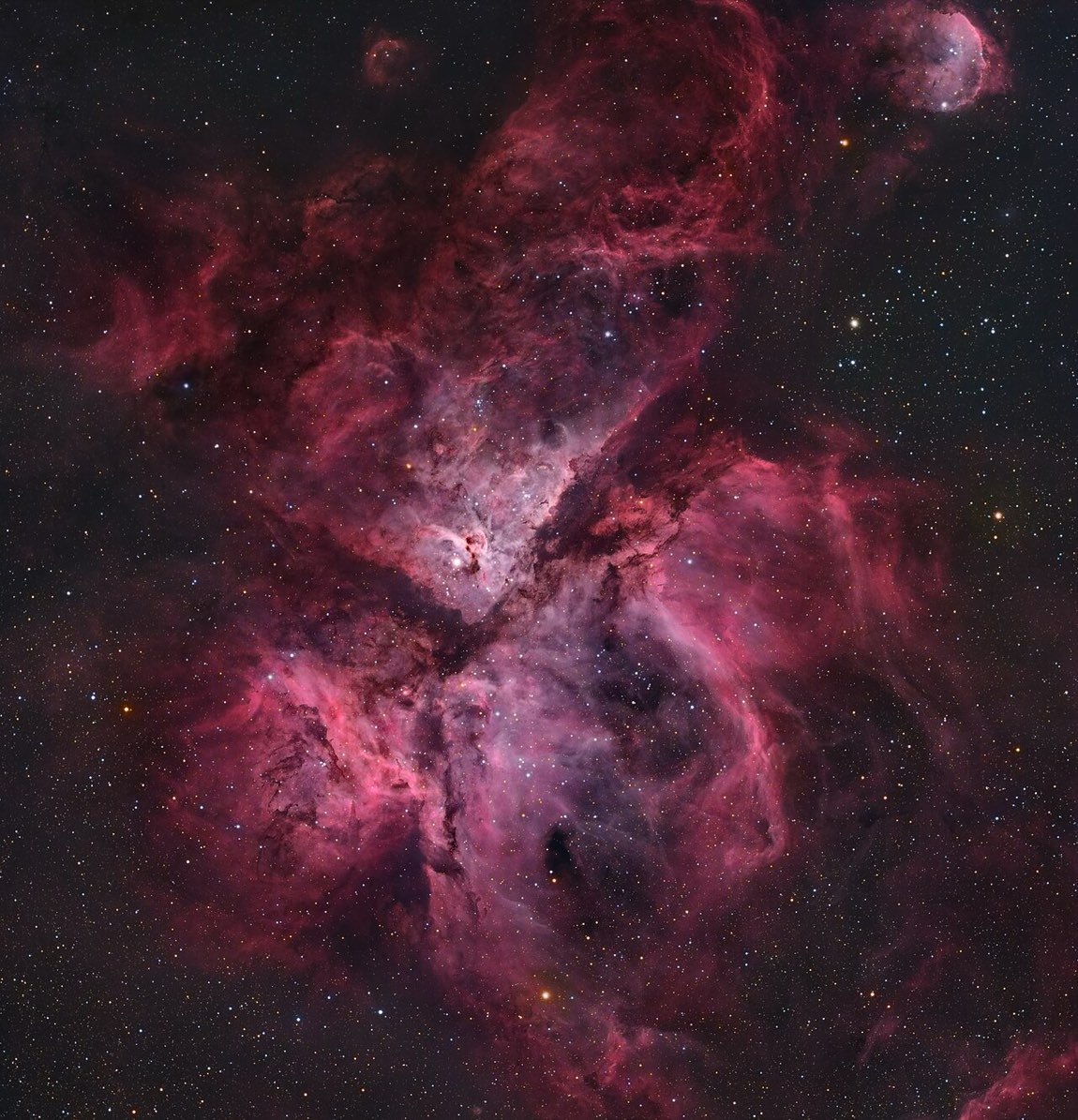
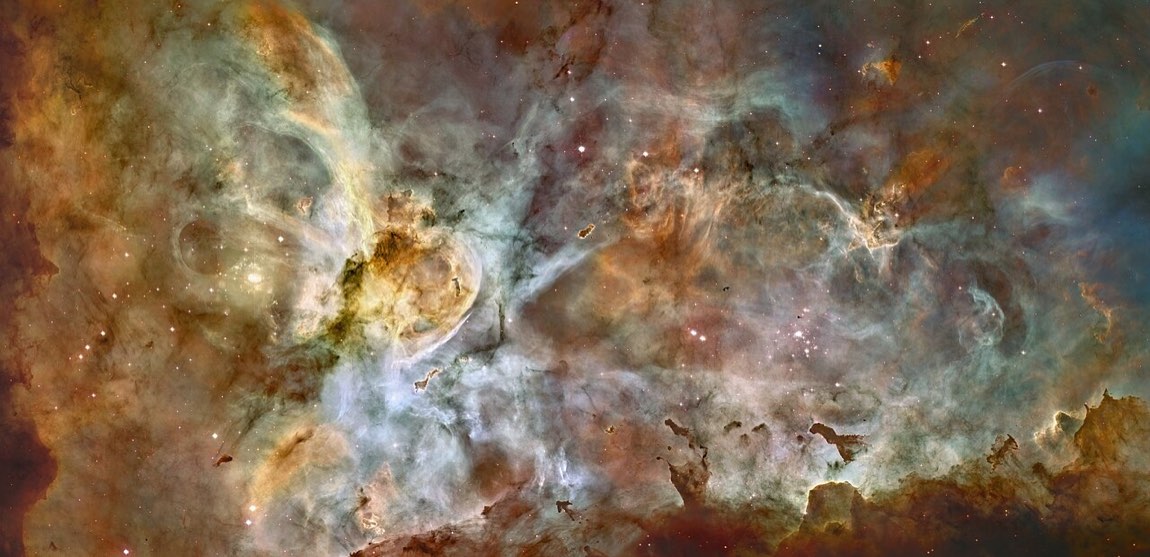
The Carina Nebula is one of the largest star-forming regions in the galaxy — four times the size of Orion's nebula and bright enough to see with the naked eye from the southern hemisphere. It became a household image in July 2022, when JWST's first public photographs featured its 'Cosmic Cliffs.' It also shelters Eta Carinae: a colossal double star that nearly exploded in the 1840s and remains the galaxy's most watched supernova candidate.
Go deeper
The complex spans ~300 light-years and hosts over 65 O-type stars, including WR 25 and the LBV Eta Carinae — a ~90+30 M☉ binary whose 1843 'Great Eruption' ejected ~10–40 M☉ (the Homunculus lobes) and briefly made it the sky's second-brightest star, an event it survived (a 'supernova impostor'). Eta Car could detonate as a true supernova (or even a long GRB, though its axis points away from Earth) on any timescale from tonight to a million years — with front-row seats at a safe 7,500 ly.
01 The star that refused to die
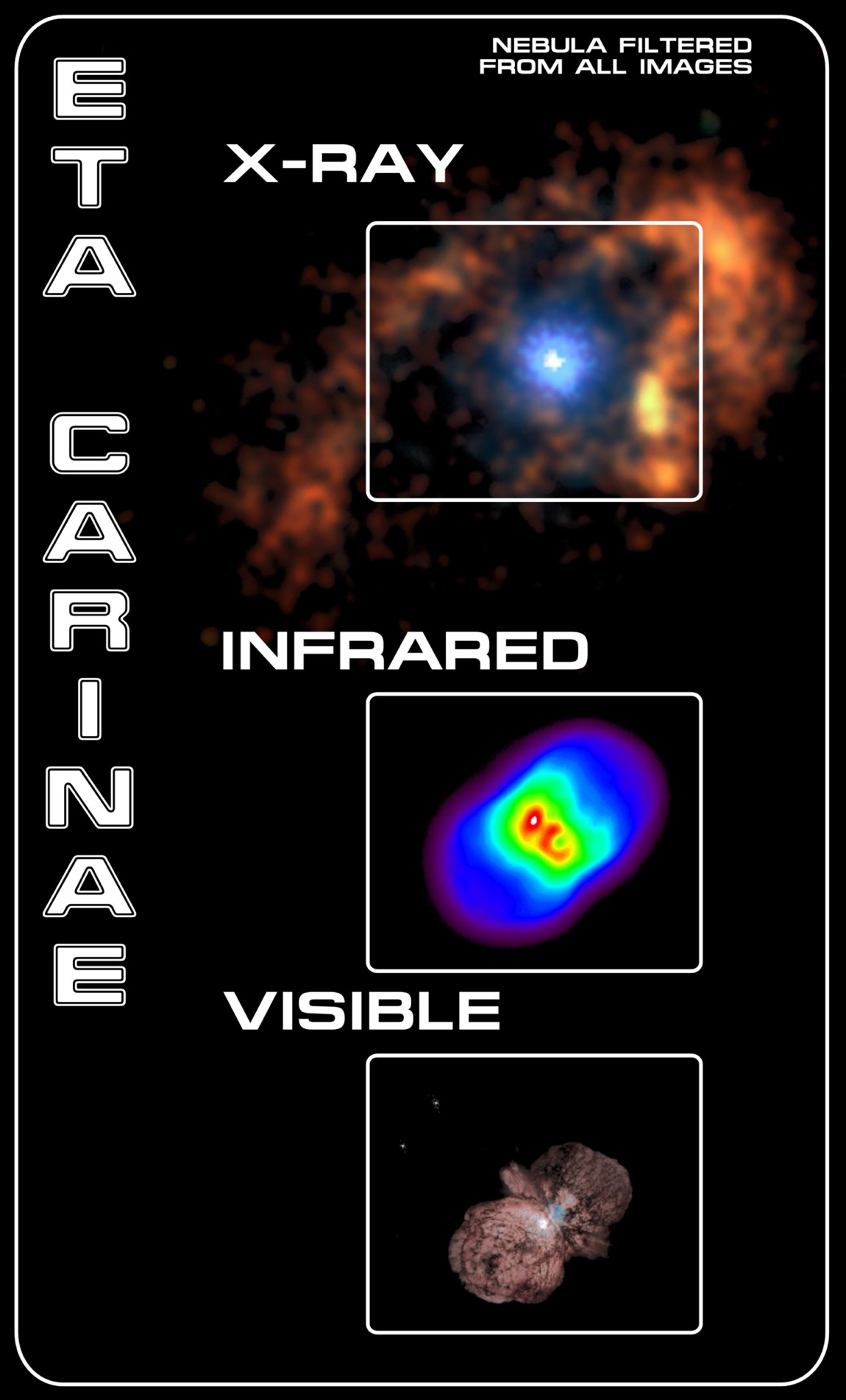
In the 1840s, sailors' star charts had to be redrawn: a previously modest southern star flared until only Sirius outshone it. Eta Carinae had erupted, hurling off dozens of Suns' worth of gas — and then, against every expectation, survived. The dumbbell-shaped cloud of that eruption is still expanding around it, glowing in telescope images like a peanut of fire.
02 Waiting for the bang Deeper
Stars above ~100 solar masses live fast and die spectacularly. Eta Car has the mass, the instability, and the eruption record; when it goes, it may rival Venus in our sky for weeks. 'When' spans tonight to a hundred thousand years — astronomers monitor it continuously, partly as the nearest dress rehearsal for physics we otherwise only see in distant galaxies.
The deep dive
Researched for the Atlas from Wikipedia — Carina Nebula (11,242 characters read) · updated Sep 20, 2026
03 Discovered on a single January night
The Carina Nebula entered the scientific record on 25 January 1752, when French astronomer Nicolas-Louis de Lacaille observed it from the Cape of Good Hope in what is now South Africa. Because the nebula sits deep in the southern sky, European astronomers working from their home continent had no chance of seeing it, and it remained unknown to the formal astronomical community until Lacaille's southern expedition. The nebula spans 120 by 120 arcminutes on the sky — that is a patch of sky roughly sixteen times the area covered by a full Moon — centered on the coordinates right ascension 10h 45m 08.5s and declination −59° 52′ 04″. Despite being four times larger than the Orion Nebula and actually brighter, the Carina Nebula has stayed comparatively obscure simply because most of the world's population and most of history's observatories sit in the Northern Hemisphere, where this object never clears the horizon.
 ⤢
⤢
04 A nursery running on several schedules
One of the Carina Nebula's most striking qualities is that star formation inside it is not a single tidy event but an ongoing, staggered process happening at different rates in different corners. The cluster Trumpler 14 is among the youngest known open clusters anywhere, at only half a million years old — an infant by cosmic standards. Meanwhile NGC 3293, another cluster within the association, is visibly older and physically more distant from Trumpler 14, and that separation in age and space points to sequential star formation: each wave of new stars is thought to trigger or enable the next. The association that wraps all of these clusters together, Carina OB1, is described as the largest stellar association in the nebula. It contains Trumpler 14, Trumpler 15, Trumpler 16, Collinder 228, Collinder 232, NGC 3324, and NGC 3293. Having clusters at such different stages of development within a single nebula gives astronomers a rare opportunity to study birth, early youth, and adolescence of stars side by side.
05 The Keyhole: a shape that needed a name
Nestled inside the Carina Nebula is a smaller dark cloud of cold molecules and dust laced with bright, fluorescing filaments of hot gas — the Keyhole Nebula. Its diameter is approximately seven light-years, or about 2.1 parsecs. When John Herschel first described it he reached for the awkward phrase "lemniscate-oval vacuity," and the word lemniscate lingered in the literature for decades. The name we use today came from popular astronomy writer Emma Converse, who in an 1873 article in Appleton's Journal described the cloud's outline as "resembling a keyhole." The name caught on. The Keyhole has no NGC number of its own — it is sometimes mistakenly called NGC 3324, but that designation actually belongs to a separate reflection and emission nebula northwest of the Carina Nebula. Its appearance has measurably changed since Herschel's day, most likely because the ionizing ultraviolet radiation pouring from Eta Carinae has shifted, altering which parts of the cloud glow and which stay dark.
06 The Little Man wrapped around a giant star Deeper
Immediately surrounding Eta Carinae is a structure called the Homunculus Nebula — Latin for "Little Man" — a small H II region where gas has been shocked into ionized and excited states. Astronomers believe it was blasted outward during an enormous eruption in 1841, the same event that briefly pushed Eta Carinae to become the second-brightest star in the entire sky. The Homunculus absorbs a large fraction of the central star system's fierce radiation and re-emits it as infrared light, making it the brightest object in the sky at mid-infrared wavelengths. Its geometry has been measured carefully: the bipolar lobes extend to a largest radius of about 22,000 AU, and the symmetry axis is tilted 41 degrees away from our line of sight, meaning we see it slightly more end-on than side-on. Using the cloud's observed angular dimensions and that axial symmetry, researchers derived a distance of 7,660 ± 160 light-years, a measurement that is independent of and consistent with other distance estimates to the nebula.
 ⤢
⤢
07 A globule that refuses to be ignored
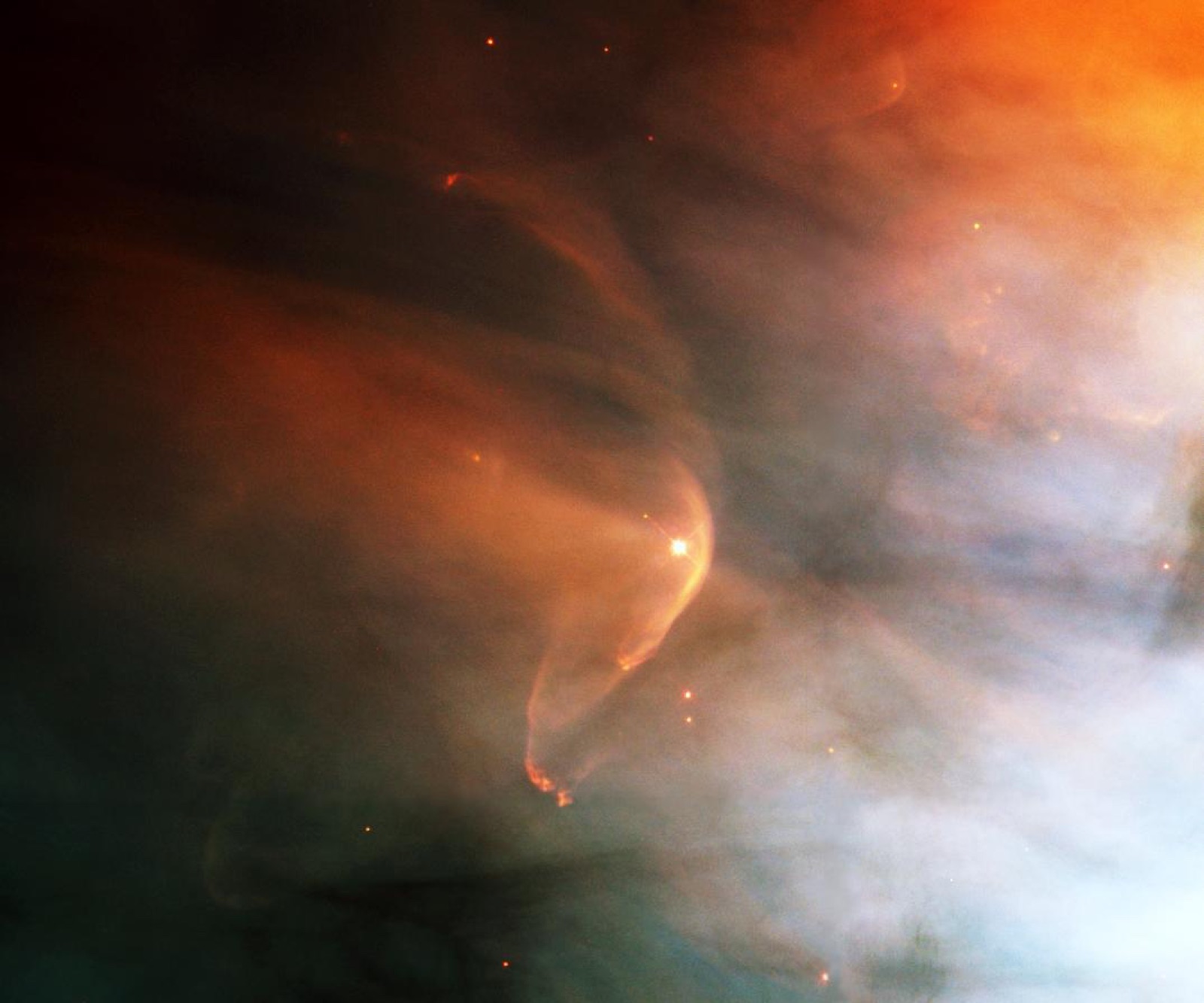
Hidden within the Keyhole Nebula at coordinates RA 10h 44m 30s, Dec −59° 40′ is a small Bok globule that the Hubble Space Telescope photographed and that researchers nicknamed the "Carina Defiant Finger" for its unmistakable shape. Hubble images show light radiating off the globule's edges, most dramatically at its southern tip where the "finger" points. The structure carries a mass of at least 6 solar masses, and evidence suggests stars may already be forming deep inside it. Like any dense cloud bathed in the punishing radiation environment of the Carina Nebula, the Defiant Finger is slowly being eaten away — a process called photoevaporation. Estimates put its complete destruction somewhere between 200,000 and 1,000,000 years from now. It is thought to be ionized primarily by the Wolf–Rayet star WR 25 and possibly also by Trumpler 16-244, a bright blue supergiant — two of the nebula's most energetic light sources.
08 Trumpler 14: 2,000 stars packed in six light-years Deeper
Trumpler 14 sits within the inner regions of the Carina Nebula roughly 8,000 light-years from Earth and packs an impressive amount of mass and stellar youth into a diameter of just six light-years, or 1.8 parsecs — a sphere you could traverse at the speed of light in six years, compared to the 100,000-light-year width of the whole Milky Way. About 2,000 individual stars have been identified within it, and the cluster's total mass is estimated at 4,300 solar masses. Among its inhabitants is HD 93129A, an O2 supergiant — O2 being one of the rarest and hottest spectral subtypes known. Because Trumpler 14 is only half a million years old, many of its stars have not yet settled into stable hydrogen-burning lives; some may still be shedding the gas clouds they were born from. Its age and proximity to other clusters in Carina OB1 make it a benchmark for testing models of how the most massive stars form and disperse their birth material.
09 Extreme binary stars and what they reveal Deeper
The Carina Nebula is home to several binary star systems that push physical limits in different ways. WR 22 is an eclipsing binary whose primary Wolf–Rayet star carries a dynamical mass ranging from just under 60 to over 70 solar masses depending on the orbital model used, with spectroscopic estimates landing at around 74 to 78.1 solar masses; its secondary falls between about 21 and 27 solar masses. WR 25, in the heart of Trumpler 16, is possibly the most luminous star in the entire galaxy, paired with a hard-to-detect OB companion. HD 93205 contains an O3.5 primary with a mass of 40 to 60 solar masses and an O8 secondary of roughly 20 solar masses that travels its orbit at more than 300 km/s, fast enough that general relativistic effects cause the orbit's apsidal line to shift in a measurable, predictable way — making it what astronomers classify as a relativistic binary. These systems let researchers measure stellar masses directly rather than relying on theoretical models.
 ⤢
⤢
10 Mystic Mountain and stellar jets
In early February 2010, the Hubble Space Telescope trained its Wide Field Camera 3 on a towering pillar of dust and gas in the Carina Nebula, capturing the image on 1–2 February 2010 as part of the telescope's twentieth anniversary celebration. The resulting photograph became one of Hubble's most widely shared images and the feature was named Mystic Mountain. The pillar stands three light-years tall — roughly 0.92 parsecs — which is comparable to the distance between our Sun and the nearest star system, Alpha Centauri. Buried inside Mystic Mountain are nascent stars still in the process of forming, and these protostars are anything but quiet: they fire off powerful jets of gas that stream outward from the pillar's peaks. These jets are a normal phase of early stellar life, driven by material falling inward onto a forming star and being partially redirected outward along the star's magnetic poles, carving channels through the surrounding cloud.
11 HD 93129: three stars, all extraordinary Deeper
HD 93129 is a triple star system in which every component ranks among the most luminous stars in the Milky Way. At the heart of the system is HD 93129 A, itself a close pair: component Aa is an O2 supergiant, and Ab is an O3.5 main-sequence star. The angular separation between Aa and Ab shrank from 55 milliarcseconds in 2004 to just 27 milliarcseconds in 2013, a change that is visible over a human career but for which no reliable orbital solution yet exists. The third star, HD 93129 B, is an O3.5 main-sequence star sitting about 3 arcseconds away from the inner pair and roughly 1.5 magnitudes fainter than A and B combined — placing it at approximately the same brightness as the secondary Ab. All O2 and O3.5 stars are vanishingly rare; having three of them gravitationally linked within a single system makes HD 93129 one of the most remarkable multiple-star systems known and a prime laboratory for studying how the very top of the stellar mass distribution forms and evolves.
12 How Eta Carinae shapes its surroundings
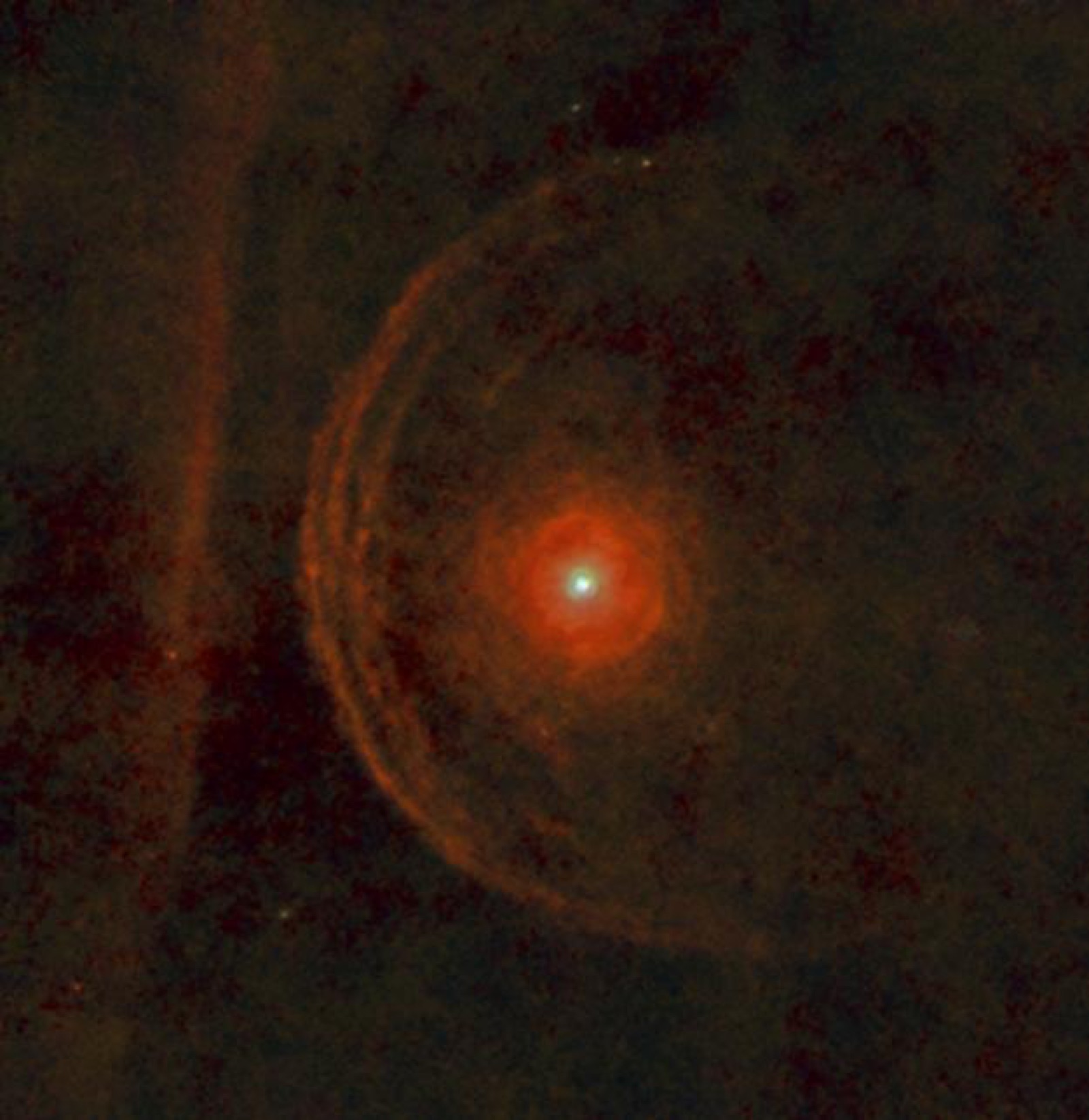
Eta Carinae does not merely sit inside the Carina Nebula — it actively sculpts the gas and dust around it. The star's intense radiation pressure and stellar winds carve and compress nearby material, and the evidence is written in the nebula itself: dark globules and other compact features have tails pointing directly away from Eta Carinae, like windsocks streaming away from a gale. Before the Great Eruption of the 1840s, which wrapped the star in a thick shell of newly ejected dust, far more of Eta Carinae's ultraviolet light flooded outward into the surrounding nebula. That ultraviolet radiation is what ionizes the gas and makes nebulae glow, so the whole appearance of the Carina Nebula would have been measurably different before the 1840s. The Keyhole Nebula's changing appearance since Herschel's era may itself partly reflect this shift. A single stellar outburst, in other words, left a permanent mark on the look of a region spanning hundreds of light-years.
 ⤢
⤢
13 The nebula's place in the galaxy's structure
The Carina Nebula is not floating in some random part of the Milky Way — it lies in the Carina–Sagittarius Arm, one of the major spiral arms of our galaxy, in the constellation Carina. This arm is a region of elevated gas density where star formation proceeds at above-average rates, which helps explain why the Carina Nebula is so exceptionally active and well-populated with massive young stars. At roughly 8,500 light-years from Earth, the nebula is far enough away that we cannot resolve individual low-mass stars without very large telescopes, but close enough that astronomers can study its brightest and most extreme members in remarkable detail. Eta Carinae in particular is described as currently the most massive star that can be studied in great detail because of its combination of size and accessible distance — several other candidate stars may be more massive, but the data on them are described in the article as far less robust, a reminder that even the rankings of cosmic record-holders depend critically on measurement quality.
14 What JWST revealed at the Cosmic Cliffs
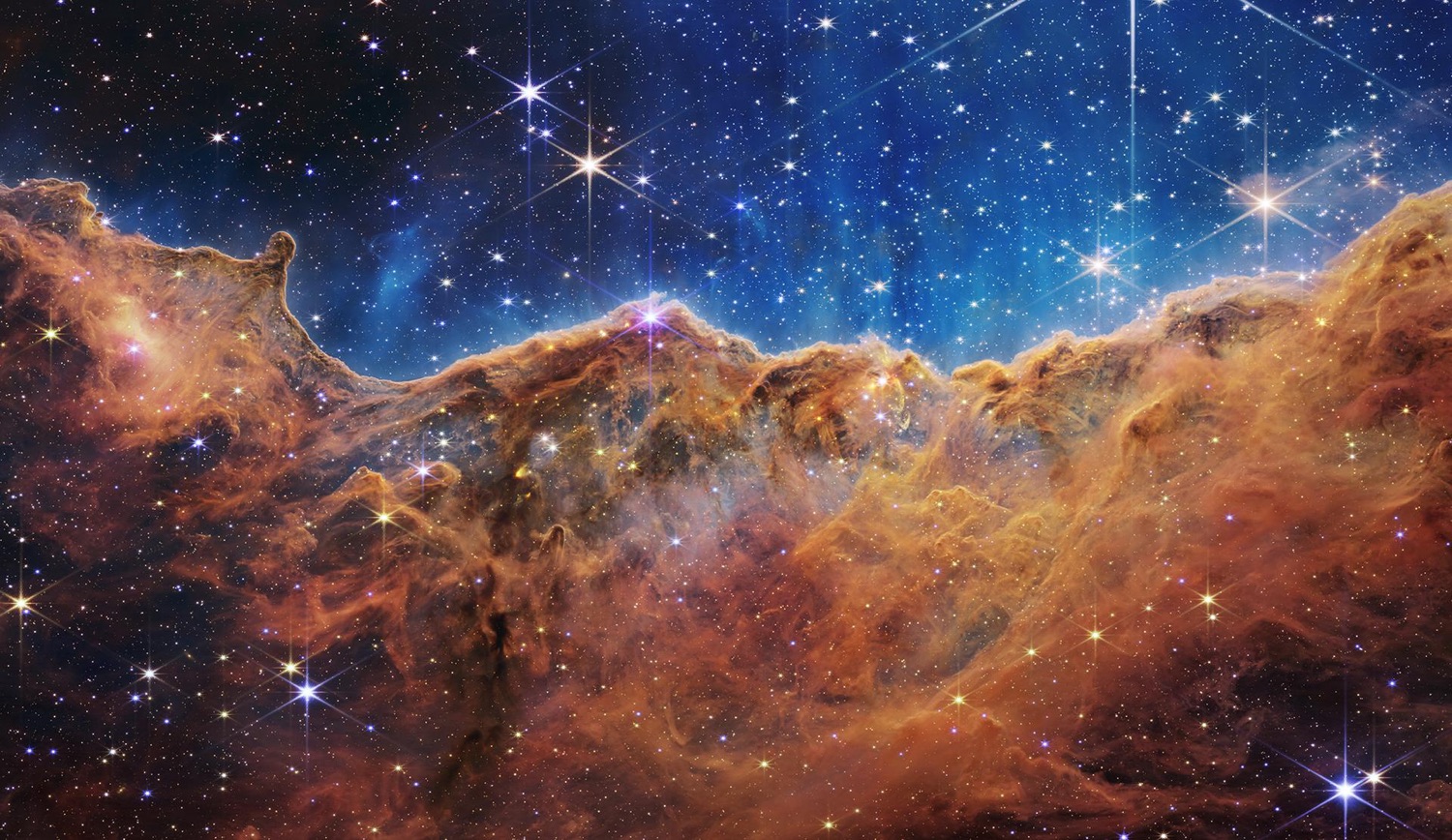
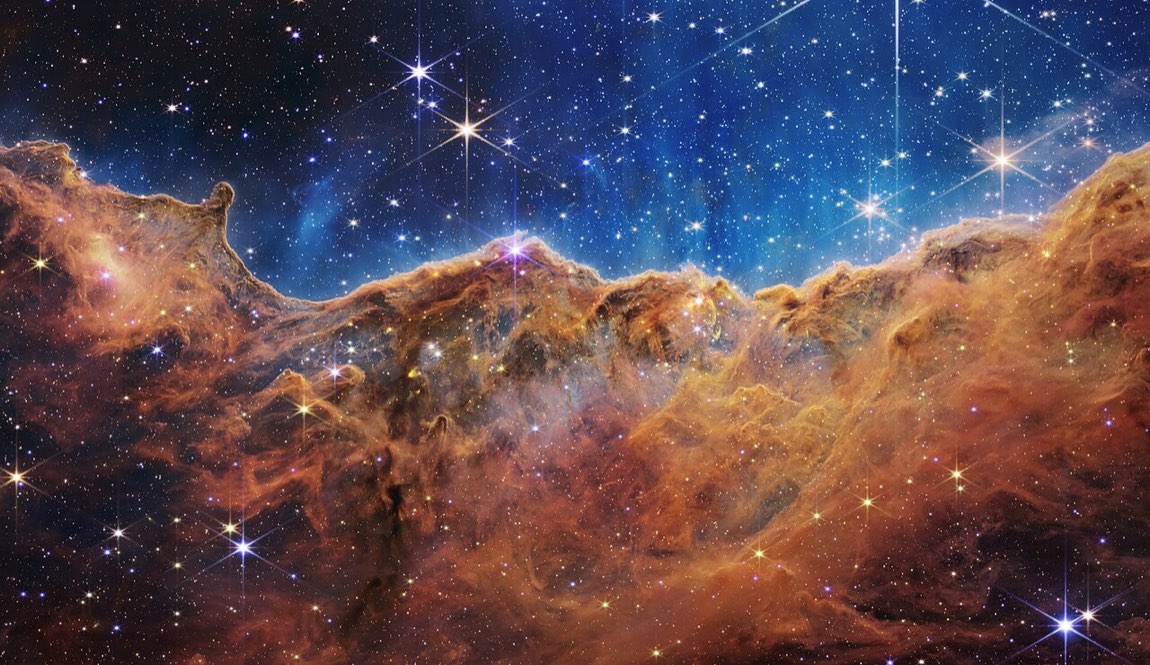
When the James Webb Space Telescope released its first official science images, mission planners chose five targets to showcase the observatory's capabilities, and the Carina Nebula made the list. JWST focused on an early star-forming region within NGC 3324 — a reflection and emission nebula located just northwest of the main Carina Nebula — producing a detailed image of a landscape called the Cosmic Cliffs. The choice was deliberate: JWST's infrared sensitivity lets it peer through the curtains of dust that block visible-light telescopes, revealing protostars and the earliest stages of stellar development that would otherwise be hidden. NGC 3293, another cluster associated with Carina OB1, is noted as the oldest in the association and the most distant from Trumpler 14, showing that the region's star-forming activity has been marching outward over time. Taken together, the Carina Nebula offers a layered archive of star formation across multiple epochs, from the ancient NGC 3293 to the infant Trumpler 14, with JWST now adding previously invisible chapters to that story.
 ⤢
⤢
Could life exist here?
A hard-radiation environment being resculpted by giant stars.
Our labels: Confirmed · Strong Evidence · Estimated · Hypothesis · Theoretical · Speculative (see Methodology).
Weird & wonderful
- Eta Carinae briefly became the second-brightest star in the sky in 1843 — from 7,500 light-years away.
- Its Homunculus cloud expands fast enough to cross the Earth–Moon distance in about an hour.
- The Cosmic Cliffs in JWST's image are a wall of gas roughly 7 light-years tall.