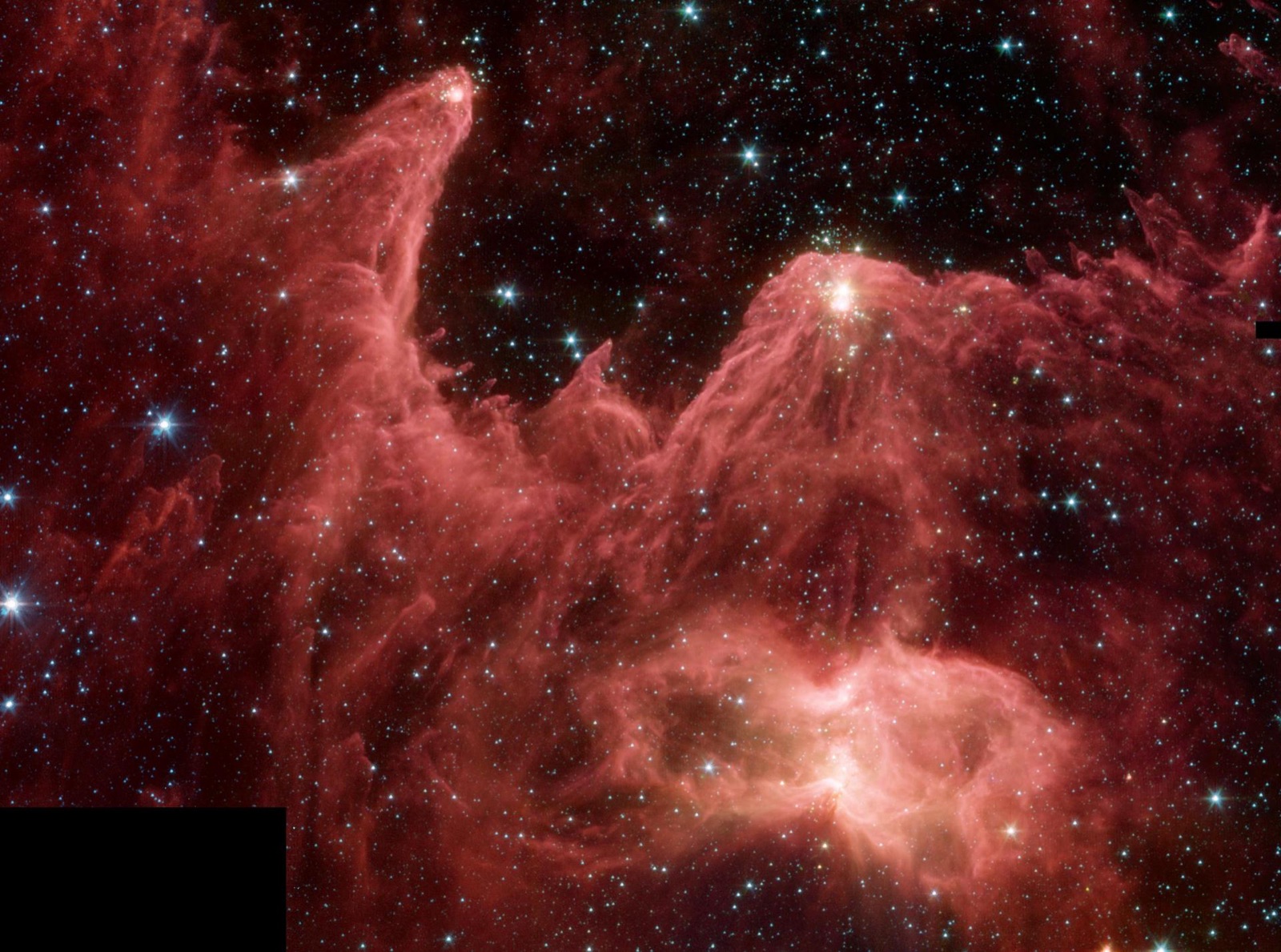
 Photograph · IRAC Image: NASA/JPL-Caltech/Harvard-Smithsonian CfA/ESA/STScI<br />Visible Light Image: NASA/JPL-Caltech/Harvard-Smithsonian CfA/DSS
Nebula · Deep guide
The Eagle Nebula
Also called: M16 · Home of the Pillars of Creation
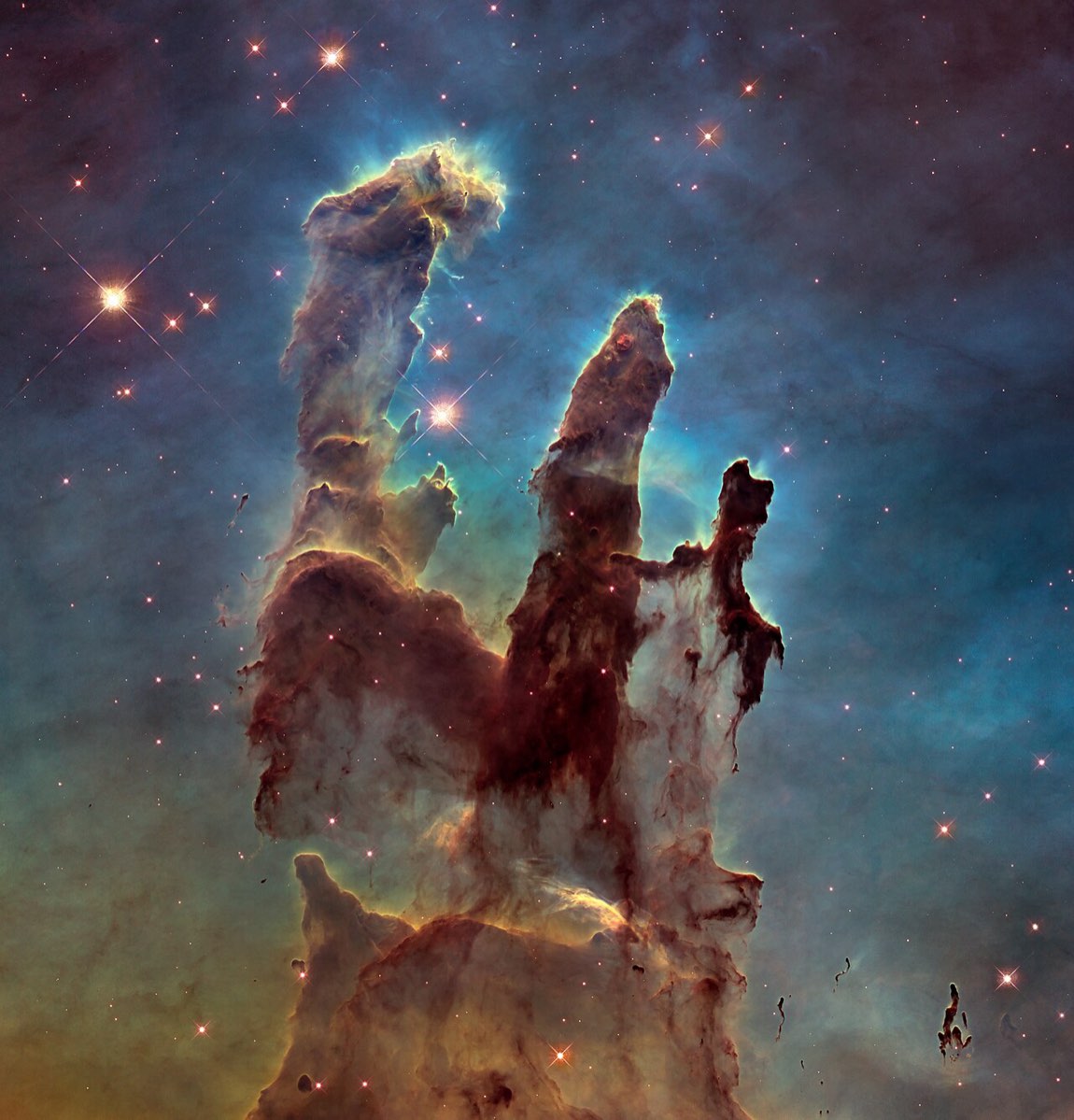
The Pillars of Creation, the most famous photograph in astronomy, live here.
What is it?
The Eagle Nebula is a star-forming cloud 5,700 light-years away, and inside it stand the Pillars of Creation: towers of gas and dust light-years tall, sculpted by the radiation of newborn stars, and immortalized by Hubble's 1995 image — probably the most recognized astronomy photograph ever taken. New stars are condensing inside the pillars' fingertips right now.
Go deeper
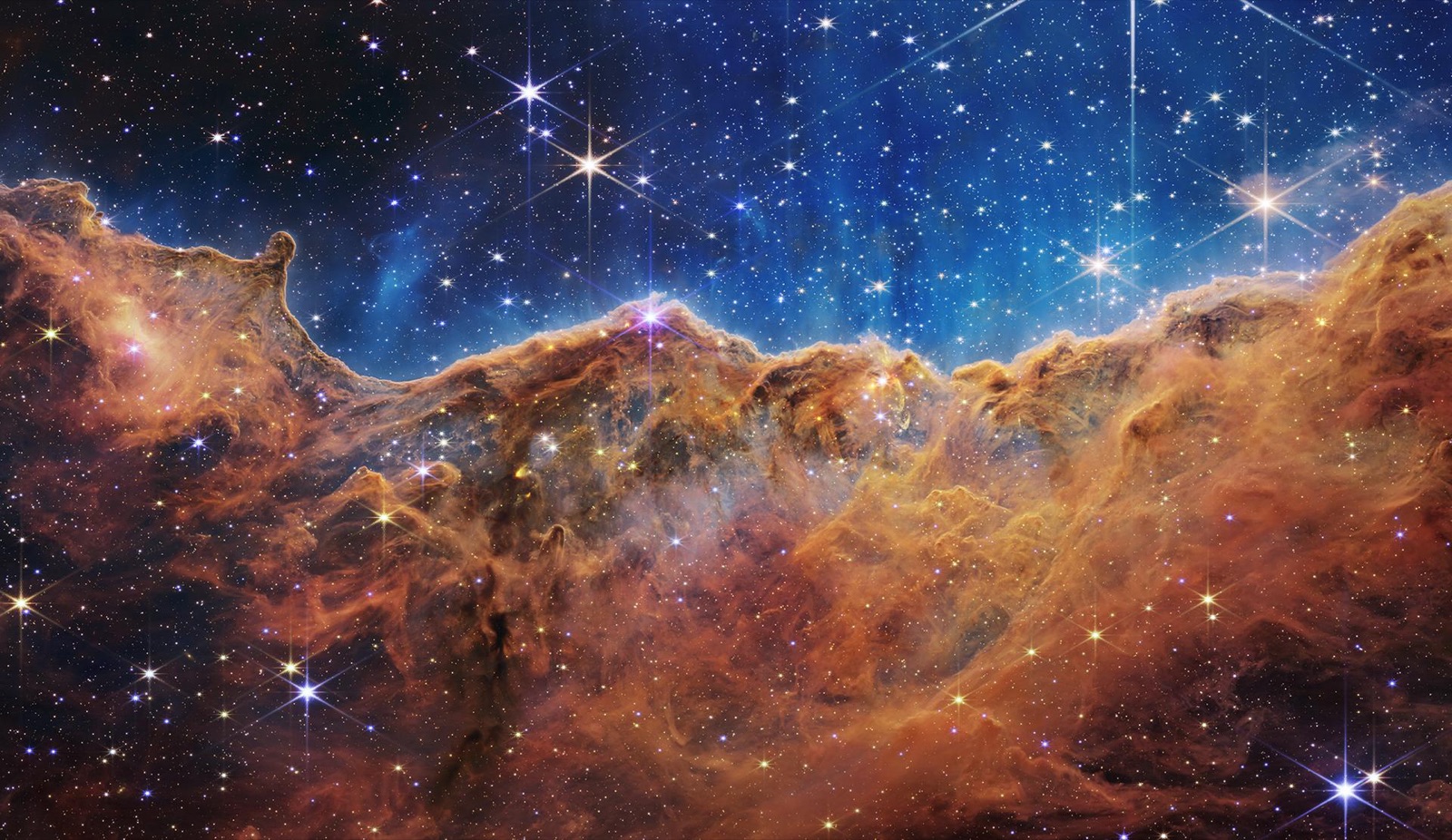
The Pillars are dense molecular columns resisting photo-evaporation by an adjacent young cluster (NGC 6611) — erosion in progress, with evaporating gaseous globules (EGGs) exposing embryonic stars at their tips. JWST's 2022 infrared portrait sees through the dust to the protostars inside. The pillars' remaining lifetime is a few hundred thousand years; claims (from Spitzer data) that a supernova blast already destroyed them were not borne out — no approaching shock is confirmed.
01 Sculpture by starlight
The pillars are what's left of a larger cloud that fierce ultraviolet light from nearby giant stars is boiling away. Denser knots shield the gas behind them — like sandstone hoodoos shielding softer rock in a desert — leaving columns pointing back at their sculptors. The same radiation destroying the pillars compressed them first, triggering the star birth inside.
02 Monuments with expiry dates Deeper
At current erosion rates the Pillars have a few hundred thousand years left — and because light takes 5,700 years to reach us, any sudden change lags that far behind reality. Astronomy's icons are all snapshots of processes: what Hubble photographed is a moment in a demolition-and-construction site, not a permanent cathedral.
The deep dive
Researched for the Atlas from Wikipedia — Eagle Nebula (4,009 characters read) · updated Sep 20, 2026
03 A nebula hiding inside a star cluster
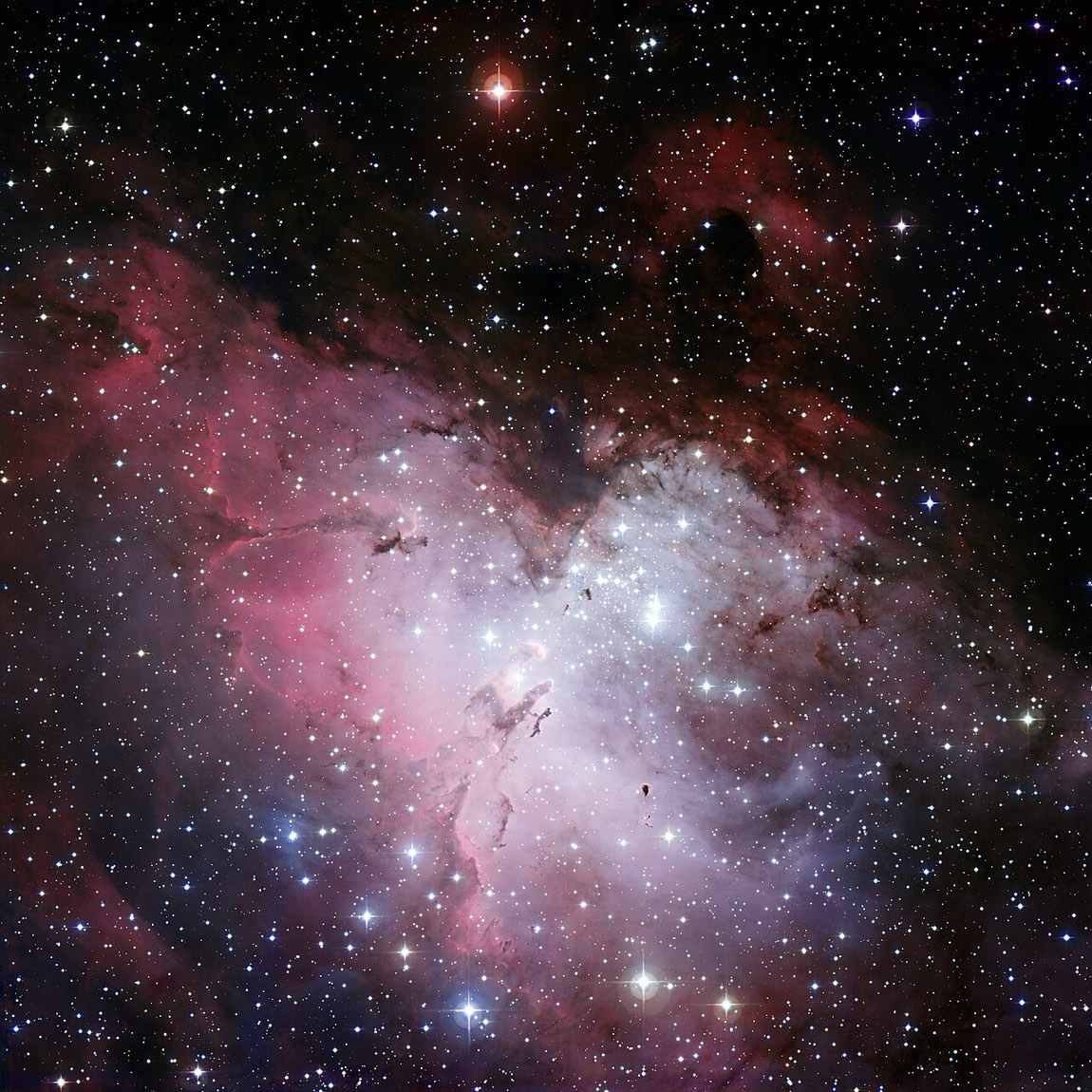
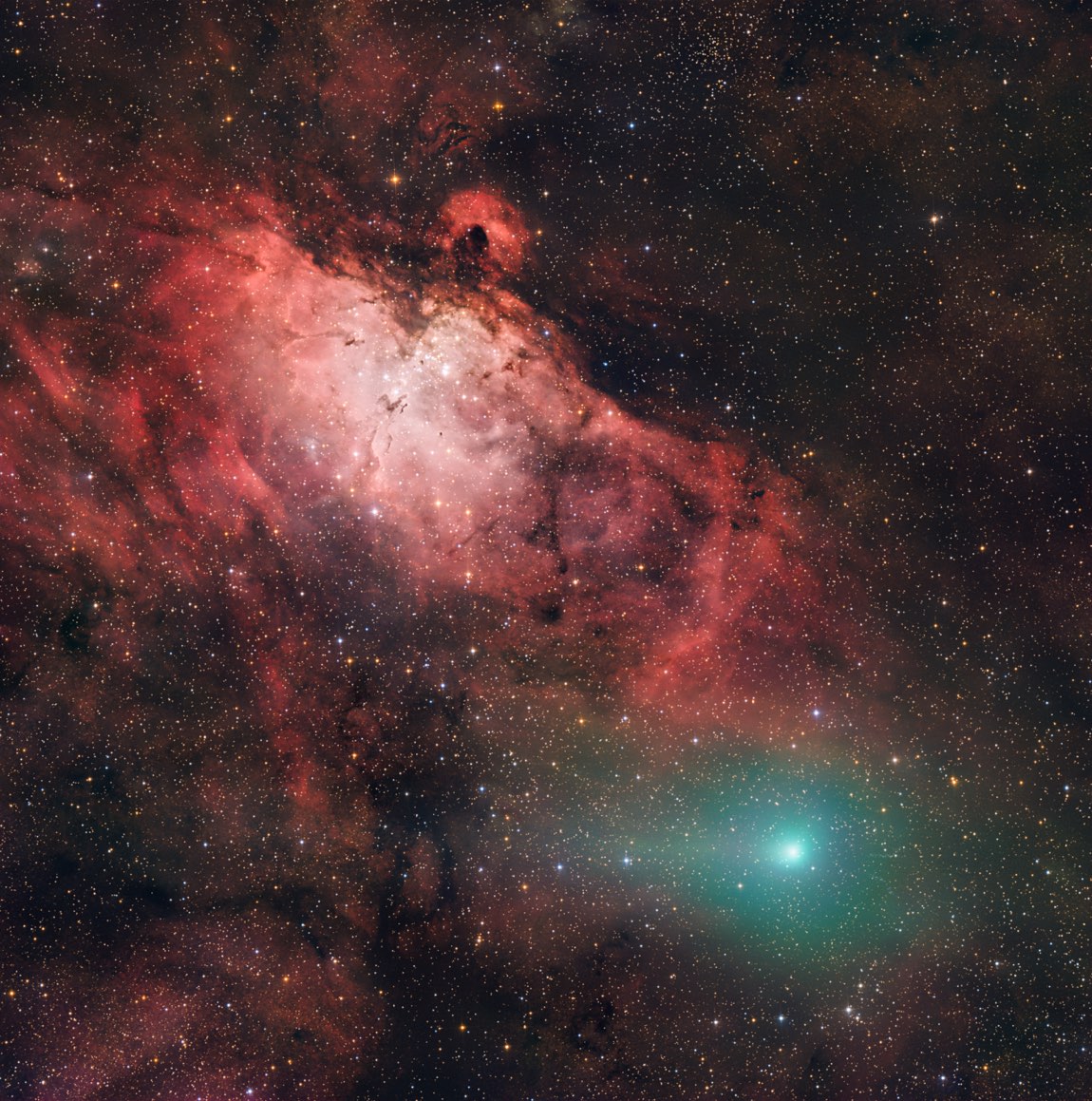
Most people think of the Eagle Nebula as one thing, but it is really two overlapping structures wearing the same name. The glowing gas cloud catalogued as IC 4703 is a diffuse emission nebula — an H II region lit up by energetic radiation from young stars within it. Sitting inside that cloud is an open star cluster catalogued separately as NGC 6611, containing approximately 8,100 stars. Those stars are mostly bunched into a gap in the surrounding molecular cloud to the north-west of the famous Pillars of Creation, not spread evenly across the glowing gas. Messier 16, the designation most amateur astronomers use, technically refers to the cluster, while IC 4703 is the nebula proper — though in everyday conversation the labels get blurred together. The whole system lies in the Sagittarius Arm of the Milky Way, roughly 5,700 light-years from Earth, making it a relatively nearby example of vigorous, ongoing star birth happening right now in our own galactic neighbourhood.
 ⤢
⤢
04 Discovery: a Swiss astronomer's lucky night
The Eagle Nebula entered the written record thanks to Jean-Philippe de Cheseaux, a Swiss astronomer who spotted the object in 1745 to 1746. De Cheseaux was working during an era when telescopes were good enough to resolve hazy patches from true point-like stars, but before photography gave astronomers anything permanent to study. His discovery was one of many faint clusters and nebulae catalogued during that period as observers began systematically sweeping the sky. Charles Messier later included the object in his famous catalogue — giving it the designation Messier 16 — primarily so that comet hunters would not mistake it for a comet. The name "Star Queen Nebula" came much later, coined by the twentieth-century astronomer and author Robert Burnham Jr., who characterised the dark central pillar silhouetted against the glowing gas as the figure of a Star Queen. Both the "Eagle" and the "Star Queen" names trace back to that same dark central shape, interpreted differently by different imaginative eyes.
05 The brightest star: a heavyweight binary Deeper
Not every bright point in the Eagle Nebula is an ordinary star. The brightest member of the cluster, catalogued as HD 168076, shines at an apparent magnitude of +8.24 — faint enough that the naked eye misses it, but easily picked out with a decent pair of binoculars. What looks like a single star is actually two massive stars in orbit around each other. The primary is classified as an O3.5V star, one of the hottest and most luminous stellar types that exist, while its companion is an O7.5V star. Together they account for a combined mass of roughly 80 times the mass of the Sun, and the system pours out light at up to 1 million times the Sun's luminosity. Stars of O spectral type live extraordinarily short lives by cosmic standards, burning through their hydrogen fuel in just a few million years. Given that the cluster itself is estimated to be only 1 to 2 million years old, HD 168076 is essentially a newborn already blazing at nearly its maximum output.
06 EGGs: stars caught in the act of hatching
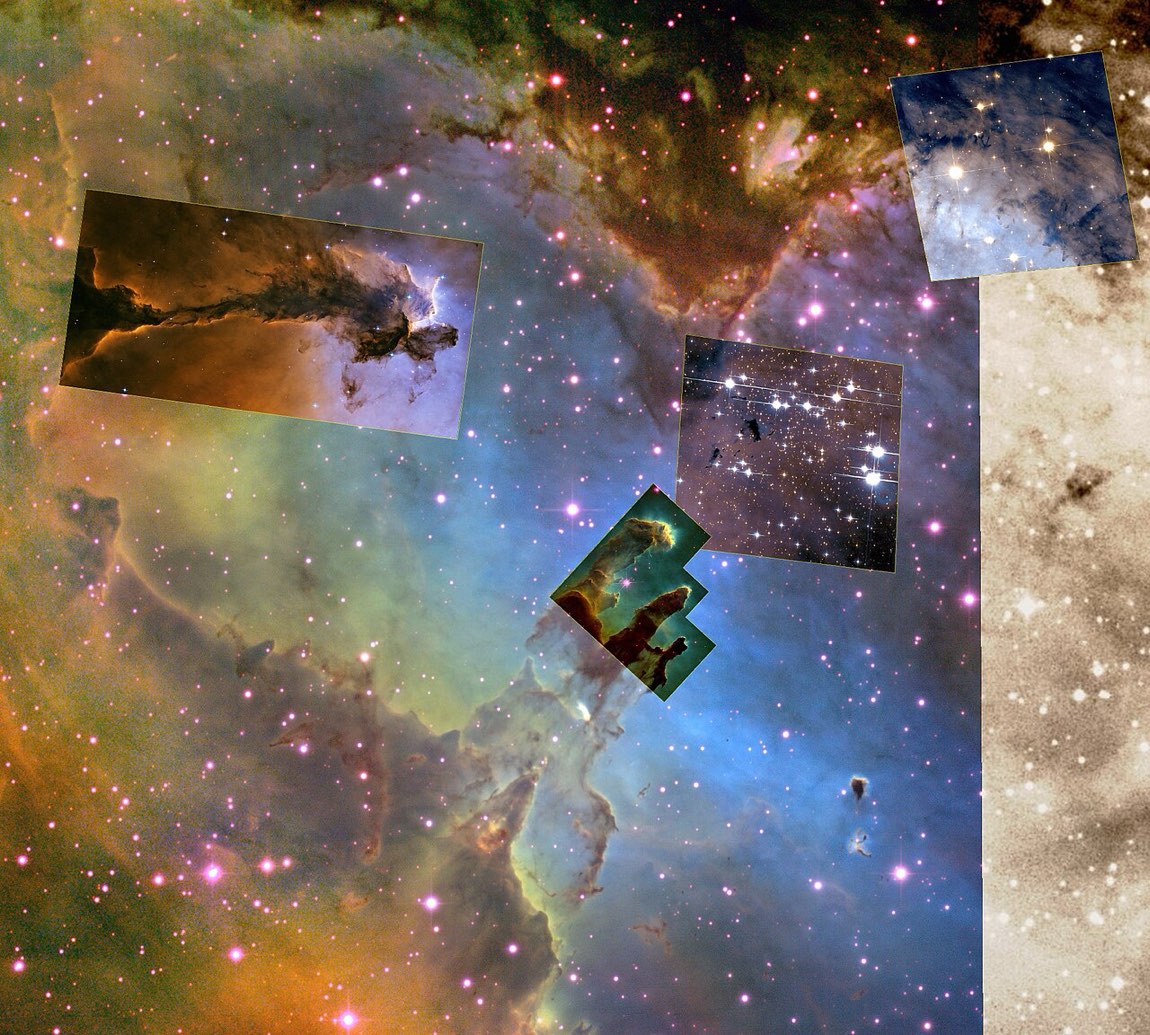
Inside and across the surface of the famous pillars, astronomers have identified compact knots of especially dense gas given the name EGGs — short for Evaporating Gaseous Globules. The acronym is deliberate: these structures are understood to be stellar eggs, cocoons of gas dense enough to gravitationally collapse into new stars. Some EGGs are believed to already contain protostars, meaning the process of star formation is actively underway inside them right now. The pillars themselves act as shields: surrounding gas is being blasted away by ultraviolet radiation from nearby hot stars, but the denser EGGs resist that erosion longer. Stars are confirmed to be forming inside some of these globules. The small dark pockets visible in the Hubble imagery are thought to be exactly this kind of protostar, catalogued as Bok globules. The EGGs were identified from the landmark 1995 Hubble images produced by astronomers Jeff Hester and Paul Scowen, whose work transformed scientific understanding of the star-formation processes operating inside the nebula.
 ⤢
⤢
07 What X-rays reveal that visible light cannot Deeper
Visible-light images of the Eagle Nebula tell one story; X-ray observations from NASA's Chandra X-ray Observatory tell a subtly different one. When scientists compared Chandra's X-ray data with Hubble's iconic Pillars of Creation image, they found that the X-ray sources — which correspond to young, hot stars — do not line up with the pillars at all. Instead, those X-ray-emitting stars are scattered more or less randomly across the wider nebula. The explanation ties directly to the EGGs and the protostars suspected to be forming inside the pillars: those embedded protostars are not yet hot enough to generate detectable X-ray emission. In other words, the pillars are unusually quiet in X-rays precisely because the stars gestating inside them are still too young and cool to announce themselves in high-energy light. This mismatch between the X-ray map and the visible structure is a concrete illustration of how multi-wavelength astronomy reveals hidden layers of complexity that no single telescope or wavelength can capture on its own.
08 A gas spire nearly ten light-years tall
The three famous pillars are the Eagle Nebula's most photographed feature, but they are not the only dramatic column of gas in the region. Extending from the northeastern part of the nebula is a separate spire of gas approximately 9.5 light-years long — equivalent to roughly 90 trillion kilometres. To put that in everyday terms, 9.5 light-years is more than twice the distance from the Sun to the nearest star system, Alpha Centauri. This spire is a reminder that the Eagle Nebula is far larger than any single image conveys: the pillars themselves, though visually striking, are embedded in a much more extended and structurally complex cloud of interstellar gas and dust. The full nebula is a diffuse emission nebula glowing because embedded and nearby hot stars ionise the surrounding hydrogen gas, causing it to radiate in characteristic colours — the red of hydrogen-alpha emission being most prominent in long-exposure photographs.
09 The supernova threat: real but perhaps already past Deeper
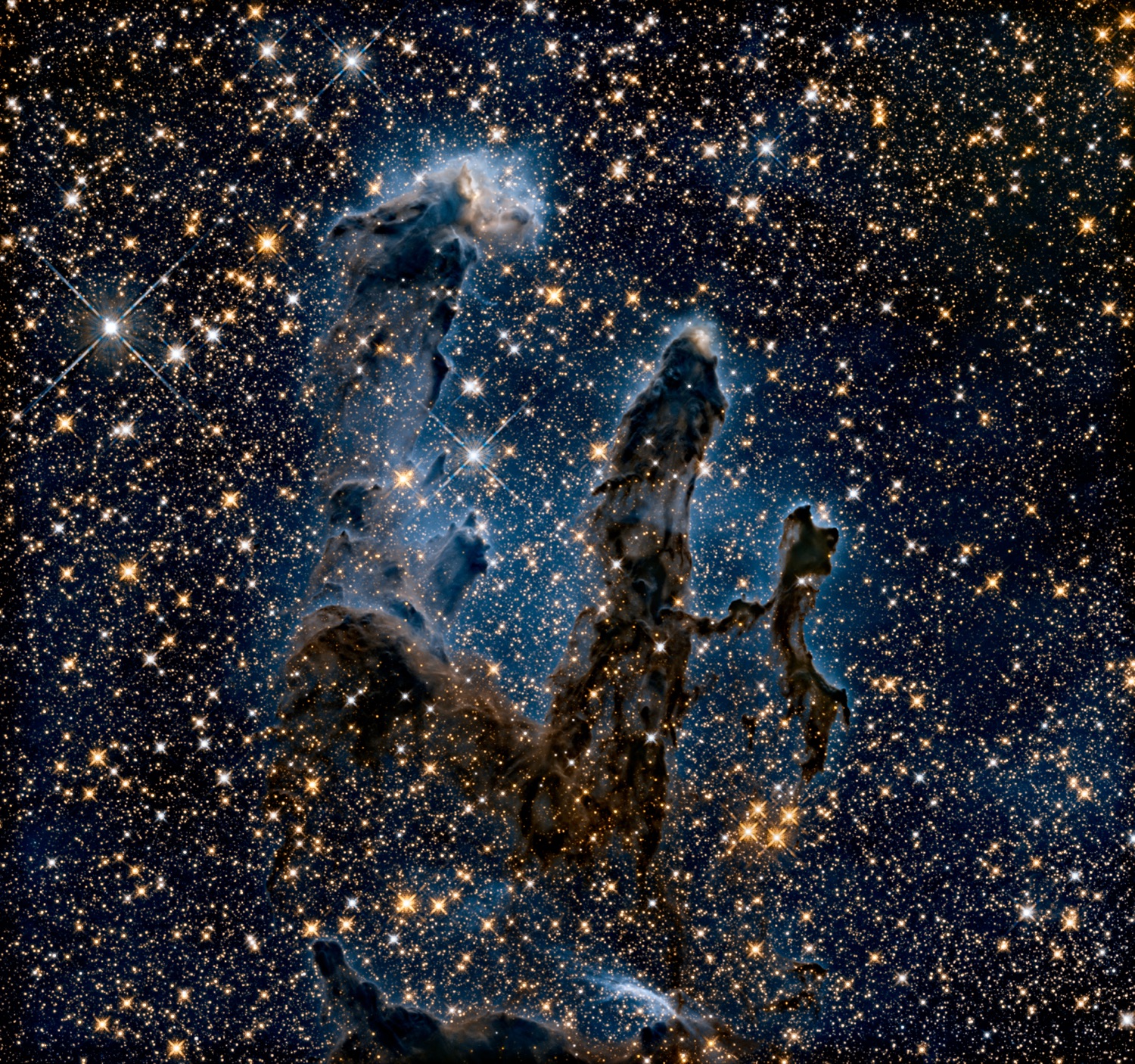
In 2007, data from the Spitzer Space Telescope raised an unsettling possibility about the pillars' fate. Spitzer detected hot gas in the region that scientists interpreted as evidence of a supernova that exploded somewhere between 8,000 and 9,000 years ago. Because the nebula is 5,700 light-years away, the flash of visible light from that explosion would have reached Earth only 1,000 to 2,000 years ago — visible to ancient observers for a brief period before fading. More critically, a slower-moving shock wave from the same explosion was theorised to have been ploughing through the nebula for thousands of years, potentially destroying the delicate pillars long before any of those effects reached Earth. However, follow-up observations revised this alarming picture. When Hubble re-imaged the pillars in 2014 — twenty years after the original 1995 observation — in both visible and infrared light, no evidence of an internal supernova was found. The 2014 images instead provided a detailed measure of the rate at which the pillars are evaporating, and the current best estimate is that the pillars, in some form, will persist for at least 100,000 more years.
 ⤢
⤢
10 Hubble 2014: watching the pillars change
The twenty-year gap between the original 1995 Hubble images and the 2014 follow-up observations turned out to be scientifically invaluable. By comparing two snapshots separated by two decades, astronomers could directly measure how fast the pillars are being eaten away by the radiation and stellar winds from nearby hot stars — a process called photoevaporation. No single observation could have revealed this; only the passage of time made the change measurable. The 2014 images were captured in both visible light and infrared light, with infrared capable of piercing the dusty columns to reveal structures hidden inside them. Together the two wavelengths gave the most detailed account yet of the evaporation rate and the internal architecture of the pillars. The conclusion — that the pillars should survive in recognisable form for at least another 100,000 years — means that every future generation of astronomers, and potentially observers with better telescopes than ours, will still be able to study these structures in detail.
11 Cousins of the pillars in a distant nebula
The Eagle Nebula's pillars are famous, but they are not unique. A structurally similar formation exists in the Soul Nebula, located in the constellation Cassiopeia, and was imaged by the Spitzer Space Telescope in 2005. That larger structure earned comparable names — "Pillars of Star Creation" and "Pillars of Star Formation" — because it operates by the same physical process: dense columns of gas and dust resist the erosive radiation from nearby hot stars, with EGG-like knots sheltered inside them potentially forming new stars. The existence of near-identical structures in different nebulae across the galaxy confirms that pillar formation is not a quirk specific to M16 but a general outcome of the interaction between intense stellar radiation and cold molecular cloud material. Where massive young stars light up their birth clouds, pillars appear to be an almost inevitable byproduct — sculpted monuments to the very stars that are slowly destroying them.
12 How a cluster this young can already be so bright Deeper
At an estimated age of only 1 to 2 million years, the Eagle Nebula's star cluster is extraordinarily young. For comparison, the Sun is approximately 4.6 billion years old, meaning these stars have existed for less than 0.05 percent of the Sun's current age. Yet the cluster is already populated with massive O-type stars blasting out ultraviolet radiation intense enough to ionise the surrounding nebula and carve the famous pillars. This is possible because massive stars form and reach the main sequence far faster than smaller stars like the Sun: a star of 80 solar masses collapses and ignites on a timescale of a hundred thousand years or less. As soon as those hot stars switched on, they began reshaping their birthplace — ionising gas, driving shock waves into surrounding clouds, and triggering or suppressing new rounds of star formation nearby. The cluster, in short, is already old enough to be actively destroying the very nebula that gave birth to it.
 ⤢
⤢
13 Finding the Eagle Nebula in the night sky
The Eagle Nebula sits in the constellation Serpens Cauda — the tail of the Serpent — which itself lies close to the rich star fields of Sagittarius and Scutum along the summer Milky Way. For observers in the northern hemisphere, the best viewing window falls in July and August, when the constellation climbs reasonably high above the southern horizon after dark. The star cluster NGC 6611 is detectable with binoculars under reasonably dark skies, thanks to its brightest member, HD 168076, shining at apparent magnitude +8.24. A small telescope reveals the cluster clearly and hints at the surrounding nebulosity. The glowing gas of IC 4703 is best seen through a telescope equipped with a narrowband or hydrogen-alpha filter, which blocks unwanted light pollution and enhances the contrast of the emission nebula. The Pillars of Creation themselves require either a large amateur telescope under excellent conditions or, of course, a space telescope to appreciate in any detail.
Could life exist here?
Newborn systems — check back in a billion years.
Our labels: Confirmed · Strong Evidence · Estimated · Hypothesis · Theoretical · Speculative (see Methodology).
Weird & wonderful
- The tallest pillar is about 45 trillion km high.
- Stars at the pillars' tips are hatching from 'EGGs' — evaporating gaseous globules; astronomers enjoyed that acronym.
- JWST's infrared view makes the opaque pillars translucent, full of glowing embryos.
More real images of The Eagle Nebula
Genuine spacecraft and telescope imagery, every frame credited and licensed. Tap any photo to enlarge.