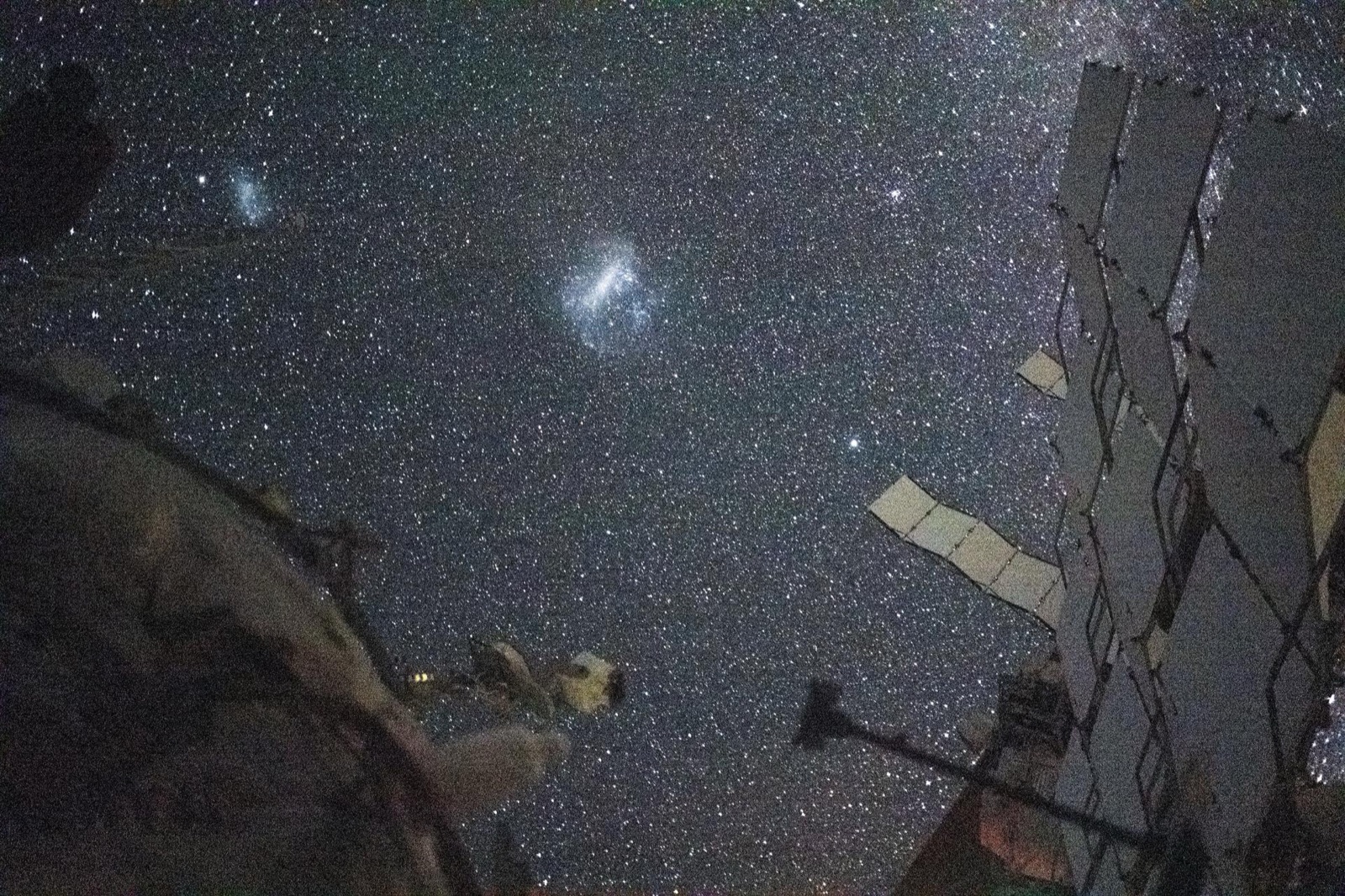
 Photograph · JSC / NASA Image Library
Galaxy · Deep guide
Large Magellanic Cloud
Also called: LMC
The Milky Way's brightest companion is a southern-sky galaxy you can see like a detached cloud.
What is it?
The Large Magellanic Cloud is the Milky Way's most prominent satellite galaxy, about 160,000 light-years away. From the southern hemisphere it hangs in the night sky like a torn-off piece of the Milky Way — clearly visible to the naked eye. Despite holding 'only' ~20 billion stars, it hosts the most vigorous star-forming region in our whole galactic neighborhood, the Tarantula Nebula.
Go deeper
The LMC (with the Small Magellanic Cloud) is likely on its first infall toward the Milky Way, trailing the huge Magellanic Stream of stripped gas. It hosted SN 1987A — the nearest supernova in four centuries, whose 19 detected neutrinos founded extragalactic neutrino astronomy and whose remnant JWST now images in detail (a long-sought neutron star finally supported by 2024 JWST spectra). The LMC anchors the cosmic distance ladder; in ~2 billion years the Milky Way will likely absorb it.
01 Magellan's clouds
Southern navigators knew them for millennia; Europe learned of them from Magellan's round-the-world voyage (1519–22), and the name stuck. The two Clouds circle the south celestial pole — from Australia, Chile, or South Africa they are as familiar as the Big Dipper is up north, and no northern traveler forgets first seeing galaxies with bare eyes.
02 The supernova next door Deeper
On February 23, 1987, a blue supergiant in the LMC exploded. Three neutrino detectors caught 19 particles three hours before the light arrived — confirming, in one night, the core-collapse theory of supernovae. SN 1987A remains astronomy's most-studied explosion: we have watched its shockwave light up rings of pre-explosion gas across four decades, and JWST finally found the neutron star hiding in the debris.
The deep dive
Researched for the Atlas from Wikipedia — Large Magellanic Cloud (10,499 characters read) · updated Sep 20, 2026
03 A galaxy sitting at a tilt
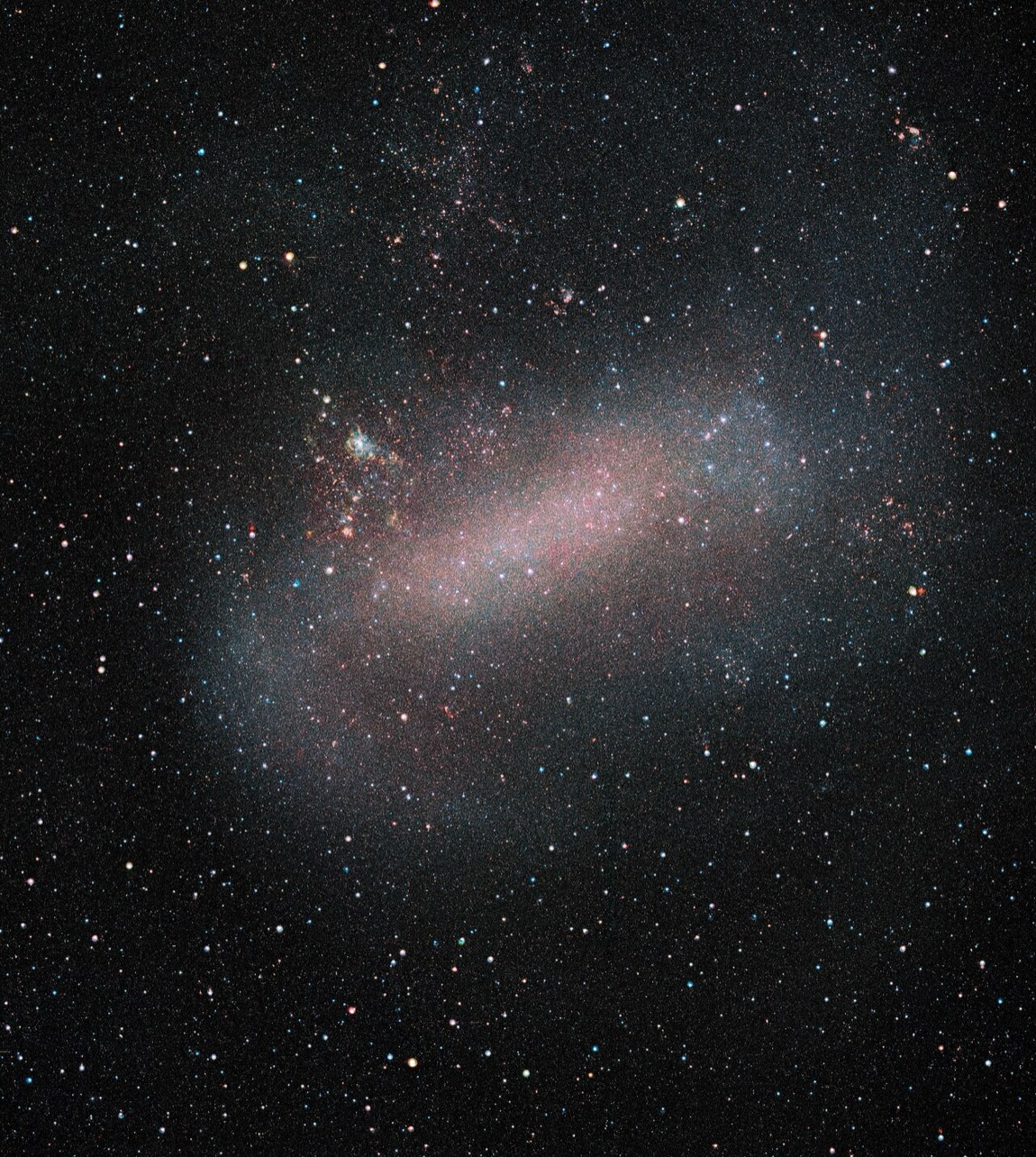
For a long time astronomers assumed the Large Magellanic Cloud lay essentially flat, like a coin facing us, so that every part of it could be treated as the same distance away. That comfortable assumption collapsed in 1986, when Caldwell and Coulson found that Cepheid variable stars in the northeastern part of the LMC are measurably closer to the Milky Way than those in the southwest. Follow-up studies between 2001 and 2002 confirmed the tilt using three independent tracers — field Cepheids again, core helium-burning red clump stars, and the luminosity tip of the red giant branch. All three methods converged on the same answer: the LMC's disk is inclined at roughly 35° to our line of sight, where a perfectly face-on galaxy would score 0°. Further work on carbon star motions revealed that this disk is not only tilted but also thick and flared at its edges — a shape astronomers attribute to the gravitational bullying it receives from its smaller companion, the Small Magellanic Cloud.
04 Pinning down the distance Deeper
Measuring how far away the LMC sits has been one of the great precision challenges of modern astronomy, because the answer calibrates distance measurements across the entire observable universe. The most widely used rulers are Cepheid variable stars, whose absolute brightness is tied to the period over which they pulse brighter and dimmer. A complication is metallicity: Cepheids in the Milky Way, which have historically been used to set the calibration, are more metal-rich than those in the LMC, and that difference likely shifts the period-luminosity relationship. In 2006 astronomers re-calibrated the Cepheid scale using stars in the galaxy Messier 106 that span a range of metallicities, arriving at an absolute distance modulus of 18.41, equivalent to 48 kiloparsecs or 160,000 light-years. A more precise result came in March 2013, published in Nature, using late-type eclipsing binary stars — systems whose geometry can be solved without any assumptions about stellar composition or mass. That study placed the LMC at 49.97 kiloparsecs (163,000 light-years) with an accuracy of 2.2%, so precise that the remaining uncertainty is actually smaller than the estimated physical size of the LMC itself.
 ⤢
⤢
05 The off-center bar and its slow spin
Running through the heart of the LMC is a prominent stellar bar — a dense elongated concentration of stars — but it sits noticeably off-center within the galaxy, a geometric quirk that hints at a turbulent past. The bar has a radius of 6,900 light-years and is oriented at a position angle of about 121°. It also appears warped: its eastern and western ends are slightly closer to the Milky Way than its middle section, as though someone gently bent a rigid rod. Astronomers think the LMC was once a more orderly barred dwarf spiral galaxy, but gravitational tugging from both the Small Magellanic Cloud and the Milky Way disrupted its spiral arms over billions of years, leaving the lopsided structure we see today. In 2014, measurements from the Hubble Space Telescope allowed astronomers to determine how long one full rotation of the LMC takes: 250 million years — coincidentally the same order of magnitude as the Milky Way's own galactic year.
06 Star clusters by the hundreds
The LMC is extraordinarily rich in the signposts of stellar life cycles. Surveys have catalogued roughly 60 globular clusters — ancient, tightly packed spheres of stars — alongside approximately 400 planetary nebulae, the glowing shells cast off by dying sun-like stars, and around 700 open clusters, the looser stellar nurseries where new stars are still being born. Hundreds of thousands of giant and supergiant stars have also been identified across the galaxy. Robert Burnham Jr. famously described the LMC as an "astronomical treasure-house, a great celestial laboratory for the study of the growth and evolution of the stars," and the inventory justifies that label. Studies of roughly 80 star clusters by Schommer and colleagues showed that the cluster system moves in a disk-like distribution consistent with the galaxy's overall rotation. Later work by Grocholski and collaborators independently calculated distances to a sample of those clusters and confirmed they inhabit the same plane as the general field-star population.
07 The Tarantula: a star factory without equal
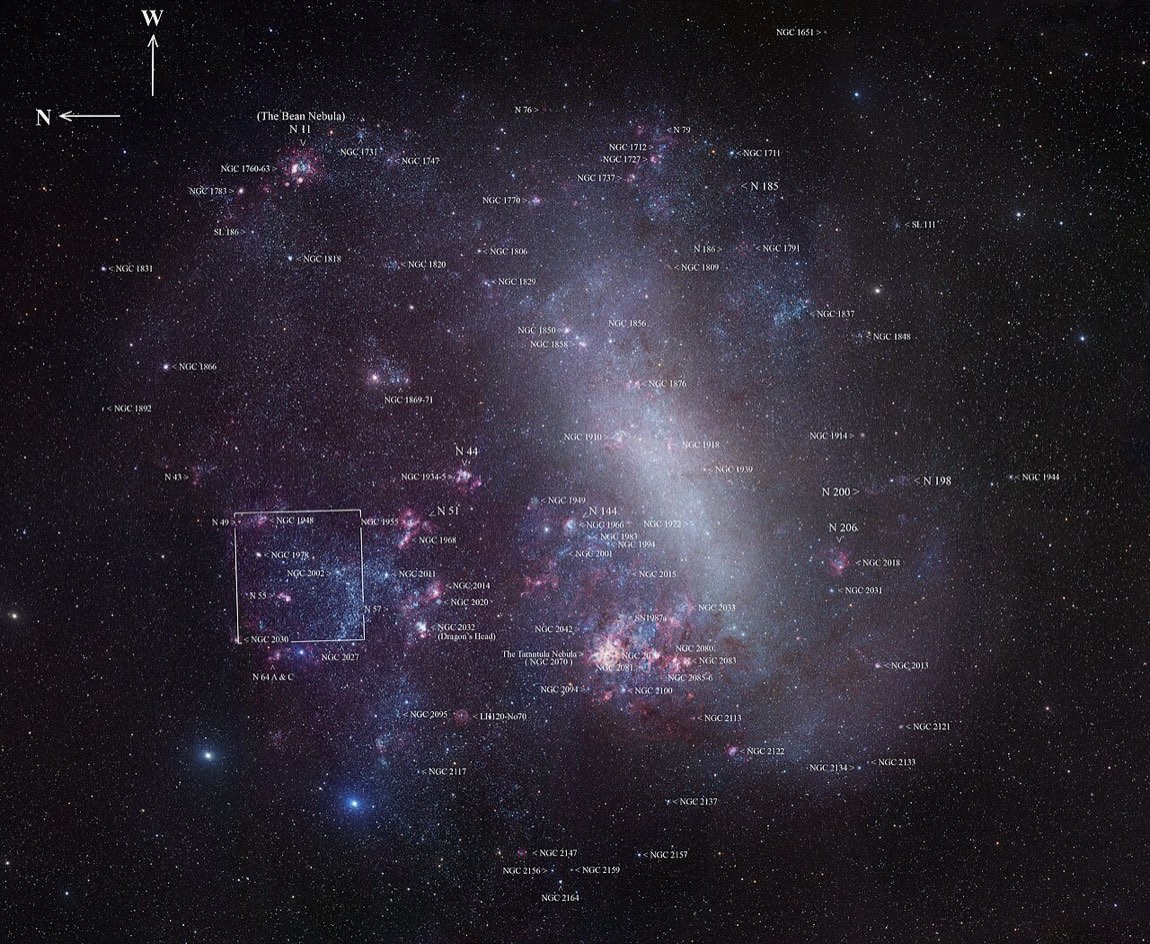
Tucked inside the LMC is the Tarantula Nebula, the most energetically active star-forming region in the entire Local Group of galaxies — a distinction that makes it one of the most intensely studied patches of sky in astronomy. Like many irregular galaxies, the LMC as a whole is rich in the raw ingredients of star formation: gas and dust in abundance, and vigorous ongoing activity throughout its disk. The Tarantula stands apart even within that fertile environment, producing massive stars at a rate that dwarfs anything in the Milky Way. A bridge of gas physically connects the LMC to the Small Magellanic Cloud, and that bridge is itself a site of active star formation, driven by the tidal forces between the two galaxies. Both clouds share a common envelope of neutral hydrogen gas, evidence that they have been gravitationally bound to each other for a very long time, mutually shaping each other's star-forming histories across billions of years.
08 Supernova remnants and what they reveal Deeper
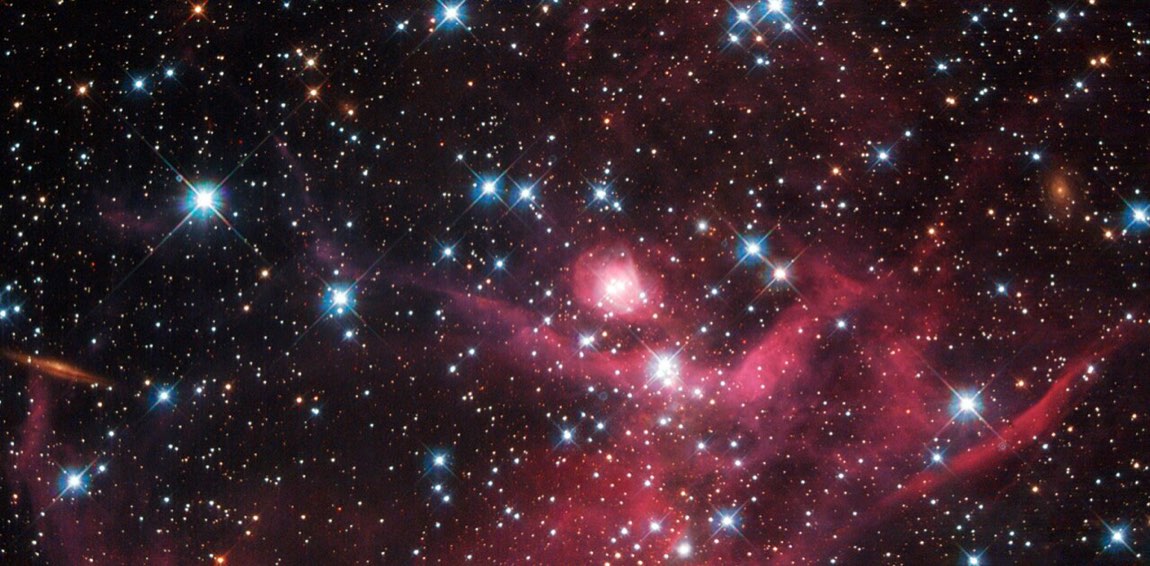
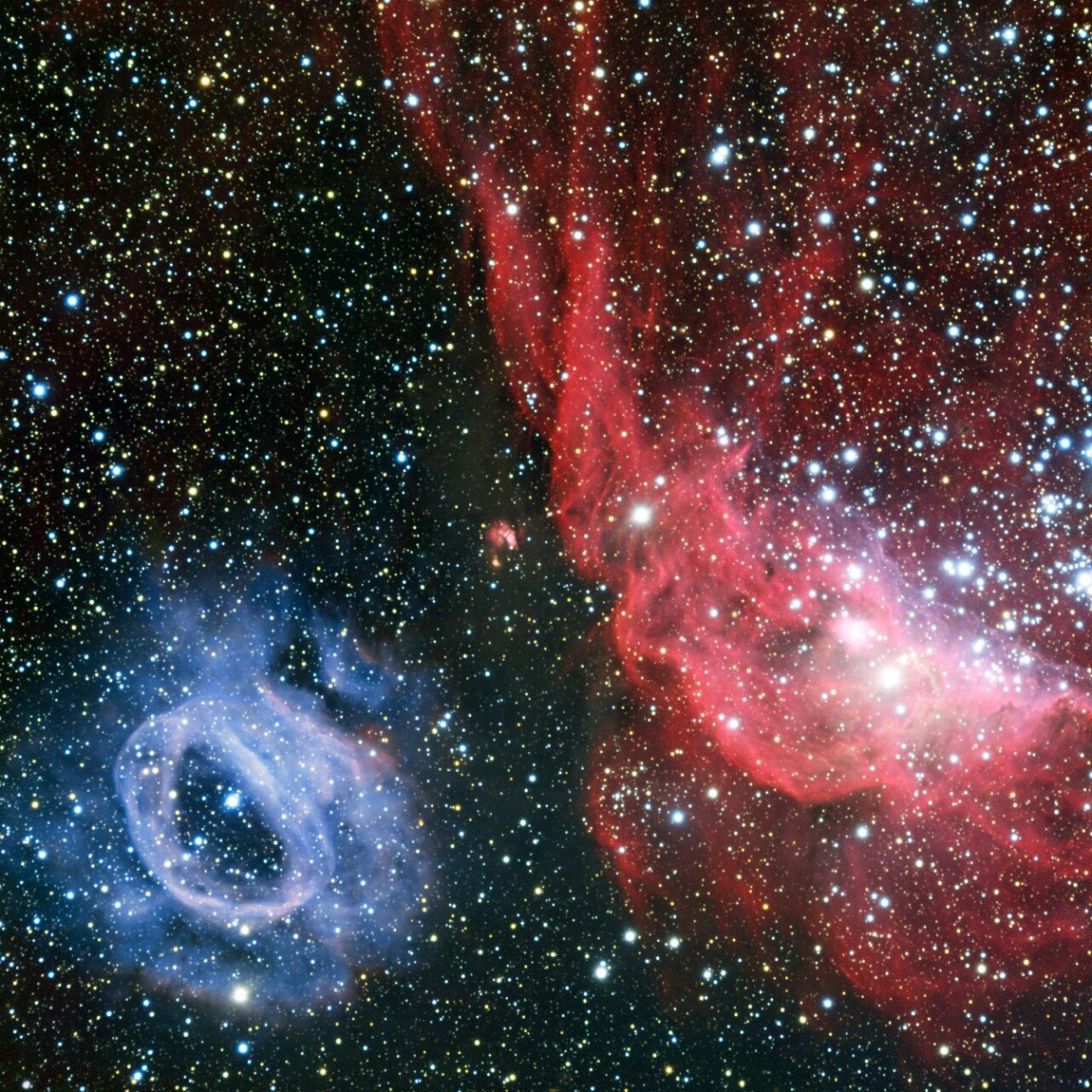
The LMC contains multiple supernova remnants that serve as natural laboratories for understanding stellar death. One striking example is DEM L316, which at first glance looks like a single structure but is in fact two separate remnants caught in the same field of view. Chandra X-ray Observatory spectra revealed a crucial difference between them: the hot gas shell on the upper left contains a high abundance of iron, the chemical fingerprint of a Type Ia supernova — the thermonuclear explosion of a white dwarf star. The lower remnant shows far less iron, marking it instead as a Type II supernova, the core-collapse death of a massive star. Another remnant, SNR 0540-697, was spatially resolved using the ROSAT X-ray telescope. A 16-millisecond X-ray pulsar — a rapidly spinning neutron star — is associated with SNR 0538-69.1. The nitrogen-rich remnant N86, officially named the Lionel-Murphy SNR, was named by astronomers at Mount Stromlo Observatory in honor of Australian High Court Justice Lionel Murphy, acknowledging both his interest in science and a perceived resemblance to his nose.
 ⤢
⤢
09 How X-ray astronomy found the LMC Deeper
The story of detecting the LMC in X-rays is a history of rocket flights and gradual discovery. On September 20, 1966, and again two days later, Nike-Tomahawk rockets searched for X-ray emission from the Magellanic Clouds and found nothing above background in the energy range of 8 to 80 keV. The second flight lifted off from Johnston Atoll at 17:13 UTC, reaching an apogee of 160 kilometers and spinning at 5.6 rotations per second for stabilization. Success came on October 29, 1968, when another rocket launched from the same atoll at 11:32 UTC detected the first discrete X-ray source in the constellation Dorado — the LMC itself. The emission extended across about 12° of sky and radiated energy at a rate of 4×10³⁸ ergs per second in the 1.5–10.5 keV band, assuming a distance of 50 kiloparsecs. A follow-up instrument aboard a Thor missile on September 24, 1970, extended observations and identified the X-ray source as containing the star ε Doradus, with a luminosity of 6×10³¹ watts across the 1.5–12 keV range.
10 X-ray binaries: stellar partnerships gone extreme Deeper
Among the LMC's most energetic residents are its X-ray binary systems, pairs of stars in which one member has collapsed into a neutron star or black hole and is actively pulling material from its companion. The first identified X-ray source in the LMC, LMC X-1 — located at right ascension 05h 40m 05s, declination −69° 45′ 51″ — belongs to the class of high-mass X-ray binaries, where the donor star is itself a heavyweight. Of the first five luminous X-ray binaries catalogued in the LMC — LMC X-1, X-2, X-3, X-4, and A 0538-66, the last of which was detected by the Ariel 5 satellite — LMC X-2 stands out as the system's brightest low-mass X-ray binary, meaning its donor star is comparatively lightweight. These systems matter well beyond the LMC itself: because the galaxy lies at a well-determined distance and suffers less obscuring dust than the plane of the Milky Way, its X-ray binaries can be studied with unusual precision, making the LMC a key calibration ground for understanding extreme stellar physics.
11 A black hole hiding in a star cluster
In November 2021, astronomers announced they had discovered a new black hole inside the LMC by studying the star cluster NGC 1850 with the European Southern Observatory's Very Large Telescope in Chile. The black hole, designated NGC 1850 BH1, gave itself away not through light but through gravity: its pull measurably perturbed the orbit of a nearby companion star estimated to have about five times the mass of the Sun. Finding a black hole this way — by watching what it does to its neighbors rather than looking for its own radiation — is a technique that becomes increasingly powerful as telescopes improve. The discovery added to a mounting picture of the LMC as a galaxy with a surprisingly rich population of extreme objects. It also foreshadowed an even larger announcement: in March 2025, the Center for Astrophysics announced strong evidence for a supermassive black hole at the LMC's center, estimated at 600,000 times the mass of the Sun, making it the second-closest supermassive black hole to Earth after the Milky Way's own Sagittarius A*.
12 Stars flung across the Milky Way
One of the most surprising connections between the LMC and the Milky Way involves stars that were violently ejected from one galaxy and found traveling through the other. Twenty-one hypervelocity stars have been discovered moving through the Milky Way's halo at extraordinary speeds, and astronomers believe they were launched from the Large Magellanic Cloud. The proposed mechanism is the Hills mechanism: a binary star system wanders too close to the supermassive black hole at the LMC's center, which is estimated to have 630,000 times the mass of the Sun, though with an uncertainty range stretching from about 250,000 to over 1,000,000 solar masses. The intense gravity of the black hole captures one star of the pair and flings the other outward at tremendous velocity. Those ejected stars then travel across the intergalactic gulf and enter the Milky Way as uninvited guests. Their trajectories, if traced backward, point toward the LMC, making them living evidence of the black hole's presence long before direct observational confirmation arrived in 2025.
 ⤢
⤢
13 Is the LMC actually orbiting us?
For decades it was taken as established fact that the Large and Small Magellanic Clouds are loyal satellites of the Milky Way, bound in long-term orbits around our galaxy just as moons orbit planets. That picture was seriously questioned in 2006 when measurements made with the Hubble Space Telescope suggested both clouds may be moving too fast to be gravitationally bound to the Milky Way on a closed orbit. If confirmed in full, this would mean the Clouds are not old companions making repeated loops around us but rather newcomers on their first close passage, or traveling on very long elliptical orbits that take them far out into intergalactic space. The finding reshapes how we interpret everything from the Magellanic Stream — the trail of gas stretching behind the clouds — to the star-forming bridge connecting the LMC to the SMC. Despite this uncertainty, the LMC is still predicted to merge with the Milky Way in approximately 2.4 billion years, suggesting that whatever its past orbit looked like, its future is tied to ours.
14 How and where to see it yourself
The Large Magellanic Cloud is one of the most rewarding naked-eye objects in the sky for anyone who can get to the right latitude. With a declination of about −70°, it is visible from the entire Southern Hemisphere and from as far north as 20° N latitude — roughly the latitude of Mexico City, Caracas, or Mumbai. From those equatorial locations, the LMC reaches opposition around December 5, meaning it is above the horizon all night near that date. South of about 28° south latitude — covering most of Australia, South Africa, New Zealand, and Argentina — the LMC never sets and is truly circumpolar, visible on any clear night of the year. It spans about 10° of sky, equivalent to 20 times the diameter of the full Moon, so from a dark site free of light pollution it appears as an obvious detached patch of the Milky Way, straddling the constellations Dorado and Mensa. No telescope or binoculars are needed to find it, though even modest optical aids begin to reveal individual star clusters and the glow of the Tarantula Nebula within it.
15 The earliest records of the cloud
The LMC has been seen by southern-sky observers since prehistoric times, but its written history is more precisely dated. A claim that the Persian astronomer Abd al-Rahman al-Sufi Shirazi — known in Europe as Azophi — described the LMC in his Book of Fixed Stars around 964 AD has circulated widely, with his reference being to something called Al Bakr, the White Ox. Scholars now consider this attribution a misunderstanding: al-Sufi's text actually referred to some stars lying south of the star Canopus, a region he admitted he had not personally observed. The first confirmed recorded observation in writing comes from a letter dated 1502, written by the Italian explorer Amerigo Vespucci following his second voyage to the Southern Hemisphere. Vespucci described seeing "three Canopi, two bright and one obscure" — the two bright objects being the Large and Small Magellanic Clouds, and the obscure one being the Coalsack dark nebula. Ferdinand Magellan then observed the LMC during his circumnavigation voyage of 1519, and his widely read accounts brought the cloud into mainstream European awareness, eventually attaching his name to it permanently.
 ⤢
⤢
Could life exist here?
Billions of stars, vigorous chemistry — same honest unknown.
Our labels: Confirmed · Strong Evidence · Estimated · Hypothesis · Theoretical · Speculative (see Methodology).
Weird & wonderful
- The Tarantula Nebula is so bright that at the Orion Nebula's distance it would cast shadows at night.
- The LMC's gravity measurably bends the outer Milky Way.
- Some of its stars will end up orbiting inside our galaxy — galactic immigration in progress.