Moon · Deep guide · orbits 225088 Gonggong
Xiangliu
Also called: Gonggong I
Gonggong's moon, discovered years after the fact in archived Hubble pictures.
What is it?
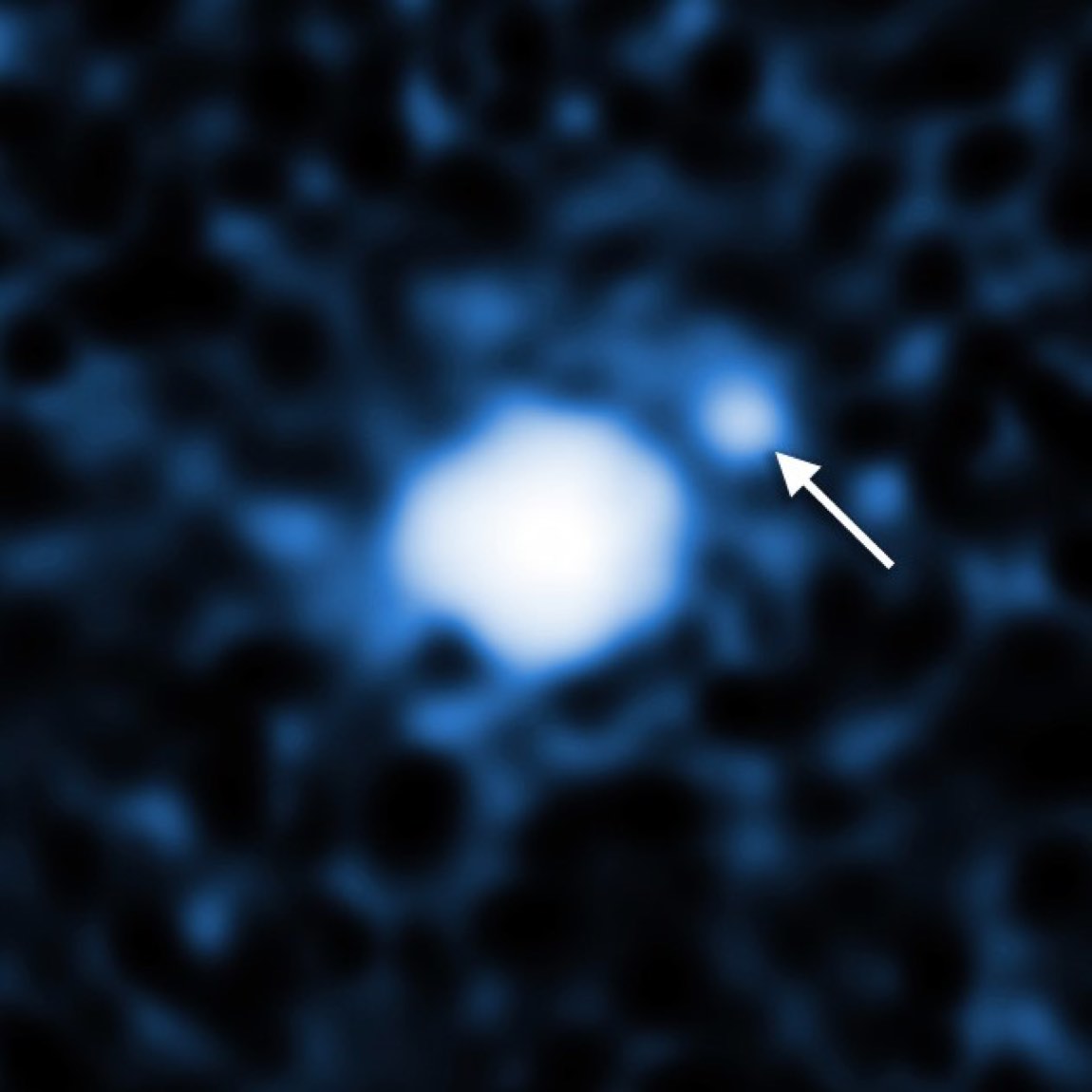
Xiangliu was identified in archived Hubble Space Telescope images from September 2010, and its discovery was announced in 2016 by Gábor Marton, Csaba Kiss and Thomas Müller. It is thought to be less than 100 km across and follows a noticeably elongated orbit around Gonggong, about 24,000 km out, taking roughly 25 days. It is named after the nine-headed serpent of Chinese mythology who served the water god Gonggong.
The deep dive
Researched for the Atlas from Wikipedia — Xiangliu (moon) (4,810 characters read) · updated Nov 15, 2026
01 Found hiding in decade-old photos
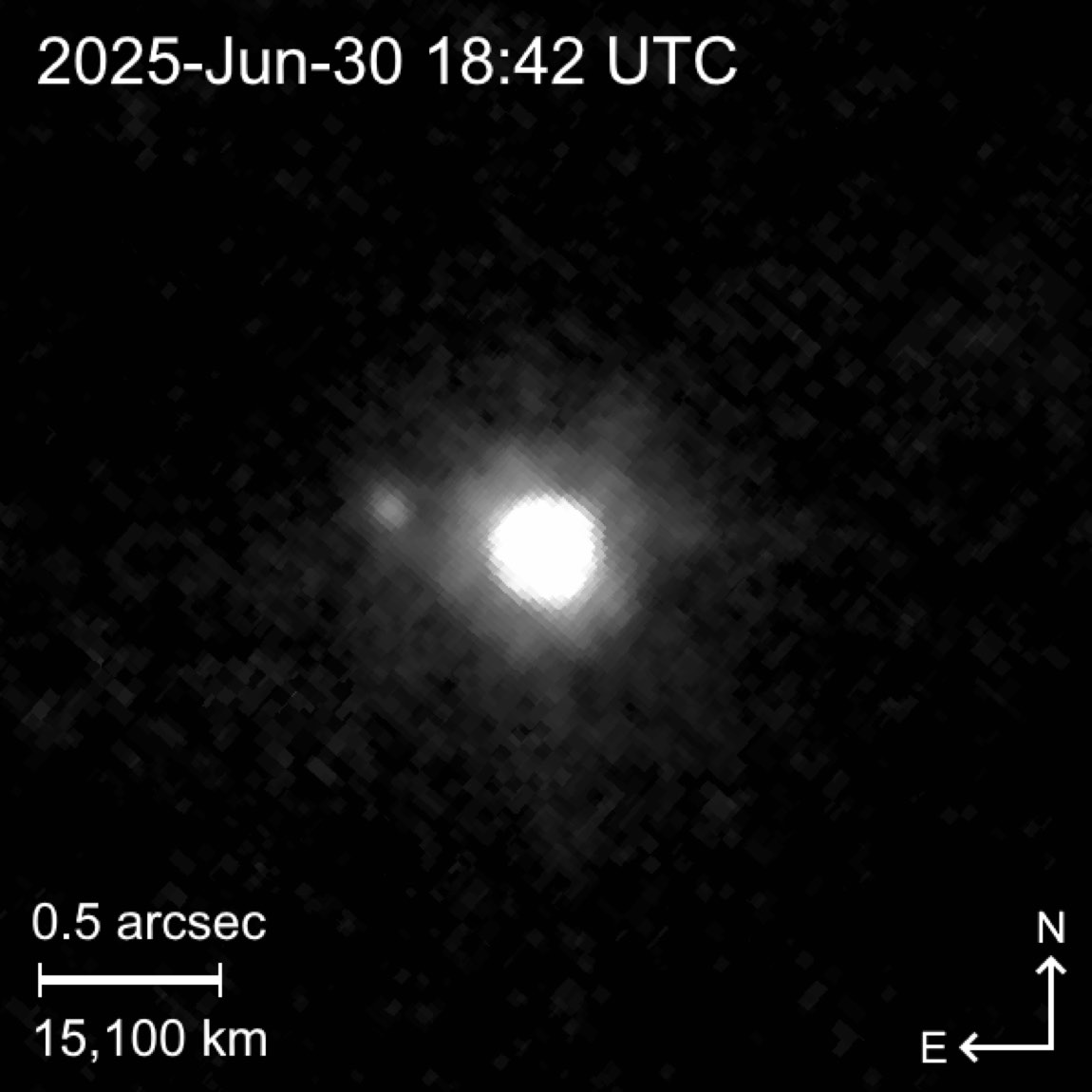
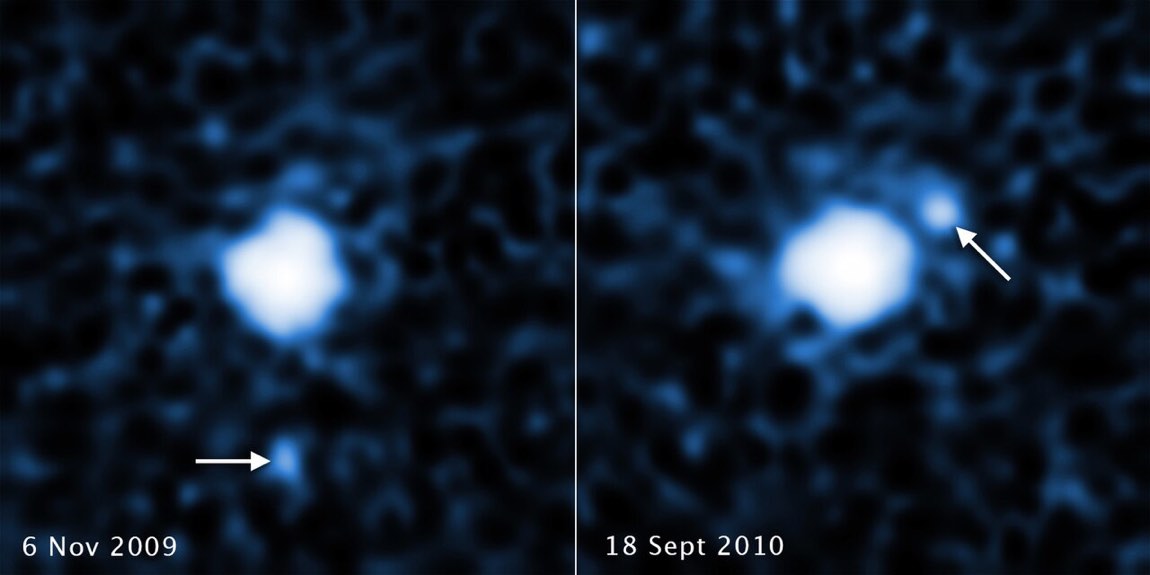
Xiangliu was not spotted through a telescope pointed deliberately at the sky but rescued from images that had been sitting in an archive for years. When astronomers noticed in early 2016 that Gonggong rotates unusually slowly, they suspected a moon might be responsible — tidal friction between a planet and a satellite is a well-known brake on spin. That suspicion sent Csaba Kiss and colleagues back through archival Hubble Space Telescope observations. Digging into Wide Field Camera 3 images taken on 18 September 2010, they found a faint speck orbiting at least 15,000 km from Gonggong. The formal announcement came at the 48th Meeting of the Division for Planetary Sciences on 17 October 2016. Even better, the team subsequently traced the moon back to even earlier Hubble frames taken on 9 November 2009, giving them a longer baseline of observations to begin pinning down its orbit. The discoverers were Gábor Marton, Csaba Kiss, and Thomas Müller.
02 A monster's name from Chinese myth
The name Xiangliu comes from Chinese mythology, where the creature is described as a nine-headed venomous snake monster who served as the chief minister of the water god Gonggong. In the old stories, Xiangliu is associated with flooding and destruction — a fittingly dramatic pedigree for a moon of the outer Solar System. The choice was no accident. When the discovery team first proposed names for Gonggong itself and invited a public vote, they were already thinking ahead: they deliberately selected mythological figures whose entourages could later provide names for any satellites that turned up. That strategy paid off when Xiangliu was confirmed. The naming privilege belonged to the discovery team led by Csaba Kiss. Both names, Gonggong and Xiangliu, were reviewed and approved by the International Astronomical Union's Committee on Small Body Nomenclature, with the Minor Planet Center announcing both simultaneously on 5 February 2020.
03 An orbit that took years to pin down Deeper
With only two sets of Hubble images from 2009 and 2010, the discovery team could initially say only that Xiangliu's orbital period fell somewhere between 20 and 100 days — a wide range that left the dynamics of the system poorly constrained. Additional Hubble observations carried out in 2017 sharpened the picture considerably. Under the best-fit prograde solution, Xiangliu circles Gonggong every 25.22 days at an average distance of 24,021 km, roughly sixty times the distance from Earth to the Moon scaled down to fit this tiny system. The orbit is steeply tilted, inclined about 83 degrees to the ecliptic. If Xiangliu orbits close to Gonggong's equatorial plane — a reasonable assumption — this steep inclination implies that we are viewing Gonggong nearly pole-on from Earth. One important ambiguity remains: because observations cover only a small arc of Gonggong's long journey around the Sun, astronomers cannot yet determine whether the orbit is prograde or retrograde.
04 Why the orbit is so stretched out Deeper
Xiangliu's orbit is strikingly elongated, with an eccentricity of about 0.29. For comparison, an eccentricity of zero would be a perfect circle; Mars, considered an eccentric planet in our solar system, has an eccentricity of only 0.09. Three explanations are on the table. The orbit may simply have formed eccentric and never had time to relax. Alternatively, tidal evolution may have been operating, but so slowly — on a timescale comparable to the roughly 4.5-billion-year age of the Solar System — that circularization is still incomplete. A third possibility is the Kozai mechanism, a gravitational resonance that can pump up orbital eccentricity over time. In Xiangliu's case, the Kozai effect could be driven either by the distant gravitational tug of the Sun or by subtle variations in Gonggong's own gravitational field caused by Gonggong's oblate shape. Distinguishing among these scenarios requires better data on both the orbit and Gonggong's interior structure.
05 Size: smaller than first thought
Estimating the size of a moon so far away and so faint is genuinely difficult. At the time Xiangliu was first announced, its diameter was put at about 237 km — a figure derived by assuming it reflected sunlight at the same rate as Gonggong itself. That assumption turned out to be questionable. A tighter constraint emerged from the eccentricity argument: to maintain an orbital eccentricity of 0.29 over billions of years, Xiangliu must be small enough that tidal forces remain weak — specifically, less than 100 km in diameter. That size limit implies an albedo greater than 0.2, meaning it reflects more than a fifth of the sunlight that hits it. To put 100 km in perspective, that is roughly the driving distance across the state of Tennessee. The moon is therefore probably a compact, icy body, though its exact shape and surface texture remain unknown.
 ⤢
06 Xiangliu is surprisingly less red Deeper
One of the most puzzling findings from the 2017 Hubble observations concerns color. Photometric measurements showed that Xiangliu is 4.59 magnitudes fainter than Gonggong, yielding an estimated absolute magnitude of 6.93 ± 0.15, while Gonggong itself has an absolute magnitude of 2.34. More striking than the brightness difference is the color difference. Astronomers measure color using the V–I index, which compares brightness in visual and infrared wavelengths. Gonggong has a V–I value of 1.65 ± 0.03, making it quite red — a hallmark of many outer Solar System bodies whose surfaces are coated with complex organic compounds called tholins. Xiangliu, by contrast, has a V–I of only 1.22 ± 0.17, significantly less red. The difference, ΔV–I = 0.43 ± 0.17, is among the largest color contrasts observed for any known trans-Neptunian satellite pair. This is unusual: most moons of trans-Neptunian objects share similar colors to their parent bodies, suggesting a shared origin. What makes Xiangliu's surface different remains an open question.
07 Tidal locking and a slowed-down world
Xiangliu is thought to be tidally locked to Gonggong, meaning one face of the moon permanently points toward the dwarf planet, just as one face of our Moon always faces Earth. The relationship runs even deeper, however, because it was Gonggong's unusually slow spin that led astronomers to suspect a moon existed in the first place. When Gonggong was found in March 2016 to rotate sluggishly, researchers proposed that tidal interactions with a satellite could have gradually stolen angular momentum from the dwarf planet and transferred it outward, slowing the spin over billions of years. This reasoning turned the slow rotation from a curiosity into a detective's clue. The idea that Xiangliu may also contribute to maintaining Gonggong's highly eccentric solar orbit — either through ongoing tidal interactions or through the Kozai mechanism — means this small moon may be quietly sculpting its host's place in the Solar System in multiple ways simultaneously.
08 How Xiangliu earned a formal designation
When the discovery of Xiangliu was announced in October 2016, the satellite was not immediately given a provisional designation — an unusual situation in modern planetary science, where new objects are typically catalogued quickly. The formal designation that eventually emerged is (225088) Gonggong I, following the convention for naming moons of numbered minor planets, where the Roman numeral I simply indicates it is the first confirmed satellite of object number 225088. The official names Gonggong and Xiangliu were approved together by the International Astronomical Union's Committee on Small Body Nomenclature and announced by the Minor Planet Center on 5 February 2020 — roughly a decade after the images in which Xiangliu was hiding were originally taken by the Hubble Space Telescope.
09 Open questions still waiting for answers Deeper
Despite the progress made with Hubble, Xiangliu leaves several fundamental questions unanswered. The direction of its orbit — prograde or retrograde — cannot yet be determined because available observations cover only a small arc of Gonggong's roughly 550-year journey around the Sun; different portions of that long orbit would allow the geometry to be resolved more cleanly. The true diameter remains bounded only by an upper limit of less than 100 km, with no firm lower bound established. The cause of the pronounced color difference between Gonggong and Xiangliu is unexplained; impact gardening, different internal compositions exposed by a giant impact, or differential processing of surface ices by radiation are all possibilities the article does not rule in or out. The relative contributions of tidal friction, the Kozai mechanism, and Gonggong's oblateness to the orbital eccentricity also remain undetermined. Each of these questions would likely benefit from a dedicated spacecraft mission or future large-telescope observations.
 ⤢