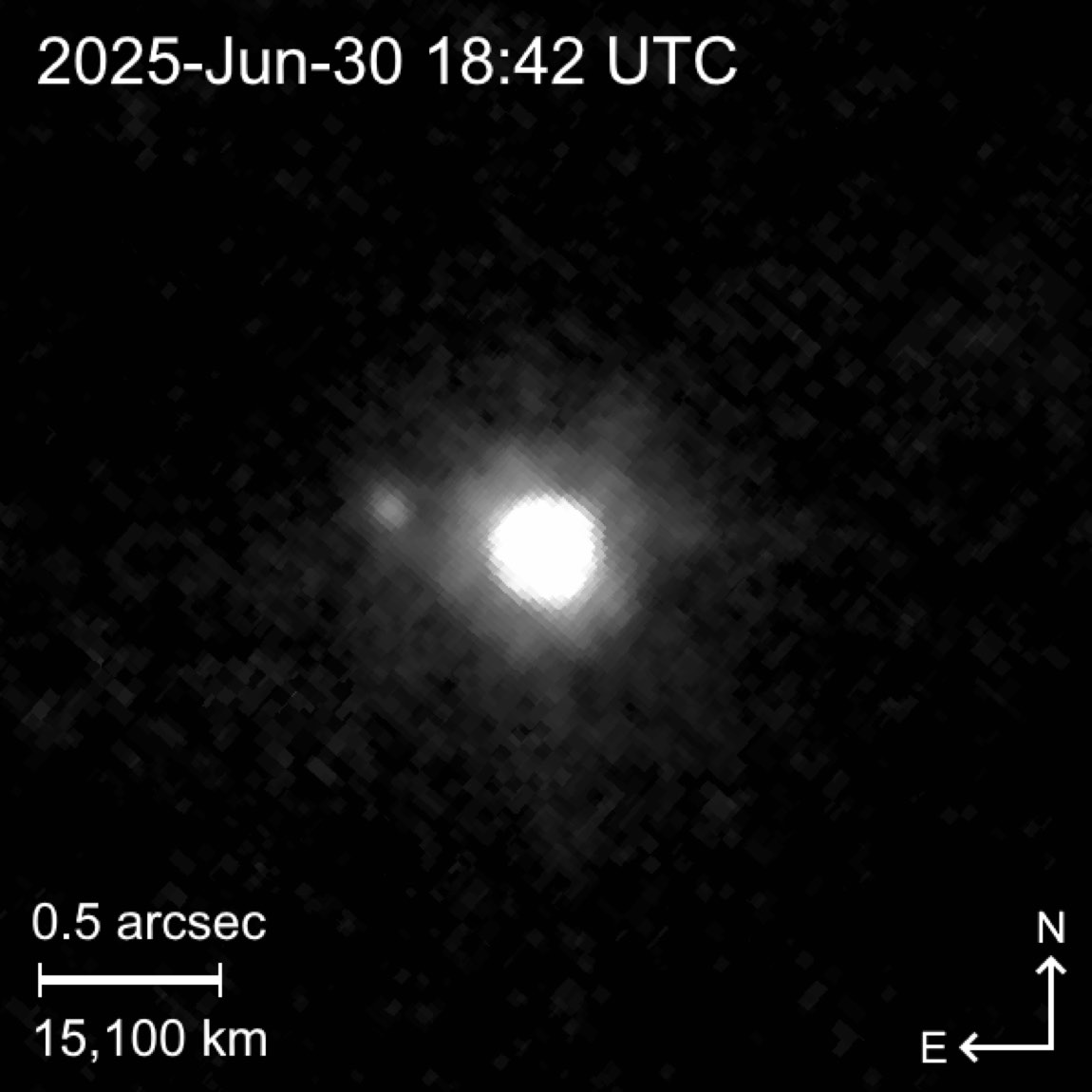
 Photograph · Processing by Nrco0e ; images taken by Estela Fernandez-Valenzuela with Hubble S · CC BY 4.0
Moon · Deep guide · orbits 50000 Quaoar
Weywot
Also called: Quaoar I
Quaoar's dark little moon, whose resonances help keep the dwarf planet's strange rings narrow.
What is it?
Weywot was discovered in February 2006 by Michael Brown and Terry-Ann Suer in Hubble Space Telescope images. It is about 146 km across, one of the darkest known moons beyond Neptune, and orbits Quaoar every 12.4 days. Quaoar has two narrow rings, and their edges line up with orbital resonances with Weywot, which are thought to help confine them. It is named after the Tongva sky god, a son of Quaoar.
The deep dive
Researched for the Atlas from Wikipedia — Weywot (7,522 characters read) · updated Nov 15, 2026
01 How Weywot Was Found and Confirmed
Weywot's discovery unfolded in stages across nearly four years. Michael Brown was conducting a systematic Hubble survey for satellites around large trans-Neptunian objects when, on 14 February 2006, the Advanced Camera for Surveys captured consecutive images showing a faint point of light sitting 0.35 arcseconds away from Quaoar — stationary relative to it, a telltale sign of a bound companion. Brown and his colleague Terry-Ann Suer did not formally announce the find until 22 February 2007, reporting it to the Central Bureau for Astronomical Telegrams alongside three other newly found TNO satellites: Vanth, Tinia, and the unnamed moon of 208996 Achlys. To nail down Weywot's orbit, Brown returned to Hubble in March 2007 and again in March 2008. Even so, the orbit remained ambiguous for years, with limited data hinting at a highly eccentric path that could be either prograde or retrograde. The ambiguity was not fully resolved until a fortuitous stellar occultation observed from Namibia on 4 August 2019 pinpointed Weywot's position precisely enough to confirm a prograde, nearly circular 12.4-day orbit. Notably, attempts to find Weywot in earlier ultraviolet Hubble images from 2002 failed — the moon was either hidden behind Quaoar or simply too faint in ultraviolet light.
02 Occultations: Watching Weywot Cross a Star
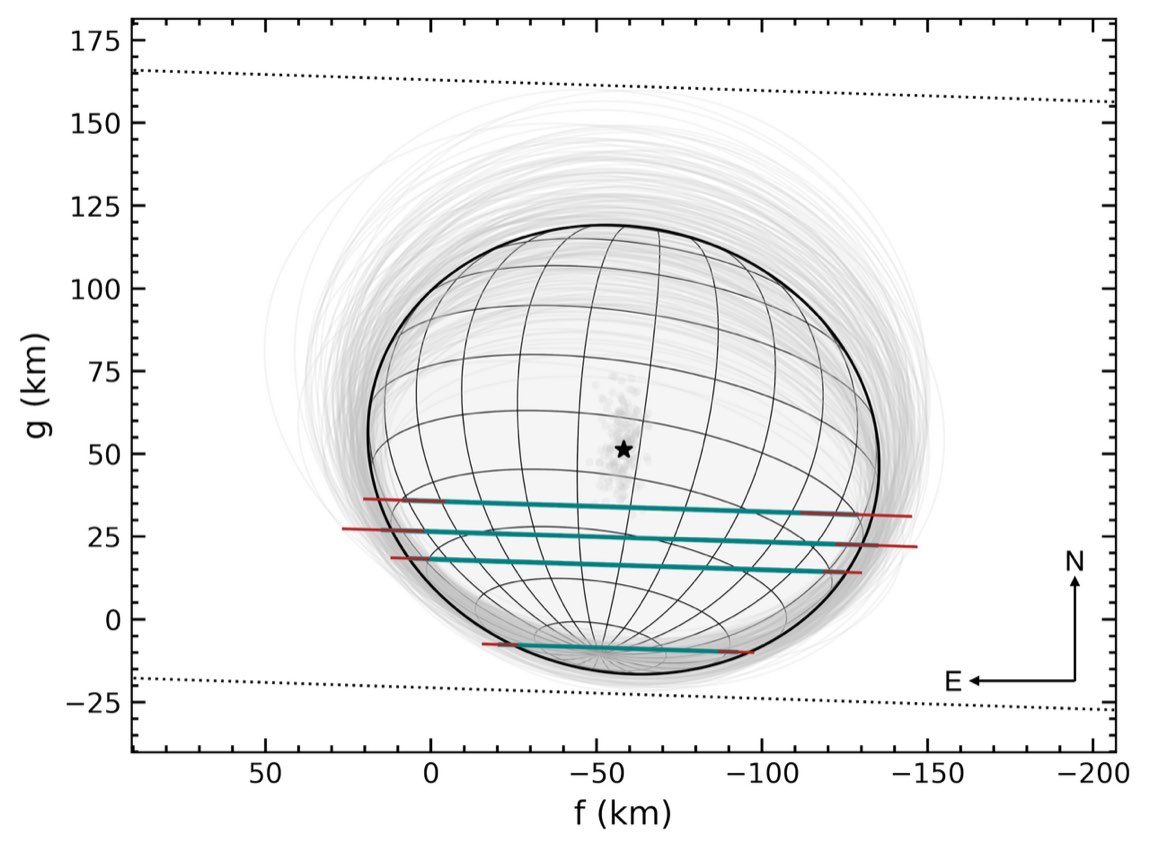
Stellar occultations — moments when a solar system body passes in front of a background star, briefly snuffing it out — have become the sharpest tool for measuring Weywot. As of 2026, four successful occultations have been observed. The first, on 4 August 2019, was caught by astronomers in Namibia who were not specifically hunting for it; the event revealed that Weywot was both larger and darker than prevailing estimates had suggested. The most scientifically valuable event so far came on 22 June 2023, when Weywot was observed occulting a star from multiple different locations simultaneously. Having several geographically separated chords through the shadow allowed astronomers to reconstruct Weywot's cross-sectional shape with real accuracy, and to pin down its albedo. This multi-chord campaign confirmed the elongated, flattened form that later Hubble imaging from 2023 to 2025 also supported. Those same Hubble sessions improved predictions for future occultations and provided independent confirmation that Weywot rotates in a tidally locked fashion — always showing the same face toward Quaoar.
03 A Name Chosen by the Tongva People
When Weywot's discovery was announced in February 2007, the moon received no provisional designation — an unusual step. Michael Brown had earlier named Quaoar itself after the creator-god of the Tongva, the Indigenous people of the Los Angeles Basin, and he deliberately left the choice of a name for the moon to the Tongva community themselves. The Tongva selected Weywot, their sky god and the son of Quaoar in their mythology, making the mythological relationship between parent and satellite literally mirror the physical one. The Minor Planet Center made the name official in a notice published on 4 October 2009 — more than three years after the discovery images were taken. The pairing of Quaoar and Weywot as parent body and moon therefore carries a rare cultural coherence: both names come from the same living tradition, chosen by its own community rather than assigned by astronomers working from an external mythology. This practice of consulting the source community was notably different from the more common approach of astronomers selecting names unilaterally from mythological catalogues.
04 Weywot's Lumpy, Non-Equilibrium Shape Deeper
The dimensions reconstructed from stellar occultations and Hubble imaging reveal a triaxial ellipsoid roughly 164 km × 146 km × 130 km (102 mi × 91 mi × 81 mi), with a mean diameter of 146 ± 10 km. That elongated, flattened profile is physically significant: a body that had flowed into hydrostatic equilibrium under tidal forces from Quaoar would look different — more smoothly distorted in a predictable way. Weywot's actual shape does not match that prediction, which tells scientists that the interior must have enough mechanical strength to resist flowing. The leading interpretation is that Weywot is a rubble pile — a loose aggregate of rock and ice held together by gravity rather than any solid cohesion, but still rigid enough over geological time to preserve a lumpy, non-equilibrium form. Because it is tidally locked, Weywot's elongated axis is presumably pointed toward Quaoar, and Earth-based observers watch the moon rotate its long axis in and out of view over each 12.4-day orbital cycle, producing a brightness fluctuation with a peak-to-trough amplitude of 0.119 ± 0.036 magnitudes.
05 An Extremely Dark and Icy Surface
With a geometric albedo of only 0.036, Weywot reflects roughly 3.6 percent of incoming sunlight — making it about 3.6 times darker than its parent Quaoar, which itself is not especially bright. For comparison, fresh asphalt reflects around 4 percent of light, so Weywot's surface sits in roughly that range. This places it among the darkest known moons beyond Neptune. Paradoxically, preliminary observations by the James Webb Space Telescope have shown that this very dark surface is actually rich in water ice, classifying Weywot as an H2O-type trans-Neptunian object. H2O-type TNOs are understood to have "mature" surfaces that have been extensively processed by space weathering — bombardment by cosmic rays and energetic particles over billions of years — which darkens and reddens water ice rather than leaving it bright white. Dysnomia, the moon of Eris, and Vanth, the moon of Orcus, share similarly low albedos despite orbiting brighter parent bodies, suggesting these dark moons of large TNOs may share a common formation and evolutionary pathway with relatively lower water-ice mass fractions locked into their bulk composition.
06 Mass, Density, and What They Reveal Deeper
Because Weywot is massive enough to cause Quaoar to wobble slightly, astronomers can apply gravitational physics to measure the moon's mass directly. Stellar occultations and Hubble imaging that detected this wobble yielded a mass of (1.485 ± 0.360) × 10¹⁸ kg — roughly 1.5 quintillion kilograms, which sounds enormous but represents only 0.12% ± 0.03% of Quaoar's own mass. Combining that mass with the volume implied by Weywot's dimensions gives a bulk density of 0.95 ± 0.60 g/cm³. The uncertainty on that density figure is large, spanning values from about 0.35 to 1.55 g/cm³, so it must be read cautiously. The central value of 0.95 g/cm³ is very close to the density of water (1.0 g/cm³), and theoretical models predict that small, icy outer solar system bodies should have densities around 0.7 g/cm³. This is consistent with Weywot being dominated by water ice with some admixture of rock — which also aligns with the JWST spectroscopic detection of water ice on its surface.
07 Weywot's Orbit in Precise Detail Deeper
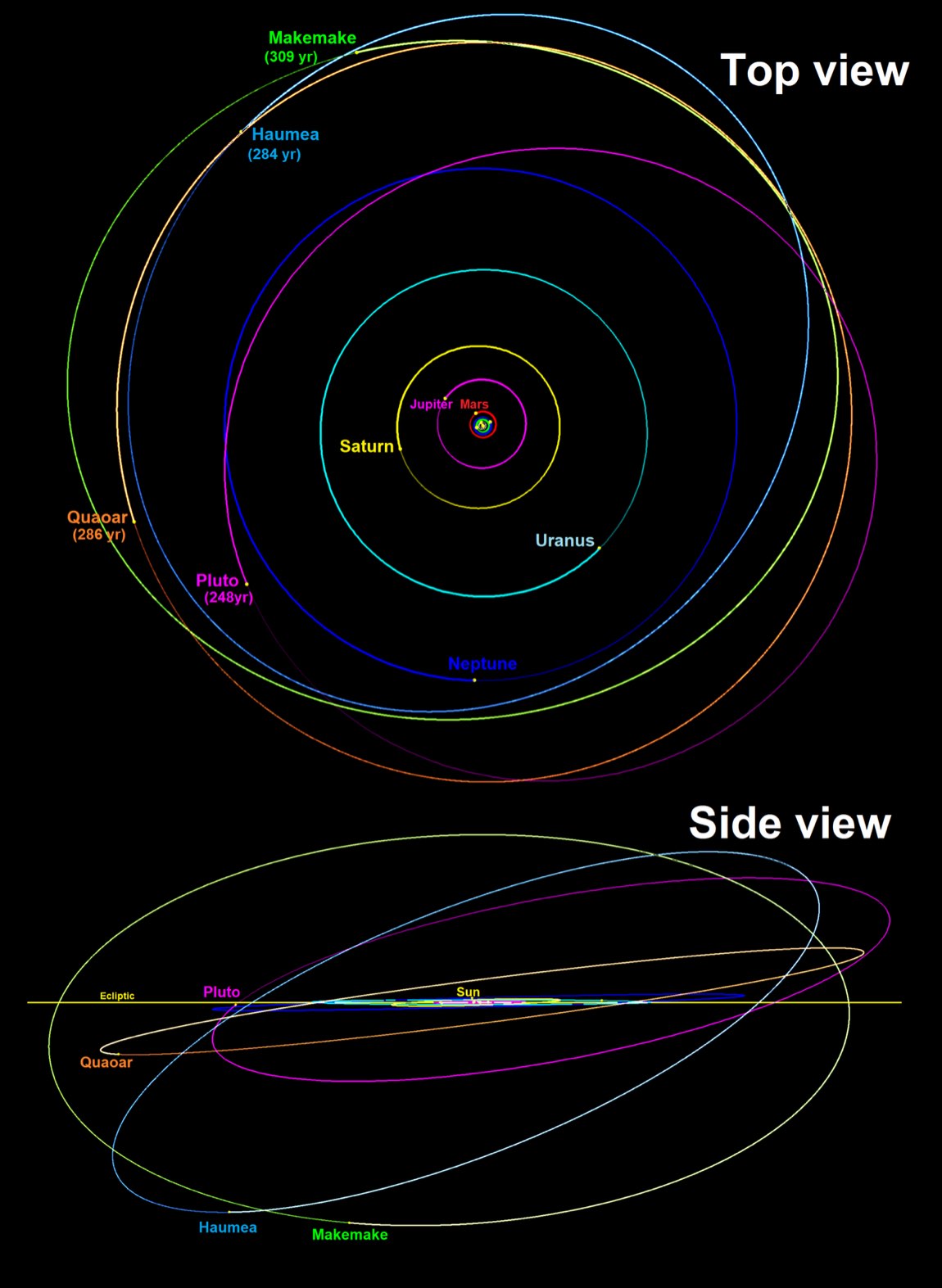
Weywot circles Quaoar at an average distance of 13,300 km — close enough that if you placed Quaoar where Earth sits, Weywot would orbit inside the Moon's distance by a wide margin. The orbit is nearly circular, with an eccentricity of approximately 0.01, and is tilted about 6° relative to the plane of Quaoar's rings, which are assumed to also mark Quaoar's equatorial plane. The orbit is not static: it undergoes apsidal precession at a rate of 0.48 +0.24/−0.21 degrees per year, meaning the direction of the orbit's closest approach slowly rotates, and nodal precession at −0.49 +0.21/−0.24 degrees per year, meaning the tilt of the orbit plane slowly swings around Quaoar's pole. These precession rates carry information about the distribution of mass inside Quaoar, particularly any equatorial bulge, and will help constrain interior models as measurements improve. The small but non-zero inclination of Weywot's orbit relative to the ring plane is also dynamically interesting because it could drive vertical waves through the rings.
08 How Weywot Shapes Quaoar's Rings
Quaoar possesses two narrow rings, designated Q1R and Q2R, orbiting at distances of approximately 4,100 km and 2,530 km from the dwarf planet respectively. Both rings happen to sit very close to mean-motion orbital resonances with Weywot — locations where a ring particle completes a simple integer ratio of orbits for every one orbit Weywot completes. The inner edge of Q1R aligns with Weywot's 6:1 resonance at 4,035 km, meaning ring particles there orbit exactly six times for every single orbit of Weywot. The outer edge of Q2R aligns with the much weaker 12:1 resonance at 2,543 km. These gravitational nudges, combined with spin-orbit resonances involving Quaoar's own rotation, are believed to work together to keep the rings narrow rather than spreading out. Weywot's slight orbital inclination adds another layer: a tilted moon can excite vertical bending waves in a ring, which may prevent ring material from clumping together into a satellite. The overall picture is of Weywot acting as a distant gravitational shepherd, helping to structure the ring system through resonance.
09 A Possible Inner Moon and Resonance Chain Deeper
In June 2025, researchers tentatively identified a possible inner moon of Quaoar orbiting closer in than Weywot. If confirmed, Weywot would be predicted to sit in a 2:7 mean-motion resonance with this inner body — meaning Weywot completes two orbits for every seven of the inner moon's. This kind of resonance is not merely a coincidence; it represents an ongoing gravitational conversation between the two moons. Weywot's influence, even at that resonant relationship, is predicted to gradually raise the inner moon's orbital eccentricity and tilt its orbital plane slightly. As of the article's information, this inner moon has not been confirmed, so the resonance relationship and its consequences remain speculative but scientifically motivated. If the inner moon is real, the Quaoar system would become one of the more structurally complex small-body systems in the outer solar system, with two moons and two rings all gravitationally interacting through a web of resonances.
10 The Mystery of Quaoar's Slow Spin
One open puzzle in the Quaoar system directly involves Weywot's limitations. In most moon-planet systems, tidal friction transfers angular momentum from the planet's spin to the moon's orbit over time, gradually slowing the planet's rotation. Weywot's tidal influence on Quaoar has been calculated, and the result is clear: Weywot's tides are far too weak to have been responsible for whatever slow rotation period Quaoar currently has. The implication is that something else must have set Quaoar's spin to its present-day value — perhaps a large ancient collision, a different dynamical history, or the cumulative effect of some other process not yet identified. This is listed as an open question in the scientific literature, meaning no consensus explanation currently exists. The mismatch between Weywot's tidal capacity and Quaoar's observed spin rate makes the broader system an interesting case study in how small moons and their parent bodies co-evolve, or in this case, fail to fully do so.
11 Why Only Hubble and JWST Can See It
Weywot has an apparent magnitude of about 24.5 in visible light — roughly 170 times fainter than Quaoar, a difference of about 5.6 magnitudes. To put that in everyday terms, the magnitude gap between Quaoar and Weywot is comparable to the gap between a moderately bright star visible to the naked eye and something utterly invisible without a telescope. Detecting a 24.5-magnitude object is already at the edge of what most large ground-based telescopes can do, but the challenge is compounded by the fact that Weywot sits only 0.35 arcseconds from Quaoar as seen from Earth — the width of a human hair held about 25 metres away. Separating Weywot's faint signal from Quaoar's glare at that tiny angular distance requires both exceptional light-gathering power and the sharpest possible angular resolution. That combination is why all confirmed imaging of Weywot has required the Hubble Space Telescope, and why the James Webb Space Telescope has now also joined the effort for spectroscopic work.
12 Tidal Locking and What It Means
The confirmation that Weywot is tidally locked to Quaoar — always keeping the same face pointed toward the dwarf planet as it orbits — came from matching the period of its brightness variations exactly to its 12.4-day orbital period. As Weywot's elongated shape turns in space, observers on Earth see alternately more and less of its longer axis, causing predictable brightening and dimming. If Weywot were spinning freely at some other rate, the brightness period and orbital period would not match; the fact that they do is the observational fingerprint of tidal locking. Theory independently predicted that Weywot should reach tidal lock within 150 million years of its formation, so the confirmed locking is consistent with the moon having existed for a substantial fraction of the solar system's history. Tidal locking also implies that one side of Weywot permanently faces the harsh radiation and micrometeorite environment of open space, while the other basks in the relatively warmer influence of Quaoar — a dichotomy that could, in principle, produce subtle differences in surface chemistry between the two hemispheres.
 ⤢