Dwarf Planet · Deep guide
225088 Gonggong
Also called: 225088 Gonggong · (225088) Gonggong · 2007 OR10
A large, deep-red world on a steeply tilted orbit, named after a Chinese water god.
What is it?
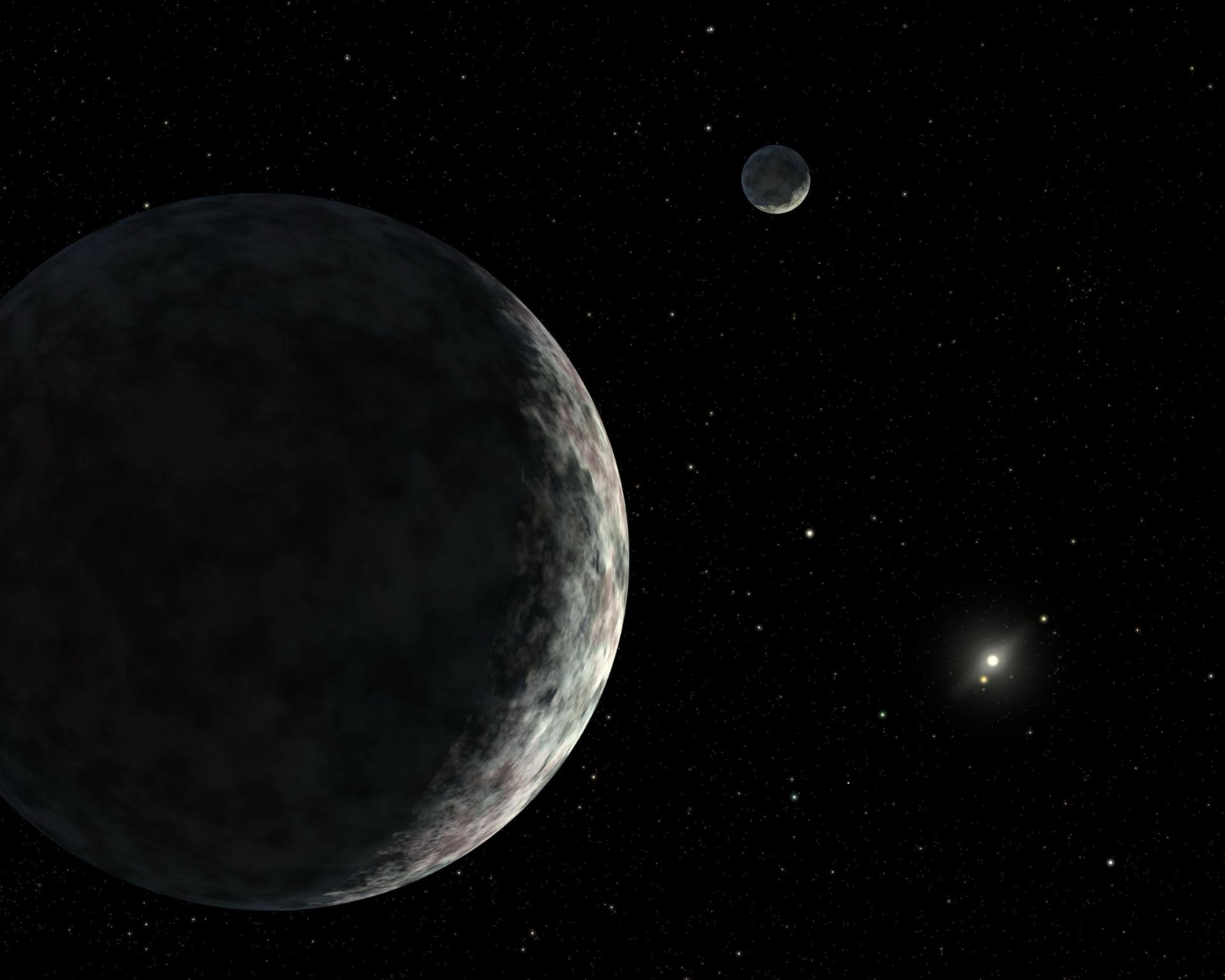
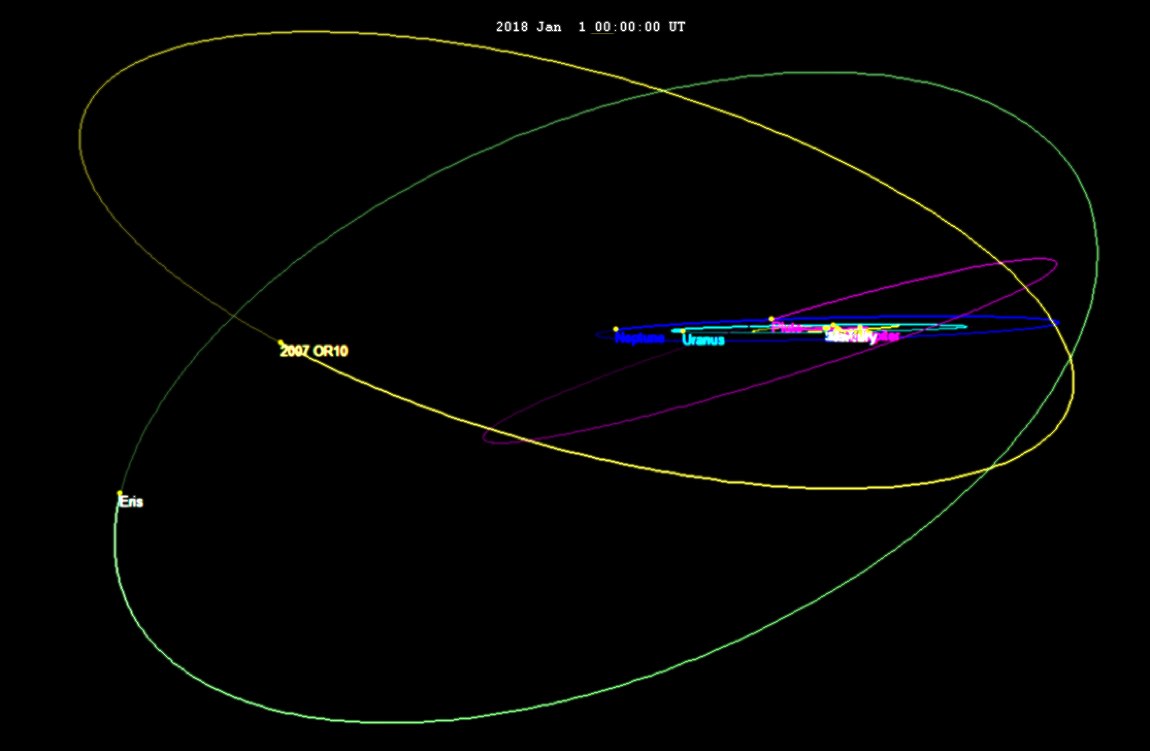
Gonggong is an icy body about 1,230 km across — similar in size to Pluto's moon Charon — in the scattered disc beyond Neptune. Its orbit is tilted about 31° and very stretched, taking about 547 years. It has a moon, Xiangliu, and may be massive enough to hold a thin methane atmosphere. It is considered a strong dwarf-planet candidate, but has not been officially recognized by the IAU. Its name was chosen through a public online vote in 2019.
The deep dive
Researched for the Atlas from Wikipedia — Gonggong (dwarf planet) (20,289 characters read) · updated Nov 14, 2026
01 Discovered by a Graduate Student Blinking Images
Gonggong was found on 17 July 2007 by Megan Schwamb, Michael Brown, and David Rabinowitz as part of the Palomar Distant Solar System Survey, which used the Samuel Oschin telescope at Palomar Observatory near San Diego, California. The survey was specifically designed to find distant objects in the region of Sedna, beyond 50 AU from the Sun, and was capable of detecting movement out to at least 1,000 AU. Schwamb — then a graduate student working on her doctoral thesis under Michael Brown at Caltech — identified Gonggong by using the blinking technique, which involves rapidly alternating between two images of the same patch of sky taken at different times so that moving objects stand out against the fixed stars. In the discovery images, Gonggong moved so slowly across the sky that its great distance was immediately apparent. The discovery was formally announced in a Minor Planet Electronic Circular on 7 January 2009, and Gonggong received the provisional designation 2007 OR10, indicating it was the 267th object discovered in the second half of July 2007. The Minor Planet Center assigned it the number 225088 on 2 November 2009.
02 A Name Chosen by 280,000 Public Votes
Before receiving its official name, Gonggong spent years as the largest unnamed object in the Solar System. Michael Brown had initially nicknamed it "Snow White," assuming it would turn out pale and icy like members of the Haumea collisional family — but the object proved to be strikingly red, so the nickname was dropped. Brown held off on naming it for years, considering it unremarkable despite its size. In 2011 he changed his mind after water ice and possible methane were detected on its surface, and in 2016 the Kepler spacecraft's larger size estimate further convinced the team it deserved a formal name. In 2019 the discoverers ran a public online poll offering three choices drawn from creation-related mythologies: Gonggong (Chinese), Holle (German), and Vili (Norse). All three were connected to water, ice, snow, and red — matching the object's character — and each had an associated companion figure who could later lend a name to the satellite. Gonggong won with 46 percent of 280,000 votes cast. The International Astronomical Union's Committee on Small Body Nomenclature accepted the proposal, and the name was officially announced by the Minor Planet Center on 5 February 2020.
03 The Myth Behind the Name
The dwarf planet's name comes from Gònggōng, a water god in Chinese mythology depicted as having a copper-and-iron, red-haired human head — sometimes a torso — attached to the body or tail of a serpent. In the myths, Gonggong was an agent of chaos and catastrophe, causing devastating floods and, most dramatically, tilting the Earth itself before being sent into exile. His minister was Xiangliu, a nine-headed poisonous snake monster who shared his master's destructive tendencies and was likewise associated with floods. The choice of name fits the object on multiple levels: its deep red color echoes Gonggong's red hair, its surface chemistry connects it to water, and its orbit — steeply tilted at 30.9 degrees to the ecliptic — echoes the mythological tilting of the Earth. The satellite was subsequently named Xiangliu, following IAU tradition of naming moons after mythological associates of the body they orbit. Gonggong's Unicode symbol, U+1F77D, was designed by Massachusetts software engineer Denis Moskowitz and combines the Chinese character 共 with a snake's tail.
04 An Extreme Orbit Among Dwarf Planets Deeper
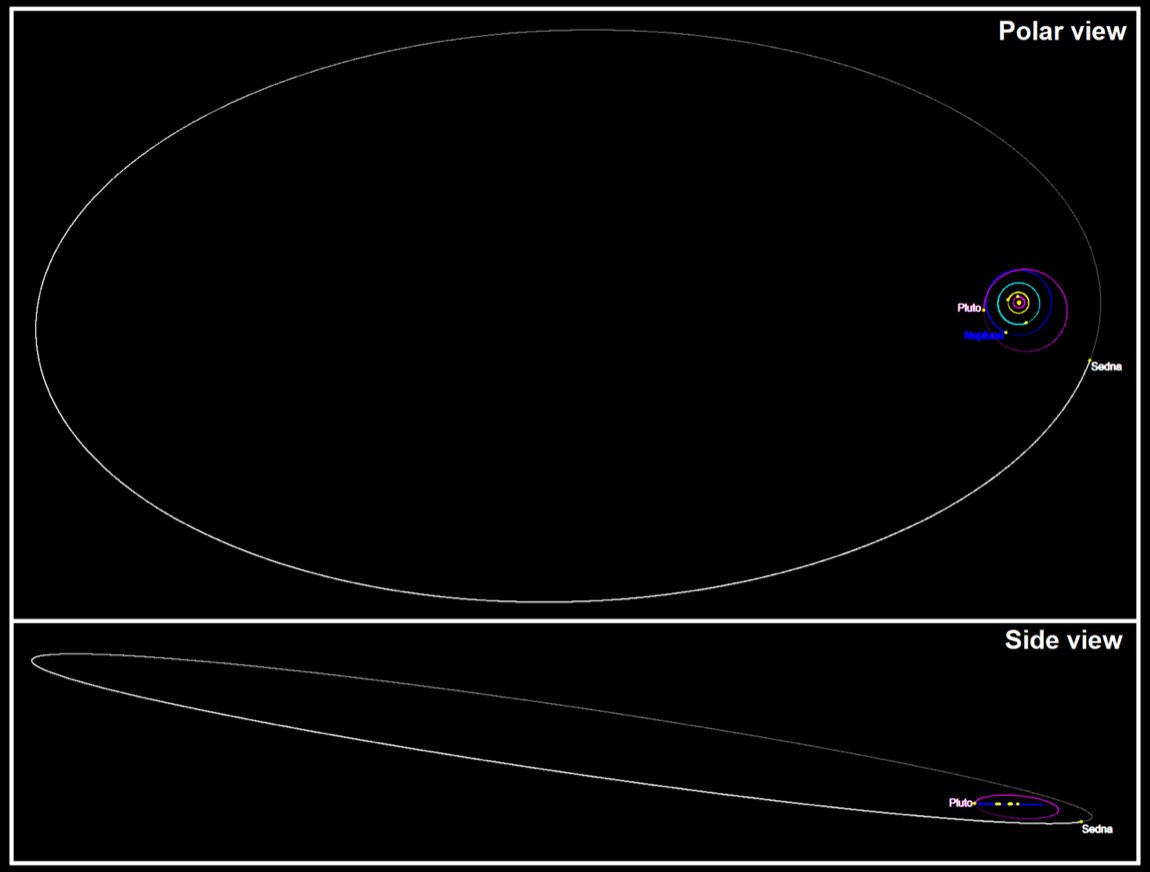
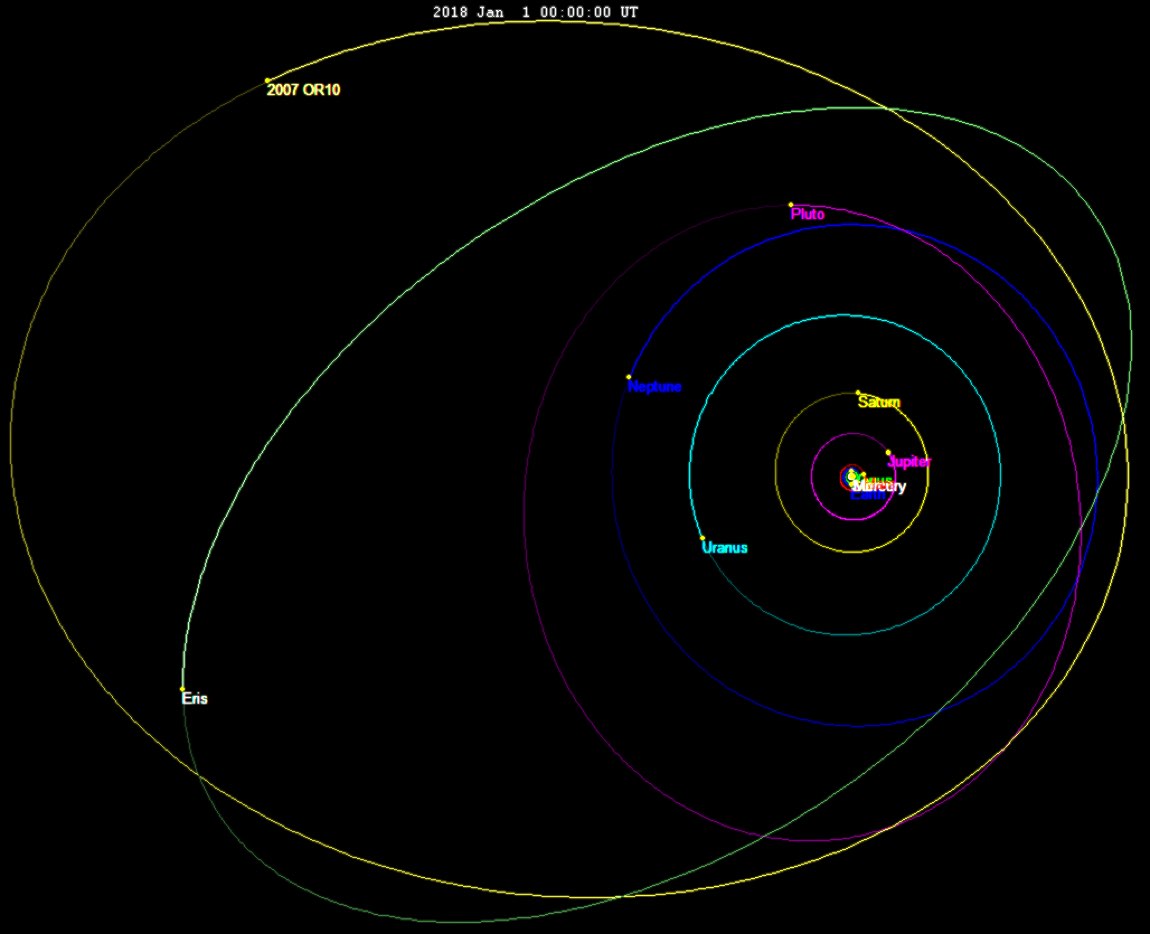
Gonggong's orbit stands out even among the already-unusual population of distant dwarf planets. Its orbital eccentricity of 0.50 means its distance from the Sun swings between 33.2 AU at perihelion — roughly the distance of Neptune — and 100.6 AU at aphelion, a range comparable to traveling from Neptune to well beyond Pluto. Its orbital period of 547 years is the third-longest among likely dwarf planets, behind only Eris at 561 years and the extreme case of Sedna at approximately 11,400 years. Its inclination of 30.9 degrees to the ecliptic is second only to Eris among dwarf planets. Gonggong last reached perihelion in 1857 and will reach aphelion in 2130, meaning the entire recorded history of modern astronomy has watched it only during its outbound journey. The Deep Ecliptic Survey finds it locked in a 3:10 mean-motion resonance with Neptune: Gonggong completes exactly three orbits for every ten Neptune completes, a gravitational relationship that stabilizes its otherwise chaotic-seeming path. As of 2021, it was receding from the Sun at 1.1 kilometers per second — about 2,500 miles per hour.
05 How Its True Size Was Finally Pinned Down Deeper
Measuring Gonggong's diameter proved surprisingly difficult and produced wildly different answers over a decade. In 2010, astronomer Gonzalo Tancredi estimated 1,752 km — which would have ranked it among the largest trans-Neptunian objects — but this lacked lightcurve data or reliable albedo information. A Herschel Space Observatory survey in 2012 gave 1,280 ± 210 km. Combined Herschel and Spitzer Space Telescope data in 2013 suggested a smaller and less certain 1,142 km with an uncertainty range spanning hundreds of kilometers. Then in 2016, Kepler spacecraft observations as part of the K2 mission produced a startling upward revision to 1,535 km, which at the time would have made Gonggong the third-largest trans-Neptunian object — larger than Makemake. This large estimate implied an improbably low density of only 0.92 g/cm³. The resolution came in 2018 when analysis of the satellite Xiangliu's orbit yielded a precise mass, and investigators also realized they had been viewing Gonggong nearly pole-on rather than equator-on, which had distorted the Kepler light-curve interpretation. Combining mass, density, and corrected geometry, the current best estimate settled at 1,230 ± 50 km, restoring Gonggong to fifth place among trans-Neptunian objects.
06 Interior Structure and Density Clues Deeper
The orbital motion of Gonggong's satellite Xiangliu has allowed scientists to calculate the dwarf planet's mass precisely at 1.75 × 10²¹ kg — slightly heavier than Pluto's moon Charon, which masses 1.586 × 10²¹ kg. Combined with the revised diameter estimate, this yields a density of 1.74 ± 0.16 g/cm³, also slightly higher than Charon's 1.702 g/cm³. This density is consistent with a body composed of a mixture of rock and ice, denser than pure ice (roughly 1 g/cm³) but far less dense than solid rock. The combination of Gonggong's large mass and density strongly suggests it has achieved hydrostatic equilibrium, meaning gravity has pulled it into a rounded shape — specifically what scientists call a Maclaurin spheroid, a slightly oblate ellipsoid flattened by its own rotation. Its expected oblateness is low: approximately 0.03 if the rotation period is 22.4 hours, or just 0.007 if 44.81 hours is the true period. Gonggong ranks as the fifth most massive trans-Neptunian object overall, behind Eris, Pluto, Haumea, and Makemake.
 ⤢
07 A Moon That Slowed a World's Spin
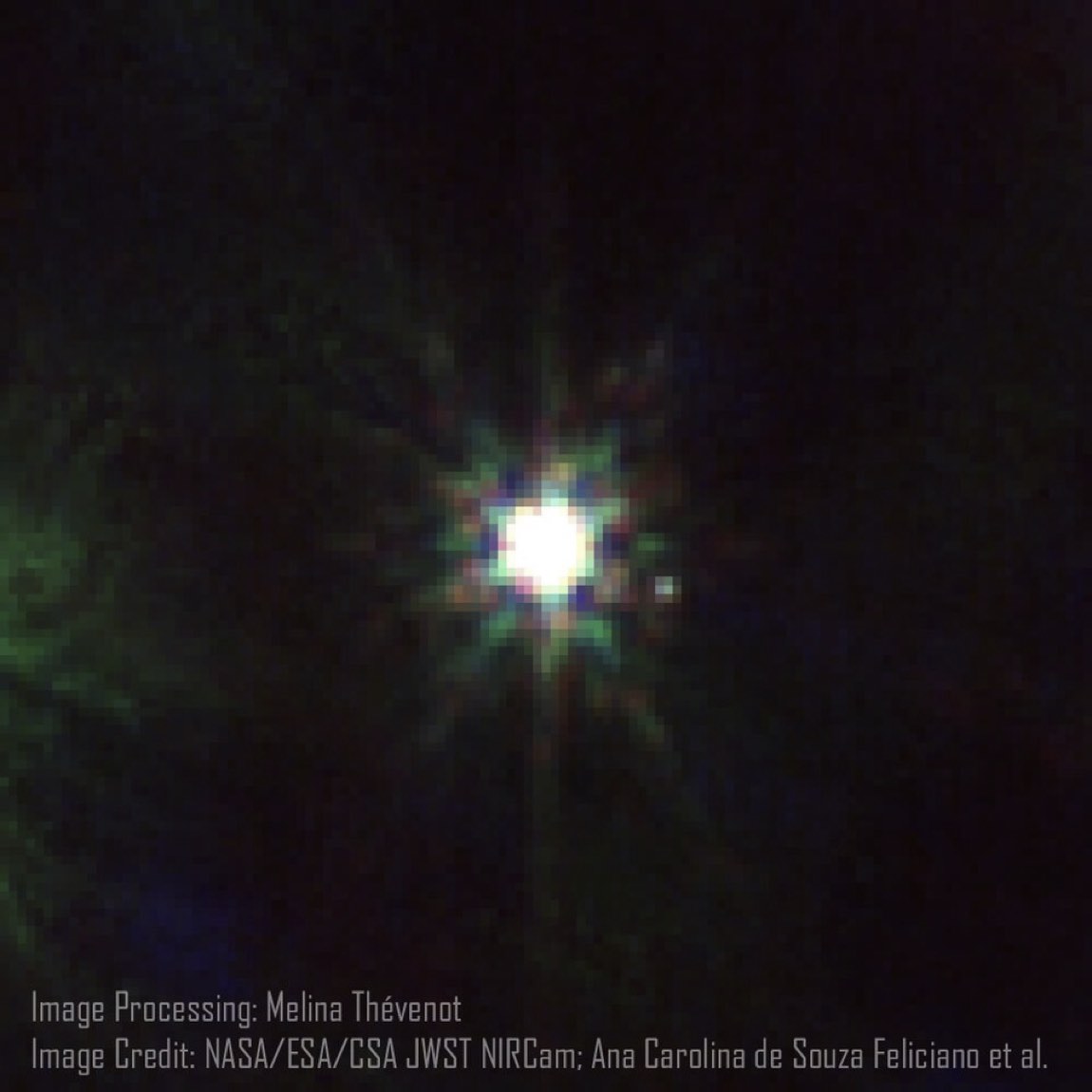
The existence of Gonggong's satellite Xiangliu was suspected before it was actually seen. When Kepler measured Gonggong's rotation period as approximately 22.4 hours in early 2016, astronomers immediately noticed this was unusually slow — most trans-Neptunian objects spin with periods between 6 and 12 hours — and suspected tidal braking from an unseen moon might be responsible. This prompted Csaba Kiss and colleagues to search through archival Hubble Space Telescope images. They found Xiangliu hiding in observations taken on 18 September 2010 as a faint dot orbiting Gonggong at a separation of at least 15,000 km — roughly the distance from New York to Sydney and back three times. The discovery was announced at a Division for Planetary Sciences meeting on 17 October 2016. Xiangliu is approximately 100 km in diameter and completes one orbit around Gonggong every 25 days. The satellite was officially named on 5 February 2020, simultaneously with the naming of Gonggong itself, taking its name from the nine-headed serpent monster that accompanied Gonggong in Chinese mythology.
08 Red Surface Chemistry: Tholins, Ice, and Ethane Deeper
Gonggong's surface hosts a surprisingly complex chemical inventory. Its striking red color — among the reddest of all trans-Neptunian objects, particularly at visible and near-infrared wavelengths — is attributed to tholins, reddish organic compounds produced when solar radiation and cosmic rays break down methane through photolysis. The reflectance spectrum first measured in 2011 with the FIRE spectrograph on the Magellan Baade Telescope at Las Campanas Observatory in Chile showed broad absorption bands at 1.5 μm and 2 μm characteristic of water ice, confirmed by Hubble's Wide Field Camera 3. A 2015 near-infrared observation detected an absorption feature at 2.27 μm pointing to methanol and its irradiation products. Then in 2022, the James Webb Space Telescope delivered low-resolution spectroscopy across 0.7–5 μm and found significant amounts of ethane ice (C₂H₆) on the surface, though apparently less than on Sedna. JWST also found evidence of small amounts of carbon dioxide complexed with dark surface material or ices, plus complex organics. Crucially, JWST found no evidence of methane or methanol — apparently contradicting the earlier detections — leaving the precise surface composition an active area of debate.
09 Precovery: Finding It Decades Before Discovery
Although Gonggong was not recognized until 2007, astronomers have since traced it back through decades of archival telescope images in a process called precovery. As of September 2025, it has been observed a total of 484 times across 23 oppositions — the annual windows when Earth is positioned between the Sun and the outer Solar System, providing the best viewing geometry. The earliest confirmed precovery image was taken by the La Silla Observatory in Chile on 19 August 1985, more than two decades before the official discovery. These archival sightings are scientifically valuable because they greatly extend the arc of orbital measurements, allowing astronomers to calculate Gonggong's path around the Sun with far greater precision than the 2007 discovery images alone would permit. The longer the documented observation arc, the tighter the constraints on parameters like eccentricity, inclination, and the exact timing of past and future perihelion passages — all of which feed into models of its possible atmosphere, surface temperature history, and resonance with Neptune.
10 Faint, Red, and Just Beyond Naked-Eye Reach
Even for dedicated amateur astronomers, Gonggong is a challenging target. At approximately 88–90 AU from the Sun, its apparent magnitude is only 21.5 — roughly 25,000 times fainter than the dimmest stars visible to the unaided eye. A large telescope with sensitive digital imaging is required just to detect it as a point of light. Its absolute magnitude — a measure of intrinsic brightness — is 2.34, making it the seventh-brightest trans-Neptunian object by that measure, though the Minor Planet Center and Jet Propulsion Laboratory databases favor a brighter value of 1.84 that would rank it fifth. Interestingly, despite being closer to the Sun than Eris, Gonggong appears considerably dimmer in our sky: Eris has an apparent magnitude of 18.8 because its surface is far more reflective. Gonggong's albedo, or reflectivity, is only 0.14 — meaning it absorbs 86 percent of the sunlight that strikes it, returning just 14 percent to space. This dark, red surface makes it intrinsically harder to spot than its size alone would suggest.
11 What a Mission to Gonggong Would Require
No spacecraft has ever visited Gonggong, and the engineering challenge of doing so is formidable. Planetary scientist Amanda Zangari calculated that a flyby mission using current rocket capabilities would require a minimum of over 20 years of travel time. The most favorable trajectory identified involves using Jupiter's gravity as a slingshot — a technique proven on missions like Voyager and New Horizons — which could reduce the journey to just under 25 years if launched in 2030 or 2031. When such a spacecraft finally arrived, Gonggong would be approximately 95 AU from the Sun, nearly a hundred times Earth's distance. At that range, a radio signal traveling at the speed of light would take over 13 hours to reach Earth — meaning any flyby science would be conducted entirely autonomously, with results trickling back over days. The sheer duration and distance involved places a Gonggong mission in the same category of ambition as a hypothetical Sedna mission, requiring advances in propulsion, power systems, and onboard autonomy that do not yet exist in operational form.
12 Open Questions That Remain Unanswered Deeper
Despite years of observation, Gonggong leaves astronomers with several unresolved puzzles. The contradiction between earlier spectroscopic detections of methanol and methane and the 2022 JWST findings — which found neither — illustrates how difficult remote characterization of such faint, distant surfaces can be, and which dataset is correct remains uncertain. Gonggong's exact rotation period is itself still ambiguous: Kepler produced values of both 44.81 ± 0.37 hours and 22.4 ± 0.18 hours, with the shorter period considered more plausible based on modeling but not definitively confirmed. Whether Gonggong is truly in hydrostatic equilibrium — a requirement for formal dwarf planet classification — cannot be directly observed at its distance, and the case of Iapetus, which is not in equilibrium despite being larger at 1,470 km, shows that size alone is no guarantee. The nature and extent of any present-day methane atmosphere, the precise mechanism by which cryovolcanism deposited water ice on the surface in the past, and the formation history of the Gonggong–Xiangliu binary system all remain open to investigation, ideally by a future spacecraft.
 ⤢