Moon · Deep guide · orbits 90482 Orcus
Vanth
Also called: Orcus I
A big, dark moon about half the size of Orcus, its parent world.
What is it?
Vanth was discovered by Michael Brown and Terry-Ann Suer in Hubble Space Telescope images taken in November 2005. At about 443 km across it is roughly half the size of Orcus, making the pair close to a double system. Vanth circles Orcus every 9.5 days at about 9,000 km, and its surface is dark. It is named after the winged Etruscan spirit who guides souls to the underworld, a name first suggested by writer Sonya Taaffe.
The deep dive
Researched for the Atlas from Wikipedia — Vanth (moon) (13,416 characters read) · updated Nov 15, 2026
01 How Vanth Was Found and Announced
Vanth's discovery began with a single Hubble Space Telescope image taken on 13 November 2005, as part of Michael Brown's systematic survey for satellites around large trans-Neptunian objects using Hubble's Advanced Camera for Surveys. The survey itself wrapped up in late 2006, and it was not until 22 February 2007 that Brown and his colleague Terry-Ann Suer formally reported the find to the Central Bureau for Astronomical Telegrams — the announcement came bundled with three other newly discovered trans-Neptunian satellites at the same time, so Vanth was not exactly a headline act on the day the world learned it existed. After the initial detection, Brown kept pointing Hubble at the Orcus–Vanth system during October through December 2006 and again November through December 2007, building up enough observations to properly pin down the moon's orbit. The gap between the discovery image and the public announcement — more than a year — reflects just how methodical large TNO surveys must be before results are ready for formal reporting.
02 A Name Chosen by the Internet
Vanth entered public awareness in a genuinely unusual way. Before it was named, the moon had no provisional designation at all — an oddity in itself. On 23 March 2009, Michael Brown simply asked readers of his blog to suggest names, with a deadline of 5 April for the best suggestion to be submitted to the International Astronomical Union. The winning entry came from Sonya Taaffe, a fiction writer, who proposed Vanth: the winged Etruscan psychopomp who guides souls of the dead to the underworld. The name resonated because it fit the chthonic mythology already attached to Orcus, and because Vanth's relationship to Orcus in Etruscan belief mirrors almost exactly the relationship between Charon and Pluto in Greek myth. Etruscan art even shows Vanth regularly depicted alongside Charun — the Etruscan equivalent of Charon — which parallels how the Orcus system echoes the Pluto–Charon system. Brown also quoted Taaffe's evocative line that if Vanth "accompanies dead souls from the moment of death to the underworld itself, then of course her face is turned always toward Orcus," a poetic nod to Vanth's likely synchronous orbit. The IAU's Committee for Small Body Nomenclature approved the name, and the official citation was published by the Minor Planet Center on 30 March 2010.
03 Seeing Vanth from Earth: A Real Challenge
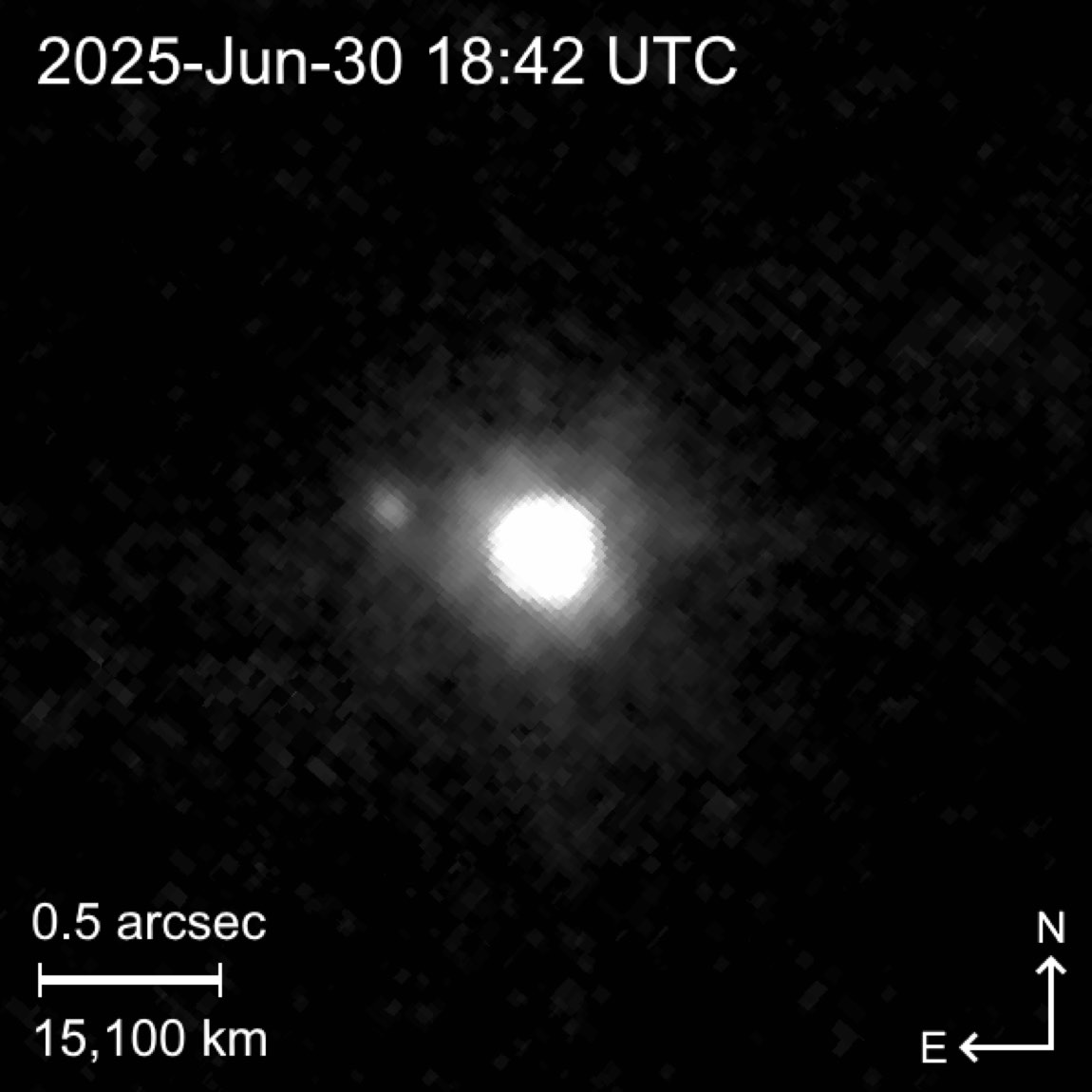
Even with the best equipment on Earth, Vanth is extraordinarily difficult to observe. Its angular separation from Orcus reaches a maximum of only 0.25 arcseconds as seen from Earth — roughly the angle subtended by a human hair held at arm's length. Resolving it visually therefore demands either large-aperture space telescopes or ground-based telescopes equipped with adaptive optics or interferometry. Vanth's apparent magnitude in visible light is around 22, which is 2.61 magnitudes fainter than Orcus itself, meaning it delivers only about 9% of Orcus's brightness to our detectors. Looking forward, both Orcus and Vanth will gradually brighten as the system moves closer to the Sun on its way toward perihelion in 2142, which will improve observing conditions over the coming century — though no living astronomer will see that full journey completed.
04 What Stellar Occultations Revealed Deeper
The most precise measurements of Vanth's size came not from photographs but from watching it blot out distant stars. The first successful stellar occultation by Vanth was recorded on 1 March 2014 at a single observatory in Hokkaido, Japan, where the occultation lasted just 3 seconds. Because only one observatory caught the event, that single chord across Vanth's disk could not meaningfully constrain the moon's diameter or shape. The more informative observation came on 7 March 2017, when observatories across the Americas and the Pacific Ocean watched for the same effect. Of five participating observatories, two made positive detections. The stations that did not detect the occultation, combined with the complication that the target star was actually a double star, together tightly narrowed Vanth's diameter to between 432 and 453 km (268–281 mi), assuming a spherical shape. The 2017 event also ruled out any detectable atmosphere, placing an upper bound of just 1–4 microbars on any surface pressure, and found no evidence of rings within 10,000 km (6,200 mi) of Vanth or beyond 8,010 km (4,980 mi) from Orcus.
05 An Orbit That Faces Directly Toward Us Deeper
Vanth's orbit around Orcus is inclined almost exactly 90° relative to the plane of the Solar System — it circles Orcus in a plane that stands nearly perpendicular to the ecliptic. Because of the geometry of the Orcus–Vanth system's own 247-year orbit around the Sun, the north pole of Vanth's orbit happened to point almost directly at Earth throughout the entire observed period from 2005 to 2023. This pole-on perspective meant astronomers saw Vanth's orbit essentially as a circle rather than an ellipse, and it also meant that a large fraction of each body's surface remained visible at all times. That geometry was beautiful for some purposes but awkward for others: the near-constant illumination produced very small changes in brightness, complicating light-curve analysis. More consequentially, the pole-on view prevented astronomers from determining Vanth's true orbital inclination until 2015. The perspective will slowly tip over the coming decades, shifting to an edge-on view by 2082, at which point Orcus and Vanth will begin periodically eclipsing and transiting each other — a season of mutual events that will offer new measurement opportunities.
06 The Binary Architecture of Orcus–Vanth
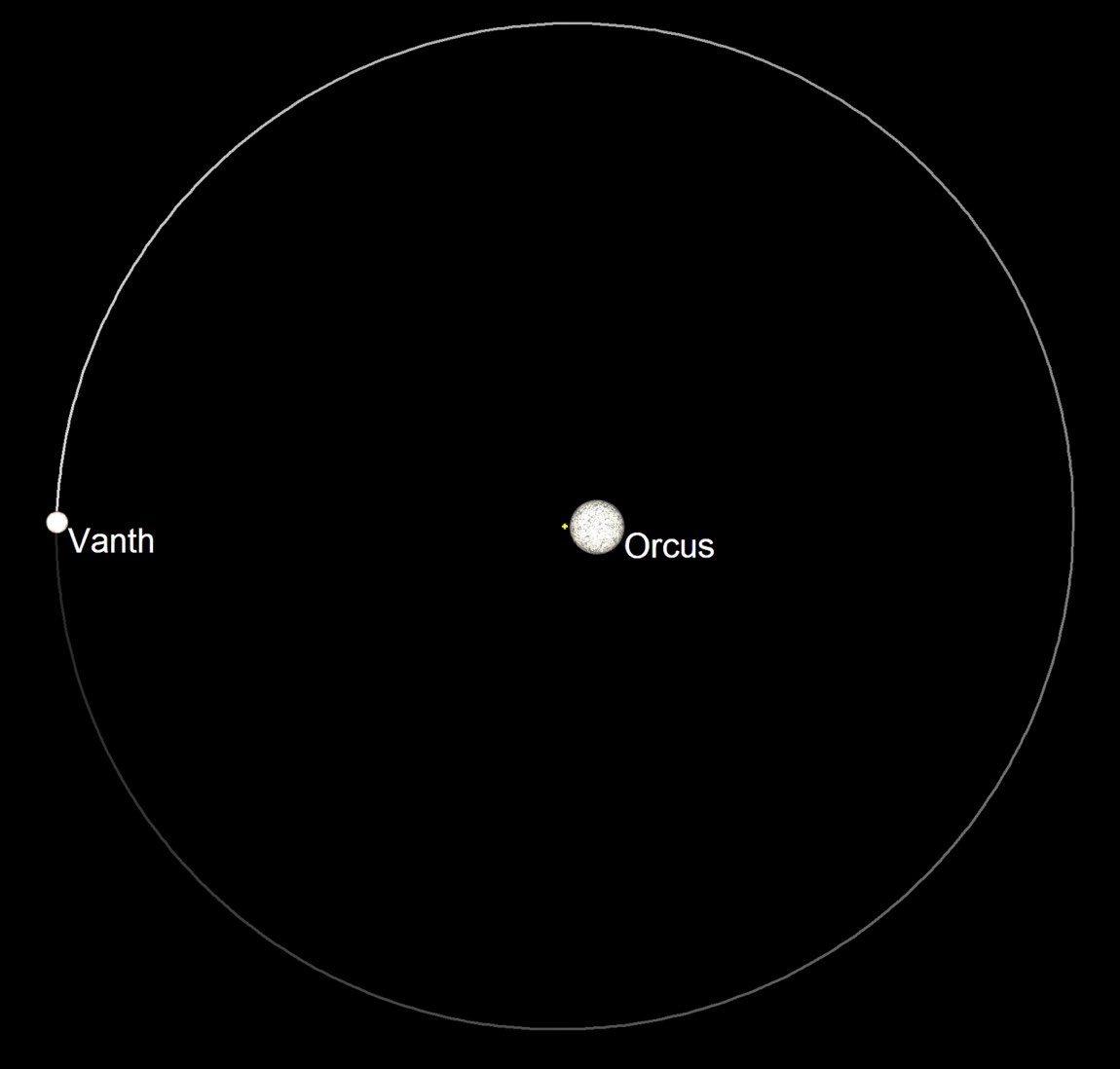
Orcus and Vanth are separated by just 9,000 km (5,600 mi) center to center — for comparison, that is slightly more than the diameter of Earth. Despite being the smaller body, Vanth is massive enough to shift the system's shared center of gravity, the barycenter, outside Orcus itself. Vanth orbits the barycenter at a radius of 7,770 km (4,830 mi), which is 86.3% of the total separation distance, while Orcus orbits the same barycenter at a much tighter radius of only 1,230 km (760 mi). Both bodies complete one revolution in 9.54 days on nearly circular orbits. This architecture — two bodies each orbiting a point between them — mirrors the Pluto–Charon binary and qualifies Orcus–Vanth as a true binary system. What makes Vanth especially remarkable is its mass ratio: at 16% ± 2% of Orcus's mass, Vanth is proportionally the most massive satellite known in any planet or dwarf-planet system, surpassing even Charon's 12% mass ratio relative to Pluto.
07 Vanth's Dark, Reddish Surface
While Orcus has a neutral, grayish surface rich in exposed water ice, Vanth is a noticeably different world to look at — darker and somewhat redder. Hubble observations from 2007 to 2008 showed that Vanth's reflectivity increases across longer, redder wavelengths, a signature consistent with tholins: complex organic compounds that form when radiation processes simple molecules over billions of years. Near-infrared spectroscopy by the Very Large Telescope in 2010 confirmed this reddish color but could not conclusively detect water ice because the observations lacked sufficient resolution. The apparent low abundance of water ice sets Vanth apart from Orcus, whose surface is dominated by it. Volatile ices like ammonia and methane are not expected to survive on Vanth at all because the moon's gravity is too weak to prevent those gases from escaping into space. ALMA observations in 2016 measured Vanth's geometric albedo at just 0.08, meaning it reflects only 8% of incoming sunlight — roughly as dark as fresh asphalt — confirming predictions that it should be darker than Orcus.
08 Synchronous Rotation and the Light-Curve Puzzle Deeper
Tracking how the brightness of the Orcus–Vanth system changes over time is harder than it sounds. Because most Earth-based telescopes cannot resolve Orcus and Vanth separately, their combined light is recorded as one signal. Additionally, the pole-on orbital geometry during the observation period kept a large portion of both surfaces continually illuminated, suppressing brightness variations. Despite these complications, continuous photometric monitoring of the unresolved system in 2009–2010 revealed a light-curve amplitude of 0.06 ± 0.04 magnitudes cycling with a period of 9.7 ± 0.3 days — closely matching Vanth's 9.54-day orbital period. This coincidence strongly suggests synchronous rotation, where at least one body always keeps the same face toward the other. Researcher José Luis Ortiz and colleagues argued in 2011 that Vanth at minimum is synchronously rotating; David Rabinowitz and Yasi Owainati countered in 2014 that both components are probably synchronously locked — a doubly synchronous state like that of Pluto–Charon. The question remains open because no individually resolved light curve for Vanth alone has been measured.
09 Is Vanth Even Round? The Shape Question Deeper
With a diameter of 443 ± 10 km (275 ± 6 mi), Vanth sits tantalizingly close to the 450 km (280 mi) threshold that researchers use as a rough guideline for hydrostatic equilibrium in trans-Neptunian objects — the point at which gravity is strong enough to pull a body into a roughly spherical shape. Vanth may fall just below that threshold, meaning it might not be massive enough to have squeezed itself into a true sphere, particularly in the extreme cold of the Kuiper belt. At temperatures below 44 K (−229 °C), ice and rock behave more rigidly than they would in warmer environments, resisting the slow gravitational reshaping that produces spherical bodies. Without an individually resolved light curve, Vanth's true shape remains unknown. The 2017 stellar occultation constrained its diameter range under the assumption of a spherical shape, but that assumption has not yet been tested. Resolving this question will likely require either mutual-event observations after 2082 or future spacecraft observations.
10 A Giant Impact 4 Billion Years Ago
The leading explanation for how Vanth came to exist echoes the story told for Pluto and Charon: a giant impact. The hypothesis holds that a large body struck Orcus at an oblique angle — hydrodynamic simulations by Sota Arakawa and colleagues in 2019 suggested the impactor needed to arrive traveling close to Orcus's escape velocity and hit at an angle greater than 45° — sending a large, intact fragment into orbit. That fragment became Vanth. The timing is thought to predate the outward migration of Neptune, which occurred roughly 700 million years after the Solar System formed, placing the impact more than 4 billion years ago. Simulations by Arakawa et al. further predicted that both Orcus and Vanth would have remained molten for at least 10,000 years, during which tidal forces gradually locked both bodies into synchronous rotation and expanded Vanth's initially eccentric orbit into the nearly circular one seen today. Earlier calculations by Michael Brown and colleagues in 2010 estimated that this tidal migration to the current separation distance took between 150 and 400 million years.
11 Why the Color Difference Complicates the Story Deeper
If Vanth formed from material blasted off Orcus in a giant impact, the simplest expectation is that the two bodies should look similar — same density, same composition, same color. Density measurements are consistent with that prediction, though with large uncertainties: ALMA data suggest a density of 1.5 g/cm³ (with an uncertainty range of +0.5 to −1.0 g/cm³), while the occultation-based diameter yields a higher estimate of 1.9 ± 0.3 g/cm³. The surface properties, however, tell a more complicated story. Orcus has a neutral gray color and abundant exposed water ice, whereas Vanth appears redder and seems to lack exposed water ice, more closely resembling unprocessed primordial Kuiper belt objects. This compositional divergence does not definitively disprove the impact model — post-impact processing could explain such differences — but it once gave some credibility to the alternative idea that Vanth was gravitationally captured rather than impact-generated. That capture hypothesis has since fallen out of favor as understanding of dwarf-planet satellite formation has improved, but the color discrepancy remains an open question that more precise spectroscopic and density measurements could help resolve.
12 Open Questions and Future Observations Deeper
Despite nearly two decades of Hubble, ALMA, and ground-based observations, several fundamental properties of Vanth remain poorly constrained. Its mass is known to be (8.7 ± 0.8) × 10¹⁹ kg, but density estimates still carry large enough uncertainties that distinguishing between an icy and a rocky interior is not yet possible. Vanth's shape has never been independently confirmed as spherical, and no individually resolved light curve exists to test that assumption. The water-ice question — whether Vanth truly lacks it or whether early spectroscopic attempts simply lacked the sensitivity to detect it — awaits higher-resolution infrared spectroscopy. Perhaps the most anticipated future development is the onset of mutual events around 2082, when the orbital geometry will shift from pole-on to edge-on as seen from Earth. During that season, Orcus and Vanth will eclipse and transit each other repeatedly, providing precise measurements of their sizes, shapes, albedo maps, and densities that no other technique can currently supply. The system will also continue brightening toward its 2142 perihelion, which will make all future observations somewhat easier than they are today.
 ⤢