 Photograph · JosephTheDalmatian · CC0
Dwarf Planet · Deep guide
50000 Quaoar
Also called: 50000 Quaoar · (50000) Quaoar · 2002 LM60
A Kuiper belt world with rings orbiting where rings shouldn't be able to survive.
What is it?
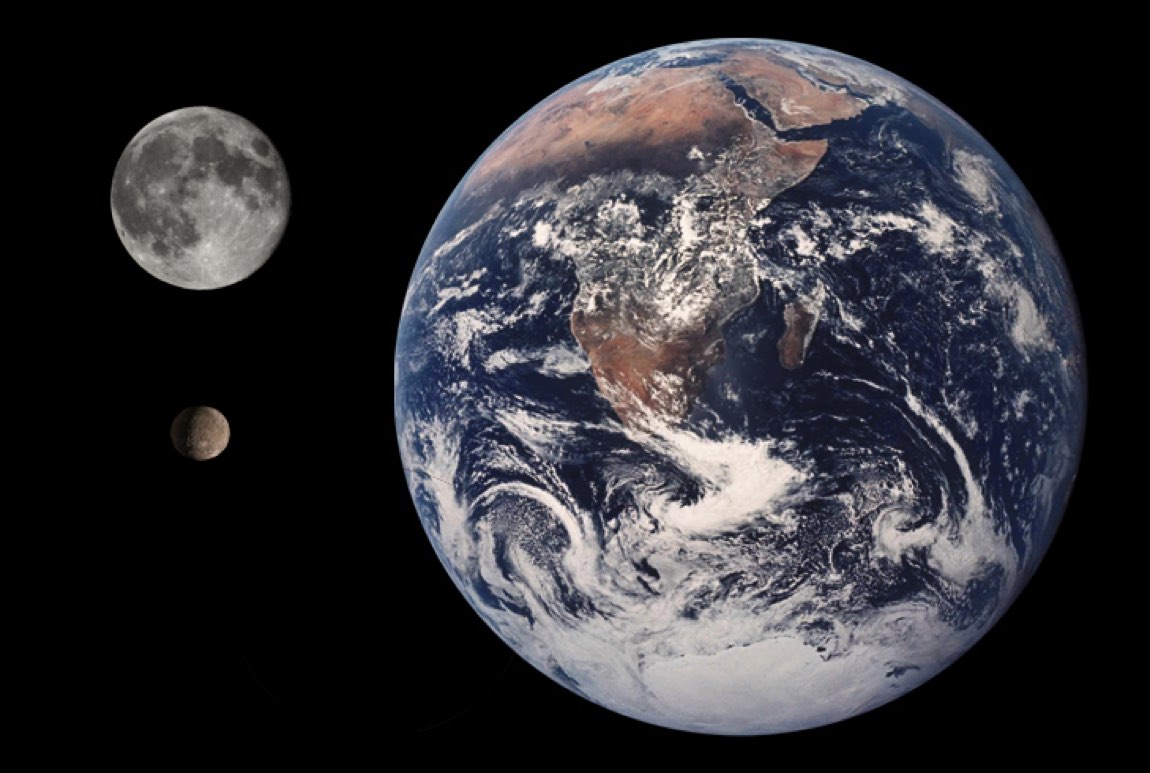
Quaoar is an icy, slightly egg-shaped body about 1,100 km across in the Kuiper belt, about half the size of Pluto. Its reddish surface holds crystalline water ice and traces of frozen methane. Stellar occultations revealed two thin rings lying farther out than theory says rings can last, a puzzle that may involve its moon Weywot. It is widely regarded as a dwarf-planet candidate, but the IAU has not officially classified it as one.
The deep dive
Researched for the Atlas from Wikipedia — Quaoar (25,119 characters read) · updated Nov 14, 2026
01 How Quaoar Was Found in Old Photographs
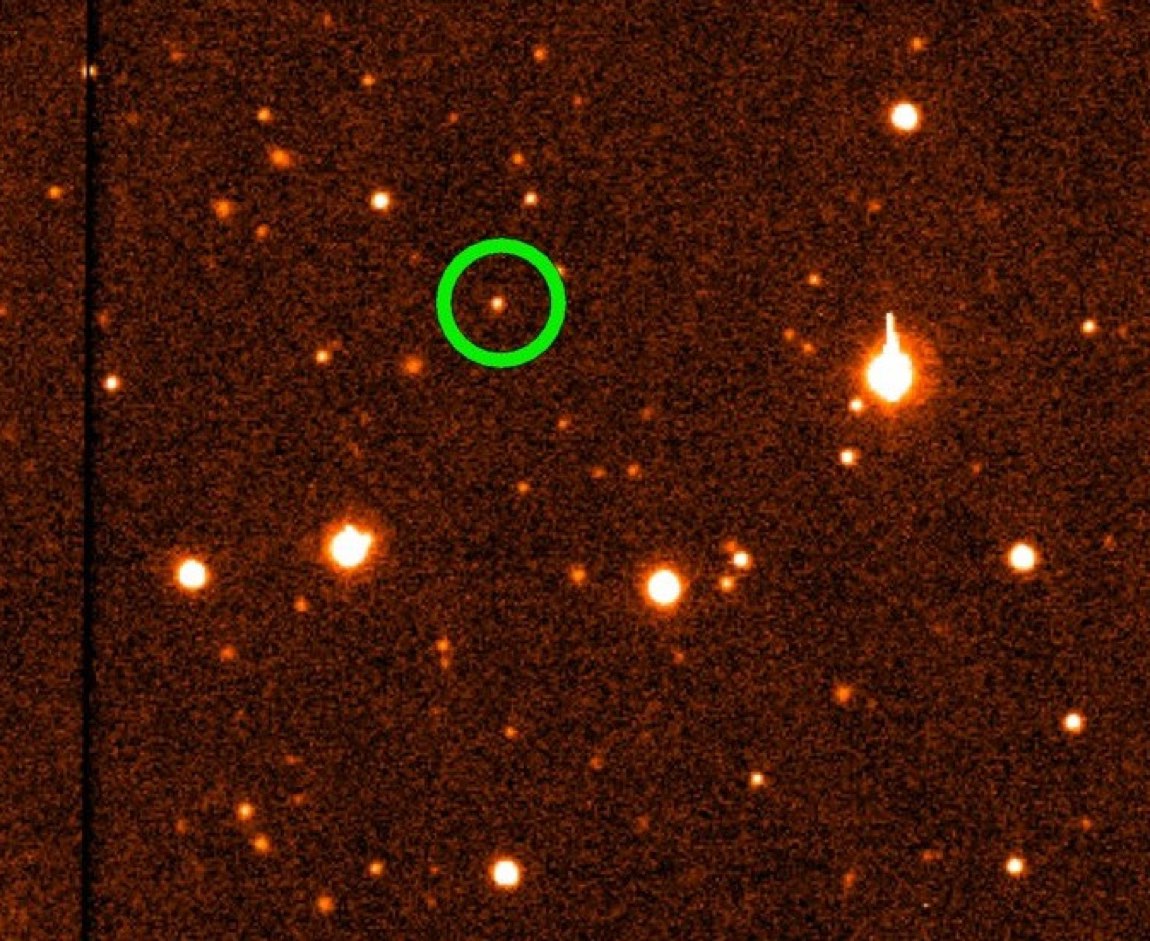
Chad Trujillo and Michael Brown announced Quaoar to the world on 7 October 2002, but the object had actually been captured on film decades earlier without anyone realizing it. After spotting Quaoar moving through the constellation Ophiuchus at magnitude 18.6 in June 2002, the team hunted through observatory archives for older images — called precovery images — to pin down its orbit precisely. They found photographs taken by the Near-Earth Asteroid Tracking survey in 1996 and between 2000 and 2002, and they also turned up two photographic plates shot by astronomer Charles T. Kowal in May 1983 while he was hunting for the hypothesized Planet X at Palomar. Even older, an image taken on 25 May 1954 as part of the Palomar Observatory Sky Survey was later identified by Edward Rhoads as carrying Quaoar's light — nearly half a century before the official discovery. This chain of archival detective work let Brown and Trujillo calculate a reliable orbit from the very beginning, sparing years of follow-up that might otherwise have been needed.
02 A Name Borrowed from Living Culture
Most newly discovered Kuiper belt objects receive names from ancient mythology, but Quaoar's naming process took an unusually personal turn. Because non-resonant Kuiper belt objects are named after creation deities under International Astronomical Union conventions, Brown and Trujillo looked to Native American traditions near Caltech's home in the Los Angeles Basin. They settled on Kwawar, the genderless creator force of the Tongva people — a being that sings and dances deities into existence, beginning with Weywot the Sky Father, then Chehooit the Earth Mother and Tamit the Grandfather Sun, and eventually the animals and the first humans. Crucially, the team discovered that the Tongva were not a purely historical culture: contemporary members still existed, and Brown and Trujillo contacted them directly. Tribal historian Marc Acuña confirmed the name was appropriate. The Tongva preferred the spelling Qua-o-ar, which the discoverers adopted with hyphens removed. The name was publicly announced before the IAU's Committee on Small Body Nomenclature had formally approved it — a protocol violation noted by Minor Planet Center head Brian Marsden in 2004 — but the committee approved it regardless, and the official citation was published on 20 November 2002.
03 An Orbit Remarkably Stable and Circular
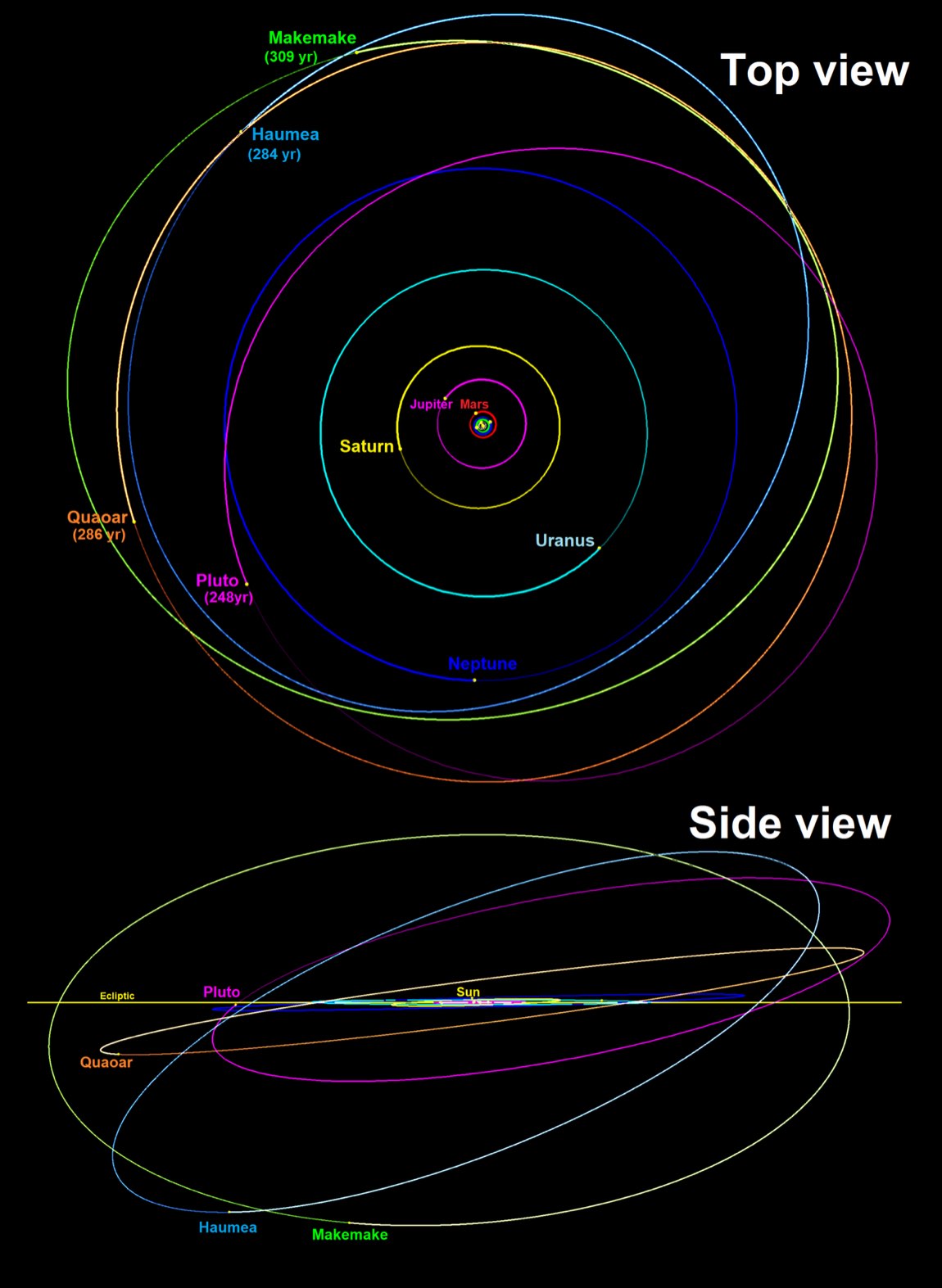
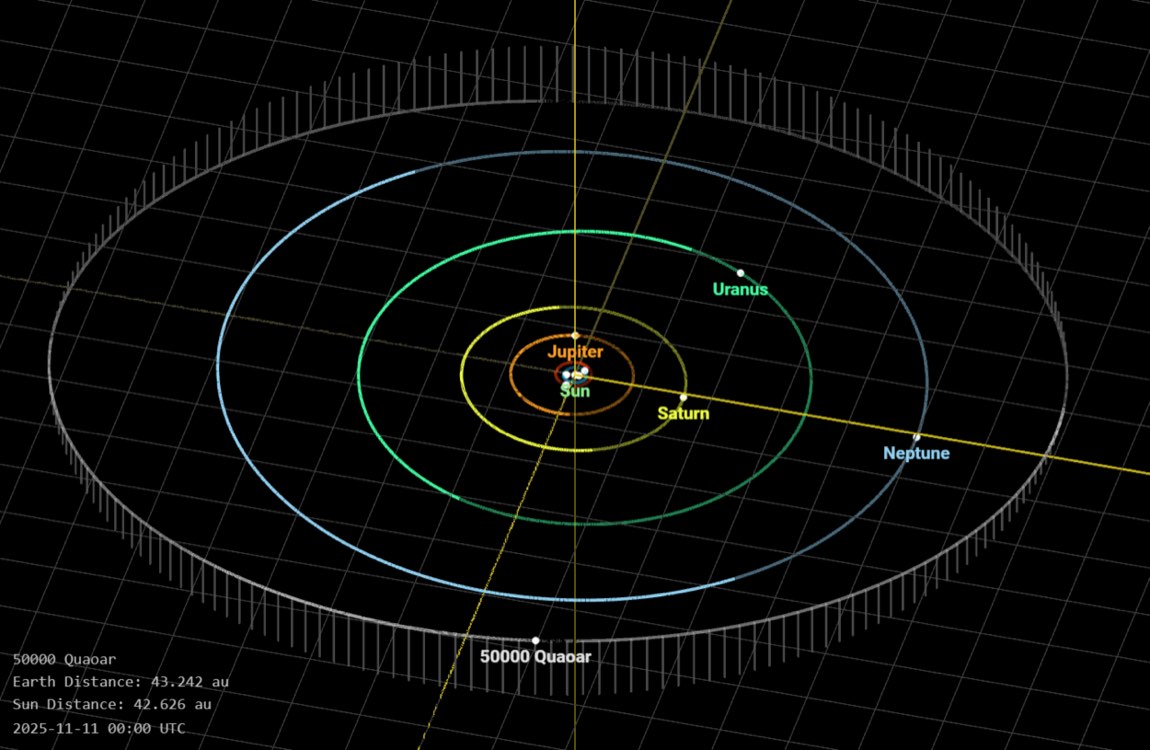
Quaoar travels around the Sun at an average distance of 43.3 AU — roughly 6.48 billion km — completing one orbit every 285 years. What makes this orbit stand out in the Kuiper belt is how nearly circular it is. With an orbital eccentricity of only about 0.04, Quaoar's distance from the Sun barely changes, ranging from 42 AU at its closest point to 45 AU at its farthest. Light from the Sun takes more than 5 hours just to reach it. Because the orbit is so round, Quaoar never strays anywhere near Neptune; its minimum approach distance from Neptune is about 12 AU, and it holds no mean-motion resonance with that planet. Computer simulations run by the Deep Ecliptic Survey show that Quaoar's perihelion and aphelion distances remain essentially constant over the next ten million years. The orbit is inclined 8° to the ecliptic, which is moderately high for a Kuiper belt object, placing Quaoar in the dynamically hot classical population — a group thought to have been stirred up and scattered to higher inclinations by Neptune as it migrated outward early in Solar System history. Quaoar will reach its next perihelion on 11 February 2075.
04 A Frozen Body That Should Look Different Deeper
Quaoar's shape is one of its most scientifically puzzling features. Measurements from stellar occultations conducted between 2011 and 2025, combined with large brightness swings as it rotates, point to a triaxial ellipsoid with dimensions of 1,241.4 km × 1,093.0 km × 1,023.0 km — yielding a volume-equivalent diameter of 1,115.7 km. The problem is that an object as massive as Quaoar is expected to be pulled into a symmetrical, rotationally flattened sphere by gravity, a state called hydrostatic equilibrium. Slowly rotating bodies in equilibrium should be oblate spheroids; only very fast rotators, like Haumea which spins in under 4 hours, become stretched ellipsoids. Quaoar rotates far more slowly and yet is elongated. In 2024, Csaba Kiss and colleagues proposed a solution: Quaoar likely started life spinning rapidly, locked into an elongated shape consistent with that fast rotation, and then gradually slowed down because of tidal forces exerted by its moon Weywot — but its frozen, rigid interior could not reshape itself as it spun down. The result is a body whose shape remembers a younger, faster past, analogous to Saturn's moon Iapetus, which is too flattened for its current slow rotation.
05 Surface Chemistry: Ice, Organics, and Methane Deeper
Quaoar's surface reflects only about 11% of the sunlight it receives, suggesting that fresh bright ice has been depleted and replaced by darker processed material. Spectroscopic observations by David C. Jewitt and Jane Luu in 2004 detected crystalline water ice and hints of ammonia hydrate. Crystalline water ice is chemically significant because radiation should convert it to amorphous ice over time, and it can only re-form at temperatures of at least 110 K (−163 °C) — far warmer than Quaoar's present surface temperature of under 50 K (−223.2 °C). Its presence means the surface was heated within the last ten million years, either by impacts or radiogenic warming from within. By 2007, more precise near-infrared spectra revealed about 5% solid methane and ethane. Methane, with a boiling point of 112 K (−161 °C), is volatile at Quaoar's temperatures and would normally escape from smaller bodies, putting Quaoar in an intermediate category between volatile-rich worlds like Pluto and Eris and the many smaller objects that have lost all such ices. In 2022, the James Webb Space Telescope added carbon dioxide ice, complex organics, significant ethane ice, hydrogen cyanide, and carbon monoxide to the inventory, while its spectra did not show conclusive evidence of ammonia hydrates.
06 Why Quaoar's Rings Puzzle Physicists Deeper
The rings of Quaoar defy a cornerstone of planetary science. The Roche limit is the distance inside which tidal forces prevent loose debris from clumping together into a moon; beyond it, particles should quickly aggregate and disappear. Both of Quaoar's rings sit comfortably outside this theoretical boundary. The outer ring, Q1R, orbits at 4,057 ± 6 km from Quaoar's center — more than double the theoretical maximum Roche limit distance — yet it persists. One leading explanation is temperature: Quaoar's environment is so cold that ring particles collide elastically, bouncing off each other rather than sticking together and accreting. Quaoar's elongated shape and the gravitational nudges of its moons are also thought to contribute to ring stability. Additionally, both rings happen to sit in spin-orbit resonances with Quaoar's rotation period — Q1R near the 1:3 resonance and Q2R at the 5:7 resonance. Similar resonance-confinement has been seen at Chariklo and Haumea, suggesting this may be a general mechanism keeping rings stable around small, slow-rotating bodies far from the Sun. Q1R also sits sandwiched between the 6:1 mean-motion resonance with Weywot at 4,021 ± 57 km and the 1:3 spin-orbit resonance at 4,197 ± 58 km, implying both play roles in preventing the ring material from coalescing into a single moon.
 ⤢
07 The Two Very Different Rings Up Close Deeper
Although Quaoar's two rings share the distinction of existing where rings theoretically should not, they are strikingly different from one another. The outer ring, Q1R, is chaotic and irregular: its radial width varies enormously, from just 5 km in its densest sections to as wide as 300 km in its most diffuse stretches, and its optical depth swings from 0.004 to as high as 0.7. This clumpy, irregular structure resembles Saturn's turbulent F ring or Neptune's ring arcs, which are known to be sculpted by embedded kilometer-sized moonlets. Some researchers suspect similar small bodies are hiding inside Q1R, gravitationally stirring its material. The inner ring, Q2R, is a quieter structure: relatively uniform, only about 10 km wide, and with a consistently low optical depth of 0.004 — comparable to the most transparent parts of Q1R. Q2R orbits at 2,520 ± 20 km from Quaoar's center, roughly four and a half times the planet's radius. Both rings are thought to consist of icy particles. Quaoar's rings were discovered through stellar occultation campaigns coordinated under the European Research Council's Lucky Star project, with Q1R announced in February 2023 and Q2R following in April 2023, making Quaoar the eighth Solar System body confirmed to have rings.
08 Weywot: A Dark Moon on a Tight Orbit
Quaoar's confirmed moon, Weywot, was found on Valentine's Day 2006 by Michael E. Brown and Terry-Ann Suer. Its name follows the Tongva mythology that inspired Quaoar's name: Weywot is the Sky Father, the first deity that the creator Quaoar sang into existence. Physically, Weywot is a small and very dark object, with a volume-equivalent diameter of roughly 146 km — small enough to fit comfortably within England's borders. It orbits Quaoar at a distance of about 13,300 km, completing one orbit every 12.4 days on a nearly circular path inclined 5° to Quaoar's equator. This moon sits beyond both of Quaoar's rings and plays a surprisingly important scientific role: the entire mass estimate for Quaoar — 1.212 × 10²¹ kg — was derived from tracking Weywot's orbit, which in turn allowed researchers to calculate Quaoar's density of about 1.7 g/cm³ and infer a rock-and-ice interior. Weywot's gravitational influence is also credited with helping to stabilize Quaoar's unusual rings and, through tidal forces, with slowing Quaoar's rotation over time and thereby locking in its non-equilibrium elongated shape.
09 A Possible Second Moon Hiding in Plain Sight
On 25 June 2025, astronomers Richard Nolthenius and Kirk Bender independently recorded, from two different telescopes at the same observatory in California, a 1.23-second-long occultation of a background star near Quaoar that did not match the predicted behavior of either Weywot or Quaoar's known rings. The most likely explanation is a small, previously unknown moon orbiting at roughly 5,700 to 5,800 km from Quaoar — outside both rings but inside Weywot's orbit — with an orbital period estimated at 3.6 days. The candidate moon would be at least 38 km in diameter and about 100 times less massive than Weywot. At an apparent magnitude of around 28, it is essentially undetectable by any existing telescope including JWST; only stellar occultations or future extremely large telescopes could confirm it. If real, this object may be in a 5:3 or 8:5 mean-motion resonance with Q1R, potentially explaining some of that ring's irregular structure. A 2026 study by Felipe Braga-Ribas and colleagues noted that the mere 0.08% statistical chance of serendipitously detecting such a moon through occultation suggests that many more small moons probably orbit Quaoar unseen, possibly surrounding its rings much as small moons surround Saturn's and Neptune's ring arcs.
10 An Atmosphere Too Thin to Measure Easily Deeper
Quaoar's surface methane and other volatiles hint at the possibility of an extremely tenuous atmosphere produced by slow sublimation of those ices. At its measured mean temperature of roughly 44 K (−229.2 °C), however, any atmosphere would be extraordinarily thin. A nitrogen or carbon monoxide atmosphere has been ruled out entirely because those gases would escape Quaoar's weak gravity. Methane was considered a candidate until 2013, when Quaoar passed in front of a 15.8-magnitude background star and no atmospheric signal appeared, capping any methane pressure at less than 20 nanobars — assuming a mean temperature of 42 K and a predominantly methane composition. For comparison, Earth's atmospheric pressure at sea level is about 101,325 microbars, so even that upper limit is roughly five billion times thinner than what we breathe. A 2019 stellar occultation tightened the upper limit to 10 nanobars, and further analysis published in 2026 pushed the ceiling down to just 0.15 nanobars. The overall pressure ceiling across all scenarios sits in the range of a few microbars. Quaoar's atmosphere, if it exists at all, is currently beyond the reach of direct detection.
11 What Lies Beneath: Quaoar's Interior Deeper
With a bulk density of about 1.7 g/cm³ derived from Weywot's orbit, Quaoar is denser than pure ice at roughly 0.9 g/cm³ but less dense than rock at around 3 g/cm³, pointing to a mixture of both. Its large size means that radioactive elements in the rock fraction have likely generated enough heat over billions of years to melt the interior and allow denser rock to sink toward the center while ice rose to form a shell — a process called differentiation. The expected result is a rocky core surrounded by an icy mantle. A 2006 study by Hauke Hussmann and colleagues concluded that radiogenic heating alone may not sustain a liquid water ocean at the boundary between the mantle and core today. The story of Quaoar's interior was complicated by early measurement errors: initial estimates placed its density between 2 and 4 g/cm³, leading to speculation that a giant impact had stripped away an icy mantle and left only a bare rocky planetary core. Those ideas were abandoned as more accurate diameter measurements from stellar occultations brought the density estimate down to its present value.
12 Snapshots from New Horizons and Future Visits
No spacecraft has ever visited Quaoar, but the object has already appeared in images taken from deep space. In July 2016, the Long Range Reconnaissance Imager aboard New Horizons — fresh from its Pluto flyby — captured a sequence of four images of Quaoar from roughly 14 AU away. Future visits are more than idle speculation. Trajectory calculations show that a flyby using a Jupiter gravity assist would reach Quaoar in 13.6 years, with viable launch windows on 25 December 2026, 22 November 2027, 22 December 2028, 22 January 2030, and 20 December 2040; the spacecraft would find Quaoar between 41 and 43 AU from the Sun. The proposed Interstellar Probe concept, developed by Pontus Brandt and colleagues at Johns Hopkins Applied Physics Laboratory, could fly past Quaoar in the 2030s before continuing into interstellar space. China's proposed Shensuo probes, designed to explore the heliosphere, have also listed Quaoar as a possible flyby target. Scientists are drawn to Quaoar for its possibly escaping methane atmosphere, potential cryovolcanism, its paradoxical rings, and its location near the heliospheric nose — all of which make it one of the more scientifically compelling unvisited worlds in the outer Solar System.
 ⤢