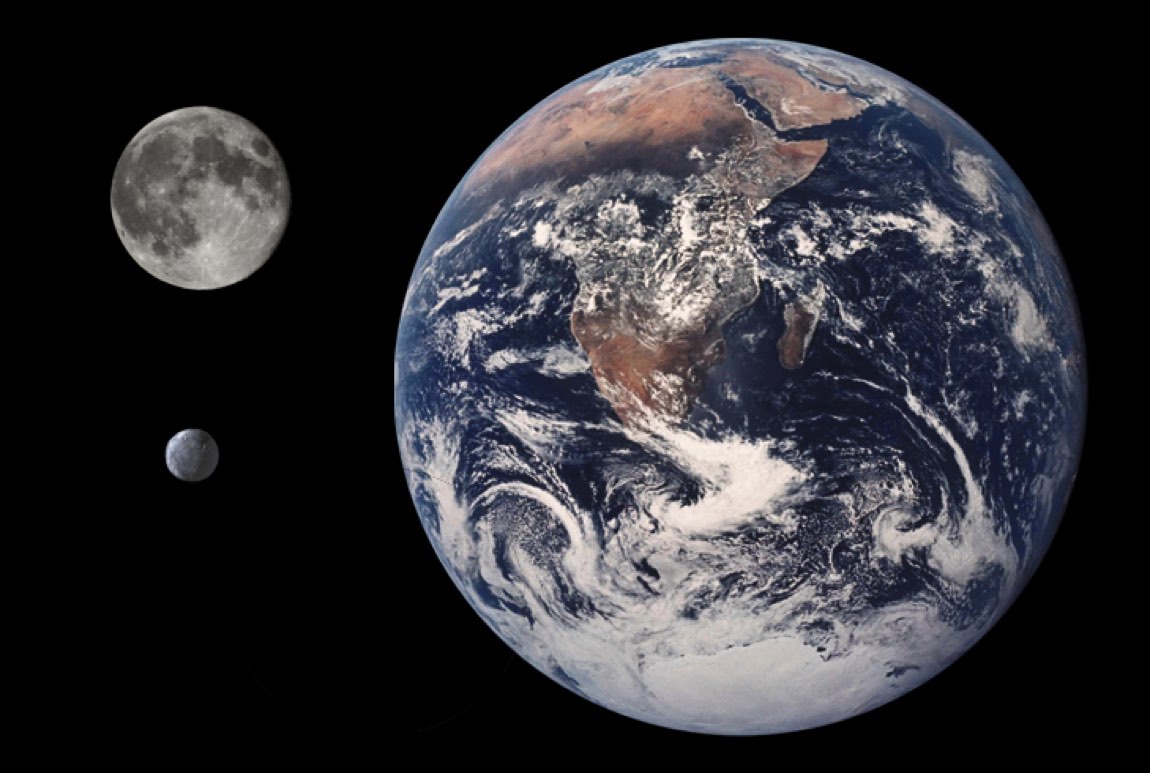
 Photograph · California Institute of Technology · Public domain
Dwarf Planet · Deep guide
90482 Orcus
Also called: 90482 Orcus · (90482) Orcus · 2004 DW
The 'anti-Pluto': a world in Pluto's orbital family, always on the opposite side of its orbit.
What is it?
Orcus is an icy body roughly 900 km across in the Kuiper belt, with a large moon called Vanth. Like Pluto it is a plutino, circling the Sun twice for every three orbits of Neptune — but its position is opposite Pluto's, so it is farthest from the Sun when Pluto is nearest. Its bright, neutral-coloured surface is rich in crystalline water ice, which may hint at past cryovolcanism. It is a dwarf-planet candidate not officially recognized by the IAU.
The deep dive
Researched for the Atlas from Wikipedia — Orcus (dwarf planet) (11,593 characters read) · updated Nov 14, 2026
01 The Anti-Pluto: A Mirror World in Reverse
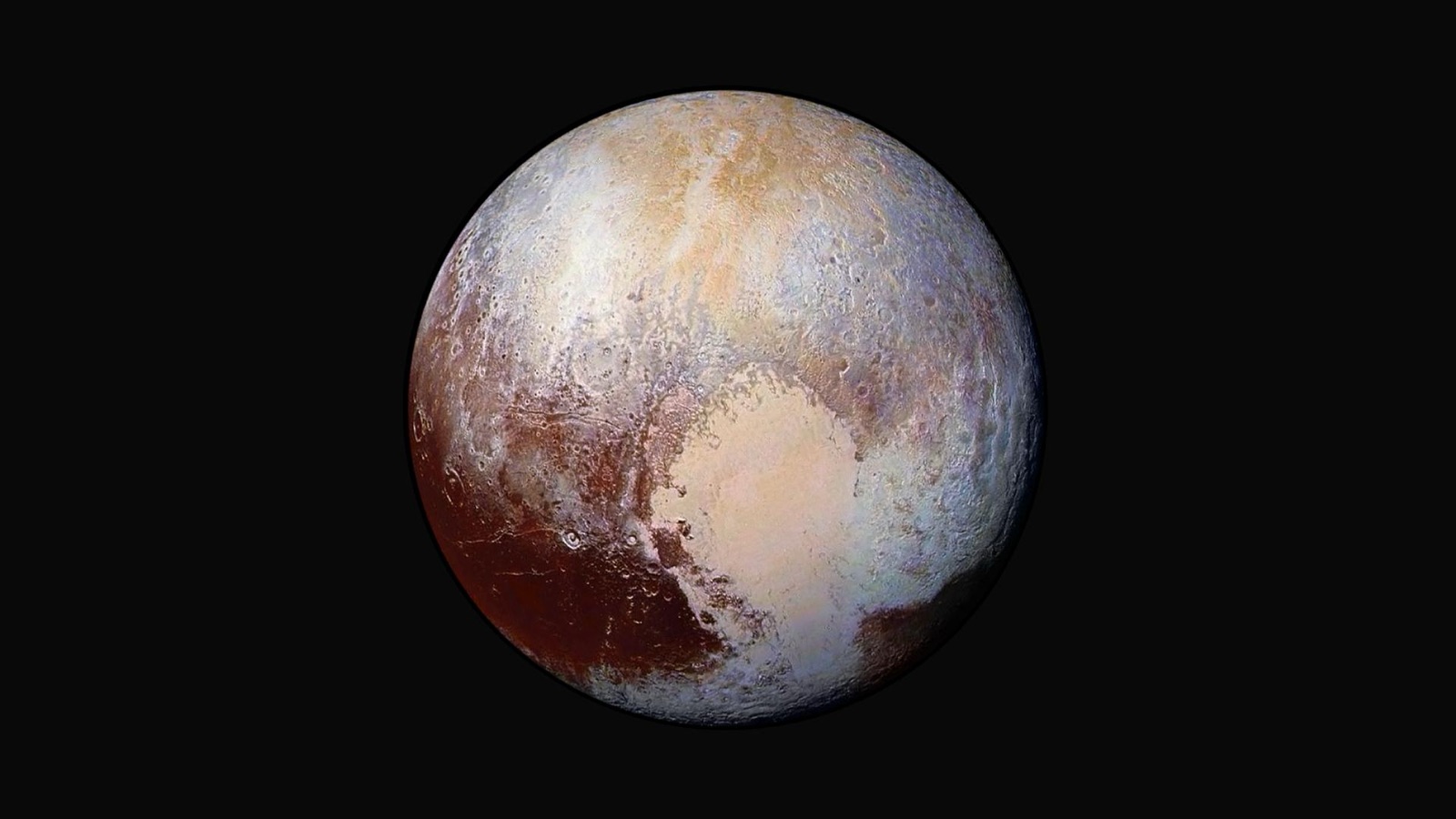
The nickname "anti-Pluto" is not mere poetic fancy — it rests on a precise gravitational relationship. Both Orcus and Pluto are locked in a 2:3 resonance with Neptune, meaning each completes two orbits for every three Neptune completes. Their orbital shapes and tilts are strikingly similar: both have perihelia above the ecliptic, with comparable eccentricities and inclinations, and the perihelion of Orcus's orbit sits roughly 120° away from Pluto's. The critical difference is phase. When Pluto swings closest to the Sun — as it did most recently in 1989 — Orcus is simultaneously at its farthest point, its aphelion, which it last reached in 2019. Because their shared resonance with Neptune keeps them perpetually half an orbit apart, Orcus will never drift close to Pluto. The comparison extends further: just as Pluto has the large moon Charon, Orcus has Vanth. This constellation of similarities-with-reversals drove the discoverers to choose a name from the same mythological neighborhood as Pluto's own.
02 Orbital Mechanics and Long-Term Stability Deeper
Orcus moves in an orbit inclined at 20.6° to the ecliptic and will not reach perihelion again until around 12 January 2143, when it will come closest to the Sun. Although its orbit geometrically approaches Neptune's path at one point, the 2:3 resonance guarantees a safe angular buffer: there is always more than 60° of separation between Orcus and Neptune, and simulations confirm that over a 14,000-year window Orcus stays more than 18 AU away from the ice giant. Looking further ahead, simulations by the Deep Ecliptic Survey suggest that over the next 10 million years Orcus could develop a minimum perihelion distance as small as 27.8 AU — meaning its closest solar approach could shrink somewhat over geological timescales, though it would remain firmly in the outer Solar System. Such long-term modeling reveals that plutino orbits, while stable on human timescales, are not perfectly frozen and can evolve gradually under the gravitational sculpting of the giant planets.
03 Precovery: Finding It Before It Was Found
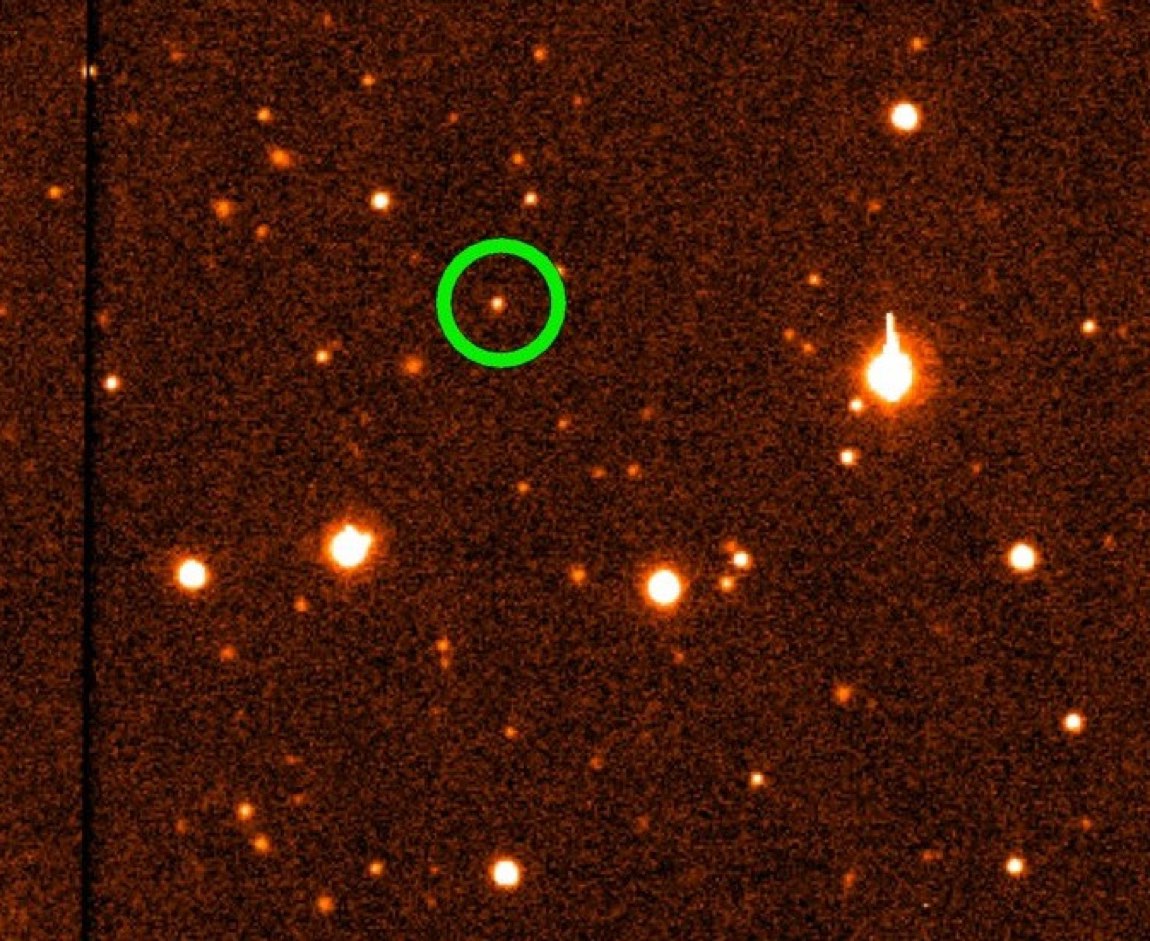
Although Michael Brown of Caltech, Chad Trujillo of the Gemini Observatory, and David Rabinowitz of Yale University officially discovered Orcus on 17 February 2004, astronomers were able to reach back in time to find earlier images of the object hiding unrecognized in archival plates. These precovery images came from the Palomar Observatory and were retrieved from the Digitized Sky Survey — the earliest dating to 8 November 1951, more than half a century before the formal discovery. Precovery is a standard and powerful tool in Solar System astronomy: once an orbit is computed from new observations, researchers can calculate where the object should have appeared in older sky surveys and confirm those positions, dramatically extending the arc of observations and sharpening the orbital solution. In Orcus's case, those 1951 images predate the discovery by 52 years, giving the orbit calculation a much longer baseline than the discovery night alone could provide.
04 Naming: Gods, Islands, and Broken Oaths
The name Orcus was published by the Minor Planet Center on 26 November 2004. Under IAU naming conventions, objects comparable in size and orbit to Pluto are assigned names of underworld deities. The discoverers chose Orcus — an Etruscan god who, unlike Pluto (ruler of the underworld), served specifically as the punisher of broken oaths and the condemned. This distinction made the name doubly fitting: Orcus is mythologically connected to Pluto yet occupies a different role, mirroring the object's astronomical relationship to the dwarf planet Pluto. There was also a personal dimension: Brown has acknowledged that the name doubled as a private tribute to Orcas Island, a place where his wife grew up and that the couple visits regularly. Vanth, the moon named on 30 March 2010, comes from the same Etruscan tradition — a winged female figure of the underworld who could appear at the moment of death and guide souls to the afterlife, a role known as psychopomp.
05 Water Ice, Tholins, and an Unusual Surface Deeper
From the moment of its first spectroscopic observation in 2004, Orcus stood out among trans-Neptunian objects. Most such bodies show a reddish visible spectrum and featureless infrared signatures, but Orcus displays a flat, neutral-colored visible spectrum alongside moderately strong water-ice absorption bands at 1.5 and 2.0 micrometers. Early observations with the European Southern Observatory and Gemini telescope pointed to mixtures of water ice and carbonaceous compounds called tholins — complex organic molecules formed when simple carbon-bearing compounds are irradiated. Modeling constrains the surface coverage: water ice can blanket no more than 50 percent of the surface, and methane ice no more than 30 percent, a composition less icy than Charon but similar to Neptune's moon Triton. Higher-quality spectra gathered between 2008 and 2010 added a deep absorption feature at 1.65 micrometers — a fingerprint of crystalline water ice — and another feature at 2.22 micrometers whose origin remains debated. Best-fit radiative transfer models favor a mixture of water ice, tholins, ethane ice, and ammonium ions, though a mixture involving methane ice and ammonia hydrate also performs reasonably well. As of 2010, only crystalline water ice and possibly dark tholins have been reliably confirmed.
06 Crystalline Ice and the Case for Past Cryovolcanism Deeper
The crystalline form of water ice detected on Orcus's surface poses a puzzle. High-energy galactic and solar radiation steadily scrambles the ordered crystal lattice into amorphous ice, a process that should completely erase any crystalline signature within about 10 million years — a geologically short interval. The persistence of the 1.65-micrometer crystalline band, which on Orcus is broad and deep at 12 percent, implies that the surface has been refreshed relatively recently in geological terms. One leading candidate for this renewal is cryovolcanism: eruptions of water-rich slush or fluid from the interior rather than molten rock. Some calculations indicate that cryovolcanism may be possible for trans-Neptunian objects larger than about 1,000 km in diameter, putting Orcus right at the threshold. The preferred mechanism may have been explosive aqueous volcanism, where dissolved methane erupts from water-ammonia melts. Ammonia, if confirmed, would be significant: it has not been detected on any other trans-Neptunian object or outer-planet icy satellite except Miranda. At least one past cryovolcanic episode could explain both the crystalline ice and the possible ammonia signature simultaneously.
07 Vanth: A Moon Worthy of Its Own Dwarf Planet
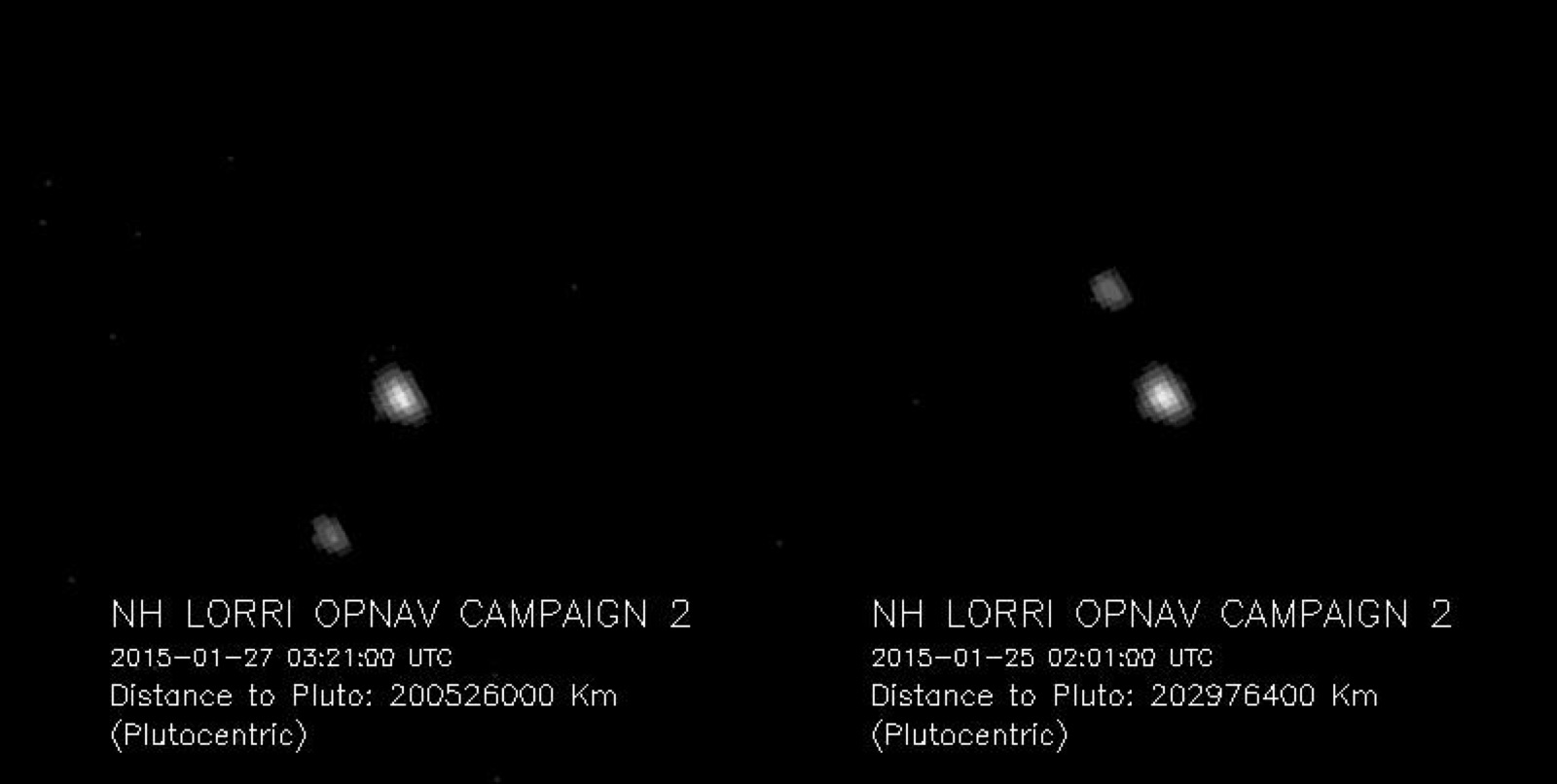
Vanth was spotted in Hubble Space Telescope discovery images taken on 13 November 2005 by Michael Brown and T.-A. Suer, though the finding was not announced until an IAU Circular notice on 22 February 2007. Its size makes it exceptional: submillimeter imaging with ALMA in 2016 measured Vanth at 475 km (295 mi) in diameter, and a stellar occultation in 2017 refined that to 442.5 km (275.0 mi) with an uncertainty of just 10.2 km (6.3 mi). By comparison, Vanth is the third-largest known moon of any dwarf planet, ranking behind only Pluto's Charon and Eris's Dysnomia. ALMA measurements also revealed that Vanth contains 13.7 percent — plus or minus 1.3 percent — of the total system mass, and that both Orcus and Vanth share a similar density of roughly 1.5 grams per cubic centimeter. Vanth is notably darker than Orcus, with an albedo of only about 8 percent compared to Orcus's 21–25 percent, suggesting their surfaces have evolved differently despite being gravitationally bound partners for billions of years.
08 A System's Mass and What It Tells Us Deeper
Because Vanth orbits Orcus in a measurable path, astronomers can apply gravitational physics to weigh the entire system. The combined mass of Orcus and Vanth has been estimated at (6.348 ± 0.019) × 10²⁰ kilograms — almost exactly matching the mass of Tethys, a mid-sized moon of Saturn, which comes in at 6.175 × 10²⁰ kg. Put another way, the Orcus system has only about 3.8 percent of the mass of Eris, the most massive known dwarf planet at 1.66 × 10²² kg. The ratio of Vanth's mass to Orcus's mass was pinned down astrometrically using ALMA at 0.16 ± 0.02. The fact that both bodies share densities of around 1.5 g/cm³ is scientifically useful: it suggests broadly similar interior compositions, a mix of rock and ice that is denser than pure water ice (1.0 g/cm³) but less dense than rock, consistent with what is seen in other mid-sized Kuiper Belt objects. The uncertainty in the mass ratio remains significant, however — the ratio of Orcus's mass to Vanth's could range anywhere from 1:33 to 1:12.
09 The Puzzle of Orcus's Rotation
How fast Orcus spins remains genuinely unresolved. Different photometric surveys have produced incompatible answers: some detect low-amplitude brightness variations with periods spanning 7 to 21 hours, while others detect no variability at all. The leading explanation for the apparent flatness of its light curve is geometry rather than a truly uniform surface. Orcus's rotational axis is thought to roughly coincide with the orbital axis of Vanth, which means that from Earth we are currently looking almost straight down onto Orcus's pole. Viewing an object pole-on naturally suppresses any rotational brightness modulation, since we see the same hemisphere throughout its spin cycle. Astronomer José Luis Ortiz and colleagues derived a candidate rotation period of about 10.5 hours under the assumption that Orcus is not tidally locked to Vanth. If it is tidally locked, however, the rotation period would instead match Vanth's orbital period of 9.7 days — a dramatically slower spin more akin to the Earth-Moon system.
10 Symbols, Unicode, and the Anti-Pluto Glyph
Although the IAU no longer recommends planetary symbols in professional astronomy — and Orcus accordingly never received one in the scientific literature — symbols have circulated among astrologers and enthusiasts. One symbol, encoded in Unicode as U+1F77F, was designed by Denis Moskowitz, a software engineer in Massachusetts. It is an "OR" monogram crafted to simultaneously suggest a skull and an orca's open jaw, weaving together the object's name and its underworld associations. A second, rarer symbol depicts an inverted version of the astrological Pluto symbol, designed by Melanie Reinhart specifically to reflect Orcus's identity as the anti-Pluto. The existence of two competing unofficial symbols, neither sanctioned by the IAU, is itself a small window into how astronomical objects accumulate cultural meaning beyond the scientific community that discovers and studies them.
11 Where Orcus Sits Among Kuiper Belt Objects Deeper
Orcus occupies a distinctive niche even among the growing catalog of large trans-Neptunian objects. Its diameter estimate of 910 km (570 mi) from ALMA — or up to 958.4 km (595.5 mi) from combined Spitzer and Herschel observations — places it comfortably among the largest known Kuiper Belt objects, comparable in scale to Ceres in the inner Solar System. It is the second-largest known plutino, surpassed only by Pluto itself. Its albedo of 21–25 percent may be typical for trans-Neptunian objects approaching the 1,000 km diameter range, as that size threshold is thought to be where bodies become massive enough to retain surface volatiles such as methane. Orcus sits right at this boundary. Its water-ice absorption bands are the deepest of any Kuiper Belt object outside the Haumea collisional family, and its surface spectrum closely resembles those of Pluto's moon Charon and the large plutino 208996 Achlys — both featuring the same combination of a neutral visible color and moderately strong near-infrared water-ice bands. The large icy moons of Uranus also share similarly shaped infrared spectra.
12 Open Questions and Future Observations
Despite two decades of study since its 2004 discovery, Orcus leaves many questions unanswered. The firm identification of ammonia, methane, and other hydrocarbons on its surface awaits better infrared spectra than have yet been obtained — as of 2010, only crystalline water ice and possibly tholins are reliably confirmed. Whether Orcus experienced cryovolcanism, and if so how recently, remains a matter of modeling rather than direct evidence. The rotation period is contested across different surveys, and the precise mass ratio between Orcus and Vanth carries a wide range of uncertainty. The magnitude and size estimates carry an additional caveat: they were computed treating Orcus as a single object, and the presence of Vanth — containing roughly 13.7 percent of the system's mass — means the numbers could shift meaningfully once the two bodies are more fully resolved. No spacecraft has visited Orcus, and no mission is currently planned. High-resolution observations from future large telescopes, additional stellar occultations, and potentially a dedicated outer Solar System mission represent the clearest paths toward resolving these open questions.
 ⤢