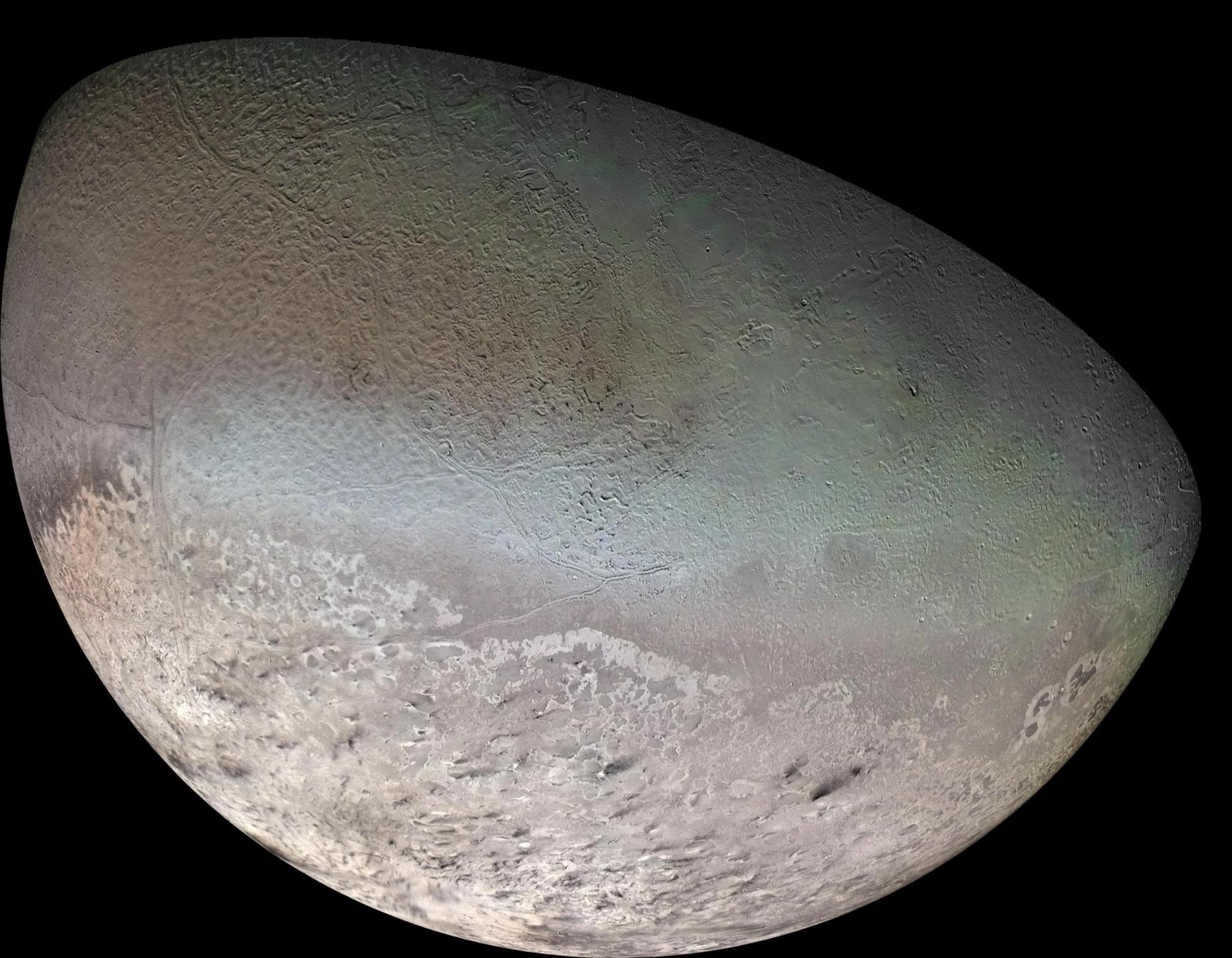
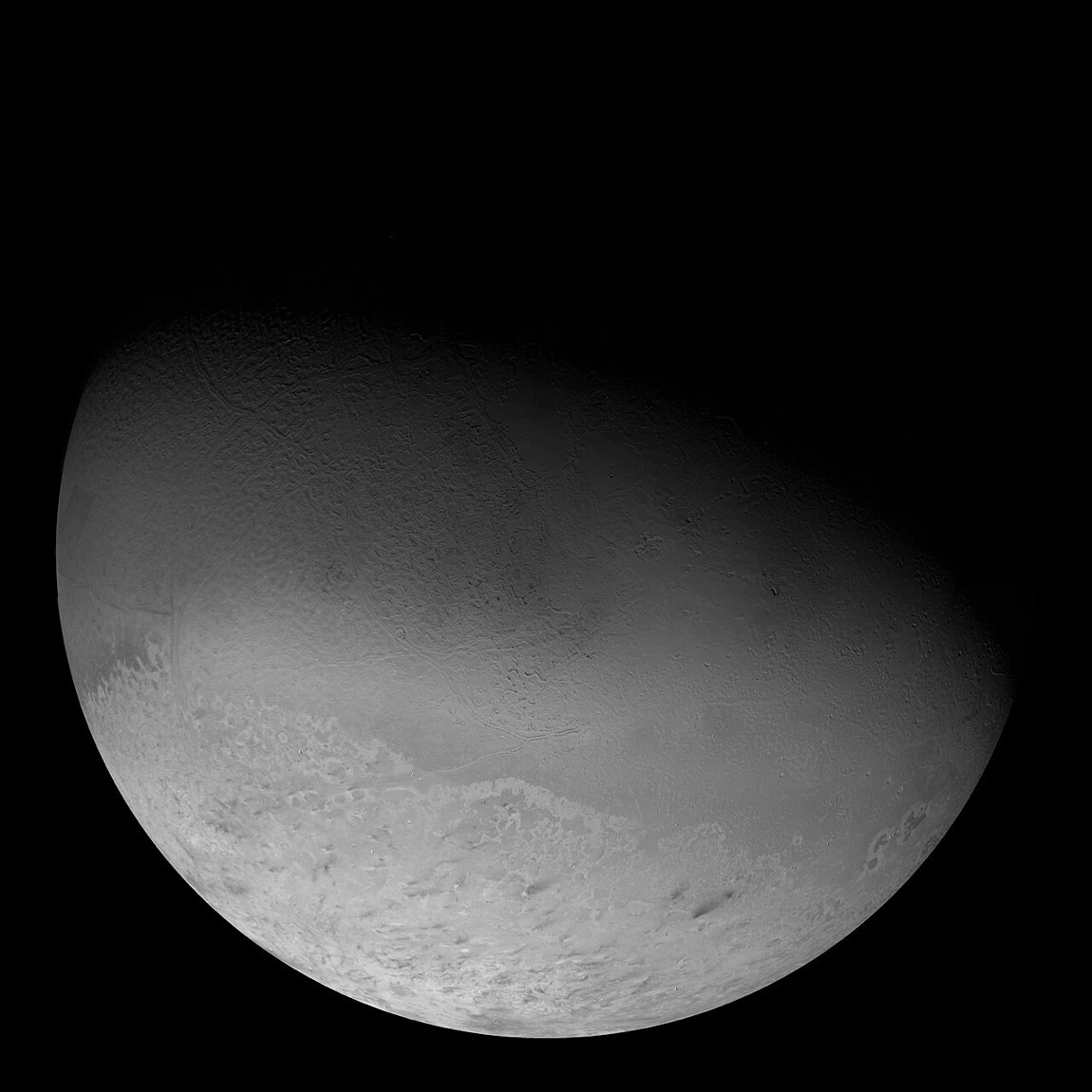
 Photograph · NASA/JPL/USGS
Moon · Deep guide · orbits Neptune
Triton
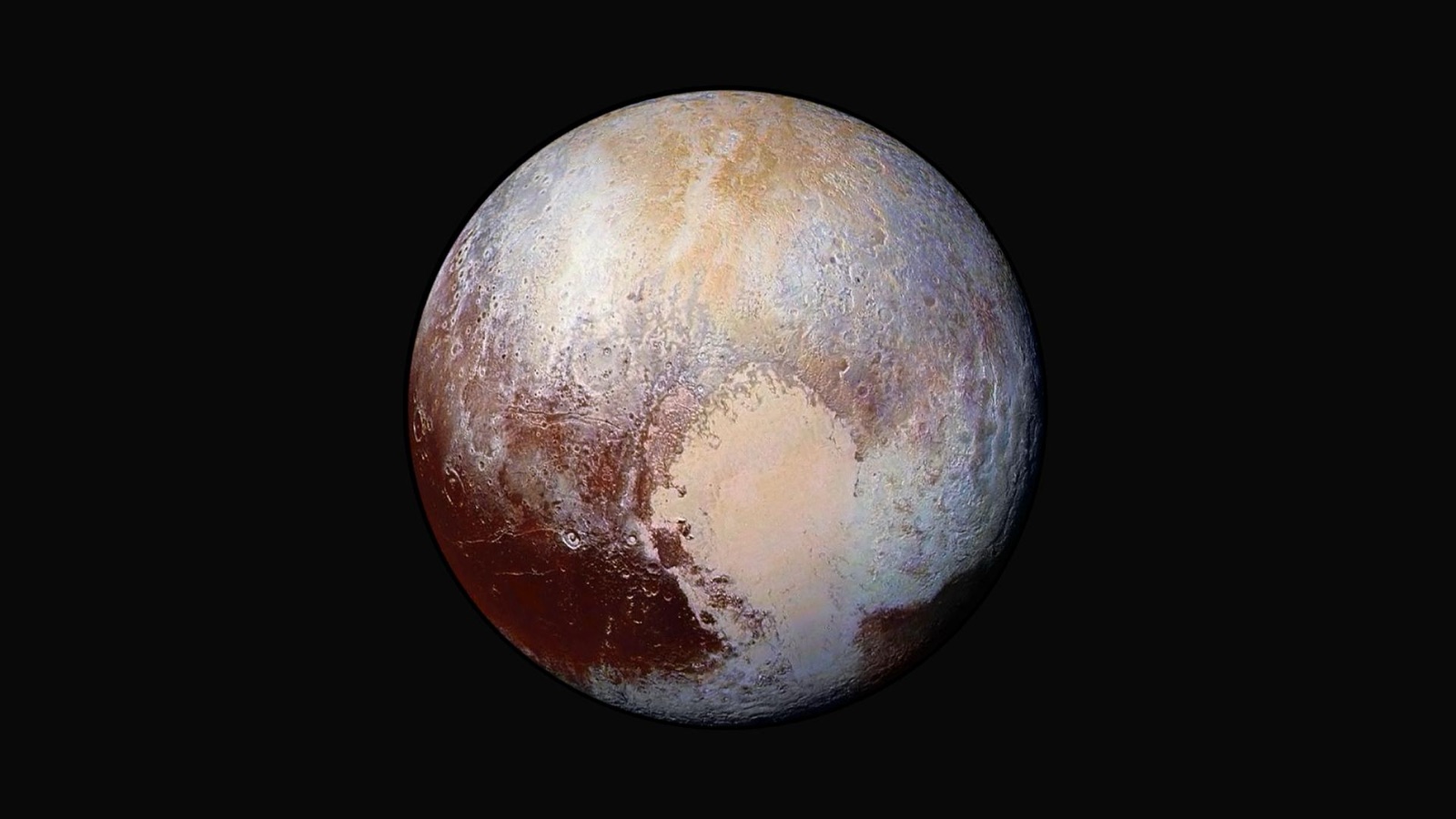
A kidnapped Pluto with erupting nitrogen geysers, circling Neptune backwards.
What is it?
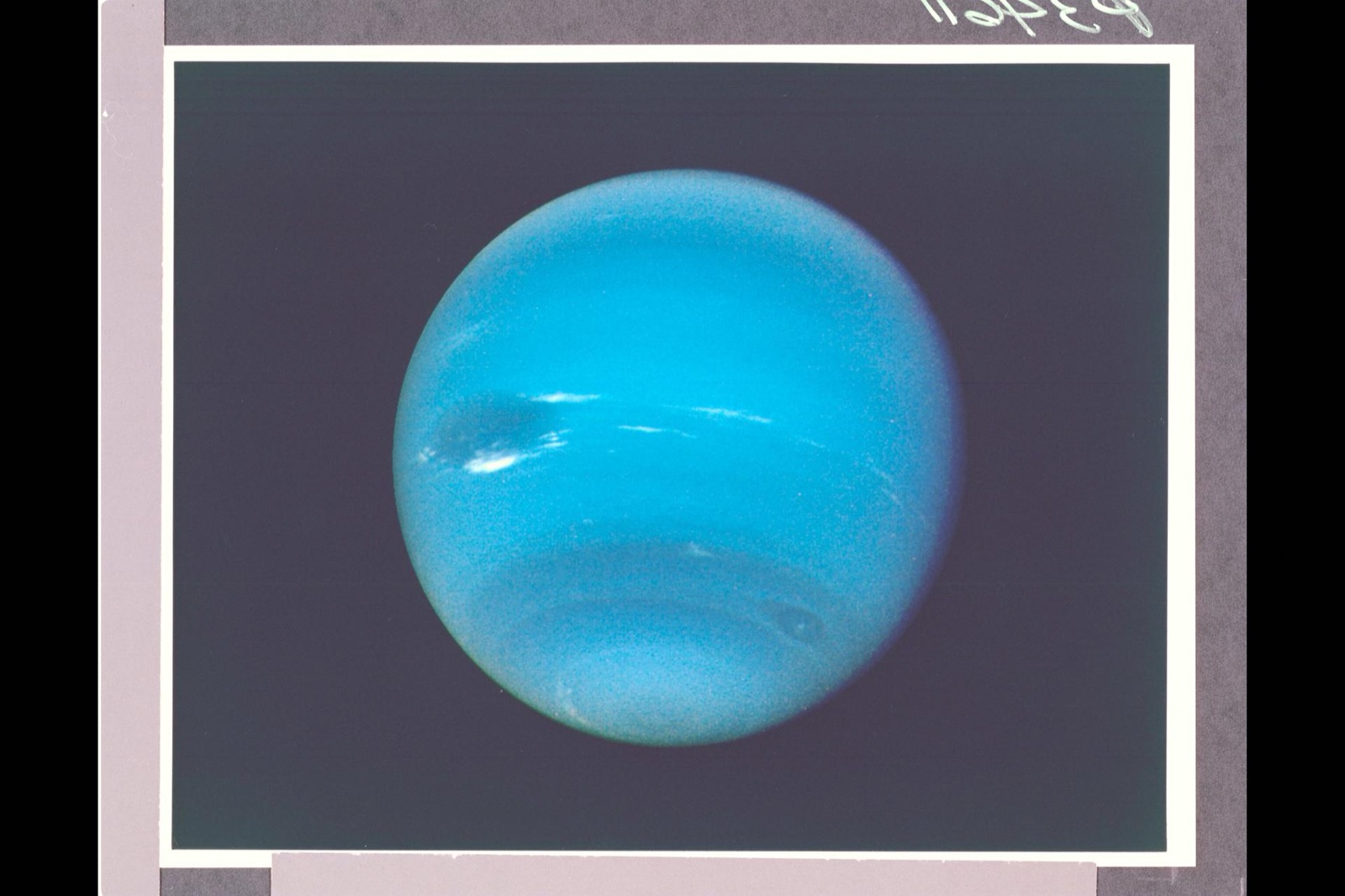
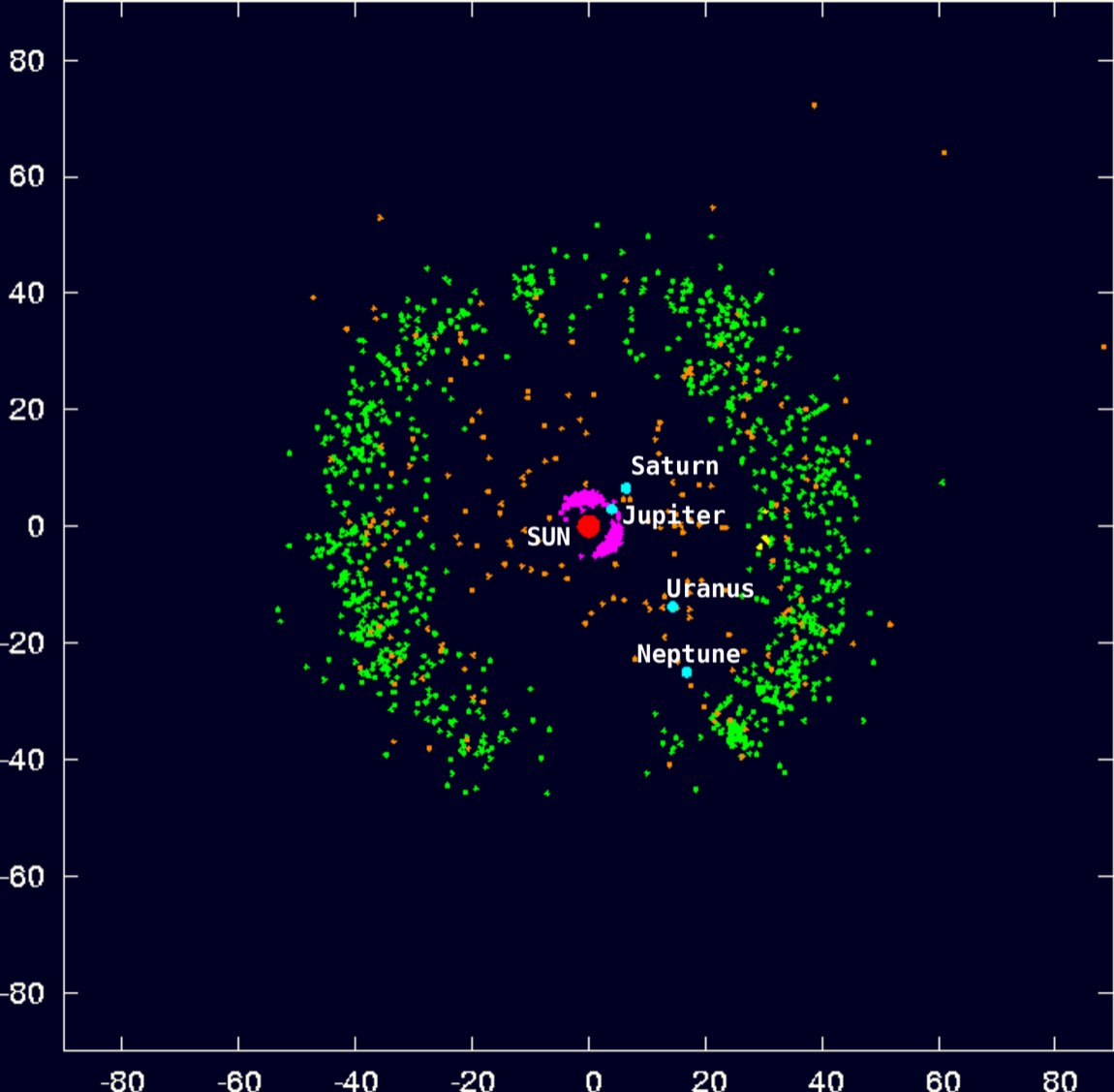
Triton is Neptune's big moon, and it is wrong in the most interesting way: it orbits backwards — opposite to Neptune's spin — which no large moon should do. The explanation: Triton didn't form there. It is almost certainly a captured dwarf planet from the Kuiper Belt, a sibling of Pluto that strayed too close. Voyager 2 flew past in 1989 and caught its geysers erupting — on a world at −235 °C.
Go deeper
Capture likely cost Triton everything: tidal circularization melted it, destroyed Neptune's original moons, and left Triton on a doomed inward spiral (breakup into a ring in ~3.6 billion years). Voyager saw a young, nearly craterless surface of nitrogen and methane ices with 'cantaloupe terrain' found nowhere else, plus dark geyser plumes 8 km tall — possibly solar-driven nitrogen jets, possibly signs of internal heat. Models give Triton a real chance of a subsurface ocean (ammonia-laced), making it the Kuiper Belt's most accessible ocean-world candidate. A return mission (Trident, Neptune Odyssey) has been proposed repeatedly; none is yet approved.
01 The smoking gun of a kidnapping
Moons that form alongside their planet all orbit the same way the planet spins — that's how the birth disk works. Triton circles Neptune the wrong way, tilted steeply. The only good explanation is that Neptune's gravity snagged a passing world. Triton and Pluto are nearly the same size and density: two siblings, one captured, one free.
02 Geysers at −235 °C Deeper
Voyager 2 photographed dark columns rising 8 km and streaming downwind. Leading model: sunlight penetrating clear nitrogen ice builds greenhouse pressure pockets that burst — a 'solid-state greenhouse.' If instead they tap internal heat, Triton is an active ocean world. Deciding between the two is a headline goal of any return mission.
The deep dive
Researched for the Atlas from Wikipedia — Triton (moon) (27,411 characters read) · updated Sep 20, 2026
03 William Lassell and a very busy 17 days
Neptune itself was only announced to the world on September 23, 1846. Seventeen days later, on October 10, 1846, English astronomer William Lassell spotted Triton — making it the first Neptunian moon ever found, discovered almost before astronomers had finished celebrating the planet itself. Lassell was not a professional scientist by trade; he brewed beer for a living and built his own telescopes as a passionate hobby. The instrument he used was a 61-centimeter aperture metal-mirror reflector he had constructed himself, nicknamed the "two-foot" reflector, which was later donated to the Royal Observatory at Greenwich before eventually being dismantled. He found Triton after receiving a letter from John Herschel urging him to search the new planet's neighbourhood for satellites. Lassell also claimed for a time that he had detected rings around Neptune, but those rings are so faint and dark that it is not considered plausible he actually saw them. Interestingly, he never named his discovery; Triton went simply by "the satellite of Neptune" until a second moon, Nereid, was found in 1949. The name Triton — son of Poseidon in Greek myth, fitting for a moon of the Roman god's counterpart — was first proposed by astronomer Camille Flammarion in his 1880 book Astronomie Populaire and only officially adopted many decades after that.
 ⤢
⤢
04 An orbit unlike any other large moon's
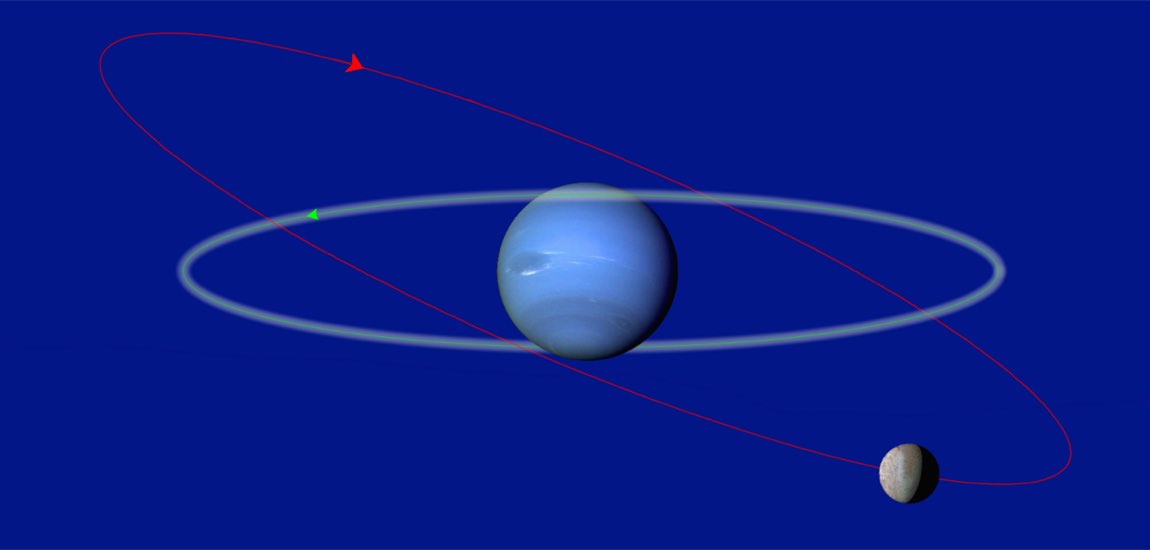
Triton travels around Neptune backwards. Every other large moon in the Solar System orbits in the same direction its planet spins; Triton does the opposite, a motion called retrograde. Its orbital inclination is 157 degrees — any inclination above 90 degrees signals retrograde motion. Many tiny, distant irregular moons of Jupiter and Saturn also go retrograde, but the largest of those, Saturn's Phoebe, has only 8 percent of Triton's diameter and a mere 0.03 percent of its mass. Triton is therefore, by an enormous margin, the largest retrograde moon known anywhere. Complicating things further, Triton's orbit precesses — it slowly swings around — with a period of about 678 Earth years, which equals roughly 4.1 Neptunian years. This makes its inclination relative to Neptune's equator oscillate between 127 and 173 degrees over that cycle; right now, at 130 degrees, Triton's orbit is near its most tilted departure from Neptune's equatorial plane. Because of its tidal lock, Triton always keeps one face toward Neptune, and its rotational axis is currently tilted about 40 degrees from Neptune's orbital plane, giving Triton dramatic polar seasons as first one pole and then the other swings into sunlight — seasonal changes that were actually observed from Earth in 2010.
05 How a wandering binary world got trapped Deeper
The most favoured modern hypothesis for Triton's capture is elegant: before Triton arrived at Neptune, it was half of a binary pair of Kuiper Belt objects travelling together through the outer Solar System. When this binary pair made a close approach to Neptune, gravitational forces tore the pair apart. One member was flung away into space; the other — Triton — lost enough energy in the exchange to become bound to Neptune. The event is described as brief but gentle, which is significant because it means Triton likely avoided being shattered by the encounter. This binary-exchange mechanism is supported by the observation that large Kuiper Belt objects very commonly travel in binary pairs. Supporting evidence for a Kuiper Belt origin also comes from a 2024 study of the chemical compositions of both Pluto and Triton, which concluded the two worlds originated in the same region of the outer Solar System. Two older and less favoured mechanisms had also been proposed: collision with a passing body (considered unlikely) or collision with an existing moon already orbiting Neptune. Even after capture, 2017 simulations suggest Triton probably collided with at least one other Neptunian moon before its orbit settled down, and it likely caused further collisions among those other moons through gravitational disturbances.
06 The slow demolition of Neptune's old moon family Deeper
When Triton first fell into Neptune's grip, its orbit would have been wildly elongated — highly eccentric, slicing through the paths of whatever regular moons Neptune already had. Gravitational interactions would have hurled those original moons into chaotic, disrupted trajectories, dispersing or destroying them. This is one reason Neptune has far fewer moons than Jupiter or Saturn, whose moon families were never disturbed by such a violent intruder. The only survivor of that era whose orbit betrays the chaos is Nereid, Neptune's third-largest moon, which has an extraordinarily eccentric orbit — the most eccentric of any known moon — thought to be a direct scar of Triton's violent arrival. Triton's own highly eccentric post-capture orbit would have generated enormous tidal heating in its interior, possibly keeping the body's interior molten or partially fluid for as long as a billion years. Scientists believe this prolonged internal heating is what drove the differentiation visible today: Triton separated into a dense rocky-metallic core, a water-ice mantle, and a crust, just as Earth differentiated under its own internal heat. Once Triton's orbit became nearly circular and tidal locking was complete, that powerful heat source faded, though radioactive decay and obliquity tides continue to warm the interior today.
 ⤢
⤢
07 Inside Triton: ice, rock, and a hidden ocean
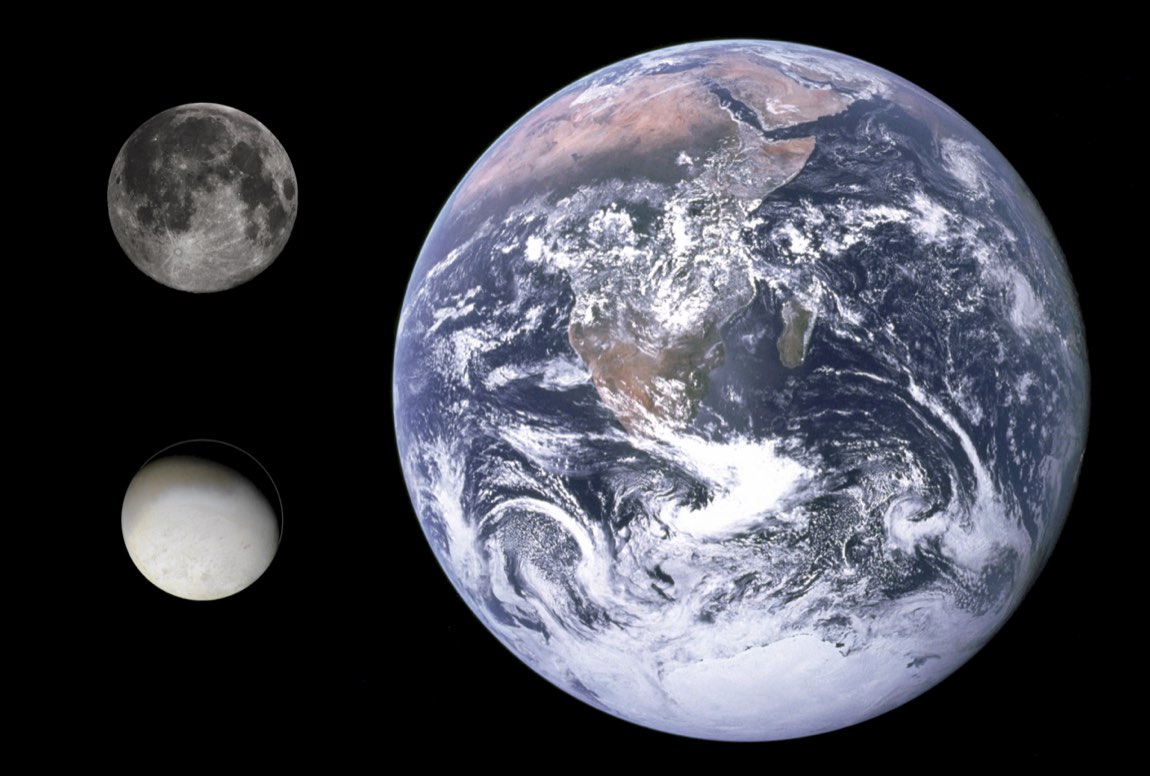
Despite being a moon of a distant ice giant, Triton has an internal structure surprisingly reminiscent of Earth's: a differentiated body with a solid rocky-metallic core at the centre, a mantle of water ice, and an icy crust on top. Its mean density is 2.061 grams per cubic centimetre, which implies the bulk composition is roughly 30 to 45 percent water ice by mass, with the remainder being mostly rock and metal. Enough rock sits in that core that radioactive decay is thought to be generating heat continuously, and scientists believe this is sufficient to maintain a liquid water ocean beneath the surface even today — a subsurface sea analogous to the one suspected under Jupiter's moon Europa. What remains uncertain is whether that internal heat alone is enough to drive convection through Triton's icy crust. The current leading idea is that it is not quite sufficient on its own, but that strong obliquity tides — flexing caused by the mismatch between Triton's orbital tilt and Neptune's rotation — add the extra warmth needed to power the surface geological activity observers have detected. The surface itself is coated in a thin, transparent, annealed sheet of frozen nitrogen. Beneath that, the surface composition is roughly 55 percent nitrogen ice, 15 to 35 percent water ice, and 10 to 20 percent frozen carbon dioxide, with trace amounts of methane and carbon monoxide.
08 A surface shaped by ice volcanoes and tearing faults Deeper
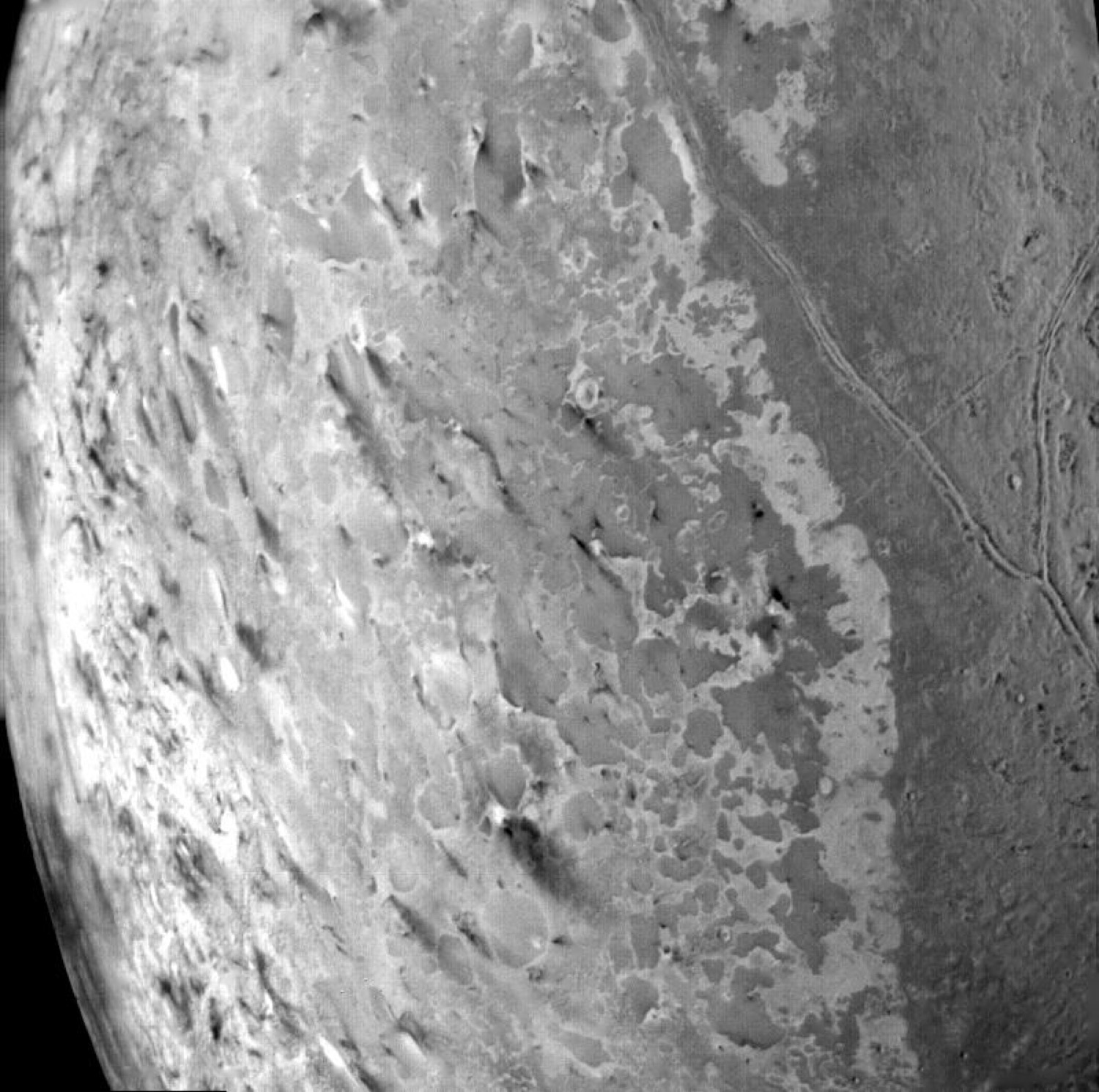
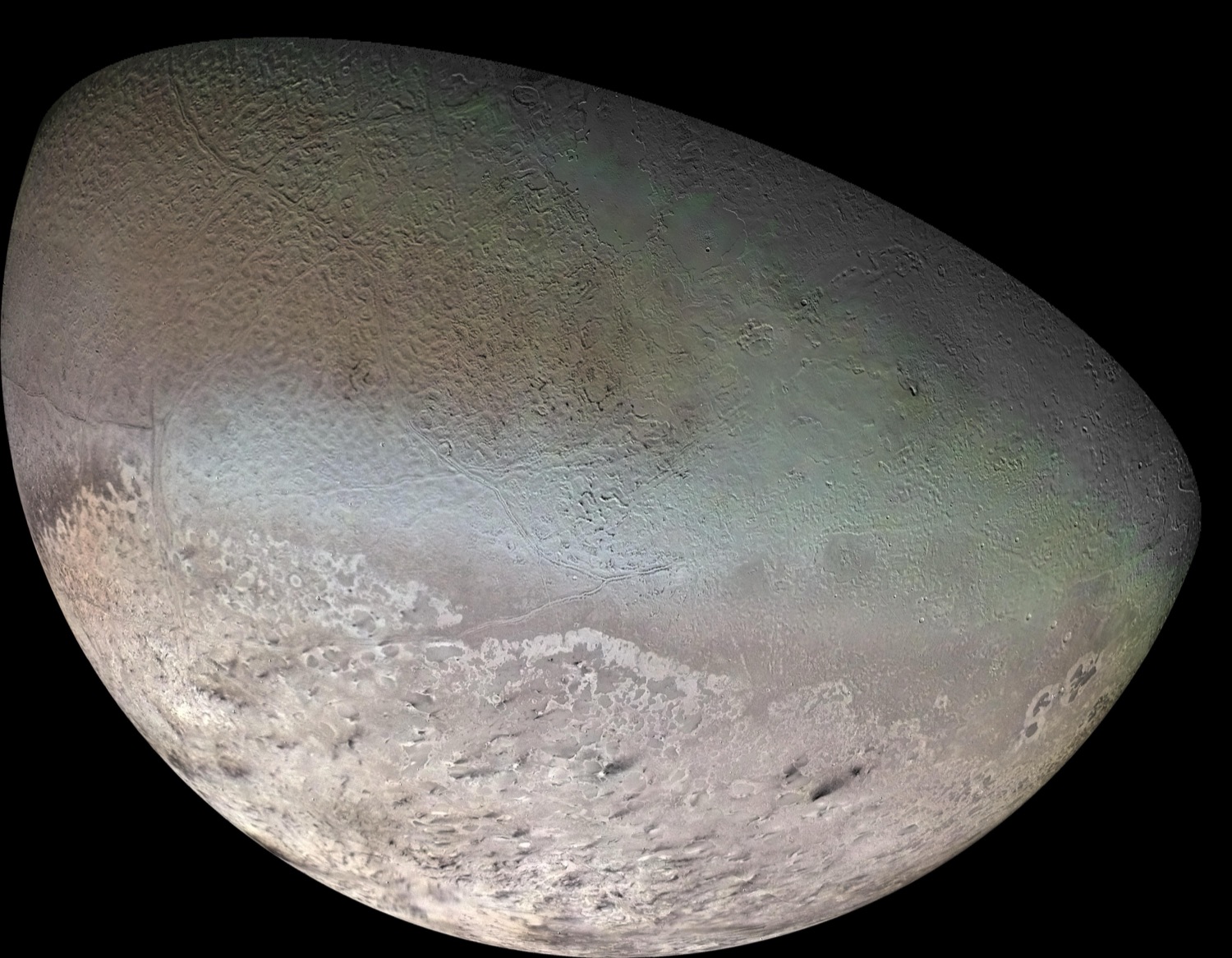
Voyager 2's 1989 flyby mapped only 40 percent of Triton's surface, yet even that partial view revealed a geological portfolio of extraordinary complexity. The western hemisphere is dominated by "cantaloupe terrain" — a landscape of rounded depressions 30 to 40 kilometres in diameter that resembles the skin of a cantaloupe melon. It is found nowhere else in the Solar System. Because these depressions are all roughly the same size and have smooth, similar profiles, they are almost certainly not impact craters; the leading explanation is diapirism, where blobs of less-dense material slowly push up through denser material from below. The eastern hemisphere is blanketed by high plains such as Cipango Planum, thought to be vast sheets of icy lava that flooded and buried older terrain. One of the most striking individual features is Leviathan Patera, a caldera-like depression roughly 100 kilometres across near the equator, surrounded by a cryovolcanic plain of at least 490,000 square kilometres — making it one of the largest volcanic or cryovolcanic constructs anywhere in the Solar System. Connected to it are two enormous cryolava lakes, representing what were once stable bodies of surface liquid water while molten, the first such features identified outside Earth. Across the surface, long double ridges with central troughs strongly resemble features on Europa and may share a similar origin in strike-slip faulting.
09 Triton's remarkably thin and variable air
Triton has a real atmosphere, global in extent but extraordinarily thin. Its surface pressure ranges from only about 1.4 to 1.9 pascals — for comparison, Earth's sea-level pressure is about 101,325 pascals, making Triton's air roughly 70,000 times thinner. The atmosphere is dominated by nitrogen, with trace carbon monoxide and small amounts of methane near the surface. Like Pluto's atmosphere, it is thought to arise from nitrogen evaporating off the surface ice. Despite its thinness, the atmosphere has structure: a troposphere extending 8 kilometres upward, where turbulence and seasonal winds can move particles larger than a micrometre — as evidenced by streaks left by geyser plumes visible on the surface. Above that, unusually, there is no stratosphere; instead a thermosphere runs from 8 to 950 kilometres altitude, and an exosphere above that. The upper atmosphere reaches 95 ± 5 K, far warmer than the surface, because it absorbs energy from both solar radiation and Neptune's magnetosphere. One of the most puzzling observed facts is how dramatically the atmosphere changed: between 1989 and roughly 1997 its pressure appeared to nearly triple, before returning close to Voyager 2 levels by 2017. The cause of that rapid spike and reversal remains unexplained.
 ⤢
⤢
10 What the craters — and their absence — reveal Deeper
Impact craters are the geological clock of a planetary surface: the more craters, the older the terrain. By that measure, Triton's surface is astonishingly young. Voyager 2 found only 179 craters incontestably of impact origin across the 40 percent of the surface it imaged — compared with 835 confirmed impact craters on Uranus's moon Miranda, which has only 3 percent of Triton's surface area. The largest confirmed impact crater is Mazomba, just 27 kilometres in diameter. Crater-counting studies suggest that the geologically active regions of Triton's surface are as young as an estimated 6 million years old, while even the more heavily cratered areas date back only an estimated 50 million years — a mere blink in Solar System history. The craters that do exist are concentrated almost entirely on Triton's leading hemisphere, the face pointing in the direction of orbital motion, clustered between 30 and 70 degrees longitude. This is expected because objects swept up from orbit around Neptune hit the leading face more frequently and with greater violence than the trailing face. However, the observed asymmetry in cratering is even more extreme than current models of impactor populations can explain, implying that the crater-free regions have been actively resurfaced very recently.
11 Colour, albedo, and why Triton glitters
Triton is one of the most reflective objects in the Solar System, bouncing back 60 to 95 percent of the sunlight that reaches it. Earth's Moon, for comparison, reflects only about 11 percent of incoming sunlight. This extreme brightness is a direct consequence of Triton's surface being coated in fresh, bright nitrogen ice. It is also the reason Triton is so cold: instead of absorbing solar energy and warming up, the surface reflects most of it straight back into space, producing the coldest recorded surface temperature in the Solar System at 38 K, or negative 235 degrees Celsius. Triton's high reflectivity is so sensitive that even tiny changes in the spectral properties of the ice can meaningfully alter how much heat is absorbed, which is why small shifts in frost distribution or ice type are plausible drivers of the atmospheric pressure changes observed between 1989 and 2017. Against its bright white background, Triton also displays patches of reddish colour. These are thought to be deposits of tholins — complex organic compounds formed when methane ice is bombarded by ultraviolet radiation — as well as dark, tarry deposits of similar organic material scattered across the plains. The surface area of Triton totals 23 million square kilometres, which equals 4.5 percent of Earth's total surface or about 15.5 percent of Earth's dry land area.
12 Voyager 2: forty percent of a world in one afternoon
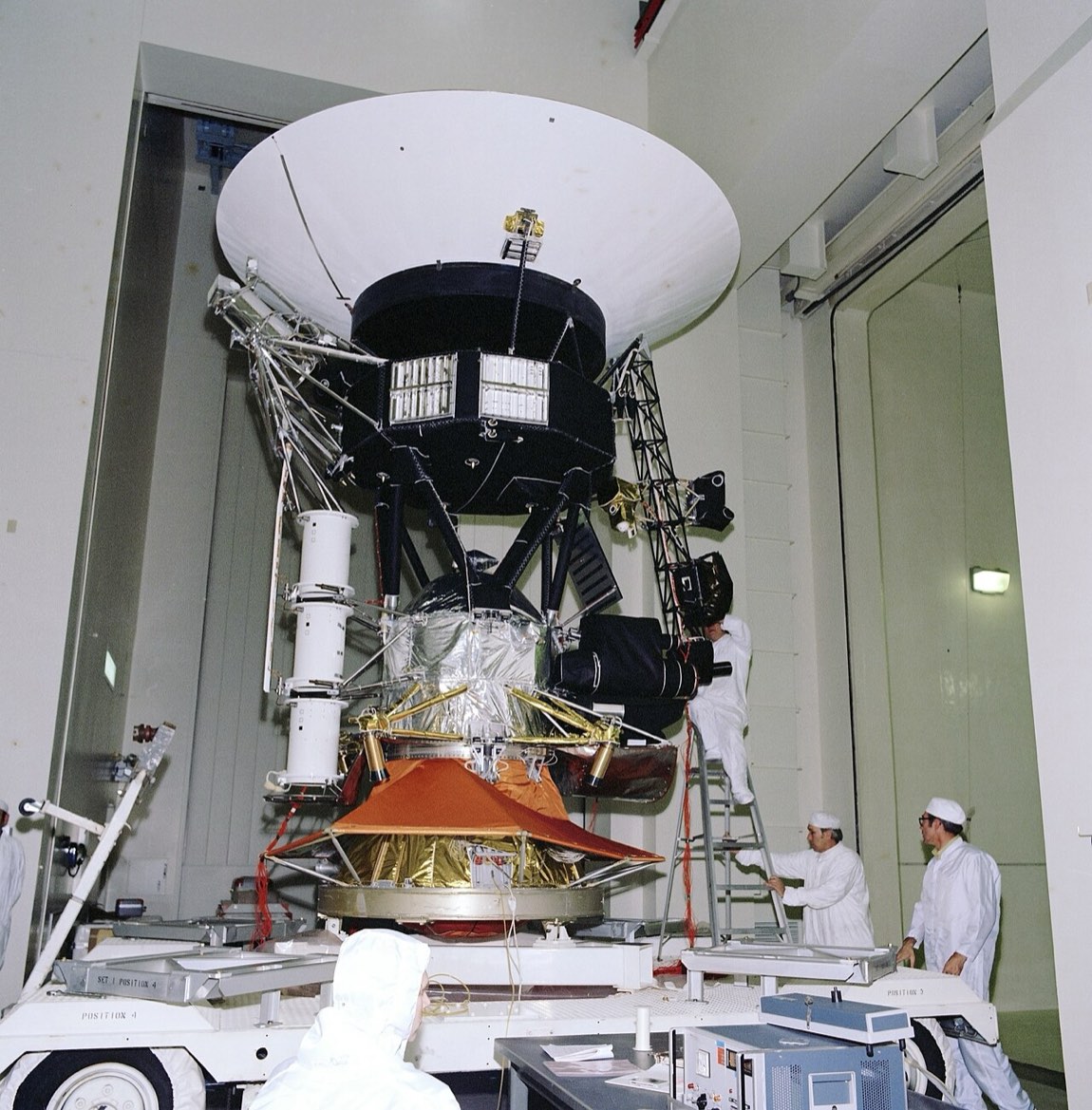
Every detailed fact known about Triton's surface comes from a single spacecraft encounter: Voyager 2's flyby on August 25, 1989, conducted from a closest approach distance of about 40,000 kilometres. In that single pass, the probe imaged roughly 40 percent of the moon's surface, discovered the active nitrogen plumes, measured the atmosphere, confirmed the retrograde orbit's precise parameters, and obtained the best estimate of Triton's diameter at 2,706 kilometres — vastly more accurate than the wildly varying ground-based estimates, which had ranged from 2,500 to 6,000 kilometres. The first serious attempt to measure Triton's diameter had been made by Gerard Kuiper in 1954, who obtained a value of 3,800 kilometres — an overestimate of more than 40 percent. Before the flyby, astronomers had also speculated that Triton might have liquid nitrogen seas and an atmosphere nearly a third as dense as Earth's, neither of which turned out to be true. Since 1989, all additional knowledge has come from Earth-based telescopes and stellar occultation observations. No spacecraft has returned. As of 2026, Voyager 2 remains humanity's only up-close visit to Triton, and the 60 percent of the surface it never photographed remains completely unknown in detail.
 ⤢
⤢
13 The fleet of missions that never flew
Scientists have repeatedly designed compelling mission concepts for Triton, and none has yet been approved for flight. The Trident spacecraft was formally proposed in 2019 under NASA's Discovery Program — a relatively low-cost category — as a flyby mission designed to investigate Triton's potential as an ocean world. Two New Frontiers-class concepts followed: Triton Ocean World Surveyor, which would launch in 2031 and arrive in 2047, and Nautilus, which would launch in August 2042 and arrive in April 2057. A grander vision called Neptune Odyssey, a full Neptune orbiter with Triton as its primary science target, began formal study in April 2021 as a potential large strategic NASA mission that would launch in 2033 and reach the Neptune system in 2049. An even more imaginative concept, the Triton Hopper, proposed a lander that would mine nitrogen ice directly from Triton's surface and process it as rocket propellant, allowing the vehicle to hop across the landscape from site to site. NASA's current outer Solar System funding remains focused on the Jupiter and Saturn systems, and none of the Neptune or Triton proposals has advanced beyond the study phase.
14 Triton's orbital death sentence — on a long fuse Deeper
Because Triton orbits Neptune in the wrong direction, tidal forces are slowly but relentlessly draining energy from its orbit rather than sustaining it. The result is that Triton is spiralling inward. Its orbit is already closer to Neptune than the Moon is to Earth. Eventually, it will cross Neptune's Roche limit — the distance at which tidal forces overpower the self-gravity holding a body together. At that point Triton will either be torn apart into a new ring system, perhaps resembling Saturn's rings in scale, or it will plunge directly into Neptune's atmosphere. Exactly when this happens has been revised significantly: an earlier estimate placed the crossing of the Roche limit at roughly 3.6 billion years from now, but a 2025 study concluded the timeline is far longer — approximately 28 billion years — indicating that Triton's orbital evolution is more stable than previously thought. For context, 28 billion years is about twice the current age of the Universe. The near-perfect circularity of today's orbit — with an eccentricity of just 0.000016 — was itself a slow achievement. Tidal friction alone could not have circularized the originally wild post-capture orbit fast enough; gas drag from a disc of prograde debris around Neptune is thought to have played a major role in rounding the orbit out to its current almost perfectly circular state.
15 Named places on a barely-seen world
Despite only 40 percent of its surface having been imaged, Triton already has a rich collection of named geological features drawn from oceanic and aquatic mythology worldwide — fitting for a moon of the god of the sea. The geyser plumes observed by Voyager 2 are named after water spirits: the Hili plume takes its name from a Zulu water sprite and the Mahilani plume from a Tongan sea spirit. Ridge systems carry names such as Yasu Sulci, Ho Sulci, and Lo Sulci. The giant cryovolcanic caldera near the equator is Leviathan Patera, named for the biblical sea monster, and its surrounding plain is Cipango Planum. The largest confirmed impact crater is Mazomba, 27 kilometres in diameter. The dark surface patches known as maculae — typically about 100 kilometres in diameter with bright halos 20 to 30 kilometres wide — are named but remain only partially understood geologically. The four especially flat, roughly circular "walled plains" on the surface, thought to have been formed by floods of icy lava, vary in altitude by less than 200 metres across their entire extents, making them among the flattest terrains yet documented anywhere in the Solar System. All of these names apply to features documented by a single spacecraft during a single afternoon of observations in August 1989.
 ⤢
⤢
You would weigh…
Surface gravity 0.78 m/s² vs Earth’s 9.81 m/s². Try every world →
Could life exist here?
A possible ammonia-water ocean under a young, active surface keeps Triton on the serious list — with a giant asterisk: one flyby's worth of data, 35+ years old.
Our labels: Confirmed · Strong Evidence · Estimated · Hypothesis · Theoretical · Speculative (see Methodology).
Could humans live here?
No. Triton is for robotic explorers; even they need 12+ year cruises.
How would we get there?
Voyager 2 took 12 years. Proposed missions use Jupiter assists for ~13-year cruises. Nothing is currently scheduled.
| Technology | Status | Travel time (one way, straight line) |
|---|---|---|
| Apollo-style spacecraft, about 39,000 km/h | Flown technology | 13 years |
| Ion-propulsion probe, about 90,000 km/h | Flown technology | 6 years |
| Voyager 1, about 61,000 km/h | Flown technology | 8 years |
| Parker Solar Probe, about 690,000 km/h | Flown technology | 273 days |
| Nuclear-thermal rocket, about 120,000 km/h cruise | In development | 4 years |
| Laser light-sail at 20% of light speed | Proposed concept | 20.8 hours |
| Light itself, 299,792 km/s | Physical limit | 4.2 hours |
Simplified straight-line times at cruise speed. Real missions fly curved orbital paths and take longer. Full travel calculator →
Weird & wonderful
- Triton is slowly falling toward Neptune — its finale will be a ring brighter than Saturn's.
- Voyager 2 caught geysers erupting on a world colder than liquid nitrogen.
- Its 'cantaloupe terrain' looks like melon skin and exists nowhere else.
- Triton probably once had moons of its own — lost in the capture.
More real images of Triton
Genuine spacecraft and telescope imagery, every frame credited and licensed. Tap any photo to enlarge.