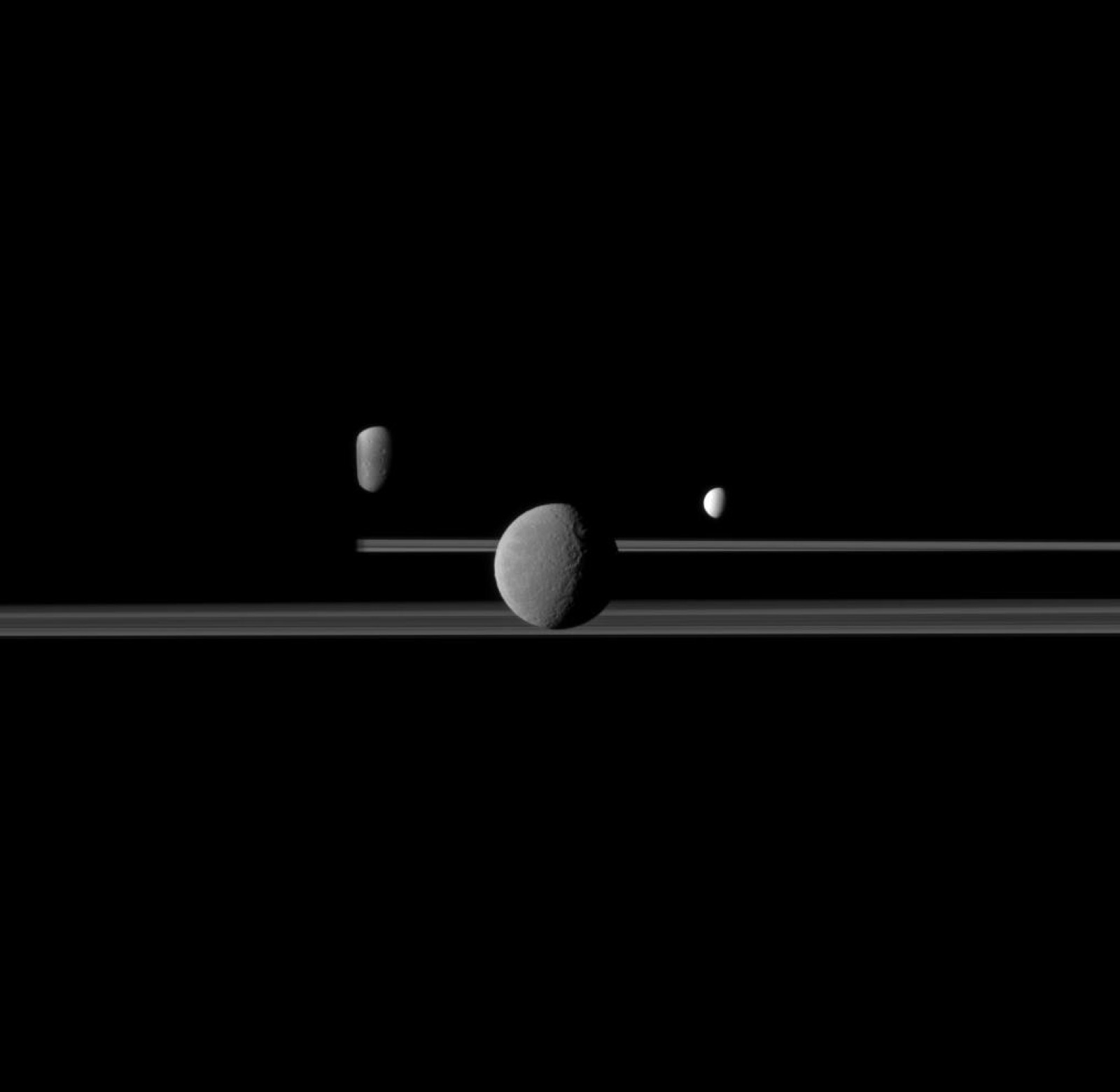
 Photograph · NASA/JPL/Space Science Institute
Moon · Deep guide · orbits Saturn
Rhea
Saturn's second-largest moon, an ancient ice ball with a whisper of oxygen.
What is it?
Rhea is a heavily cratered world of ice and rock, 1,528 km across, orbiting Saturn every 4.5 days. Cassini found it has an astonishingly thin atmosphere — an exosphere of oxygen and carbon dioxide, the first oxygen atmosphere detected beyond Earth, produced as radiation splits its surface ice.
The deep dive
Researched for the Atlas from Wikipedia — Rhea (moon) (12,458 characters read) · updated Sep 20, 2026
01 Discovered by candlelight in 1672
Giovanni Domenico Cassini spotted Rhea on 23 December 1672 using a 10.4-metre telescope crafted by the celebrated lens-maker Giuseppe Campani. It was the second moon of Saturn that Cassini personally discovered and only the third Saturnian moon known to humanity at the time. Cassini did not name the moon after a mythological figure — instead he bundled his four discoveries together under the collective title Sidera Lodoicea, meaning 'the stars of Louis,' as a tribute to his patron King Louis XIV of France. The mythological name Rhea would not be attached to this world for another 175 years. It was the English astronomer John Herschel — son of William Herschel, the discoverer of Uranus — who in 1847 formally proposed in his Results of Astronomical Observations made at the Cape of Good Hope that the siblings of Cronus from Greek mythology should name Saturn's moons. Since Rhea in myth was the Titan mother of the first Olympian gods and wife of Cronus (the Greek counterpart of Saturn), the name was a natural fit.
02 A world built almost entirely of ice
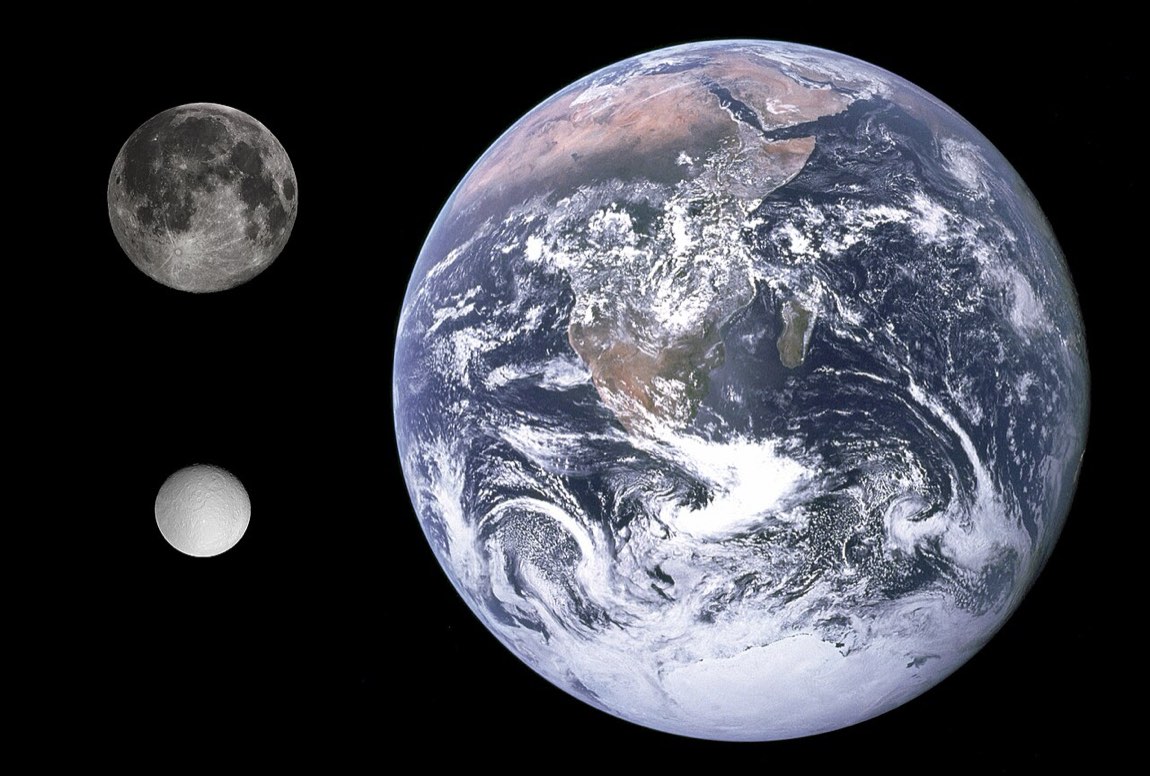
Rhea has a mean diameter of 1,528 kilometres, making it Saturn's second-largest moon, yet it is less than a third the radius of Titan. What makes Rhea unusual is just how light it is: its density is only about 1.236 grams per cubic centimetre, barely denser than water. That low density reveals its recipe — roughly 75 percent water ice and only about 25 percent rock. Deeper inside, temperatures and pressures are thought to be high enough to produce Ice II, a high-pressure crystalline form of water ice, beginning somewhere between 350 and 450 kilometres beneath the surface. Rhea's surface area works out to approximately 7,330,000 square kilometres, almost exactly the area of Australia (7,688,287 square kilometres), so imagining hiking across Rhea is roughly like circumnavigating an entire continent of frozen terrain. Despite being the ninth-largest moon in the Solar System by size, Rhea ranks only tenth in mass, because Uranus's moon Oberon, though slightly smaller in volume, is significantly denser at 1.63 grams per cubic centimetre compared to Rhea's 1.24.
03 The great interior debate: core or no core? Deeper
For decades astronomers assumed Rhea must have a dense rocky core surrounded by an ice mantle — a layered, differentiated structure similar to many other icy moons. The Cassini orbiter's close 2005 flyby scrambled that picture. A 2007 paper derived an axial dimensionless moment of inertia coefficient of 0.4, a value that points to a nearly uniform interior with only mild compression of ice at the centre; a rocky core would push that coefficient down to around 0.34. Yet the same year a second paper placed the coefficient at about 0.37, and a third paper questioned whether Rhea is even in hydrostatic equilibrium, which would make deriving any interior model from gravity data unreliable. One of the original authors revisited all three results in 2008 and concluded there was a systematic error in the Cassini radio Doppler dataset. Restricting the analysis to data gathered closest to the moon, he recovered his original value of roughly 0.4 — consistent with a homogeneous, largely undifferentiated interior. Rhea's triaxial shape also supports this picture of a uniform body in hydrostatic equilibrium. The question of whether a small liquid-water ocean could persist through radioactive heating was raised in 2006 modelling, but more recent evidence of a homogeneous interior makes that scenario unlikely.
04 Why Rhea's craters look so crisp
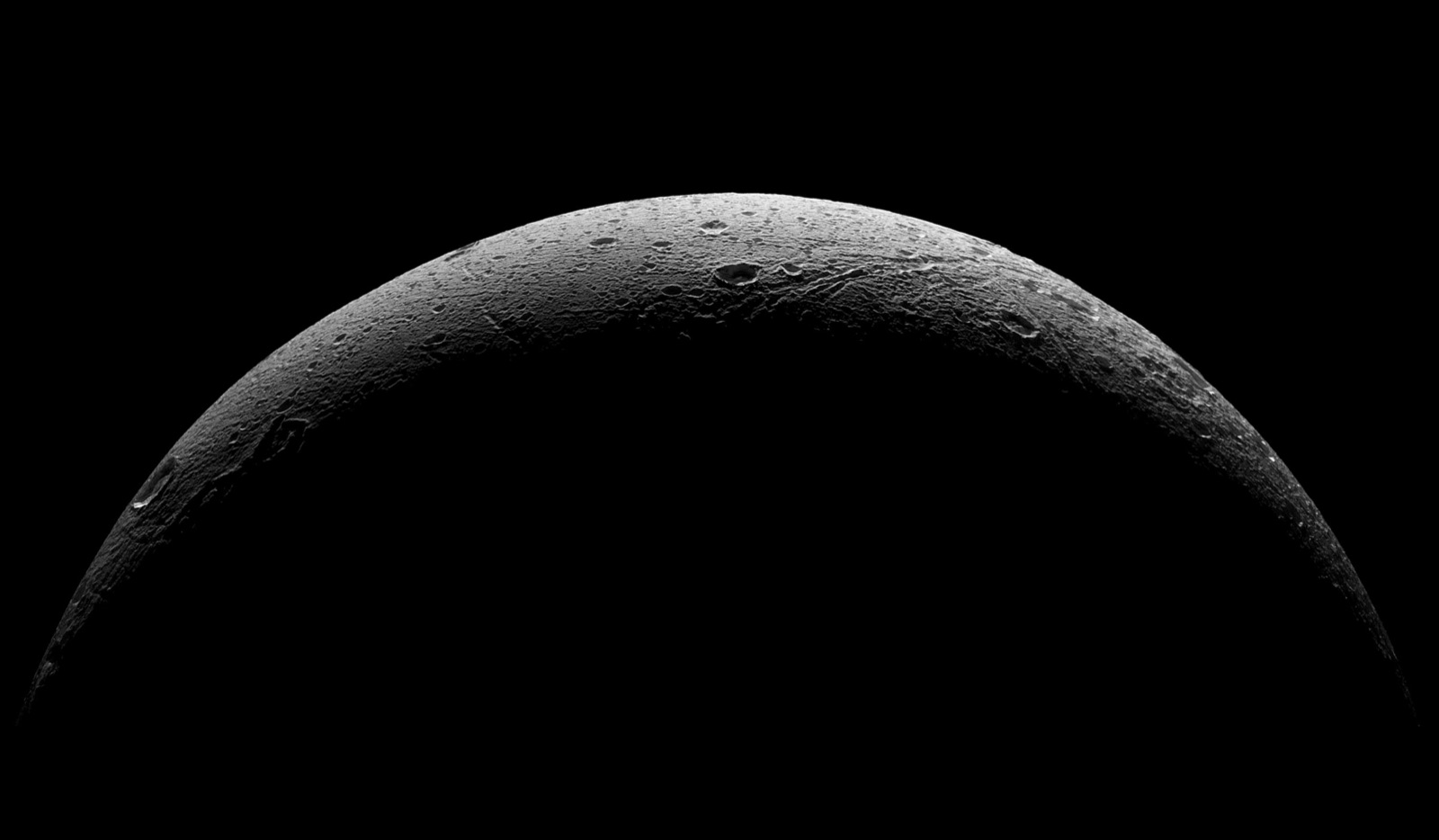
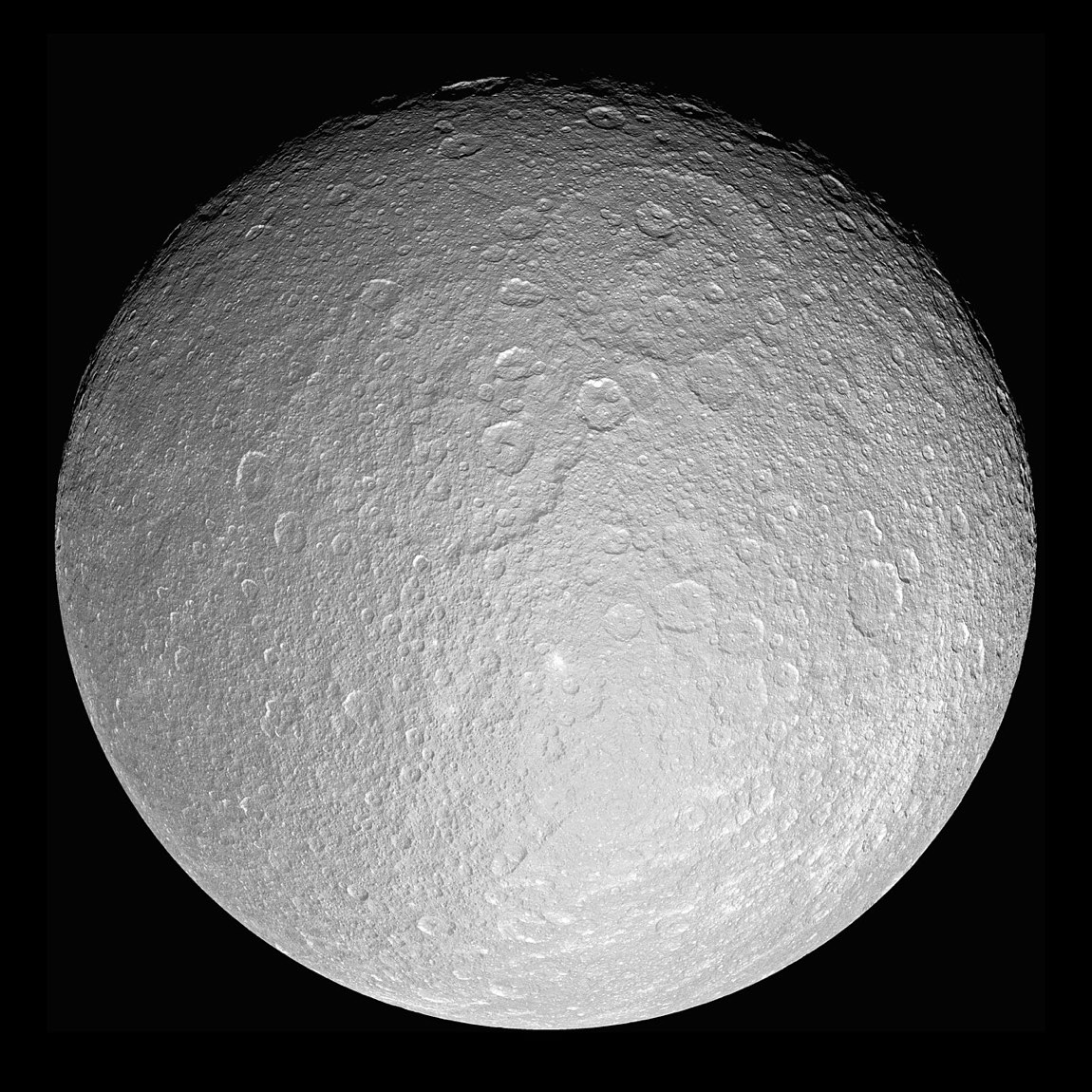
Stand anywhere on Rhea and you would be surrounded by impact craters, but they would look strikingly sharp compared to their counterparts on Ganymede or Callisto. Planetary scientists attribute this to Rhea's very low surface gravity — just 0.26 metres per second squared, compared to 1.428 on Ganymede and 1.235 on Callisto. With such weak gravity, crater walls do not slump and flatten over time the way they do on larger worlds, so the topography stays crisp. The same low gravity explains another oddity: ejecta blankets, the asymmetrical skirts of debris thrown outward around craters, are essentially absent on Rhea. Material simply flies too far and spreads too thinly to leave a coherent blanket. The heavily cratered plains are estimated to be up to four billion years old on average, making them some of the oldest unaltered surfaces in the Saturn system. Rhea's craters also lack the high relief features seen on the Moon and Mercury, mirroring the behaviour seen on Callisto — a comparison that hints at the role surface gravity plays in sculpting icy worlds.
05 The Splat and other landmark craters
Rhea's most photogenic feature is a 48-kilometre-wide impact crater sitting at 112° west longitude, officially named Inktomi but popularly nicknamed 'The Splat' because of the dramatic system of bright rays it sprays across the surface. Those rays extend up to 400 kilometres from the crater rim, blanketing most of one hemisphere with fresh bright material. A 2007 paper in Lunar and Planetary Science hypothesised that Inktomi may be one of the youngest craters on any of Saturn's inner moons, its brightness reflecting relatively unweathered ice not yet darkened by radiation or micrometeorite gardening. On the hemisphere facing away from Saturn, Rhea hosts two enormous impact basins roughly 400 and 500 kilometres across. The more northerly and better-preserved of the two is called Tirawa, which is broadly comparable in size to the basin Odysseus on the neighbouring moon Tethys. The surface can also be divided into two geological zones based on crater size: one dominated by craters larger than 40 kilometres in diameter, and another in polar and equatorial regions containing only smaller craters — evidence that a major resurfacing event altered part of Rhea during or shortly after its formation.
06 Bright wispy cliffs on the dark trailing side
One of Rhea's most visually striking features appears on its trailing hemisphere — the side that faces backward along the direction of its orbit. Bright wispy streaks cut across a darker background, creating patterns that superficially resemble brushstrokes on a canvas. For a long time these were described simply as 'wispy terrain,' but Cassini data revealed their true nature: they are networks of tectonic fractures, specifically depressions called graben and elongated troughs, whose cliff faces are coated in clean, reflective water ice. The cliffs' bright ice contrasts sharply with the surrounding dark material, which is believed to consist of tholins — complex organic compounds produced when radiation and heat break apart simple molecules containing carbon, nitrogen, and hydrogen frozen in the surface ice. These tholins are analogous to the dark reddish material seen on other icy bodies in the outer Solar System. The trailing hemisphere receives heavy irradiation from Saturn's magnetosphere, which drives ongoing chemical changes and may continually regenerate both the dark organic coating and, through radiolysis of water ice, some of the oxygen in Rhea's exosphere.
 ⤢
⤢
07 A whisper-thin oxygen and CO₂ atmosphere
On 27 November 2010, NASA announced that Rhea possesses an exosphere — an extremely tenuous atmosphere that barely qualifies as a gas envelope. It is composed of oxygen and carbon dioxide in a ratio of roughly 5 to 2. The surface density is between 100,000 and 1,000,000 molecules per cubic centimetre depending on local temperature, which sounds like a lot until you realise Earth's atmosphere at sea level contains around 2.7 × 10¹⁹ molecules in the same volume — making Rhea's exosphere tens of trillions of times thinner. The primary source of oxygen is well understood: high-energy particles from Saturn's magnetosphere bombard the water-ice surface in a process called radiolysis, splitting water molecules and releasing oxygen. The carbon dioxide is more mysterious. It may come from the oxidation of organic compounds already locked in the ice, or it may seep out from Rhea's interior as a form of outgassing. Sorting out which source dominates remains an open question.
08 The rings that probably were not there Deeper
On 6 March 2008, NASA announced a tantalising possibility: Rhea might be encircled by its own ring system, which would have been the first rings ever confirmed around a moon. The evidence came from Cassini observations of how electrons trapped in Saturn's magnetic field changed their flow pattern as the spacecraft passed by Rhea — a signature consistent with solid material absorbing some of those particles. Theorists suggested that dust and debris could extend out to Rhea's Hill sphere, the gravitational boundary of its influence, with three narrow denser rings closer in. The case seemed to gain further support when Cassini detected a set of small ultraviolet-bright spots arranged along Rhea's equator, interpreted as impact points where deorbiting ring material was hitting the surface. However, when Cassini deliberately tilted to observe the proposed ring plane from multiple angles, no ring material was detected. The rings, if they exist at all, were below detection thresholds, and scientists acknowledge that an alternative explanation for the original electron-flow observations is still needed.
09 How Cassini mapped Rhea up close
The first images of Rhea were returned by the Voyager spacecraft during their flybys in 1980 and 1981, giving planetary scientists their initial global view of this icy world. The real revolution came with the Cassini–Huygens mission, launched in 1997 and designed specifically to study the Saturn system. Over the course of its mission, the Cassini orbiter made five targeted close flybys of Rhea. The first and most distant of the close encounters, on 26 November 2005, brought Cassini within 500 kilometres of the surface. An August 2007 flyby passed at 5,750 kilometres. Then the spacecraft grew progressively bolder: 100 kilometres on 2 March 2010; a remarkably close 69 kilometres on 11 January 2011 — close enough that a jet passenger aircraft flying straight would cover that distance in under eight minutes; and a final farewell flyby at 992 kilometres on 9 March 2013. Each pass provided new gravity, imaging, and particle data that reshaped understanding of Rhea's interior, surface, and space environment.
10 Rhea's place in Saturn's moon family tree Deeper
Rhea is also officially designated Saturn V, meaning it is the fifth major moon counting outward from Saturn, after Mimas, Enceladus, Tethys, and Dione. That numbering scheme has a tangled history: early astronomers simply referred to Titan and the four Cassini moons as Saturn I through Saturn V. When William Herschel discovered Mimas and Enceladus in 1789, the scheme stretched to Saturn VII, and the 1848 discovery of Hyperion pushed it to Saturn VIII. As for how Rhea formed, the dominant model invokes co-accretion from the disc of material surrounding the young Saturn — the same general process thought to have built all the planets. But a rival model proposed by Erik Asphaug and Andreas Reufer offers a more violent origin story. In their scenario, Titan formed through a series of giant impacts between pre-existing proto-moons. Rhea and Iapetus, the two largest moons outside Titan's orbit, may then have assembled from the debris of those catastrophic collisions, making Rhea in a sense a second-generation world built from the wreckage of even older bodies.
11 The symbol almost nobody uses
Most planetary moons, apart from Earth's own Moon, have never been assigned individual astronomical symbols, and Rhea is no exception in the official literature. However, Denis Moskowitz, a software engineer best known for designing most of the symbols used for dwarf planets, took it upon himself to create one for Rhea. His design combines the Greek letter rho — the initial letter of Rhea's name — with the hooked crook that forms part of the traditional symbol for Saturn. The result is a compact glyph that elegantly ties the moon's name to its parent planet. Despite the cleverness of the design, the symbol has not entered widespread use among astronomers or in scientific publications. Rhea remains one of countless Solar System bodies that exist in the literature as a name and a number, Saturn V, rather than as a symbol — a small reminder of how informal and sometimes ad hoc the history of astronomical nomenclature can be.
12 Open questions scientists are still arguing about Deeper
Rhea looks like a straightforward icy moon, but several fundamental questions remain genuinely unresolved. The interior structure debate — homogeneous ball of ice and rock versus a differentiated rocky core — has not been definitively settled, with different analyses of the same Cassini gravity data producing moments of inertia ranging from 0.37 to 0.40, each implying a different internal architecture. The origin of the carbon dioxide in the exosphere is unclear, with oxidation of surface organics and interior outgassing both being plausible but unconfirmed. The mysterious ultraviolet-bright equatorial spots, once thought to be ring-impact scars, are unexplained now that ring material itself was not detected. The faint equatorial line of material visible on the surface, possibly deposited by deorbiting debris, also lacks a firm explanation. And the broader question of whether Rhea formed by co-accretion from Saturn's primordial disc or as debris from giant impacts that shaped Titan is still an active area of modelling. Each of these puzzles awaits a future mission with the patience and instrumentation to look more closely.
 ⤢
⤢
You would weigh…
Surface gravity 0.26 m/s² vs Earth’s 9.81 m/s². Try every world →