 Photograph · NASA/JPL/Space Science Institute
Moon · Deep guide · orbits Saturn
Iapetus
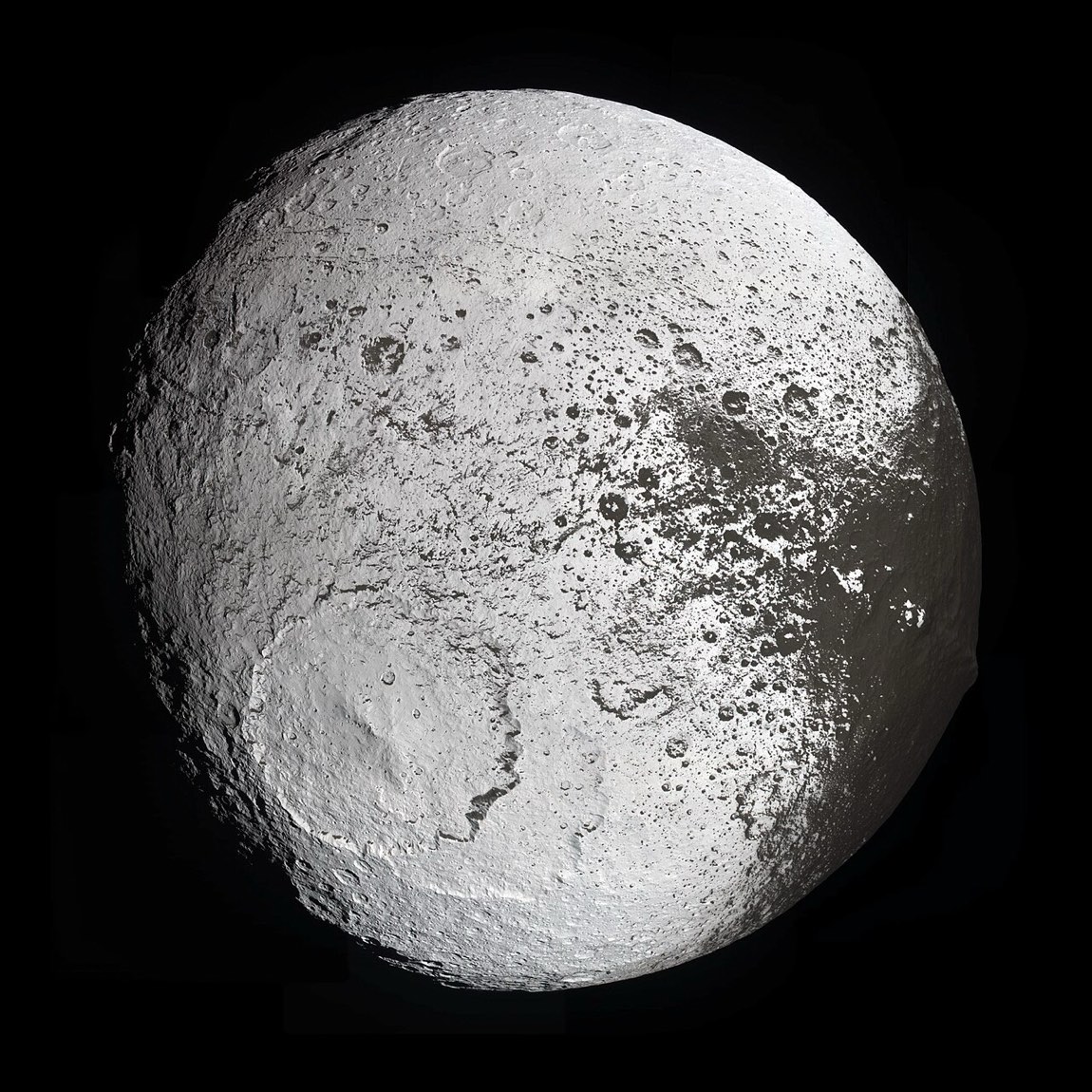
Saturn's two-faced moon: coal-black on one side, snow-white on the other.
What is it?
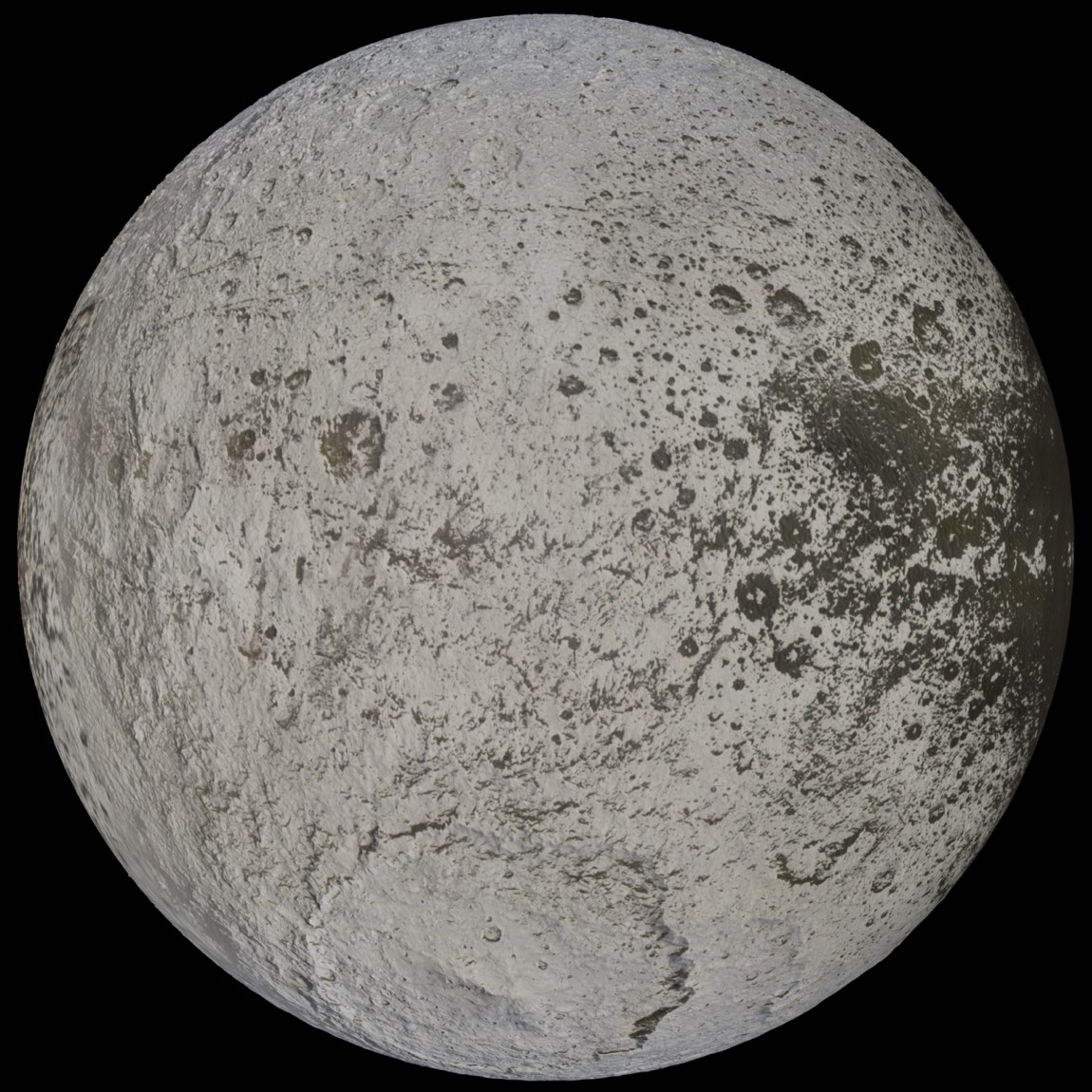
Iapetus is one of the strangest worlds known: its leading hemisphere is as dark as coal while the trailing one is bright ice, a contrast visible even in 17th-century telescopes — Cassini himself noticed the moon vanished on one side of its orbit. Adding to the mystery, a ridge of mountains up to 13 km tall runs precisely along its equator, like a walnut's seam.
The deep dive
Researched for the Atlas from Wikipedia — Iapetus (moon) (17,529 characters read) · updated Sep 20, 2026
01 How Cassini Cracked the Two-Tone Mystery
For more than three centuries after Giovanni Domenico Cassini first noticed Iapetus dimming when it moved to the eastern side of Saturn, astronomers could only guess why one hemisphere was so much darker than the other. Cassini correctly deduced in the 1670s that the moon must be tidally locked and have one bright and one dark face, but the cause of that darkness waited until the space age to be explained. The leading hypothesis today involves two cooperating processes. First, dust blasted off small outer moons by micrometeoroid impacts — most importantly Phoebe, the largest outer moon — spirals inward and coats the leading hemisphere of Iapetus. That initial coating creates a modest difference in how much sunlight each hemisphere absorbs. Second, because Iapetus rotates once every 79 days, the darkened surface grows warm enough during its long day to sublimate ice, which then migrates to cooler regions and refreezes. This thermal runaway amplifies the original contrast over billions of years. The dark material is estimated to be only a few tens of centimeters thick in some areas, yet the feedback mechanism is powerful enough that the dark region loses roughly 20 meters of ice to sublimation every billion years while the bright regions lose only about 10 centimeters over the same span.
02 The Phoebe Ring and Infalling Dust Deeper
A key piece of evidence supporting the exogenic origin of Iapetus's dark coating came on 6 October 2009, when astronomers announced the discovery of a vast, tenuous disk of material lying in the plane of Phoebe's orbit. Detected using the Spitzer Space Telescope, this ring extends from 128 to 207 times the radius of Saturn, while Phoebe itself orbits at an average of about 215 Saturn radii. Material knocked from Phoebe's surface by micrometeoroid bombardment would spiral gradually inward, darkening as it was processed by sunlight, and any portion of it that crossed Iapetus's orbital path would be swept up preferentially by the leading hemisphere. Although Phoebe's own composition is compositionally closer to the bright regions of Iapetus than the dark ones, the model does not require Phoebe dust to be the final dark material; it only needs to seed an initial albedo contrast. Once that contrast existed, the thermal feedback mechanism described by scientists would take over and drive the dichotomy to the extreme seen today. Simple numerical models of these combined exogenic deposition and thermal water-redistribution processes can closely reproduce the two-toned pattern observed on Iapetus, lending the combined hypothesis considerable credibility.
03 The Walnut Ridge Nobody Can Fully Explain
When Cassini spacecraft images taken on December 31, 2004 revealed a towering ridge running along the equator of Iapetus, planetary scientists were stunned. The ridge stretches about 1,300 km long, reaches 20 km wide, and rises 13 km high, with individual peaks climbing more than 20 km above the surrounding plains — placing them among the tallest mountains in the entire Solar System. For comparison, Mount Everest is less than 9 km tall. The ridge runs along the center of the dark Cassini Regio and follows the equator almost perfectly, which is itself deeply puzzling. It forms a complex system of isolated peaks, segments exceeding 200 km in length, and sections showing three nearly parallel ridges running side by side. Heavy cratering across the ridge shows it is ancient. Its existence had actually been hinted at earlier, inferred from polar images taken by Voyager 2, but Cassini confirmed it dramatically. Four main hypotheses compete: the ridge could be a fossil remnant of Iapetus's early oblate shape, the collapsed remains of a former ring system, material welled up from the interior, or the product of convective overturn. None fully explains why the ridge is confined almost entirely to Cassini Regio.
 ⤢
⤢
04 A Shape Frozen in Time Deeper
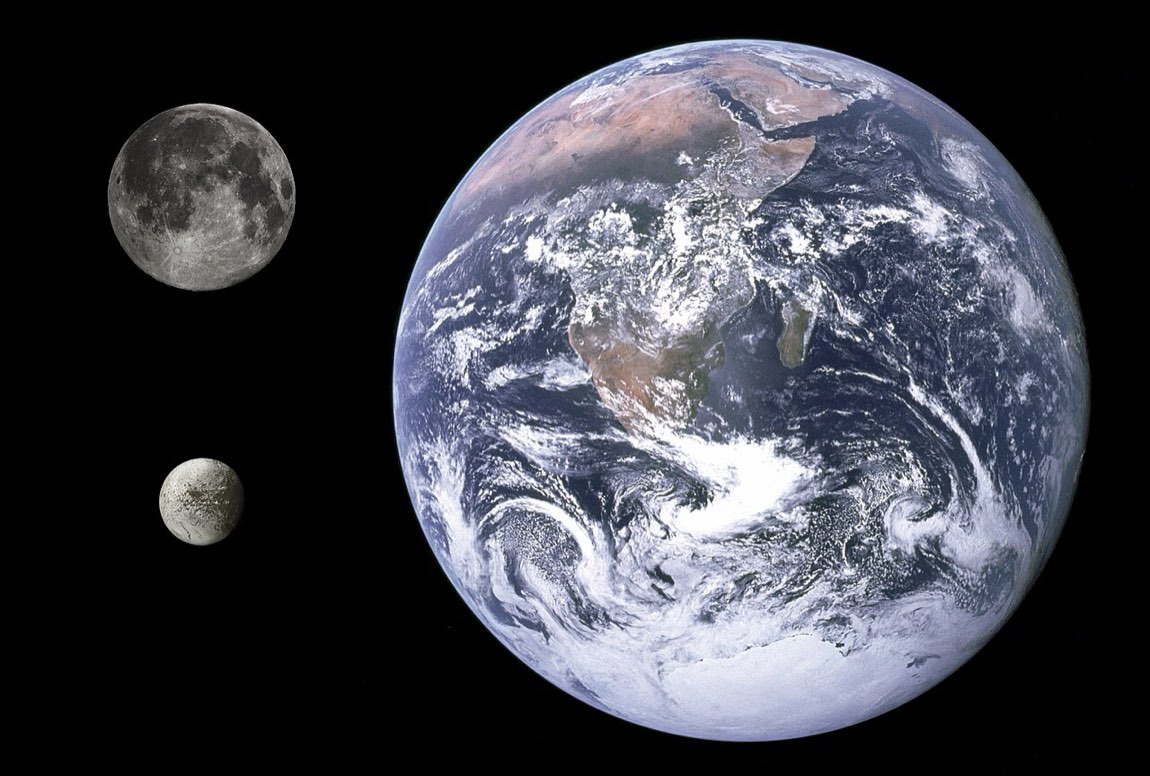
Iapetus has a distinctly non-spherical shape that has puzzled researchers. Current triaxial measurements give it radial dimensions of 746.7 km × 745.7 km × 712.1 km, meaning it is noticeably flattened at the poles — a walnut-like form reinforced further by the equatorial ridge. In hydrostatic equilibrium, such an oblate shape would be consistent with a rotational period of approximately 16 hours. Yet Iapetus today rotates once every 79 days, the slowest rotation in the Saturnian moon system. The reconciliation proposed by scientists is that Iapetus's crust froze into its current shape very early in its history, when the moon was still spinning much faster. Tidal forces from Saturn then gradually slowed that rotation over geologic time until the moon became tidally locked, but the rigid crust retained the memory of its earlier faster spin. This frozen-shape hypothesis would also explain the equatorial bulge. It is an elegant idea, though researchers note that measurements of the full surface in sufficient resolution have not yet been achieved, meaning the exact shape figures may carry kilometer-scale uncertainties.
05 Craters, Scarps, and Landslides
Iapetus is heavily cratered, bearing the scars of billions of years of bombardment. Cassini images revealed at least five impact basins wider than 350 km, and the largest, named Turgis, has a diameter of 580 km — wide enough to swallow the entire state of Colorado. Turgis's rim is extraordinarily steep, featuring a scarp about 15 km high, taller than any mountain on Earth. Beyond impact craters, Iapetus also hosts long-runout landslides, known scientifically as sturzstroms — a phenomenon also seen on Mars and other bodies. On Iapetus these may be facilitated by ice sliding, which can allow debris to travel far greater distances than dry rock slides would permit. The color dichotomy between bright and dark regions is visible at remarkably fine scales: down to the 30-metre imaging resolution of Cassini's cameras, there are distinct light and dark patches with virtually no intermediate shades of grey. Dark material settles into low-lying areas while bright ice clings to the weakly illuminated, pole-facing interior slopes of craters, creating a stark and visually dramatic landscape across the transition zone between Cassini Regio and the brighter terrain.
06 Named for Epic Heroes and Titans
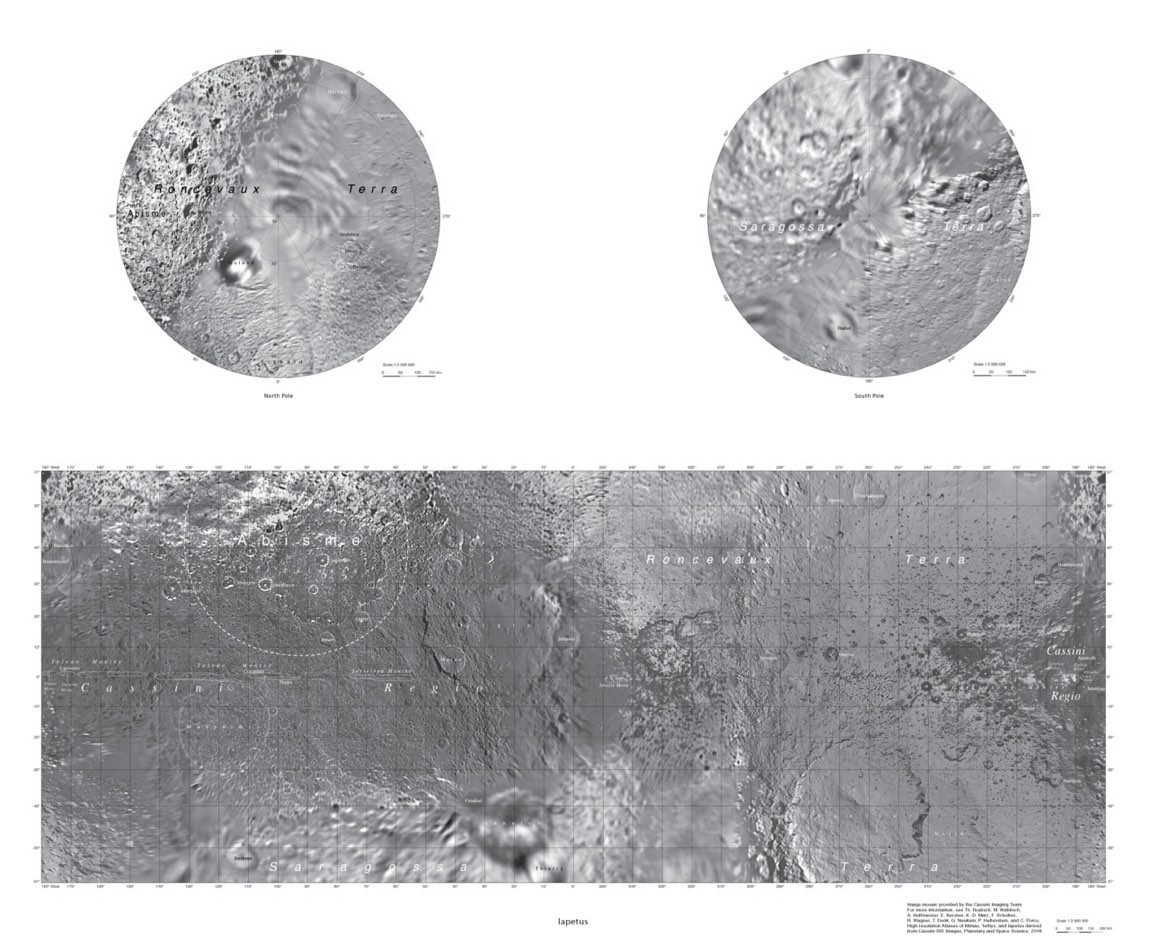
The naming heritage of Iapetus stretches across centuries and literary traditions. The moon itself takes its name from the Titan Iapetus of Greek mythology, a suggestion made by John Herschel, son of William Herschel, in his 1847 publication Results of Astronomical Observations made at the Cape of Good Hope. Herschel advocated naming Saturn's moons after Titans — brothers and sisters of Cronus, whom the Romans identified with Saturn — and after Giants who sided with the Titans against Zeus. The geological features on Iapetus itself follow a different literary tradition: they are named after characters and places from the French medieval epic poem The Song of Roland. Hence the dark region is Cassini Regio, honoring the discoverer, while the bright northern terrain is Roncevaux Terra and the southern bright terrain is Saragossa Terra, both drawn from the poem's geography. The moon's designation has evolved considerably since discovery: Cassini originally grouped it with Tethys, Dione, and Rhea under the label Sidera Lodoicea, honoring King Louis XIV. Astronomers then numbered it Saturn V, then Saturn VII after Mimas and Enceladus were found in 1789, and finally Saturn VIII after Hyperion was discovered in 1848 — the Roman numeral designation still used today.
 ⤢
⤢
07 What Four Spacecraft Actually Revealed Deeper
Four spacecraft have encountered the Saturnian system with varying relevance to Iapetus. Pioneer 11 was first but contributed almost nothing to Iapetus science specifically, coming no closer than 1,030,000 km and returning no useful images of the moon. Voyager 1, arriving at Saturn on November 12, 1980, became the first mission to photograph Iapetus clearly enough to show its two-tone appearance, doing so from a distance of 2,480,000 km while exiting the system. Voyager 2 arrived on August 22, 1981 and made a closest approach of 909,000 km, photographing the north pole as it entered the system from the opposite approach direction of Voyager 1. The Cassini orbiter, which entered Saturn orbit on July 1, 2004, transformed Iapetus science with six targeted flybys over three years. Its first flyby on December 31, 2004 passed at 123,400 km, discovering the equatorial ridge. A second flyby on November 12, 2005 came to 415,000 km, followed by successively varied encounters. The closest encounter of all came on September 10, 2007, when Cassini approached from the night side to just 1,227 km — close enough to reveal that the dark coating is only a few tens of centimeters thick in places, and that craters in the dark region have punched through to bright ice beneath. No further targeted flybys of Iapetus were conducted after 2007.
08 An Orbit Unlike Any Other Large Moon Deeper
Iapetus occupies one of the most dynamically unusual orbits in the Saturn system. It orbits on average 2.4 times farther from Saturn than Hyperion, the next moon inward, yet unlike chaotically rotating Hyperion, Iapetus is tidally locked — making it the most distant tidally locked moon in the Solar System. Its orbital plane is the most steeply inclined of all Saturn's regular satellites; only the irregular outer moons such as Phoebe have more inclined orbits. The inclination relative to Saturn's equator oscillates between 5 and 21 degrees over a nodal precession period of roughly 3,400 years, and its orbital precession is about the slowest possible for any moon of Saturn. Iapetus sits just outside the Laplace radius, the boundary at which a moon's orbital precession shifts from being dominated by the planet's equatorial bulge to being dominated by the Sun's gravity — leaving Iapetus in an ambiguous dynamical zone between regular and irregular satellite classifications. It is also caught in a secular resonance involving both Jupiter and Saturn, a gravitational entanglement expected to persist for tens of millions of years, though long-term stability beyond that timescale is not guaranteed. The cause of the highly inclined orbit remains unknown; one proposal invokes a close encounter between Saturn and another planet in the distant past.
09 Saturn's Rings, Visible Only From Here
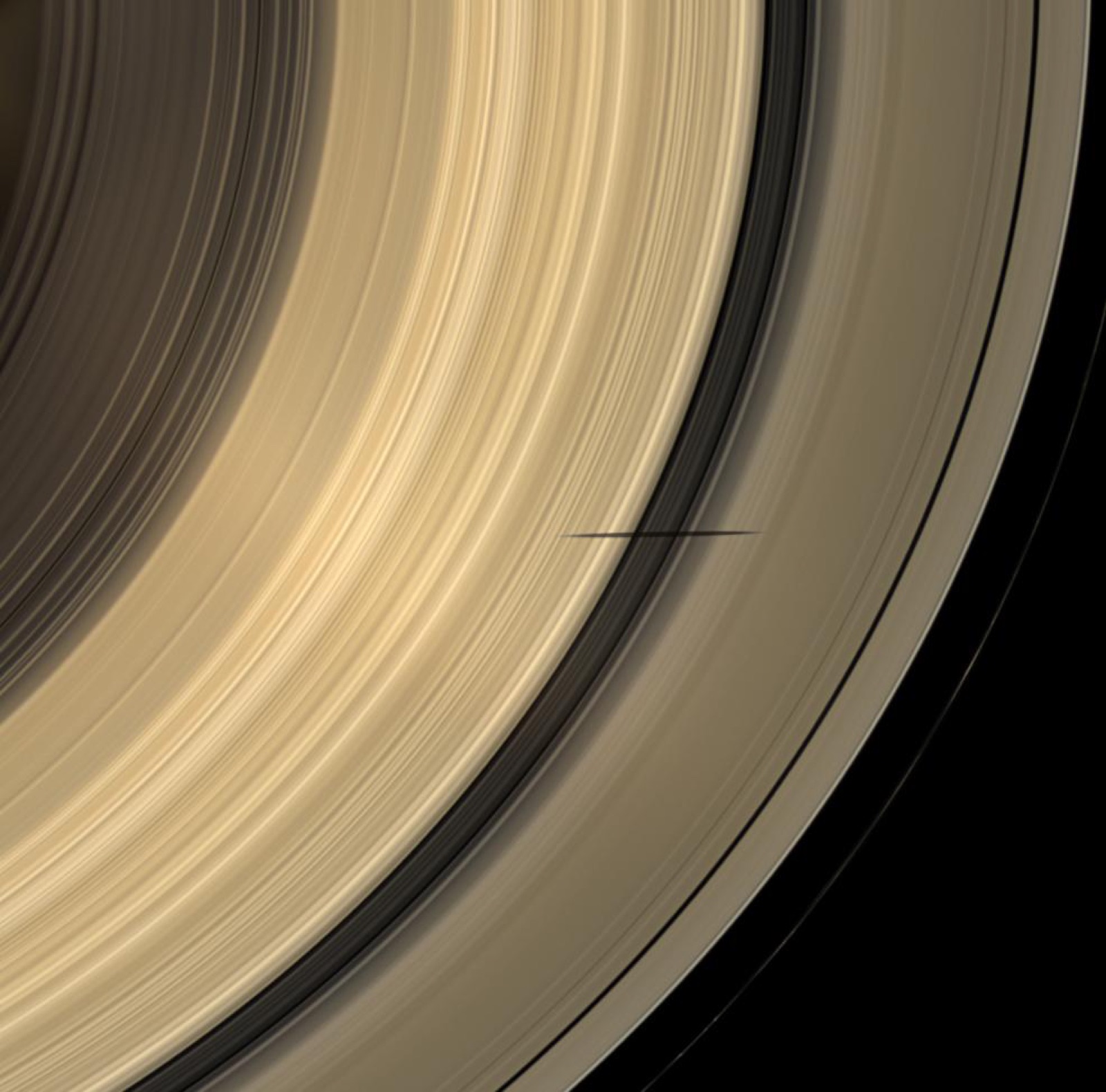
One of the more quietly remarkable consequences of Iapetus's unusual orbital inclination is its unique view of Saturn's rings. Because Iapetus orbits at a steep angle relative to Saturn's equatorial plane — the plane in which the rings lie — a hypothetical observer standing on Iapetus would be the only person standing on any of Saturn's large moons able to see the rings spread out as a grand disk across the sky. From all the inner major moons, the rings are viewed edge-on and appear as little more than a thin bright line. The rings' tilt as seen from Iapetus changes over the 3,400-year nodal precession cycle as the orbital inclination swings between 5 and 21 degrees relative to Saturn's equator, meaning the rings would appear at varying angles during that vast cycle. This viewing geometry is a direct consequence of the same inclined orbit that puzzles dynamicists — one unexplained aspect of Iapetus inadvertently grants it a privilege denied to every other large satellite in the Saturnian system.
 ⤢
⤢
10 How Old Is Iapetus, Really? Deeper
The question of when Iapetus formed is genuinely unsettled. The standard picture holds that Saturn's moons grew through co-accretion from a disk of material surrounding the young planet, in a process analogous to planetary formation around the Sun. One more recent model proposed that Titan formed through a series of giant impacts between earlier moons, with Iapetus and Rhea being debris products of those collisions. However, newer studies have complicated this picture significantly. Research suggests that all of Saturn's moons inward of Titan may be no more than 100 million years old — geologically recent compared with the 4.5-billion-year age of the Solar System — which would mean Iapetus could not have formed in the same giant-impact scenario that may have involved those younger inner moons. Instead, Iapetus, along with Titan, may be a primordial satellite, preserved from the earliest epoch of Saturn's formation. The heavily cratered and ancient-looking equatorial ridge is consistent with great age, but the formation question is not resolved, and Iapetus's unusual orbit, ambiguous dynamical classification, and poorly understood interior all leave its origin story open.
11 Dark Chemistry on an Icy World Deeper
The dark material blanketing Cassini Regio is not merely dirty ice — its chemistry is genuinely complex and scientifically intriguing. Earth-based spectroscopic observations have established that it is carbonaceous in nature. More specifically, it likely contains cyano-compounds such as frozen hydrogen cyanide polymers, and the material as a whole contains organic compounds chemically similar to those found in primitive meteorites or on the surfaces of comets. The leading hemisphere shows a slightly reddish-brown coloration, and comparisons between bright and dark areas of both hemispheres reveal a subtle but real color dichotomy: the leading hemisphere is generally more reddish than the trailing hemisphere, both in dark and bright patches. The transition zone between Cassini Regio and the bright terrains shows a sharp color boundary that closely follows the hemisphere boundary, with gradations occurring over scales of hundreds of kilometers. The dark layer itself is extraordinarily thin — only a few tens of centimeters in at least some areas — yet it reduces the albedo dramatically, from the 0.5–0.6 reflectivity of the bright poles and trailing hemisphere down to just 0.03–0.05 in the darkest parts of Cassini Regio, a difference that Cassini himself detected with his naked eye in 1705.
12 How Iapetus Was Found — and Almost Lost
The discovery of Iapetus in October 1671 is one of the more detective-like stories in the history of astronomy. Giovanni Domenico Cassini, an Italian-born French astronomer, first spotted it when the moon was on Saturn's western side. When he tried to find it on the eastern side months later, it had vanished from view — or so it seemed. The same frustrating pattern repeated the following year. This was not instrument failure; it was physics. The dark leading hemisphere, with an albedo of just 0.03 to 0.05, was simply too faint for the telescopes of the day when it faced Earth. The bright trailing hemisphere, with an albedo of 0.5 to 0.6, was visible at apparent magnitude around 10.2, while the dark hemisphere's apparent magnitude of around 11.9 placed it beyond the reach of seventeenth-century optics. Cassini correctly reasoned that the moon must have one bright and one dark hemisphere and must always keep the same face toward Saturn. He finally confirmed its existence on the eastern side in 1705 after obtaining an improved telescope. This made Iapetus the sixth extraterrestrial moon discovered in human history and the second of Saturn's moons after Titan, which Christiaan Huygens had spotted 16 years earlier in 1655.
 ⤢
⤢
You would weigh…
Surface gravity 0.22 m/s² vs Earth’s 9.81 m/s². Try every world →
More real images of Iapetus
Genuine spacecraft and telescope imagery, every frame credited and licensed. Tap any photo to enlarge.