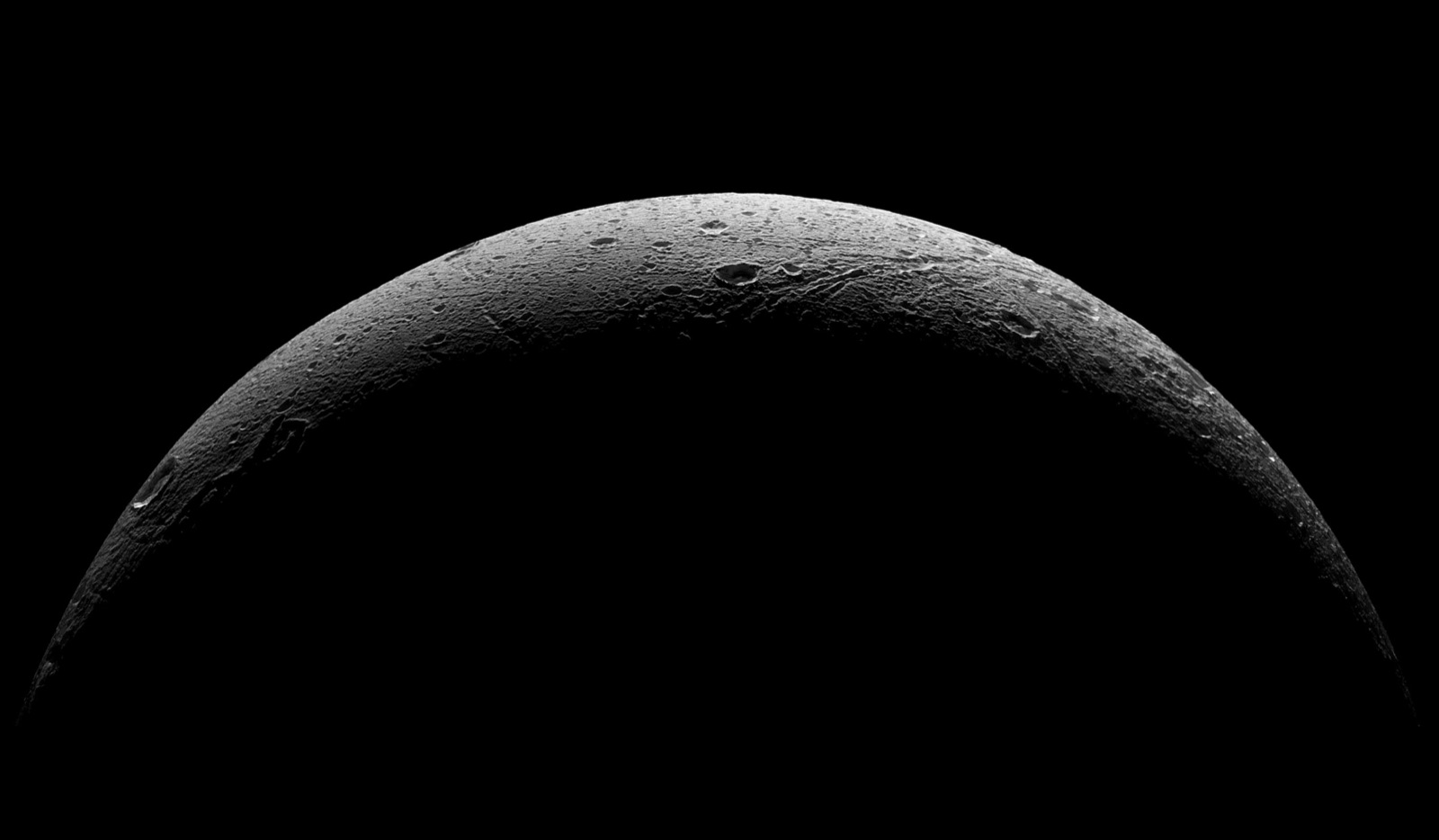
 Photograph · NASA/JPL-Caltech/Space Science Institute
Moon · Deep guide · orbits Saturn
Dione
A cracked ice world that may hide a deep buried ocean.
What is it?
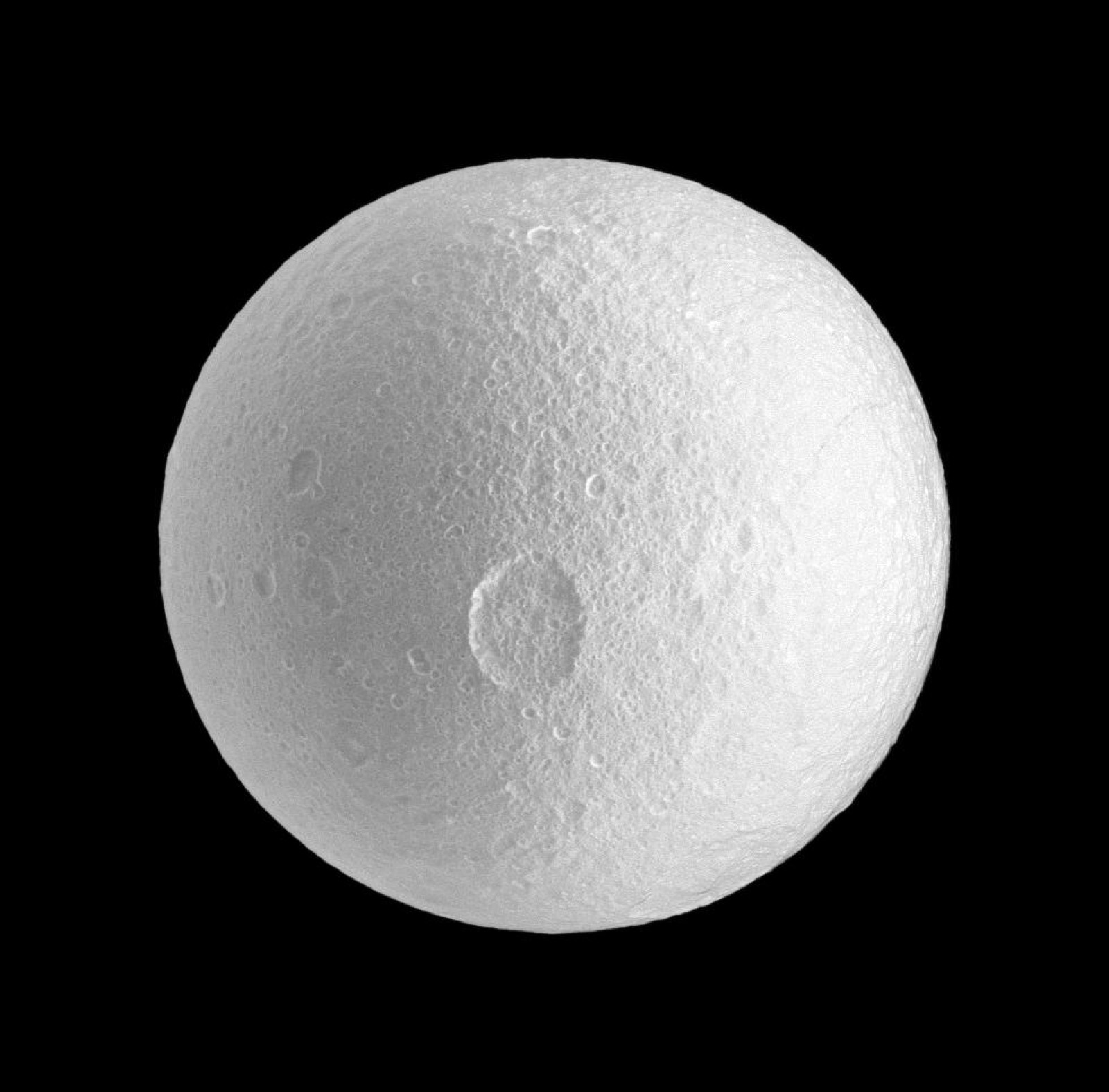
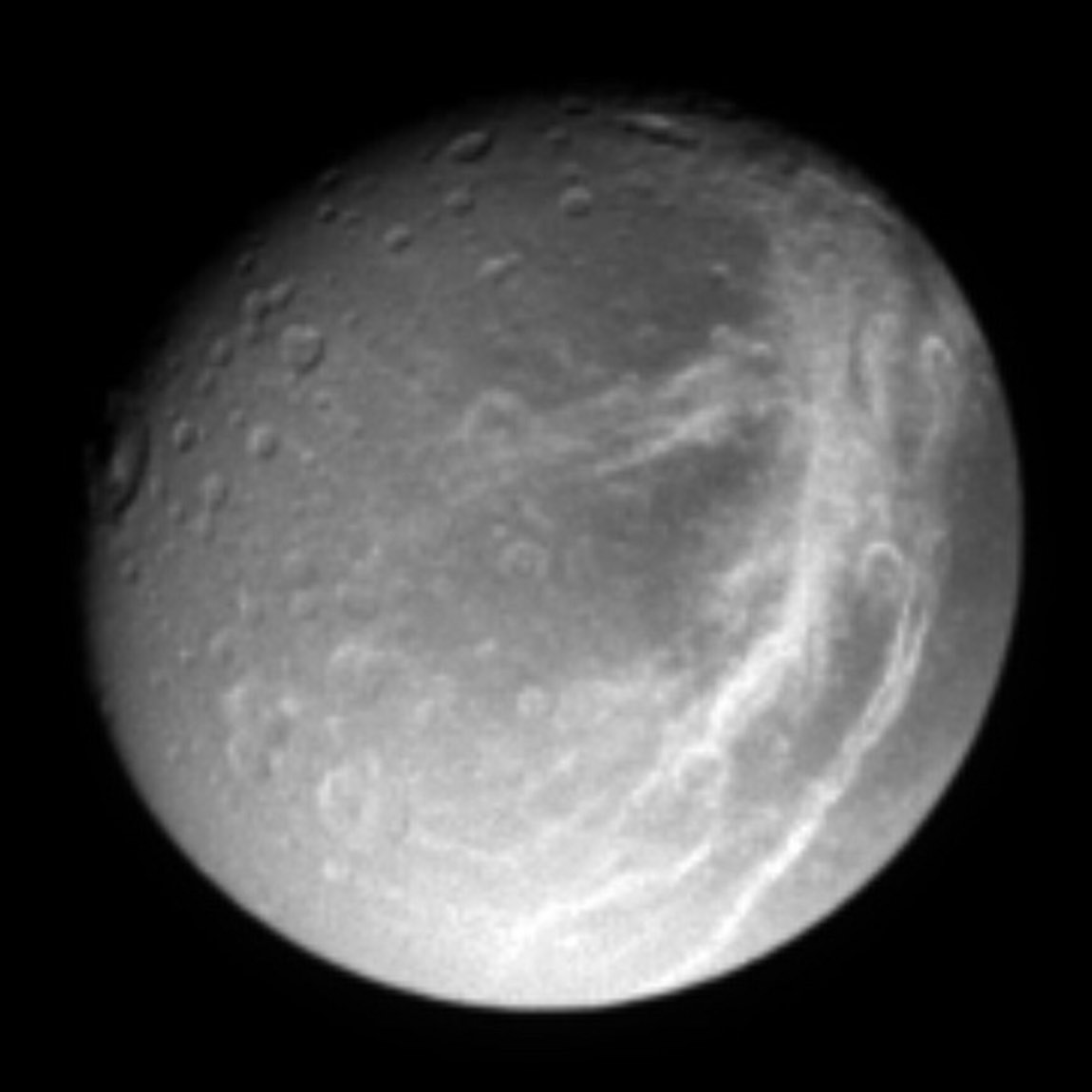
Dione, 1,123 km across, shows Saturn's history written in ice: ancient cratered plains crossed by brilliant cliffs of fractured ice — the 'wispy terrain' Cassini resolved into canyon walls hundreds of meters high. Gravity measurements hint at a subsurface ocean dozens of kilometers down, making quiet Dione a dark-horse ocean world.
The deep dive
Researched for the Atlas from Wikipedia — Dione (moon) (9,801 characters read) · updated Sep 20, 2026
01 How Dione Got Its Name
When Giovanni Domenico Cassini discovered Dione in 1684, he did not call it Dione at all. Using a large aerial telescope set up on the grounds of the Paris Observatory, he grouped it with three other moons he found — Tethys, Rhea, and Iapetus — and named them all Sidera Lodoicea, meaning "the stars of Louis," as a tribute to King Louis XIV of France. The moons of Saturn went unnamed in any mythological sense for more than 160 years, until 1847, when John Herschel, son of the astronomer William Herschel, published his observations made at the Cape of Good Hope and proposed borrowing names from the Titans, the sisters and brothers of Cronus in Greek mythology. Dione is a Titaness in that tradition. In more recent times, a software engineer named Denis Moskowitz — who designed most of the symbols for dwarf planets — proposed a dedicated symbol for Dione combining a Greek delta with the crook of the Saturn symbol, though this symbol has never come into widespread use in astronomy.
02 Inside Dione: Rock, Ice, and Hidden Water Deeper
Dione's mean density of about 1.48 g/cm³ places it in an interesting middle ground: too dense to be mostly ice, too light to be mostly rock. Scientists interpret this as a roughly equal mix of silicate rock and water ice by mass. Cassini's shape and gravity measurements allowed researchers to sketch a more detailed interior portrait: a rocky core with a radius of roughly 400 km — about the distance from London to Edinburgh — surrounded by an envelope of H₂O roughly 160 km thick. Most of that envelope is water ice, but some models suggest that the lowermost portion could be a liquid salt water ocean, making Dione structurally similar to its orbital neighbor Enceladus. Dione's ice shell is thought to vary in thickness by less than 5%, with the thinnest regions at the poles, where tidal heating of the crust is greatest. Neither Dione nor Enceladus has a shape close to hydrostatic equilibrium, meaning neither is as perfectly spherical as one might expect; instead, their irregular shapes are maintained by isostasy, a balance between surface loads and the buoyancy of the underlying layers.
03 The Ridge That Hints at a Hidden Ocean Deeper
One of the most geologically intriguing features on Dione is Janiculum Dorsa, a ridge standing between 1 and 2 km high on the moon's leading hemisphere. What caught scientists' attention was not the ridge itself but what lies beneath it: the crust appears to pucker downward by about 0.5 km under the ridge's weight. In May 2013, NASA announced that Cassini's topographic data made this bending most plausible if Dione possessed a global subsurface liquid ocean at the time the ridge formed. A warm, partially fluid interior would allow tidal flexing to keep the crust soft enough to sag. The reasoning mirrors the case for Enceladus, where similar evidence of internal liquid water is supported by active cryovolcanic jets. Dione shows no such dramatic surface venting today, but the topographic argument suggests its interior history was far more dynamic than its quiet present surface implies. The question of whether any liquid water layer persists inside Dione right now remains open.
 ⤢
⤢
04 From Wispy Streaks to Towering Ice Cliffs
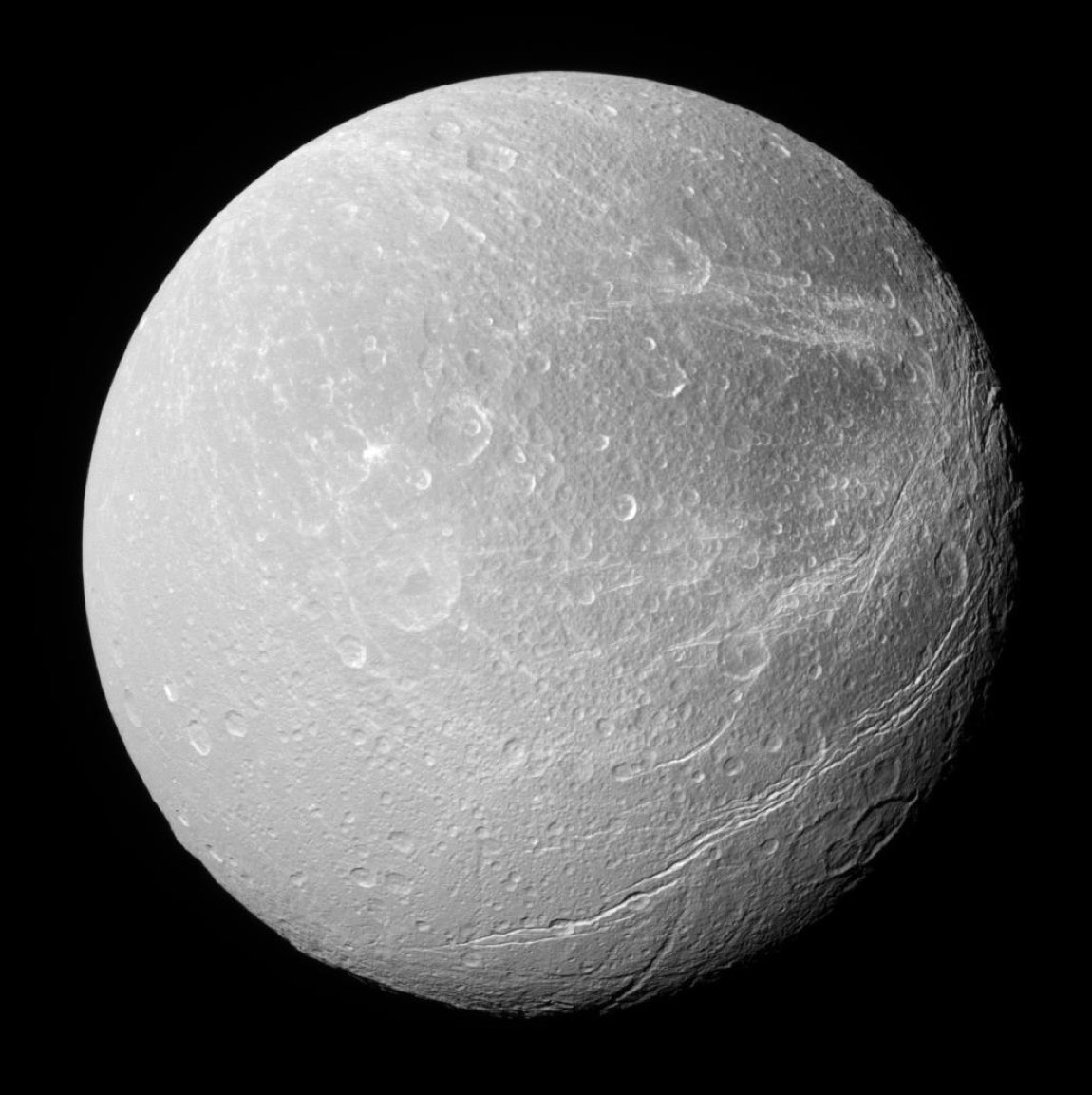
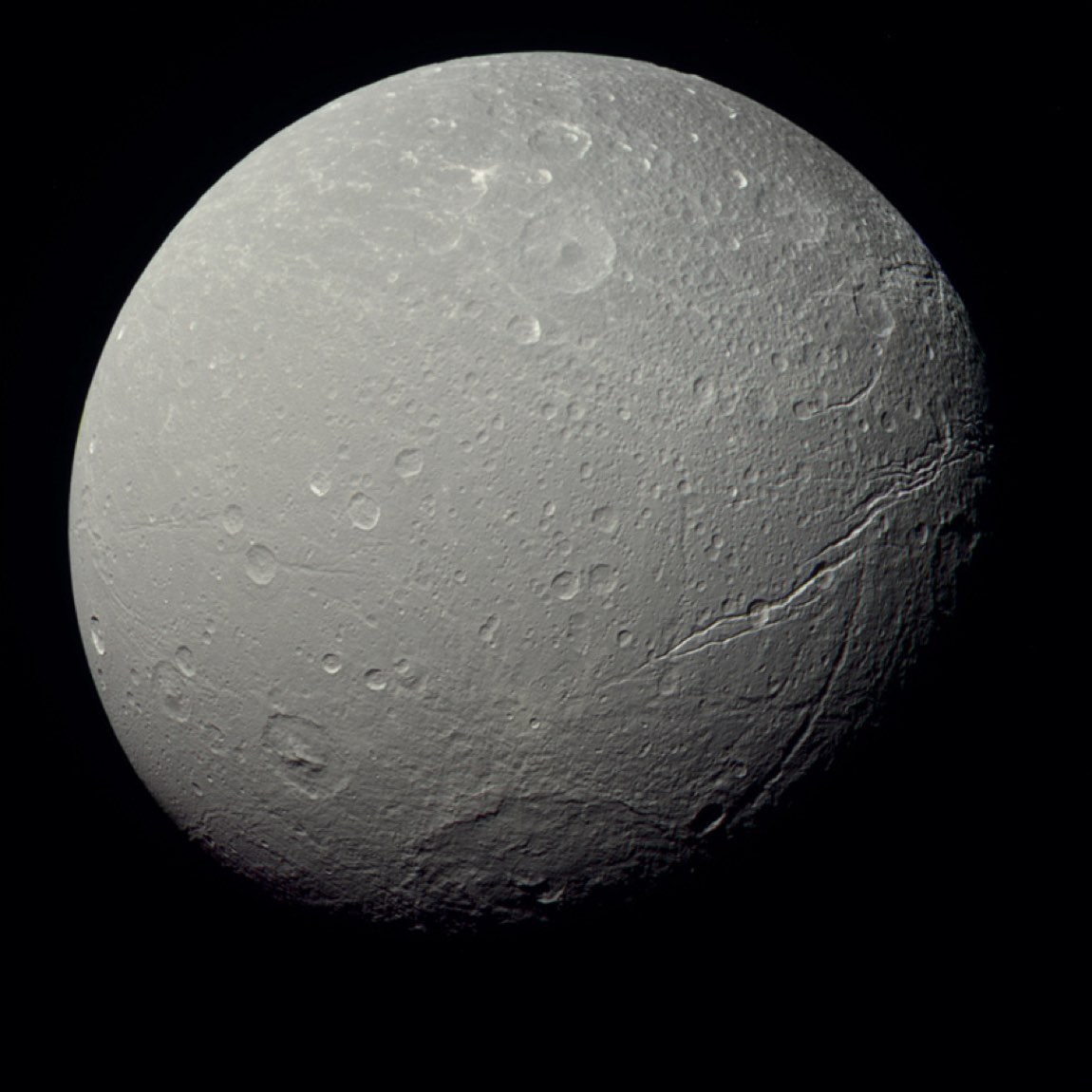
When Voyager 1 photographed Dione in 1980, its trailing hemisphere was marked by bright, hazy-looking streaks that scientists called "wispy terrain." The features were puzzling: whatever the material was, it had a high albedo yet was thin enough not to hide the topography underneath. A leading hypothesis held that shortly after Dione formed it was geologically active, and eruptions along surface cracks deposited ice or ash as a kind of snow, later erased on the leading hemisphere by continued cratering. That explanation turned out to be entirely wrong. On 13 December 2004, the Cassini spacecraft swept past Dione and sent back close-up images that reidentified the wisps as something far more dramatic: bright ice cliffs produced by tectonic fracturing. These chasmata — long, steep-sided canyons — shine brilliantly because freshly exposed water ice is highly reflective. A follow-up Cassini flyby on 11 October 2005, passing within 500 km, captured oblique views showing that some of these cliffs stand several hundred metres high, making Dione a world defined by enormous rifts across its trailing side.
05 Dione's Orbital Dance with Enceladus
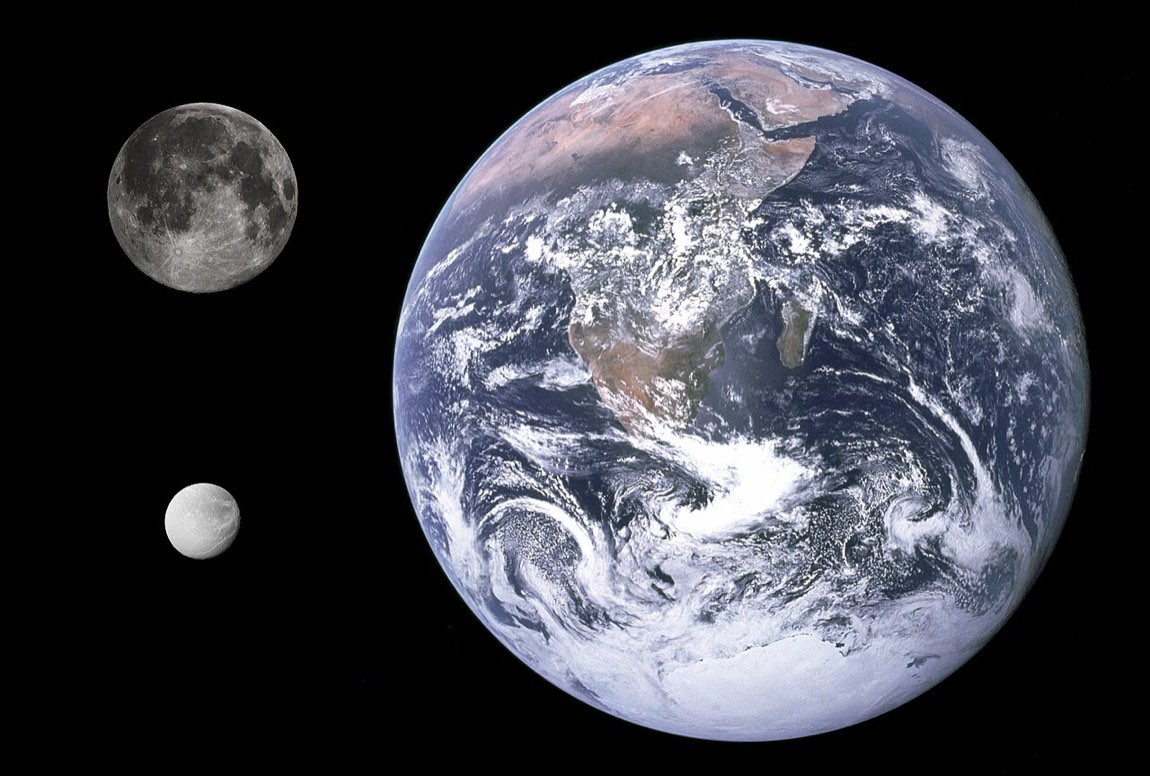
Dione and Enceladus are locked in a gravitational partnership called a 1:2 mean-motion orbital resonance, meaning Dione completes exactly one orbit of Saturn for every two orbits Enceladus finishes. This relationship has consequences that reach far beyond simple timing. The resonance continuously pumps up Enceladus's orbital eccentricity to 0.0047, which means Enceladus is stretched and squeezed by Saturn's gravity as it moves closer and farther in each orbit. That flexing generates internal heat and drives Enceladus's famous cryovolcanic geysers. Dione does not escape unaffected: the resonance also maintains a smaller eccentricity in its own orbit of 0.0022, producing tidal heating inside Dione as well. Dione's orbital semimajor axis is about 2% smaller than that of Earth's Moon, yet because Saturn is 95 times more massive than Earth, Dione completes its orbit in only one-tenth the time the Moon takes to circle Earth. That fact alone illustrates how profoundly a planet's mass reshapes the orbital timescales of everything around it.
06 Two Moons Riding in Dione's Wake
Dione does not travel alone. It shares its orbit with two much smaller companions called trojan moons, or co-orbital moons: Helene and Polydeuces. These objects sit at Dione's Lagrangian points L4 and L5, the gravitational sweet spots that lie 60 degrees ahead of and 60 degrees behind Dione along its orbital path. At these positions, the combined gravity of Saturn and Dione keeps the smaller moons stably corralled without requiring any fuel or active steering — purely a result of orbital mechanics. As far back as 1982, astronomer Stephen P. Synnott reported evidence of an additional leading co-orbital moon located about twelve degrees ahead of Helene, though the trojan system is defined primarily by Helene and Polydeuces. The existence of trojan companions is relatively rare among the moons of the solar system, making Dione's entourage a notable feature of Saturn's complex moon family.
 ⤢
⤢
07 A Cratered Surface That Tells a Twisted History Deeper
Dione's surface records a history that initially puzzled planetary scientists. The trailing hemisphere — the side that faces backward along the orbit — is the most heavily cratered, with numerous impact scars greater than 100 km in diameter. The leading hemisphere, which most models predict should receive the most impacts for a tidally locked moon, is comparatively smooth, with craters typically less than 30 km across. Scientists Eugene Shoemaker and Ruth Wolfe developed a cratering model predicting the opposite distribution. The best explanation for the mismatch is that during the period of heavy bombardment early in solar system history, Dione was tidally locked to Saturn in the reverse orientation. Because Dione is relatively small, a single impact large enough to carve a 35 km crater could have spun the whole moon around. Given that many craters larger than 35 km exist on its surface, Dione was likely flipped multiple times before settling into its current orientation, which it appears to have held for several billion years. Like Callisto, Dione's craters lack the tall, sharp-rimmed relief seen on the Moon or Mercury, likely because the icy crust gradually slumped and relaxed over geological time.
08 The Faint Oxygen Atmosphere
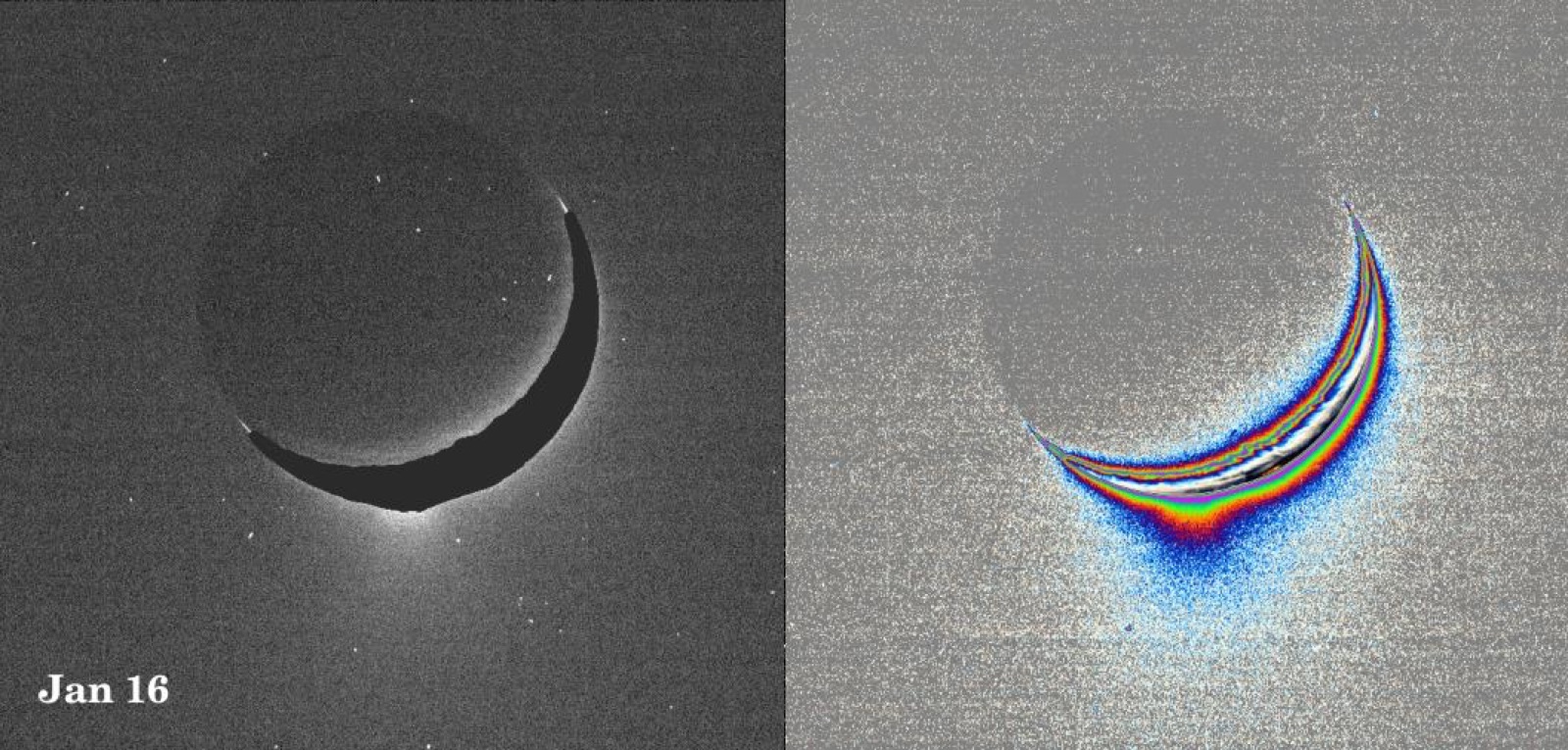
On 7 April 2010, as Cassini flew past Dione at a distance of 500 km, its instruments detected something unexpected: a vanishingly thin envelope of molecular oxygen ions surrounding the moon. The ion density measured by the Cassini plasma spectrometer ranged from only 0.01 to 0.09 ions per cubic centimetre — so sparse that scientists prefer to describe it as an exosphere rather than a true atmosphere, since the gas molecules almost never collide with one another. Cassini could not directly detect water vapor in the exosphere because high background levels masked the signal, but researchers believe the process generating the oxygen is relatively straightforward: highly charged particles from Saturn's powerful radiation belts strike the water ice on Dione's surface and split water molecules into hydrogen and oxygen. The oxygen ions then loft away from the surface to form this ghostly shell. This mechanism, known as radiolysis, likely operates on other icy moons in Saturn's system as well, making Dione's exosphere a useful natural laboratory for understanding radiation-driven chemistry in the outer solar system.
09 Mysterious Bright Lines Across the Equator Deeper
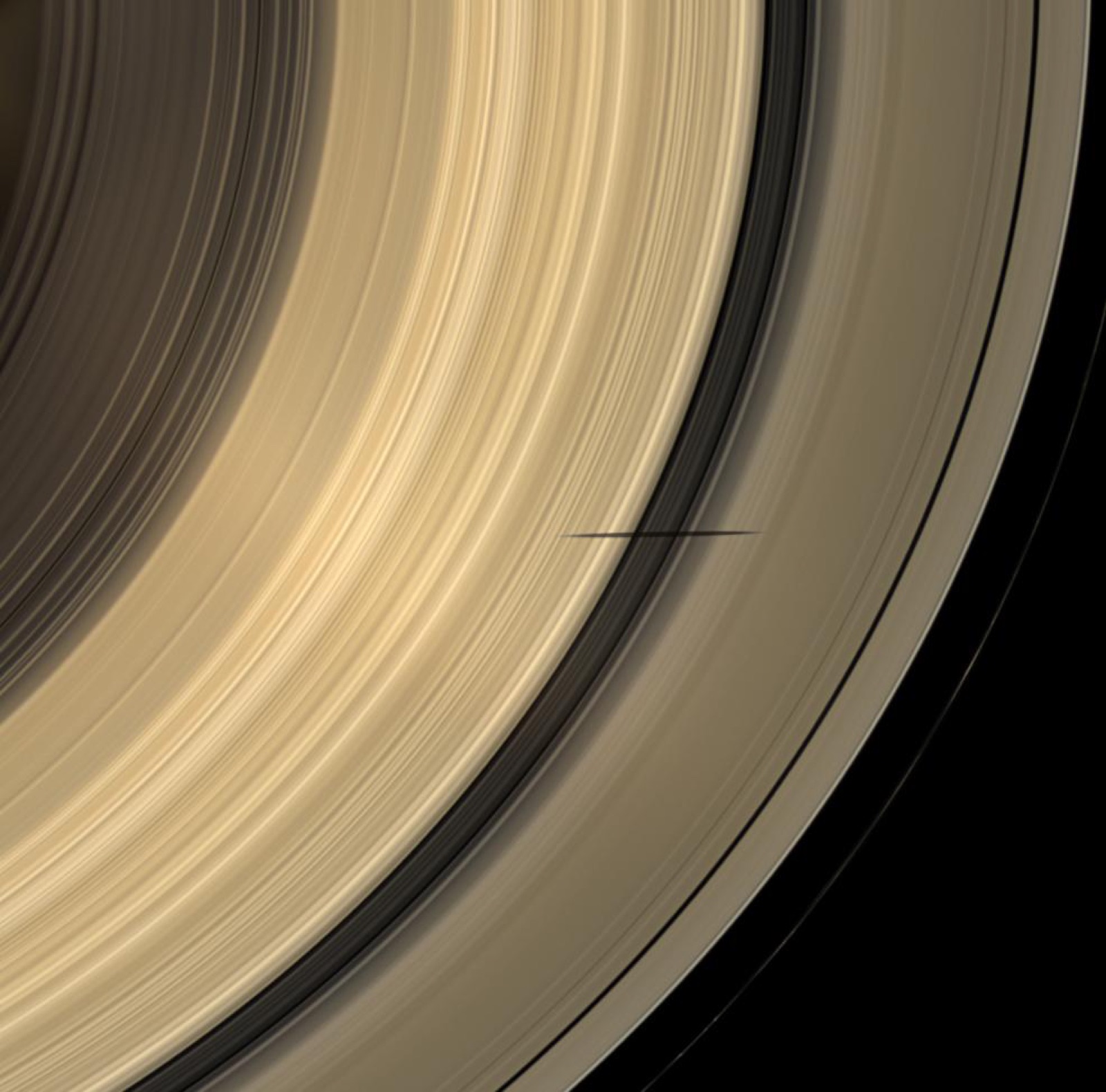
Alongside its famous ice cliffs, Dione harbors another puzzling set of surface markings: linear features called virgae, which stretch for hundreds of kilometres in length but measure less than 5 km in width. These bright stripes run parallel to the equator and appear only at latitudes below 45 degrees north or south, fading at higher latitudes. They are visibly brighter than the surrounding terrain and appear to drape over pre-existing features such as ridges and craters, indicating that they are geologically young and were deposited after the underlying landscape had already formed. Similar features have been observed on Rhea. The leading hypothesis is an exogenic origin: material sourced from Saturn's rings, from Dione's co-orbital moons, or from closely approaching comets may have been deposited across the surface through low-velocity impacts. Exactly what that material is, and precisely how it settles into such geometrically ordered, latitude-constrained lines, remains an open and actively debated question in planetary science.
 ⤢
⤢
10 Five Close Encounters: The Cassini Flybys
Before Cassini, humanity's only close look at Dione came from the Voyager probes in 1980, which revealed the broad outlines of the moon's terrain but lacked the resolution to resolve its most puzzling features. Cassini changed that with five targeted close approaches spanning a decade. The first close flyby came on 11 October 2005 at just 500 km, capturing the oblique views of ice cliffs that overturned the wispy-terrain hypothesis. A second flyby on 7 April 2010 — also at 500 km — detected the oxygen exosphere. The third approach on 12 December 2011 came within a remarkable 99 km of the surface, the closest Cassini ever passed Dione, roughly the cruising altitude of some high-altitude research aircraft above Earth. A fourth flyby on 16 June 2015 passed at 516 km, followed by the mission's final Dione encounter on 17 August 2015 at 474 km. Taken together, these passes allowed scientists to build detailed topographic maps, measure the gravity field, and characterize the plasma environment — transforming Dione from a blurry dot in Voyager imagery into a geologically complex world with a plausible hidden ocean.
11 How Dione Compares to Its Neighbor Rhea
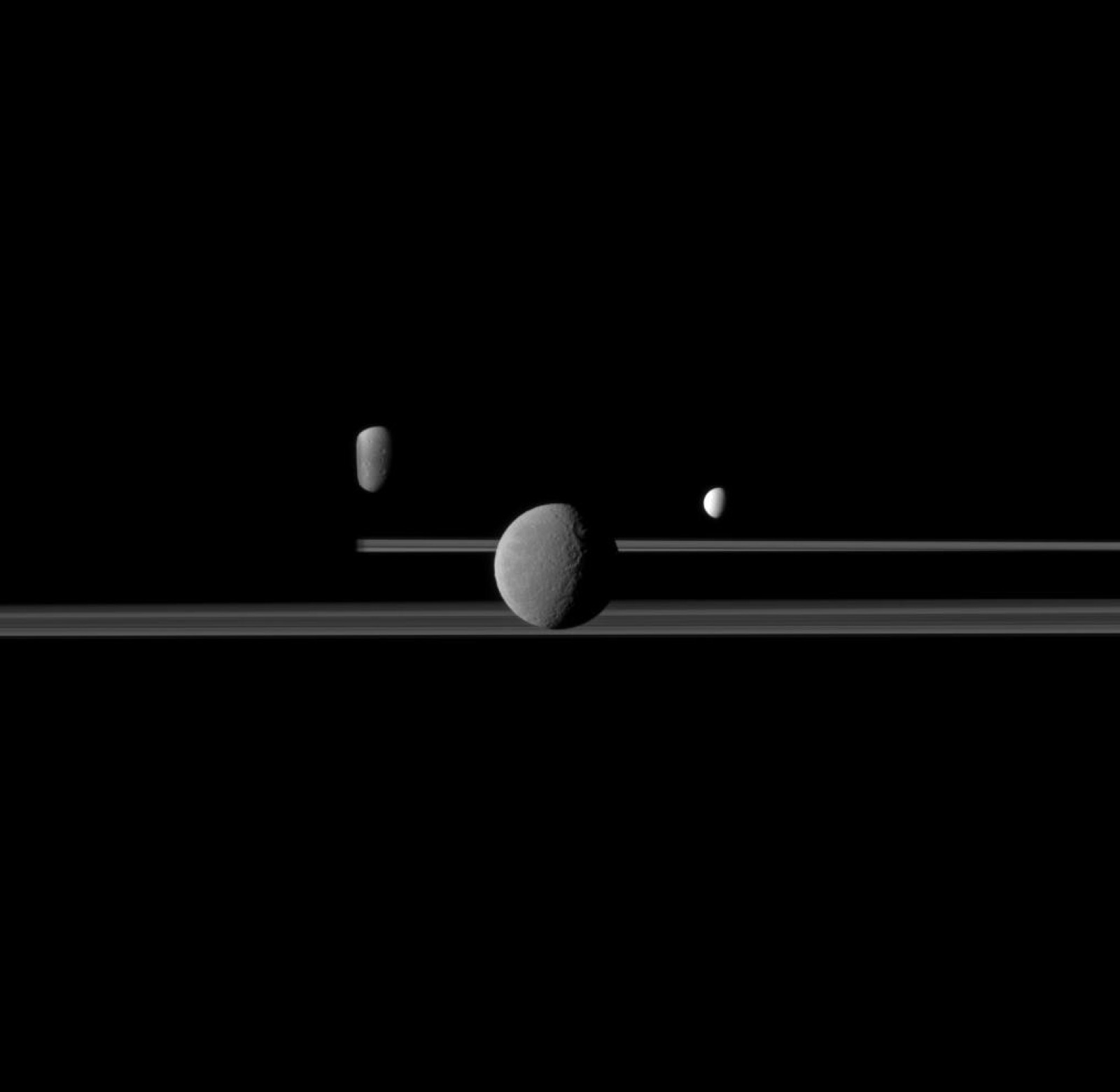
Dione is often described as the smaller, denser sibling of Rhea, and the comparison is illuminating. Both moons share similar surface albedo patterns and varied terrain, and both show a clear difference between their leading and trailing hemispheres. Dione's leading hemisphere is heavily cratered and uniformly bright, while its trailing side is dominated by the tectonic cliffs and is notably darker. Rhea displays analogous asymmetry. Despite their similarities, Dione is described in the article as somewhat smaller and denser than Rhea, making it the fourth-largest moon of Saturn overall and the 15th largest moon in the entire solar system. What makes Dione especially remarkable is its mass: it is described as more massive than all known moons smaller than itself combined. That single fact captures how sharply the size distribution of moons drops off; Dione sits near the top of a long tail of progressively tinier objects, outweighing all of them together.
12 Open Questions Dione Still Poses Deeper
Despite a decade of Cassini observations, Dione leaves several fundamental questions unresolved. The most consequential is whether a subsurface liquid ocean exists today or whether it has long since frozen solid, with the topographic evidence from Janiculum Dorsa reflecting only ancient, warmer conditions. The origin of the equatorial virgae is debated, with no consensus on whether the bright lines come from ring material, co-orbital moon debris, or cometary particles. The mechanism by which Dione's cratering distribution became inverted — concentrated on the trailing rather than the leading hemisphere — is accepted in broad outline but the details of how many times the moon was reoriented remain uncertain. The darkness of the trailing hemisphere relative to the leading side also lacks a fully agreed explanation. No future mission to Dione has been approved as of the article's information, meaning that the Cassini dataset is likely to remain the primary scientific record for the foreseeable future, with researchers continuing to mine its gravity, imaging, and plasma measurements for further clues about this quietly complex moon.
 ⤢
⤢
You would weigh…
Surface gravity 0.23 m/s² vs Earth’s 9.81 m/s². Try every world →