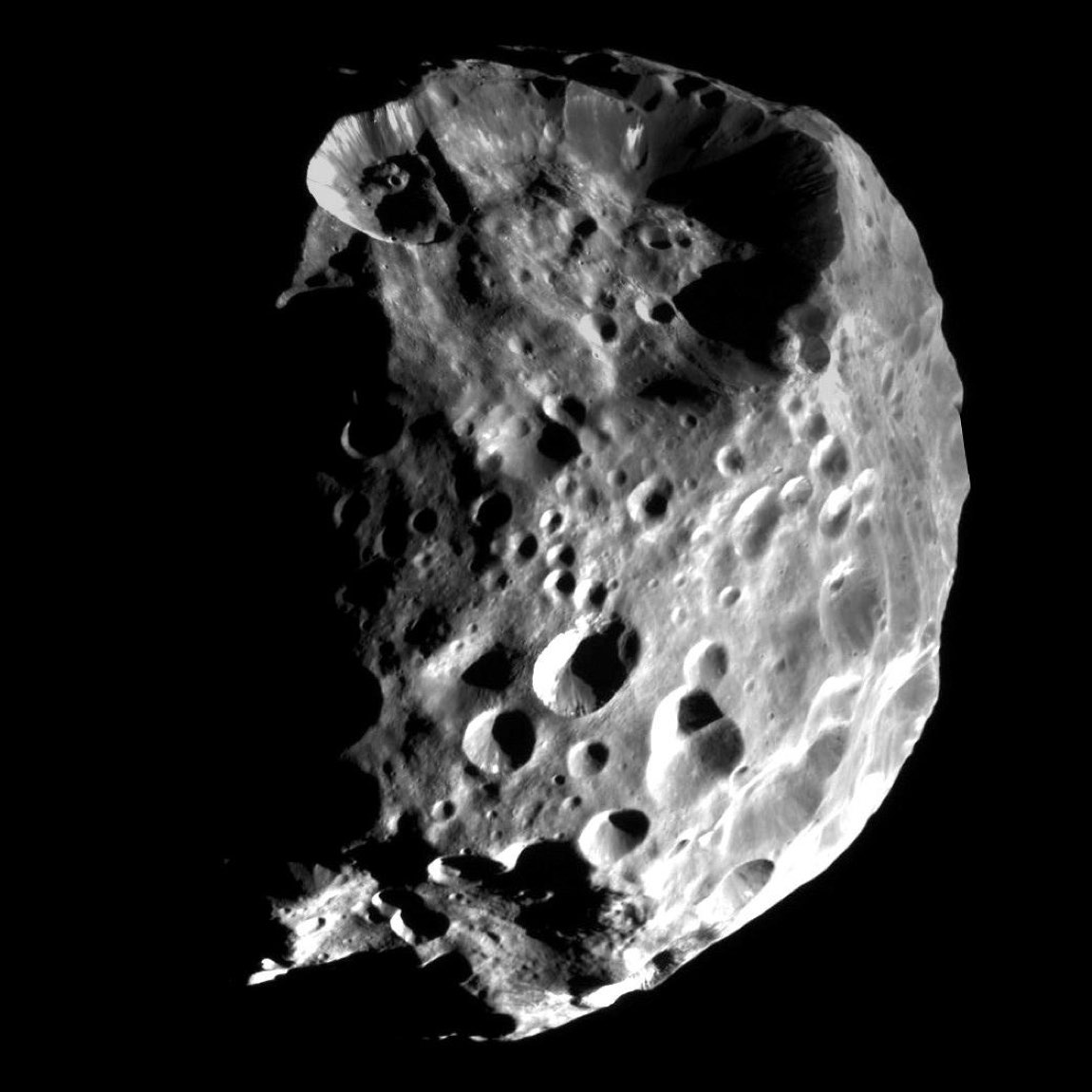
 Photograph · NASA/JPL/Space Science Institute · Public domain
Moon · Deep guide · orbits Saturn
Phoebe
Also called: Saturn IX
A dark, backward-orbiting world that may be a captured visitor from the Kuiper belt.
What is it?
Phoebe is Saturn's largest irregular moon, about 213 km across, orbiting backwards nearly 13 million km out. William Pickering found it in 1899 on photographic plates — the first moon discovered by photography — and for a century it was Saturn's outermost known moon. Cassini passed just 2,068 km away in June 2004, revealing a dark, heavily cratered surface; the biggest crater, Jason, is about 100 km wide. Dust from Phoebe feeds the huge, tilted Phoebe ring, and it may be a captured centaur.
The deep dive
Researched for the Atlas from Wikipedia — Phoebe (moon) (11,101 characters read) · updated Nov 14, 2026
01 The first moon found with a camera
Before Phoebe, every moon in the Solar System had been spotted by eye pressed to a telescope eyepiece. That changed on 18 March 1899, when William Henry Pickering studied photographic plates taken by DeLisle Stewart at the Boyden Station of the Carmen Alto Observatory near Arequipa, Peru. Stewart had exposed those plates starting 16 August 1898, meaning the discovery sat latent on glass for more than six months before anyone noticed the faint, slow-moving dot. The technique Pickering used — comparing plates taken on different nights to catch objects that had shifted position — would go on to become the standard method for finding distant solar system bodies, eventually leading to the discovery of Pluto decades later. Phoebe's photographic debut marked a genuine turning point in how humanity hunts for new worlds.
02 An orbit that runs against the grain
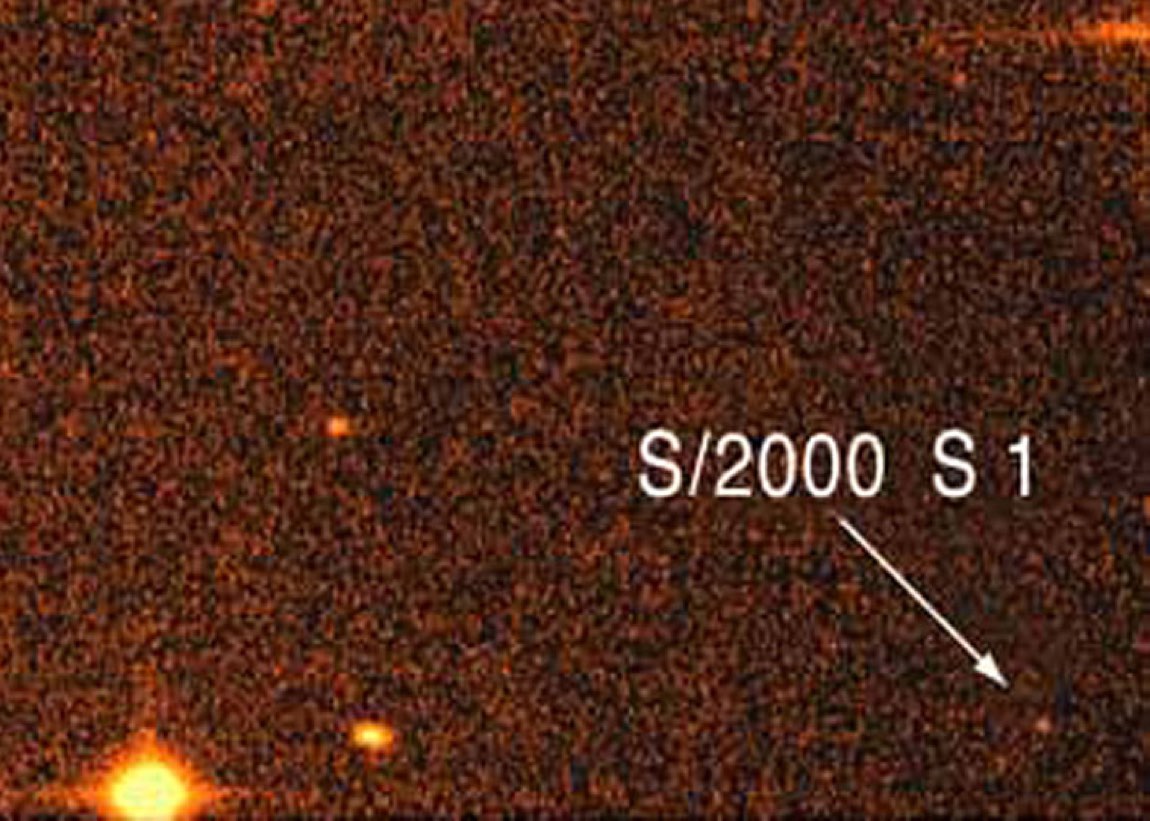
Phoebe does not behave like a well-mannered moon. While Saturn's regular satellites circle the planet in the same direction Saturn rotates, Phoebe travels the other way entirely — a retrograde orbit that immediately flags it as a foreign body captured long after the planet formed. It takes roughly 18 months to complete one loop around Saturn. Its orbit is also moderately eccentric, meaning its distance from Saturn swings noticeably rather than holding steady. For more than a century after its discovery, Phoebe held the title of Saturn's outermost known moon, a record that stood until smaller moons were detected in 2000. It sits almost four times farther from Saturn than its nearest large neighbor, Iapetus, an isolation that underscores just how gravitationally distant and foreign Phoebe really is.
03 How Phoebe may have sculpted Saturn's moon family Deeper
Phoebe is not just a passive occupant of Saturn's outer reaches — its sheer bulk has arguably shaped the population of irregular moons around it. Because irregular satellites occupy a relatively cramped orbital space, they collide among themselves at a rate four orders of magnitude higher than main-belt asteroids do. Phoebe is expected to be involved in roughly half of those collisions, chiefly because of its large cross-section. Any object unlucky enough to strike Phoebe is simply eliminated, effectively clearing the neighborhood in a way loosely analogous to how a major planet clears its orbital zone. Models suggest this process may have reduced Saturn's original irregular moon population by about 30% and simultaneously nudged Phoebe's own orbital distance inward from a value roughly 30% larger than it occupies today. Debris blasted off Phoebe by the biggest historic impacts is thought to be the origin of several smaller Norse-group moons, almost all of which are less than 10 km in radius.
04 The invisible giant ring Phoebe feeds
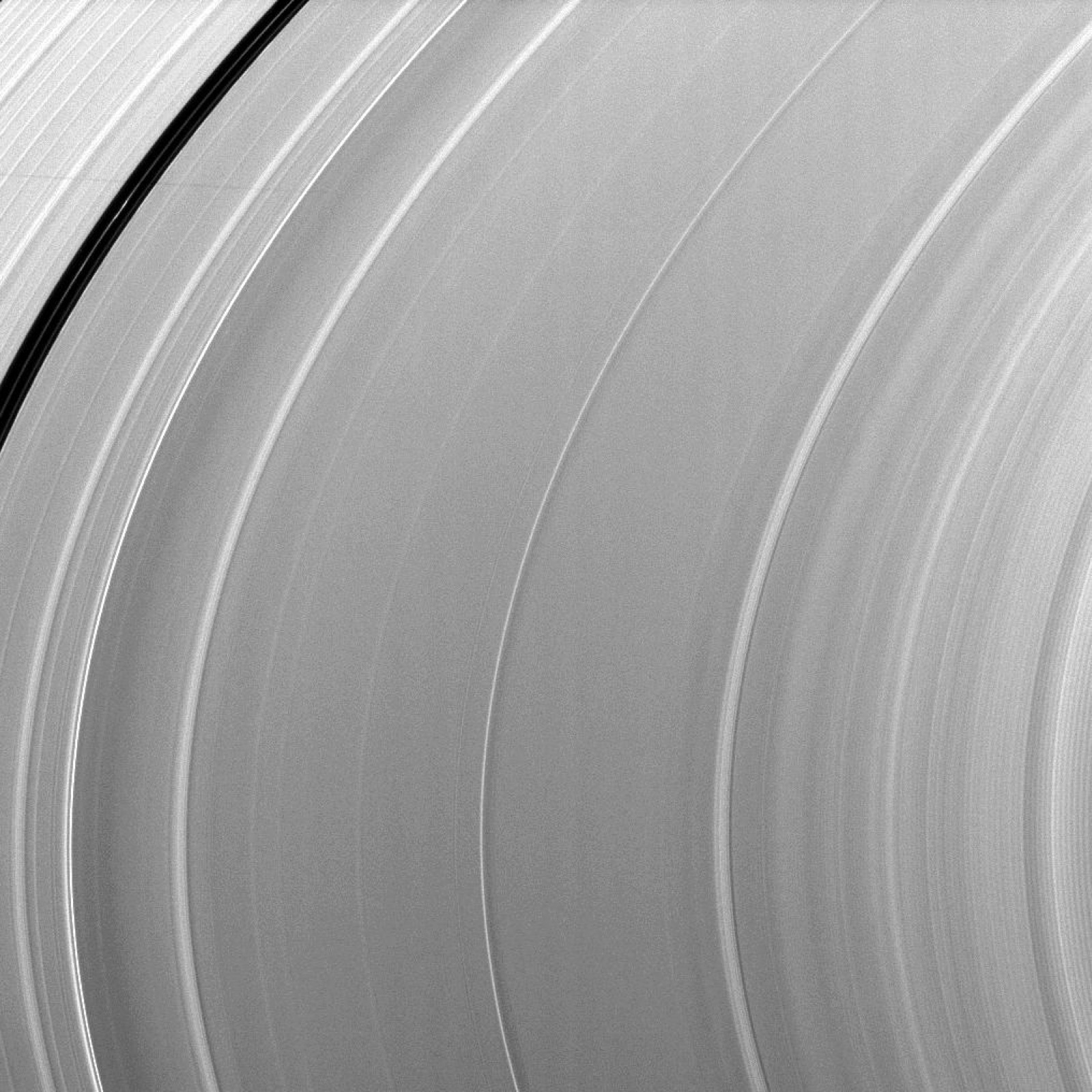
Tiny meteoroids constantly sandblast Phoebe's surface, kicking up dust that gradually spreads into a vast, faint ring encircling Saturn. This Phoebe ring tilts 27 degrees from Saturn's equatorial plane, setting it apart from every other ring in the system. It stretches from at least 128 to 207 times Saturn's radius, while Phoebe itself orbits at an average of 215 Saturn radii. Despite its enormous extent — the ring is roughly 40 times as thick as Saturn's diameter — it is virtually invisible to ordinary telescopes and was only discovered using NASA's infrared Spitzer Space Telescope. Because the ring particles inherit Phoebe's retrograde motion, they travel opposite to the direction Iapetus orbits. Material spiraling inward therefore slams into Iapetus's leading hemisphere, depositing dark material that researchers believe contributes to that moon's striking two-tone coloration.
05 A captured Kuiper Belt world in disguise
Phoebe's dark surface first made scientists think it was a captured carbonaceous asteroid, chemically primitive and unchanged since the early Solar System. Cassini's close flyby shattered that idea. Images revealed craters with noticeably brighter floors, hinting at large quantities of water ice hiding beneath a thin dark blanket estimated at only 300 to 500 metres thick. Carbon dioxide was detected on the surface — something never found on a true asteroid. Phoebe turns out to be roughly 50% rock, compared to the 35% or so typical of Saturn's inner moons. Spectroscopic observations by the James Webb Space Telescope and Cassini's own VIMS instrument confirmed water ice and carbon dioxide, with ambiguous hints of organic compounds, and the overall spectral shape closely matches that of Kuiper Belt objects. Phoebe carries distinctly more water ice than other Saturnian irregular satellites such as Siarnaq and Albiorix, reinforcing its outsider status.
06 A warm, watery youth despite tiny size Deeper
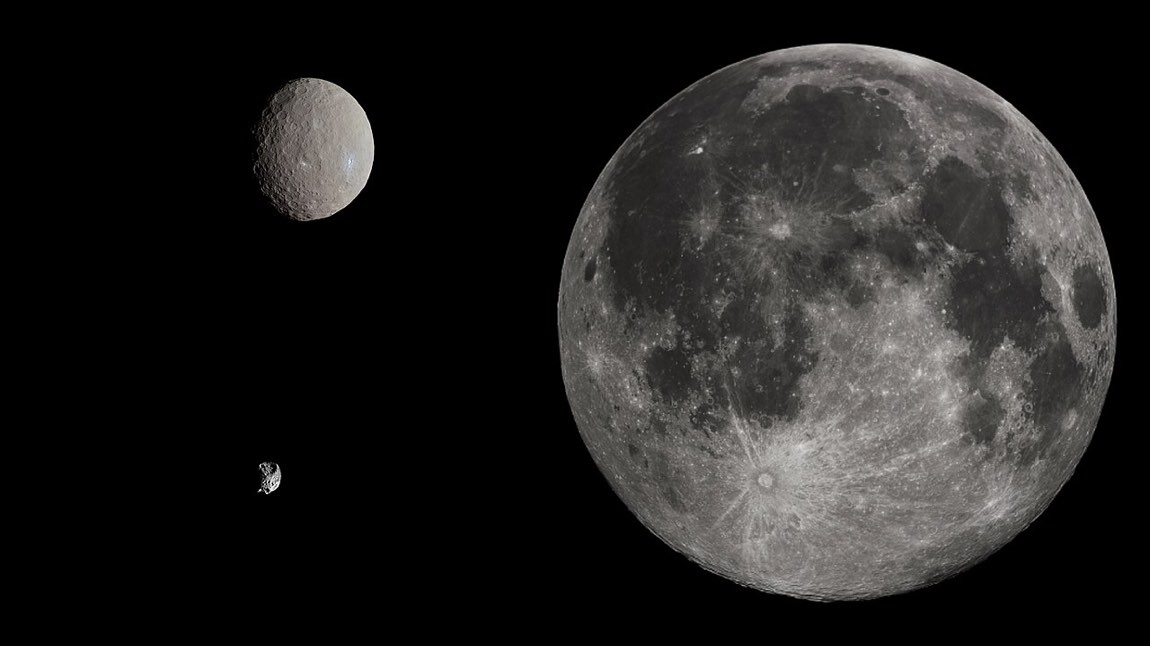
Phoebe's current frozen, battered appearance conceals a surprisingly dynamic early history. If it formed in the Kuiper Belt within three million years of the Solar System's birth, it would have incorporated significant quantities of short-lived radioactive isotopes still producing heat at that time. That heat was apparently enough to melt Phoebe into a sphere and sustain liquid water within it for tens of millions of years — a remarkable conclusion for a body only about 213 km across, roughly one-sixteenth the diameter of our Moon. The warmth also allowed the interior to differentiate, with denser rocky material sinking toward the center and lighter material rising. Eventually the heat source exhausted itself, Phoebe froze solid, and subsequent impacts battered it away from perfect roundness into the slightly irregular shape seen today. Its oblateness is still broadly consistent with an object in hydrostatic equilibrium with its current 9-hour-16-minute rotation period.
 ⤢
07 Surface geology: craters, ice, and Jason's scar
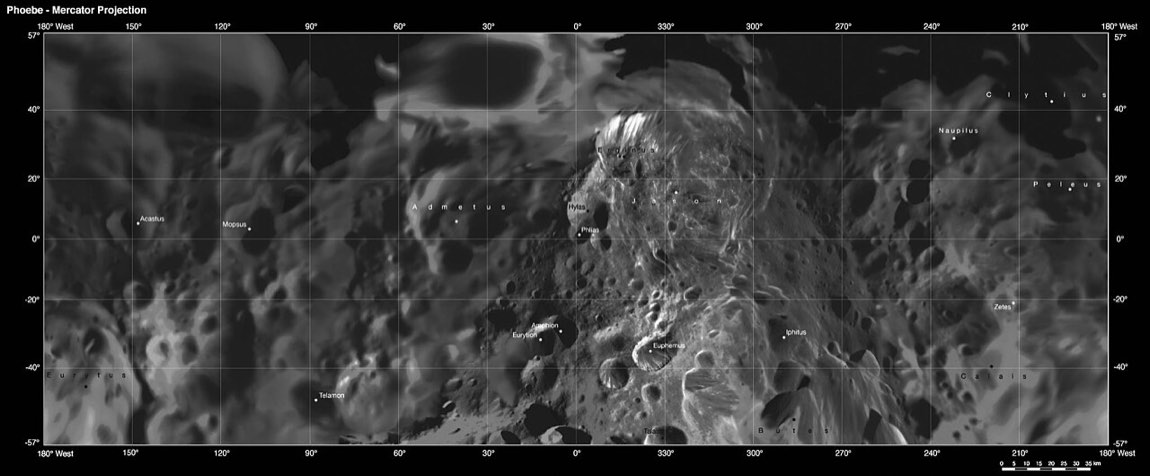
Cassini's 2004 flyby revealed a heavily cratered surface that matched predictions made before the encounter. The largest crater, named Jason, stretches roughly 100 km across — nearly half Phoebe's mean diameter of 212.8 km — a scar that speaks to a genuinely violent impact history. Phoebe's albedo sits at only about 8–9%, making it quite dark overall, though that figure is relatively bright compared to other irregular moons measured elsewhere in the Solar System. The variation in brightness across different craters betrays the layered composition: dark material on top, brighter icy material exposed where impacts have punched through. The IAU designated Jason and the Argonauts legend as the naming theme for Phoebe's surface features, and in 2005 officially named 24 craters. One region, Leto Regio, honors Phoebe's mythological daughter rather than an Argonaut, the sole exception to the rule.
08 Cassini's deliberate detour to reach Phoebe
Phoebe sits so far from Saturn that visiting it required advance planning baked into Cassini's entire trajectory. Mission designers chose the spacecraft's arrival path and timing specifically to allow a close Phoebe flyby before Cassini fired its engine to enter Saturn orbit. On 11 June 2004, Cassini passed just 2,068 kilometres from Phoebe's surface, returning high-resolution images of a scarred world. Because Phoebe rotates once every approximately 9 hours and 17 minutes, the spacecraft's encounter lasted long enough to image nearly the entire surface — a lucky coincidence of timing and spin rate. The close approach also allowed scientists to determine Phoebe's mass with an uncertainty of only 1 in 500. Without the deliberate detour, Cassini would almost certainly have produced images little better than the blurry frames Voyager 2 captured from 2.2 million kilometres away in September 1981, where Phoebe filled only about 11 pixels.
09 Phoebe's puzzling size among its retrograde cousins Deeper
Among all retrograde moons in the Solar System, only Neptune's Triton is larger than Phoebe. Within Saturn's own Norse group of retrograde satellites, Phoebe dwarfs everything else by a margin that researchers find genuinely difficult to explain. The next largest retrograde moon of Saturn, Ymir, is dramatically smaller, and no straightforward model of capture or collisional evolution naturally produces such a size gap. Several explanations have been proposed: Phoebe's capture may simply have been a statistical fluke, or it may have arrived via a different dynamical mechanism than the smaller irregulars. Alternatively, its composition — a dense, C-type body — might have made it intrinsically harder to shatter in a collision compared to D-type or P-type objects, leaving one large survivor where a different impactor would have produced only fragments. The question remains open, making Phoebe's dominance of the Norse group one of its quieter but more intriguing unsolved puzzles.
10 The mythology woven into Phoebe's name
Phoebe takes its name from the Titaness Phoebe of Greek mythology, associated with the Moon and sister of Cronus — the Greek counterpart of the Roman god Saturn. The connection to Saturn's divine lineage made the name an obvious fit when it was assigned. In scientific literature the moon also appears as Saturn IX. The IAU's choice to use the Jason and the Argonauts legend for naming surface features was deliberate and poetic: the team behind the Cassini–Huygens mission drew an explicit parallel between Jason's voyage into unknown waters and their own spacecraft's journey to a distant realm. As Toby Owen of the University of Hawaiʻi at Mānoa, who chaired the IAU Outer Solar System Task Group, explained, the scientists joining the mission represented "a wide, international spectrum of outstanding people who were willing to take the risk" — modern Argonauts seeking their own grand prize at Saturn.
11 Phoebe's dark material and Hyperion's odd surface Deeper
Phoebe's influence on the Saturn system extends beyond Iapetus and the Phoebe ring. Material knocked off Phoebe's surface by microscopic meteor impacts may also be responsible for the dark patches found on the sponge-like surface of Hyperion, another of Saturn's moons. Hyperion is itself larger in radius than Phoebe but less massive — an unusual pairing that reflects very different internal structures. The darkening mechanism would be similar in principle to what affects Iapetus: Phoebean debris drifts inward and coats whatever surface it encounters. The implication is that a single distant captured body has left fingerprints across multiple moons in Saturn's system. This kind of long-range contamination was not seriously anticipated before Cassini arrived, and it adds another layer to Phoebe's outsized role in shaping its adopted planetary neighborhood despite being smaller than many inner moons.
12 Open questions: centaur, asteroid, or something else? Deeper
The prevailing view — that Phoebe is a captured centaur from the Kuiper Belt — rests on strong but not conclusive evidence. The spectral match to Kuiper Belt objects, the carbon dioxide, the ice-rich interior, and the differentiated structure all point outward. Yet some studies argue instead for an origin among C-type asteroids, noting compositional similarities to that class. The two hypotheses are not easily distinguished because both C-type asteroids and some Kuiper Belt objects share dark, carbon-rich surfaces. The ambiguous evidence for organic compounds detected by JWST and Cassini's VIMS instrument adds further texture without settling the debate. Phoebe is also the first body in its suspected class — a potential captured centaur — to be imaged as anything more than a point of light, so there is no direct comparison object to anchor interpretations. Future missions or more detailed spectroscopic campaigns will likely be needed to close this question definitively.
 ⤢