 Photograph · ESO · CC BY 4.0
Moon · Deep guide · orbits Saturn
Ymir
Also called: Saturn XIX · S/2000 S 1
Saturn's second-largest backward-orbiting moon, taking 3.6 years per lap.
What is it?
Ymir is a retrograde irregular moon of Saturn, about 19 km across, named after the primordial frost giant of Norse myth. Brett Gladman's team found it in 2000; with Paaliaq it was the first irregular moon of Saturn found since Phoebe. It orbits about 23 million km out, one of Saturn's largest known orbits, and needs about 3.6 years to go around once. It is the second-largest retrograde irregular moon of Saturn after Phoebe.
The deep dive
Researched for the Atlas from Wikipedia — Ymir (moon) (2,274 characters read) · updated Nov 14, 2026
01 A century-long gap between discoveries
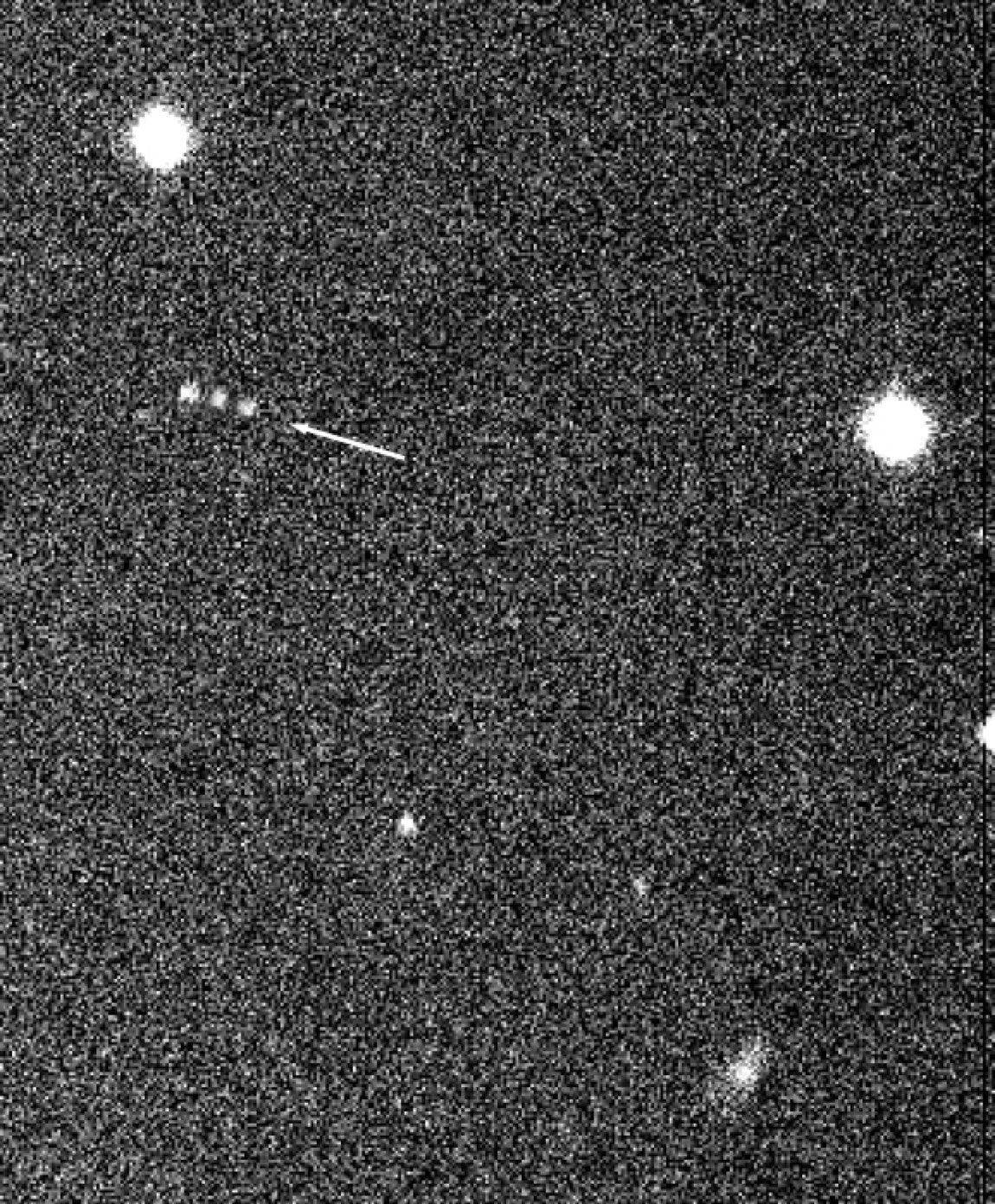
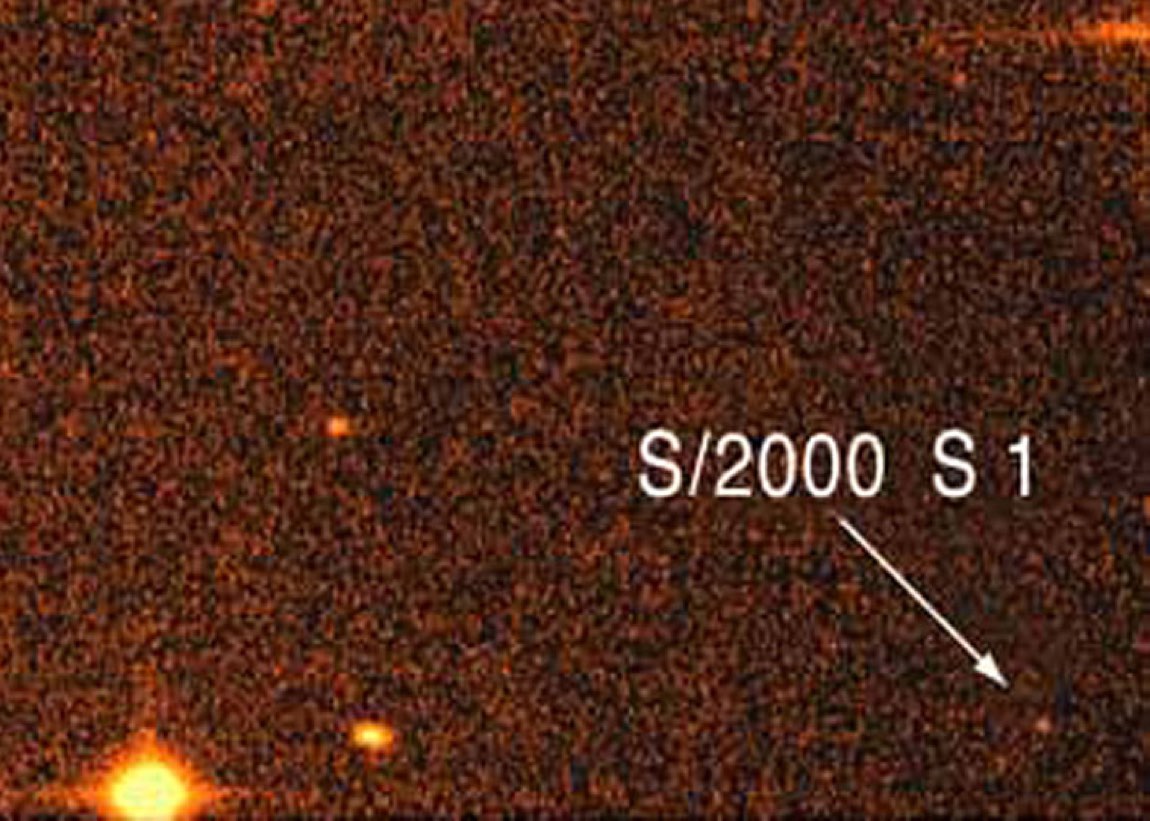
When Brett J. Gladman and colleagues spotted Ymir in 2000, they were closing a remarkable gap in Saturn's known family. Phoebe, the first irregular moon of Saturn ever identified, had been discovered a full century earlier, meaning astronomers had gone a hundred years without detecting a single additional irregular satellite around the ringed planet. Ymir and Paaliaq changed that overnight — their detection in 2000 marked the first time since Phoebe that any irregular moon of Saturn had been confirmed. It was a testament both to how faint and distant these small bodies are and to the quantum leap in telescope technology and digital detectors that finally made hunting them practical. Ymir received the temporary designation S/2000 S 1 before its official name was settled three years later, in August 2003.
02 Named for the ancestor of all frost giants
The name Ymir comes directly from Norse mythology, where Ymir holds the singular status of ancestor to all the Jotuns — the frost giants of the Norse cosmos. This was not an arbitrary choice. Saturn's irregular retrograde moons are collectively grouped under the "Norse group," and naming them after figures from Norse mythology creates a coherent mythological identity for this family of distant, dark, cold bodies. Ymir the mythological figure predates the gods themselves in the Norse tradition, making the name fitting for a moon that may itself be a relic from the solar system's earliest, most chaotic era. The naming was formalized in August 2003, roughly three years after the discovery, following the standard International Astronomical Union process.
03 One of Saturn's widest known orbits Deeper
Ymir orbits Saturn at an average distance of approximately 23 million kilometers — so far out that the journey around Saturn takes 3.6 years, longer than Mars takes to orbit the Sun. That span of 23 million kilometers is roughly 150 times the distance from Earth to the Moon, illustrating just how loosely Saturn's gravitational grip holds onto these outer irregulars. Its orbit is not a tidy circle: an eccentricity of 0.337 means Ymir swings significantly closer and farther from Saturn over each long orbit. Its inclination of 173° to the ecliptic confirms its retrograde motion — it travels the "wrong way" compared to most moons. Critically, this orbit is not static. Solar gravity and gravitational nudges from the planets continuously deform and precess it, so Ymir's exact path shifts over time in ways that must be tracked carefully.
04 Membership in the Phoebe subgroup explained Deeper
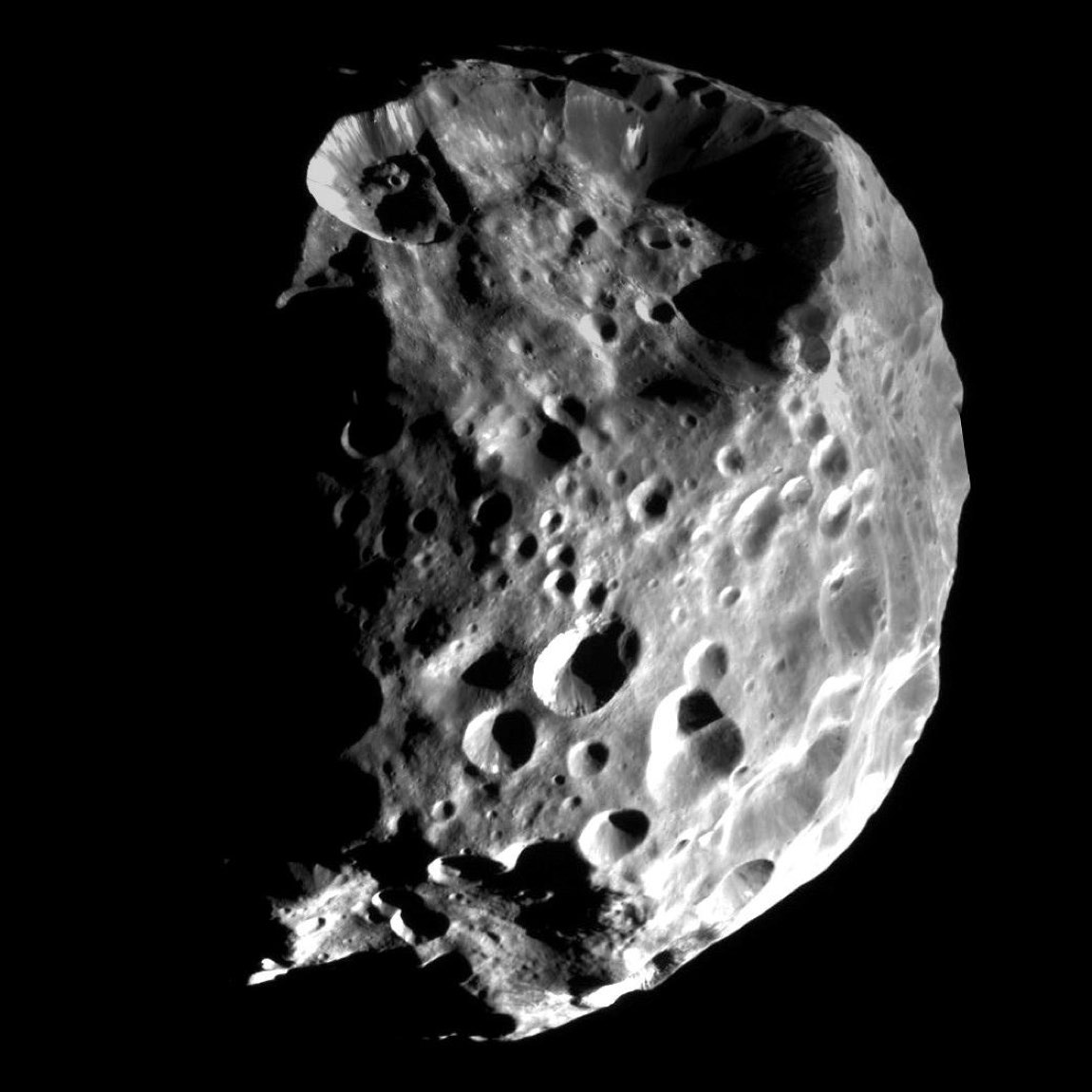
Ymir's orbital parameters place it squarely within the Phoebe subgroup, a defined cluster of retrograde moons that share a broad orbital neighborhood around Saturn. The subgroup spans distances of 13 million to 27 million kilometers from Saturn, with orbital inclinations ranging between 172.5° and 180° and eccentricities falling roughly between 0.1 and 0.5. Ymir satisfies all three criteria: its ~23-million-kilometer average distance, 173° inclination, and 0.337 eccentricity fit comfortably within those ranges. Despite sharing this orbital family with Phoebe — Saturn's most famous irregular moon — Ymir is physically quite different from Phoebe. Where Phoebe appears grey in color, Cassini–Huygens spectral data show Ymir is distinctly reddish, a difference that becomes important when scientists try to work out whether these moons truly share a common origin.
05 A tiny, oddly shaped, dark little world
Ymir is estimated to be about 19 kilometers in diameter, calculated by assuming it reflects just 6% of the sunlight that hits it — an albedo typical of dark, carbonaceous outer solar system bodies. At that size, Ymir is roughly as wide as Manhattan is long, making it a genuinely tiny object to have detected at 23 million kilometers from Saturn. Despite its small size, Ymir is the second-largest member of the Norse group, with only Phoebe being larger. Among all of Saturn's moons that take more than 3 Earth years to complete a single orbit, Ymir is actually the biggest known. Its shape is not a simple sphere: light curve data suggest a triangular form, and scientists have raised the possibility that Ymir could be a contact binary — two separate lobes touching — because its measured brightness swings by very large amounts as it rotates.
06 A fast backward spin in deep cold
Ymir rotates in a retrograde direction, spinning opposite to the way most solar system bodies spin, completing one full rotation approximately every 11.9 hours. That is a surprisingly quick spin for such a small, distant object — faster than Earth's own 24-hour day. This rotation period was pinned down from light curve measurements collected by the Cassini spacecraft during its time at Saturn. As Ymir rotates, its brightness varies in patterns similar to those seen on Siarnaq, another of Saturn's irregular moons, which is part of why scientists infer both have comparable, non-spherical shapes. The large amplitude of Ymir's brightness swings is what has led researchers to seriously entertain the contact binary hypothesis, since a highly elongated or double-lobed body produces exactly that kind of dramatic, repeated brightening and dimming.
07 A captured intruder, not a native moon
The prevailing view is that Ymir did not form in orbit around Saturn but was instead captured from elsewhere in the solar system after Saturn itself had already formed. The Norse group as a whole is thought to represent the debris of one or more captured heliocentric asteroids — space rocks that once orbited the Sun independently and were then snared by Saturn's gravity during a close encounter. Ymir would then be a surviving fragment of that broken-up captured body, left orbiting at great distance in the chaotic outer reaches of the Saturnian system. The process by which Saturn could have captured such objects remains an area of active research, since simply passing through Saturn's gravitational sphere of influence is not enough — something must have drained away the extra energy needed to shift the trajectory from a flyby to a captured orbit.
08 Reddish color hints at a different past Deeper
Even though Ymir is grouped with Phoebe in the same orbital subgroup, its reddish spectral color sets it apart. Phoebe appears grey, a color profile associated with certain classes of primitive outer solar system material, while Ymir's reddish tint is more reminiscent of bodies from the outer solar system that have had different surface chemistry or exposure histories. This color difference, combined with what the article describes as different "track characteristics," has led scientists to suggest that Ymir could have a separate origin from the rest of the Norse group — meaning it may have been captured independently rather than being a fragment of the same ancestral body that produced its orbital neighbors. This remains a suggestion rather than a settled conclusion, and it underscores how much is still unknown about the origins of Saturn's irregular moon population.
09 Twelve years under Cassini's watch
Ymir was observed by NASA's Cassini spacecraft across a span of twelve years, from 2005 through 2017. This extended observing campaign produced the light curve measurements from which Ymir's 11.9-hour rotation period was derived and its unusual shape inferred. Cassini also collected the spectral data that revealed Ymir's reddish color, distinguishing it from grey Phoebe. These observations represent essentially everything science currently knows about Ymir's physical properties in any detail, since the moon is far too small and distant to be meaningfully resolved by Earth-based telescopes. The fact that Cassini could measure light curves for a 19-kilometer object at tens of millions of kilometers distance speaks to the instrument's remarkable sensitivity. No spacecraft has made a targeted close flyby of Ymir.
10 Open questions science has yet to answer Deeper
Several fundamental questions about Ymir remain unresolved. The contact binary hypothesis — that Ymir consists of two lobes in gentle contact — is a real possibility suggested by the light curve data, but it has not been confirmed. The question of whether Ymir shares a common captured parent body with the rest of the Norse group, or arrived at Saturn through a completely separate capture event, is also open. Its true albedo is assumed to be 6% for the purpose of calculating its size, but that assumption has not been independently verified, meaning the 19-kilometer diameter estimate carries real uncertainty. And the precise mechanism by which small bodies like Ymir are captured into permanent Saturn orbit remains a subject of ongoing theoretical work. Answers to these questions would likely require a dedicated mission with instruments capable of close observation — something that does not currently exist in any space agency's confirmed plans.