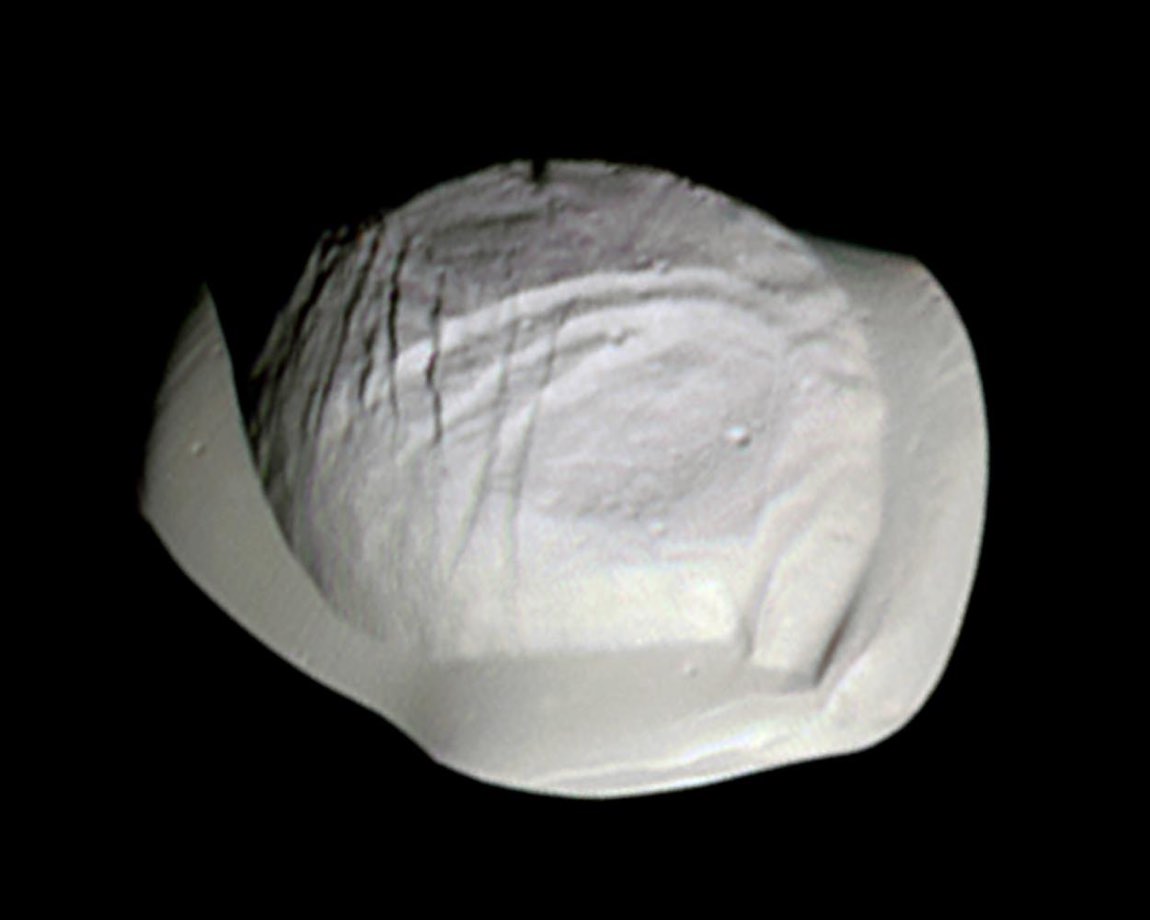
 Photograph · NASA/JPL-Caltech/Space Science Institute · Public domain
Moon · Deep guide · orbits Saturn
Pan
Also called: Saturn XVIII · S/1981 S 13
A walnut-shaped moon that sweeps clean the Encke Gap in Saturn's rings.
What is it?
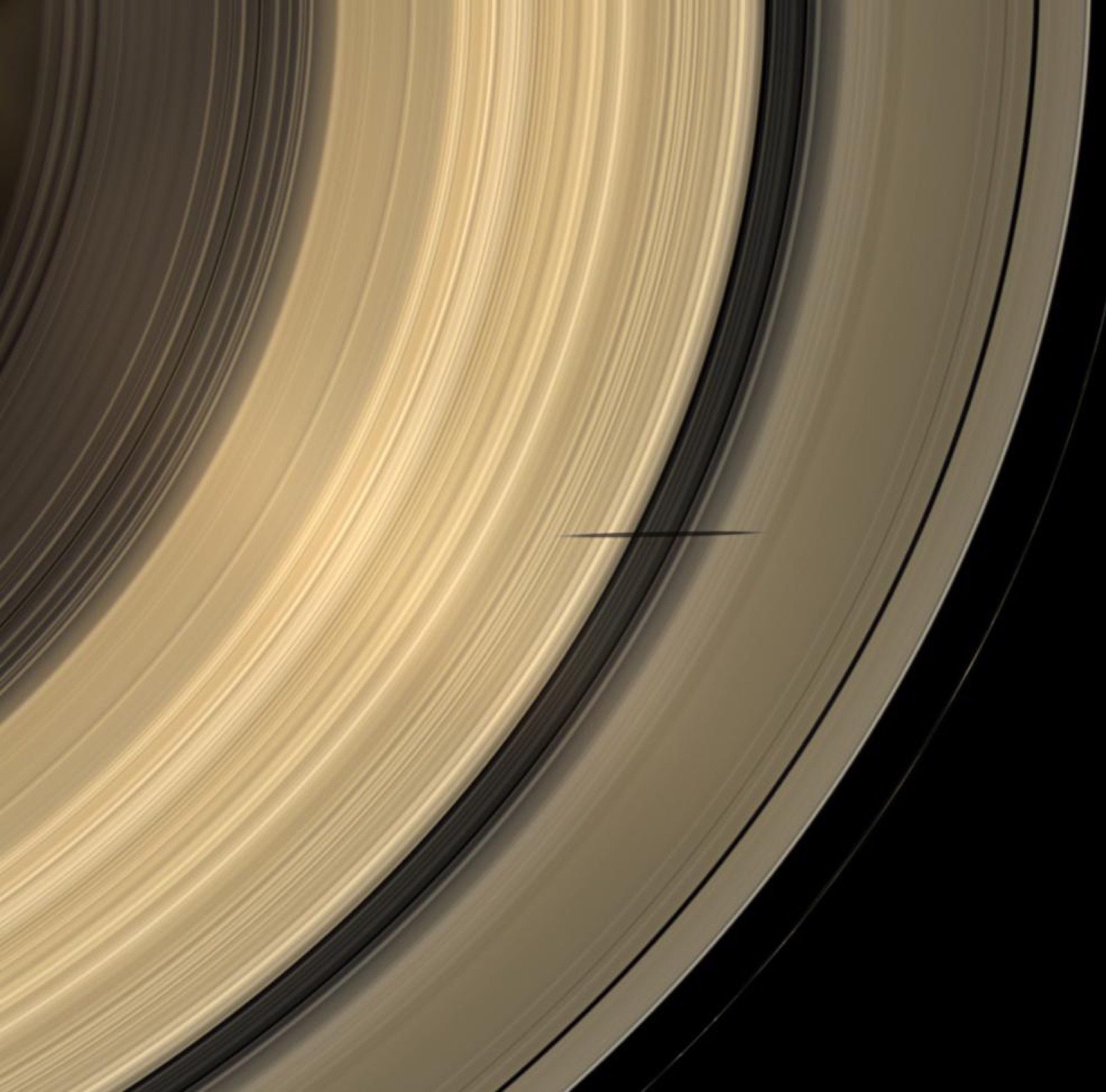
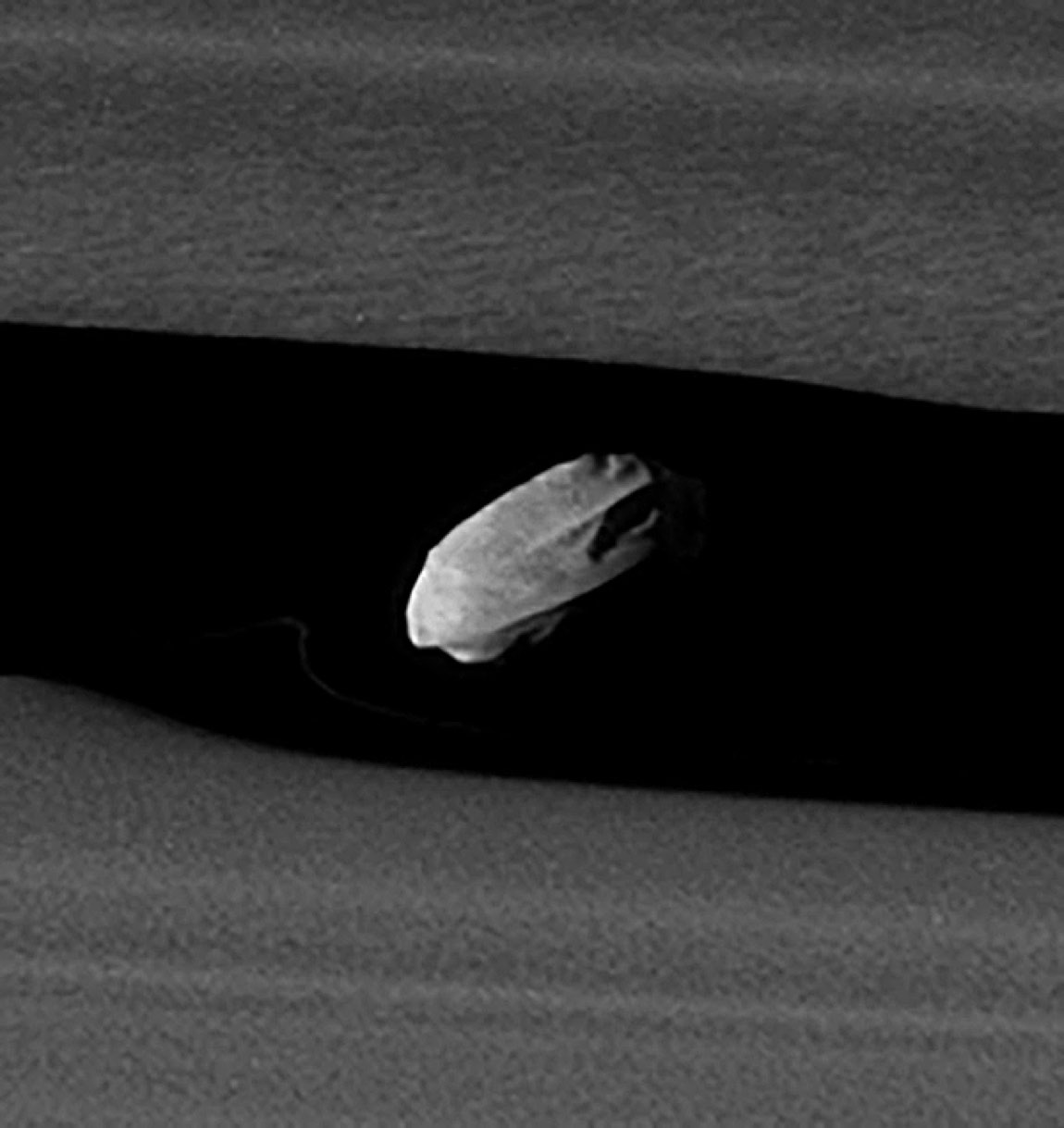
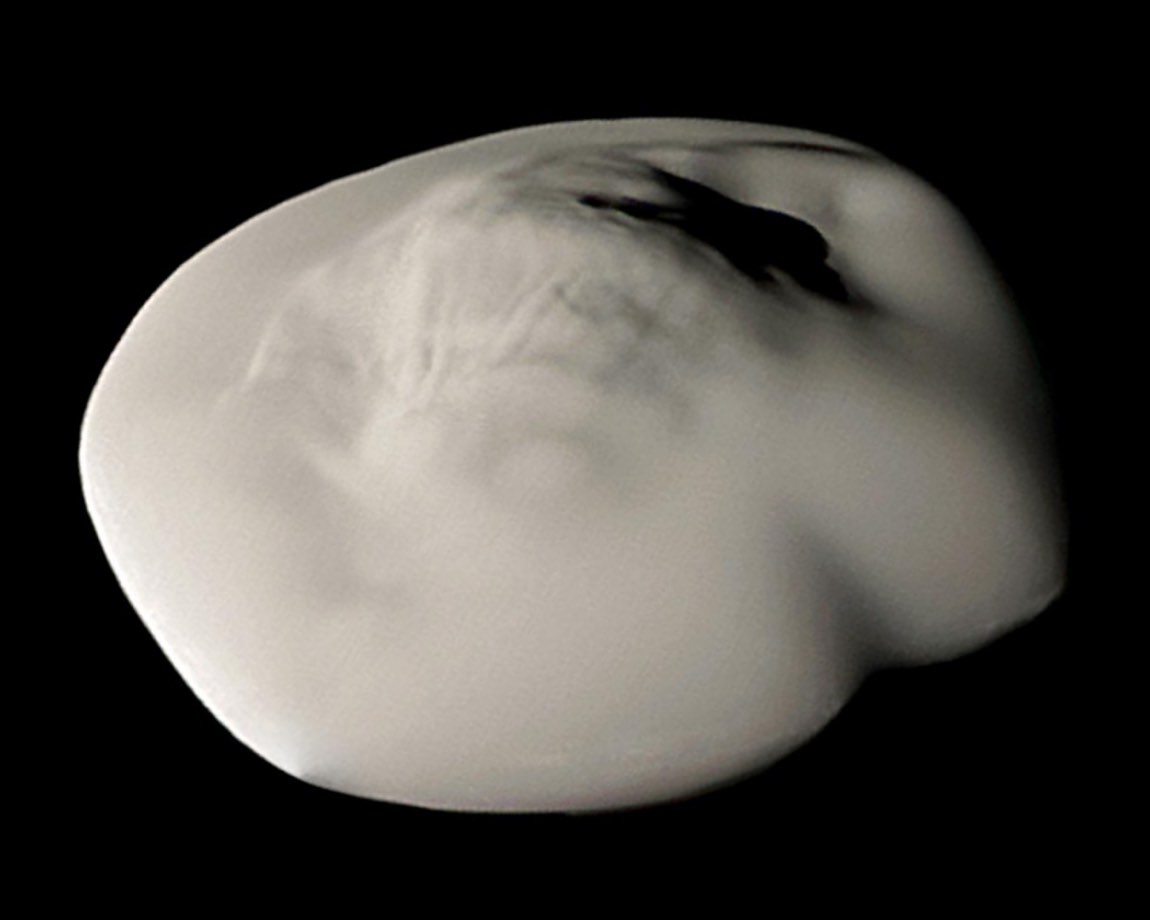
Pan is the innermost named moon of Saturn, about 35 km long, and it orbits inside the Encke Gap in the A ring. Its gravity keeps the gap open and raises wavy ripples on the ring edges — ripples that let scientists predict where Pan should be before anyone saw it. Mark Showalter found it in 1990 by searching old Voyager 2 images. Cassini close-ups show a thin equatorial ridge built from swept-up ring material, giving Pan its famous walnut or ravioli shape.
The deep dive
Researched for the Atlas from Wikipedia — Pan (moon) (3,187 characters read) · updated Nov 14, 2026
01 Predicted before it was ever seen
Pan is one of the rare moons in the solar system that was mathematically forecast before anyone actually spotted it. In 1985, planetary scientists Jeffrey N. Cuzzi and Jeffrey D. Scargle noticed that the edges of the Encke Gap were not clean and straight — they rippled in a way that could only be explained by gravitational tugging from an unseen body orbiting within the gap. The following year, Showalter and colleagues pushed the analysis further, modeling the gravitational wake the hidden moon was leaving behind. From that modeling alone they predicted a semi-major axis of 133,603 ± 10 km and a mass of 5–10 × 10⁻¹² Saturn masses. When Pan was finally confirmed, its actual semi-major axis differed from the prediction by just 19 km, and its mass turned out to be 8.6 × 10⁻¹² Saturn masses — well within the predicted range. The moon also turned up within 1° of the predicted position in the sky, a stunning vindication of gravitational detective work done years before anyone knew where to look.
02 A 1981 discovery made in 1990
Pan's formal discovery came not from a fresh observation but from digging through old photographs. Mark R. Showalter confirmed the moon's existence in 1990 by carefully reanalyzing images taken by the Voyager 2 spacecraft years earlier. The discovery images themselves dated all the way back to 1981, which is why Pan received the provisional designation S/1981 S 13 — the number encodes the year the light actually hit the camera, not the year the moon was recognized. Finding it required a clever computational strategy: Showalter considered every Voyager 2 image in the archive and used computer calculations to predict the exact circumstances under which the moon would be visible in each frame. The search paid off. Every qualifying Voyager 2 image with a resolution better than roughly 50 km per pixel shows Pan clearly, and in total the moon appears in eleven separate Voyager 2 images. Its name was officially assigned on 16 September 1991, honoring the Greek god Pan — deity of shepherds — a pointed nod to the moon's role as a gravitational shepherd of the Encke Gap.
03 Why the Encke Gap stays open
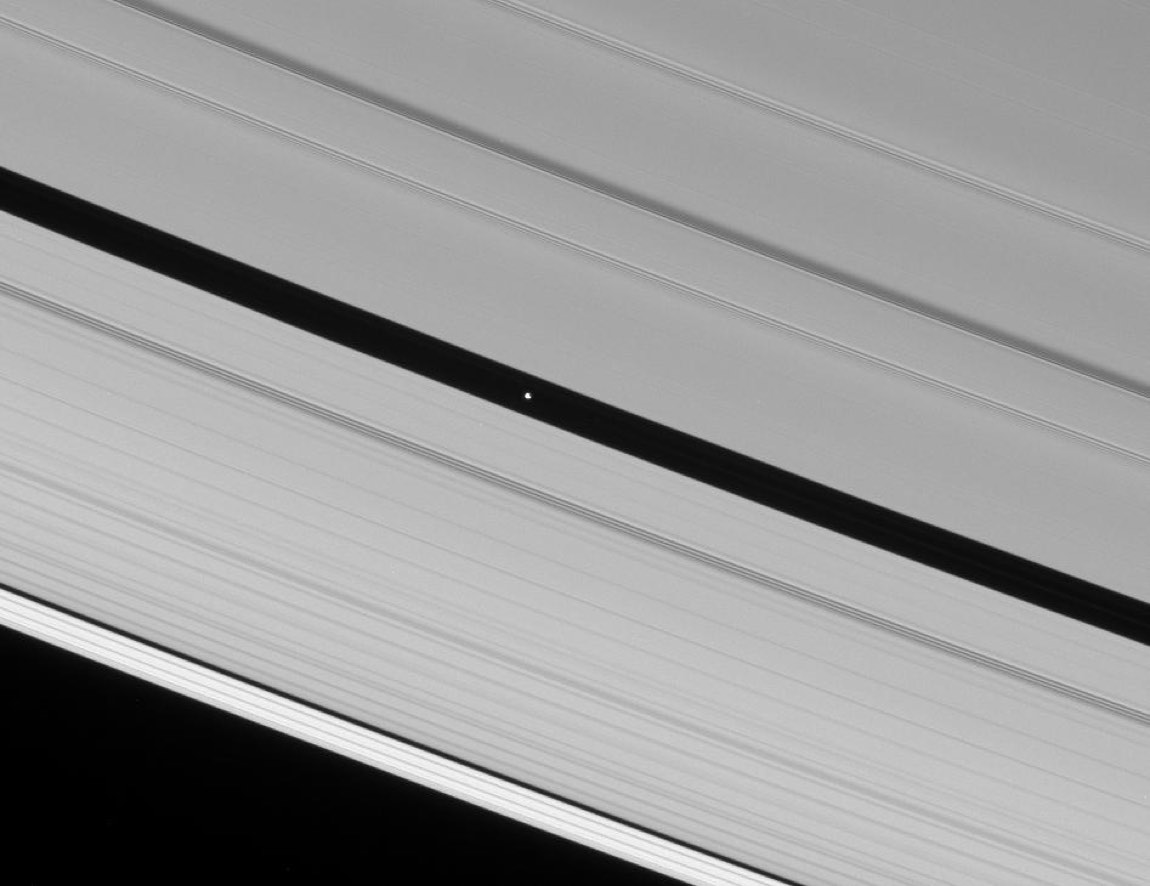
Saturn's A Ring is not seamless. Running through it is a gap about 322 km wide known as the Encke Gap, and Pan is the reason that corridor remains clear. As Pan travels its orbit, its gravity scatters ring particles away from the gap's center, continuously sweeping the lane free of debris. This makes Pan a classic shepherd moon — a small body that uses gravitational influence to maintain a sharp boundary in a ring system. The relationship is not purely one-way, however. The Encke Gap contains a ringlet that sits right along Pan's orbital path, and the dynamics there show that Pan is actively holding those particles in horseshoe orbits — a pattern where particles alternately fall slightly inside and outside the moon's path rather than drifting away. A second ringlet inside the gap is periodically disturbed by Pan in a fashion similar to how the moon Prometheus disrupts Saturn's F Ring, adding further complexity to what might look like an empty stripe in the rings.
 ⤢
04 An orbit that barely tilts or stretches Deeper
Pan's orbit is remarkably close to circular and almost perfectly flat relative to Saturn's equatorial plane. The moon's orbital eccentricity is small enough that Pan's distance from Saturn varies by only about 4 km over the course of one orbit — a tiny swing given that it travels all the way around inside a gap 322 km wide. Its orbital inclination, the angle at which the orbit tips away from Saturn's equator, is so slight that current measurements cannot distinguish it from zero. This near-zero inclination matters practically: it means Pan stays centered in the midplane of the ring system rather than bobbing up and down through it, which is part of why it can so effectively police the Encke Gap. Even slight vertical excursions would reduce its ability to gravitationally sculpt the gap edges. The precision of these orbital parameters also made the original mathematical prediction of Pan's location so accurate — a nearly circular, nearly coplanar orbit is a well-behaved one that leaves predictable gravitational fingerprints in the gap's wavy walls.
05 The walnut, the ravioli, and the ridge
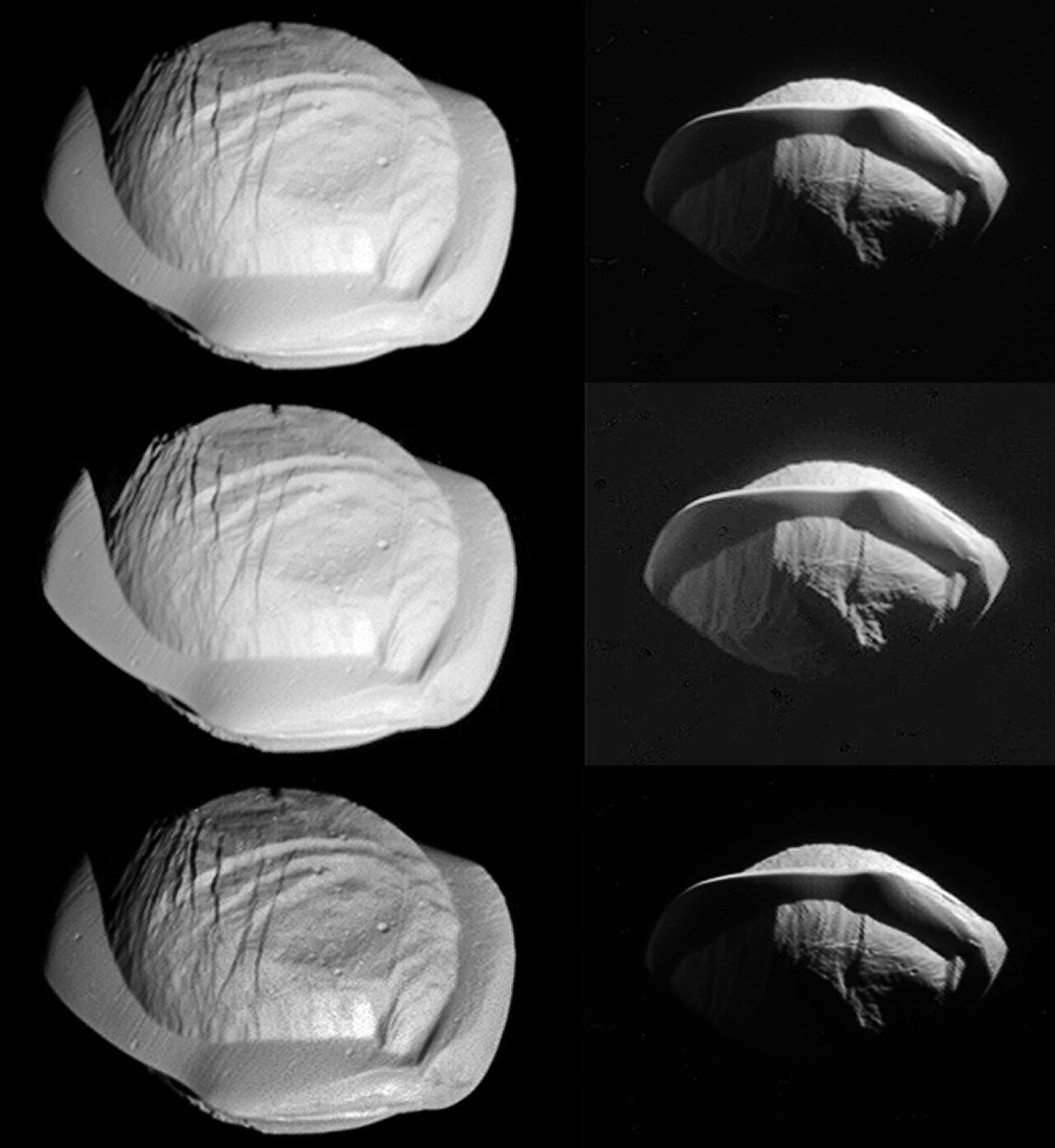
Pan's shape is immediately striking in close-up images. Scientists on the Cassini mission described it as walnut-shaped, while journalists reached for different comparisons — space empanada and ravioli both made headlines. All of these descriptions point to the same feature: a prominent equatorial ridge that wraps around the moon's midsection, giving it a distinctly bulged, almost sculpted look. That ridge is not a coincidence of geology. It is made of ring material that Pan has swept up from the Encke Gap over time, gradually accumulating a belt of debris around its equator. The ridge is substantial — it accounts for roughly 10% of Pan's total volume and extends 10 to 20 degrees away from the equator on both sides. Its outer surface is generally smoother than Pan's older core, though it is not featureless; grooves and craters are still present on it. Perhaps most striking is that there is a sharp boundary between the ridge and the core, suggesting the two regions have distinct histories and that the accretion of ring material was a process that added onto a pre-existing body rather than gradually reshaping it uniformly.
06 A similar ridge on a neighboring moon Deeper
Pan is not the only small Saturn moon wearing an unusual equatorial belt. The moon Atlas, which also orbits in the outer part of the ring system, displays a strikingly similar equatorial ridge. Cassini scientists explicitly noted the resemblance between the two, suggesting that the same mechanism — the accretion of ring material onto a moon's equator — may be operating in both cases. This raises an interesting question about how widespread such a process is around Saturn and whether other small moons embedded in or near the rings might be building up similar structures over time. For Pan, the ridge's polygonal shape adds another layer of curiosity: rather than being a smooth, perfectly rounded belt, it has angular segments, giving it an almost faceted appearance. What drives that polygonal geometry rather than a smooth equatorial bulge is not fully explained in current research, and it remains one of the more visually distinctive puzzles Pan presents to planetary scientists.
 ⤢
07 Could moonlet mergers have built Pan? Deeper
The conventional explanation for Pan's unusual shape centers on ring material accumulating around a central core, but at least one newer line of research points toward a more violent origin story. A study highlighted in the available record proposes that Pan's bizarre form could also have resulted from collisions between tiny moonlets — small precursor bodies that gradually merged together and in doing so created the strangely shaped object we see today. This scenario, known as the pyramidal regime formation scenario, suggests that Pan's shape is not simply the product of gentle dust accretion but could carry the structural memory of repeated low-speed impacts and mergers between small bodies in the early ring environment. If correct, this would mean Pan's interior is not a simple core overlaid with a soft ridge, but rather a more complex amalgamation of merged objects. Distinguishing between these formation pathways observationally is difficult, and the question of exactly how Pan achieved its present shape remains an open one in the planetary science literature.
08 Pan's size in everyday perspective
Pan is a genuinely tiny world by any measure. It stretches approximately 35 kilometres across its longest dimension and 23 km wide — roughly the distance you might drive on a highway in about 15 minutes at motorway speed. To put that in an urban context, Pan's longest axis is comparable to the distance from one side of a large metropolitan area to the other. At those dimensions, Pan's gravity is far too weak to pull itself into a sphere, which is part of why it retains its irregular, walnut-like shape rather than rounding out the way larger moons do. The moon orbits within the Encke Gap, a channel in Saturn's A Ring that is itself about 322 km wide — meaning the gap Pan patrols is roughly nine times Pan's own length. Despite its small size, Pan's gravitational influence is enough to maintain that corridor, a reminder that even modest masses can have outsized dynamical effects when they are well-positioned within a ring system.
09 The name and its mythological logic
The name Pan was officially assigned on 16 September 1991, and the choice was deliberately thematic rather than arbitrary. In Greek mythology, Pan was the god of shepherds, wild nature, and rustic music — a deity associated with the tending and guiding of flocks. Naming this particular moon Pan was a direct acknowledgment of its physical role in Saturn's ring system: Pan is a shepherd moon, using its gravity to herd ring particles and keep the Encke Gap clear. The naming convention for Saturn's moons at this period often drew on figures from Greek and Roman mythology, but the specific selection of Pan carried a satisfying conceptual elegance that made it stand out. The moon is also officially catalogued as Saturn XVIII, the Roman numeral designation reflecting its place in the sequential numbering of Saturn's confirmed moons. That catalog number, however, says nothing about its position or importance — Pan is the innermost of Saturn's named moons, sitting closer to the planet than any of its named siblings.
 ⤢
10 Open questions Pan still poses Deeper
Despite being confirmed in 1990 and imaged in detail by Cassini, Pan leaves several questions unanswered. The formation debate — whether the moon's shape arose from ring material accretion, from moonlet mergers under the pyramidal regime scenario, or some combination of both — has not been resolved with available data. The polygonal geometry of the equatorial ridge lacks a fully accepted explanation. Pan's orbital inclination is so close to zero that present measurements simply cannot determine whether it is exactly zero or just very small, leaving a gap in the orbital picture. The interior structure of Pan is also essentially unknown: whether its core is a single cohesive object or a loosely bound rubble pile of merged moonlets has not been established. Even the long-term stability of Pan's shepherding role — whether it will continue to maintain the Encke Gap indefinitely or whether the gap might eventually close or change character — is a question that planetary dynamicists continue to explore. Pan is a small moon, but it carries a surprisingly large list of unresolved puzzles.