 Photograph · NASA/JPL-Caltech/Space Science Institute; editing by Matúš Motlo · Public domain
Moon · Deep guide · orbits Saturn
Daphnis
Also called: Saturn XXXV · S/2005 S 1
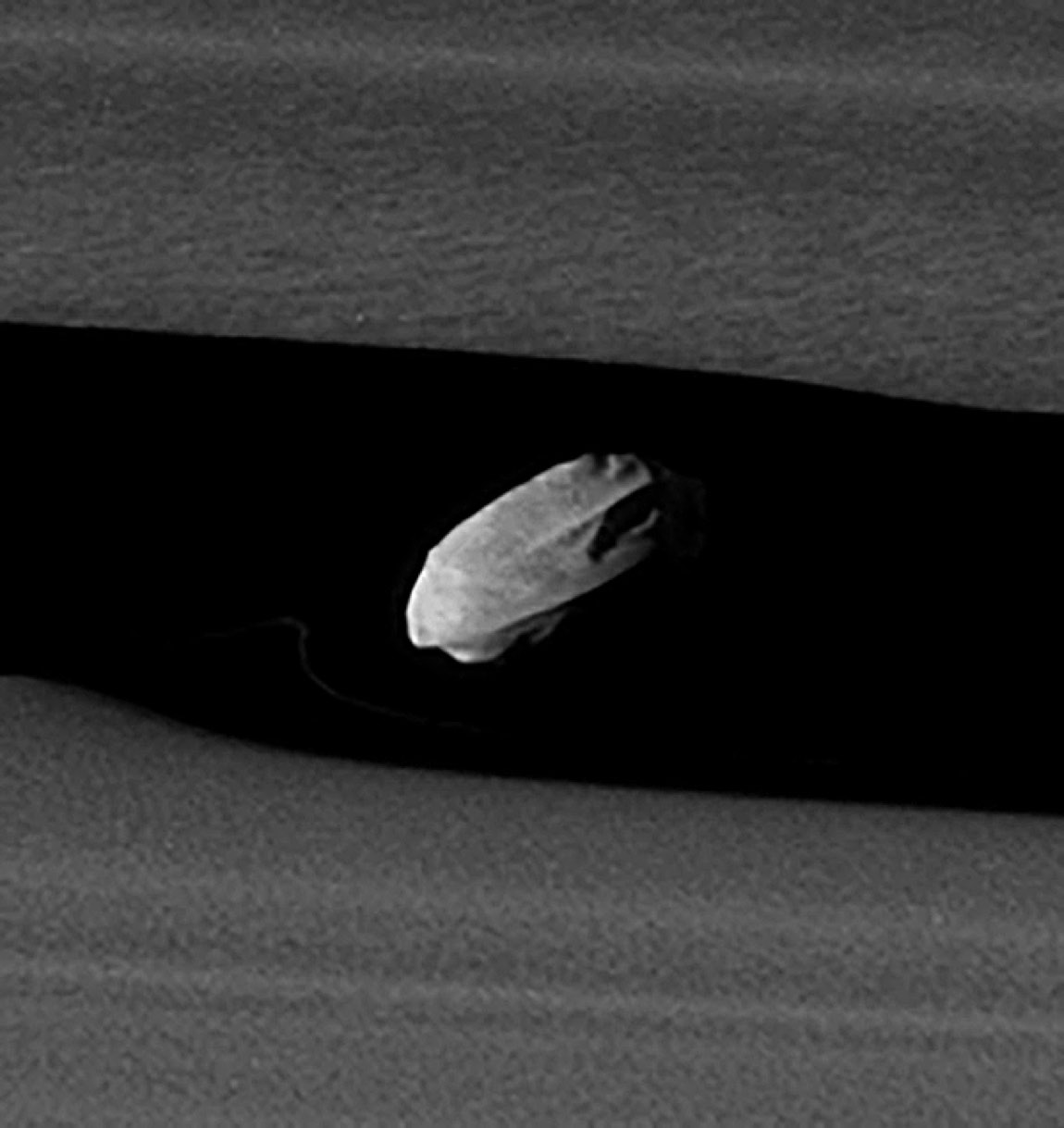
An 8-km moon that raises towering waves along the edges of the rings' Keeler Gap.
What is it?
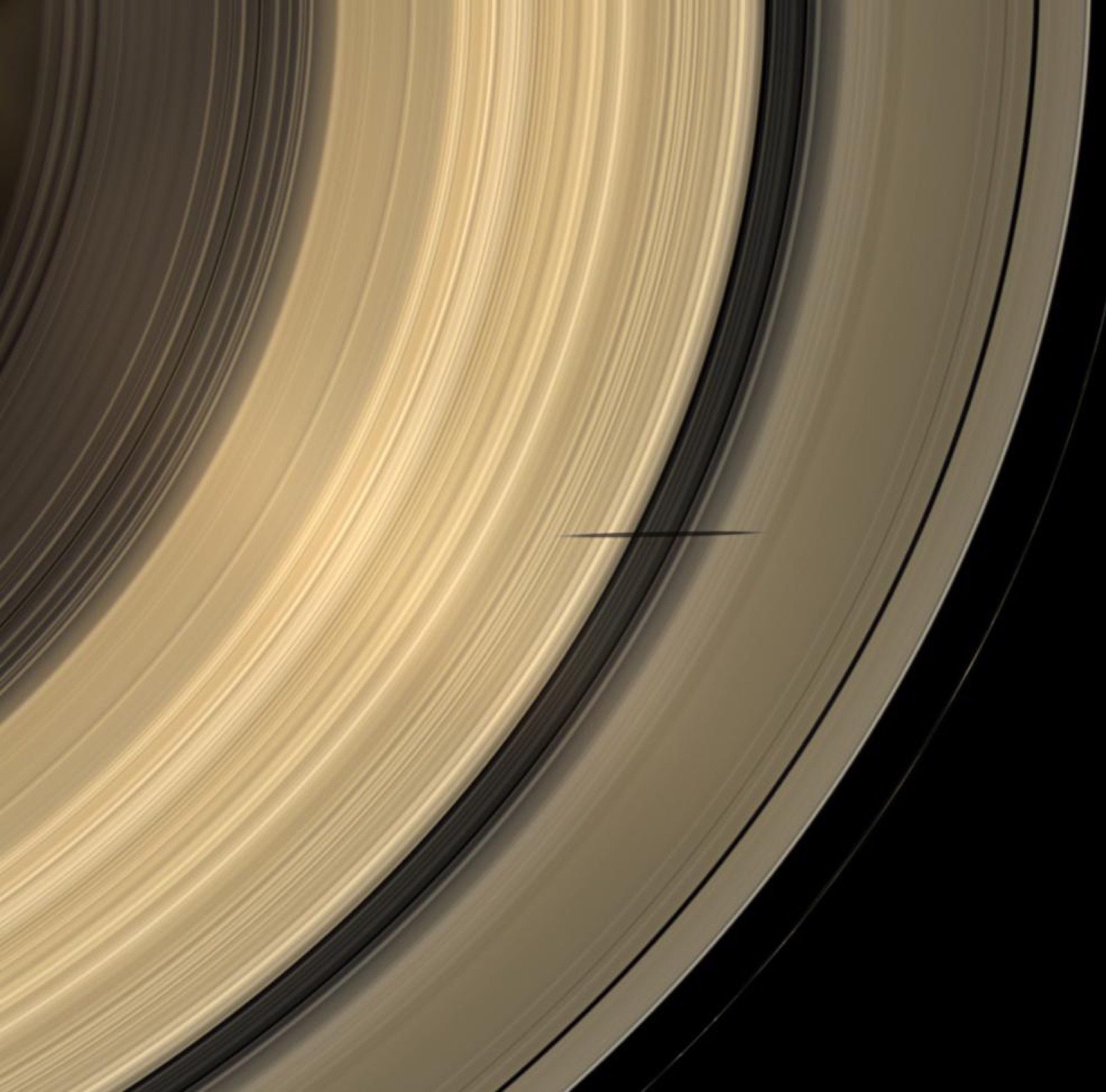
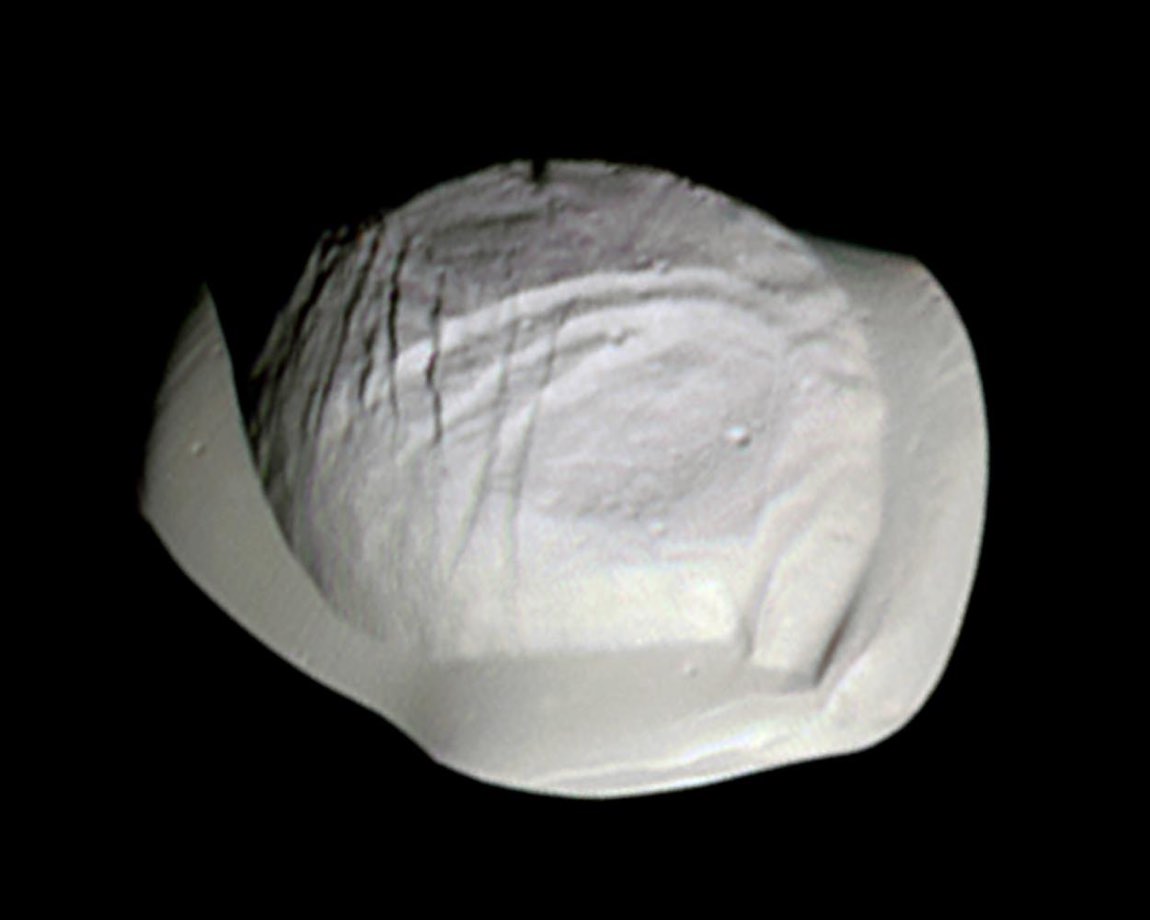
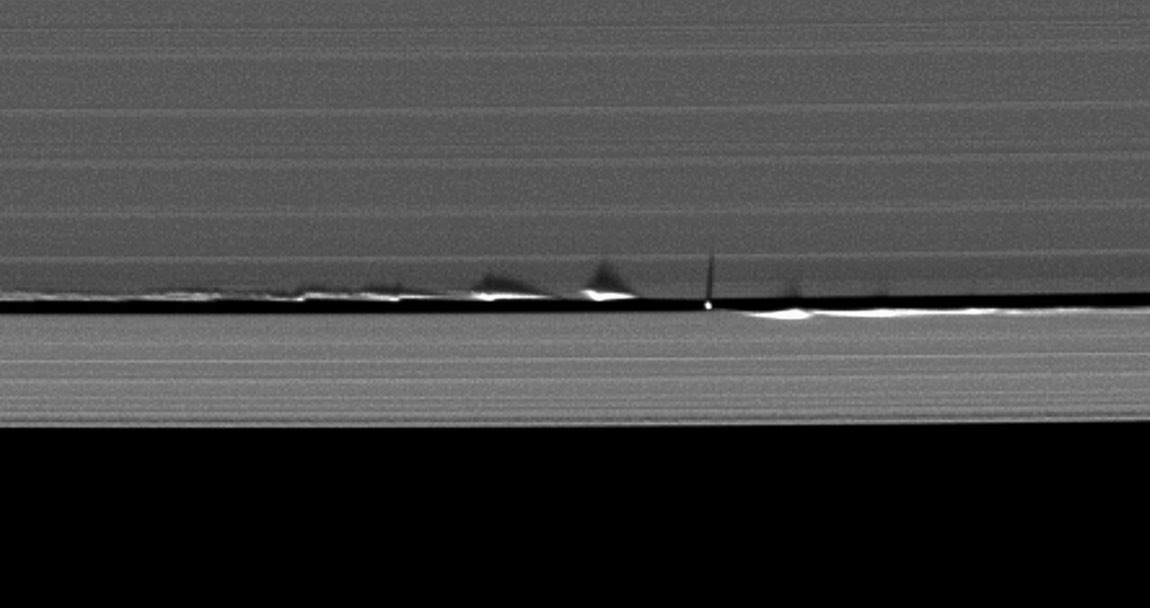
Daphnis is a tiny moon, about 8 km across, that orbits within the Keeler Gap near the outer edge of Saturn's A ring. Ripples on the gap's edges had hinted at a hidden moon before the Cassini spacecraft photographed it in May 2005. Because Daphnis's orbit is slightly tilted, the waves it stirs in the ring have vertical relief and cast shadows near Saturn's equinox. Close images show a mostly smooth body with an equatorial ridge, much like Pan.
The deep dive
Researched for the Atlas from Wikipedia — Daphnis (moon) (3,349 characters read) · updated Nov 14, 2026
01 Inferred before it was ever seen
Daphnis is one of the rare objects in the solar system whose existence was predicted before anyone actually photographed it. Scientists watching Cassini's early images of Saturn's A ring noticed that the edges of the Keeler Gap were not smooth — they rippled and waved in ways that only made sense if something gravitational was orbiting inside. Those ripples acted as a fingerprint, pointing to a hidden moon. The actual discovery came when the Cassini Imaging Science Team examined a time-lapse sequence of narrow-angle-camera exposures taken over just 16 minutes on May 1, 2005. The formal announcement followed on May 10, 2005. Researchers then searched back through earlier Cassini images and found Daphnis hiding in plain sight: 32 low-phase images taken of the F ring on April 13, 2005, spanning 18 minutes, contained it, as did two high-resolution images from May 2, 2005, in which its roughly 7-kilometer disk was actually resolved at 3.54 km per pixel. The moon's story, then, begins not with a sighting but with a wobble.
02 A name tied to shepherds and Titans
The name Daphnis was officially assigned in 2006, two years after the moon's first images were taken. In Greek mythology, Daphnis was a shepherd, pipe player, and pastoral poet — a gentle, rustic figure quite different from the titanic gods after whom Saturn's largest moons are named. The choice was deliberate: Daphnis was a descendant of the Titans, creating a family connection to that broader naming tradition while also fitting a separate, more specific rule. Both Daphnis and Pan — the only two known shepherd moons that orbit within Saturn's main rings — are named for mythological figures associated with shepherding. Pan tends a gap of his own, the Encke Gap, while Daphnis tends the Keeler Gap. The parallel naming reflects not just mythology but function: both moons literally shepherd the ring material around them, gravitationally herding particles and keeping their respective gaps relatively clear. The moon's provisional designation before naming was S/2005 S 1, and it is also catalogued as Saturn XXXV.
03 An orbit with just enough wobble to matter Deeper
Daphnis follows a nearly circular, nearly flat orbit, but 'nearly' turns out to carry enormous consequences at this scale. Its orbital eccentricity is small yet measurably above zero, causing the moon's distance from Saturn to vary by roughly 9 km — a fluctuation comparable to the width of a small town. More consequential is its inclination, which is likewise tiny but still significantly larger than that of Pan, the other ring-embedded moonlet. Because of this inclination, Daphnis bobs up and down by about 17 km above and below the ring plane as it travels. The Keeler Gap it inhabits is only about 42 km wide, so that 17-km vertical excursion means Daphnis periodically approaches the gap's edges from above or below rather than staying neatly centered. These small but real deviations from a perfect circular, equatorial orbit help explain the complex wave patterns the moon imprints on the gap edges, and they make Daphnis's gravitational housekeeping considerably more dynamic than a simple two-dimensional picture would suggest.
04 How a 7-km moon sculpts a ring edge
Despite being only about 7.8 km across — smaller than many cities — Daphnis has a measurable grip on the ring particles around it. As it orbits within the Keeler Gap, its gravity tugs ring particles on the gap's inner and outer edges toward it, and those particles then fall back into the ring after the moon passes. This creates a train of gravitational waves rippling outward from the gap boundaries. The waves do not appear symmetrically on both sides: on the inner edge, the waves run ahead of Daphnis in its orbital direction, while on the outer edge they lag behind. This asymmetry happens because ring particles at different distances from Saturn orbit at different speeds, so the gravitational influence of the moon arrives and departs differently on each side. In a photograph taken on January 18, 2017, something even more dramatic was visible: a thin tendril of ring particles stretching outward from the edge toward the moon itself. Scientists at JPL interpreted this as a packet of material that Daphnis had pulled loose from the ring, now spreading as it slowly dispersed — a brief, frozen record of gravitational capture in action.
05 An equatorial ridge with an unexpected story Deeper
When Cassini photographed Daphnis up close on January 18, 2017, the images revealed an irregularly shaped body with a mostly smooth surface, a few craters, and — most intriguingly — an equatorial ridge, a raised band running around the moon's midsection. A second, shorter ridge also appears in the northern hemisphere, extending roughly 90 degrees in longitude. Equatorial ridges are known from other small bodies, including Pan, and for shepherd moons the prevailing theory is that ridge thickness should correlate with both the moon's orbital inclination and the thickness of the ring in which it orbits. Daphnis, however, complicates this picture. Its equatorial ridge accounts for only about 1 percent of the moon's total volume — far smaller than the correlation would predict. Combined with the expectation that the entire surface of Daphnis is blanketed in ring particles, researchers have proposed that the ridge does not simply reflect the ring's physical thickness but instead mirrors density variations within the ring itself. In other words, the ridge may be a record of where the ring was denser, not deeper, when Daphnis was accumulating its surface coating.
06 A body that is mostly empty space
One of the most striking physical facts about Daphnis is what it is not: solid. Its density is low enough that scientists expect it to have a porosity exceeding 60 percent. That means more than three-fifths of Daphnis's interior, by volume, is simply empty space — gaps between loosely packed particles rather than continuous rock or ice. An object this porous is less like a solid moon and more like a very loosely compressed pile of rubble held together primarily by its own weak gravity. This kind of structure is consistent with the idea that Daphnis formed by gradual accumulation of ring material rather than from a single, coherent chunk. The high porosity also means the moon would be extraordinarily fragile by terrestrial standards; a significant impact that might leave only a crater on a solid body could potentially restructure or even partially disperse a pile-of-rubble object like Daphnis. Its surface, expected to be entirely covered in ring particles given its small size, reinforces the picture of a moon that is essentially an overgrown clump of the very ring it now helps to shape.
07 Cassini's close encounter of January 2017
For most of Cassini's time at Saturn, Daphnis was simply too small and too embedded in the ring to photograph in useful detail. That changed dramatically on January 18, 2017, when Cassini passed close enough to reveal the moon's actual shape and surface character for the first time. The images from that encounter are the primary source of everything known about Daphnis's physical appearance: the irregular shape, the mostly smooth surface with scattered craters, the equatorial ridge, the northern hemisphere ridge, and the dramatic tendril of ring material apparently being drawn toward the moon. This single flyby fundamentally transformed Daphnis from a point of light inferred from ring ripples into a real, three-dimensional world with its own topography and geological story. The encounter was part of Cassini's extended mission activities as the spacecraft maneuvered closer to the ring plane in preparation for its final Grand Finale orbits, which ultimately plunged it into Saturn's atmosphere in September 2017.
08 Pan and Daphnis: siblings in the rings Deeper
Daphnis and Pan share a distinction held by no other known moons in the solar system: they both orbit entirely within Saturn's main rings, each maintaining its own gap. Pan, the larger of the two, keeps the Encke Gap open and has an orbital inclination lower than Daphnis's. The article notes that Daphnis's inclination is significantly greater than Pan's, and that this difference matters for understanding the equatorial ridges both moons display. For shepherd moons as a class, the theoretical expectation is that ridge size scales with inclination and ring thickness — a moon bobbing more steeply through the ring plane should accumulate more material around its equator. Daphnis's ridge being only 1 percent of its volume, despite its measurable inclination, suggests either that the theory needs refinement or that Daphnis's particular ring environment is different in character from what the model assumes. Both moons carry mythological names tied to shepherding, reinforcing their functional role, but their physical differences remind researchers that even two moons doing the same gravitational job can tell very different stories about how rings and embedded moons co-evolve over time.
09 Open questions Daphnis still poses Deeper
Despite the revelations of the January 2017 Cassini images, Daphnis leaves several genuine scientific questions unanswered. The relationship between its equatorial ridge and ring density variations is not yet fully explained; it remains an interpretive proposal rather than a confirmed mechanism. The origin of the northern hemisphere ridge — shorter and covering only about 90 degrees of longitude — has no clear explanation separate from the equatorial one, and the two features may have different formation histories. The nature of the tendril of ring material photographed reaching toward the moon is described by JPL as a possible interpretation rather than a certainty: it may represent material being actively drawn out, or it may be something else entirely. More broadly, Daphnis's very high porosity raises questions about its internal structure and how its loosely bound rubble pile has remained coherent across the age of the solar system while orbiting within an active, collisional ring. No follow-up mission to Saturn capable of resolving these questions is currently operational, so for now, Daphnis's inner workings remain largely a matter of inference and modeling.
 ⤢