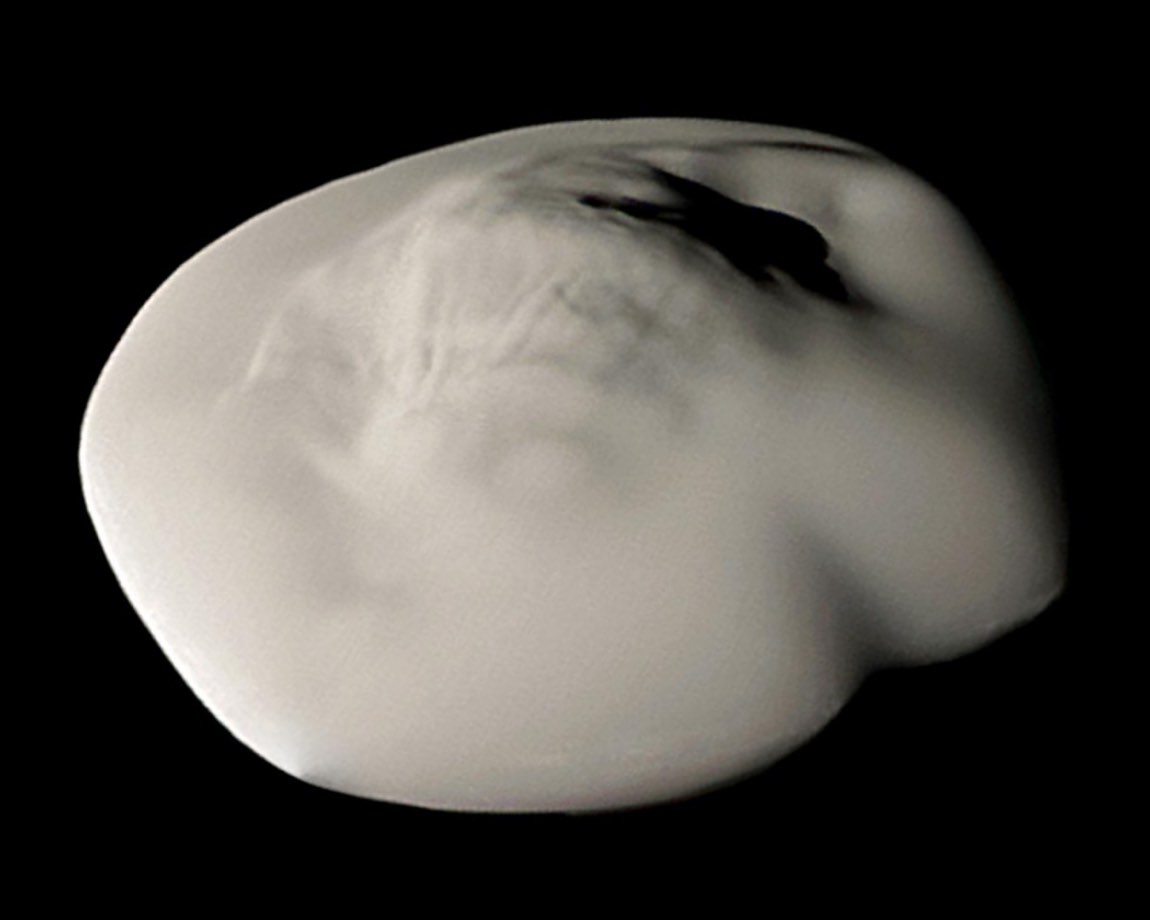
 Photograph · NASA/JPL-Caltech/Space Science Institute · Public domain
Moon · Deep guide · orbits Saturn
Atlas
Also called: Saturn XV · S/1980 S 28
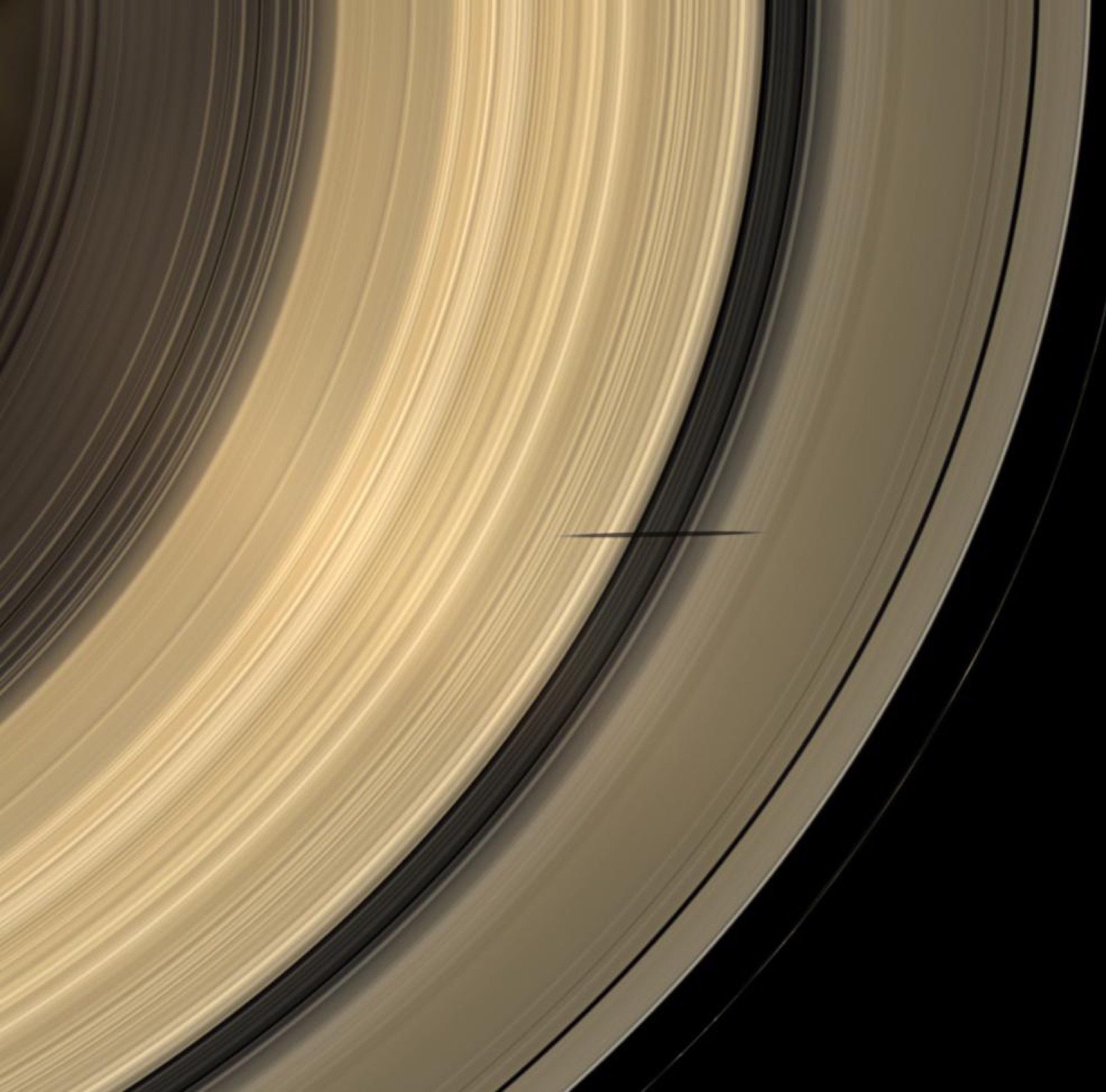
A flying-saucer moon just beyond the sharp outer edge of Saturn's A ring.
What is it?
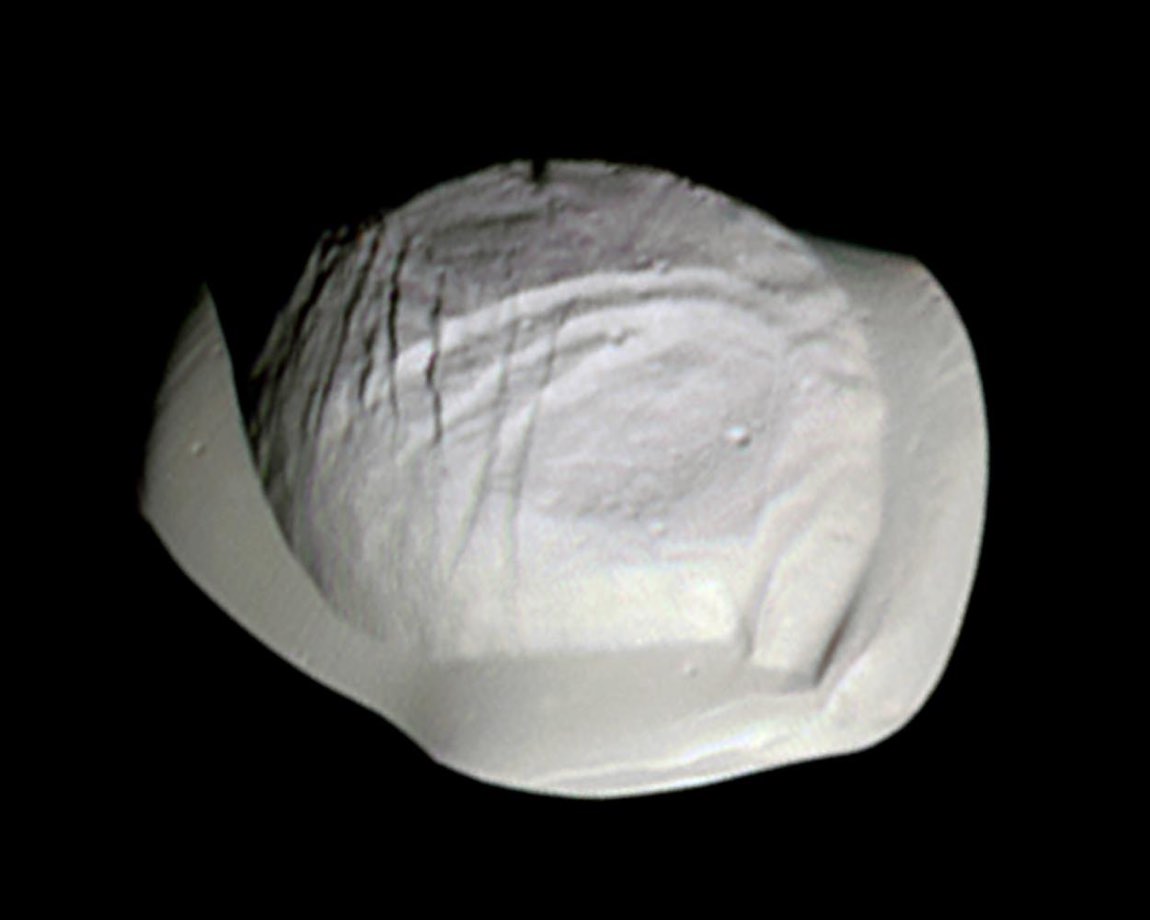
Atlas is a small inner moon of Saturn, about 41 km across at its widest, orbiting just outside the A ring. Richard Terrile discovered it in 1980 in Voyager 1 images, and it was named after the Titan who held up the sky. Cassini images from 2005 revealed a rounded core wrapped in a large, smooth equatorial ridge — about a quarter of its volume — that makes it look like a flying saucer. Its orbit is chaotic, constantly nudged by nearby Prometheus and Pandora.
The deep dive
Researched for the Atlas from Wikipedia — Atlas (moon) (2,030 characters read) · updated Nov 14, 2026
01 Discovered in a photograph, named in myth
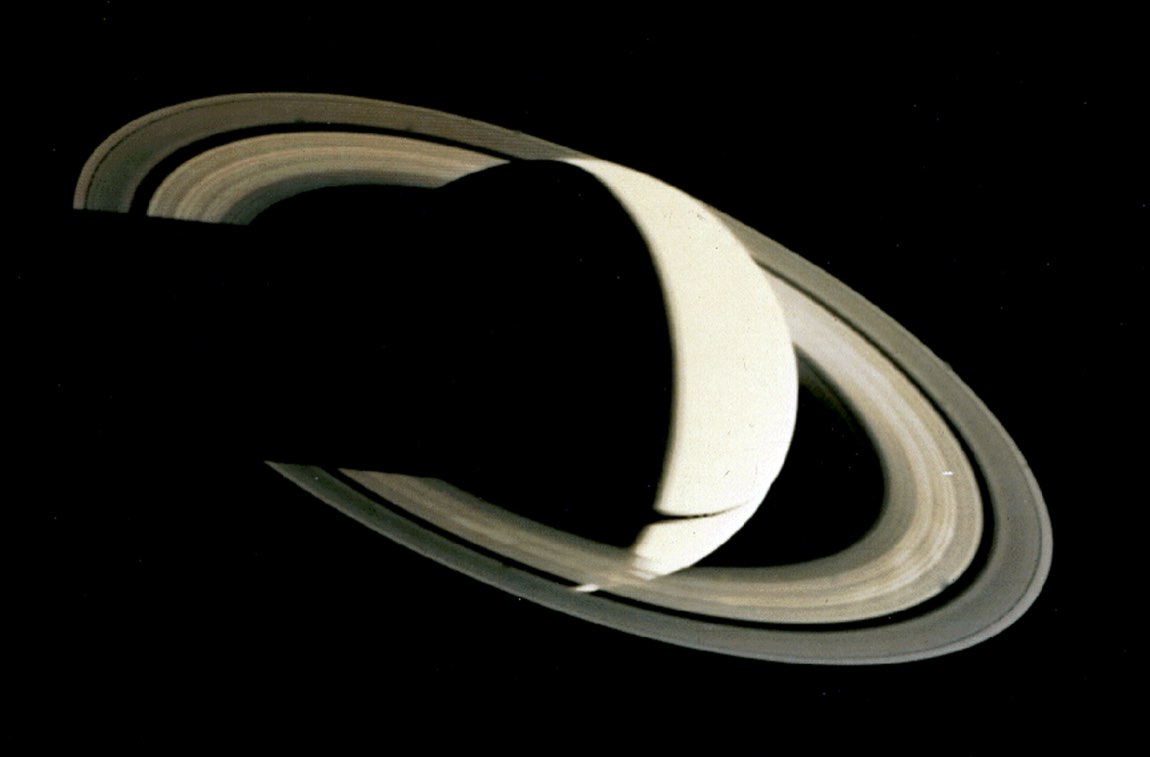
Atlas was spotted by astronomer Richard Terrile in 1980 while poring over images beamed back by the Voyager spacecraft. It received the provisional designation S/1980 S 28 — a placeholder label that tells you exactly when and where it was found. Three years later, in 1983, it earned a proper name drawn from Greek mythology: Atlas, the Titan condemned to hold the sky on his shoulders for eternity. The parallel was deliberate and poetic. At the time, scientists believed the moon was doing something structurally similar — holding Saturn's A ring in place at its sharp outer edge, shepherding the ring particles and preventing them from spreading. That guardian role seemed to justify naming it after the great cosmic load-bearer. It is also formally catalogued as Saturn XV, meaning it was the fifteenth Saturnian moon to receive an official designation. The name stuck even after the original scientific reasoning behind it was revised.
02 Why the shepherd story turned out to be wrong Deeper
For years, Atlas was classified as a shepherd satellite — a moon whose gravity sculpts and maintains a ring edge. Its position as the closest satellite to the sharp outer boundary of the A ring made the hypothesis feel almost self-evident. But closer analysis overturned that tidy picture. The outer edge of the A ring is now understood to be maintained not by Atlas at all, but by a 7:6 orbital resonance with two larger and more distant moons, Janus and Epimetheus. In resonance dynamics, the gravitational nudges these moons deliver at regular, repeating intervals add up over time and act like a fence that ring particles cannot easily cross. Atlas, it turns out, is simply a bystander living near that fence rather than the builder of it. This kind of revision is common in planetary science: a moon's location near a ring edge does not automatically make it the cause of that edge. The corrected understanding also prompted a subtle reassessment of why the name Atlas was chosen, since the moon turned out to be far less load-bearing than originally assumed.
03 A ring of its very own
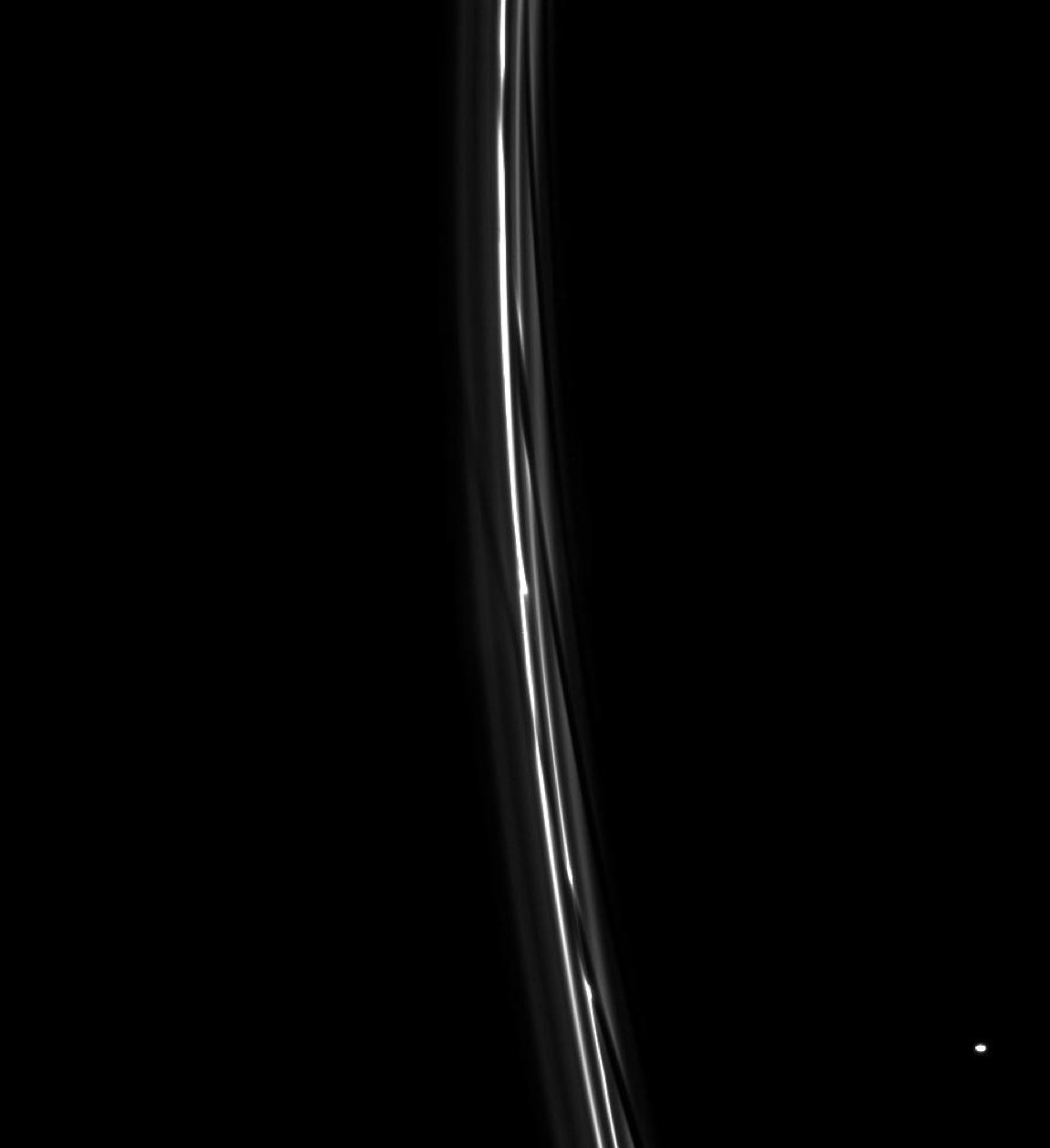
In 2004, researchers examining Cassini data made a small but intriguing discovery: a faint, thin ring occupying the same orbit as Atlas. This ring was given the temporary designation R/2004 S 1, following the standard convention of noting the year and the sequence of the discovery. It sits inside what is called the Atlantean orbit — essentially the path that Atlas traces around Saturn. The existence of a ring sharing a moon's orbit is not unique in the solar system, but it adds texture to Atlas's story. The ring is described as faint and thin, which suggests it is not a massive structure but rather a tenuous scattering of particles. Whether Atlas actively contributes material to this ring, or whether the ring is simply debris that has settled gravitationally into the same orbital lane, is a question the article does not fully resolve. What is clear is that Atlas is not just a moon orbiting near a ring — it carries a ring with it.
04 Chaos with a ten-year clock Deeper
Atlas does not follow a calm, predictable orbit. It is classified as chaotic in the technical dynamical sense, and its Lyapunov time — the timescale over which small uncertainties in its position grow to become unpredictable — is just 10 years. That is extraordinarily short by solar system standards and means that even with perfect measurements today, its position a few decades from now cannot be reliably calculated. The main culprits are the neighboring moons Prometheus and, to a lesser degree, Pandora, whose gravitational tugs perturb Atlas continuously. These perturbations are not trivial: Atlas swings up to 600 kilometers — roughly the distance from London to Edinburgh and back — away from where a simple Keplerian orbit would predict it to be. That deviation traces out in longitude and completes a rough cycle of about 3 years. The formal term for the deviation is an excursion in longitude from the precessing Keplerian orbit. For mission planners and theorists alike, this chaotic behavior makes Atlas one of the more dynamically interesting small moons in Saturn's inner system.
05 The flying saucer shape of Atlas
If you saw Atlas from the right angle, you might mistake it for a child's drawing of a flying saucer. High-resolution images captured by the Cassini spacecraft in June 2005 showed a roughly spherical core wrapped by a large, smooth, and dramatically pronounced equatorial ridge. The ridge is not a subtle feature — it is enormous relative to the moon itself, extending between 20 and 50 degrees from the equator and accounting for about 25 percent of Atlas's total volume. It is also completely smooth down to the finest resolution available in the imagery, with no craters, scarps, or rough texture visible on its surface. There is a smooth and gradual transition between the ridge and the main body of the moon. The overall shape is described as roughly polygonal when viewed closely rather than a perfect circular belt. This extreme flattening at the equator makes Atlas visually unlike most other small moons and raises immediate questions about how such a structure could form and persist.
06 How the ridge grew: ring material piling up Deeper
The most likely explanation for Atlas's dramatic equatorial ridge, according to current understanding, is that the moon has been sweeping up material from Saturn's rings over time, and that material preferentially accumulates at the equator. The geometry of this process is driven by the extreme thinness of the rings themselves: ring particles approach Atlas at very low angles relative to the equatorial plane, so when they strike the moon, they tend to land near the equator rather than near the poles. Over geological time, this bombardment and accretion builds up the ridge. The process has a natural limit, however. The size of the equatorial ridge is described as comparable with what is called the Roche lobe of the moon — the region within which Atlas's own gravity dominates over tidal forces from Saturn. Once the ridge reaches this size, any additional particles landing near the equator experience centrifugal force strong enough to nearly overcome Atlas's tiny gravity, meaning they are likely to be lost back into space rather than sticking. The ridge is therefore thought to be close to its maximum possible size.
07 Voyager's fleeting first look
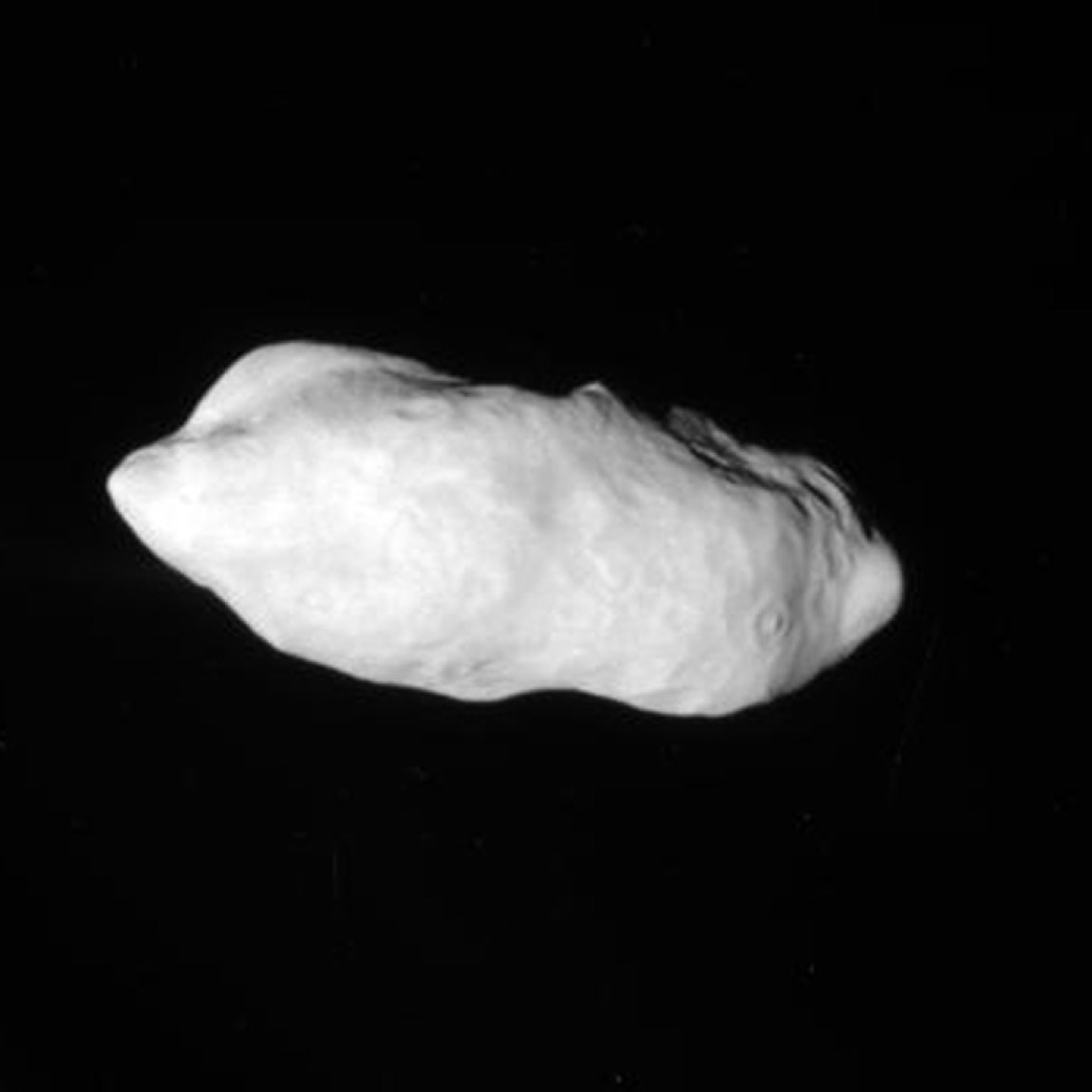
Atlas was identified from photographs taken during the Voyager mission in 1980, making it one of several small inner Saturnian moons first glimpsed in that pioneering flyby data. Richard Terrile, the astronomer who identified it, was working through the Voyager image archive when he spotted the small body near the outer edge of the A ring. The discovery was provisional at that stage — Voyager did not linger, and the images available from that era could not reveal surface detail on a moon this small. For more than two decades, Atlas remained a data point rather than a world: a moving dot whose existence was confirmed but whose character was largely unknown. The moon's true nature only became clear after the Cassini spacecraft arrived at Saturn and began its long and detailed survey of the system. The June 2005 high-resolution images were the moment Atlas went from a designated dot to a recognizable, peculiarly shaped object with a story written on its surface.
08 What Cassini's close images actually showed
Cassini's high-resolution imaging of Atlas in June 2005 delivered what Voyager never could: enough detail to describe the moon's physical character with confidence. The images confirmed the roughly spherical central body but made the equatorial ridge unmistakable. What struck researchers immediately was the total smoothness of the ridge. In a solar system where small bodies are routinely covered in impact craters, boulders, and irregular terrain, Atlas's ridge is featureless. This smoothness extends all the way down to the limit of what the camera could resolve, meaning there may be fine texture at scales Cassini simply could not capture. The transition zone between the central body and the ridge is also smooth and gradual rather than abrupt, suggesting the ridge was not deposited suddenly but built up incrementally. These Cassini observations represent the best and most complete look at Atlas that has ever been achieved, and the images remain the primary data source for understanding this moon's physical structure today.
09 Open questions that Atlas still poses Deeper
Despite the insights from Cassini, Atlas leaves several questions unanswered. The formation mechanism of the equatorial ridge is considered the most likely explanation rather than a confirmed fact — alternative processes that might produce a similar shape have not been fully ruled out. The faint ring sharing Atlas's orbit, designated R/2004 S 1, is poorly characterized; its composition, the source of its particles, and its relationship to Atlas are not established in detail. The chaotic nature of Atlas's orbit, while mathematically documented through its 10-year Lyapunov time, means that long-term predictions of its trajectory carry fundamental limits, and the question of how this chaos evolves over millions of years remains open. The relative roles of Prometheus and Pandora in driving Atlas's orbital perturbations are described as unequal — Prometheus perturbs it significantly while Pandora does so to a lesser degree — but the precise dynamics of this three-body interaction continue to be a subject of study. Atlas is a small moon, but it is a genuinely puzzling one.
 ⤢